Do not show me the person dancing to our music, enjoying our food, fetishizing the Black man, or some other cultural consumption. Show me the one who is demanding Harvard deposit $100 million of their own funds to OneUnited Bank so that OneUnited, Liberty Bank, and other African American owned banks can make loans to our community for business and homeownership. Show me the ones who uses their privilege to stick up for what society has done and does to Black women and Black family. That is who can come to the potluck, but the cookout is ours. We have a tendency to shrink ourselves to Others’ fragility of real conversations that we need to have for ourselves when Others are present. – William A. Foster, IV
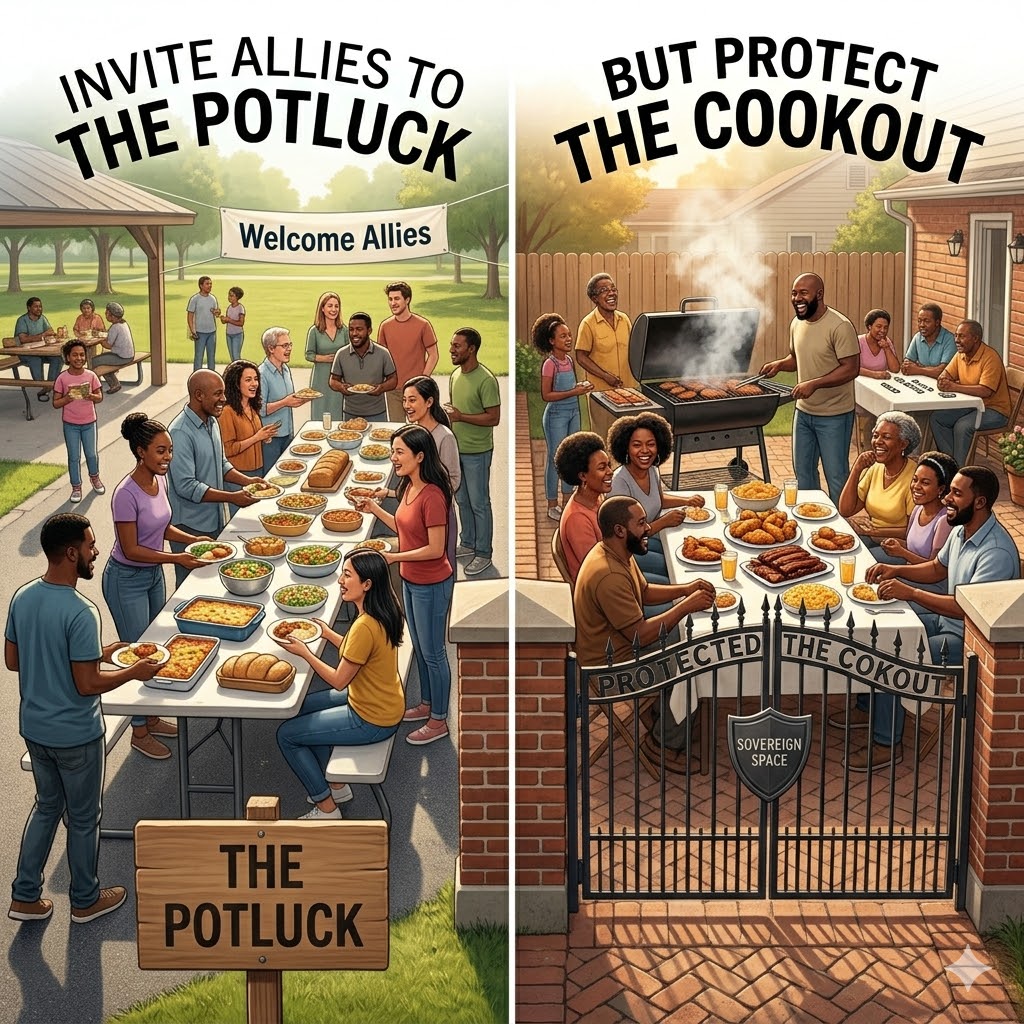
There is an old story, told in various forms across African American communities, about a family that learned to cook in secret. For generations, they had grown their own food, developed their own techniques, and built a kitchen that could feed a neighborhood. One day, a neighbor knocked on the door, drawn by the smell. They were welcomed in, fed generously, and they returned often. They brought friends. They praised the food. They called themselves part of the family. Eventually they began to suggest improvements to the kitchen — a different arrangement, a new appliance, a recipe adjusted for broader tastes. The family, grateful for the company, accommodated each request. By the time they looked up, the kitchen still stood. The neighbor’s name was on the deed. The family was still cooking. They just no longer owned the stove.
But generosity extended without institutional clarity is not community building. It is exposure. And the history of African American institutional life is, in no small part, a history of spaces built with collective sacrifice that were subsequently absorbed, diluted, defunded, or dismantled once their value became legible to the outside world.
The cookout, in other words, is not a metaphor. It is an asset. And assets require more than governance, they require protection. Not the passive protection of a community that hopes its institutions will be respected, but the active, disciplined defense of people who understand that what they have built has value precisely because others will seek to capture it. Protection, at the institutional level, is not always a defensive posture. Sometimes it means going on offense by organizing buying power before the crisis arrives, building legal capacity before the lawsuit is filed, funding Black media before the narrative is set by someone else. Communities that wait to protect what they have until after it is threatened are communities that spend their energy on recovery rather than accumulation. The history of Black Wall Street, of the Freedman’s Bank, of the systematic dismantling of Black-owned cooperatives during the mid-twentieth century is not a history of insufficient gratitude from the outside world. It is a history of insufficient institutional defense from within. The lesson is not to be less generous. It is to be better armed.
The analytical literature on Black wealth formation is consistent on a foundational point: communities that retain capital, talent, and institutional loyalty generate compounding returns across generations. Communities that allow those resources to migrate outward whether through spending patterns, marriage partners, talent pipelines, or cultural appropriation subsidize the wealth accumulation of others while undermining their own. The cookout dynamic maps directly onto this framework. When African American cultural production, social spaces, and institutional knowledge are shared without reciprocal investment, the result is a net transfer of value from Black institutions to non-Black ones. This is not a theoretical concern. It is the operating condition of the present economy.
Consider the structure of the music industry, where Black artists have generated the dominant commercial genres of the twentieth and twenty-first centuries — blues, jazz, rock and roll, hip-hop, R&B — while the majority of accumulated wealth from those genres has resided in non-Black-owned labels, distributors, publishing houses, and streaming platforms. Consider the food economy, where Black culinary traditions have been commodified into billion-dollar restaurant chains and packaged goods while the originators of those traditions remain systematically underbanked and undercapitalized. Consider the fashion and beauty industries, where aesthetics developed within African American communities command global markets while the infrastructure of those markets sits largely outside Black institutional ownership. In each case, the cultural product was welcomed. The economic architecture was not extended.
Allies who celebrate Black culture without supporting Black institutions are not allies in any operationally meaningful sense. They are consumers. The distinction is not semantic. An ally, by institutional definition, extends their power, capital, and access in support of an aligned party’s strategic objectives. A consumer extracts value from a community’s production without contributing to the institutional conditions that make that production possible. The presence of a non-Black person at the potluck enjoying the food, the music, the wit, the aesthetic while opposing or simply ignoring the policy conditions, banking relationships, and institutional investments that African American communities require to sustain themselves, is the profile of a consumer, not a coalition partner. They have not earned the potluck. They have certainly not been invited to the cookout.
This distinction becomes especially critical in the current political economy. Federal and state policy over the past several decades has systematically defunded or defanged the institutional infrastructure of Black America: HBCUs chronically underfunded relative to their peer institutions; Black-owned banks capitalized at a fraction of the levels needed to serve their communities; Black neighborhoods subject to environmental, housing, and educational policies that extract tax revenue while withholding proportional investment. In this context, cultural adjacency or rather the willingness to celebrate Juneteenth, consume Black media, or engage Black social vernacular is insufficient as an expression of solidarity. It may, in fact, function as cover for the absence of the structural commitments that matter.
The HBCU sector offers a particularly instructive case study. Historically Black Colleges and Universities were built precisely because African Americans were excluded from the educational institutions of their own country. They were not a gesture of separatism; they were an institutional response to exclusion. Over the course of the twentieth century, HBCUs produced a disproportionate share of the Black professional class, trained the majority of Black doctors, lawyers, engineers, and teachers of their generation, and served as incubators for the civil rights movement’s leadership and organizational capacity. They are, by any rigorous measure, among the most productive institutions in American higher education history relative to the resources they have been given.
Yet HBCUs now operate in a competitive landscape that rewards endowment size, federal research designation, and alumni giving rates; all measures that reflect historical access to capital rather than institutional quality or community impact. Predominantly white institutions that previously excluded Black students now recruit them aggressively, drawing talent and tuition revenue that would otherwise compound within the HBCU ecosystem. The language used to justify this recruitment is almost always the language of inclusion and opportunity. But inclusion in another institution’s ecosystem is not equivalent to investment in your own. A Black student who attends a well-resourced predominantly white institution may gain individual credentials. The HBCU they did not attend loses the tuition, the alumni relationship, endowment compounding, and the network density that transforms good universities into great ones.
This is not an argument against shared space. There are potlucks to which allies are genuinely welcome that inlcude moments of coalition, cross-cultural solidarity, and mutual investment where the presence of non-Black partners strengthens rather than dilutes collective purpose. But a potluck is not a cookout, and the distinction is not decorative. At a potluck, everyone brings something to the table. The host provides the space; the guests contribute to the meal. It is a transaction of mutual provision, and it works precisely because no one arrives empty-handed expecting to be fed. A cookout is different. A cookout is the community’s own table that is prepared by Black hands, funded by Black resources, held in Black space, for Black people. Its purpose is not coalition. Its purpose is sustenance, honesty, and the particular freedom that only comes when a people can speak plainly among themselves without managing anyone else’s comfort. Both gatherings have their place. They are not interchangeable, and confusing one for the other is how communities lose the only space that was ever entirely their own.
What African American institutional life requires is a clear distinction between spaces of engagement and spaces of sovereignty. Spaces of engagement are where coalitions are built, where allies demonstrate reciprocity, where the community interfaces with the broader economy and polity on its own terms. Spaces of sovereignty are where Black families and communities convene among themselves to assess the wealth gap without softening the diagnosis, to discuss the particular pressures facing Black women and Black men without moderating the conversation for outside sensibilities, to make strategic decisions about institutional investment and political alignment without the distortion that comes from managing the reactions of those who do not share the same structural position. Both kinds of space are necessary. Only one of them is currently treated as optional.
What does that governance structure look like in practice? It looks like HBCU alumni choosing, as a default rather than an afterthought, to bank with Black-owned financial institutions the Liberty Banks, the OneUnited Banks, the First Independence Banks rather than routing deposits to institutions that do not reinvest proportionally in Black communities. It looks like Black professionals who have achieved positions of institutional authority actively directing contracts, investment mandates, and philanthropic dollars toward Black-owned firms and HBCU vendors rather than defaulting to the institutional relationships they inherited. It looks like African American civic organizations insisting on quantifiable reciprocity as a condition of coalition not cultural appreciation, not rhetorical solidarity, but measurable investment.
There is a separate and equally important argument that must be made here, because it is the one most frequently obscured by well-intentioned framing: inclusion is not ownership. Even in the most favorable version of the ally relationship where non-Black partners, institutions, and individuals are genuinely committed to diversity, sincerely supportive of Black participation, and actively working to open doors none of that changes the structural necessity of Black-owned institutions. Inclusion operates within someone else’s architecture. Ownership builds your own.
This distinction is not abstract. It has a balance sheet. When a Black professional is included in a non-Black-owned firm, their labor generates returns that compound within that firm’s ownership structure and those are returns that flow to shareholders, partners, and stakeholders who are, in the aggregate, not Black. The professional may advance. They may be compensated well. They may even occupy positions of genuine authority. But the wealth generated by their inclusion does not build Black institutional capital; it builds the institution that included them. Inclusion, at scale, is a mechanism by which Black talent subsidizes non-Black institutional growth. It is not a substitute for ownership. It is, in many cases, its alternative.
The same logic applies to HBCUs operating in a landscape of ostensibly inclusive predominantly white institutions. The argument made against HBCU investment that the best Black students should simply attend the best-resourced universities, wherever those happen to be is structurally an argument against Black institutional ownership in higher education. It accepts inclusion as a terminal condition rather than a transitional one. A Black student included at Harvard is not the same institutional fact as Harvard-level resources flowing into an HBCU. One is a credential extended to an individual. The other is capacity built within a community-owned institution that will outlast any single student and compound across generations.
Ownership is also the only form of institutional participation that is durable against shifts in political will. Inclusion depends on the continued goodwill of those doing the including. When political climates shift, when diversity commitments are deprioritized, when administration changes, when economic contractions force budget realignments the “included” are the first to absorb the cost. Ownership is not subject to another party’s goodwill. A Black-owned bank does not require a non-Black institution to remain committed to serving Black depositors. A Black-owned media organization does not require a conglomerate’s editorial patience. An HBCU does not require a predominantly white institution to remain interested in Black academic excellence. Ownership is the only form of institutional security that does not expire when someone else’s priorities change.
This is why the recent assault on diversity, equity, and inclusion programs in American corporations and universities however dismaying as a political signal is not the fundamental crisis for African American institutional life that it is sometimes framed as being. The fundamental crisis predates the DEI rollback and will outlast its reversal. It is the historical condition of a community that has been systematically excluded from ownership while being selectively included in participation. DEI programs, at their most effective, opened doors into institutions that someone else owned. Their elimination forecloses that access. But their presence never resolved the ownership question. The community that owns nothing is equally vulnerable in both eras, it simply has a longer walk to the door in one of them.
The same analytical framework applies to an institution that is rarely named as such in discussions of Black economic strategy: the Black family. The family unit is not a private matter sealed off from institutional analysis. It is the primary site of intergenerational wealth transfer, the first school of civic and financial literacy, and the foundational node in any network of community institutional density. How the Black family is formed, sustained, and oriented toward community investment is therefore a question of institutional consequence, not merely personal preference.
This makes the question of interracial partnership and specifically, the assumptions that sometimes travel with it a legitimate subject of institutional inquiry. The concern here is not interracial partnership as such. It is the set of ideological commitments that non-Black partners sometimes bring into Black family formation, and what those commitments mean for the community institutions that depend on family-level investment and loyalty to survive.
A non-Black person who partners with a Black man or woman has not, by virtue of that partnership, demonstrated any commitment to African American institutional empowerment. The relationship is personal. The institutional question is separate, and it must be asked separately. Does this person bank at Black-owned financial institutions? Do they support HBCU attendance, alumni giving, and network loyalty as a family value? Do they understand that the wealth gap their Black partner navigates is not an abstraction but a structural condition reproduced through specific policy and capital allocation decisions and that their own family’s economic choices either mitigate or compound that condition? Personal love does not answer institutional questions. Only institutional behavior does.
The specific case of non-Black women partnered with Black men warrants direct analysis, because it intersects with a set of structural realities that the colorblind framework is particularly ill-equipped to see. Black women in America face a documented and compounding disadvantage in the partner market, a disadvantage produced not by individual preference alone but by the structural devaluation of Black femininity in American cultural and economic life, by the incarceration and early mortality rates that reduce the available pool of Black men, and by media and social ecosystems that actively hierarchize desirability along racial lines. These are not grievances. They are measurable structural conditions with identifiable institutional causes.
Non-Black women who partner with Black men enter this landscape with structural advantages they did not earn and, in the colorblind framework, are not required to acknowledge. The colorblind framework of “we are the world,” love is love, race doesn’t matter to me functions in this context not as enlightenment but as insulation from accountability. It allows a person to benefit from the aesthetics and community of Blackness, to be welcomed into Black family life and Black social space, while remaining ideologically committed to a universalism that forecloses any obligation to the specific institutional needs of the community whose door they have entered. The distinction between a potluck and a cookout becomes precise here: they have been given a seat at the table of coalition, but they have wandered into the cookout consuming its warmth, its honesty, its intimacy without ever acknowledging who built the table or accepting any obligation to help it stand.
This matters institutionally because family formation is where ideology meets capital allocation. A household in which one partner is oriented toward Black institutional investment and one is oriented toward a colorblind universalism that treats all institutions as equivalent is a household with a structural conflict embedded in its financial decisions. Where will their children attend college? Which financial institutions will hold their savings? Which civic organizations will receive their philanthropic commitments? Which political candidates and policy frameworks will they support? These are not questions that love resolves. They are questions that ideology answers and the colorblind ideology consistently answers them in ways that route resources away from the Black institutional ecosystem and toward the universal one, which in practice means the mainstream one, which in practice means the predominantly non-Black one.
The institution of the Black family, therefore, must be understood as requiring the same institutional clarity as any other node in the African American ecosystem. Welcoming a non-Black partner into Black family life is not categorically different from inviting a non-Black guest to the potluck. In both cases, the question is not the warmth of the welcome. The question is whether the guest understands what was built, what it cost, and what it requires to survive and whether they comprehend that the cookout, the sovereign space, the honest table, was never theirs to enter simply because they were loved by someone who belonged there. Structural advantages do not disappear because they are unacknowledged. They accumulate. And a household ideology that refuses to see those advantages and to accept the institutional obligations they create is not a neutral position. It is a position that benefits from Black institutional labor while declining to contribute to it.
It also looks like intellectual clarity about co-optation, which is the more subtle and in many ways more consequential threat to Black institutional space. Co-optation does not require hostility. It requires only that a framework, a concept, a methodology, or a space developed with Black intellectual labor and institutional capital be adopted and repackaged by actors who do not acknowledge its origin, do not direct resources back to its source, and do not bear the institutional costs that made its development possible. This happens in academia, where Black Studies frameworks migrate into mainstream curricula without corresponding investment in Black Studies departments. It happens in corporate diversity programs, where the conceptual vocabulary of African American equity movements is deployed in the service of institutional reputation management rather than structural change. It happens in media, where Black cultural aesthetics are packaged for mass consumption while Black-owned media organizations operate on fractional budgets.
The question facing African American institutional leadership is not whether to engage with the broader economy and polity of course it must. The question is on what terms. Engagement without institutional conditions is simply absorption. The HBCU sector, the network of Black-owned banks and CDFIs, the ecosystem of Black professional associations and civic organizations, the tradition of Black media, these are not relics of a segregated past. They are the institutional architecture of a future in which African Americans participate in American (and global) economic and political life from a position of institutional strength rather than perpetual dependency.
That institutional architecture does not sustain itself through cultural warmth. It sustains itself through capital, coordination, and the disciplined exercise of institutional loyalty. The potluck can be generous and it should be, because coalition requires genuine exchange. But the cookout is not the potluck. The cookout is where the community gathers to be honest with itself, to protect what it has built, and to plan for what it still must build. Allies are welcome at the potluck when they bring something real. The cookout is not their invitation to extend.
The fire is on. The food is ready. But the table was built by people who had no other table to go to. That history is not decoration. It is the deed.
Disclaimer: This article was assisted by Claude AI.