Category Archives: Economics

The Income Gap Beneath the Aesthetic: Why African American Lifestyle Aspirations Outpace Economic Reality

Imagine a family that built a house. Not inherited it, not stumbled into it but built it, board by board, through discipline, ingenuity, and collective sacrifice. The house was real. It had rooms filled with furniture, a business on the corner, a bank down the street, a school nearby. The neighborhood thrived because the institutions within it were strong and self-reinforcing. Then the neighbors burned it down. Not metaphorically — burned it down, seized the land, rewrote the deed, and walked away with the tools. This happened not once but repeatedly, across generations and geographies, through legal architecture and extralegal violence alike. The family’s anger is entirely justified. The theft was real. The arson was documented. The loss was total and the perpetrators largely unaccountable.

But the house still needs to be rebuilt.

And here is the hard truth that justified anger cannot dissolve: the rebuilding requires the same discipline, ingenuity, and collective sacrifice as the original construction perhaps more, because this time it must be built with proper defenses. Stronger foundations. Diversified income streams. Institutions designed to survive hostility rather than assume good faith. The family cannot afford to rest in the rubble and call it protest. It cannot furnish an unbuilt house with aspirational spending and call it progress. The grief is legitimate. The rage is warranted. But neither grief nor rage lays a single board. The house demands builders, and builders before they can rest, must first build.

There is a structural mismatch at the center of African American economic life that rarely receives the frank, quantitative examination it deserves. The cultural aspiration toward comfort, leisure, and luxury, a posture increasingly celebrated under the banner of the “soft life” has emerged with real force and not without moral legitimacy. The desire to rest, to be unburdened, to live well is a reasonable human aspiration, and for Black women in particular it carries the weight of generations of overextension. But aspiration untethered from income architecture is not a lifestyle strategy it is a financial liability. And the numbers, examined without sentiment, make the case plainly: African American household income does not currently support the consumption patterns and life expectations that have come to dominate the cultural conversation.

This is not a moral indictment. It is a structural diagnosis. The soft life is not wrong. The economics are simply not there yet.

The median weekly earnings for Black full-time workers in the first quarter of 2024 stood at $908 compared to $1,157 for White workers and $1,505 for Asian workers. Annualized, this places median Black worker earnings at approximately $47,200. The median household income for African Americans reached $56,020 in 2024, compared to a national average household income of $83,810 and a White household average of $124,500. Some 61.8% of African American households earn less than $75,000 annually, and only 27% of Black households exceed $100,000 in income, a threshold that 46.8% of White households surpass. These are not marginal differences. They are structural chasms that determine what households can afford to save, invest, and build.

The income gap is not merely a matter of aggregate shortfall. It is a function of occupational concentration. African Americans remain dramatically underrepresented in the highest-earning career categories: STEM-based science and engineering, investment finance, business ownership at scale, and the upper tiers of corporate management. In 2021, Black or African American workers in science and engineering occupations had median earnings of $59,800, the lowest among racial and ethnic groups tracked, compared to $107,900 for Asian workers in the same fields. The salary premium that STEM careers offer over non-STEM work exists for Black workers, but the participation rate limits how broadly that premium reaches across the community. Nearly 58% of Black or African American workers are employed outside of science, engineering, or STEM-related areas entirely.

The gender dimension of this problem is frequently misread. African American women have achieved meaningful gains in labor force participation and educational attainment, outpacing Black men in college enrollment by a substantial margin. But participation rates and credential accumulation have not translated into equivalent entry into high-compensation fields. Black women are heavily represented in management roles, the service industry, sales, and office occupations — sectors characterized by modest wage ceilings and limited equity upside. Black women’s median weekly earnings of $887 represent 85.3% of White women’s earnings of $1,040 — a gap that, while narrower than the male-to-male disparity, still accumulates into meaningful lifetime income deficits. More critically, neither the occupational profile of Black men nor that of Black women places either group in proximity to the financial services, technology entrepreneurship, or ownership-class economics that generate the kind of income and wealth capable of sustaining the consumption expectations that aspirational culture projects.

There is, however, a dimension of the income problem that earned wages alone cannot fully illuminate, and it may be the most telling of all: passive income. Wealth that works while one sleeps through dividends, rental income, business distributions, and interest is not a luxury feature of the financial system. It is the mechanism by which all other wealth gaps compound and perpetuate. Only 7% of Black households report receiving passive income from sources such as rental properties, interest, dividends, or business ownership compared to 24% of White households. And when such income does exist, the median amount for Black families is approximately $2,000 annually, compared to nearly $5,000 for White households. This is not a secondary observation. It is the statistical signature of a community almost entirely excluded from the capital class — the tier of economic life where money generates more money without additional labor.

The implications of that exclusion are severe. Black households rely more heavily on wages and salaries rather than passive income streams, and without accumulated wealth or financial investments, it becomes harder to transition from relying solely on wages to generating income passively. The debt burden compounds this further: Black households tend to carry higher levels of student loan debt relative to income, which reduces the disposable income that could otherwise be directed toward wealth-generating assets. This is the trap in precise structural terms: earned income is consumed servicing debt, leaving no surplus to convert into the asset base that generates passive returns. Each month begins at zero. Each generation inherits the same constraint. The soft life as aspiration sits atop this architecture and finds no foundation.

The consequence of this occupational and income reality extends further into household formation. The marriage rate among African Americans has fallen from approximately 60% in the 1960s to just 29% in 2021. This matters economically in ways that exceed the social commentary often surrounding it. Black married couples had a median net worth of $131,000 in 2019, compared to only $29,000 for Black single individuals — a gap of roughly three to four times. The dual-income household is not merely a social arrangement; it is a capital formation mechanism. Two modest incomes, pooled and directed strategically, can accomplish what a single income, however aspirationally deployed, cannot. When household formation rates decline, the financial unit of account shrinks. The result is not simply less comfort it is structurally constrained savings capacity, reduced homeownership rates, diminished retirement security, and negligible investable surplus.

This brings the soft-life discourse into direct collision with economic arithmetic. The soft life, as a cultural concept, carries entirely legitimate roots. The desire to step back from overextension is not irrational; it is self-preserving. But the aspiration as it has been culturally operationalized — emphasizing travel, luxury goods, minimal work, and premium consumption — requires an income infrastructure that the median African American household does not possess. The soft life as an aesthetic has spread across a community where, the median Black household holds just $44,100 in net worth compared to $284,310 for White households or roughly 15 cents for every dollar White households possess. The median Black household has only $2,200 in checking and savings accounts, approximately a fifth of what White households hold. Aspirational consumption layered over that wealth foundation does not produce liberation. It produces debt.

Consumer credit among African American households climbed to $740 billion in 2024, representing nearly 48% of all African American household liabilities and growing at more than double the rate of asset appreciation. The shift toward unsecured, high-interest borrowing to fund present consumption represents the structural outcome of a community whose income and wealth positions do not support the lifestyles being pursued. With African American-owned banks holding just $6.4 billion in combined assets, the vast majority of that $1.55 trillion in household liabilities flows to institutions outside the community meaning that interest payments, fees, and the wealth-building potential of lending relationships are being systematically extracted from the Black institutional ecosystem. The community is not simply spending beyond its means; it is doing so in a way that enriches external financial institutions rather than its own.

The comparison with other groups is instructive precisely because it is structural, not cultural. Households that have accumulated generational wealth, that inherit homes rather than rent them, that receive family capital for business formation or down payments, that can distribute housing costs across extended family networks, or that have parents who absorb the student debt burden — those households operate from a fundamentally different economic baseline. The aspiration toward leisure and comfort that is financially reasonable for households with $284,000 in net worth, with 24% receiving passive income, is not the same proposition for households with $44,000 in net worth, with $26,000 in student loan debt, and fewer than one in ten receiving any passive income whatsoever. This is not a commentary on character. It is a commentary on compound arithmetic.

The three missing pillars; high-income career concentration, passive income streams, and wealth-building household formation, reinforce one another in ways that make each individually insufficient to close the gap. High earned income without passive income accumulation remains treadmill economics: impressive in the short run, exhausting across a lifetime, and non-transferable across generations. Passive income without the earned income base to seed initial investments is equally out of reach for most households. And both are more difficult to build and sustain outside of the two-income, asset-pooling household structure that marriage has historically provided. The causality runs in a specific direction: institutional infrastructure creates the conditions for sustainable individual and collective wealth building, not the other way around. But at the household level, the sequencing is equally specific where earned income must first be directed toward asset acquisition rather than consumption, and those assets must be allowed to compound before comfort becomes the organizing principle of financial life.

What the data demand is a recalibration of collective strategy, beginning with income generation at the individual level and extending upward through institutional infrastructure. The income problem is real and addressable, but it requires African Americans — men and women alike — to direct educational and career investments toward the highest-compensation fields in the economy: engineering, software development, quantitative finance, medicine, law at the partnership track, and scalable business ownership. The wage premium of STEM occupations over non-STEM work stands at roughly $19,100 per year even at the median. But earned income must be understood as the raw material for wealth, not the destination. The destination is an asset base generating passive returns — the condition that makes rest not just emotionally justified but financially sustainable.

The institutional dimension cannot be separated from either the income or the passive income dimension. If approximately 95% of African American debt is held by non-Black institutions, and that debt carries an average interest rate of 8%, African American households collectively transfer roughly $120 billion annually in interest payments to institutions with no vested interest in Black wealth creation. That capital hemorrhage occurs upstream of any lifestyle decision. It is the structural tax imposed by institutional absence, the cost of lacking the banking, investment, and insurance infrastructure to retain and recirculate capital within the community. The passive income gap is not only a personal finance failure; it is the individual-level expression of institutional underdevelopment. Communities that have strong banks, investment firms, and cooperative capital structures create the conditions in which their members can access investment vehicles, receive competitive lending terms, and build the asset portfolios that generate passive returns. Those institutions do not yet exist at adequate scale for African America.

The soft life is a worthy destination. But destinations require roads, and roads require investment. The African American community is not yet at a place; economically, institutionally, or in terms of income concentration in high-value careers and asset-generating passive income streams, where widespread leisure is the financially rational near-term posture. The pragmatic path forward involves strategic sacrifice now: of time, of consumption, of immediate comfort, in exchange for the capital, credentials, and institutional infrastructure that make genuine ease sustainable across a generation and transferable to the next. Every dollar directed toward an index fund rather than a luxury purchase, every professional credential pursued in a high-compensation field, every household formed that pools two incomes toward asset acquisition rather than consumer spending — these are not acts of deprivation. They are acts of institution-building at the individual scale. And they are the precondition for the rest that so many in this community have, entirely reasonably, been waiting a very long time to claim.

That is the harder conversation. It is also the more honest one.

Disclaimer: This article was assisted by Claude AI.

“You’re Not Even Looking at the Problem”: Why African America Is Losing the Game of Wealth & Power

“Talent without institutions is a pipeline to someone else’s profit.” – William A. Foster, IV

In a pivotal scene from the film Moneyball, Billy Beane stares across the table at a room of seasoned scouts and executives, asking again and again, “What’s the problem?” The men fumble for surface-level answers—lost players, declining performance, tight budgets—but Beane cuts through the noise with surgical precision: “You’re not even looking at the problem.” His frustration isn’t simply about baseball; it’s about the failure to reframe strategy in the face of structural disadvantages. It’s about institutions mistaking symptoms for causes.

That same failure of vision and the urgent need for a paradigm shift applies not just to baseball, but to African America’s quest for economic power, institutional wealth, and self-determined sovereignty.

African America’s greatest minds, labor, and capital are often deployed outside of African American institutions. In essence, the community is fielding players, but not for its own teams. Valedictorians enroll at predominantly white institutions. Brilliant entrepreneurs pitch to Silicon Valley venture capitalists. Top athletes build billion-dollar empires for Nike, not Actively Black. The irony is that African America is not talent-poor. It is institution-poor. And that distinction is everything.

The most misunderstood problem in African American wealth-building discourse is not the racial wealth gap, it is the institutional wealth gap. African America commands over $1.6 trillion in consumer spending power annually, yet circulates less than 2% of that inside its own institutions before it exits the community entirely. Compare this to Jewish Americans, who circulate an estimated 8 to 12 times within their institutional networks, or East Asian Americans at 6 to 12 times, or even Latino Americans at 4 to 6. The velocity of African American economic energy leaves almost immediately. Another financial literacy seminar cannot fix this. What is required are financial institutions that keep wealth anchored in the community and institution-to-institution cooperation that builds collective power rather than isolated individual net worth.

Much like Billy Beane confronting baseball’s scouting orthodoxy, African America must confront its deep obsession with prestige, particularly the pursuit of inclusion in institutions that were never designed for its empowerment. The community still celebrates when African Americans “break barriers” into historically exclusive spaces: the first Black partner at a global law firm, the first Black president of an Ivy League university, the first Black billionaire appointed to a PWI board. These are symbolic gestures, not systemic gains. They are the equivalent of drafting a slugger with a high batting average while ignoring his low on-base percentage. It may photograph well, but it does not win championships.

Meanwhile, African American institutions like HBCUs, Black-owned banks, credit unions, media companies, foundations remain undercapitalized and under-circulated. According to FDIC data, African American banks account for less than 0.03% of the U.S. banking system’s total assets, despite serving millions of customers. Most carry assets under $500 million, while PNC, JPMorgan Chase, and Bank of America each hold hundreds of billions in Black consumer deposits alone. The community is putting elite players on the field just not on its own team.

One of the most damaging consequences of the post-civil rights integration era has been the illusion of proximity to power. Inclusion into dominant systems has led many African Americans to feel they are participating in the architecture of power, when in reality they are consumers of it, not owners. The institutions that determine economic direction in this country like investment firms, insurance conglomerates, think tanks, and lobbying organizations remain largely absent African American leadership at the structural level. While the public fixates on celebrity billionaires, it rarely accounts for institutional billionaires: universities with $40 billion endowments, banks with $3 trillion balance sheets, pension funds managing hundreds of billions in assets. Harvard University’s endowment, at roughly $50 billion, generates more annual passive income than the top 20 HBCUs combined in operating budgets. The Ivy League is not competing with African America. It operates on an entirely different playing field.

The data makes the scale of the gap unmistakable. As of 2022, the median net worth of a white household exceeded $188,000. For African American households, the figure was $24,100. But the institutional gap is even more stark. The top 10 predominantly white universities hold over $200 billion in combined endowments. The top 10 HBCUs hold less than $3 billion combined. In the philanthropic sector, the contrast is equally severe: the Gates Foundation manages nearly $8 billion in annual revenue and over $80 billion in assets. Meanwhile, even foundations attached to African American billionaires often operate at a fraction of that capacity. When African Americans are high earners individually, they frequently exist within ecosystems of institutional fragility—fragile schools, fragile banks, fragile civic organizations. This fragility makes individual wealth vulnerable, disperses influence, and mutes policy impact. The community continues to negotiate from positions of dependence.

The strongest ethnic and national economies do not simply focus on internal wealth generation, they construct infrastructure for internal circulation and cooperation. That means Black-owned banks financing Black developers. HBCUs recruiting faculty trained at other HBCUs rather than defaulting to PWI pipelines. Black foundations endowing Black hospitals, think tanks, and research centers. Black technology firms building hiring relationships with HBCU STEM programs. Black media outlets directing advertising budgets toward Black-owned businesses rather than relying on revenue from Google and Pepsi. Currently, this kind of circulation is sporadic and disorganized. Too often, African American institutions function as isolated islands, each struggling independently in a competitive environment that rewards scale and coordination. What is needed is a federation mindset of institutions operating in genuine symbiosis, where growth is strategic rather than accidental. Consider the compounding effect if every HBCU committed 20% of its endowment to Black-owned financial institutions, or if every African American megachurch directed 10% of its annual budget toward a Black-owned insurance provider. These institution-to-institution agreements would create forms of institutional wealth that accumulate quietly but with enormous strategic consequence.

Billy Beane’s genius in Moneyball was not merely contrarianism. It was data literacy. He saw what others refused to acknowledge: that reaching base was more valuable than batting average, and that the traditional metrics of scouting obscured the actual drivers of winning. African America must apply the same discipline to its institutional life. That requires building institutional balance sheets that honestly account for asset and liability structures; capital flow maps that trace where African American money goes after it is earned; circulation velocity metrics that measure how many times a dollar moves among Black institutions before exiting; and influence indexes that evaluate which African American institutions actually shape policy, capital markets, and media narratives. Without that data infrastructure, the community will continue to feel prosperous in moments while remaining fragile in structure and celebrating the anecdote while missing the trend.

Talent allocation is the other dimension of the problem that demands a strategic reframe. Just as the scouts in Moneyball chased big names and home run statistics, African American institutions often pursue talent without connecting it to long-term institutional strategy. Celebrity partnerships, honorary degrees, and gala appearances generate visibility but rarely feed institutional growth. A Tuskegee graduate built the foundations of American agricultural science. But talent, without institutions to give it depth, direction, and deployment, is ultimately portable. It gets recruited away, diluted, or co-opted. The community does not simply need more talented individuals. It needs to scout differently, train differently, and deploy those individuals in ways that compound institutional strength rather than individual achievement.

The question of narrative control is inseparable from the question of institutional power. Of the top twenty media companies in the United States, none are Black-owned. Most African American narratives in news, entertainment, and advertising are filtered through non-Black ownership and editorial priorities. This means political discourse is easily hijacked, cultural capital is regularly commodified without equity stakes, and social movements are routinely defanged by outside interests with different agendas. Reclaiming narrative sovereignty requires sustained investment in Black-owned media, particularly digital platforms and local investigative journalism. More critically, it requires routing advertising dollars toward Black media institutions rather than treating them as secondary channels. Even the most incisive voices will remain echoes if they are amplified through someone else’s infrastructure.

The genius of Billy Beane was not discovering undervalued players, it was reframing the entire game. African America has been operating under a set of assumptions that no longer serve its institutional interests, if they ever did. It has been trying to win with outdated tactics, sentimental strategies, and a persistent belief that the core problem is individual rather than structural. Fighting racism is necessary but insufficient. Engineering sovereignty is the work. That begins with an honest diagnosis: African America is building talent for other people’s institutions. It is celebrating inclusion while surrendering control. It is mistaking prestige for ownership. And it continues to treat the gap as primarily personal when the evidence points overwhelmingly to institutional causes.

“You’re not even looking at the problem,” Beane said.

It is past time to look.

Disclaimer: This article was assisted by ClaudeAI.

City & Police Budgets: Are They Prepared For The Era Of The Driverless Car?

“The only way you survive is you continuously transform into something else. It’s this idea of continuous transformation that makes you an innovation company.” – Ginni Rometty

By William A. Foster, IV

Anyone who knows me intimately knows I have been pulled over a lot in my lifetime. In my first month after transferring into Virginia State University, I was pulled over five times by the local police. I have probably paid enough in fines and court costs to fund a full-ride scholarship at many HBCUs.

Instead, I—like many African Americans (disproportionately speaking) and Americans in general—was paying into what amounts to a shadow tax system. This system is fueled not by income or property, but by police-issued traffic tickets. It’s a pay-as-you-go model for civic participation, enforced with red-and-blue lights. And while traffic violations serve a nominal safety purpose, they also feed the operational budgets of thousands of city governments and police departments across the United States.

This framework—an unspoken pact between public safety enforcement and municipal finance—is now facing an existential threat. The advent of autonomous vehicles, or AVs, promises to upend not just transportation norms, but the budgetary bedrock of American cities. And yet, amid the techno-optimism of AVs, one question remains startlingly unexamined: if machines no longer speed, run red lights, or roll through stop signs, who—or what—will fund the municipal revenue streams that traffic enforcement has long propped up?

The Traffic Ticket Economy

To understand the fiscal cliff approaching, it’s necessary to acknowledge just how embedded traffic tickets are in city and police budgets. A 2019 report by Governing Magazine found that nearly 600 jurisdictions across the United States relied on fines and fees for at least 10% of their general fund revenues. In 80 of those towns, fines and fees made up more than 50% of revenue. These places, like Calverton Park, Missouri, and Henderson, Louisiana, have built entire municipal ecosystems around traffic enforcement.

For many cities, especially those with shrinking tax bases or limited industry, traffic fines are a predictable stream of cash. The relationship between enforcement and revenue becomes so intertwined that police departments may face pressure explicit or implied to issue a certain number of citations. While quotas are technically illegal in many states, anecdotal and whistleblower reports have revealed otherwise.

For marginalized communities, the burden is not merely financial but psychological and systemic. A 2015 Department of Justice investigation into Ferguson, Missouri, revealed how ticketing became a weaponized form of racial control, with Black residents disproportionately stopped, cited, and incarcerated for minor traffic infractions. Thus, traffic enforcement has become more than a tool for safety it’s become a fiscal engine, a behavioral control mechanism, and a lightning rod for racial and economic justice debates.

Enter the Driverless Car

Autonomous vehicles promise to revolutionize mobility. Tech firms like Waymo, Tesla, Cruise, and Apple are jockeying to commercialize a future where cars operate without human drivers. Proponents point to fewer accidents, faster commutes, and more accessible transportation options for people with disabilities or the elderly. But AVs also promise near-perfect compliance with traffic laws. They don’t speed. They don’t drive drunk. They don’t fail to signal or get distracted by cell phones. That’s great for public safety and a death knell for traffic citation revenue.

A 2018 analysis by the Eno Center for Transportation found that AVs could eventually eliminate up to 90% of traffic-related tickets. Another study by the University of Texas estimated that driverless vehicles could reduce annual ticketing revenue by $4 billion nationally. These projections don’t even include the indirect financial losses from towing, impound fees, court costs, and driver education programs—services that exist largely to correct human error.

The Quiet Fiscal Crisis Ahead

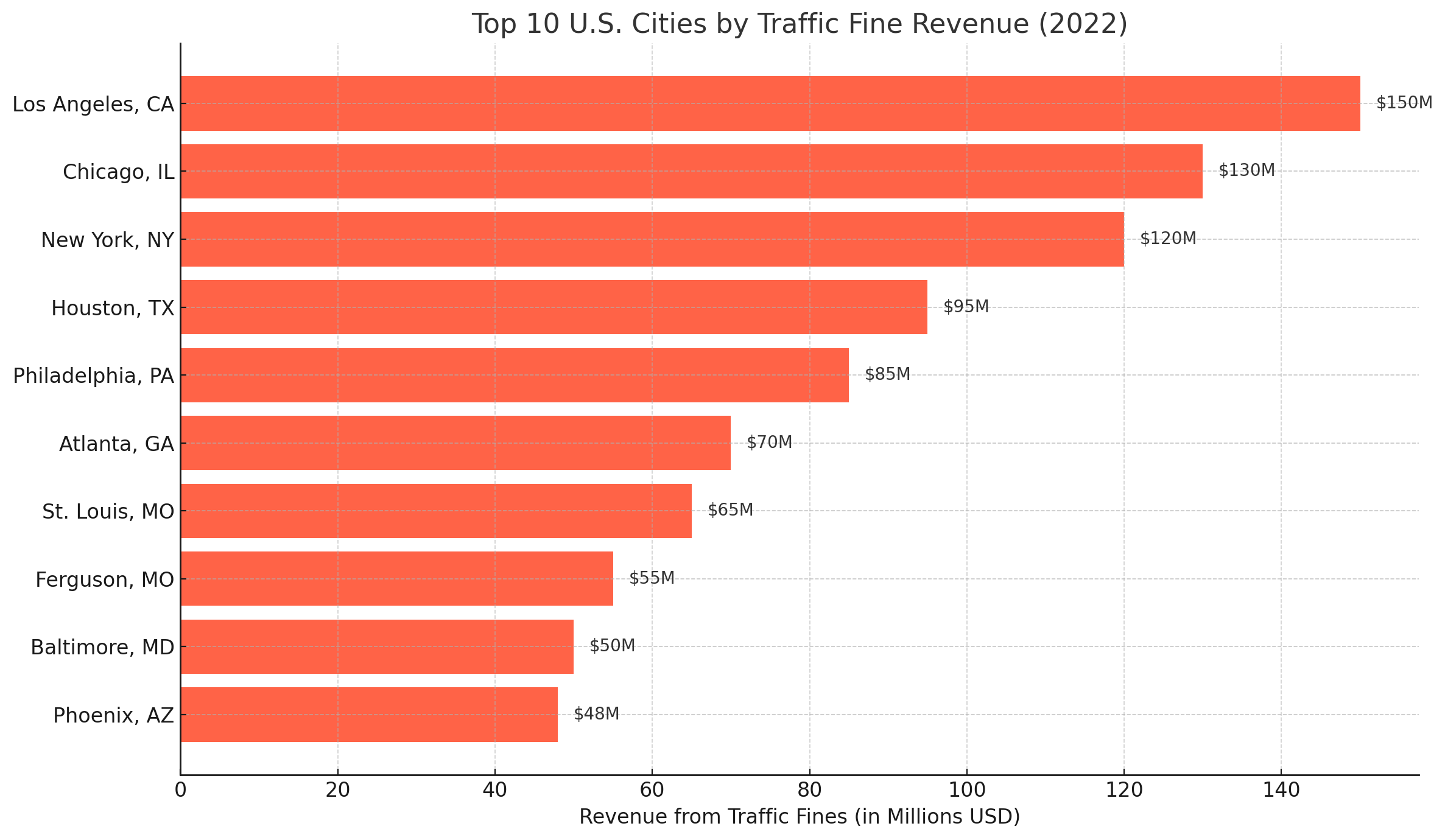
For cities, this shift is not theoretical it’s fiscal. In a 2020 audit of San Francisco’s finances, officials warned that AV adoption could cut traffic fine revenues by 50% by 2040. In Los Angeles, ticketing generates over $150 million annually. If AVs wipe out even half of that, the city will need to either cut services or find new revenue sources. The pressure is particularly acute for small towns and municipalities that have used traffic enforcement as an economic development tool, often targeting out-of-town drivers on underposted speed traps. The loss of such income may mean layoffs for police departments, library closures, deferred maintenance, or higher property taxes. The irony is striking: a technology designed to increase safety could force cities into fiscal austerity or into finding new ways to extract revenue from increasingly law-abiding machine operators.

Policing Without Pullovers

There’s another dimension to consider: the very nature of policing may change. Much of modern American policing revolves around vehicle stops, which serve not just to enforce traffic laws, but to search for drugs, guns, warrants, and more. According to the Stanford Open Policing Project, police make over 50,000 traffic stops per day in the U.S. AVs could eliminate this cornerstone of law enforcement’s engagement with the public.

In some quarters, this is welcome news. Advocates for criminal justice reform argue that fewer stops could mean fewer racially charged confrontations, fewer unnecessary arrests, and fewer deaths. But for departments whose mission and staffing are oriented around vehicle enforcement, this creates an identity crisis.

Moreover, will police departments respond to the fiscal void by doubling down on other kinds of fines and citations—jaywalking, bicycle violations, loitering—or increasing their reliance on civil asset forfeiture, a deeply controversial practice?

The Race and Class Implications

It is critical to understand that traffic enforcement in America does not occur in a vacuum—it is deeply racialized and class-based. Poorer residents and communities of color are more likely to be pulled over, more likely to be unable to pay, and more likely to face compounded legal trouble from unpaid fines.

With AVs, which will initially be expensive and likely concentrated in wealthier areas, there’s a real risk of a dual system emerging. Rich neighborhoods may become AV utopias with safe, citation-free transport, while poorer areas continue to face heavy-handed traffic enforcement until legacy vehicles are phased out. The timeline for AV adoption may therefore exacerbate existing inequalities rather than resolve them.

Moreover, if cities try to recoup lost revenue through flat fees or usage taxes, they must be mindful of regressivity. A flat AV tax would hit lower-income users harder, even as they adopt older or shared AV technology.

The Urban Planning Ripple Effects

The decline of ticketing is only one part of the municipal financial picture AVs threaten to redraw. Consider the broader impact on urban planning and budgets: fewer accidents mean less need for emergency services, fewer parking tickets reduce municipal court dockets, fewer DUIs lessen jail populations.

This could be a moment for reallocation, not just resignation. Cities might seize the transition to AVs as an opportunity to rethink public space, reinvest savings from emergency responses into social programs, or pivot their budgetary dependencies away from punitive revenue altogether.

But it requires planning. Today, very few city budget blueprints forecast for an AV future. The conversation is dominated by curb space management, rideshare integration, and data privacy—but not budget reform. That’s a mistake.

Solutions & Proactive Policy

So, what can cities do to prepare?

  1. Revenue Diversification
    Cities must transition away from fine-heavy fiscal models. This may mean more progressive taxation, congestion pricing, or taxing the AV platforms themselves. For instance, Chicago already taxes ride-hailing services and allocates a portion toward public transit.
  2. Equity in AV Deployment
    Cities must ensure that AV benefits don’t accrue only to the wealthy. Requiring AV companies to operate in low-income neighborhoods, share data with city planners, and contribute to mobility justice funds could ensure more inclusive outcomes.
  3. Policing Reform
    As traffic stops decline, cities can reassign officers to community service roles, behavioral crisis teams, or investigative units. AVs could accelerate the conversation on demilitarizing the police and moving toward public safety models that are less reliant on confrontation.
  4. Participatory Budgeting
    Cities should engage residents directly in conversations about how budgets are shaped, especially when long-standing revenue streams (like traffic fines) begin to disappear. Participatory budgeting can align spending with community values rather than institutional inertia.
  5. AV Fee Structures
    Some cities may introduce per-mile AV taxes or vehicle occupancy incentives. If structured well, these can offset lost ticket revenue while promoting sustainable transport behavior.
  6. State-Level Oversight
    In many states, traffic fine revenue is capped or partially redirected. Legislatures could intervene to mandate revenue neutrality, preventing cities from replacing one predatory revenue model with another.

The Way Forward

As with many shifts in technology, the arrival of AVs has triggered excitement about safety, efficiency, and innovation. But few are sounding the alarm about what is lost—especially for cities and police departments whose fiscal models were quietly built on human error and punishment.

That’s not to say traffic enforcement should be mourned. For many, it has been more punitive than protective, a reminder of how racial and economic disparities are built into the bones of urban governance. AVs could offer a reprieve.

But only if cities prepare. Only if we confront the uncomfortable reality that public budgets were sustained by bad behavior—and begin the work of replacing that scaffolding with something more just, more sustainable, and more transparent.

The driverless car is coming. Whether cities crash into that future or coast into it smoothly depends on what they do now—not when the last human foot presses a gas pedal, but long before.

Disclaimer: This article was assisted by ChatGPT

Delay As Strategy: Why Democrats Must Stall The Federal Reserve Chair Confirmation Until After The 2026 Midterms

If the Democrats can not hold the line of the Federal Reserve’s independence, then America as we know it is over. The U.S. dollar as the world’s reserve currency will be on life support and foreign countries will be expeditious in the pulling of the plug because trust in the U.S. financial system will be no more. – William A. Foster, IV

Jerome Powell leaves the Federal Reserve on May 15th. His likely successor, Kevin Warsh, is a wealthy former governor with convenient monetary views and a notable reluctance to say obvious things plainly. Democrats have the procedural votes to slow his confirmation. Whether they have the institutional will to use them is a different question and the answer matters more than most people realise.

The Federal Reserve does not often feature in discussions of HBCUs. It should. The interest rate at which a small Black-owned bank in Memphis can borrow money, the credit conditions facing a first-generation homeowner in Atlanta, the yield that a university endowment in Alabama can realistically expect on its bond portfolio: all of these are shaped, in ways direct and indirect, by the policy choices made inside the Eccles Building in Washington. The selection of a new Federal Reserve chair is, among other things, a decision about whose economy gets managed.

That is what makes the confirmation of Kevin Warsh, President Donald Trump’s nominee to succeed Jerome Powell, more consequential than the usual Washington pageant of hearings, hedged testimony, and partisan positioning. Warsh appeared before the Senate Banking Committee on April 21st. By the end of the day, a reasonably clear picture had emerged not just of his monetary philosophy, but of his character. It was not a flattering portrait.

Start with the money, because with Warsh the money is unavoidable. Financial disclosure forms filed ahead of the hearing placed his personal holdings at between $135 million and $226 million, concentrated heavily in two positions in the Juggernaut Fund LP, a vehicle associated with billionaire investor Stanley Druckenmiller, for whom Warsh has worked as a partner. His wife, Jane Lauder, granddaughter of cosmetics entrepreneur Estée Lauder, has an estimated personal fortune of around $1.9 billion. By comparison, Jerome Powell, the man Warsh would replace, disclosed assets of roughly $19.5 million, held mostly in index funds and municipal bonds. Ben Bernanke, who chaired the Fed during the 2008 financial crisis, stepped down in 2014 with assets of at most $2.3 million, mostly in retirement accounts. The message encoded in Warsh’s disclosure is not that rich people cannot run central banks. It is that the man who will make decisions about credit access for working Americans has never had occasion to worry about credit access himself.

The hearing did nothing to soften that impression. Warsh was asked, at one point, a question that should not require courage to answer: who won the 2020 presidential election? The answer is documented, certified by Congress, and not remotely in dispute among anyone operating in good faith. Warsh declined to say it plainly. He noted instead that “this body certified that election”—a formulation so carefully calibrated to avoid displeasing the president who nominated him that it managed to be both technically accurate and substantively evasive. Paul Krugman, the Nobel Prize-winning economist, called Warsh Trump’s “sock puppet.” Senator Elizabeth Warren used the same phrase. The comparison is uncharitable. It is also, on the evidence of the hearing, not easily rebutted.

Warsh was equally reluctant to defend Fed Governor Lisa Cook (Spelman), who faces politically motivated scrutiny from the administration, or to express support for Powell, who is the subject of a Justice Department investigation that Republican Senator Thom Tillis of North Carolina has used as a pretext to block Warsh’s own confirmation vote—a piece of procedural irony that illuminates just how thoroughly this nomination has been consumed by partisan mechanics. A nominee unable to defend his soon-to-be colleagues from transparently political attacks is, at minimum, a nominee who has chosen to demonstrate that loyalty to the president outranks loyalty to the institution he is asking to lead.

What might a Warsh-led Federal Reserve actually look like? The hearing offered some clues, and they are worth examining seriously rather than dismissing as political noise. The Council on Foreign Relations, reviewing his stated priorities, identified three broad themes: a return to the Fed’s core mandate of price stability and maximum employment, a stricter approach to inflation targeting, and a reduced reliance on quantitative easing and forward guidance. None of these is inherently unreasonable as a policy preference. The question is how they interact with the distributional realities of the American economy.

When the Federal Reserve tightens monetary conditions, raises interest rates, reduces the supply of credit, the effects are not equally distributed. Large corporations with investment-grade credit ratings refinance their debt through instruments that most individuals never encounter. Small businesses, particularly those operating in underserved communities with thinner banking relationships, find that credit simply disappears, or becomes prohibitively expensive. Families with secure equity in their homes can ride out a tightening cycle. Families trying to enter the housing market for the first time, often with smaller down payments and less financial buffer, are priced out. African American households, for reasons rooted in decades of discriminatory lending, exclusion from wartime wealth-building programmes, and constrained intergenerational asset transfer, are disproportionately represented in that second group. They enter recessions earlier, recover later, and bear more of the cost of monetary medicine administered for conditions they did not cause.

HBCUs sit at the intersection of several of these vulnerabilities. They operate with endowments that are, on average, a fraction of those at comparable predominantly white institutions partly because their alumni were, for generations, systematically excluded from the wealth accumulation that fuels philanthropic giving. They educate a student population that carries above-average debt loads into a labour market that does not always reward them proportionally. And despite the existence of a network of Black-owned banks and Minority Depository Institutions across the South and Midwest, only two HBCUs currently bank with Black-owned financial institutions. The rest rely on large money-center banks—the same institutions with documented histories of predatory lending to African American borrowers and communities. The irony is structural: HBCUs are among the most visible anchors of African American institutional life, yet their banking relationships run through the very sector that has most consistently extracted wealth from the communities they serve. The monetary environment matters to HBCUs not as a background condition but as an operational reality, and the institutions managing their accounts have rarely been the ones most attentive to their interests.

Into this context arrives a nominee who has, according to an analysis by Employ America, a nonpartisan inflation research group, demonstrated a pattern of supporting tight money when Democrats hold the White House and easy money when Republicans do. Warsh has also expressed the view that productivity gains from artificial intelligence could justify lower interest rates than would otherwise be warranted. That is a philosophically coherent position, though it happens to align precisely with what the current administration has made clear it wants: lower rates, delivered promptly. The convergence of Warsh’s stated views with the president’s stated preferences is, one might say, remarkable in its consistency.

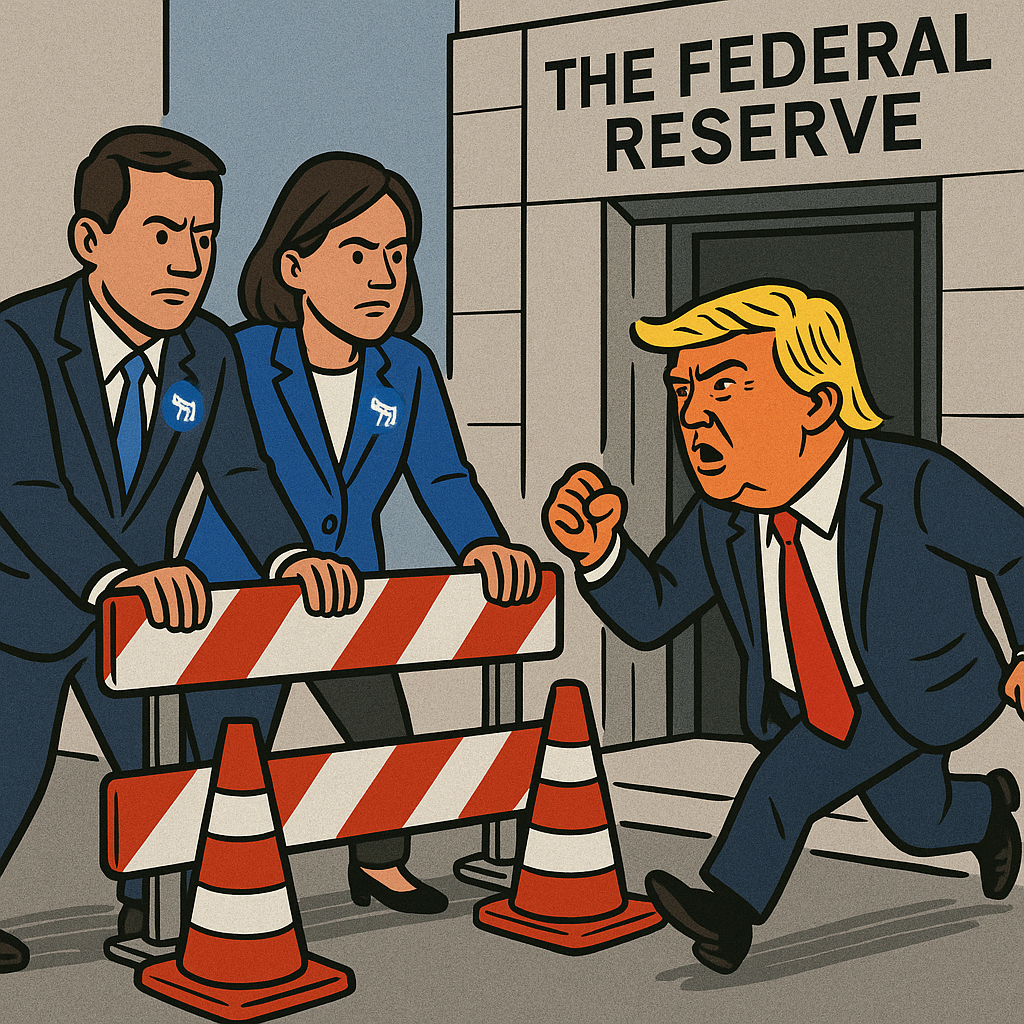
All of which brings the discussion to the Senate, and to the question of what Democrats should do with the leverage they currently possess. The arithmetic is not complicated. Invoking cloture, the procedural step that ends debate and allows a confirmation vote, requires 60 votes. Republicans hold 53 seats. Democrats, including two independents who caucus with them, hold 47. That is more than enough to block confirmation indefinitely. Not to delay it. To block it. The mechanism differs from the Garland blockade when Republicans held the majority in 2016 and simply refused to schedule hearings; Democrats today are in the minority and must deny cloture but the constitutional leverage is equivalent and the outcome is identical. No confirmation without Democratic cooperation. The real obstacle is not parliamentary. It is political. Democrats have a long and costly institutional history of treating procedural restraint as a virtue even when their opponents have long since abandoned the same courtesy, and of discovering, too late, that the other side was keeping score.

Republicans offered the definitive tutorial in this kind of institutional resolve in 2016, when the Senate majority, led by Mitch McConnell, refused to consider President Obama’s nomination of Merrick Garland to the Supreme Court for nearly a year, on the stated grounds that a new president should make the selection. The stated grounds were pretextual. The real grounds were power. The manoeuvre was widely criticised as a breach of constitutional norms. It was also completely effective. The Supreme Court was reshaped for a generation. The lesson drawn by McConnell’s critics that norms of procedural deference were worth preserving regardless of how the other side behaved has not aged especially well. The lesson drawn by McConnell himself, that institutional power belongs to those willing to use it without apology, has proved considerably more durable. Democrats are not in the majority. They do not need to be. They need only hold together, deny cloture, and decline to confirm a nominee who has already failed the most basic test of the job. If Merrick Garland could be refused a hearing on thinner grounds, Kevin Warsh can be refused a confirmation vote on these.

Democrats who delay Warsh’s confirmation need not invent a pretext. The grounds are substantive and readily defensible. The nominee’s financial disclosures are among the most complex ever submitted for this position, listing roughly 1,800 individual assets, many classified under confidentiality agreements that prevent him from identifying the underlying holdings. He has pledged to divest within 90 days of confirmation, but the Senate is not obligated to extend that trust in advance. His confirmation hearing raised, rather than resolved, questions about his independence from the executive branch. A thorough vetting is not obstruction. It is the job.

The midterm elections in November 2026 add a further dimension that Democrats would be foolish to ignore. Monetary policy works with a lag. Rate decisions made in the spring are felt by households in the autumn. A newly confirmed Fed chair eager to demonstrate usefulness to the administration that appointed him would have both the motive and the means to generate a short-term economic improvement—lower mortgage rates, looser credit, a consumer spending bounce—timed to arrive just as voters are making up their minds about which party to support. That Democrats would have facilitated this outcome through premature confirmation is not an argument they would enjoy making to their constituents.

A sustained blockade, by contrast, forces a public conversation about what kind of institution the Federal Reserve should be. It creates an opportunity to put into the congressional record testimony from economists who study monetary policy’s distributional effects, from community bankers who work in markets the Federal Reserve’s balance sheet decisions directly affect, and from HBCU administrators who can explain, in terms that general audiences can understand, how interest rate policy shapes the financial landscape of institutions that serve some of the most economically vulnerable students in American higher education. The Fed’s decisions are made in public. Their consequences for working Americans—and especially for African American communities—are rarely discussed in the rooms where those decisions get made. A confirmation blockade is that conversation, conducted at a volume that cannot be ignored.

The Federal Reserve’s independence is not a natural condition. It is a political achievement, and like all political achievements, it requires active defence from those with the means to provide it. A nominee who cannot bring himself to say who won a presidential election—a question whose answer is written in congressional certification and judicial record—has already told the market, and the public, something important about how he understands that independence. The Senate does not have to accept that answer. Democrats have the votes to reject it. The question is whether they have the will to use them without flinching, without offering off-ramps to colleagues tempted by the false comfort of bipartisan procedural cooperation, and without eventually concluding that confirmation on unfavourable terms is preferable to the discomfort of sustained opposition. It is not. Warsh should not be confirmed. He should be blocked. The precedent for doing so was set by the people now asking Democrats to stand down.

For African American institutions, and for the HBCUs that represent their most durable infrastructure, the lesson is one they have had occasion to learn repeatedly: the rules of the game are made by those who show up and insist on making them. Monetary policy is not race-neutral, however much it presents itself as such. The cost of credit, the availability of capital, the conditions under which wealth can be built and transmitted across generations—these are not technical abstractions. They are the material of institutional survival. The question of who chairs the Federal Reserve is, among other things, a question about whose survival the institution is organised to protect. That question deserves a full and unhurried answer.

Disclaimer: This article was assisted by ClaudeAI.

The Institutional Imperative: Moving Beyond Individual Black Wealth Narratives

I would rather earn 1% off a 100 people’s efforts than 100% of my own efforts. – John D. Rockefeller

The contrast is stark and telling. On one screen, a promotional poster for a docuseries about Black wealth features accomplished individuals—entrepreneurs, entertainers, and personal finance influencers. On another, the Bloomberg Invest conference lineup showcases representatives from Goldman Sachs, BlackRock, sovereign wealth funds, and central banks. This visual juxtaposition reveals a fundamental problem in how African American wealth building is conceived, discussed, and ultimately constrained in America: we’re having an individual conversation while everyone else is having an institutional one.

When African American wealth is discussed in mainstream media and even within our own communities, the focus overwhelmingly centers on individual achievement and personal financial literacy. The narrative typically revolves around budgeting tips, entrepreneurship stories, side hustles, and the importance of “building your own.” While these elements certainly matter, they represent only a fraction of how wealth is actually created, preserved, and transferred across generations in America.

Compare this to how other communities approach wealth building. Bloomberg conferences don’t feature panels on how to save money or start a small business. Instead, they convene institutional investors managing trillions of dollars, central bankers who set monetary policy, executives from asset management firms overseeing pension funds, and sovereign wealth fund managers representing entire nations’ financial interests. The conversation isn’t about individual wealth accumulation it’s about institutional capital allocation, market infrastructure, regulatory frameworks, and systemic wealth generation. This isn’t merely a difference in scale; it’s a difference in kind. Individual wealth building, no matter how successful, operates within a system. Institutional wealth building shapes that system.

The economic implications of this gap are staggering. Consider the arithmetic presented in the text message exchange: if approximately 95% of African American debt is held by non-Black institutions, and that debt carries an average interest rate of 8%, African American households collectively transfer roughly $120 billion annually in interest payments to institutions that have no vested interest in Black wealth creation or community reinvestment. This figure isn’t just large it’s transformative. To put it in perspective, $120 billion annually exceeds the GDP of many nations. That likely at least 10% of African America’s $2.1 trillion in buying power is leaving the community for interest before a single bill is paid or single investment can be made. It represents capital that flows out of Black communities without generating corresponding wealth-building infrastructure within those communities. This is the cost of institutional absence.

When communities lack their own lending institutions, investment banks, insurance companies, and asset management firms, they become permanent capital exporters. Every mortgage payment, every car loan, every credit card balance becomes a wealth transfer rather than a wealth circulation mechanism. Other communities long ago recognized this dynamic and built institutional frameworks to capture, recycle, and multiply capital within their own ecosystems.

Institutional wealth building operates on fundamentally different principles than individual wealth accumulation. It involves capital pooling and deployment, where institutions aggregate capital from thousands or millions of sources and deploy it strategically for returns that benefit the collective. Pension funds, for instance, don’t teach their beneficiaries how to pick stocks they hire professional managers to generate returns that secure retirements for entire workforces. Large institutions don’t just participate in markets; they shape them. They influence interest rates, capital flows, regulatory frameworks, and investment trends. When BlackRock or Vanguard shifts their investment thesis, entire sectors respond.

Institutions are designed to outlive individuals. They create mechanisms for wealth transfer that transcend personal mortality, ensuring that capital accumulates across generations rather than dispersing with each estate. By pooling resources, institutions can absorb risks that would devastate individuals, enabling them to pursue longer-term, higher-return strategies that individuals cannot access. Perhaps most importantly, institutional capital commands political attention and shapes policy in ways that individual wealth, however substantial, simply cannot.

The current institutional deficit in African American communities isn’t accidental it’s the product of deliberate historical forces. During the early 20th century, Black communities did build impressive institutional infrastructure. Black Wall Street in Tulsa, thriving business districts in Rosewood, Florida, and numerous Black-owned banks, insurance companies, and investment firms represented genuine institutional wealth building. These were systematically destroyed sometimes literally, as in the Tulsa Race Massacre of 1921, and sometimes through discriminatory policies, denial of business licenses, exclusion from capital markets, and targeted regulatory enforcement. The institutions that survived faced existential challenges during desegregation, as the most affluent Black customers gained access to white institutions that had previously excluded them. The result is that African Americans today face a unique challenge: rebuilding institutional infrastructure in a mature capitalist economy where the institutional landscape is already dominated by established players with centuries of accumulated capital, networks, and political influence.

Given this context, why does African American wealth discourse remain so focused on individual action? Several factors contribute to this pattern. American culture celebrates individual achievement and self-made success. This narrative is particularly seductive for African Americans seeking to overcome discrimination through personal excellence. However, it obscures the reality that most substantial wealth in America is institutional, not individual. Teaching people to budget or start a business is concrete and actionable. Discussing the need for African American-owned asset management firms managing hundreds of billions in capital is abstract and seemingly impossible for most people to influence. Individual success stories make compelling content. Institutional finance is complex, technical, and doesn’t generate the emotional engagement that drives social media metrics and television ratings.

Institutional finance is deliberately exclusionary, with high barriers to entry, specialized knowledge requirements, and established networks that are difficult to penetrate. This makes it harder for diverse voices to participate in and shape these conversations. Moreover, focusing on individual responsibility can deflect attention from systemic inequalities and the need for institutional reform. If wealth gaps are framed as the result of individual choices rather than institutional access, the solution becomes personal change rather than structural change.

The problem is that individual wealth building, while important, simply cannot close the wealth gap or address the capital hemorrhage happening through institutional absence. You cannot budget your way to institutional power. You cannot side-hustle your way to sovereign wealth fund influence. Closing the institutional gap would require coordinated action across multiple domains. This means growing and creating Black-owned banks, credit unions, insurance companies, asset management firms, and investment banks capable of competing at scale—institutions managing not millions but billions and eventually trillions in assets.

It requires ensuring that the substantial capital in public pension funds, university endowments, and foundation assets that serve African American communities is managed with intentionality about wealth creation within those communities. Building investment funds that can provide growth capital to Black-owned businesses beyond the startup phase, enabling them to scale to institutional size, becomes essential. Creating institutions that can acquire, develop, and manage commercial and residential real estate at scale, capturing appreciation and rental income for community benefit, must be prioritized. Developing institutional voices that can effectively advocate for policies that support Black wealth building, from community reinvestment requirements to procurement set-asides to tax structures that favor long-term capital formation, is critical.

This isn’t a call to abandon individual financial responsibility or entrepreneurship both remain important. Rather, it’s a recognition that these individual efforts need institutional infrastructure to support them, multiply their effects, and prevent the constant capital drain that currently undermines them. The Bloomberg conference model reveals what serious wealth building conversations look like among communities that already possess institutional power. The participants aren’t there to learn how to balance their personal checking accounts they’re there to discuss macroeconomic trends, regulatory changes, emerging markets, and trillion-dollar capital allocation decisions.

African American communities need forums that operate at the same level of institutional sophistication. This means convening the leaders of Black-owned financial institutions, pension fund managers, university endowment chiefs, foundation presidents, private equity partners, and policymakers to discuss not individual wealth tips but institutional strategy. It means asking questions like: How do we coordinate capital deployment across Black-owned financial institutions to maximize community impact? How do we leverage public pension fund capital to support Black wealth building without sacrificing returns? What regulatory changes would most effectively support Black institutional development? How do we build the pipeline of talent needed to manage billions in institutional capital?

The real challenge can be distilled into three interconnected imperatives: individually Black people must get wealthier, there must be an increase in Black institutional investing, and the overall wealth of Black people as a whole must increase. All three are important, yet the current discourse focuses almost exclusively on the first element while neglecting the second and third. The reality is that without institutional infrastructure, individual wealth gains will continue to leak out of the community rather than accumulating into collective wealth.

A fundamental truth that much of African American wealth discourse has yet to fully internalize is that wealth is created through institutions. There exists a critical misalignment between how wealth is actually built and how we talk about building it. We prioritize individual wealth accumulation without recognizing that the causality runs in the opposite direction—institutional infrastructure creates the conditions for sustainable individual and collective wealth building, not the other way around. We can celebrate individual achievement, teach financial literacy, promote entrepreneurship, and encourage personal responsibility all we want. But until African American communities build and control institutions that can pool capital, shape markets, influence policy, and deploy resources strategically across generations, the wealth gap will persist and likely widen.

A docuseries about successful individuals may be inspiring. But inspiration without infrastructure leads nowhere. Other communities learned this lesson generations ago (from us) and built accordingly. A critical question cuts to the heart of the matter: Who in these wealth-building conversations is representing an African American institution? When wealth dialogues feature only individuals representing themselves or individual brands rather than institutions representing collective capital and community interests, we’re having the wrong conversation at the wrong altitude.

It’s time for African American wealth conversations to graduate from the individual focus to the institutional imperative. The Bloomberg model isn’t just for other people it’s a template for how serious wealth building actually works. The question isn’t whether African Americans can produce individually wealthy people we’ve proven that repeatedly. The question is whether we can build the institutional infrastructure that turns individual success into collective, multigenerational wealth. That’s the conversation we should be having, and it needs to happen at the same level of sophistication and institutional focus that other communities take for granted. Until then, we’re simply rearranging deck chairs while hundreds of billions if not trillions flow out of our communities annually, enriching institutions that have no stake in our collective prosperity.

Disclaimer: This article was assisted by ClaudeAI.