Tag Archives: hbcu financial strategy

The Africa Travel Ban Is an HBCU Problem

Africans in the United States must remember that the slave ships brought no West Indians, no Caribbeans, no Jamaicans or Trinidadians or Barbadians to this hemisphere. The slave ships brought only African people and most of us took the semblance of nationality from the places where slave ships dropped us off. – Dr. John H. Clarke

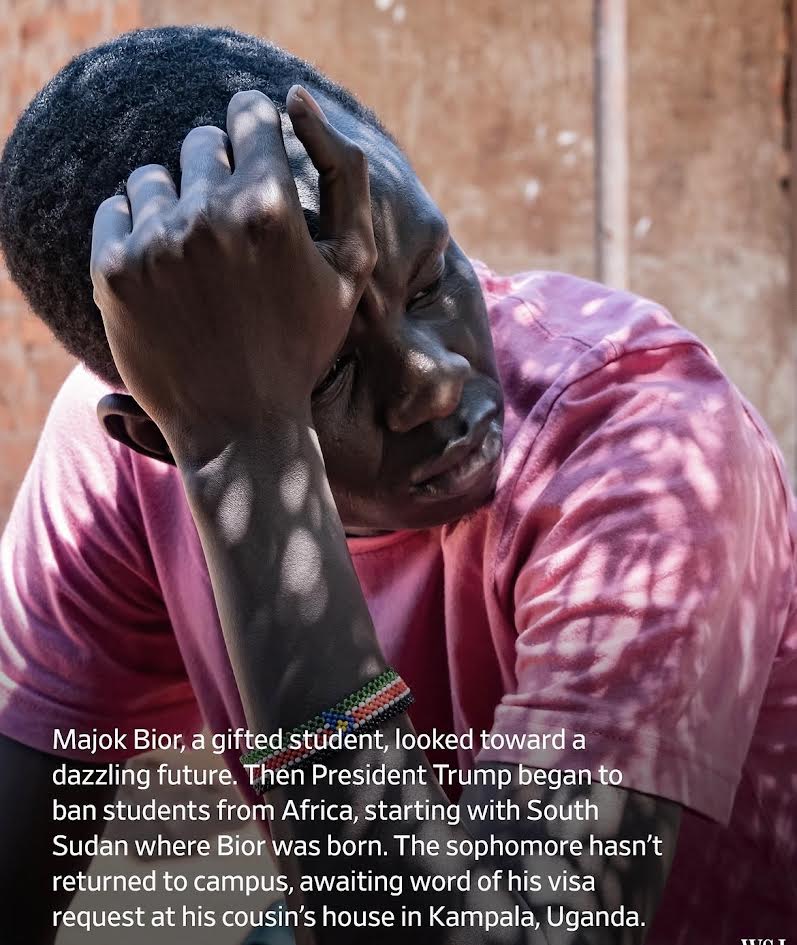
Photo from the Wall Street Journal

The photograph of Majok Bior, a South Sudanese computer science sophomore at Duke University, stranded at his cousin’s home in Kampala after the Trump administration’s travel restrictions invalidated his visa — has circulated widely as a symbol of individual suffering. And it is that. But to read it only through the lens of personal tragedy is to miss the structural dimensions of what is unfolding across American higher education, and to miss, in particular, what this moment means for HBCUs.

The Trump administration’s travel ban, initially signed on June 4, 2025, targeted 12 countries and placed partial restrictions on seven more, covering a geography concentrated in Africa and the Middle East. By December 2025, that list had expanded to 39 countries and territories, with Nigeria, historically one of the top ten sources of international students in the United States, placed under partial restrictions effective January 1, 2026. Individuals in Nigeria will not be able to receive student visas beginning January 1. Secretary of State Marco Rubio has signaled further expansion, with a State Department memo identifying 36 additional countries for potential restriction, including 25 African nations as well as countries in the Caribbean, Central Asia, and the Pacific Islands. If that expansion proceeds, the policy will have effectively severed the institutional connection between American higher education and the African continent.

For HBCUs specifically, this is not a distant geopolitical event. It is a direct threat to an enrollment strategy, a revenue base, and a civilizational relationship that institutions have spent decades building.

To understand the financial stakes, one must first understand how international student enrollment became integral to the fiscal architecture of many HBCUs. In addition to the tuition money international students often bring, many foreign students pay the full sticker price, often aided by their home countries’ governments there are benefits for HBCUs’ American students as well. International students, particularly those arriving with government-funded scholarships from Nigeria, Ghana, Saudi Arabia, and other nations, have served as a reliable source of full-fare tuition revenue at institutions that chronically lack the endowment depth to absorb enrollment volatility.

Among HBCUs with ten or more international students, Morgan State had the most as of the 2017-18 academic year, with 945 students; Howard was second with 920; and Tennessee State third with 584, according to the Institute of International Education. These numbers have only grown. Tennessee State, for instance, went from 77 international undergraduate students in 2008-09 to 549 by fall 2016 representing roughly 8 percent of its undergraduate student body. Across the sector, African students from Nigeria and Ghana historically constituted a significant share of that international cohort.

The financial logic was sound. A university with modest endowment holdings and only one HBCU, Howard University, currently holds an endowment exceeding $1 billion, cannot easily absorb the loss of a tuition-paying population without triggering cascading institutional consequences. When full-fare international students leave an enrollment ledger, the institution must either raise tuition on domestic students who are often already Pell Grant-eligible, draw down reserves, reduce staffing, or curtail academic programs. In a sector where financial fragility is not the exception but the norm, any of those choices carries compounding institutional risk. Preliminary projections by NAFSA and international education research partner JB International predict a 30 to 40 percent decline in new international student enrollment, leading to a 15 percent decline in overall enrollment this fall and loss of $7 billion within local economies and more than 60,000 jobs. That system-wide figure masks the disproportionate exposure at institutions whose international student populations are concentrated in African countries now under restriction.

The financial dimension, however, is only the first tier of the problem. The more consequential loss may be strategic: the slow dismantling of an institutional relationship between HBCUs and Africa that has been a defining feature of both parties’ long-term development. For decades, HBCU campuses have served as one of the primary entry points for African students seeking American credentials and professional networks. The relationship has never been purely transactional. It has been civilizational, rooted in a shared recognition that the institutional capacity of the African diaspora, on both sides of the Atlantic, depends on the training and circulation of its most capable people. Howard University, Morgan State, Florida A&M, and Tennessee State have all cultivated significant African student communities that returned home as engineers, physicians, lawyers, economists, and public administrators, seeding institutions across the continent with HBCU-educated professionals.

That pipeline is now interrupted. Majok Bior is one face of the disruption. He is also, statistically, the kind of student, a full-scholarship computer science talent, whose skills and networks would have contributed meaningfully to either the American or the African institutional ecosystem over the subsequent decades. The State Department’s position is unambiguous. There is no appeals window, no informal pathway, no consular discretion available to students like Bior whose visas were invalidated mid-enrollment. The pipeline does not merely slow. It stops.

The administration has signaled it may further target sub-Saharan Africa for future travel bans. Twenty-four of the 36 countries identified as future ban candidates are in sub-Saharan Africa. If all 24 were to be hit with bans, an additional 71 percent of the region’s population would be affected. At that scale, the policy would not merely interrupt an enrollment channel. It would functionally close the institutional bridge between American HBCUs and the African continent.

The arrivals data make the stakes concrete. The number of new and returning African students arriving in the United States for the 2025 fall semester fell by nearly a third from the previous year, according to preliminary Commerce Department data. Arrivals from Nigeria and Ghana, which historically send more students to the United States than any other African countries, dropped by roughly half. Those are not marginal declines. They represent a structural break in the flow of talent that has sustained both HBCU campuses and the professional networks those campuses anchor.

The broader context amplifies the damage. HBCUs have been managing a long-running tension between their mission to serve African American students and the enrollment arithmetic that increasingly pushes them toward diversification. Black student enrollment at HBCUs increased by just 15 percent from 1976 to 2022, while enrollment of students from other racial and ethnic groups rose by a staggering 117 percent during the same period. Within that context, African international students have occupied an important, if underappreciated, position: they are enrolled students who are Black, who arrive often with external funding, and who align with the cultural mission of the institution in ways that students from other international communities do not. The loss of this population does not merely reduce headcount. It removes a category of student whose presence reinforces the intellectual and cultural identity of HBCU campuses while simultaneously contributing to their revenue base.

HBCU leaders should resist the temptation to treat the current moment as a policy problem requiring a policy solution that is, to wait for a change in administration or a favorable court ruling before taking action. The institutional response must be proactive, and it must be organized at the sector level rather than institution by institution.

The first imperative is legal and advocacy coordination. HBCUs should be visible participants in the coalition of higher education institutions pushing back against travel ban expansion. The legal challenges already filed by some universities have produced limited court-ordered exceptions. HBCU presidents, through their associations and individually, possess a particular moral authority in this argument: these institutions were founded on the principle that the state should not determine who deserves access to education. That founding logic has direct application to the current moment, and its articulation should not be left to the advocacy organizations of predominantly white institutions alone.

The second is the construction of alternative enrollment infrastructure. Several countries whose students are not currently restricted represent significant untapped pipelines for HBCUs including Kenya, Ethiopia, South Africa, and several francophone West African nations not yet under full restriction. Morgan State’s international enrollment tripling between 2014 and 2017, driven by a concerted recruitment strategy, demonstrates that rapid scaling is possible when institutions make it a priority. The question now is whether that kind of deliberate enrollment strategy can be retargeted toward countries where the policy environment remains navigable.

The third imperative, and the most consequential for the long run, is the development of transnational academic infrastructure that does not depend on American visa policy at all and here the sector does not need to theorize. It already has a model. Claflin University, an HBCU in Orangeburg, South Carolina, and Africa University in Zimbabwe have together built and delivered a fully online Master of Science program in Biotechnology and Climate Change, producing their first cohort of graduates in 2025. The program requires no visa, no transatlantic relocation, and no dependence on the goodwill of a State Department consular officer. It delivers graduate-level credentials, anchored to an HBCU’s academic infrastructure, to scholars who remain embedded in the African communities they will eventually serve. That is not a symbolic gesture. It is a replicable institutional architecture — one that severs the link between American immigration policy and the HBCU-Africa educational relationship at precisely the point where that link has proven most vulnerable. The disciplines selected are themselves strategic: biotechnology and climate change are among the fields where African scholars have the most urgent applied work to do, and where the absence of well-trained researchers carries the steepest institutional cost. What Claflin and Africa University have built is a proof of concept for the entire sector. Howard, Morgan State, Florida A&M, and Tennessee State, institutions that have already invested in African student pipelines and cultivated international enrollment are positioned to extend this model into additional disciplines, additional partner institutions, and additional countries. Students who were considering coming in 2026 will be discouraged and will be looking to other destinations, as one international education expert has observed. If those students go elsewhere, HBCUs should be competing to ensure that some of that “elsewhere” is a degree program bearing an HBCU’s name, delivered on African soil, through African partner institutions, and impervious to the policy preferences of any particular American administration.

The image of Majok Bior waiting in Kampala is a human document. But it is also an institutional document. It records the moment when an African student who had successfully navigated the American credentialing system, who had won a full scholarship, enrolled in computer science, played intramural soccer, and survived chemistry class was extracted from that system not by any failure of his own but by a federal policy aimed at restricting the movement of African people into American institutions. HBCUs were built precisely because such exclusions were once the default condition of American higher education. The institutional memory of that history is not a rhetorical resource. It is a strategic asset, a basis for understanding that the institutions which serve communities without consistent access to political protection must always be building structures that can survive the withdrawal of that protection. The Africa travel ban is an HBCU problem. The sector’s response to it will reveal something important about whether these institutions have developed the depth and coordination to meet a challenge that is, in its essential structure, the same challenge they were built to confront.

Disclaimer: This article was assisted by ClaudeAI.

When Big Gifts Cast Long Shadows: Why HBCUs Blessed by MacKenzie Scott Must Invest in the HBCUs and African American Institutions Still Left Behind

“Power grows when it circulates. If only one HBCU rises, none of us truly rise.”

MacKenzie Scott’s philanthropy has reshaped the HBCU landscape in ways that few could have imagined a decade ago. When her unrestricted gifts began landing across the sector, they offered something rare in Black institutional life: immediate liquidity, strategic freedom, and the assumption that HBCUs knew best how to use the capital given to them. Institutions like Prairie View A&M, Tuskegee, Winston-Salem State, Spelman, Morgan State, and others seized this moment to strengthen balance sheets, expand programs, retire debt, and set in motion long-term visions often delayed by years of underfunding.

But while headlines celebrated these historic gifts, another truth ran quietly beneath the surface many of the smallest, oldest, and most financially fragile HBCUs received nothing. Texas College, Voorhees, Morris, short-funded religiously affiliated colleges, and two-year HBCUs were notably absent from the list. Their exclusion was not due to a lack of mission, quality, or need. It was due to visibility, a structural inequality baked into the philanthropic landscape.

Large and mid-sized HBCUs possess communications offices, audited financial statements, national reputations, and alumni networks large enough to keep their names in circulation. Small HBCUs often have one person doing the work of an entire department, no national brand presence, and no full-time staff dedicated to donor engagement. Philanthropy at scale tends to flow to institutions already “discoverable,” which means the colleges that need the money most are often the least visible to donors like Scott. This is not a critique of her giving; she has done more for HBCUs than any private donor in a generation. Where the African American donors of consequence is a another article for another day. It is an indictment of a philanthropic system that confuses visibility with worthiness.

Unrestricted capital, however, changes power dynamics. When an HBCU receives $20 million, $40 million, or $50 million with no strings attached, it is receiving not just money but institutional autonomy. It is gaining the ability to build, to plan, to hire, to innovate, and to settle the long-deferred obligations that drain mission-driven organizations. This autonomy carries with it an important question: what responsibility does an HBCU have to the larger ecosystem when it receives this kind of power?

HBCUs often describe themselves as part of a shared lineage, a collective built from necessity and sustained by interdependence. If that is true, then institutions that receive transformative gifts have a responsibility to circulate a portion of that capital to the HBCUs that remain structurally invisible. This is not a matter of charity; it is a matter of ecosystem logic. A rising tide only lifts all boats if every institution has a boat capable of floating.

Even a small redistribution—2 to 5 percent of unrestricted gifts—would represent a meaningful shift. A $50 million gift becomes a $1–2.5 million contribution to a collective pool. A $20 million gift becomes $400,000–$1 million. A $5 million gift becomes $100,000–$250,000. Spread across the dozens of HBCUs that received Scott’s funds, such a strategy could generate $40–60 million in shared capital almost immediately. For a small HBCU with a $12 million budget, even a $500,000 infusion can stabilize operations, hire essential staff, or stave off accreditation risks. And for two-year HBCUs—critical institutions that often serve first-generation and working-class students—$250,000 can transform workforce programs or upgrade classroom technology.

When unrestricted money flows into the ecosystem, it should not be seen as belonging solely to the institution receiving it. It should be viewed as a rare chance to strengthen the entire system that sustains Black educational capacity. That means revisiting the historic practices of resource sharing that once defined HBCUs. There was a time when faculty were exchanged, when larger institutions lent administrators to smaller ones, and when collective survival was at the center of institutional strategy. Financial scarcity eroded much of that ethos over time; unrestricted capital can revive it.

The need for this kind of intra-HBCU investment becomes even more urgent when we consider how philanthropy shapes public perception. When a small HBCU faces financial distress, politicians and media often use its weakness as a reason to question the entire sector. But when a small HBCU strengthens, expands, and stabilizes, it lifts the credibility of the collective. The fate of one HBCU inevitably influences the political and philanthropic fortunes of the others. Strengthening the weakest institutions is not optional it is a strategic imperative for the strongest ones.

Shared capital also opens the door to new structures that benefit the entire ecosystem. Larger HBCUs could help create a visibility accelerator that provides grant-writing support, marketing expertise, budgeting assistance, and donor engagement tools for smaller institutions. They could establish a joint endowment fund where smaller HBCUs gain access to investment managers they could never otherwise afford. They could create emergency liquidity pools to help institutions weather short-term cash shortages that often cascade into long-term crises. They could co-sponsor research initiatives, faculty exchanges, and new academic programs at institutions that have the vision but lack the staff or funding to execute.

These are not theoretical ideas; they are practices used by well-resourced universities and nonprofit networks across the country. Major universities routinely fund pipeline schools, partner institutions, and community colleges. Corporations build up their suppliers. Regional governments pool funding to strengthen smaller municipalities. In almost every sector except the HBCU sector, power is used to build the ecosystem, not just the institution.

One of the most overlooked consequences of Scott’s gifts is the cultural message they send: large HBCUs are now in a position to move beyond survival mode and into builder mode. They can start thinking not just about their own campuses but about the health of the entire HBCU network. They have the resources to help smaller institutions become discoverable to future donors, to strengthen donor reporting infrastructure, to modernize back offices, and to raise their visibility in national conversations.

Redistribution is not about guilt. It is not about moral obligation. It is about strategic logic. Large HBCUs cannot thrive in a sector where small HBCUs collapse. For the ecosystem to have political leverage, credibility in national policy debates, and a future pipeline of Black scholars and professionals, the entire network must be strong. When an HBCU closes or falters, opponents of Black institutional development use that failure as proof of irrelevance. When an HBCU grows even a small one it becomes a success story that benefits the whole landscape.

The Scott gifts represent a once-in-a-generation financial turning point, but they are only a starting point. If HBCUs treat them as isolated blessings, the impact will be uneven and short-lived. If they treat them as seed capital for an ecosystem-wide transformation, the impact could reshape Black educational power for decades. Large HBCUs must decide whether they will be institutions that simply grow or institutions that help the entire sector evolve.

Smaller HBCUs cannot increase visibility alone. They cannot hire full development teams or produce 50-page donor reports without capital. They cannot expand new programs without bridge funding. They cannot modernize their infrastructure without partners. But the HBCUs that did receive unrestricted capital can change the landscape for them and by doing so, they strengthen the entire ecosystem.

This moment is not just about money. It is about whether HBCUs will use new wealth to reproduce old hierarchies or to build new pathways for collective power. In a philanthropic world that rewards visibility, the institutions that already stand in the light now have the responsibility and the means to illuminate the rest.

The measure of true power within the HBCU ecosystem is not what one institution accumulates. It is what the ecosystem can create together what none of its institutions could build alone. The future of HBCU philanthropy will depend on whether those blessed with unrestricted gifts choose to expand their own shadows or choose instead to cast light.

Disclaimer: This article was assisted by ChatGPT.

A Merger of (Potential) Might: Why Prairie View A&M and Texas Southern Should Combine Their Foundations to Challenge the Endowment Establishment

It is reason, and not passion, which must guide our deliberations, guide our debate, and guide our decision. – Barbara Jordan

In the gilded halls of America’s elite universities, financial firepower is both a symbol and source of dominance. Endowments—the great silent engines of academia—determine not only which students get scholarships but which schools can recruit Nobel-calibre faculty, fund original research, and shape public policy. At the apex of this order stands UTIMCO, the University of Texas and Texas A&M’s investment juggernaut, with more than $70 billion under management. Below, far below, exist the undercapitalised yet ambitious Historically Black Colleges and Universities (HBCUs) of Texas.

Two of the state’s largest HBCUs—Prairie View A&M University (PVAMU) and Texas Southern University (TSU)—have long histories, loyal alumni, and vital missions. What they do not have is institutional wealth. PVAMU’s foundation reported a modest $1.83 million in net assets in 2022. TSU’s foundation, better capitalised, holds $22.7 million. Combined, that amounts to just $24.5 million. For comparison, Rice University, less than 50 miles from either campus, holds an endowment north of $7.8 billion.

That yawning disparity matters. But it also presents an opportunity: a merger of the two foundations into a single, more potent philanthropic and investment entity. Done properly, it could reorient how Black higher education competes—not by appealing to fairness or guilt, but through scale, strategy, and institutional force.

A Rebalancing Act

To understand the potential of a PVAMU-TSU foundation merger, one must first grasp the dynamics of university endowments. Large endowments benefit from economies of scale, granting them access to exclusive investment opportunities—private equity, venture capital, hedge funds—often unavailable to smaller players. They attract the best fund managers, demand lower fees, and can weather market volatility without compromising their missions. Small foundations, by contrast, tend to be conservatively invested, costly to manage per dollar, and too fragmented to punch above their weight.

A consolidated HBCU foundation in Texas would be small compared to UTIMCO, but large relative to its peers. With a $25 million corpus as a starting point, the new entity could position itself for growth by professionalising its investment strategy, adopting a more ambitious donor engagement plan, and forming partnerships with Black-owned banks, family offices, and community institutions. Call it the Texas Black Excellence Fund, or perhaps, more simply, the TexHBCU Endowment.

To be sure, the legal and logistical barriers to such a merger are real. Foundation boards guard their autonomy jealously. Alumni pride can turn parochial. Governance models would need careful negotiation to ensure representation and avoid turf wars. But the arguments in favour are compelling.

The Power of One

First, a merger would cut overhead. Legal, accounting, auditing, and compliance costs—duplicated today—could be streamlined. A joint fundraising apparatus could create a single point of entry for corporate partners and high-net-worth donors. Branding efforts would gain coherence: instead of competing for attention, the institutions would stand together as a symbol of Black institutional unity and strength.

Second, scale invites leverage. A $25 million foundation cannot change the world overnight, but it can attract co-investments, engage in pooled funds, and perhaps even launch a purpose-driven asset management firm in the model of UTIMCO. If successful, this would be the first Black-led institutional investor of serious size in Texas—capable not only of managing endowment funds but of influencing broader economic flows across Black Texas.

Third, the merger would send a strategic signal to policymakers and philanthropic networks. It would say, in effect: “We are no longer asking for permission to grow. We are building the engine ourselves.” That tone matters. Too often, HBCUs are framed as needing rescue. A merged foundation flips that narrative. It becomes an asset allocator, a market participant, a builder of capital rather than a petitioner of it.

UTIMCO: A Goliath in the Crosshairs?

No one expects a $25 million fund to challenge a $70 billion behemoth. But that is not the point. UTIMCO’s dominance is as much political as it is financial. Its influence flows from its role as gatekeeper to resources, shaping everything from campus architecture to graduate fellowships. The merged HBCU foundation would not dethrone UTIMCO—it would decentralise power by becoming a second pole.

Indeed, the comparison may inspire mimicry. Just as UTIMCO serves multiple institutions, so too could a joint HBCU foundation. Prairie View and Texas Southern are only the beginning. Over time, the model could scale to include other Black-serving institutions across Texas and the South. This would amplify investment impact and accelerate institutional wealth-building.

Moreover, such a foundation could adopt an unapologetically developmental investment strategy. Where UTIMCO optimises for returns, the TexHBCU fund could optimise for both returns and racial equity—by investing in Black entrepreneurs, affordable housing, climate-resilient infrastructure, or educational tech. The dual mandate—profit and purpose—would not be a hindrance but a hallmark.

Regional Stakes

Prairie View sits on a rural hilltop. Texas Southern sprawls in urban Houston. But their communities are deeply connected—culturally, economically, demographically. A combined foundation could create regional development strategies that go beyond scholarship aid.

Imagine a venture fund seeding Black-owned start-ups in Houston’s Third Ward. A real estate initiative turning vacant lots into mixed-income housing for PVAMU students and local residents. A workforce development fund retraining returning citizens for green jobs across both cities. Each dollar invested becomes more than a balance sheet entry; it becomes a force for transformation.

This matters not just to students and faculty, but to the broader Texas economy. Black Texans make up 13% of the state population but own less than 3% of its small businesses. Educational attainment gaps persist. Institutional neglect deepens. The merger would not fix all this—but it would give the community a new tool for shaping its destiny.

Copy, Then Paste

If the model works, it would not stay in Texas. Southern University in Louisiana has multiple campuses and foundations that could benefit from consolidation. So does the University System of Maryland’s HBCUs. Indeed, the entire sector could adopt a federated endowment strategy—unified in purpose but distributed in governance.

HBCUs have long suffered from institutional atomisation. They are asked to compete individually in a system that rewards consolidation. Merging foundations is not just a finance play—it is a strategy for survival and sovereignty.

The Alternative: Stagnation

Critics may say a merger is too ambitious. That it risks alumni backlash or donor confusion. That it could take years to execute. But delay is itself a cost. Each year the foundations remain separate is another year of opportunity lost. Another year where millions in potential returns go unrealised. Another year where larger institutions deepen their lead.

PVAMU and TSU have histories to be proud of. But institutional pride must not become institutional inertia. A merger is not surrender—it is evolution.

In the long arc of higher education, moments of boldness define legacy. This is one of those moments. Two foundations. One future. Let the uniting begin.