— Paul Robeson, quoted in John Henrik Clarke’s collected writings
Young Africans relearning their grandparents’ languages is the visible half of a much larger story. The invisible half is that African American institutions have spent sixty years absent from the infrastructure that produces language fluency, and that absence has a price tag.
In 1939, a young man from the Gold Coast arrived at a small Black college in rural Pennsylvania to study economics and sociology. He would return home fifteen years later not merely educated but fluent in the vocabulary of institutions — economics, law, organizing, statecraft — and he would use it to lead his country to independence. A few years behind him, a young man from eastern Nigeria walked the same campus, and he too would go home to become a founding president. Lincoln University did not teach Kwame Nkrumah or Nnamdi Azikiwe Twi or Igbo. It gave them something else: the conviction that a Black institution could be the staging ground for African sovereignty. What Lincoln never built afterward was the other half of that exchange; a standing pipeline through which African language, and the economic access that comes with it, flowed back into the African American institutional ecosystem. That gap, nearly a century old, is still open.
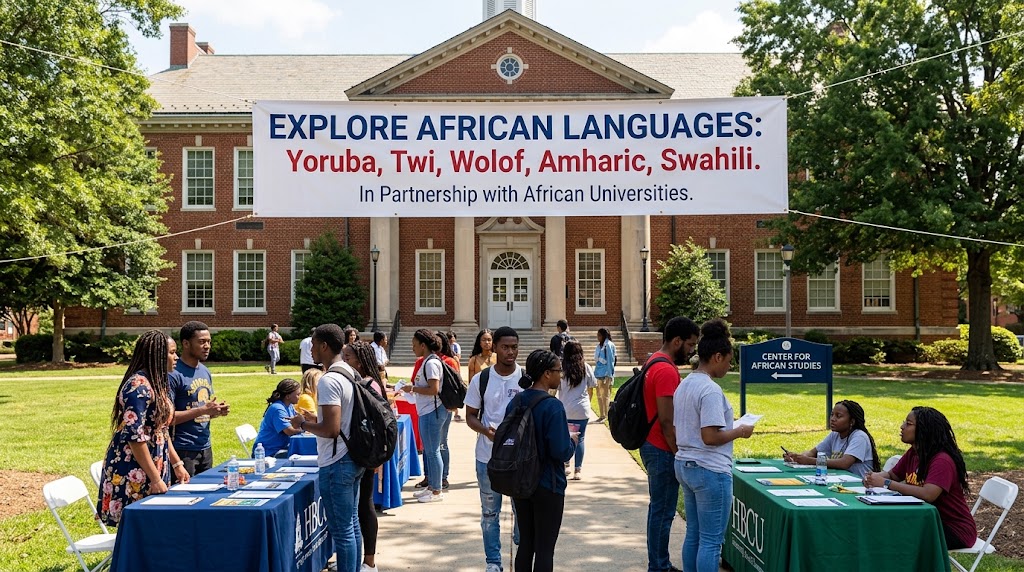
HBCUs should be offering credit-bearing instruction in African languages — Yoruba, Twi, Wolof, Amharic, Swahili — built through direct partnership with African universities, not as a cultural enrichment elective but as core workforce and trade infrastructure. The case for this is economic and institutional, not sentimental.
Language instruction is not a neutral academic offering. It is credentialing infrastructure, and credentialing infrastructure determines who gets hired into the jobs that sit between two economies. Every multinational corporation, trade mission, diplomatic post, and NGO office that needs someone who can move between English and an African language recruits from wherever that language is taught at scale. For the last half-century, that has meant federally funded area studies centers at a small number of predominantly white research universities. Title VI of the Higher Education Act has funneled National Resource Center funding into African Studies programs concentrated in a handful of institutions for decades, building durable pipelines between those campuses and the State Department, USAID, the World Bank, and multinational firms doing business across the continent. HBCUs, with rare exception, were never inside that funding architecture. The result is a predictable one: the African American professional class that works in Africa-facing trade, diplomacy, and business overwhelmingly credentialed somewhere other than a Black institution. The institutional capital generated by that career pipeline; the alumni networks, the corporate relationships, the government contracts, the endowment gifts that follow professional success accrued elsewhere.
This is a capital retention problem before it is a curriculum problem. African economies are not a charity case for the diaspora to sentimentally reconnect with; several are among the fastest-growing consumer and resource markets in the world, and the firms, universities, and governments of Ghana, Nigeria, Kenya, and Senegal are actively building the commercial and diplomatic infrastructure to engage global partners on their own terms. The African American institutional ecosystem currently has almost no standing mechanism to plug into that growth as an equal counterparty rather than as an occasional cultural visitor. A study-abroad semester is not that mechanism. A three-week heritage trip is not that mechanism. What is required is the unglamorous, compounding infrastructure of formal academic partnership: articulated language sequences, dual-enrollment agreements, joint faculty appointments, and degree pathways that produce graduates fluent enough to staff a trade desk, negotiate a supply contract, or serve as the ninth employee at a firm doing business in Accra rather than the twenty-fifth interpreter hired by someone else’s firm.
The historical precedent for this kind of institutional coordination already exists inside the African American tradition, even if it was never built out permanently. The 1955 Bandung Conference gave the Black American political and intellectual class its first serious modern vocabulary for treating African and Asian nations as strategic partners rather than subjects of missionary concern. The American Negro Leadership Conference on Africa, convened in 1962 under A. Philip Randolph, briefly organized Black civil rights leadership around explicit support for African independence movements, treating the fates of the two struggles as structurally linked. Both moments produced statements, delegations, and solidarity. Neither produced a permanent academic infrastructure. The language centers, the joint degree programs, the standing faculty exchanges — the parts that would have made the relationship self-sustaining rather than dependent on a given generation’s political enthusiasm — were never built. HBCUs are positioned to finish that unfinished work, but only if the relationship is structured as reciprocal institutional infrastructure rather than one more symbolic exchange.
What this looks like in practice is specific and buildable. A regional HBCU such as Delaware State, Fort Valley State, Norfolk State, Coppin State can enter a formal instructional partnership with a University of Ghana or University of Cape Coast for Twi and Akan instruction, delivered through hybrid faculty exchange: a visiting Ghanaian instructor teaching on the HBCU campus for a term, HBCU students completing an immersion sequence in Accra the following year, with credits and cost structured through the partnership rather than left to an expensive third-party study-abroad vendor. A Gulf Coast institution like Dillard, Xavier of Louisiana, or Tougaloo, with existing Francophone ties through Louisiana’s own linguistic history, is a natural partner for Wolof instruction anchored through Cheikh Anta Diop University in Dakar. Fisk, Alcorn State, or Bethune-Cookman could anchor Yoruba instruction through the University of Ibadan, building directly on the existing scholarly infrastructure around Yoruba studies that already exists in American academia but rarely touches a Black campus. Morgan State or Savannah State, given their urban commercial catchment areas, are positioned for Swahili and Amharic instruction tied to University of Nairobi partnerships, aimed explicitly at trade, logistics, and international business students rather than only humanities majors. None of this requires inventing new institutional categories. It requires HBCU administrations and boards to treat language partnership agreements with the same seriousness as athletic conference realignment or bond issuance, as long-term structural commitments with a defined return, not as a one-time grant-funded pilot program that disappears when the grant ends.
The financial case follows directly from the strategic one. Endowed language chairs, funded through targeted alumni or corporate giving rather than general operating budgets, insulate these programs from the boom-bust cycle that has killed most previous African language initiatives at American universities once federal or foundation funding lapsed. A joint appointment structure, where the partner African university co-funds a faculty line, reduces the standalone cost burden on an HBCU operating budget that is already stretched thin relative to peer PWIs. And the graduates of these programs are not a cost center to be justified on cultural grounds alone — they are the raw talent pool for an intermediary economic role that is currently uncontested territory for Black institutions: trade representatives, import-export entrepreneurs, diplomatic staff, and corporate Africa-desk officers who studied the language and the business context at the same institution, rather than picking up conversational fluency as an afterthought to a degree earned somewhere else entirely.
Institutional density is built one deliberate infrastructure decision at a time, and African language instruction, delivered through direct university-to-university partnership rather than through federally funded programs at institutions with no historical stake in the outcome, is one of the more obtainable pieces of that infrastructure available to HBCUs today. The relationship Lincoln University started with Nkrumah and Azikiwe in the 1930s was never completed on the language side of the ledger. Completing it now is not a nostalgic gesture toward Pan-Africanism. It is a decision about which institutions get to sit at the table as Africa’s economies continue to grow, and which ones remain permanently one credentialing cycle behind.
Disclaimer: This article was assisted by ClaudeAI.
“We keep showing up to the battlefield with a basket of flowers.” — William A. Foster, IV
HBCUs handed their irreplaceable institutional memory to outside companies for safekeeping. One of those companies just used that same catalog to rebuild itself inside ChatGPT while independent research shows the AI systems now being enriched by Black archives are covertly programmed to penalize Black people.
There is an old story about a village whose elders grew afraid that flood and fire would one day erase the ledger of who belonged to whom — the births, the marriages, the boundary lines drawn generations back by people long dead. A traveling scribe arrived offering to copy every page into his own great book, free of charge, so the village would never lose its memory again. The elders kept the original ledger. They were told they would always own it. What no one thought to ask was what the scribe’s book would become once it left the village gate. Years later, a tax collector arrived in a province three days’ ride away, carrying not muskets but the scribe’s ledger, now bound into a registry used to determine who owed what, who could travel where, and who did not count. The village’s own lineage, copied in good faith for safekeeping, had become the very instrument used to sort and diminish its descendants. The ledger had not simply failed to enrich the village. It had been turned against it.
This is the bind a number of HBCUs may be walking into, mostly by continued naivety, through the digitization of their archives.
In 2025, Getty Images, through its HBCU Grants Program, announced a partnership with the genealogy company Ancestry to digitize historical records from historically Black colleges and universities of yearbooks, newsletters, student records, newspaper archives beyond the more than 10,000 photographs already collected in Getty’s HBCU Collection. Lincoln University was the first to join. The terms, as reported, were generous on their face: participating schools retain copyright to their print and digitized materials, earn revenue from licensing fees, and gain campuswide access to Ancestry’s genealogical platform. Framed this way, it reads as a preservation story, a corporate partner using its infrastructure to protect what fire, time, and underfunded archives could not.
But preservation was never the only thing being built. Getty Images is not a nonprofit archive. It is a publicly traded visual content marketplace that has spent the better part of three years suing AI companies over unlicensed use of its catalog, watching its core stock-photo business get hollowed out by generative tools that let anyone create a usable image on demand rather than license one. Getty’s first-quarter 2026 revenue came in below analyst estimates, and its creative-licensing revenue was falling year over year. The company needed a new identity. On June 21, 2026, it found one: a multi-year display partnership with OpenAI that puts Getty’s licensed content libraries; the same libraries that now include digitized HBCU yearbooks, student records, and institutional photography into the search and discovery experiences inside ChatGPT. Getty’s stock price roughly tripled within a day of the announcement.
That reinvention is happening because the alternative may be liquidation. Getty carries roughly $1.3 billion in debt against an image library whose value analysts describe as melting in the face of AI-generated competition. Its equity is valued at a fraction of its enterprise value, its profits have declined for five consecutive years, and in March 2026 the company received a formal noncompliance notice from the New York Stock Exchange. It has already tried an NFT pivot that collapsed and is now weighing a contested merger with Shutterstock, still under review by UK regulators. Coverage describing the company as on the brink of bankruptcy predates the OpenAI deal by three months. That context matters for HBCUs specifically: the digitized yearbooks, student records, and institutional photography now sit inside the licensed-content library of a financially distressed public company. Retaining copyright to the underlying documents does not give HBCUs any say over what happens to the surrounding infrastructure — the platform, the licensing relationships, the curated “HBCU Collection” itself — if Getty enters bankruptcy proceedings or completes a merger. That infrastructure is a balance-sheet asset, and balance-sheet assets get sold to creditors, folded into acquiring companies, or restructured on terms set by people who have never been in a room with an HBCU archivist. An institution that signs a preservation agreement with a company this fragile is not just dependent on that company’s strategic choices. It is dependent on that company’s solvency.
The companies have been careful to describe this as a display and discovery deal, not a training deal; Getty’s images, the reporting insists, will not be folded into OpenAI’s model weights, only surfaced with attribution when ChatGPT users search for visuals. That distinction matters to lawyers. It should matter much less to HBCU trustees, foundations, and general counsels, because the relevant question was never whether Getty’s catalog would train a model somewhere down the line. The relevant question is who decided that the digitized memory of Black institutions would become inventory in Getty’s strategic reinvention as, in its own framing, “a licensed content layer AI companies need” and what HBCUs received, structurally, for being part of that reinvention. The answer, as far as the public record shows, is a flat licensing fee and a consumer genealogy subscription. No equity in Getty’s repositioning. No board seat. No audit rights over how, where, or alongside what the material now appears. The asset HBCUs were told they would always own quietly became someone else’s turnaround story, and the schools found out the way everyone else did from a press release.
What makes this more than a licensing-terms dispute is what independent researchers have already documented about the systems now being enriched by this material. A 2024 Nature study out of Stanford and the University of Chicago led by Valentin Hofmann, Pratyusha Ria Kalluri, Dan Jurafsky, and Sharese King found that major large language models, including multiple generations of OpenAI’s GPT family, exhibit what the researchers call covert racism against speakers of African American English. Using a matched-guise method, the team found these models were significantly more likely to associate text written in African American English with archaic, pre–Civil Rights-era stereotypes calling the speaker lazy, stupid, ignorant, or dirty even while the same models gave warm, positive answers when asked directly about Black people. The covert bias did not shrink as the models got bigger or newer; in the researchers’ findings, it grew. And the harms were not abstract: in their experiments, models assigned speakers of African American English to lower-prestige jobs, convicted them of crimes more often, and recommended the death penalty over a life sentence more often than for speakers of Standard American English describing the identical act.
A separate technical review published in MIT’s Data Intelligence journal catalogs the broader structural problems with ChatGPT-class systems: a documented tendency to hallucinate confident, fabricated text; an originality problem serious enough that plagiarism-detection studies have found unacceptable similarity rates in a meaningful share of AI-generated academic work; unresolved copyright questions stemming from training data whose provenance OpenAI has never fully disclosed; and privacy risks tied to large-scale, loosely governed data ingestion. None of this is fringe criticism. It is the peer-reviewed and institutionally published baseline understanding of the technology now being handed a new discovery surface built, in part, from Black institutional archives.
Put plainly: HBCUs digitized their history to protect it from being lost, and a meaningful slice of that history is now circulating through the search layer of a system independently shown to encode the exact stereotypes (laziness, criminality, low worth) that HBCUs were founded to refute. The ledger did not just fail to enrich the village. It is sitting inside the registry now used against it.
This was avoidable, and the proof is that a Black-owned alternative already exists in the exact lane Ancestry occupies. African Ancestry has spent more than two decades helping people of African descent trace their lineage to a specific present-day African country and ethnic group through DNA testing; the precise genealogical mission Ancestry was brought in to serve, built and owned by people with every incentive to govern HBCU lineage data the way HBCUs would govern it themselves. No HBCU digitization announcement to date has named African Ancestry as a structural partner, a data steward, or an equity participant in a Black-owned genealogical and archival infrastructure built to HBCU specifications. The capacity was never the obstacle. The question, as with every partnership in this recurring pattern, is whether HBCU leadership thought to ask why the steward of last resort had to be someone else’s company.
This is also not a new pattern dressed up in new technology. HBCUs have shown a consistent institutional habit of treating partnerships with well-resourced outside companies as wins in themselves, without pricing in what happens to the asset — money, talent, or in this case memory — once it leaves campus. The same logic that sends institutional banking relationships, construction contracts, and real estate partnerships to non-Black firms with larger marketing budgets sent HBCU archives to the largest visual-content company in the world rather than to a coalition of Black-owned archival, genealogical, and data-infrastructure firms capitalized for exactly that purpose. The difference with data is that the leak compounds. A dollar spent with a non-Black vendor leaves the ecosystem once. A digitized archive licensed into someone else’s AI strategy can be relicensed, redisplayed, and repackaged indefinitely, generating value on every future turn that the originating institution has no claim to and, increasingly, no visibility into.
None of this is an argument for refusing digitization, or for sentimental attachment to physical archives that fire and flood will eventually win against. It is an argument for treating institutional data exactly like institutional capital, because that is what it now is. HBCUs that have already signed digitization agreements should have counsel audit every one of them for downstream-licensing clauses; the fine print that allows a partner to relicense, redisplay, or repurpose institutional material in deals the school never approved and was never asked about. Future agreements should require consent and compensation for any second-order use, equity or revenue-share participation rather than flat fees, and standing audit rights over how AI systems trained on or surfacing institutional content treat Black subjects, Black history, and Black language. And HBCUs sitting on irreplaceable archives should be capitalizing Black-owned digital infrastructure, African Ancestry among the obvious candidates, to build the stewardship capacity that makes a Getty Images necessary in the first place, rather than discovering, after the fact, what their memory was worth to someone else.
The scribe’s ledger is already out of the village. The only remaining question is who governs what it becomes next.
Disclaimer: This article was assisted by ClaudeAI.
When you can do the common things of life in an uncommon way, you will command the attention of the world. – George Washington Carver
In Washington, the phrase “support for HBCUs” has become one of the most reliable applause lines in American political life. Presidents invoke it. Appropriations committees cite it. Press releases are issued, summits are convened, and photographs are taken with smiling institutional presidents. And then, year after year, the National Center for Science and Engineering Statistics releases the Higher Education Research and Development (HERD) Survey, the most comprehensive longitudinal dataset tracking university research investment in the United States, and the applause gives way to the same uncomfortable arithmetic.
In FY 2024, 59 HBCUs and affiliated institutions spent a combined $929.2 million on research and development. That is a large number in isolation. It is a devastating number in context. The total national higher education R&D enterprise that same year amounted to $117.7 billion. HBCUs accounted for 0.79% of it which is less than eight-tenths of one percent of the nation’s research investment, for institutions that produce a disproportionate share of Black STEM graduates, pre-medical students, and humanities scholars. The gap between what this figure is and what it should be is not a rounding error. It is a policy failure of the first order. But before laying the entirety of that failure at Washington’s feet, it is worth asking a harder question: how much of it is also self-inflicted?
What is worse than the current number is the trajectory. In 2015, the HBCU share of national R&D stood at 0.82%. In 2024, it stands at 0.79%. Ten years, three presidencies, dozens of executive orders, and multiple congressional funding packages later, the needle has moved — backward. The absolute dollar figures have grown, from $565.8 million in 2015 to $929.2 million in 2024, an increase of roughly 64% over the decade. But that growth is illusory when measured against the expansion of the national enterprise itself. The entire higher education R&D sector grew from $68.7 billion to $117.7 billion over the same period, an increase of 71%. HBCUs did not keep pace. They ran, and the field ran faster.
This is not a partisan observation. The data is indifferent to party affiliation. Under the Obama administration in FY 2015, HBCUs held a 0.82% share. By FY 2016, Obama’s final full year, it had slipped to 0.80%. Under the first Trump administration, the share fell steadily from 0.75% in 2017 to a decade-low of 0.63% in 2020. The Biden era produced the strongest absolute growth — $929 million in 2024 against $542 million in 2020 — but even at its peak, the Biden era only recovered the share to 0.79%, still below the Obama-era baseline. No administration has treated parity as a governing imperative. No Congress has appropriated at the scale the problem requires.
The HERD data makes the scale of the problem legible in a way that press releases cannot obscure. To reach just 1% of national R&D investment, a number that is not ambitious but merely honest, given that HBCUs serve a population roughly 15% of the total undergraduate student body, annual HBCU research expenditures would need to reach $1.18 billion, a gap of $248 million from current levels. To reach 2%, still proportionally below HBCU enrollment weight, the number is $2.35 billion, a gap of more than $1.4 billion annually. At 5%, which is arguably the minimum threshold for serious institutional research competitiveness, the annual requirement rises to $5.89 billion. These are not fantastical projections. They are the arithmetic of what it costs to matter in the modern knowledge economy.
There is one additional data point that every HBCU president, board member, alumni association chair, and development officer should be required to sit with before any other conversation about strategy begins. In FY 2024, 39 individual PWIs each spent more on research and development than all 59 HBCUs combined. Not more per institution. More in total more than $929 million apiece, individually, at 39 separate universities, while the entire organized HBCU sector could not collectively match what any one of them spent alone. Johns Hopkins, the perennial top-ranked research university, spent $4.1 billion on R&D in FY 2024, an amount more than four times the combined output of every HBCU in the country. But Johns Hopkins is not the only comparison that should give pause. The University of Pennsylvania spent $2.2 billion, an amount more than twice the entire HBCU sector. The University of California San Francisco spent $2.1 billion. The University of Michigan spent $2.1 billion. The University of Wisconsin-Madison spent $1.9 billion. These are not the top five institutions in the country by research output simply because they are wealthier or more selective than HBCUs in some abstract sense. They are the top five because they decided, at an institutional level, that research was the primary mechanism through which a university generates long-term power — economic, political, and reputational — and they built accordingly. Each of those five institutions, on its own, individually outspends every HBCU in America combined by a factor of two or more. Ohio State. Texas A&M. These are not exotic outliers. Several of them are state universities with public missions not fundamentally dissimilar from many HBCUs. The difference is not that their researchers are more talented or their communities more deserving. The difference is that somewhere in their institutional histories, research became the mission not a supplement to it. That reorientation produced decades of compounding returns. HBCUs are still debating whether to begin.
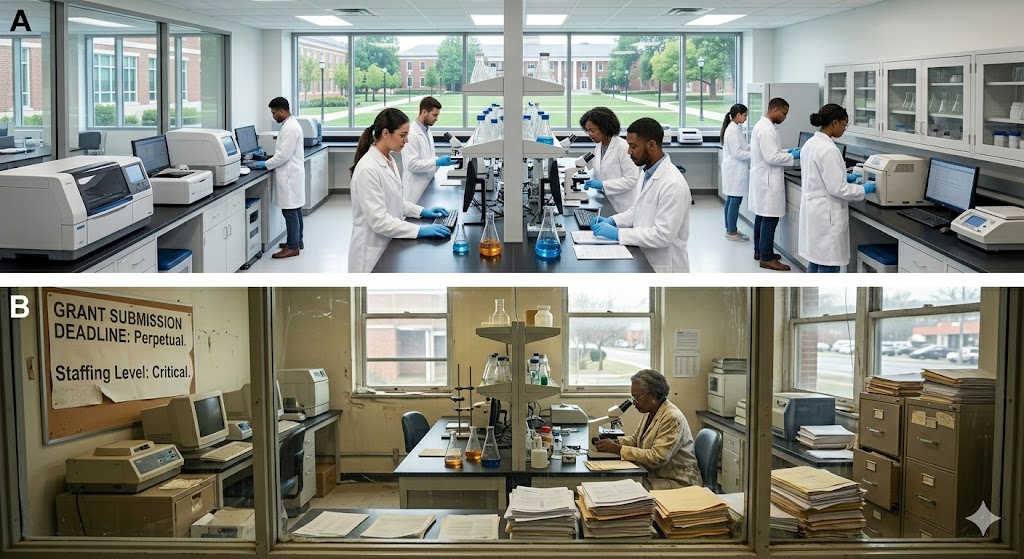
The external funding gap is real. But it exists alongside and is partly enabled by a pattern of institutional self-neglect that the HBCU sector has been reluctant to examine with full candor. Too many HBCU administrations, particularly those overseeing graduate programs, have treated research not as a strategic priority but as a grant-chasing appendage: a necessary line item for federal reporting, a credential for accreditation purposes, something the provost manages while the president attends to enrollment and donor relations. The result is an institutional culture in which research infrastructure is perpetually undercapitalized, grant offices are understaffed, and the graduate school — the engine of every serious research university — is treated as a placeholder for undergraduates (the bulk of most HBCU graduate schools are their own undergraduates) rather than the economic generator it is designed to be. This is not an abstraction. It shows up directly in the HERD rankings.
Howard University, the flagship of HBCU research activity, spent $101.8 million in FY 2024, ranking 178th nationally. North Carolina A&T, which has made the most deliberate institutional bet on STEM research, spent $81.8 million and ranked 192nd. Morehouse School of Medicine spent $68.7 million and ranked 212th. Florida A&M spent $68.7 million and ranked 213th. These are the top tier four institutions spending a combined $321 million out of the sector’s $929 million total. The other 55 institutions divided the remaining $608 million, an average of just $11 million each. And that average flatters the distribution considerably. Grambling State University, one of the most storied names in HBCU history, spent $486,000 in FY 2024, ranked 811th nationally, in the 13th percentile. Shaw University spent $452,000. Coppin State spent $304,000. Mississippi Valley State spent $161,000. Jarvis Christian College spent $150,000. These are institutions with graduate programs, loyal alumni networks, and deep community roots. The research numbers they are producing are not the result of limited potential. They are the result of limited prioritization. There is a meaningful distinction between the two, and the sector has been too comfortable blurring it.
The comparison with peer land-grant and regional public universities is instructive and uncomfortable. A regional public university with comparable enrollment to Morgan State or Tennessee State will typically have a dedicated technology transfer office, a research commercialization incubator, multiple endowed research chairs, and a graduate school that is explicitly linked to the institution’s strategic revenue plan. These are not luxuries at those institutions. They are understood as core infrastructure. At too many HBCUs, they remain aspirational bullet points in strategic plans that are never fully funded.
The institutional neglect of research infrastructure does not exist in a vacuum. It is reinforced and in many ways perpetuated by a philanthropic culture among HBCU alumni that directs dollars toward the visible and the sentimental rather than the strategic. Ask an HBCU alumni association what its fundraising priorities are, and the answers are predictable: scholarships, athletics, the marching band, campus beautification, the homecoming experience. These are not illegitimate priorities. Scholarships keep students enrolled. A great homecoming is an institutional identity statement. But they are not the investments that build research universities, and the gap between where HBCU alumni philanthropy flows and where HBCU research infrastructure requires investment is one of the most consequential misalignments in Black institutional life.
The problem is structural and informational. HBCU alumni, by and large, do not know what their institutions’ research portfolios look like. They do not know that their alma mater ranks in the 13th percentile of national research expenditures. They do not know that the graduate school is operating without a dedicated technology licensing office. They have never been presented with a case for why endowing a research chair in computational biology or environmental science would generate more long-term institutional value than another scholarship fund. No one has made that case to them, because the institutions themselves have not fully internalized it. PWI alumni are regularly presented with precisely this framing. Major research universities run sophisticated campaigns explaining to their donor bases that an endowed professorship creates a permanent research income stream, that a gift to a technology commercialization fund can generate licensing revenue that multiplies the original gift, that an investment in graduate fellowships attracts research talent that then generates grant overhead that funds the next generation of infrastructure. The cause-and-effect chain from donation to institutional research capacity to economic output is laid out explicitly. HBCU development offices have, with notable exceptions, not made this case. The result is that HBCU alumni who are themselves scientists, engineers, physicians, and entrepreneurs give generously to scholarships while their institutions’ research infrastructure atrophies. They are loyal donors funding an incomplete vision of what their institutions could be.
The competitive gap is widening not only in research expenditure but in the commercialization infrastructure that converts research into institutional wealth and nowhere is that gap more nakedly visible than in patent production. The National Academy of Inventors publishes an annual ranking of U.S. universities by utility patents granted. In 2024, the University of California system led the country with 540 patents. MIT produced 295. The University of Texas system produced 234. Purdue produced 213. Stanford produced 199. Not one HBCU appears anywhere in the top 100. Not Howard. Not NC A&T. Not Florida A&M. The list runs to 100 institutions and ends with universities holding 14 patents each. HBCUs could not place a single institution on it. This is not incidental. It is the downstream consequence of four and a half decades of abdication from the commercialization economy that the Bayh-Dole Act of 1980 made available to every research university in America. That legislation gave universities ownership of discoveries made with federal research funding — a structural gift that created the legal architecture for technology licensing offices, spinoff companies, and the university-based venture ecosystem that now anchors the innovation economies of entire regions. MIT’s technology licensing office has generated billions in cumulative revenue and been instrumental in creating hundreds of companies. Stanford’s equivalent has returned substantial royalty income to its operating budget and endowment for decades. The institutions that built aggressive commercialization infrastructure around Bayh-Dole are now compounding institutional wealth at a rate that has nothing to do with tuition receipts or annual federal appropriations. HBCUs have largely been bystanders to this transformation for forty-five years. Every year that an HBCU produces federally funded research without a pipeline for commercializing it is a year in which intellectual property that legally belongs to the institution is effectively abandoned. The patents are not filed. The licensing agreements are not negotiated. The spinoff companies are not formed. The wealth that research can generate, wealth that is independent of enrollment cycles, tuition sensitivity, and federal political winds is left on the table. When a major technology company funds a research center at MIT or Carnegie Mellon, it is making an investment in an ecosystem that has already demonstrated the capacity to convert that investment into commercially viable output. That ecosystem produced Google. It produced Genentech. It produced the foundational patents behind industries that did not exist a generation ago. The question for HBCUs is not how to be invited into that ecosystem. Invitation is not the goal, and dependence on the goodwill of institutions that have never prioritized Black wealth creation is not a strategy. The goal is to build a parallel ecosystem; one anchored in HBCU research infrastructure, capitalized through the African diaspora, and oriented toward producing the companies, the patents, and the intellectual property that generate Black institutional wealth on a generational time horizon. The African American community has spending power measured in the trillions. The African continent represents one of the fastest-growing concentrations of capital and technological ambition in the world. The Caribbean and broader diaspora hold resources, networks, and markets that no MIT spinoff has been designed to serve. An HBCU-anchored research commercialization ecosystem, built in genuine partnership with diaspora capital rather than in perpetual petition to federal appropriators, is the architecture through which an African American-owned Google becomes imaginable not as aspiration, but as institutional output. Stanford did not produce Google because it got lucky. It produced Google because it had spent decades building the research infrastructure, the technology transfer capacity, the graduate talent pipelines, and the investor relationships that made commercializable discovery an institutional inevitability rather than an accident. HBCUs have the community. They have the talent. They have, in the diaspora, a potential capital base that dwarfs what most research universities could claim at the moment they began building. What they have not yet built is the infrastructure that converts all of that latent capacity into compounding institutional power. That is the work. And it cannot begin until the sector decides that research is not an afterthought it is the foundation.
None of that ecosystem can be built, however, if the students arriving at HBCU research programs have spent their entire academic formation inside institutions that treated STEM as an afterthought. The research university does not begin at the graduate school. It begins at the pipeline that feeds it. The elite PWI research institutions that dominate the HERD rankings and the NAI patent list are not drawing their graduate talent from underfunded schools with overextended teachers and no competition culture. They are drawing from Phillips Exeter, Phillips Andover, and the constellation of elite preparatory institutions that have spent generations building exactly the kind of STEM competition infrastructure (doctoral-level coaches, state-of-the-art laboratories, national Olympiad pipelines) that produces the researchers who then generate the patents and the companies. The African American community once had more than 100 Black boarding schools. Four remain. The collapse of that infrastructure is not unrelated to the HERD data. It is part of the same story. Rebuilding a network of elite Black private day schools and boarding schools institutions explicitly designed as STEM pipelines into HBCUs and from HBCUs into the research economy is not a separate conversation from the one this article is having. It is the upstream chapter of it. An HBCU research ecosystem capable of producing commercially viable intellectual property requires a feeder system that has been preparing Black students for that level of scientific culture since before they arrive on campus. The Eight Schools Association does not produce Intel Science Fair winners by accident. Neither will HBCUs produce the next generation of research scientists, patent-holders, and technology entrepreneurs without building the institutional infrastructure that makes that outcome systematic rather than exceptional.
The deepest problem, however, is one that no federal grant program and no alumni campaign can solve on its own. It is a problem of institutional identity. Research at most HBCUs is understood as the work of a specific class of people: faculty with PhDs, graduate students, grant administrators. It is not understood as the work of the institution. This is a fundamentally impoverished conception of what a research university is, and it has real consequences for both the quantity and the quality of what gets produced. The most research-intensive universities in the world do not operate this way. At institutions where research is genuinely central to the mission, the orientation pervades the entire organization. The facilities management team understands that their work maintains the physical infrastructure on which research depends. Procurement staff understand that how they manage equipment acquisition and vendor relationships affects the cost-efficiency of the research enterprise. The administrative staff in grant offices understand themselves as investigators’ partners, not their compliance monitors. The groundskeepers and custodial staff who maintain the physical environment of laboratories and research spaces are part of an institution that takes seriously what happens inside those spaces. This is not sentimentality. It is operational culture. And it is the difference between institutions that treat research as a revenue center and those that treat it as a credential.
For HBCUs, the argument for this kind of whole-institution research identity is not merely operational. It is strategic and historical. The communities that HBCUs were built to serve have profound, unmet research needs: in environmental health, in medical outcomes, in economic development, in urban infrastructure, in food systems, in financial services. The proximity of HBCUs to those communities — geographic, cultural, institutional — is itself a competitive research advantage that no PWI can fully replicate. Community-engaged research, participatory research models, place-based longitudinal studies of Black American communities — these are areas in which HBCUs have natural authority. But capitalizing on that authority requires treating research as a whole-institution commitment, not a departmental function. It means building research literacy across every level of the institution. It means having honest conversations, from the boardroom to the grounds crew, about what research is, why it matters, and what the institution loses every year it is treated as secondary. Not because every employee will write a journal article, but because institutional culture is built through shared understanding of institutional purpose. When everyone connected to a campus understands that its long-term capacity to serve its community is tied to its research productivity, the institution begins to function differently. Budget priorities shift. Hiring decisions reflect research capacity. Alumni giving conversations expand beyond the sentimental to the strategic.
The institutions already gaining ground demonstrate the model. Morgan State’s growth from $13.6 million in 2015 to $55.5 million in 2024 — a 309% increase — did not come from waiting on Washington. It came from deciding that research was a strategic priority and building the administrative infrastructure to compete for it. Winston-Salem State’s 840% growth over the same period came from targeting federal health research dollars with institutional precision. Delaware State nearly tripled its portfolio. These trajectories prove the capacity exists.
There are also signs that the sector is beginning to grasp the coordination imperative. On April 29, 2026, fifteen HBCUs announced the formation of the Association of HBCU Research Institutions (AHRI), a national coalition explicitly designed to accelerate research capacity, increase the number of HBCUs achieving R1 Carnegie Classification, and expand collective policy influence. The founding membership includes Howard, the sector’s only R1 institution, alongside thirteen R2 institutions: Clark Atlanta, Delaware State, Florida A&M, Hampton, Jackson State, Morgan State, NC A&T, Prairie View A&M, South Carolina State, Southern University, Tennessee State, Texas Southern, and Virginia State. Collectively, AHRI’s members account for roughly half of all competitively awarded federal research funding among HBCUs. The coalition is co-located with the Association of American Universities and has secured a three-year, $1 million grant from Harvard’s Legacy of Slavery initiative, with Harvard’s Office of the Vice Provost for Research providing technical assistance. The formation of AHRI is the most substantive structural move the HBCU research sector has made in a generation, and it deserves to be recognized as such. But one million dollars over three years, measured against a sector-wide research gap of hundreds of millions annually and a patent economy in which HBCUs hold zero of the top 100 positions, is a foundation, not a solution. The significance of AHRI is not the capital it has raised. It is the architecture it represents — fifteen institutions deciding that isolation is no longer a viable strategy. If that architecture is built upon seriously, capitalized at the scale the HERD data demands, and extended to the 44 HBCU/PBI institutions not yet in the coalition, it becomes the organizational infrastructure through which the ecosystem this article has described can actually be constructed. If it becomes another announcement without a follow-through funding strategy, the HERD Survey will record the same story in 2034 that it has recorded every year since 2015.
But the formation of AHRI also demands a harder question that the coalition’s announcement did not address: how much genuine institutional autonomy do its member institutions actually have? Research strategy is a function of institutional governance. An institution that cannot independently set its research agenda, control its own board appointments, or protect its leadership from politically motivated interference cannot build the kind of sustained, multi-year research infrastructure the HERD data demands regardless of what coalition it joins. This is not a hypothetical concern. Prairie View A&M, one of AHRI’s founding members, operates within the Texas A&M University System, a governance structure in which the flagship institution’s interests, priorities, and resource allocation decisions do not always align with those of a historically Black land-grant whose research mission serves a fundamentally different community. The degree to which Prairie View can pursue an independent research commercialization strategy, build its own technology transfer infrastructure, or make unilateral decisions about patent filing and licensing within that system is a question the coalition’s formation does not resolve. Texas Southern, another AHRI founding member, has experienced more direct interference: its board has been subject to hostile gubernatorial appointments that resulted in the termination of institutional leadership in ways that the broader HBCU community recognized as reflecting political interests rather than institutional ones. Tennessee State has faced comparable dynamics, with the state’s Republican-controlled legislature effectively vacating its board and replacing it with gubernatorial appointees, a maneuver that places the strategic direction of a public HBCU in the hands of an administration with no particular stake in HBCU research excellence. An HBCU that cannot protect its own president, control its own board, or govern its own research agenda is not positioned to build a serious research enterprise regardless of its AHRI membership. The coalition is only as strategically coherent as the institutional autonomy of its members. That autonomy, for several of its founding institutions, is not guaranteed. It is contested.
The structural argument that the data ultimately forces is this: no external actor — no administration, no Congress, no philanthropic initiative operating at current scales — has demonstrated the will to close a gap this large. Replicating and scaling what the sector’s fastest-growing research institutions have done requires HBCU administrations to stop treating their research enterprises as afterthoughts, HBCU alumni to stop treating their philanthropy as sentiment, and HBCU communities to start treating institutional research capacity as what it actually is — a long-term economic and political asset that compounds in value every year it is invested in, and deteriorates every year it is not.
The HERD Survey is updated annually. And annually, the same story is told. The question is whether the institutions that story concerns have finally decided to write a different one.
Data sourced from the National Center for Science and Engineering Statistics, Higher Education R&D Survey (HERD), FY 2015–2024; and the National Academy of Inventors, 2024 Top 100 U.S. Universities Granted U.S. Utility Patents. All HERD expenditure figures are in thousands of current dollars.
Disclaimer: This article was assisted by ClaudeAI.
HBCUs are more than just schools, they are a home. – Chadwick Boseman
The paradox is impossible to ignore: African American communities consistently champion the importance of buying Black and supporting Black-owned businesses, yet when it comes to what may be the largest purchase of a lifetime, a college education, the overwhelming majority of Black families choose to invest those dollars elsewhere. This decision has profound consequences for the survival and strength of Historically Black Colleges and Universities, institutions that remain pillars of Black achievement, economic mobility, and community power.
As of Spring 2025, approximately 19.4 million students are enrolled in U.S. colleges and universities, with about 15 million undergraduates and over 3 million graduate students, according to data from the National Student Clearinghouse Research Center reported by NPR and BestColleges. This enrollment represents a recovery from pandemic-era declines, though numbers remain below 2010 peaks. African American students comprise roughly 13-15% of this total enrollment, representing approximately 2.5 to 2.9 million students across all institution types. When we calculate the economic value of these students based on current tuition rates, the numbers are staggering.
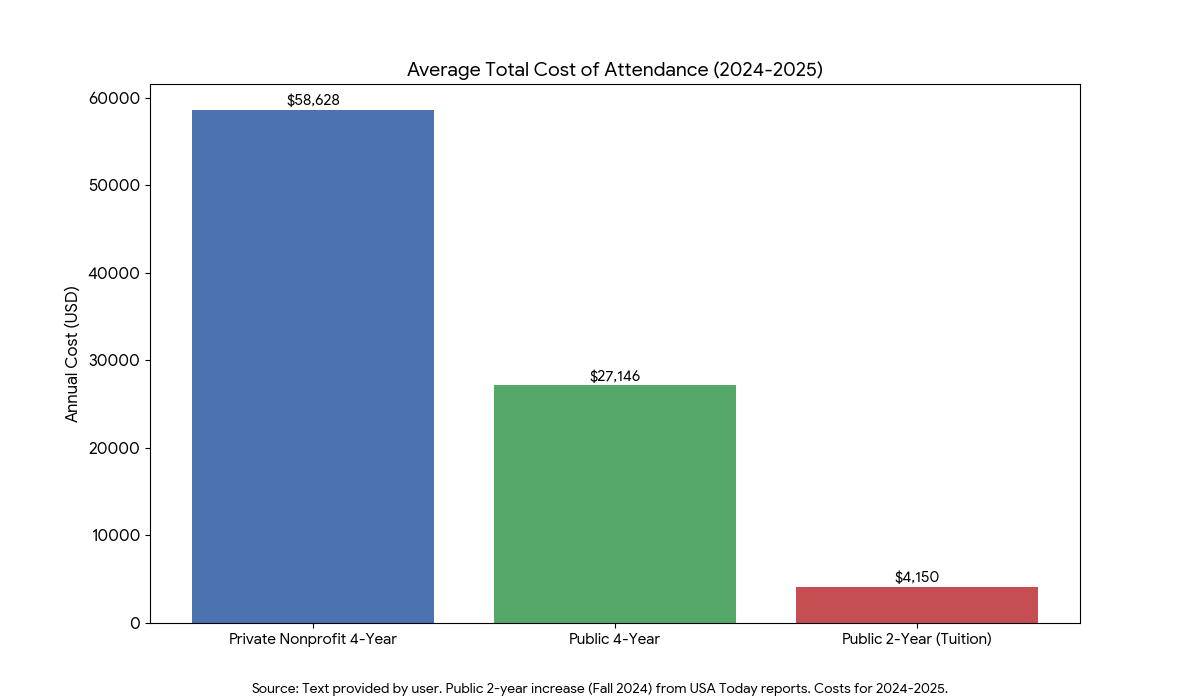
For the 2024-2025 academic year, public four-year institutions charge approximately $11,950 for in-state students and $31,880 for out-of-state students. Private nonprofit four-year schools average around $45,000 in tuition and fees. Public two-year colleges, which experienced a 3% enrollment increase in Fall 2024 according to USA Today reports, charge an average of $4,150 for in-district students. When you factor in room and board expenses, which averaged $13,310 for 2024-2025, the total cost of attendance reaches approximately $27,146 at public four-year institutions and $58,628 at private nonprofit four-year schools. Using a weighted average cost of attendance of approximately $26,000-$28,000 per year across all institution types, African American students and their families collectively spend approximately $64 billion annually on higher education. This represents enormous purchasing power—power that could transform Black institutions and communities if redirected strategically.
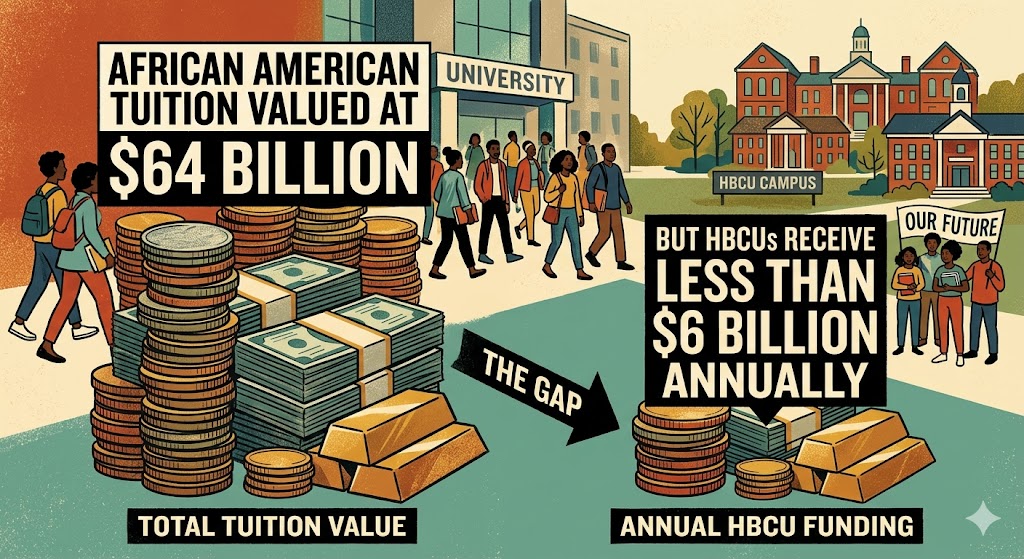
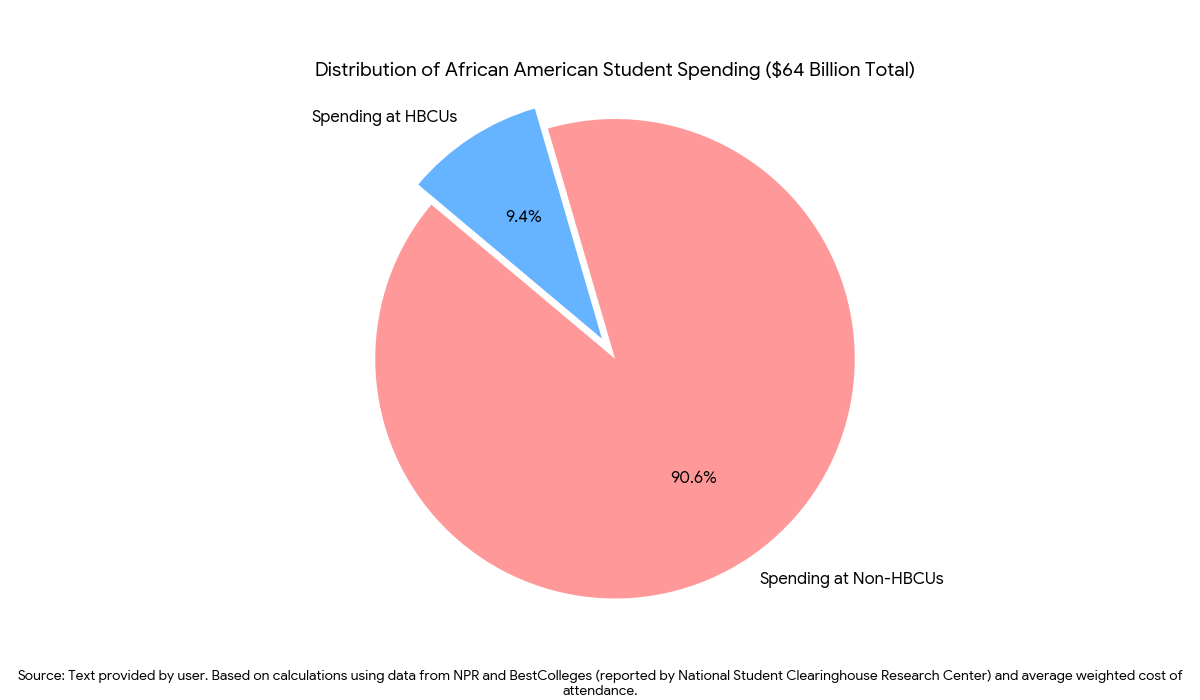
Here’s the uncomfortable truth: of that $64 billion, African American students at HBCUs represent only about $6 billion in tuition revenue and that $6 billion is essentially all HBCUs have to work with. Unlike predominantly white institutions with massive endowments, substantial state funding, and robust donor bases, HBCUs are almost entirely tuition-dependent. This means that more than 90% of African American education dollars approximately $58 billion annually flow to institutions that were not built for us, by us, or with our advancement as their primary mission.
We talk extensively about supporting Black businesses, banking Black, and keeping dollars circulating in our communities. Yet when families sit down to make college decisions, often the single largest financial investment they will make outside of purchasing a home, the conversation shifts. Suddenly, the narrative becomes about rankings, prestige, resources, and opportunities at predominantly white institutions, while HBCUs are considered as backup options or dismissed entirely.
This pattern has devastating consequences. The approximately 222,300 African American students currently enrolled at HBCUs generate roughly $6 billion in tuition revenue and for most HBCUs, that tuition revenue represents the vast majority of their operating budgets. Unlike well-endowed predominantly white institutions that rely heavily on endowment returns, substantial state appropriations, federal research grants, and robust alumni giving, HBCUs are critically dependent on tuition dollars just to keep their doors open. When Black students choose to take their tuition dollars elsewhere, it directly threatens these institutions’ survival, limiting their ability to maintain programs, hire faculty, upgrade facilities, and provide student services.
The impact extends far beyond immediate operating budgets. Every student who chooses a predominantly white institution over an HBCU represents not just lost tuition revenue today, but lost philanthropic potential tomorrow. Alumni giving is the lifeblood of institutional endowments, and alumni tend to give most generously to the institutions they attended. When successful Black professionals graduate from predominantly white institutions, their alumni donations when they give at all flow back to those schools. Harvard, Yale, Stanford, and other elite institutions benefit from the success of Black graduates who might have attended HBCUs if those institutions had received even a fraction of the resources concentrated at the top of higher education’s hierarchy. Meanwhile, HBCU endowments remain comparatively microscopic, not because their graduates are less successful, but because there are fewer of them writing checks back to their alma maters.
This creates a vicious cycle. Smaller enrollment means less tuition revenue and for institutions operating almost entirely on tuition, this is an existential threat. Fewer graduates means smaller donor pools. Smaller donor pools mean smaller endowments. Smaller endowments mean even greater dependence on tuition revenue and less money for scholarships, facilities, and programs. Less competitive resources make it harder to attract students. And the cycle continues, generation after generation.
The wealth gap between HBCU endowments and those of predominantly white institutions is staggering and growing. Howard University recently became the first HBCU to cross the $1 billion endowment mark, a milestone that should be celebrated but instead highlights the crisis. The top 10 HBCU endowments combined total approximately $2.6 billion. Meanwhile, Harvard University’s endowment alone exceeds $50 billion, and the top 10 predominantly white institutions hold a combined $336 billion in endowments. The PWI-to-HBCU endowment gap stands at 129 to 1. Only one HBCU has an endowment over $1 billion, while 148 predominantly white institutions have endowments exceeding that mark. This disparity means that while HBCUs scrape by on tuition revenue with minimal endowment support, elite PWIs can offer generous financial aid packages funded by massive investment returns, making them appear more affordable even as they siphon Black student dollars away from Black institutions.
In barbershops and beauty salons, at family gatherings and community events, the conversation about economic empowerment is constant. We discuss the importance of circulation of Black dollars, the need to build generational wealth, and the imperative of supporting institutions that support us. Social media amplifies calls to buy Black, support Black-owned restaurants, use Black banks, and patronize Black professionals. Yet somehow, this collective consciousness evaporates when it’s time to choose a college. Parents who wouldn’t think twice about driving across town to support a Black-owned business will encourage their children to attend predominantly white institutions without seriously considering HBCU alternatives. Students who wear “support Black business” t-shirts apply exclusively to schools where they will be a small minority, where their history may be marginalized, and where their dollars will fund institutions with no historical commitment to Black advancement.
This isn’t about judgment these are rational decisions made by families trying to secure the best possible future for their children in a competitive world. The problem is that these individual rational choices, when aggregated, produce a collective outcome that weakens the very institutions most committed to Black success.
Consider what HBCUs accomplish with their fraction of African American education dollars. These institutions enroll approximately 10% of all African American college students but produce nearly 20% of Black graduates. They generate an even higher percentage of Black professionals in critical fields like engineering, medicine, and education. The majority of Black doctors, a disproportionate share of Black lawyers, and a significant portion of Black educators earned their degrees from HBCUs. HBCUs create environments where Black students see themselves in positions of leadership, where their history and culture are centered rather than marginalized, and where they build networks that last lifetimes. Research consistently shows that Black students at HBCUs report higher levels of engagement, stronger sense of belonging, and greater confidence in their abilities compared to Black students at predominantly white institutions.
They accomplish all of this while operating on budgets that would be considered inadequate at any predominantly white institution. They make miracles happen with limited resources, outdated facilities, and faculty salaries that make it difficult to compete for top talent. Imagine what they could do with just a fraction of that $64 billion currently flowing elsewhere.
The numbers tell a stark story. Approximately 292,500 students currently attend HBCUs, with African American students comprising about 76% of that enrollment roughly 222,300 Black students. At an average cost of attendance of $26,000-$28,000 annually, these students represent approximately $6 billion in tuition revenue flowing to HBCUs each year. Meanwhile, the remaining 2.3 to 2.7 million African American college students roughly 90% of all Black college students generate approximately $58 billion in tuition revenue for predominantly white institutions.
Think about that ratio: $6 billion staying in Black institutions versus $58 billion leaving them. This isn’t about equity or fairness this is about economic power and where we choose to deploy it. Every semester, Black families collectively make purchasing decisions that send nearly ten times more money to institutions with no historical commitment to Black advancement than to institutions that were literally built to educate us when no one else would.
The enrollment landscape is shifting. Spring 2025’s 19.4 million total enrollment shows growth in both undergraduate and graduate programs. Particularly significant is the 3% surge in community college enrollment in Fall 2024, suggesting that cost considerations are increasingly driving educational decisions. This cost consciousness presents an opportunity. As families become more aware of student debt burdens and question the return on investment of expensive predominantly white institutions, HBCUs offer compelling value propositions. But they can only compete if they have the resources to tell their stories effectively, maintain quality programs, and provide the support services today’s students expect.
The net price reality adds another dimension. While published tuition rates provide a baseline, actual costs after financial aid vary significantly, typically ranging from $17,000 to $25,000 depending on institution type. However, African American students often face higher net prices than their peers at the same institutions due to lower family wealth and less access to non-loan aid. This means Black families are stretching further financially, taking on more debt, and working more hours often to attend institutions with no particular commitment to Black student success.
The solution requires a fundamental shift in how we think about educational choices. White families don’t agonize over whether to “give HBCUs a chance” they automatically prioritize their own institutions. They attend state flagships, legacy schools where their parents and grandparents went, institutions that have accumulated centuries of wealth from their community’s investment. They don’t need to be convinced to support their own. Yet somehow, Black families have internalized a narrative that HBCUs are noble but limited, worth considering but not prioritizing, respectable but not prestigious. This is the mental colonization that costs us $58 billion annually.
We need to be as intentional about our education spending as we claim to be about supporting Black businesses. This means making HBCUs the default choice, not the backup plan. It means understanding that when white families send their children to their flagship state universities and legacy institutions, they’re not making a sacrifice they’re making an investment in institutional power that compounds over generations. Black families deserve the same mindset. The choice of where to spend education dollars is an economic decision with ramifications far beyond individual degree attainment. It’s about building institutional power that can withstand political and social headwinds.
Institutional strength matters. Strong HBCUs create jobs in Black communities, anchor local economies, generate Black wealth through employment and contracts, and serve as catalysts for community development. They provide platforms for Black intellectual leadership, preserve and advance Black culture, and create networks of mutual support that span generations and geographies. In an increasingly uncertain social and political environment, the importance of strong Black institutions becomes even more apparent. When external support proves unreliable, when political winds shift, when social progress reverses, communities need institutions they control and can depend on. HBCUs represent exactly that kind of institutional foundation.
The question isn’t whether HBCUs deserve support their track record speaks for itself. The question is whether African American families will align their spending decisions with their stated values around Black economic empowerment. That $64 billion represents power—power to build, strengthen, and sustain institutions that have proven their commitment to Black success. How we choose to deploy that power will determine whether HBCUs merely survive or truly thrive in the generations ahead.
The choice is ours. The power has always been ours. The question is whether we’ll use it.
Disclaimer: This article was assisted by ClaudeAI.
Africans in the United States must remember that the slave ships brought no West Indians, no Caribbeans, no Jamaicans or Trinidadians or Barbadians to this hemisphere. The slave ships brought only African people and most of us took the semblance of nationality from the places where slave ships dropped us off. – Dr. John H. Clarke
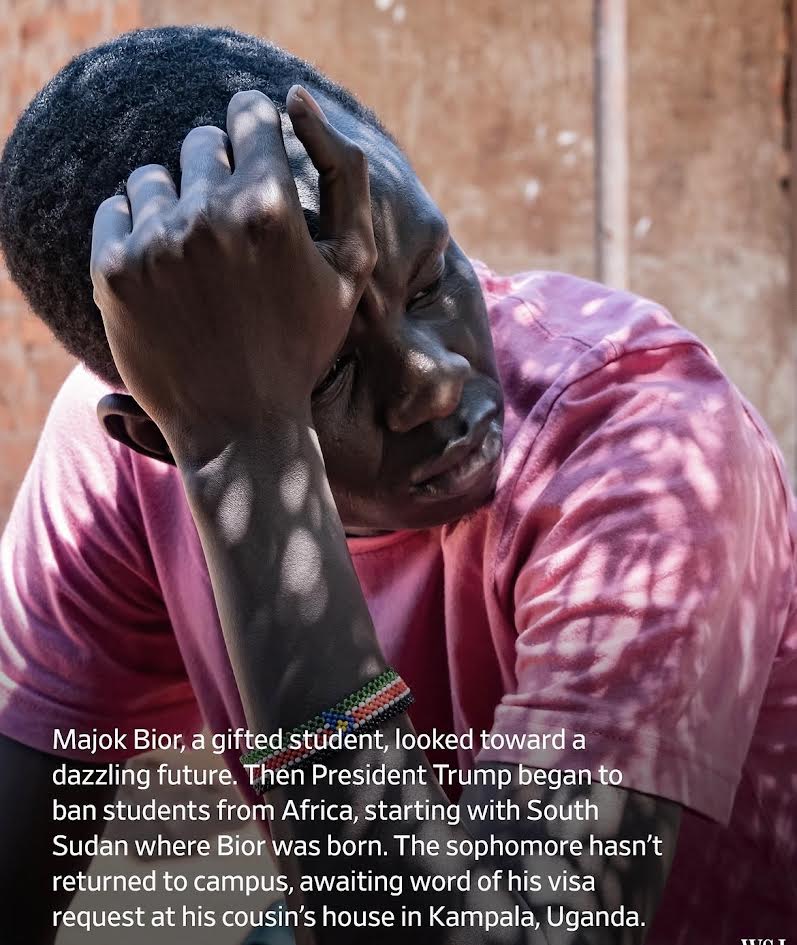
Photo from the Wall Street Journal
The photograph of Majok Bior, a South Sudanese computer science sophomore at Duke University, stranded at his cousin’s home in Kampala after the Trump administration’s travel restrictions invalidated his visa — has circulated widely as a symbol of individual suffering. And it is that. But to read it only through the lens of personal tragedy is to miss the structural dimensions of what is unfolding across American higher education, and to miss, in particular, what this moment means for HBCUs.
The Trump administration’s travel ban, initially signed on June 4, 2025, targeted 12 countries and placed partial restrictions on seven more, covering a geography concentrated in Africa and the Middle East. By December 2025, that list had expanded to 39 countries and territories, with Nigeria, historically one of the top ten sources of international students in the United States, placed under partial restrictions effective January 1, 2026. Individuals in Nigeria will not be able to receive student visas beginning January 1. Secretary of State Marco Rubio has signaled further expansion, with a State Department memo identifying 36 additional countries for potential restriction, including 25 African nations as well as countries in the Caribbean, Central Asia, and the Pacific Islands. If that expansion proceeds, the policy will have effectively severed the institutional connection between American higher education and the African continent.
For HBCUs specifically, this is not a distant geopolitical event. It is a direct threat to an enrollment strategy, a revenue base, and a civilizational relationship that institutions have spent decades building.
To understand the financial stakes, one must first understand how international student enrollment became integral to the fiscal architecture of many HBCUs. In addition to the tuition money international students often bring, many foreign students pay the full sticker price, often aided by their home countries’ governments there are benefits for HBCUs’ American students as well. International students, particularly those arriving with government-funded scholarships from Nigeria, Ghana, Saudi Arabia, and other nations, have served as a reliable source of full-fare tuition revenue at institutions that chronically lack the endowment depth to absorb enrollment volatility.
Among HBCUs with ten or more international students, Morgan State had the most as of the 2017-18 academic year, with 945 students; Howard was second with 920; and Tennessee State third with 584, according to the Institute of International Education. These numbers have only grown. Tennessee State, for instance, went from 77 international undergraduate students in 2008-09 to 549 by fall 2016 representing roughly 8 percent of its undergraduate student body. Across the sector, African students from Nigeria and Ghana historically constituted a significant share of that international cohort.
The financial logic was sound. A university with modest endowment holdings and only one HBCU, Howard University, currently holds an endowment exceeding $1 billion, cannot easily absorb the loss of a tuition-paying population without triggering cascading institutional consequences. When full-fare international students leave an enrollment ledger, the institution must either raise tuition on domestic students who are often already Pell Grant-eligible, draw down reserves, reduce staffing, or curtail academic programs. In a sector where financial fragility is not the exception but the norm, any of those choices carries compounding institutional risk. Preliminary projections by NAFSA and international education research partner JB International predict a 30 to 40 percent decline in new international student enrollment, leading to a 15 percent decline in overall enrollment this fall and loss of $7 billion within local economies and more than 60,000 jobs. That system-wide figure masks the disproportionate exposure at institutions whose international student populations are concentrated in African countries now under restriction.
The financial dimension, however, is only the first tier of the problem. The more consequential loss may be strategic: the slow dismantling of an institutional relationship between HBCUs and Africa that has been a defining feature of both parties’ long-term development. For decades, HBCU campuses have served as one of the primary entry points for African students seeking American credentials and professional networks. The relationship has never been purely transactional. It has been civilizational, rooted in a shared recognition that the institutional capacity of the African diaspora, on both sides of the Atlantic, depends on the training and circulation of its most capable people. Howard University, Morgan State, Florida A&M, and Tennessee State have all cultivated significant African student communities that returned home as engineers, physicians, lawyers, economists, and public administrators, seeding institutions across the continent with HBCU-educated professionals.
That pipeline is now interrupted. Majok Bior is one face of the disruption. He is also, statistically, the kind of student, a full-scholarship computer science talent, whose skills and networks would have contributed meaningfully to either the American or the African institutional ecosystem over the subsequent decades. The State Department’s position is unambiguous. There is no appeals window, no informal pathway, no consular discretion available to students like Bior whose visas were invalidated mid-enrollment. The pipeline does not merely slow. It stops.
The administration has signaled it may further target sub-Saharan Africa for future travel bans. Twenty-four of the 36 countries identified as future ban candidates are in sub-Saharan Africa. If all 24 were to be hit with bans, an additional 71 percent of the region’s population would be affected. At that scale, the policy would not merely interrupt an enrollment channel. It would functionally close the institutional bridge between American HBCUs and the African continent.
The arrivals data make the stakes concrete. The number of new and returning African students arriving in the United States for the 2025 fall semester fell by nearly a third from the previous year, according to preliminary Commerce Department data. Arrivals from Nigeria and Ghana, which historically send more students to the United States than any other African countries, dropped by roughly half. Those are not marginal declines. They represent a structural break in the flow of talent that has sustained both HBCU campuses and the professional networks those campuses anchor.
The broader context amplifies the damage. HBCUs have been managing a long-running tension between their mission to serve African American students and the enrollment arithmetic that increasingly pushes them toward diversification. Black student enrollment at HBCUs increased by just 15 percent from 1976 to 2022, while enrollment of students from other racial and ethnic groups rose by a staggering 117 percent during the same period. Within that context, African international students have occupied an important, if underappreciated, position: they are enrolled students who are Black, who arrive often with external funding, and who align with the cultural mission of the institution in ways that students from other international communities do not. The loss of this population does not merely reduce headcount. It removes a category of student whose presence reinforces the intellectual and cultural identity of HBCU campuses while simultaneously contributing to their revenue base.
HBCU leaders should resist the temptation to treat the current moment as a policy problem requiring a policy solution that is, to wait for a change in administration or a favorable court ruling before taking action. The institutional response must be proactive, and it must be organized at the sector level rather than institution by institution.
The first imperative is legal and advocacy coordination. HBCUs should be visible participants in the coalition of higher education institutions pushing back against travel ban expansion. The legal challenges already filed by some universities have produced limited court-ordered exceptions. HBCU presidents, through their associations and individually, possess a particular moral authority in this argument: these institutions were founded on the principle that the state should not determine who deserves access to education. That founding logic has direct application to the current moment, and its articulation should not be left to the advocacy organizations of predominantly white institutions alone.
The second is the construction of alternative enrollment infrastructure. Several countries whose students are not currently restricted represent significant untapped pipelines for HBCUs including Kenya, Ethiopia, South Africa, and several francophone West African nations not yet under full restriction. Morgan State’s international enrollment tripling between 2014 and 2017, driven by a concerted recruitment strategy, demonstrates that rapid scaling is possible when institutions make it a priority. The question now is whether that kind of deliberate enrollment strategy can be retargeted toward countries where the policy environment remains navigable.
The third imperative, and the most consequential for the long run, is the development of transnational academic infrastructure that does not depend on American visa policy at all and here the sector does not need to theorize. It already has a model. Claflin University, an HBCU in Orangeburg, South Carolina, and Africa University in Zimbabwe have together built and delivered a fully online Master of Science program in Biotechnology and Climate Change, producing their first cohort of graduates in 2025. The program requires no visa, no transatlantic relocation, and no dependence on the goodwill of a State Department consular officer. It delivers graduate-level credentials, anchored to an HBCU’s academic infrastructure, to scholars who remain embedded in the African communities they will eventually serve. That is not a symbolic gesture. It is a replicable institutional architecture — one that severs the link between American immigration policy and the HBCU-Africa educational relationship at precisely the point where that link has proven most vulnerable. The disciplines selected are themselves strategic: biotechnology and climate change are among the fields where African scholars have the most urgent applied work to do, and where the absence of well-trained researchers carries the steepest institutional cost. What Claflin and Africa University have built is a proof of concept for the entire sector. Howard, Morgan State, Florida A&M, and Tennessee State, institutions that have already invested in African student pipelines and cultivated international enrollment are positioned to extend this model into additional disciplines, additional partner institutions, and additional countries. Students who were considering coming in 2026 will be discouraged and will be looking to other destinations, as one international education expert has observed. If those students go elsewhere, HBCUs should be competing to ensure that some of that “elsewhere” is a degree program bearing an HBCU’s name, delivered on African soil, through African partner institutions, and impervious to the policy preferences of any particular American administration.
The image of Majok Bior waiting in Kampala is a human document. But it is also an institutional document. It records the moment when an African student who had successfully navigated the American credentialing system, who had won a full scholarship, enrolled in computer science, played intramural soccer, and survived chemistry class was extracted from that system not by any failure of his own but by a federal policy aimed at restricting the movement of African people into American institutions. HBCUs were built precisely because such exclusions were once the default condition of American higher education. The institutional memory of that history is not a rhetorical resource. It is a strategic asset, a basis for understanding that the institutions which serve communities without consistent access to political protection must always be building structures that can survive the withdrawal of that protection. The Africa travel ban is an HBCU problem. The sector’s response to it will reveal something important about whether these institutions have developed the depth and coordination to meet a challenge that is, in its essential structure, the same challenge they were built to confront.
Disclaimer: This article was assisted by ClaudeAI.