Tag Archives: HBCU economics

The Income Gap Beneath the Aesthetic: Why African American Lifestyle Aspirations Outpace Economic Reality

Imagine a family that built a house. Not inherited it, not stumbled into it but built it, board by board, through discipline, ingenuity, and collective sacrifice. The house was real. It had rooms filled with furniture, a business on the corner, a bank down the street, a school nearby. The neighborhood thrived because the institutions within it were strong and self-reinforcing. Then the neighbors burned it down. Not metaphorically — burned it down, seized the land, rewrote the deed, and walked away with the tools. This happened not once but repeatedly, across generations and geographies, through legal architecture and extralegal violence alike. The family’s anger is entirely justified. The theft was real. The arson was documented. The loss was total and the perpetrators largely unaccountable.

But the house still needs to be rebuilt.

And here is the hard truth that justified anger cannot dissolve: the rebuilding requires the same discipline, ingenuity, and collective sacrifice as the original construction perhaps more, because this time it must be built with proper defenses. Stronger foundations. Diversified income streams. Institutions designed to survive hostility rather than assume good faith. The family cannot afford to rest in the rubble and call it protest. It cannot furnish an unbuilt house with aspirational spending and call it progress. The grief is legitimate. The rage is warranted. But neither grief nor rage lays a single board. The house demands builders, and builders before they can rest, must first build.

There is a structural mismatch at the center of African American economic life that rarely receives the frank, quantitative examination it deserves. The cultural aspiration toward comfort, leisure, and luxury, a posture increasingly celebrated under the banner of the “soft life” has emerged with real force and not without moral legitimacy. The desire to rest, to be unburdened, to live well is a reasonable human aspiration, and for Black women in particular it carries the weight of generations of overextension. But aspiration untethered from income architecture is not a lifestyle strategy it is a financial liability. And the numbers, examined without sentiment, make the case plainly: African American household income does not currently support the consumption patterns and life expectations that have come to dominate the cultural conversation.

This is not a moral indictment. It is a structural diagnosis. The soft life is not wrong. The economics are simply not there yet.

The median weekly earnings for Black full-time workers in the first quarter of 2024 stood at $908 compared to $1,157 for White workers and $1,505 for Asian workers. Annualized, this places median Black worker earnings at approximately $47,200. The median household income for African Americans reached $56,020 in 2024, compared to a national average household income of $83,810 and a White household average of $124,500. Some 61.8% of African American households earn less than $75,000 annually, and only 27% of Black households exceed $100,000 in income, a threshold that 46.8% of White households surpass. These are not marginal differences. They are structural chasms that determine what households can afford to save, invest, and build.

The income gap is not merely a matter of aggregate shortfall. It is a function of occupational concentration. African Americans remain dramatically underrepresented in the highest-earning career categories: STEM-based science and engineering, investment finance, business ownership at scale, and the upper tiers of corporate management. In 2021, Black or African American workers in science and engineering occupations had median earnings of $59,800, the lowest among racial and ethnic groups tracked, compared to $107,900 for Asian workers in the same fields. The salary premium that STEM careers offer over non-STEM work exists for Black workers, but the participation rate limits how broadly that premium reaches across the community. Nearly 58% of Black or African American workers are employed outside of science, engineering, or STEM-related areas entirely.

The gender dimension of this problem is frequently misread. African American women have achieved meaningful gains in labor force participation and educational attainment, outpacing Black men in college enrollment by a substantial margin. But participation rates and credential accumulation have not translated into equivalent entry into high-compensation fields. Black women are heavily represented in management roles, the service industry, sales, and office occupations — sectors characterized by modest wage ceilings and limited equity upside. Black women’s median weekly earnings of $887 represent 85.3% of White women’s earnings of $1,040 — a gap that, while narrower than the male-to-male disparity, still accumulates into meaningful lifetime income deficits. More critically, neither the occupational profile of Black men nor that of Black women places either group in proximity to the financial services, technology entrepreneurship, or ownership-class economics that generate the kind of income and wealth capable of sustaining the consumption expectations that aspirational culture projects.

There is, however, a dimension of the income problem that earned wages alone cannot fully illuminate, and it may be the most telling of all: passive income. Wealth that works while one sleeps through dividends, rental income, business distributions, and interest is not a luxury feature of the financial system. It is the mechanism by which all other wealth gaps compound and perpetuate. Only 7% of Black households report receiving passive income from sources such as rental properties, interest, dividends, or business ownership compared to 24% of White households. And when such income does exist, the median amount for Black families is approximately $2,000 annually, compared to nearly $5,000 for White households. This is not a secondary observation. It is the statistical signature of a community almost entirely excluded from the capital class — the tier of economic life where money generates more money without additional labor.

The implications of that exclusion are severe. Black households rely more heavily on wages and salaries rather than passive income streams, and without accumulated wealth or financial investments, it becomes harder to transition from relying solely on wages to generating income passively. The debt burden compounds this further: Black households tend to carry higher levels of student loan debt relative to income, which reduces the disposable income that could otherwise be directed toward wealth-generating assets. This is the trap in precise structural terms: earned income is consumed servicing debt, leaving no surplus to convert into the asset base that generates passive returns. Each month begins at zero. Each generation inherits the same constraint. The soft life as aspiration sits atop this architecture and finds no foundation.

The consequence of this occupational and income reality extends further into household formation. The marriage rate among African Americans has fallen from approximately 60% in the 1960s to just 29% in 2021. This matters economically in ways that exceed the social commentary often surrounding it. Black married couples had a median net worth of $131,000 in 2019, compared to only $29,000 for Black single individuals — a gap of roughly three to four times. The dual-income household is not merely a social arrangement; it is a capital formation mechanism. Two modest incomes, pooled and directed strategically, can accomplish what a single income, however aspirationally deployed, cannot. When household formation rates decline, the financial unit of account shrinks. The result is not simply less comfort it is structurally constrained savings capacity, reduced homeownership rates, diminished retirement security, and negligible investable surplus.

This brings the soft-life discourse into direct collision with economic arithmetic. The soft life, as a cultural concept, carries entirely legitimate roots. The desire to step back from overextension is not irrational; it is self-preserving. But the aspiration as it has been culturally operationalized — emphasizing travel, luxury goods, minimal work, and premium consumption — requires an income infrastructure that the median African American household does not possess. The soft life as an aesthetic has spread across a community where, the median Black household holds just $44,100 in net worth compared to $284,310 for White households or roughly 15 cents for every dollar White households possess. The median Black household has only $2,200 in checking and savings accounts, approximately a fifth of what White households hold. Aspirational consumption layered over that wealth foundation does not produce liberation. It produces debt.

Consumer credit among African American households climbed to $740 billion in 2024, representing nearly 48% of all African American household liabilities and growing at more than double the rate of asset appreciation. The shift toward unsecured, high-interest borrowing to fund present consumption represents the structural outcome of a community whose income and wealth positions do not support the lifestyles being pursued. With African American-owned banks holding just $6.4 billion in combined assets, the vast majority of that $1.55 trillion in household liabilities flows to institutions outside the community meaning that interest payments, fees, and the wealth-building potential of lending relationships are being systematically extracted from the Black institutional ecosystem. The community is not simply spending beyond its means; it is doing so in a way that enriches external financial institutions rather than its own.

The comparison with other groups is instructive precisely because it is structural, not cultural. Households that have accumulated generational wealth, that inherit homes rather than rent them, that receive family capital for business formation or down payments, that can distribute housing costs across extended family networks, or that have parents who absorb the student debt burden — those households operate from a fundamentally different economic baseline. The aspiration toward leisure and comfort that is financially reasonable for households with $284,000 in net worth, with 24% receiving passive income, is not the same proposition for households with $44,000 in net worth, with $26,000 in student loan debt, and fewer than one in ten receiving any passive income whatsoever. This is not a commentary on character. It is a commentary on compound arithmetic.

The three missing pillars; high-income career concentration, passive income streams, and wealth-building household formation, reinforce one another in ways that make each individually insufficient to close the gap. High earned income without passive income accumulation remains treadmill economics: impressive in the short run, exhausting across a lifetime, and non-transferable across generations. Passive income without the earned income base to seed initial investments is equally out of reach for most households. And both are more difficult to build and sustain outside of the two-income, asset-pooling household structure that marriage has historically provided. The causality runs in a specific direction: institutional infrastructure creates the conditions for sustainable individual and collective wealth building, not the other way around. But at the household level, the sequencing is equally specific where earned income must first be directed toward asset acquisition rather than consumption, and those assets must be allowed to compound before comfort becomes the organizing principle of financial life.

What the data demand is a recalibration of collective strategy, beginning with income generation at the individual level and extending upward through institutional infrastructure. The income problem is real and addressable, but it requires African Americans — men and women alike — to direct educational and career investments toward the highest-compensation fields in the economy: engineering, software development, quantitative finance, medicine, law at the partnership track, and scalable business ownership. The wage premium of STEM occupations over non-STEM work stands at roughly $19,100 per year even at the median. But earned income must be understood as the raw material for wealth, not the destination. The destination is an asset base generating passive returns — the condition that makes rest not just emotionally justified but financially sustainable.

The institutional dimension cannot be separated from either the income or the passive income dimension. If approximately 95% of African American debt is held by non-Black institutions, and that debt carries an average interest rate of 8%, African American households collectively transfer roughly $120 billion annually in interest payments to institutions with no vested interest in Black wealth creation. That capital hemorrhage occurs upstream of any lifestyle decision. It is the structural tax imposed by institutional absence, the cost of lacking the banking, investment, and insurance infrastructure to retain and recirculate capital within the community. The passive income gap is not only a personal finance failure; it is the individual-level expression of institutional underdevelopment. Communities that have strong banks, investment firms, and cooperative capital structures create the conditions in which their members can access investment vehicles, receive competitive lending terms, and build the asset portfolios that generate passive returns. Those institutions do not yet exist at adequate scale for African America.

The soft life is a worthy destination. But destinations require roads, and roads require investment. The African American community is not yet at a place; economically, institutionally, or in terms of income concentration in high-value careers and asset-generating passive income streams, where widespread leisure is the financially rational near-term posture. The pragmatic path forward involves strategic sacrifice now: of time, of consumption, of immediate comfort, in exchange for the capital, credentials, and institutional infrastructure that make genuine ease sustainable across a generation and transferable to the next. Every dollar directed toward an index fund rather than a luxury purchase, every professional credential pursued in a high-compensation field, every household formed that pools two incomes toward asset acquisition rather than consumer spending — these are not acts of deprivation. They are acts of institution-building at the individual scale. And they are the precondition for the rest that so many in this community have, entirely reasonably, been waiting a very long time to claim.

That is the harder conversation. It is also the more honest one.

Disclaimer: This article was assisted by Claude AI.

The HBCU Card? Why the Community’s Institutional Dollar Constantly Fails to Circulate at the HBCU’s Front Door

Let us put our money together; let us use our money; let us put our money out at usury among ourselves, and reap the benefit ourselves. – Maggie Lena Walker

The HBCU Card routes HBCU community spending through a family-owned Minnesota bank. African American-owned financial institutions are watching from the sideline. HBCUs are institutions with balance sheets, alumni networks, and banking relationships. When those relationships run through a family-owned bank in St. Paul, Minnesota, the question is not whether the partnership is well-intentioned. The question is who is building institutional capacity for whom.

There is an old arrangement, familiar to the sharecropping South, called the company store. The employer owned the land, controlled the wages, and operated the only store within reach. The worker labored, earned, and spent and every dollar completed a circle that ended back in the employer’s pocket. The arrangement was not presented as exploitation. It was presented as convenience. As service. As the reasonable way things worked given the options available. The options, of course, were controlled by the same party that ran the store. HBCUs in 2026 are not sharecroppers. They are institutions with endowments, alumni networks, and balance sheets. Which makes it harder, not easier, to explain why they are running the company store model on their own communities.

A prepaid Mastercard called the HBCU Card is circulating in HBCU communities, issued through Sunrise Banks, N.A., a family-owned bank headquartered in St. Paul, Minnesota. It carries the logos of individual HBCUs. It returns a fraction of transaction fees to participating schools. The pitch is that HBCU students and alumni can express institutional pride through their spending and send a little money back to their alma mater in the process. That is the whole proposal. Read it twice if you need to.

It is not alignment. It is a licensing agreement dressed up as solidarity.

Sunrise Banks is a privately held, family-owned institution headquartered in St. Paul, Minnesota, wholly owned by University Financial Corp, GBC, led by CEO David Reiling and his father, Bill Reiling. The bank is a certified B Corporation and holds CDFI designation from the U.S. Treasury. Its social impact commitments are real. None of that is the point. Sunrise Banks is not an African American-owned institution. It has no ownership ties to the HBCU community. It is not part of the African American financial ecosystem in any structural sense. It is a vendor that found a distribution channel, and the distribution channel said yes. Banking is not a transaction. It is infrastructure. Deposits flow into balance sheets that fund mortgages, small business loans, and community reinvestment. When that capital is held by institutions with ownership accountability to the depositing community, it compounds within that ecosystem. When it flows to an outside institution, however well-certified, however socially conscious its marketing, it leaves. A branded card does not change the direction of the outflow. Pride does not reroute capital. Ownership does.

HBCUs are, by their founding logic, in the business of building something that lasts. Endowments. Land. Research infrastructure. Alumni networks that compound across generations. That is the institutional premise. Against that premise, the HBCU Card is an embarrassment. It asks HBCU communities to generate transaction fee revenue, a rounding error in any serious capital strategy — and hand the actual value of the arrangement to a Minnesota family bank. The HBCU gets logo placement. Sunrise Banks gets a branded distribution network across dozens of historically Black institutions, customer acquisition at scale, and the reputational association with one of African America’s most symbolically resonant set of institutions. That is not a partnership. That is a concession. This would be forgivable if there were no alternative. There is. There are 221 of them.

As of 2025, there are 205 active African American-owned credit unions holding more than $8.15 billion in assets and serving nearly 727,000 members across 29 states and the District of Columbia. There are 16 African American-owned banks holding $6.7 billion in combined assets. Louisiana alone has 25 African American-owned credit unions. Illinois has 23. Virginia has 13. These institutions are not obscure. They are documented, chartered, federally insured, and in many cases operating within miles of HBCU campuses. Six HBCU-affiliated credit unions, institutions built specifically to serve the campus financial community, are still active after five such institutions closed or were absorbed since 2020. Their combined assets total $76.8 million. They are contracting. The HBCU Card is expanding. This is the choice being made.

The six that remain deserve to be named because the institutions they were built to serve have apparently forgotten them. Southern Teachers & Parents Federal Credit Union, founded to serve the Southern University system across its Baton Rouge, New Orleans, and Shreveport campuses, is the largest of the survivors at $30.3 million in assets. Florida A&M University Federal Credit Union serves the flagship public HBCU in Florida. Virginia State University Federal Credit Union serves one of Virginia’s historically Black institutions. Councill Federal Credit Union serves the Alabama A&M University community. Arkansas A&M College Federal Credit Union serves the University of Arkansas at Pine Bluff. Xavier University of Louisiana Federal Credit Union serves the only historically Black Catholic university in the Western Hemisphere. These six institutions held a combined $76.8 million in assets as of the most recent reporting, a number that should be ten times larger given the campus communities they sit inside. Prairie View A&M University Federal Credit Union, founded in 1937 by sixteen people who built a financial institution to serve the employees of Texas’s first state-supported college for African Americans, did not survive. It was absorbed by Cy-Fair Federal Credit Union, the credit union of a Houston-area school district with a documented record of racial inequity in its own student discipline. An 85-year-old Black institution, built by and for a Black university community, became a subsidiary of a school district credit union. Prairie View A&M University has nothing publicly to say about it. These institutions are not disappearing because they failed their communities. They are disappearing because their communities’ own flagship institutions will not anchor them.

The scale of what coordinated HBCU engagement could mean to this sector is not theoretical. The median African American-owned credit union holds approximately $2.47 million in assets and serves roughly 618 members, operating at the margin of viability in an asset tier where the national system is contracting fastest. Only 40 percent have a functional public website. Thirty percent are congregation-affiliated, with succession risks that threaten their continuity across a single pastoral transition. These institutions are not failing for lack of purpose. They are failing for lack of the institutional anchor relationships that would capitalize and stabilize them. HBCUs are precisely that anchor. A single mid-sized HBCU redirecting its payroll processing and student financial services to an African American-owned financial institution is a capitalization event for that institution. Six HBCUs doing it in a coordinated way reshape a sector. Instead, the sector contracts and HBCUs sign prepaid card deals.

The HBCU Card requires nothing from the institution except a logo. There is no governance, no balance sheet commitment, no strategic partnership to build or manage. An administrator with a full calendar can execute it in an afternoon. That is the real explanation, and it is worth saying plainly: this is what institutional avoidance looks like when it has been dressed up with branding. Banking with an African American-owned institution requires relationships to be built, terms to be negotiated, and sometimes real advocacy inside a bureaucracy that defaults to the path of least resistance. It is harder. It is supposed to be harder. Institutions that will not do the harder work in service of their own community’s financial ecosystem are not being strategic. They are being comfortable.

The Jewish American institutional ecosystem did not build generational financial infrastructure by licensing its brand to well-intentioned outside vendors. It built banks. It built credit unions. It built investment vehicles and directed capital toward them, institution by institution, decade by decade. Cuban American financial infrastructure in South Florida did not emerge from branded prepaid cards issued by Anglo-owned banks. It emerged from institutional discipline from the deliberate decision to route deposits, payroll, and investment relationships toward institutions owned by the community they were meant to serve. African American institutions are capable of the same discipline. The question that must be asked plainly, at this point, is whether they intend to practice it.

Sunrise Banks will receive a branded distribution network across the HBCU ecosystem, customer acquisition at scale, and the reputational weight of an association with institutions that African America has defended, funded, and attended for over 150 years. HBCUs will receive a transaction fee drip. That is the deal, and anyone who has read a term sheet in their life can see which side of it they want to be on. The deeper insult is that the card’s central premise that cultural identity can be expressed through a branded payment instrument is not wrong. OneUnited Bank, one of the largest African American-owned bank in the country with $756 million in assets, already offers a full range of culturally branded debit card designs as part of its standard deposit product. The infrastructure to do this through a Black-owned bank already exists. HBCUs have simply chosen not to direct their communities toward it.

The alternative does not require building anything new. It requires redirecting what already moves. Payroll. Student fee processing. Operating accounts. Auxiliary enterprise banking. These are cash flows that exist at every HBCU right now, today, flowing through institutions with no ownership accountability to the African American community. Fort Valley State University in Georgia operates with Citizens Trust Bank and Carver State Bank in the same state. Edward Waters University in Jacksonville, Florida sits in a market with documented African American-owned financial institution presence. Bethune-Cookman University and Florida Memorial University operate in a Florida context where redirecting institutional banking relationships would register immediately and materially in the balance sheets of the African American-owned credit unions that are currently fighting to survive. None of this requires a capital campaign. It requires a decision.

Delaware State University sits in proximity to one of the most financially sophisticated African American communities on the East Coast and banks with institutions that have no structural accountability to that community. Cheyney University, the oldest HBCU in the country, founded in 1837, older than the Civil War, operates in Pennsylvania, a state with documented African American-owned financial institutions, without a formal banking relationship with a single one of them. These are not resource constraints. These are not governance complications. These are choices. Call them what they are.

This is not an indictment of Sunrise Banks. The Reiling family built a legitimate community development institution and its credentials are real. But good intentions held by people outside a community are not a substitute for ownership infrastructure inside it and this distinction should not have to be explained to the leadership of institutions that exist precisely because the African American community refused to accept the benevolence of outside institutions as a substitute for their own. The HBCU was the answer to that substitution. The HBCU Card reverses the logic entirely.

The pattern is not new and it is not subtle. African American institutions accept the role of distribution channel, brand partner, and program host for arrangements that deliver the primary economic value to someone else. The community benefit is always in the framing. It is often partially real. What it never builds is the ownership infrastructure that makes a community institutionally durable across generations. HBCU Money has documented this in research pipelines that route HBCU-generated intellectual capital into PWI commercialization structures. In philanthropic arrangements that deliver program dollars without governance rights. In workforce development partnerships that build human capital for employers with no reciprocal obligation to the communities supplying the talent. The HBCU Card is the same transaction in a different category. The African American community keeps accepting these terms. Its institutions keep modeling the acceptance. And then everyone wonders why the ecosystem does not compound.

HBCUs are not passive observers of the African American financial ecosystem. They are, or should be, its institutional anchors. A single HBCU redirecting its payroll, student financial services, and auxiliary enterprise banking to African American-owned institutions is a capitalization event for those institutions. Six doing it in coordination reshape the sector’s asset base. Twenty doing it is a structural transformation of African American financial infrastructure that no amount of philanthropic giving or federal grant-making has ever achieved. That is what is being traded away for transaction fee revenue from a prepaid card. Let that land.

The 205 African American-owned credit unions and 16 African American-owned banks — Liberty Bank and Trust, Citizens Trust Bank, Mechanics and Farmers Bank, Optus Bank, Industrial Bank, First Independence Bank, and the rest — are not waiting to be discovered. They are chartered, capitalized, and operational. They have been there. What they have not had is the institutional anchor relationships that HBCUs are positioned to provide and have repeatedly declined to provide. That is the record. It is not ambiguous.

The HBCU Card will keep finding takers. The path of least institutional resistance always does. What it will not build, what it cannot build, is the African American financial ecosystem that 150 years of HBCU existence should by now have helped to anchor. That ecosystem is being built, slowly and against the current, by institutions that have received none of the loyalty that their community’s flagship universities should be directing toward them. HBCUs were founded as an act of defiance against a system that refused to invest in Black institutional capacity. The HBCU Card is an act of surrender to the same logic, branded in school colors.

African America knows the statistic. It has been recited at every convocation, posted on every community Facebook page, cited in every financial literacy workshop for the last thirty years: a dollar circulates in the Jewish American community for an estimated 20 days, in Asian American communities for roughly 28 days, and exits the African American community in less than 6 hours. The room nods. The speaker moves on. And then the HBCU signs a deal with Sunrise Banks. This is the part that should produce institutional shame and does not. The circulation of the Black dollar has become African America’s most repeated and least practiced idea. It functions as a ritual, spoken to affirm shared values, set aside before the next institutional decision is made. And the institutional decisions are where the actual economy is built or surrendered. HBCUs are supposed to be different. They are the institutions African America built when it was not allowed to build them. They carry that founding act in their names. They commemorate it at every homecoming. And then Alabama State University hands a $125 million investment management contract to a European American-owned firm without a public accounting of whether a single African American-owned asset manager was seriously considered. And Howard University puts PNC’s name on a center for entrepreneurship. And HBCU after HBCU runs its student financial services through Wells Fargo or Bank of America while Liberty Bank, Citizens Trust, and Mechanics and Farmers Bank operate in the same states, serve the same communities, and wait for a relationship that does not come. “Buy Black” is the slogan. The institutional behavior is: accept the proposal from whoever shows up with the most polished deck. This cannot be fixed at the household level. Individual people buying Black cannot compensate for institutions that do not. When HBCUs alongside fraternities, sororities, churches, and every other pillar of African American institutional life model the extraction rather than the retention, the community internalizes the lesson being taught, not the slogan being chanted. The HBCU Card is not an isolated mistake. It is a current example of a durable institutional posture: perform solidarity, outsource the economics.

Disclaimer: This article was assisted by ClaudeAI.

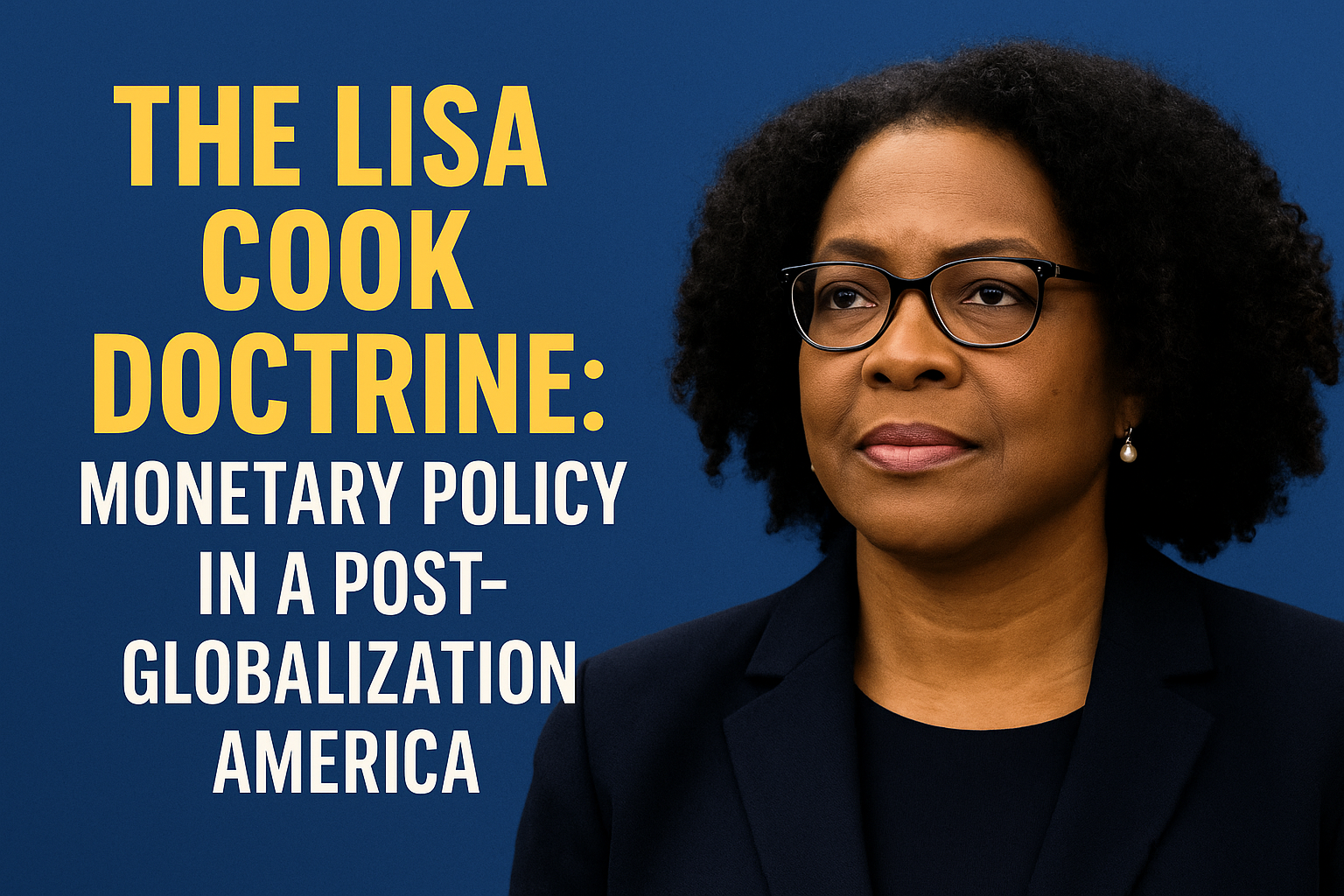
The Lisa Cook Doctrine: Monetary Policy In A Post-Globalization American

“Uncertainty is not an exception—it’s the economy’s new default. Our job isn’t to eliminate risk, but to build institutions resilient enough to thrive within it.” — Dr. Lisa D. Cook, Federal Reserve Governor & Spelman Alumna ’86

When Dr. Lisa D. Cook took the stage at the Council on Foreign Relations for the C. Peter McColough Series on International Economics, it was less a speech and more a declaration: the global economy is fragmenting, technology is compounding that fragmentation, and the Federal Reserve must remain nimble but principled in navigating this emerging disorder.

What makes Dr. Cook’s presence at the Federal Reserve so consequential is not simply her identity as the first African American woman to serve as a governor—though it is significant—but her lens. A lens forged not just through elite academic corridors, but one that dares to understand the edges of America’s economy—its marginalized labor markets, its precarious innovation system, and its uneven globalization. And if her remarks this week are any signal, Dr. Cook is actively shaping a monetary doctrine for this new epoch.

THE FEDERAL RESERVE AND ITS FRACTURED MANDATE

Dr. Cook reminded the audience that the Federal Reserve’s dual mandate—price stability and maximum employment—is being strained by new dynamics. Inflation, while down from pandemic-era peaks, remains stubbornly above target. Headline inflation is at 2.1 percent, core inflation at 2.5 percent—both still above the Fed’s 2 percent goal. On the employment side, job growth is steady, unemployment hovers at 4.2 percent, and labor force participation is not in freefall. But beneath these metrics lies disquiet.

That disquiet is coming from three fronts: trade protectionism, artificial intelligence, and long-term underinvestment in public innovation infrastructure.

In short, America’s economy is at a precipice—caught between inflation imported through tariffs and supply chain fragility, and deflationary pressures driven by automation and labor displacement.

Dr. Cook’s doctrine, it seems, is to hold the center.

TARIFFS: THE RETURN OF ECONOMIC NATIONALISM

Trade policy has re-entered the monetary discourse with a vengeance. For African American economists—and institutions like HBCUs that sit adjacent to both poor communities and international students from across the African diaspora—the discussion is no longer abstract. Dr. Cook underscored that tariffs, while politically popular, have a “nontrivial” inflationary effect.

Tariffs raise prices on imports, which businesses pass to consumers. But more importantly, they alter inflation expectations. And when inflation expectations become “unanchored,” monetary policy loses its credibility—and its traction.

This is not merely an economic concern, but a philosophical one. If the U.S. economy turns inward and abandons international trade cooperation, the financial consequences will not be equally shared. Institutions and people on the margins—like HBCUs, which rely on price-sensitive budgets and internationally sourced equipment—will be among the first to feel the tightening grip.

AI AND THE PRODUCTIVITY PARADOX

Artificial intelligence was one of the few bright spots in Dr. Cook’s analysis. While it introduces short-term labor displacement, it holds medium- to long-term potential for productivity gains, cost containment, and even inflation moderation.

Dr. Cook estimates productivity boosts from AI could range from 1 to 18 percent over the next decade. But this range, she admits, reflects the economic unknowns of the Fourth Industrial Revolution. For African American institutions, the message is twofold: AI will not wait for us to be ready, and without intentional investment in AI literacy and infrastructure, the economic benefits will bypass our communities entirely.

More than that, Dr. Cook emphasized the importance of how AI gets adopted. “It’s not job loss,” she clarified. “It’s task replacement.” The nuance matters. Black workers and businesses must advocate for job redesign, not job removal. This requires an active policy partnership between labor, government, and educational institutions.

HBCUs, with their historical ability to adapt curricula to new economic paradigms, have a window here. The time to build AI research centers, ethics think tanks, and public-private tech fellowships is not tomorrow—it is now.

UNCERTAINTY IS THE NEW NORMAL

Dr. Cook invoked former Fed Chair Ben Bernanke’s guidance: in times of heightened uncertainty, policymakers must plan for multiple scenarios. In Fed speak, this means optionality. In HBCU speak, this means resilience.

The Federal Reserve is not in a rate-cutting mood. Nor is it eager to hike. It is watching. And waiting. And watching some more. “The current stance is balanced,” Dr. Cook affirmed. “But that balance could shift in either direction.”

For HBCU leadership—especially those managing endowments, student financial aid disbursements, or capital investment strategies—this moment requires uncommon dexterity. Inflation could reaccelerate. Or the economy could cool into a stagflationary trap. The key is planning for a 2 percent interest world and a 6 percent one.

INNOVATION: TWENTY YEARS TO FRUITION

Perhaps the most poignant segment of Dr. Cook’s remarks came not from inflation or tariffs or AI—but from her reflections on innovation and time.

“It can take twenty years or more,” she noted, “from the time a student conceives an idea to the point it becomes a product on the market.”

That is a sobering timeline. And it is why public investment in basic research, early-stage science, and academic freedom matters so much. The ecosystem that birthed Silicon Valley started with small government grants, eccentric professors, and graduate students with uncertain job prospects.

For HBCUs, the lesson is urgent: waiting for federal investment in Black innovation ecosystems is no longer tenable. Institutions must pool their resources, coordinate R&D pipelines, and build their own version of the National Science Foundation if need be.

Tuskegee University had its agricultural labs. Howard had its medical research. North Carolina A&T and Prairie View have their engineering corridors. But the next phase of Black institutional development must consolidate these assets into a coordinated force, backed by investment funds, intellectual property banks, and patent commercialization arms.

THE GLOBAL BACKDROP: COORDINATION WITHOUT UNITY

On the global stage, Dr. Cook walked a careful line. She acknowledged that while central banks maintain regular dialogue—through G-7, G-20, OECD platforms—there is no grand consensus. Different countries have different mandates. The European Central Bank is laser-focused on inflation. The Bank of Japan must navigate currency volatility. The People’s Bank of China has geopolitical motives laced through its monetary calculus.

The Federal Reserve cannot outsource its decisions to global peers. But it can learn from them.

For African American policy circles and HBCU economics departments, this is a call to global literacy. We must teach our students to read the central bank minutes from Frankfurt, London, and Accra as readily as they read those from Washington.


INSTITUTIONAL IMPLICATIONS FOR HBCUs

What, then, should HBCU presidents, CFOs, and policy offices take from Dr. Cook’s remarks?

  1. Protect Purchasing Power
    Inflation—especially if prolonged—can erode real endowment spending. HBCUs must explore inflation-hedged assets, indexed tuition strategies, and energy-efficient infrastructure.
  2. Reimagine Labor Pipelines
    AI and global trade will redefine job descriptions. HBCUs must preemptively build training programs, certification pathways, and innovation hubs aligned with the labor market of 2030—not 2010.
  3. Internalize Innovation
    If innovation takes 20 years, then we must stop relying on outside institutions to fund our intellectual property journey. We must build our own innovation endowments, grant programs, and incubators.
  4. Globalize Strategically
    As America turns inward, HBCUs must look outward—toward African economies, Caribbean partnerships, and Latin American markets. Diversifying donor bases, research collaborations, and student recruitment internationally is no longer luxury. It is imperative.
  5. Endowment Defense Against Rate Risk
    Whether rates rise or fall, HBCU financial managers must adopt more active duration management strategies and review fixed income allocations accordingly.

FINAL THOUGHT: THE JUDGMENT ECONOMY

Dr. Cook’s final words were a reminder that even in an era of algorithms and quantitative models, human judgment remains central.

The economy cannot be automated. And neither can policy. The strength of institutions, including the Federal Reserve, still rests on the character and clarity of its leaders.

For HBCUs and African American institutions broadly, Dr. Cook’s rise—and her vision—should be both inspiration and instruction. It is not enough to be present in the room. One must bring a philosophy. A framework. A doctrine.

The Lisa Cook Doctrine, if there is one, is clear: do not panic, do not stagnate, and never underestimate the power of intentional innovation guided by principled policy.

In an uncertain world, that kind of leadership is the rarest form of capital.