Monthly Archives: November 2026

HBCU Women Are on America’s Tech Map. The Institutions Are Not.

“Let us put our moneys together; let us use our moneys; let us put our money out at usury among ourselves, and reap the benefit ourselves. Let us have a bank that will take the nickels and turn them into dollars.” — Maggie Lena Walker, address to the 34th Annual Session of the Right Worthy Grand Council of Virginia, Independent Order of St. Luke, August 20, 1901

In a river town known for its cloth, the finest weavers were women. Merchants traveled from three provinces to buy their work, and each spring the town crier read out the names of the best of them. The looms belonged to a family across the river. So did the cloth hall, the dye works, and the counting house that held the weavers’ wages. The crier’s list grew longer every year. The list of owners never changed. The town mistook a roll of honor for a ledger of wealth, and it did not learn the difference until the family across the river moved its looms elsewhere.

SmartAsset’s “Best and Worst Cities for Women in Tech — 2026 Study,” published on October 5 and since picked up by CultureMap and InnovationMap in Houston, ranks the 50 largest American cities on four measures. They are the gender pay gap in tech, women’s share of tech workers, tech’s share of the local workforce, and women’s median earnings adjusted for regional prices. The top three places go, unsurprisingly, to San Jose, Seattle and San Francisco.

Below them, the list begins to read like a map of African American institutional geography. Atlanta is fourth and the highest-ranked city outside the West Coast. Baltimore is fifth, Austin sixth, Oakland seventh and Boston ninth. Chicago, Charlotte, Memphis and Houston fill twelfth through fifteenth, with New York at eighteenth and Miami at twenty-second. Each of these eleven cities hosts an HBCU or a predominantly Black institution, or, in Oakland’s case, an organized campaign to acquire one.

The ranking measures how well a city’s labor market treats women as employees. HBCU Money reads it as something more consequential: a map of where HBCU-educated women’s talent is being priced, and of how much of the capital that talent generates stays inside the institutions that produced it. Communities rise or fall based on the strength of their institutions, not the brilliance of their individuals. A city can pay HBCU women handsomely while routing their earnings, savings, equity and ideas through institutions they do not own. It will then have improved a great many individual circumstances without strengthening the community at all.

The figures show both the strength and the ceiling. Memphis and Miami are the only two cities in the study where women in tech out-earn men, at 101.5 and 101.7 percent of men’s median respectively. Memphis also has one of the highest shares of women in tech anywhere, at 33.2 percent. Baltimore’s women hold 34.7 percent of tech jobs, the highest share in the top ten, and earn 92.7 percent of what men earn. In Atlanta, where 6.5 percent of the labor force works in tech, women make up 28.8 percent of those workers and earn 87.5 percent of men’s pay. Boston’s women hold 31.3 percent of tech jobs at 83.9 percent of men’s pay, and Charlotte’s hold 28.7 percent at 82.6 percent.

The larger markets tell a story of scale rather than parity. New York employs 43,595 women in tech, the most of any city in the study, at 86.3 percent of men’s pay. Chicago employs 17,940 at 90.2 percent, and Houston’s 9,456 earn 93.0 percent of men’s median. Austin employs 12,379, yet they are only 22.9 percent of its tech workforce and earn 80.0 percent of men’s pay, while Oakland’s gap is the widest in the top ten at 74.3 percent. Two patterns stand out. The two cities with the densest concentration of Black colleges, Atlanta and Baltimore, are the two highest-ranked cities outside the West Coast, and both cities where women out-earn men have an HBCU inside the local labor market.

SmartAsset does not break its figures down by race, so the share held by Black women must be inferred. The National Science Foundation’s Diversity and STEM 2023 report found that Black Americans were about 12 percent of the adult population in 2021 but only 9 percent of the STEM workforce, and UNCF puts Black women at roughly 3 percent of the tech workforce. On the supply side, HBCUs have long carried weight far beyond their size. NSF tabulations for the 1990s show HBCUs conferring roughly 30 to 41 percent of all computer science bachelor’s degrees earned by Black students in a given year. NSF also found that while 15 percent of Black bachelor’s recipients in 2016 graduated from an HBCU, 25 percent of Black science and engineering doctorate recipients from 2013 to 2017 had earned their bachelor’s degree at one. Research presented at the American Society for Engineering Education’s 2024 conference found that HBCUs raise women’s representation among computer science graduates. The reasonable inference is that in cities with HBCUs and predominantly Black institutions nearby, a disproportionate share of Black women in tech were trained by them.

The money involved is substantial. Multiplying each city’s count of women tech workers by their unadjusted median earnings gives a rough annual payroll of about $12.4 billion, earned by roughly 114,400 women across the eleven cities. If Black women hold only their national 3 percent share of those jobs, they earn about $370 million a year. In Atlanta, Baltimore, Memphis and Charlotte, where Black residents make up a large share of the population and HBCUs feed the local labor market directly, the share is almost certainly higher. At 15 percent across all eleven cities, the figure approaches $1.86 billion. That is wages alone; it excludes retirement contributions, home equity, stock grants and the patents these women’s work produces for their employers. Very little of it is retained. Paychecks are deposited with mainstream white-owned lenders, mortgages are written by them, and equity compensation stays tied to the employer.

The institutions that could hold this capital exist, but they are thin and unevenly spread. HBCU Money’s 2025 directories count 17 African American-owned banks with about $6.72 billion in combined assets and 205 African American-owned credit unions with about $8.15 billion. Only four of the eleven cities have an African American-owned bank headquartered locally: Citizens Trust Bank in Atlanta, GN Bank in Chicago, OneUnited Bank in Boston and Unity National Bank of Houston. Together they hold about $1.85 billion. Baltimore has no African American-owned bank, yet its two African American-owned credit unions, Municipal Employees Credit Union of Baltimore and Securityplus, hold about $1.84 billion between them. Atlanta’s two credit unions hold about $114 million. Chicago’s 18 hold only about $37 million, New York City’s 12 about $19 million, Houston’s seven about $25 million, and Memphis’s two about $15 million.

Austin, Oakland, Charlotte and Miami have neither a bank nor a credit union of their own, although Memphis and Miami are served by branches of Liberty Bank and Trust and OneUnited. Even the most direct link between Black universities and Black finance is eroding: five of the eleven HBCU-based credit unions operating in 2020 have since closed or been absorbed, among them Prairie View A&M’s after 85 years of independence. Deposits, however, are only the floor of institutional ownership. Intellectual property is the ceiling, and there the gap is wider still.

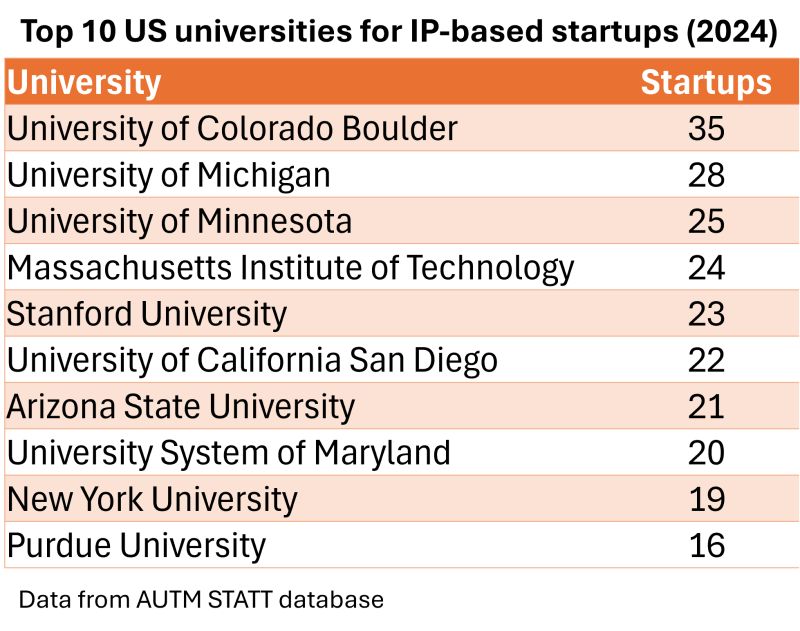
Dealroom’s ranking of the world’s best-funded university spinouts, updated October 15, counts 50 companies that have together raised $103 billion, 44 of them unicorns. Two are headquartered in this article’s cities, Houston’s Fervo Energy and Austin’s Apptronik, and neither traces back to an HBCU. AUTM’s STATT database tells the same story at the source. In 2024 the University of Colorado Boulder led American universities with 35 startups built on university intellectual property, followed by Michigan with 28 and Minnesota with 25, with MIT at 24 and New York University at 19. The University System of Maryland produced 20, and while that system includes three HBCUs (Coppin State, Bowie State and the University of Maryland Eastern Shore), its figure is reported system-wide. No HBCU appears in the top ten in its own right.

The leader on that list is the instructive case, precisely because it is not where startup ecosystems are supposed to be. CU Boulder is smaller than most of the universities around it on the list and sits far from the venture capital of the Bay Area or Cambridge. Bryn Rees of Venture Partners at CU Boulder reports that the university historically launched four to six startups a year before reaching 35 in fiscal 2024. AUTM data show only one university exceeding that count in any single year from 1991 through 2023. Its startups raised $504 million in fiscal 2023 and $426 million in fiscal 2024.
Rees attributes the change to deliberate institutional design rather than geography. The university adopted a standard, investor-endorsed set of startup license terms, Licensing with EASE, that makes licensing its technology fast and predictable. It integrated its accelerators, pitch competitions and intellectual property office into one continuous pipeline. It built a program called Embark that pairs outside entrepreneurs with its strongest technologies and produced 22 companies in its first year and a half. And it partnered with a venture fund, Buff Gold Ventures, that leads and syndicates seed and Series A rounds.

The HBCU starting point is not zero. Morgan State established its Office of Technology Transfer in 2018 and by 2023 was issued 13 utility patents, a record for any HBCU. That year it also became the only HBCU listed among the National Academy of Inventors’ top 100 American universities by utility patents granted. It added 10 more in 2025, bringing its total to 49, and is pursuing R1 research status by 2030. Since 2012 it has also been a partner in the Maryland Innovation Initiative, the state’s commercialization program run by TEDCO alongside Johns Hopkins and the University of Maryland campuses. The research engine, in other words, exists. What separates a patent from a company is everything CU Boulder built around its patents: standard terms, integrated programs, entrepreneurs ready to take technology to market, and capital committed to backing them.

The capital is where the gap is sharpest. Crunchbase data show that American startups with a Black founder or co-founder raised $942 million in 2025. That is 0.32 percent of all venture funding and less than a fifth of the $5.2 billion they raised in 2021. HBCUvc found that only 17 percent of Black-founded deals in 2024 reached a Series A round, against 37.7 percent across the market. Black women face the narrowest version of that funnel even as they form businesses faster than any other group in the country. Research from Wells Fargo and Ventureneer found that Black women-owned businesses grew about 13 percent last year, and a 2020 study by digitalundivided found that Howard University produced more Black women startup founders than any other undergraduate institution in the country.

Put together, the numbers describe a closed loop that runs in the wrong direction. HBCU-trained women earn an estimated hundreds of millions of dollars a year in eleven tech cities and save and invest it through institutions with no stake in Black founders. Black women founders, many of them HBCU-trained, then compete for a fraction of one percent of venture capital controlled by those same institutions. The case for reversing the loop rests on self-interest rather than charity. HBCU alumnae in tech hold the professional networks, the technical judgment and a share of the capital that the founders coming out of their own institutions need.

Europe treats the question of who captures university discoveries as a matter of strategic retention. The 2025 European Spinout Report, produced by a consortium that includes Dealroom, Cambridge Innovation Capital and Oxford Science Enterprises, values Europe’s deep tech and life sciences university spinouts at $399 billion. They span more than 7,300 companies and 167,000 jobs. Universities and research centers produced 40 percent of the new deep tech and life sciences startups launched there since 2019. Massimiliano Granieri, president of MITO Technology, told Il Sole 24 Ore that the aim is to commercialize European discoveries at home “instead of exporting ideas abroad.” African America faces the same problem at a different scale. An HBCU-trained engineer whose work becomes her employer’s patent has exported her ideas as surely as a European lab that licenses its discovery to a California firm.

Dr. John Henrik Clarke understood this logic. Asked by Jahannes about historically Black colleges, he said he believed in them profoundly because “people rise and fall within the context of these institutions.” He acted on that belief. Clarke left his personal library of African and African American history to the Robert W. Woodruff Library at Clark Atlanta University, citing his Georgia upbringing and Clark Atlanta’s capacity to maintain a collection of that size. He retained intellectual capital inside a Black institution when many others would gladly have taken it. Every HBCU-trained woman in these eleven cities faces a version of the same decision with each paycheck, each vested share and each invention disclosure.

Clarke’s essay “The Black Woman in History,” published in Black World in February 1975, widens the frame. Drawing on Cheikh Anta Diop, Clarke argued that African women were co-founders of institutional order rather than participants in societies built by others. In partnership with men they created the functioning family unit around which later societies and institutions were organized, and in Egypt, Kush and Ethiopia some of them ruled states. Applied to the SmartAsset data, that history changes the question. It is not enough to ask whether HBCU women are hired and paid fairly; the strategic question is whether they are positioned as builders and owners of institutions.

Each city starts from a different institutional base:

  • Atlanta has the densest in the country. Its HBCUs include Clark Atlanta, Morehouse, Spelman, Morris Brown and Morehouse School of Medicine, and Atlanta Metropolitan State College, and Atlanta Technical College are among its predominantly Black institutions.
  • Baltimore has Morgan State, Coppin State and the University of Baltimore.
  • Houston has Texas Southern, with Prairie View A&M less than an hour away. Both belong to the HBCU CHIPS Network alongside Morgan State.
  • Chicago has Chicago State University and two predominantly Black City Colleges campuses, Kennedy-King and Olive-Harvey.
  • Charlotte has Johnson C. Smith University.
  • Memphis has LeMoyne-Owen College.
  • New York has Medgar Evers College and York College within CUNY.
  • Miami has Florida Memorial University in neighboring Miami Gardens.
  • Austin has Huston-Tillotson.
  • Boston has Roxbury Community College.
  • Oakland has no HBCU. The Oakland HBCU Initiative, launched in 2025 as a fiscally sponsored project of The Oakland Fund, is organizing to bring a satellite campus of a legacy HBCU to the city, built around an entrepreneurship and STEM innovation hub, and describes it as a priority of Mayor Lee’s administration.

Clarke also wrote that successful communities are “small role models for a successful nation,” and that the ideas and impetus for nation-building come from the community. That makes the city the right unit of action. What is missing everywhere is coordination, and six steps can begin now.

The first is for HBCU alumni associations to organize women-in-tech chapters in each city and give them an explicit banking relationship with the African American-owned institutions that already exist. That might mean Morgan State and Coppin State alumnae at Securityplus in Baltimore, Texas Southern and Prairie View alumnae at Unity National in Houston, or Chicago State alumnae at GN Bank. These institutions are undercapitalized, not absent, and a deposit does not need a branch on the corner. An engineer in Austin can hold her savings at a Houston bank as easily as at one down the street. Alumnae in Charlotte have Optus Bank in Columbia, South Carolina, and Mechanics & Farmers Bank in Durham. Those in Miami and Oakland have OneUnited. In Chicago, New York and Houston, where credit unions are numerous but small, alumnae can concentrate deposits in the strongest existing institution rather than spread them thin. Alumni associations at public HBCUs are legally independent of their institutions and can act without waiting for state approval.

The second is for HBCU foundations to actively solicit gifts of vested stock from alumnae in tech. Foundations already accept appreciated securities, and a gift of company shares moves equity from an employer into an endowment. Small private institutions such as Johnson C. Smith, LeMoyne-Owen and Huston-Tillotson have the most to gain, because a handful of such gifts can change the size of their endowments.

The third is to concentrate talent by appointing these women as adjunct and practitioner faculty. LeMoyne-Owen, Coppin State, Medgar Evers, Chicago State and Atlanta Metropolitan State all sit within commuting distance of thousands of working tech professionals. Bringing them into the classroom shortens the distance between the HBCU pipeline and the local labor market, and it builds the alumni networks that later direct hiring and capital.

The fourth is a shared commercialization pipeline, with alumnae in tech as its entrepreneurs and women faculty as its inventors. CU Boulder’s model translates directly, and coordination is the HBCU advantage. If HBCUs adopt a common, investor-endorsed set of startup license terms, a founder licensing technology from Morgan State would face the same fast, predictable deal as one licensing from Texas Southern or Prairie View. That is something no single small technology transfer office can offer investors on its own. Alumnae with product, engineering and venture experience are the natural Embark-style entrepreneurs to pair with HBCU inventions. Morgan State’s patent portfolio is the obvious first test case, and the semiconductor research conducted through the HBCU CHIPS Network is a natural second.

The pipeline also needs a faculty side, and HBCU women faculty are its least-organized source of founders. The HBCU Faculty Development Network is positioned to convene them. It was founded in 1994 at Tougaloo College with support from the Bush Foundation, with LeMoyne-Owen, Fisk, Xavier and Florida Memorial on its first steering committee. Today it is based in Prairie View, runs an annual conference that draws 150 to 200 faculty and administrators, and has held a summer institute since 2002. Its mission centers on teaching and learning, so commercialization would be an extension it has to choose, but the extension is a short one.

Partnering with HBCUvc, the Network could run an HBCU women faculty commercialization cohort through its summer institute. The Network would recruit the faculty and HBCUvc would supply investor education and introductions. A partner technology transfer office, with Morgan State’s the strongest candidate, would handle invention disclosures, patents and licenses for faculty at smaller institutions where a dedicated office is a heavy fixed cost. An Inventors’ Corner beside their Authors’ Corner would make women faculty’s patents and spinouts as visible across the HBCU network as their books are today.

The fifth is to give that pipeline its own capital by establishing an HBCU Women Fund in each HBCU athletic conference, in partnership with HBCUvc. HBCU Money argued in April that the SWAC, MEAC, SIAC and CIAA should each create an independent endowment foundation raising $100 million over ten years. Each would be governed by commissioners, presidents, alumni investment professionals and students, with assets held by Black asset managers, banks and venture firms. The logic extends to a fifth conference: the HBCU Athletic Conference, the only all-HBCU conference in the NAIA. Founded in 1981 as the Gulf Coast Athletic Conference, it rebranded in 2024 under Commissioner Kiki Baker Barnes. It grew to 15 members in 2025 when Huston-Tillotson and Paul Quinn joined institutions such as Dillard, Fisk, Philander Smith, Rust, Stillman, Talladega, Tougaloo and the University of the Virgin Islands. It has already shown the instinct this article argues for: its partnership with Hope Credit Union, the Mississippi-based African American-owned institution with about $700 million in assets, puts Hope’s name on the conference’s baseball championship.

The five conferences map neatly onto the cities in this study. The SWAC holds Texas Southern and Prairie View in Houston, and the MEAC holds Morgan State and Coppin State in Baltimore. The SIAC holds Clark Atlanta and Morehouse in Atlanta, along with LeMoyne-Owen in Memphis. The CIAA holds Johnson C. Smith in Charlotte, and the HBCU Athletic Conference holds Huston-Tillotson in Austin, extending the plan’s reach to small private HBCUs that rarely appear in any tech ranking.

HBCUvc supplies what the conference foundations would lack. It is a nonprofit built to organize HBCU alumni as investors. It estimates more than 25,000 accredited investors among HBCU alumni, fewer than 3 percent of them active in angel investing, and $5 million to $10 million a year in fragmented alumni capital. It has set a goal of unlocking $50 million in community investment by 2030. Because HBCUvc does not make grants or manage funds, it is the right partner rather than the vehicle, and the division of labor follows from that:

  • The conference foundation anchors each HBCU Women Fund with a share of its endowment, sets governance and keeps the fund’s cash with African American-owned banks and credit unions.
  • HBCUvc identifies and organizes accredited alumnae as co-investors, educates newer investors and trains the analysts who staff the funds.
  • Alumnae in tech from each conference’s institutions sit on the investment committees and supply the technical diligence a generalist investor cannot.
  • The fund invests in companies founded by HBCU women, including faculty from the commercialization cohort, and in companies built on HBCU intellectual property, across the whole ecosystem.

The arithmetic is within reach. If each of the five conference foundations reached HBCU Money’s $100 million target and committed 10 percent to its women’s fund, the five funds together would hold $50 million. That is more than 5 percent of everything Black-founded startups raised in 2025. If the HBCU-trained women in these eleven cities invested 1 percent of the low-end earnings estimate alongside them, they would add about $3.7 million a year. Alumnae from institutions outside the five conferences, such as Florida Memorial, Chicago State and Medgar Evers, can join as co-investors. The conferences have already organized rivalries, championships, media rights and, in one case, a credit union partnership across institutional lines; organizing capital is the same work at higher stakes.

The sixth is information. HBCU institutional research offices should publish alumni employment and earnings data by city, gender and field. SmartAsset could not disaggregate by race because the public data do not make it easy, but HBCUs and predominantly Black institutions hold the records that would answer the question directly. A coordinated release across these eleven cities would give every bank, credit union, foundation and HBCU Women Fund in the ecosystem the market data it needs to compete for these women’s business.

The SmartAsset ranking works like the town crier’s list. It confirms that HBCU women are among the best weavers in the market, but it does not show who owns the looms, the cloth hall, the counting house or the patterns themselves. In Atlanta, Baltimore, Memphis, Miami, Chicago, New York and five other cities, the talent has already been built. CU Boulder shows how quickly institutional design can change what a university produces, and Morgan State shows that the research is already there. Whether HBCU women’s talent becomes institutional power depends on whether HBCUs, their conferences, their faculty, their alumnae, and African American-owned banks and credit unions decide to function as one ecosystem.

Disclaimer: This article was assisted by ClaudeAI.
America’s Healthcare Has Failed Black Women: The HBCU Health System Plans to Change That

“I think it’s time to kill for our women / Time to heal our women, be real to our women / And if we don’t we’ll have a race of babies / That will hate the ladies, that make the babies” – Tupac Shakur

A Black woman went into labor on a Tuesday night. The hospital ten minutes from her home had stopped delivering babies the year before. A board in another community had reviewed the numbers and decided that women like her did not pay enough to keep that wing open. So her husband drove her ninety minutes down a two-lane road in the dark, hazard lights on, while her blood pressure climbed with no one there to measure it. In the emergency bay of a hospital that had never seen her chart, far from the doctors and nurses who knew her, looked like her, and cared for her, she gave birth to a daughter who may one day suffer her same fate. Her community had never moved to take institutional ownership of that hospital, leaving it always vulnerable to the whims of others. Eleven days later she died at home, of a complication a single follow-up visit would likely have caught, in a county where there was no longer anywhere to go for one. Her death certificate listed the cause. It did not list the decision.

The United States has spent two decades treating the deaths of Black women as a clinical puzzle. It has studied implicit bias, revised hemorrhage protocols, and funded awareness campaigns, and the numbers have barely moved. The reason is that the failure is not primarily clinical. It is institutional. Black women in America receive their care, from adolescence through old age, almost entirely from institutions that Black America does not own, govern, finance, or staff at scale. Their outcomes are decided in boardrooms where they have no seat. Communities rise or fall on the strength of their institutions, not the brilliance of their individuals, and healthcare is where that principle is measured in lives. HBCU Money argues that the HBCU Health System, a proposed national network developed by The Diaspora Projects, is the first serious attempt in two generations to treat Black women’s health as an ownership problem rather than a sensitivity problem.

Childbirth is where the failure is most visible, and the data are stubborn. The National Center for Health Statistics reports that in 2024 the maternal mortality rate for Black women was 44.8 deaths per 100,000 live births. That was significantly higher than the rates for white women (14.2), Hispanic women (12.1), and Asian women (18.1). That figure is the improved one, since the Black rate peaked at 69.9 in 2021. The gap held through both the peak and the decline. But maternal death is a single chapter in a much longer story, and focusing on it alone has allowed the rest of that story to go largely unexamined.

A Black woman’s encounter with the health system does not begin in a delivery room or end there. It runs across decades and across nearly every major disease:

  • Hypertension. According to the American Heart Association, 59.2 percent of Black women live with high blood pressure, among the highest rates in the world. Only about one in five Black adults with hypertension has it under control.
  • Stroke. Black women have the highest stroke prevalence of any group, at 5.4 percent, against 2.9 percent for all women.
  • Fibroids. By age 50, up to 80 percent of Black women develop uterine fibroids. They are two to three times more likely to develop symptomatic fibroids, and fibroids are the leading reason American women undergo hysterectomy.
  • Lupus. Data from the Georgia Lupus Registry show lupus incidence among Black women aged 30 to 59 nearly three times that of white women.
  • HIV. In 2023, Black women accounted for half of all HIV diagnoses among women, despite making up 13 percent of the female population.
  • Cancer. Black women are 38 percent more likely to die of breast cancer despite a 5 percent lower incidence. Their death rate from uterine cancer is roughly double that of white women, and their cervical cancer mortality is 40 to 50 percent higher.

These are not separate crises. They are one institutional failure, repeated across every service line from screening and diagnosis to surgery and long-term management. The connections between them are not incidental. The hypertension that kills a Black woman in pregnancy is the same hypertension that, left uncontrolled, kills her at fifty through stroke or heart failure. The fibroids diagnosed late in a fragmented system become the hysterectomy that a coordinated one might have prevented.

The clearest evidence that this is a problem of ownership rather than access comes from outside the United States. The United Kingdom has what America does not: universal coverage through the National Health Service. If coverage were the binding constraint, British disparities would have closed. They have not. Oxford’s National Perinatal Epidemiology Unit, which runs the MBRRACE-UK surveillance programme, found that in 2022–24 Black women faced a risk of maternal death nearly three times that of white women. Over the same period, the UK’s overall maternal mortality rate rose 20 percent. A Black mother in London with full coverage and a Black mother in Mississippi on Medicaid share the same structural position. The institution delivering her care was not built by her community, is not governed by it, and does not depend on its loyalty to survive. Coverage is not control.

The pattern is as old as American medicine’s treatment of Black women’s bodies, and its origins are institutional. Between 1845 and 1849, in Montgomery, Alabama, the white physician James Marion Sims experimented on at least seven enslaved Black women and girls. The work produced a surgical repair for a chronic childbirth complication and earned him the title “Father of Gynecology.” Because the women were enslaved, Sims needed legal permission only from their owners, not from the women themselves. He operated on Anarcha, an enslaved teenager, at least 13 times without anesthesia before he had a technique considered safe enough for white patients. His experiments on another woman, Lucy, failed and brought her close to death from severe blood poisoning. Sims later became president of the American Medical Association, and his statue still stands on the grounds of the Alabama State Capitol, a short distance from Alabama State University.

The lesson for institution builders is precise. Black women held no authority over the institution being built on their bodies, no equity in the knowledge they produced, and no seat in the profession it founded. The specific abuse has ended. The allocation of authority largely has not.

African America answered exclusion by building, and for a time it built at remarkable scale. As HBCU Money documented in 2012, drawing on Nathaniel Wesley Jr.’s Black Hospitals in America, there were roughly 500 African American-owned and controlled hospitals at the apex. Today, only Howard University’s remains. Detroit alone was home to 18 hospitals owned and operated by African Americans between 1917 and 1991. These institutions trained the nurses and physicians that white hospitals refused, gave Black patients a place to be treated with dignity, and kept a meaningful share of the community’s health spending inside the community. Their decline from 500 to one is among the largest institutional losses African America sustained in the twentieth century. It rarely appears in conversations about the wealth gap or the health gap, though it belongs in both.

The HBCU sector owned part of that infrastructure, and the way it was lost is instructive. Flint-Goodridge Hospital in New Orleans was founded by Black women for Black people, through the work of the Phyllis Wheatley Club. At the time, Black New Orleanians could otherwise be treated only in Charity Hospital’s segregated ward. Dillard University took over the hospital in 1929 and built it a new facility in 1932. When Dillard sold the hospital in 1983, its president, Samuel DuBois Cook, laid out the causes of its decline. He cited mismanagement and financial irregularities, the desegregation of hospitals, and a patient base that was 90 percent Medicare or Medicaid, along with “the loss of broad community support.” A group of 47 Black doctors, two dentists, and one pharmacist tried to buy it. It went instead to National Medical Enterprises for $1.8 million and closed in 1985.

Cook’s list should be read as a design specification rather than an epitaph. A hospital with weak governance, a revenue base concentrated in public payers, and no organized community capital behind it will not survive competition, however necessary it may be. Integration did not transfer Black hospitals to Black communities on better terms. It dissolved them, as patients, physicians, and the federal payment streams created in 1965 flowed toward larger white-owned systems. Any serious attempt to rebuild must answer all three failures at once.

The capital-retention consequences are still compounding. Medicaid finances more than 40 percent of U.S. births and 65 percent of births to Black mothers. According to KFF, there were 3,628,934 U.S. births in 2024, 13 percent of them to Black mothers. That implies roughly 470,000 Black births a year, about 300,000 of them paid for by Medicaid. And births are only the most countable stream. Every blood pressure visit, every mammogram, every fibroid surgery, and every lupus infusion is also a revenue event. Across a Black woman’s lifetime, nearly all of that revenue is booked by institutions outside the Black ecosystem. Black women generate the volume. Others hold the asset.

The present position of the HBCU medical enterprise shows how thin its institutional footing has become. Howard University Hospital is the nation’s only teaching hospital located on an HBCU campus, and Howard nearly gave up control of it. Adventist HealthCare took over its management in 2020 under an arrangement that anticipated an eventual purchase, and both management agreements ended in February 2026. Meharry Medical College trains at Nashville General Hospital, which is governed by the Metropolitan Nashville Hospital Authority from the former Meharry-Hubbard Hospital building. Until a 2025 agreement, Meharry chief executive James Hildreth said, the college had been “relegated to the public comment section of the board meetings.” Morehouse School of Medicine conducts most of its clinical training at Grady Memorial Hospital, and Charles R. Drew University depends on Martin Luther King Jr. Community Hospital and county facilities. None of the four controls its clinical platform outright.

This matters because these four schools are the country’s most effective concentrators of Black medical talent. According to the AAMC, they have educated roughly half of all Black doctors in the United States. Yet only 5.2 percent of American physicians are Black, while African Americans are nearly 14 percent of the population. Concentrating talent without owning institutions amounts to a training subsidy for other systems. The HBCU ecosystem produces the physicians, and mainstream health systems capture the careers, the billing, and the data.

Meanwhile, the delivery infrastructure that Black women in the South rely on is contracting. The March of Dimes classifies 1,104 counties, about 35 percent of the national total, as maternity care deserts. Nearly half of Texas counties fall into that category, and 68 percent of Mississippi’s rural hospitals have no labor and delivery unit. A June 2026 report from the Center for Healthcare Quality and Payment Reform counts 139 rural hospitals that have stopped delivering babies since the end of 2020, or plan to before the end of this year. Researchers writing in Health Affairs found that obstetric staffing becomes financially unworkable under the low reimbursement that comes with a high share of Medicaid patients. Federal Medicaid reductions enacted in 2025 tighten that vise. Obstetrics is the first service line to go because it is the most expensive to staff, but the economics that close a maternity wing eventually reach the cardiology clinic and the cancer center too. This is Flint-Goodridge’s payer-mix problem, now operating at national scale.

In 2012, HBCU Money argued that not every HBCU needed to build a hospital, but that every HBCU should invest in community clinics connected regionally to an African American-owned hospital. What that argument lacked was an operating architecture. The Diaspora Projects has now proposed one: the HBCU Health System (HBCU-HS). It is a national network built on the intellectual capital, legacy, and community trust of HBCUs, designed to stand alongside the country’s leading academic medical systems. The system would operate four units:

  • HBCU Academic Medical Centers, with flagship hubs planned at Howard University Hospital, Meharry Medical College, Morehouse School of Medicine, and Charles R. Drew University.
  • HBCU Regional Clinics, organized as federally qualified health centers on HBCU campuses and in alumni communities.
  • A Virtual Care Network, a national telehealth platform staffed by HBCU-trained providers.
  • The HBCU Health Plan, offering coverage to students, faculty, and alumni.

A 15-member National Board of Trustees would govern the system. It would draw on HBCU presidents, medical professionals, public health scholars, and alumni, supported by advisory councils on women’s, men’s, and children’s health.

The flagship designations are a plan, not signed affiliations, and converting them into binding agreements is the system’s first task. The terms matter as much as the signatures. Meharry’s experience at Nashville General shows what a clinical relationship looks like without governance rights. Every HBCU-HS affiliation should therefore carry board seats, data rights, and a defined share of clinical revenue. Anything less reproduces the arrangement Sims’s patients lived under, in which Black women supply the clinical foundation and someone else holds the authority.

The plan’s most important structural choice is to give women’s health its own flagship subsidiary, HBCU Women’s Health, rather than folding it into a general service line. Its mandate spans a woman’s entire life: maternal mortality, fibroids, breast cancer, menopause, and doula and midwifery training. A subsidiary with that mandate can also integrate the cardiovascular, autoimmune, and cancer care that fragmented systems scatter across unconnected specialists. The rationale is institutional.

Compared with white women, a larger share of Black women’s maternal deaths occur between 43 days and a year after delivery, pointing to gaps in follow-up care. That is the stretch of time when no single institution owns the patient. The same gap recurs throughout her life: between the gynecologist who notes the fibroid and the surgeon who removes the uterus, between the blood pressure reading at a pharmacy kiosk and the cardiologist she never sees, between the lupus flare and the rheumatologist three counties away. A system that unites community clinics, telehealth, and a trained workforce under one governance structure can own her care across the decades in a way disconnected providers cannot.

The plan’s ten-year goal of halving Black maternal mortality would bring the rate to about 22 deaths per 100,000. That would still exceed today’s white rate, which is why the target should be understood as a floor rather than a finish line. Comparable targets for hypertension control, earlier fibroid diagnosis, and breast cancer staging should sit alongside it.

The regional clinic phase is where the system meets Black women where they live. Prairie View A&M, Southern, Jackson State, and North Carolina A&T are named as sites for years four through seven. All four sit in states where obstetric access is contracting and hypertension and stroke rates are among the nation’s highest, and all four already train health professionals. The network should reach further. Alcorn State runs a nursing school in Natchez, where the community campus of Merit Health Natchez has stopped delivering babies. Coppin State and Bethune-Cookman run nursing programs embedded in Black urban communities. Xavier University of Louisiana is establishing a new medical school with Ochsner Health.

Most of these campuses are public universities in states with little appetite for race-conscious institution-building, which limits what they can do directly. Their alumni associations and foundations, however, are legally independent entities. They can hold clinic real estate and contract with HBCU-HS where the universities themselves cannot, and the regional phase should be structured through them from the outset.

The system’s ambitions should not stop at the hospitals that already exist. Where a community has lost its maternity wing or its hospital entirely, affiliation with HBCU-HS can make a new one financeable. Affiliation brings a physician and nursing pipeline from HBCU schools, a teaching mission, and a national referral network that no standalone hospital can assemble on its own. There is precedent. Martin Luther King Jr. Community Hospital opened in 2015 on the campus of the shuttered King/Drew medical center and became a clinical home for Charles R. Drew University. Howard has said its plan to build a new, state-of-the-art hospital will continue regardless of changes in management. The financing tools already exist: HUD’s Section 242 program insures hospital mortgages, and USDA’s Community Facilities program lends to rural hospitals. HBCU-HS should maintain a standing hospital development function to bring these pieces together. The system would supply the clinical and academic anchor, Black banks and credit unions would take participations in the financing, and federal programs would carry the long-term debt.

The HBCU Health Plan answers the second failure on Cook’s list. Flint-Goodridge died with nine in ten of its patients on public payers. Today, across 107 federally designated HBCUs, student premiums, employee benefits, and alumni coverage flow to mainstream insurers. An HBCU-owned plan would keep those premiums inside the ecosystem, reinvest underwriting margins in care, and give every hub and clinic a commercially insured patient base alongside its Medicaid volume. No single HBCU has a risk pool large enough to sustain such a plan, but a pool spanning dozens of institutions and their alumni does. The plan should launch with student coverage, where enrollment is predictable, and expand into employee and alumni products as the pool matures.

The third failure, the absence of organized community capital, is a financing question that the ecosystem has more pieces to answer today than it did in 1983. Philanthropic capital has shown it can move at scale toward HBCU medicine: Bloomberg Philanthropies committed $600 million to the four HBCU medical schools in 2024. But that money builds endowments, not ownership of care platforms. The operating layer is a job for Black-owned financial institutions. HBCU Money’s 2025 directories count 17 African American-owned banks with roughly $6.72 billion in combined assets and 205 African American-owned credit unions with roughly $8.15 billion, together about $15 billion. That cannot finance an academic medical center on its own. It can hold the system’s operating deposits, finance clinic real estate and mobile units, and anchor loan participations in new hospital projects. Federally qualified health center status adds federal grants and enhanced Medicaid payment rates, which makes the choice of the FQHC model as much a financial decision as a clinical one.

The research arm deserves equal weight. The plan routes clinical data into a shared National Black Health Database and would establish an HBCU Life Expectancy Research Center to publish an annual Black Longevity Index. A database, however, needs laboratories behind it. Hormone receptor-negative breast cancers, which are harder to treat, occur 65 percent more often in Black women and kill them at 2.2 times the rate. Fibroids, lupus, and hypertensive disease follow similar patterns of disproportionate burden and, historically, disproportionate neglect in the research agenda. HBCU-HS should fund and co-locate clinical research units and wet laboratories at its flagship hubs and at partner campuses with established research capacity, including the pharmacy colleges at Xavier and Florida A&M. The studies that matter most to Black women should be designed, run, and owned inside the ecosystem. Whoever owns the dataset and the laboratory sets the research agenda, and Black women have been the subjects of American medical research since Montgomery, rarely its owners. The system’s affiliation with the Hamer-Whatley Food Security Trust extends that logic upstream. Through shared board seats and clinical referrals, it ties clinical care to the nutritional conditions that drive hypertension, diabetes, and heart disease long before a woman reaches a hospital bed.

Dr. John Henrik Clarke understood the hierarchy of institutional priorities better than many of the leaders who followed him. “If I ever have any influence over a state,” he wrote, “the first thing I would build is a decent hospital.” He measured a civilization by how it cared for its oldest and its youngest. By that measure, a people that does not own a single network of hospitals serving its women has not finished building its civilization. It is renting one.

The HBCU Health System’s ten-year plan runs from flagship hubs to regional clinics to national virtual care and partnerships across Africa and the Caribbean. Its success will depend less on its scale than on whether the ecosystem treats it as infrastructure rather than as a program. That requires five commitments now:

  1. The flagship affiliations must be negotiated with governance rights rather than as courtesy partnerships.
  2. The alumni associations and foundations of public HBCUs should prepare to serve as the clinics’ legal and real-estate partners.
  3. Black-owned banks and credit unions should position themselves as the system’s depositories and lenders.
  4. The system should establish a standing development channel for new hospitals and research laboratories.
  5. HBCU Women’s Health should lead, with a mandate covering a woman’s whole life rather than a single moment in it, because the women of this community have carried the cost of institutional absence longer than anyone.

The woman in the parable died because no one in her community had standing to decide whether her hospital would keep its doors open to her. Anarcha and Lucy had no standing either, and neither, in the end, did the community that watched Flint-Goodridge sell for $1.8 million. The HBCU Health System is, at bottom, a claim to that standing. African America cannot vote its way into the boardroom of a hospital system it does not own. It can build one.

Disclaimer: This article was assisted by ClaudeAI.
The Cultivated Man: Why Men Must Learn to Enter Museums and Theaters on Their Own and With Each Other

“The purpose of art is to lay bare the questions that have been hidden by the answers.” – James Baldwin

Every afternoon a sophomore offensive lineman walked through the lobby of a small college library in Alabama, going from the practice field to his three o’clock class. Like every student before him, he stepped around the ship set into the floor, because upperclassmen had told him nobody walks on it. No one had ever taken him to a museum as a boy, and for a year he never looked up. One October afternoon, early for class, he did. Above him, across canvases wider than a classroom, a revolt was unfolding: captives seizing a schooner, a courtroom in Connecticut, a return voyage to Africa. He stood there long enough to be late. The next week he came back to ask who painted it. The week after, he brought two teammates. By spring the three of them had driven to Atlanta to see where the painter had taught. The lineman had started reading history he was never assigned, and he had found words for grief and ambition, his own and his father’s, that he had not had the fall before. He came home that summer and took his younger brother to the city museum. He had found the door at nineteen and decided his brother would not have to wait that long.

Ask a cross-section of Black men when they first chose to walk into a museum, a gallery, or a theater as adults. School field trips don’t count. A striking number will answer some version of the same thing: with a girlfriend, or with a wife. The pattern is common enough among heterosexual men of every background that it has become a cultural cliché: the man trailing his partner through an exhibition, waiting to be released. Going together has real value, and a couple standing in front of a painting is a good thing. The problem is when the partner is the only door. When a man’s access to an entire category of intellectual and emotional development runs through one relationship, that access is borrowed, conditional, and easily lost. And when a man first walks through that door at thirty, it means no one opened it for him at eight. It means more invisible labor that women must bear and that they talk about in the arena of self-development that should have already happened for potential partners. HBCU Money argues that participation in arts and culture is a form of institutional membership, and the strongest memberships begin in boyhood. A community whose men and boys do not hold that membership in their own right leaves much of its human capital undeveloped and many of its cultural institutions without patrons.

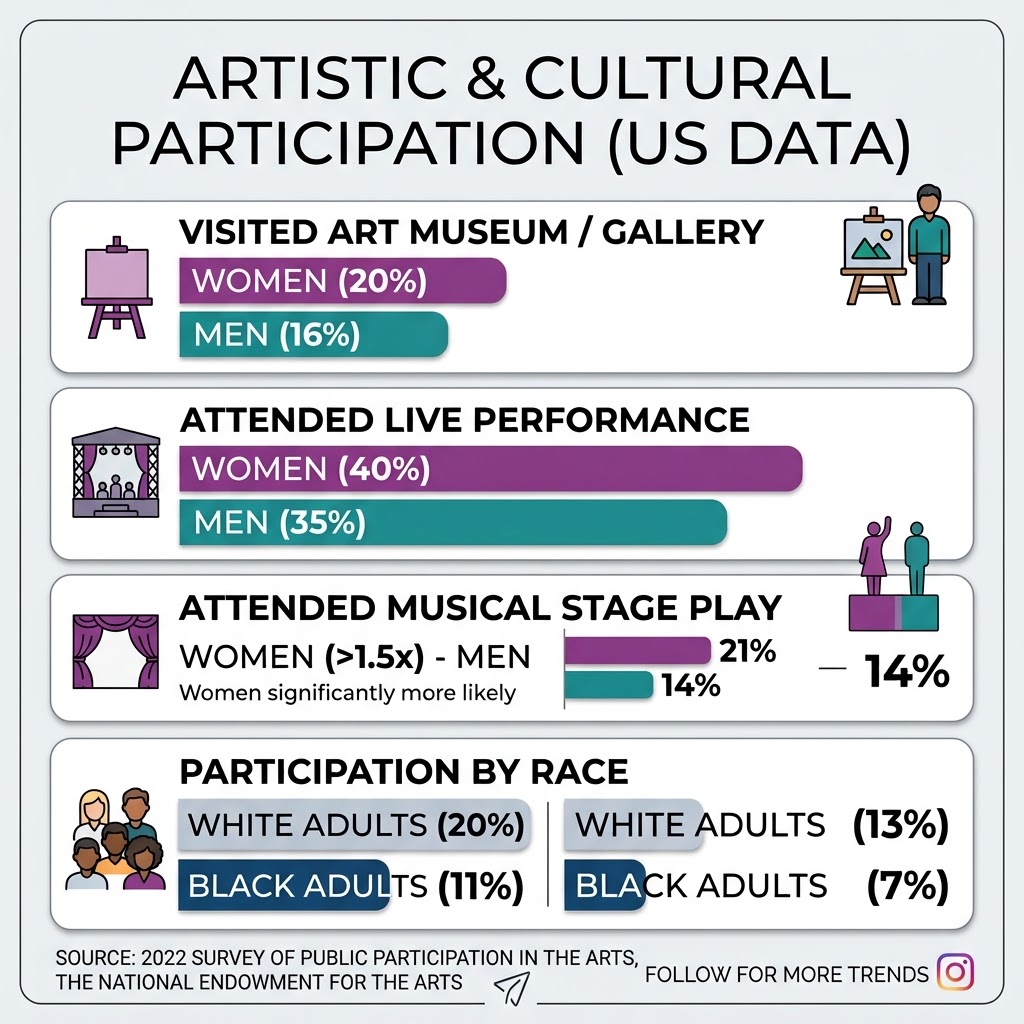
The national data shows the gap clearly. In the 2022 Survey of Public Participation in the Arts, the National Endowment for the Arts found no arts or cultural activity in which men participated at higher rates than women. Twenty percent of women visited an art museum or gallery, against 16 percent of men. Forty percent of women attended a live performance, against 35 percent of men. The racial data adds a second gap. Eleven percent of Black adults visited an art museum or gallery, compared with 20 percent of white adults, and 7 percent attended a musical stage play, compared with 13 percent. The survey does not break out results by race and sex together, but two shortfalls stacked on each other can only point one way. Black men are likely among the least present people in America’s cultural institutions, including those their own communities built.

The roots of that absence are in childhood. In a study for the NEA, Nick Rabkin and E.C. Hedberg of the University of Chicago’s National Opinion Research Center found that childhood arts education was the most significant predictor of adult arts attendance. Among adults who had any arts education as children, 57 percent attended a benchmark arts event, compared with 24 percent of those who had none. The same study documented a collapse in that early exposure. In 1982, 51 percent of African Americans reported receiving any arts education in childhood. By 2008 the figure had fallen to 26 percent. Taste, identity, and a sense of belonging in a room are largely formed before adulthood. A boy who never enters a gallery or a theater before eighteen does not simply miss an outing. He grows into a man who walks into those spaces as a guest at best, and more often stays out. The adult patterns in the NEA’s 2022 figures are, in large part, childhood patterns that arrived late.

Boys face a particular pressure on top of that loss of access. From an early age, many are taught that sports and a short list of approved masculine pursuits are the only legitimate arenas for male striving. Curiosity about painting, poetry, dance, or theater gets policed with ridicule by peers, and too often by the adult men around them. The result is not tougher men. It is men with a narrower emotional vocabulary and a narrower intellectual range, who reach adulthood waiting for someone else to give them permission to be curious. The costs show up in social life. The Survey Center on American Life found that the share of American men reporting no close friends rose from 3 percent in 1990 to 15 percent in 2021, and the share reporting six or more close friends fell from 55 percent to 27 percent. The Center pointed to traditional norms of masculinity as one reason men find it harder to be open with one another. A man without independent social and cultural venues ends up routing his emotional and intellectual life through a single partner. One relationship carries the load that a whole network of institutions once shared. That is the problem of institutional density, playing out inside a single life.

The case for art and culture in men’s development is concrete, and it begins with emotional intelligence. Theater is the most direct training ground. Psychologists Thalia Goldstein and Ellen Winner followed young adolescents through a year of instruction. Those taking acting classes gained more in empathy, in theory of mind (the capacity to read what another person is thinking and feeling), and in emotional regulation than peers studying other art forms. An actor, and to a lesser degree an engaged audience member, spends hours inside another person’s reasoning, fears, and motives. Daniel Bowen of Texas A&M and Brian Kisida of the University of Missouri showed the same effect at scale. They ran a randomized trial of Houston’s Arts Access Initiative across more than 10,000 students in 42 schools, mostly serving low-income students of color. Schools receiving more partnerships with museums, theaters, and teaching artists saw disciplinary infractions fall by 3.6 percentage points, along with gains in writing and in students’ compassion for others. The cost was roughly $15 per student. Anyone who has watched boys absorb most of the discipline in American schools should read that finding as an argument about boys.

Imagination is the second benefit, and it is often misread as an indulgence. Woodruff’s murals at Talladega span a hundred years, from a revolt at sea in 1839 to the opening of the library they hang in. To paint them, he had to picture a people’s history whole, at a time when the textbooks would not. That is the same capacity institution-builders need: the ability to see a bank, a hospital, or a research center that does not yet exist and work backward to build it. A boy who learns to hold an unfamiliar image in his mind, or to follow a story to its end, is practicing the discipline of envisioning what isn’t there yet. Communities that want founders need boys who were taught to imagine.

The third benefit is intellectual. The earlier study by Bowen, Kisida, and Jay Greene of school trips to an art museum found gains in critical thinking, historical empathy, and tolerance. A gallery asks a viewer to look closely at something ambiguous, form an interpretation, test it against evidence, and revise it. That is the structure of serious reasoning in any field. It is also the opposite of the scrolling, instant-verdict habits that now fill most boys’ free hours. Museums also make history physical. A boy who stands in front of Tanner’s The Banjo Lesson at Hampton, or the Amistad canvases at Talladega, holds a piece of the past that a textbook paragraph cannot hand him.

These capacities do not stay in the gallery. They become qualities of character: patience, attention, humility before what one does not yet understand, the ability to name a feeling before acting on it, and the willingness to sit with discomfort without lashing out. Those qualities pay off in three places. The first is the self. A man with an inner life of his own handles grief, failure, and long stretches of solitude better than one whose only outlets are competition and distraction. The second is the family. A father who can name his emotions can teach his son to name his. A husband who arrives at the museum as a fellow participant rather than a reluctant escort is a better partner. The date is better when both people chose to be there. The third is the community. Civic life runs on men who can listen to an argument, imagine another neighbor’s circumstances, and keep a meeting together when it turns tense. Those are learned skills, and the arts are among the oldest places to learn them.

The choice between athletics and the arts is also a recent invention. Dr. John Henrik Clarke’s study of Paul Robeson makes the point plainly. Clarke records that Robeson won fifteen varsity letters at Rutgers and was named a first-team All-American twice. He also earned Phi Beta Kappa honors, graduated as valedictorian, and was the debating champion all four years. Robeson then made his professional stage debut in 1920 at the Harlem YMCA, in a play called Simon, the Cyrenian. Clarke argues that Robeson was persecuted not because he was a famous singer or athlete, but because he was an artist who used his art to call for change. The same institution supported both the athlete and the actor. Clarke’s own life shows the same model. He writes that soon after arriving in New York at 18, in 1933, he became active in the Harlem History Club at the Harlem YMCA, a circle of young men building their intellectual lives together. Clarke later described a people’s culture as “the fuel that feeds the fires of their ambition, pride and self-esteem.” The same holds for the development of individual men, and for the institutions those men either sustain or abandon.

The HBCU ecosystem already has the assets. The Hampton University Museum, founded in 1868, is the oldest African American museum in the United States. It holds more than 9,000 works, including The Banjo Lesson, acquired in 1894, and the largest museum holdings of John Biggers, Elizabeth Catlett, Jacob Lawrence, and Samella Lewis. Admission is free, and the museum already runs a children’s Curiosity Room, school partnerships, and summer camps. Talladega College commissioned Hale Woodruff in 1938 to paint the murals in the parable above. In 1963, Tougaloo College became home to Mississippi’s first collection of modern art, assembled with the New York Art Committee for Tougaloo College during the height of the civil rights movement in Jackson. That collection now numbers more than a thousand works and has toured nationally as Art and Activism at Tougaloo College. Fisk University has its Jubilee Singers, whose 1871 tour kept the institution alive. North Carolina A&T has its Richard B. Harrison Players. Across the network, HBCU stages and galleries offer serious work at a fraction of the price of downtown institutions, often within driving distance of the boys who most need them.

The capital-retention stakes are concrete. Talladega College recently entered a partnership under which the Art Bridges Foundation and the Terra Foundation for American Art jointly acquired the three Amistad panels. The Toledo Museum of Art acquired The Underground Railroad, and the college retained the two remaining founding murals on campus. Whatever the financial reasoning in Talladega’s case, the general lesson holds: cultural assets go to the audiences and patrons able to sustain them. A Black public that does not attend, join, or give to HBCU museums leaves those institutions to be valued, funded, and eventually owned by others. Every membership, ticket, and gift keeps capital inside the ecosystem. Talent follows the same logic. Tougaloo has drawn Andrew W. Mellon Foundation support to train students in collections care, exhibition design, and arts administration, but programs like that produce talent only if young men show up to be trained. The pipeline of Black male curators, critics, playwrights, and arts administrators starts with Black boys who walk into these spaces and decide they belong there.

The remedies need to be institutional, and they need to start with boys.

First, alumni chapters and HBCU museums should fund early exposure for boys in nearby school districts. The Houston trial put the cost of a substantial arts experience at about $15 per student, so a single alumni chapter could underwrite a full cohort of elementary and middle-school boys from Hampton Roads, central Mississippi, or east Alabama for less than the cost of one gala table. Hampton’s existing school partnerships and summer camps are the obvious place to start. The goal is repeat visits rather than a single trip, because the Rabkin and Hedberg data shows that sustained early exposure is what builds an adult habit.

Second, HBCU theater departments should open their rehearsal rooms and matinees to boys. Youth matinees for local schools, and summer acting workshops for middle-school boys taught by theater faculty and student actors, would put the empathy and emotional-regulation gains that Goldstein and Winner measured within reach of boys who would never seek them out. Pairing these with a campus athletic program removes the stigma before it can take hold.

Third, HBCU athletic departments should build museum visits and theater attendance into team calendars. Robeson’s career is the precedent. A football program at Talladega, Hampton, or Tougaloo that walks its players through the campus collection once a semester, and attends the theater department’s spring production as a team, shows young men that curiosity is part of competing, not a betrayal of it. When local boys see college athletes in a gallery, the ridicule loses much of its force.

Fourth, fathers, uncles, coaches, and mentors should take boys to museums and plays themselves, without leaving it to mothers and teachers. A boy learns what men do by watching men do it. A father who brings his son to the Hampton museum on a Saturday, or a coach who brings his team to a campus play, teaches that this space belongs to them both. HBCU alumni associations, which are legally independent and free to act, can organize regular father-and-son and mentor outings as part of their calendars.

Fifth, adult men need the same habit. Alumni chapters should make cultural outings standing calendar items. That could mean buying a block of season tickets to an alma mater’s theater productions, organizing men’s trips to HBCU collections, or turning out in force when a traveling exhibition drawn from an HBCU collection reaches their city. HBCU museums should market directly to men, with group memberships priced for alumni chapters, fraternity alumni chapters, and church men’s ministries. Australia offers a useful model from outside the Black institutional world. The Men’s Shed movement, community workshops where men gather around shared projects, grew to more than a thousand sites and was recognized in the country’s 2010 National Male Health Policy. The Australian Men’s Shed Association’s motto is that men talk “shoulder to shoulder.” A gallery bench and a theater seat are shoulder-to-shoulder spaces too.

Sixth, the HBCU collections should coordinate. Hampton, Tougaloo, Talladega, Clark Atlanta, Fisk, and others hold work that tells a connected story. Clark Atlanta’s collection itself grew out of the Atlanta University Art Annuals that Woodruff started. A shared calendar and a coordinated touring schedule would let a school district, a men’s group, or a father plan a year of visits around the HBCU network. Isolated collections would become a circuit that a deliberate public can follow.

Clarke ended his teaching on Black heritage with a definition. Heritage, he wrote, is how people use their talents to create a history that gives them memories they can respect, and its purpose is self-awareness that equips a person to relate well to others. That is as good a description as any of what a cultivated man gains: memories he chose, a sense of himself that no one lent him, and the emotional and intellectual range to show up more fully for himself, his family, and his community. The lineman in the library found the door at nineteen. The institutional task is to make sure his younger brother finds it at nine, through a field trip, a father, a coach, or a matinee, and never thinks of it as anyone else’s door.

Disclaimer: This article was assisted by ClaudeAI.