Tag Archives: institutional wealth building

Minding Whose Store: African America Businesses Generate Just 0.43% of U.S. Revenue

Large numbers without context can be misleading to our economic reality and how institutionally poor we are. – William A. Foster, IV

If you are minding someone else’s store, then who is minding yours? Or maybe you focusing on what someone else is doing has not even allowed you to focus long enough to open your own store. These were my thoughts in 2014 when the Huffington Post decided to let the world know that the New York Times has no African American writers in their culture section. I had to take a deep breath knowing that many African Americans would chase this story and scream bloody murder and cries for fairness and justice. Of course Huffington Post at no point in time addressed the real problem of just why things like this occur, namely the New York Times (nor Huffington Post) has any African American ownership. Ironically, the same African Americans who are screaming bloody murder have probably never picked up the Amsterdam News, a 100 year old plus African American newspaper headquartered in New York that was started with a $10 investment ($356 in 2025 dollars) in 1909.

Let us talk about some numbers that should shake us to our core — not as a source of despair, but as a call to serious, sustained action. According to a February 2025 Brookings Institution report analyzing U.S. Census Bureau data, there are approximately 194,585 Black-owned employer businesses in the United States — firms with at least one employee — which generated a combined $212 billion in revenue in 2022, the most recent year of available data. Those 194,585 employer firms collectively employ approximately 1.2 million people. When non-employer businesses are included, the total number of Black-owned firms rises to approximately 3.6 million. But here is the critical detail buried in that larger number: roughly 96% of all Black-owned businesses are non-employer firms, and the average non-employer small business earns just $47,794 per year. The economic weight of the entire sector, in other words, rests on a relatively narrow base of employer firms. That $212 billion figure sounds substantial until you hold it up against a single data point: Wal-Mart’s annual revenue.

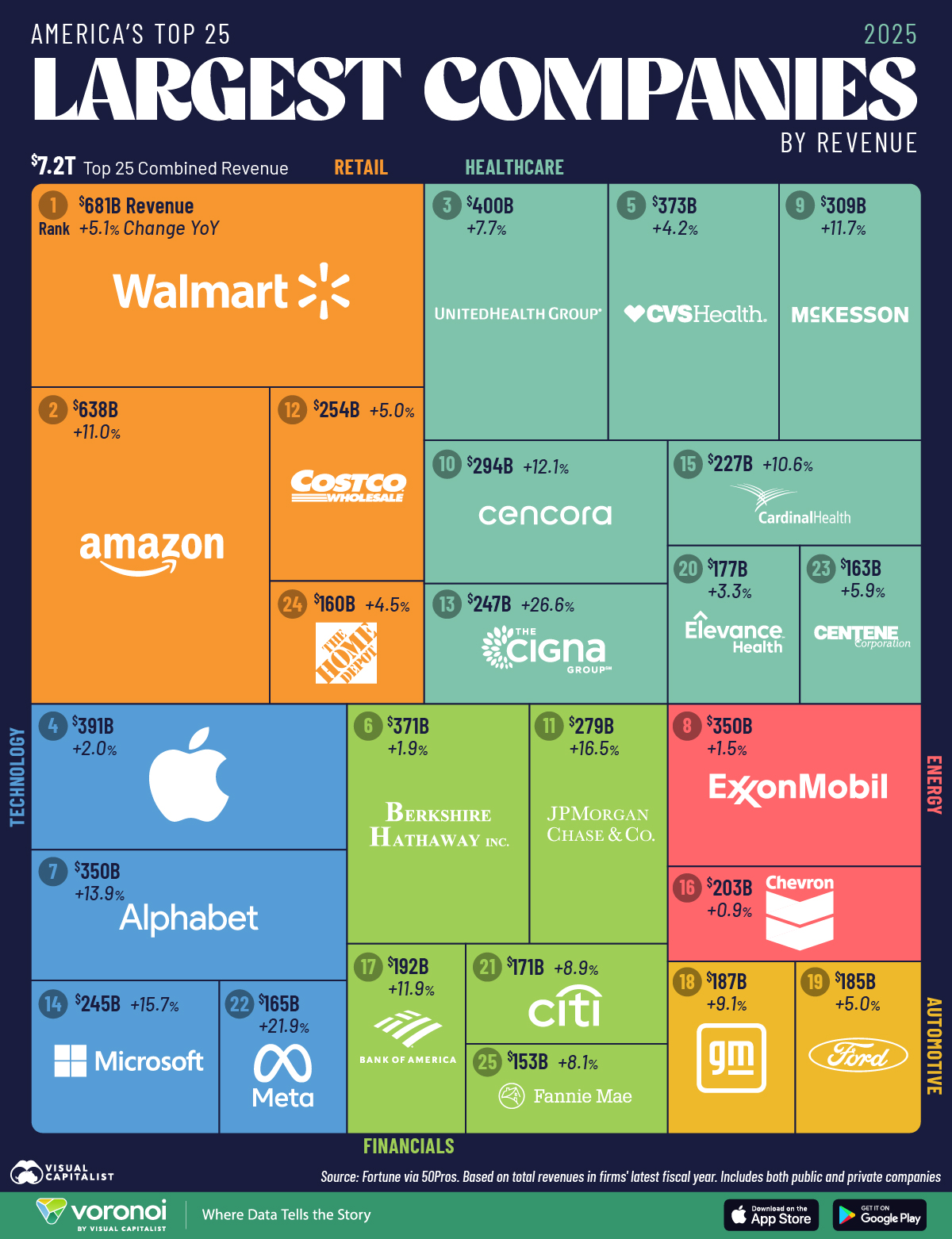
In its most recent fiscal year ending January 31, 2025, Wal-Mart Stores, Inc. reported global revenues of approximately $681 billion. Its U.S. operations alone, the stores that sit in our neighborhoods, that employ our family members at wages that often keep them below the poverty line, that accept our dollars by the billions every single day generated revenues that dwarf the total economic output of every African American-owned employer business in America combined. One company. One corporation founded by one family in Rogers, Arkansas in 1962. That single enterprise generates in annual revenue more than three times what nearly 200,000 Black-owned employer firms produced together.

And Walmart is not alone in that distinction. According to the 2025 Fortune 500, there are 15 individual American companies — each one, by itself — whose annual revenue exceeds the combined $212 billion generated by all Black-owned employer businesses in the United States. Walmart. Amazon. UnitedHealth Group. Apple. CVS Health. Berkshire Hathaway. Alphabet. ExxonMobil. McKesson. Cencora. JPMorgan Chase. Costco. Cigna. Microsoft. Cardinal Health. Fifteen companies. Nearly 200,000 Black-owned businesses. The math is not close.

Now zoom out further. Total revenues across all U.S. businesses in 2022 were $50.9 trillion. Adjusting for estimated growth through 2025, that figure is approximately $58.9 trillion. Black-owned businesses, generating an estimated $251 billion in 2025, represent roughly 0.43% of all U.S. business revenue for a community that makes up 14.4% of the population. That is a representation ratio of 1 to 33. Black Americans are generating business revenue at one thirty-third the rate their population share would suggest. And if Black-owned businesses were generating revenue proportional to their share of the U.S. population, that figure would not be $251 billion — it would be $8.5 trillion. The gap between where Black business stands today and where population parity would place it is approximately $8.2 trillion. That is not a talking point. That is the scoreboard.

Every few years, a video goes viral. A store manager says something racist. A Black customer is followed around a retail floor. Social media explodes. Calls for a boycott trend for 48 hours. And then, quietly and almost universally, people go back to shopping. The outrage dissipates. The dollars continue flowing. This is not an indictment of any individual. The economics of convenience and price are real. Wal-Mart did not become the world’s largest retailer by accident it built a supply chain and a pricing strategy that made it genuinely difficult for lower and middle-income Americans to shop elsewhere. But the conversation about African American spending power, often cited at $1.3 trillion annually, too frequently begins and ends with the individual consumer. Buy Black. Shop Black. Support Black businesses. The moral case is sound. The economic impact, however, is limited so long as it depends entirely on the goodwill and discretion of individual purchasing decisions.

The more instructive question is not whether Black consumers will choose to spend with Black businesses. It is whether Black businesses exist that other communities have no choice but to spend with. Every community that has achieved durable economic power has done so not only through consumer loyalty campaigns but through institution-to-institution capital flows. When a Jewish-owned law firm retains a Jewish-owned accounting firm, when an Asian-owned manufacturer contracts with an Asian-owned logistics company, when a white-owned corporation deposits its cash reserves in a white-owned bank that is not individual charity. That is an ecosystem. Capital circulates. Wealth compounds. Institutions grow. The African American community generates $1.3 trillion in annual spending but has yet to build the institutional infrastructure that would allow a meaningful share of that capital to circulate within the community before it exits. We need Black-owned businesses operating in sectors that other communities must engage — technology, logistics, healthcare, finance, agriculture, defense contracting — not merely retail and personal services. The goal is not to ask anyone to spend with us out of solidarity. The goal is to build enterprises so essential, so deeply woven into supply chains and institutional relationships, that the transaction happens regardless of anyone’s racial sympathies.

But this failure of institutional circulation is not only about what non-Black institutions do with their dollars. It is equally about what Black institutions do with theirs. As HBCU Money has documented, only two HBCUs are believed to bank with Black-owned banks meaning more than 90% of historically Black colleges and universities do not deposit their institutional funds with African American-owned financial institutions. Howard University, African America’s flagship HBCU, partnered with PNC Bank — an institution with over $550 billion in assets — to create a $3.4 million annual entrepreneurship center focused on teaching students about wealth building, while Industrial Bank, a Black-owned institution with $723 million in assets, operates in Howard’s own backyard. Virginia Union University announced a real estate partnership with Keller Williams, a non-Black national franchise, rather than any of the Black-owned real estate firms operating in Richmond. Alabama State University directed a $125 million financial transaction to a non-Black institution when Black-owned alternatives existed. These are not isolated incidents. They are a pattern. The six-hour circulation rate of the Black dollar is not solely a consumer problem it is an institutional one. When the very institutions built to serve African America will not circulate capital with African American-owned enterprises, they are not just minding someone else’s store. They are funding it.

The late Dr. Amos Wilson, in his landmark work on Black economics, argued that the question of Black political and social power could not be separated from the question of Black economic power. You cannot negotiate from a position of strength when you are economically dependent on those with whom you are negotiating. This is not a new observation. Booker T. Washington said it. Marcus Garvey built a shipping line around it. The founders of Black Wall Street in Tulsa, Oklahoma died for it. What makes the Wal-Mart comparison so instructive is not that it should produce shame. It should produce strategy. When Sam Walton opened his first store, he was not competing with Sears and Kmart by screaming about their hiring practices. He was building infrastructure — distribution networks, vendor relationships, loss-leader pricing strategies, and real estate positioning. He was minding his store. The result, three generations later, is a company that generates more revenue than the combined output of all African American businesses in the nation. The African American community has the talent. We have demonstrated that abundantly, in every field from medicine to technology to entertainment to law. We have the consumer base. At $1.3 trillion in annual spending, the Black consumer market is the envy of marketers worldwide. What has historically been missing is the intentional, sustained, and institutionalized redirection of that spending power toward Black-owned businesses at scale.

It would be intellectually dishonest to lay the entire weight of this disparity at the feet of consumer behavior alone. Structural barriers to Black business ownership are real and documented. Access to capital remains the single greatest obstacle. African American business owners are rejected for small business loans at rates significantly higher than their white counterparts — Black-owned small businesses received full funding in just 38% of cases, compared with 62% for white-owned firms. The racial wealth gap — driven in large part by decades of discriminatory housing policy, redlining, and exclusion from wealth-building programs like the GI Bill — means that Black entrepreneurs often lack the family wealth and generational capital that serves as seed funding for so many successful businesses. But the capital problem runs even deeper than loan denial rates. According to HBCU Money’s 2024 African America Annual Wealth Report, African American household assets reached $7.1 trillion in 2024 — yet consumer credit has surged to $740 billion, now approaching near-parity with home mortgage obligations of $780 billion. For white and Asian households, the ratio of mortgage debt to consumer credit stands at approximately 3:1. For African American households, it is nearly 1:1 — meaning a disproportionate share of Black borrowing finances consumption rather than wealth-building assets. Consumer credit grew by 10.4% in 2024, more than double the 4.0% growth in mortgage debt, suggesting that rising asset values are not translating into improved financial flexibility. The community is running faster to stay in place.

What makes this particularly damaging for business formation is where that debt flows. With African American-owned banks holding just $6.4 billion in combined assets — down from 48 institutions in 2001 to just 18 today — the overwhelming majority of the $1.55 trillion in African American household liabilities flows to institutions outside the community. A conservative estimate puts annual interest payments transferred from Black households to non-Black financial institutions at approximately $120 billion. For context, that is more than half of what all Black-owned businesses generate in revenue in an entire year, flowing out of the community in interest payments alone. There is also genuine cause for measured optimism. The Brookings Institution found that Black-owned employer businesses grew by 56.9% between 2017 and 2022 with over half of all new employer businesses started in America during that period being Black-owned. Black-female-owned businesses grew at an even faster clip of 71.6%. Revenue from Black-owned employer businesses rose by 65.7%, and total payroll increased by 69.5%. This is not a community standing still. Yet consider what the employment numbers reveal about the depth of the remaining challenge. Of the roughly 22 million African Americans in the civilian labor force, only 1.2 million — fewer than 1 in 18 — work for a Black-owned business. That means the overwhelming majority of Black workers are building someone else’s enterprise, generating wealth that flows outside the community. Now consider this: there are approximately 3.4 million Black-owned non-employer firms — businesses with no employees at all. If every single one of those firms hired just one African American, Black business employment would go from 1.2 million to 4.6 million overnight — nearly quadrupling the number of African Americans whose economic livelihood is tied to Black ownership. That single hire, multiplied across 3.4 million businesses, would represent one of the most transformative economic shifts in African American history, without a single new business being started, without a single new law being passed, and without waiting for anyone’s permission. The challenge is that the gap between where we are and where parity demands we be remains enormous. Black Americans represent 14.4% of the U.S. population but own just 3.3% of employer businesses. To reach proportional representation, the number of Black-owned employer firms would need to more than quadruple. That is a generation’s worth of sustained work and it cannot be done without both structural support and the intentional recirculation of capital through Black-owned financial institutions. African American-owned banks, credit unions, and community development financial institutions exist specifically to fill this gap. HBCUs already produce 80% of the nation’s Black judges, half of its Black doctors, and a third of its Black STEM graduates — yet their business schools have yet to consolidate around a unifying entrepreneurial mission. A purpose-built African American MBA, anchored at HBCUs and focused explicitly on building and scaling Black-owned enterprises, could be the missing institutional link between Black talent and Black capital. The infrastructure, while still insufficient, is growing. The question is whether HBCUs — and the community they serve — will demand more of it.

Minding your own store does not mean ignoring injustice. It means recognizing that the most durable response to injustice is economic self-determination. It means that for every hour spent outraged about the New York Times culture desk, there should be five hours spent building, funding, patronizing, and amplifying African American-owned media. It means that HBCUs which have historically been the primary incubators of Black professional and entrepreneurial talent deserve the full financial and institutional support of the African American community, not just during homecoming season or when they make the national news for a coaching hire. It means that the $212 billion generated by African American employer businesses today should be $424 billion in a decade, and that achieving that goal requires both new business formation and a deliberate shift in where Black consumer dollars are spent. One company — one family’s vision, relentlessly executed over six decades — built an enterprise that generates more revenue than all 3.6 million Black-owned businesses in America combined. Imagine what those 3.6 million businesses could do if they were built with that same relentlessness, funded by that same community, and patronized by that same loyalty. That is the store worth minding. That is the story worth chasing.


HBCU Money is the leading financial resource for the HBCU community. Visit us at hbcumoney.com.

Disclaimer: This article was assisted by ClaudeAI.

I Woke Up in a New Bugatti: Rap’s Poverty Promotion and the Illusion of Wealth Transfer

If you think you’re tops, you won’t do much climbing.  — Arnold Glasow

Hip-hop was born out of necessity. A sonic rebellion against poverty, violence, and systemic neglect, it emerged from the Bronx as a raw reflection of life in America’s forgotten corridors. But over the past four decades, it has transformed from cultural resistance into commercial royalty. Once recorded with borrowed turntables in community centers, it now echoes across Super Bowl halftime shows, luxury brand campaigns, and billion-dollar corporate balance sheets. Artists who once stood on corners are now seated at boardroom tables. The culture won. But the community did not.

The statistics tell a story of growth at the top and stagnation at the bottom. Hip-hop is now a $16 billion industry. It has created artists turned entrepreneurs who have expanded into liquor, fashion, tech, and sports. The music dominates global charts, sets fashion trends, and influences everything from algorithms to political campaigns. Yet this immense cultural capital has not translated into economic sovereignty for the African American community. Instead, the concentration of wealth in a few hands has often disguised the lack of institutional power. For all the charts conquered and headlines generated, African American banks, endowments, universities, and asset management firms remain modest, if not endangered.

At the heart of this failure lies a devastating contradiction. While rappers flaunt wealth more publicly than any generation before them, the economic conditions in many African American communities remain dire. The median net worth of Black households, as of 2022, stands at $44,100 compared to $284,310 for White households—a gap that has barely moved in decades. Hip-hop has become the most visible face of African American success, but that visibility is not backed by scale. There are no Black equivalents to BlackRock or Vanguard. No hip-hop-funded HBCU research lab. No Goldman Sachs of rap. Even the highest echelon of Black-owned investment firms manage a fraction of their white counterparts. Vista Equity Partners, the most prominent, oversees $103.8 billion, an extraordinary feat, yet still a rounding error next to BlackRock’s $10.5 trillion.

And even this level of institutional success is an outlier. Most Black-owned investment firms manage less than $10 billion. Most HBCUs have endowments below $50 million. The largest Black bank, OneUnited, holds roughly $650 million in assets, while Bank of America manages over $2.5 trillion. What hip-hop has delivered in influence, it has not delivered in capital. Instead of building institutions, it has made individuals rich. But those individuals exist within a system that continuously siphons wealth away from their communities.

This is not to say that artists bear the blame for economic injustice. But hip-hop has become a tool of seduction as much as expression. Its dominance in the global marketplace has aligned it with the poor man’s logic of capitalism celebrating consumption, rewarding individualism, and elevating spectacle. In this model, buying a Bugatti becomes a symbol of power, while the absence of a Black mutual fund managing $100 billion barely registers. Lyrics obsess over fashion houses like Balenciaga, but rarely name Black-owned real estate firms or venture capital funds. The dream has shifted from ownership of blocks to ownership of Birkin bags.

This performative wealth is not just cultural; it’s systemic. The music industry itself is structured to extract more than it distributes. Record labels, streaming services, and publishing houses are disproportionately owned by entities with no allegiance to Black institutions. A 2023 report by Rolling Stone noted that artists receive less than $0.004 per stream on major platforms. Even when a track is streamed millions of times, the majority of profits flow to tech firms and record conglomerates, not to the creators or their communities. The money flows up and out. It is the same pattern that defines the broader African American economic experience: labor and creativity are extracted, while ownership and equity are denied.

The disparity is especially stark when one examines capital circulation. A dollar in the Black community circulates for less than 6 hours, according to HBCU Money, while in Jewish and Asian communities, it circulates for 17 and 20 days respectively. The consequence is an economy that is constantly depleted, reliant on external institutions for everything from finance to food. Hip-hop, despite its earnings, has not altered this trajectory. The Bugatti may be new, but the bank that financed it is old—and white.

This failure to institutionalize wealth is not accidental. It reflects deeper structural barriers, including a lack of access to financial infrastructure, intergenerational capital, and legal expertise. But it also reflects a shift in priorities within the culture itself. The era of Public Enemy and X-Clan once channeled music toward collective uplift. The current era often measures success by proximity to luxury, not impact on community. The metrics of power have changed from organization to ostentation.

Still, there are exceptions that point to what is possible. But these efforts remain underfunded and under-celebrated. There is no coordinated movement among hip-hop elites to pool capital, fund cooperative ventures, or launch institutional vehicles capable of rivaling their white counterparts. What could a $1 billion hip-hop endowment fund do for HBCUs? For land ownership? For venture funding of African American startups? These questions are never asked because the Bugatti is louder than the balance sheet.

It’s not just about what rappers buy. It’s about what they build or more accurately, what they have not built. For every luxury watch, there could be a community-owned grocery store. For every $30 million home, there could be a regional loan fund or student scholarship pipeline. The failure to institutionalize success means that when an artist dies, their wealth often dies with them dispersed among heirs or recaptured by the state or private corporations. There is no hip-hop university. No national Black credit union seeded by artists. No sovereign wealth fund of the culture.

Arnold Glasow’s warning—“If you think you’re tops, you won’t do much climbing”—rings like an indictment. The culture believes it has arrived, but the destination is superficial. It has conquered billboards but not balance sheets. The climbing left to do is immense: building a generation of lawyers, financiers, real estate developers, and economists who can institutionalize the gains of cultural dominance. Without this, hip-hop’s economic contribution will remain symbolic, not structural. The world will continue to dance to the music, while Black America stays undercapitalized.

A Bugatti depreciates. Institutions compound. Until hip-hop’s economic power stops ending with the individual and starts building for the collective, the community will remain stuck in a loop of representation without accumulation. The corner coffee shop that became Starbucks is not owned by the block. And the music booming from its speakers will not change that. Not unless the wealth it generates is used to build not just to boast.

Disclaimer: This article was assisted by ChatGPT.

The Gridiron Mirage: Debunking the NFL as the Engine of African American Wealth

“A lot of enslaved people actually made money, but they had no power.” – William Rhoden

In the annals of American mythology, few institutions occupy as outsized a symbolic role in African American economic advancement as the National Football League. It is a league awash in spectacle and saturated with the rhetoric of opportunity. “The NFL has made more African American millionaires than any other institution,” say its defenders. This refrain—recited with patriotic pride or cynical resignation—has come to function as a social truism, a talisman held up to justify the nation’s meager investments in structural equity. But like most myths, its repetition does not make it true.

This article contends that this notion is not only false but insidious. It misrepresents the scale and structure of wealth in the African American community, diverts attention from more potent engines of generational prosperity, and masks the extractive and precarious nature of professional sports as a vehicle for wealth creation. The NFL is not a wealth escalator; it is, at best, a short-lived income spurt machine for a statistical elite, and at worst, a cultural and physical treadmill leading back to zero.

Gridiron Arithmetic: The Numbers Game

The first fallacy is numerical. As of the 2023 season, there were approximately 1,696 active NFL players spread across 32 teams. Around 58% of these players identified as African American, or roughly 984 athletes. Even when one accounts for the extended rosters, practice squads, and recent retirees still living off their earnings, the figure remains marginal—perhaps a few thousand men across multiple generations.

Contrast this with sectors such as healthcare, education, government, and business. The National Black MBA Association alone counts tens of thousands of members, many of whom have built sustainable wealth through entrepreneurship, investment, or corporate ascendancy. African American doctors number over 50,000. Black-owned businesses, according to the U.S. Census Bureau, exceed 140,000 with paid employees, and millions more operate as sole proprietorships.

The American Bar Association reports over 50,000 African American attorneys. Even the public sector, often decried as slow or bureaucratic, employs hundreds of thousands of Black professionals across local, state, and federal levels. These occupations, while lacking the glamour of a touchdown, generate far more stable, scalable, and generationally transferrable wealth.

Income vs. Wealth: The Shaky Foundations of NFL Riches

To understand the illusion, one must disentangle income from wealth. Wealth is not what one earns; it is what one owns. It is the portfolio, the property, the equity stake, the passive income stream, and, perhaps most critically, the ability to transfer resources across generations. NFL players earn substantial salaries during their brief careers—an average of $2.7 million per year, though the median is closer to $860,000. But careers are short, averaging just 3.3 years.

This creates what economists call a “high burn rate, low accumulation” profile. Studies have found that 15% of NFL players file for bankruptcy within 12 years of retirement, despite millions in earnings. Others do not go bankrupt but live in quiet precarity, reduced to local celebrity gigs and motivational speaking to sustain a post-football identity. The 2022 National Bureau of Economic Research paper “Bankruptcy Rates among NFL Players with Short-Lived Income” confirms this vulnerability, showing how the lack of financial literacy, support systems, and institutional guidance leads to dissipation rather than accumulation.

Meanwhile, wealth in America is driven by ownership: of businesses, real estate, stocks, and institutions. The NFL offers none of these to the vast majority of its Black athletes. Ownership, it must be said, remains the exclusive domain of white billionaires. As of 2025, there are zero majority African American owners of NFL franchises. While the NBA has made token strides—see Michael Jordan’s brief tenure as majority owner of the Charlotte Hornets—the NFL remains rigid in its old-world capital structure.

The Plantation Paradigm: Extraction, Not Empowerment

It is hard to avoid the uncomfortable metaphor that the NFL structurally resembles a modern-day plantation. African American bodies fuel the labor force, endure the risks, suffer the injuries, and entertain the masses. White ownership, white commissioners, and white-centered media conglomerates reap the institutional profits. The league generates $18 billion in annual revenue. The average team is valued at $5 billion. And yet, the athletes, even at the apex of their earning power, remain labor, not capital.

This is not a critique of sports per se. Athletics can inspire and galvanize. But the mythologizing of football as a viable strategy for racial uplift is akin to mistaking a single rainstorm for an irrigation system. The commodification of Black excellence in a space so structurally white in ownership and control cannot plausibly be the foundation for true economic emancipation.

This is made all the more clear by examining the fates of even the most successful. Players like Vince Young, who signed a $26 million contract and ended up broke, or Warren Sapp, who earned $82 million only to file for bankruptcy, are cautionary tales. Exceptions like LeBron James, who has parlayed his brand into equity ownerships and venture capital, are held up as archetypes. But these are aberrations, not templates. And they are not NFL stories.

The Opportunity Cost of Myth-Making

Perhaps the greatest harm of the “NFL creates millionaires” myth is opportunity cost. It distorts the allocation of attention, aspiration, and investment within the African American community. While youth in other demographics are taught to pursue STEM, financial literacy, or entrepreneurship, too many African American boys are sold a lottery ticket disguised as a profession. A 2021 study by the Journal of Black Studies found that African American adolescent males are 40 times more likely to aspire to a professional sports career than to become an engineer or entrepreneur.

This has ramifications far beyond the individual. It weakens pipelines to industries that are scalable, recession-resistant, and foundational to intergenerational wealth. No serious community-wide wealth can be built on the shoulders of 53-man rosters. Nor can economic independence arise from dependency on one of the most exploitative and physically damaging professions in modern labor.

There are also societal consequences. The overrepresentation of African Americans in professional sports distorts public perception. It fosters the narrative that “Black people are doing fine” because a few are seen in Super Bowl commercials or luxury car ads. It becomes a justification for denying systemic reform, funding cutbacks to HBCUs, or underinvestment in majority-Black schools. “Why do they need help?” ask the indifferent. “They have the NFL.”

Institutional Power vs Individual Stardom

In the game of wealth, institutions win. The NFL is an institution—one whose structure benefits its owners and media affiliates. The real wealth in sports lies not in being a player but in being an owner, a broadcaster, a media rights holder, or a licensed merchandiser. It lies in being Robert Kraft, not the running back who suffers a concussion under his ownership.

African American wealth building must shift its focus toward institutions that compound, aggregate, and replicate power. HBCUs, Black-owned banks, cooperative land trusts, investment syndicates, media companies, and technology accelerators are more viable pathways to collective advancement than any draft pick. Consider that a single Black-owned private equity fund managing $500 million will produce more Black millionaires than five decades of NFL careers.

In fact, historical analogues suggest that professional exclusion led to the construction of powerful Black institutions. During segregation, African Americans built hospitals, universities, bus lines, and newspapers. These were incubators of both economic and cultural power. In today’s integrationist fantasy, too many of these have been sacrificed in favor of proximity to elite white institutions—like the NFL—that will never relinquish true control.

The Global Lens: Transnational Wealth Thinking

Moreover, the fixation on domestic sports ignores the global economic realignment. The world’s fastest-growing wealth markets are in Africa, Asia, and Latin America. Forward-thinking African Americans should be exporting services, partnering with Pan-African institutions, and investing in sovereign wealth opportunities. Yet, the “NFL as savior” narrative keeps too many tethered to a narrow, provincial idea of success.

The NFL does not build factories. It does not fund innovation. It does not seed capital. It does not provide passive income. It does not own land, develop cities, or engage in infrastructure. It sells tickets. It sells ads. It breaks bodies. It builds billion-dollar stadiums on taxpayer subsidies and pays its workers less than hedge fund interns.

Real wealth is built through scale and succession. The Black farmer who owns 1,000 acres and passes it down is more transformative than the Pro Bowler whose children inherit post-career medical bills and reality show royalties.

Toward a New Narrative: Wealth Without Injury

African American communities need new wealth myths—ones grounded in fact, finance, and future orientation. The idea that the NFL is a pinnacle of Black achievement should be retired. In its place must come narratives about investment clubs, fintech startups, regenerative agriculture, urban development, and cooperative real estate ventures.

Educational institutions and cultural gatekeepers have a responsibility here. Public school counselors, pastors, and media platforms should deglamorize the sports-to-riches narrative and illuminate more durable paths. Foundations and philanthropies should invest not in football camps, but in coding bootcamps, maker spaces, and entrepreneurship labs.

Policy must evolve, too. Tax incentives should reward community ownership and capital retention. States should support Black-owned banks the way they support stadium construction. Reparations conversations should be about equity stakes, not honorary jerseys.

The NFL is not evil. It is, however, a business. And like all businesses, it is designed to maximize returns for its investors—not to solve racial inequality. The sooner we disabuse ourselves of the myth that it is a wealth escalator, the sooner we can begin the real work of building wealth—wealth that endures beyond the roar of the crowd, the flicker of the lights, or the brevity of a three-season career.

Trading Helmets for Holdings

In conclusion, the NFL is a distraction, not a development strategy. It is a parade, not a pipeline. It is a pageant of athletic excellence exploited for institutional enrichment. And it is a cultural sedative—one that soothes legitimate anger over systemic inequality with the spectacle of a few lucky gladiators.

The real revolution will not be televised on Monday Night Football. It will be written in balance sheets, ownership ledgers, and multi-generational trusts. African Americans must trade the helmet for holdings, the franchise tag for franchise ownership, and the myth of athletic salvation for the measured, compound reality of institutional power.

That is not as thrilling as a fourth-quarter comeback. But it is the only way to win the long game.