Tag Archives: African American wealth building

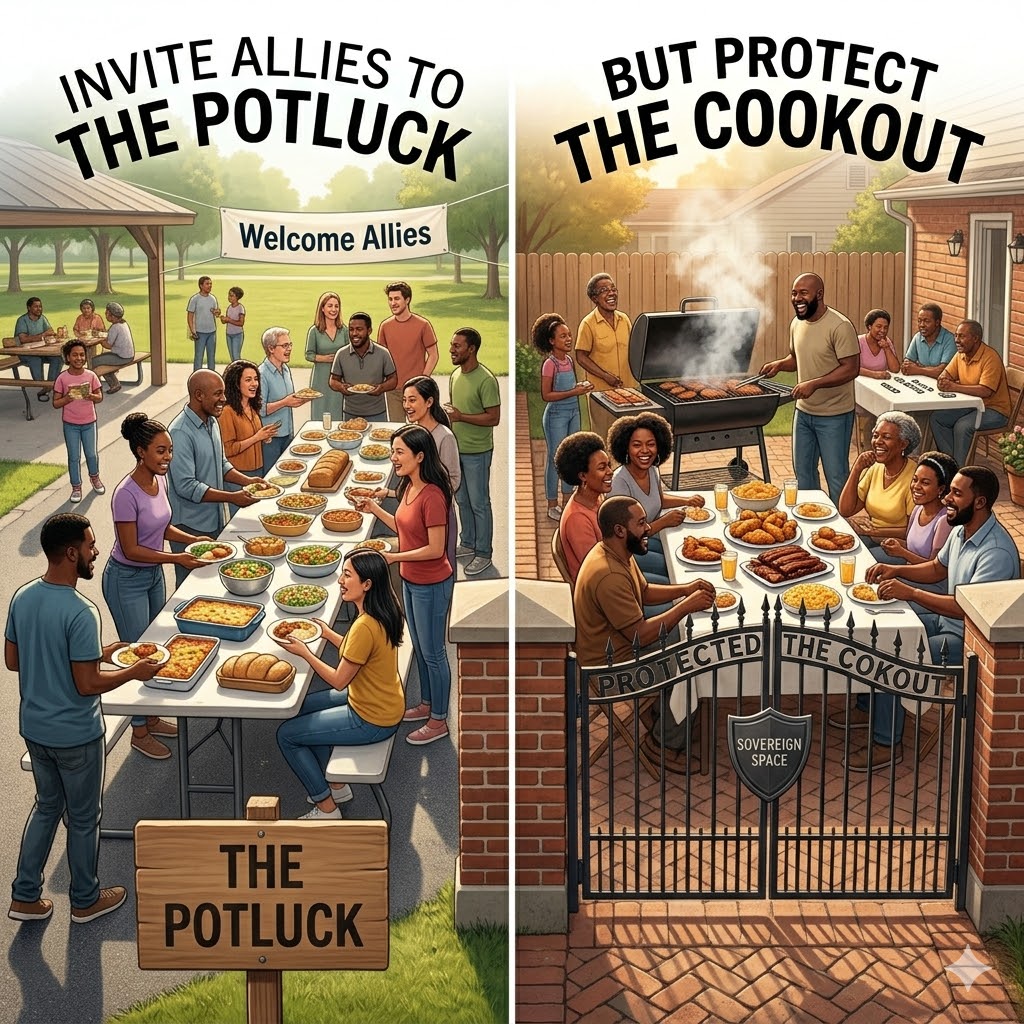
Invite Allies to the Potluck but Protect the Cookout

Do not show me the person dancing to our music, enjoying our food, fetishizing the Black man, or some other cultural consumption. Show me the one who is demanding Harvard deposit $100 million of their own funds to OneUnited Bank so that OneUnited, Liberty Bank, and other African American owned banks can make loans to our community for business and homeownership. Show me the ones who uses their privilege to stick up for what society has done and does to Black women and Black family. That is who can come to the potluck, but the cookout is ours. We have a tendency to shrink ourselves to Others’ fragility of real conversations that we need to have for ourselves when Others are present. – William A. Foster, IV
There is an old story, told in various forms across African American communities, about a family that learned to cook in secret. For generations, they had grown their own food, developed their own techniques, and built a kitchen that could feed a neighborhood. One day, a neighbor knocked on the door, drawn by the smell. They were welcomed in, fed generously, and they returned often. They brought friends. They praised the food. They called themselves part of the family. Eventually they began to suggest improvements to the kitchen — a different arrangement, a new appliance, a recipe adjusted for broader tastes. The family, grateful for the company, accommodated each request. By the time they looked up, the kitchen still stood. The neighbor’s name was on the deed. The family was still cooking. They just no longer owned the stove.

But generosity extended without institutional clarity is not community building. It is exposure. And the history of African American institutional life is, in no small part, a history of spaces built with collective sacrifice that were subsequently absorbed, diluted, defunded, or dismantled once their value became legible to the outside world.

The cookout, in other words, is not a metaphor. It is an asset. And assets require more than governance, they require protection. Not the passive protection of a community that hopes its institutions will be respected, but the active, disciplined defense of people who understand that what they have built has value precisely because others will seek to capture it. Protection, at the institutional level, is not always a defensive posture. Sometimes it means going on offense by organizing buying power before the crisis arrives, building legal capacity before the lawsuit is filed, funding Black media before the narrative is set by someone else. Communities that wait to protect what they have until after it is threatened are communities that spend their energy on recovery rather than accumulation. The history of Black Wall Street, of the Freedman’s Bank, of the systematic dismantling of Black-owned cooperatives during the mid-twentieth century is not a history of insufficient gratitude from the outside world. It is a history of insufficient institutional defense from within. The lesson is not to be less generous. It is to be better armed.

The analytical literature on Black wealth formation is consistent on a foundational point: communities that retain capital, talent, and institutional loyalty generate compounding returns across generations. Communities that allow those resources to migrate outward whether through spending patterns, marriage partners, talent pipelines, or cultural appropriation subsidize the wealth accumulation of others while undermining their own. The cookout dynamic maps directly onto this framework. When African American cultural production, social spaces, and institutional knowledge are shared without reciprocal investment, the result is a net transfer of value from Black institutions to non-Black ones. This is not a theoretical concern. It is the operating condition of the present economy.

Consider the structure of the music industry, where Black artists have generated the dominant commercial genres of the twentieth and twenty-first centuries — blues, jazz, rock and roll, hip-hop, R&B — while the majority of accumulated wealth from those genres has resided in non-Black-owned labels, distributors, publishing houses, and streaming platforms. Consider the food economy, where Black culinary traditions have been commodified into billion-dollar restaurant chains and packaged goods while the originators of those traditions remain systematically underbanked and undercapitalized. Consider the fashion and beauty industries, where aesthetics developed within African American communities command global markets while the infrastructure of those markets sits largely outside Black institutional ownership. In each case, the cultural product was welcomed. The economic architecture was not extended.

Allies who celebrate Black culture without supporting Black institutions are not allies in any operationally meaningful sense. They are consumers. The distinction is not semantic. An ally, by institutional definition, extends their power, capital, and access in support of an aligned party’s strategic objectives. A consumer extracts value from a community’s production without contributing to the institutional conditions that make that production possible. The presence of a non-Black person at the potluck enjoying the food, the music, the wit, the aesthetic while opposing or simply ignoring the policy conditions, banking relationships, and institutional investments that African American communities require to sustain themselves, is the profile of a consumer, not a coalition partner. They have not earned the potluck. They have certainly not been invited to the cookout.

This distinction becomes especially critical in the current political economy. Federal and state policy over the past several decades has systematically defunded or defanged the institutional infrastructure of Black America: HBCUs chronically underfunded relative to their peer institutions; Black-owned banks capitalized at a fraction of the levels needed to serve their communities; Black neighborhoods subject to environmental, housing, and educational policies that extract tax revenue while withholding proportional investment. In this context, cultural adjacency or rather the willingness to celebrate Juneteenth, consume Black media, or engage Black social vernacular is insufficient as an expression of solidarity. It may, in fact, function as cover for the absence of the structural commitments that matter.

The HBCU sector offers a particularly instructive case study. Historically Black Colleges and Universities were built precisely because African Americans were excluded from the educational institutions of their own country. They were not a gesture of separatism; they were an institutional response to exclusion. Over the course of the twentieth century, HBCUs produced a disproportionate share of the Black professional class, trained the majority of Black doctors, lawyers, engineers, and teachers of their generation, and served as incubators for the civil rights movement’s leadership and organizational capacity. They are, by any rigorous measure, among the most productive institutions in American higher education history relative to the resources they have been given.

Yet HBCUs now operate in a competitive landscape that rewards endowment size, federal research designation, and alumni giving rates; all measures that reflect historical access to capital rather than institutional quality or community impact. Predominantly white institutions that previously excluded Black students now recruit them aggressively, drawing talent and tuition revenue that would otherwise compound within the HBCU ecosystem. The language used to justify this recruitment is almost always the language of inclusion and opportunity. But inclusion in another institution’s ecosystem is not equivalent to investment in your own. A Black student who attends a well-resourced predominantly white institution may gain individual credentials. The HBCU they did not attend loses the tuition, the alumni relationship, endowment compounding, and the network density that transforms good universities into great ones.

This is not an argument against shared space. There are potlucks to which allies are genuinely welcome that inlcude moments of coalition, cross-cultural solidarity, and mutual investment where the presence of non-Black partners strengthens rather than dilutes collective purpose. But a potluck is not a cookout, and the distinction is not decorative. At a potluck, everyone brings something to the table. The host provides the space; the guests contribute to the meal. It is a transaction of mutual provision, and it works precisely because no one arrives empty-handed expecting to be fed. A cookout is different. A cookout is the community’s own table that is prepared by Black hands, funded by Black resources, held in Black space, for Black people. Its purpose is not coalition. Its purpose is sustenance, honesty, and the particular freedom that only comes when a people can speak plainly among themselves without managing anyone else’s comfort. Both gatherings have their place. They are not interchangeable, and confusing one for the other is how communities lose the only space that was ever entirely their own.

What African American institutional life requires is a clear distinction between spaces of engagement and spaces of sovereignty. Spaces of engagement are where coalitions are built, where allies demonstrate reciprocity, where the community interfaces with the broader economy and polity on its own terms. Spaces of sovereignty are where Black families and communities convene among themselves to assess the wealth gap without softening the diagnosis, to discuss the particular pressures facing Black women and Black men without moderating the conversation for outside sensibilities, to make strategic decisions about institutional investment and political alignment without the distortion that comes from managing the reactions of those who do not share the same structural position. Both kinds of space are necessary. Only one of them is currently treated as optional.

What does that governance structure look like in practice? It looks like HBCU alumni choosing, as a default rather than an afterthought, to bank with Black-owned financial institutions the Liberty Banks, the OneUnited Banks, the First Independence Banks rather than routing deposits to institutions that do not reinvest proportionally in Black communities. It looks like Black professionals who have achieved positions of institutional authority actively directing contracts, investment mandates, and philanthropic dollars toward Black-owned firms and HBCU vendors rather than defaulting to the institutional relationships they inherited. It looks like African American civic organizations insisting on quantifiable reciprocity as a condition of coalition not cultural appreciation, not rhetorical solidarity, but measurable investment.

There is a separate and equally important argument that must be made here, because it is the one most frequently obscured by well-intentioned framing: inclusion is not ownership. Even in the most favorable version of the ally relationship where non-Black partners, institutions, and individuals are genuinely committed to diversity, sincerely supportive of Black participation, and actively working to open doors none of that changes the structural necessity of Black-owned institutions. Inclusion operates within someone else’s architecture. Ownership builds your own.

This distinction is not abstract. It has a balance sheet. When a Black professional is included in a non-Black-owned firm, their labor generates returns that compound within that firm’s ownership structure and those are returns that flow to shareholders, partners, and stakeholders who are, in the aggregate, not Black. The professional may advance. They may be compensated well. They may even occupy positions of genuine authority. But the wealth generated by their inclusion does not build Black institutional capital; it builds the institution that included them. Inclusion, at scale, is a mechanism by which Black talent subsidizes non-Black institutional growth. It is not a substitute for ownership. It is, in many cases, its alternative.

The same logic applies to HBCUs operating in a landscape of ostensibly inclusive predominantly white institutions. The argument made against HBCU investment that the best Black students should simply attend the best-resourced universities, wherever those happen to be is structurally an argument against Black institutional ownership in higher education. It accepts inclusion as a terminal condition rather than a transitional one. A Black student included at Harvard is not the same institutional fact as Harvard-level resources flowing into an HBCU. One is a credential extended to an individual. The other is capacity built within a community-owned institution that will outlast any single student and compound across generations.

Ownership is also the only form of institutional participation that is durable against shifts in political will. Inclusion depends on the continued goodwill of those doing the including. When political climates shift, when diversity commitments are deprioritized, when administration changes, when economic contractions force budget realignments the “included” are the first to absorb the cost. Ownership is not subject to another party’s goodwill. A Black-owned bank does not require a non-Black institution to remain committed to serving Black depositors. A Black-owned media organization does not require a conglomerate’s editorial patience. An HBCU does not require a predominantly white institution to remain interested in Black academic excellence. Ownership is the only form of institutional security that does not expire when someone else’s priorities change.

This is why the recent assault on diversity, equity, and inclusion programs in American corporations and universities however dismaying as a political signal is not the fundamental crisis for African American institutional life that it is sometimes framed as being. The fundamental crisis predates the DEI rollback and will outlast its reversal. It is the historical condition of a community that has been systematically excluded from ownership while being selectively included in participation. DEI programs, at their most effective, opened doors into institutions that someone else owned. Their elimination forecloses that access. But their presence never resolved the ownership question. The community that owns nothing is equally vulnerable in both eras, it simply has a longer walk to the door in one of them.

The same analytical framework applies to an institution that is rarely named as such in discussions of Black economic strategy: the Black family. The family unit is not a private matter sealed off from institutional analysis. It is the primary site of intergenerational wealth transfer, the first school of civic and financial literacy, and the foundational node in any network of community institutional density. How the Black family is formed, sustained, and oriented toward community investment is therefore a question of institutional consequence, not merely personal preference.

This makes the question of interracial partnership and specifically, the assumptions that sometimes travel with it a legitimate subject of institutional inquiry. The concern here is not interracial partnership as such. It is the set of ideological commitments that non-Black partners sometimes bring into Black family formation, and what those commitments mean for the community institutions that depend on family-level investment and loyalty to survive.

A non-Black person who partners with a Black man or woman has not, by virtue of that partnership, demonstrated any commitment to African American institutional empowerment. The relationship is personal. The institutional question is separate, and it must be asked separately. Does this person bank at Black-owned financial institutions? Do they support HBCU attendance, alumni giving, and network loyalty as a family value? Do they understand that the wealth gap their Black partner navigates is not an abstraction but a structural condition reproduced through specific policy and capital allocation decisions and that their own family’s economic choices either mitigate or compound that condition? Personal love does not answer institutional questions. Only institutional behavior does.

The specific case of non-Black women partnered with Black men warrants direct analysis, because it intersects with a set of structural realities that the colorblind framework is particularly ill-equipped to see. Black women in America face a documented and compounding disadvantage in the partner market, a disadvantage produced not by individual preference alone but by the structural devaluation of Black femininity in American cultural and economic life, by the incarceration and early mortality rates that reduce the available pool of Black men, and by media and social ecosystems that actively hierarchize desirability along racial lines. These are not grievances. They are measurable structural conditions with identifiable institutional causes.

Non-Black women who partner with Black men enter this landscape with structural advantages they did not earn and, in the colorblind framework, are not required to acknowledge. The colorblind framework of “we are the world,” love is love, race doesn’t matter to me functions in this context not as enlightenment but as insulation from accountability. It allows a person to benefit from the aesthetics and community of Blackness, to be welcomed into Black family life and Black social space, while remaining ideologically committed to a universalism that forecloses any obligation to the specific institutional needs of the community whose door they have entered. The distinction between a potluck and a cookout becomes precise here: they have been given a seat at the table of coalition, but they have wandered into the cookout consuming its warmth, its honesty, its intimacy without ever acknowledging who built the table or accepting any obligation to help it stand.

This matters institutionally because family formation is where ideology meets capital allocation. A household in which one partner is oriented toward Black institutional investment and one is oriented toward a colorblind universalism that treats all institutions as equivalent is a household with a structural conflict embedded in its financial decisions. Where will their children attend college? Which financial institutions will hold their savings? Which civic organizations will receive their philanthropic commitments? Which political candidates and policy frameworks will they support? These are not questions that love resolves. They are questions that ideology answers and the colorblind ideology consistently answers them in ways that route resources away from the Black institutional ecosystem and toward the universal one, which in practice means the mainstream one, which in practice means the predominantly non-Black one.

The institution of the Black family, therefore, must be understood as requiring the same institutional clarity as any other node in the African American ecosystem. Welcoming a non-Black partner into Black family life is not categorically different from inviting a non-Black guest to the potluck. In both cases, the question is not the warmth of the welcome. The question is whether the guest understands what was built, what it cost, and what it requires to survive and whether they comprehend that the cookout, the sovereign space, the honest table, was never theirs to enter simply because they were loved by someone who belonged there. Structural advantages do not disappear because they are unacknowledged. They accumulate. And a household ideology that refuses to see those advantages and to accept the institutional obligations they create is not a neutral position. It is a position that benefits from Black institutional labor while declining to contribute to it.

It also looks like intellectual clarity about co-optation, which is the more subtle and in many ways more consequential threat to Black institutional space. Co-optation does not require hostility. It requires only that a framework, a concept, a methodology, or a space developed with Black intellectual labor and institutional capital be adopted and repackaged by actors who do not acknowledge its origin, do not direct resources back to its source, and do not bear the institutional costs that made its development possible. This happens in academia, where Black Studies frameworks migrate into mainstream curricula without corresponding investment in Black Studies departments. It happens in corporate diversity programs, where the conceptual vocabulary of African American equity movements is deployed in the service of institutional reputation management rather than structural change. It happens in media, where Black cultural aesthetics are packaged for mass consumption while Black-owned media organizations operate on fractional budgets.

The question facing African American institutional leadership is not whether to engage with the broader economy and polity of course it must. The question is on what terms. Engagement without institutional conditions is simply absorption. The HBCU sector, the network of Black-owned banks and CDFIs, the ecosystem of Black professional associations and civic organizations, the tradition of Black media, these are not relics of a segregated past. They are the institutional architecture of a future in which African Americans participate in American (and global) economic and political life from a position of institutional strength rather than perpetual dependency.

That institutional architecture does not sustain itself through cultural warmth. It sustains itself through capital, coordination, and the disciplined exercise of institutional loyalty. The potluck can be generous and it should be, because coalition requires genuine exchange. But the cookout is not the potluck. The cookout is where the community gathers to be honest with itself, to protect what it has built, and to plan for what it still must build. Allies are welcome at the potluck when they bring something real. The cookout is not their invitation to extend.

The fire is on. The food is ready. But the table was built by people who had no other table to go to. That history is not decoration. It is the deed.

Disclaimer: This article was assisted by Claude AI.

The HBCU Card? Why the Community’s Institutional Dollar Constantly Fails to Circulate at the HBCU’s Front Door

Let us put our money together; let us use our money; let us put our money out at usury among ourselves, and reap the benefit ourselves. – Maggie Lena Walker

The HBCU Card routes HBCU community spending through a family-owned Minnesota bank. African American-owned financial institutions are watching from the sideline. HBCUs are institutions with balance sheets, alumni networks, and banking relationships. When those relationships run through a family-owned bank in St. Paul, Minnesota, the question is not whether the partnership is well-intentioned. The question is who is building institutional capacity for whom.

There is an old arrangement, familiar to the sharecropping South, called the company store. The employer owned the land, controlled the wages, and operated the only store within reach. The worker labored, earned, and spent and every dollar completed a circle that ended back in the employer’s pocket. The arrangement was not presented as exploitation. It was presented as convenience. As service. As the reasonable way things worked given the options available. The options, of course, were controlled by the same party that ran the store. HBCUs in 2026 are not sharecroppers. They are institutions with endowments, alumni networks, and balance sheets. Which makes it harder, not easier, to explain why they are running the company store model on their own communities.

A prepaid Mastercard called the HBCU Card is circulating in HBCU communities, issued through Sunrise Banks, N.A., a family-owned bank headquartered in St. Paul, Minnesota. It carries the logos of individual HBCUs. It returns a fraction of transaction fees to participating schools. The pitch is that HBCU students and alumni can express institutional pride through their spending and send a little money back to their alma mater in the process. That is the whole proposal. Read it twice if you need to.

It is not alignment. It is a licensing agreement dressed up as solidarity.

Sunrise Banks is a privately held, family-owned institution headquartered in St. Paul, Minnesota, wholly owned by University Financial Corp, GBC, led by CEO David Reiling and his father, Bill Reiling. The bank is a certified B Corporation and holds CDFI designation from the U.S. Treasury. Its social impact commitments are real. None of that is the point. Sunrise Banks is not an African American-owned institution. It has no ownership ties to the HBCU community. It is not part of the African American financial ecosystem in any structural sense. It is a vendor that found a distribution channel, and the distribution channel said yes. Banking is not a transaction. It is infrastructure. Deposits flow into balance sheets that fund mortgages, small business loans, and community reinvestment. When that capital is held by institutions with ownership accountability to the depositing community, it compounds within that ecosystem. When it flows to an outside institution, however well-certified, however socially conscious its marketing, it leaves. A branded card does not change the direction of the outflow. Pride does not reroute capital. Ownership does.

HBCUs are, by their founding logic, in the business of building something that lasts. Endowments. Land. Research infrastructure. Alumni networks that compound across generations. That is the institutional premise. Against that premise, the HBCU Card is an embarrassment. It asks HBCU communities to generate transaction fee revenue, a rounding error in any serious capital strategy — and hand the actual value of the arrangement to a Minnesota family bank. The HBCU gets logo placement. Sunrise Banks gets a branded distribution network across dozens of historically Black institutions, customer acquisition at scale, and the reputational association with one of African America’s most symbolically resonant set of institutions. That is not a partnership. That is a concession. This would be forgivable if there were no alternative. There is. There are 221 of them.

As of 2025, there are 205 active African American-owned credit unions holding more than $8.15 billion in assets and serving nearly 727,000 members across 29 states and the District of Columbia. There are 16 African American-owned banks holding $6.7 billion in combined assets. Louisiana alone has 25 African American-owned credit unions. Illinois has 23. Virginia has 13. These institutions are not obscure. They are documented, chartered, federally insured, and in many cases operating within miles of HBCU campuses. Six HBCU-affiliated credit unions, institutions built specifically to serve the campus financial community, are still active after five such institutions closed or were absorbed since 2020. Their combined assets total $76.8 million. They are contracting. The HBCU Card is expanding. This is the choice being made.

The six that remain deserve to be named because the institutions they were built to serve have apparently forgotten them. Southern Teachers & Parents Federal Credit Union, founded to serve the Southern University system across its Baton Rouge, New Orleans, and Shreveport campuses, is the largest of the survivors at $30.3 million in assets. Florida A&M University Federal Credit Union serves the flagship public HBCU in Florida. Virginia State University Federal Credit Union serves one of Virginia’s historically Black institutions. Councill Federal Credit Union serves the Alabama A&M University community. Arkansas A&M College Federal Credit Union serves the University of Arkansas at Pine Bluff. Xavier University of Louisiana Federal Credit Union serves the only historically Black Catholic university in the Western Hemisphere. These six institutions held a combined $76.8 million in assets as of the most recent reporting, a number that should be ten times larger given the campus communities they sit inside. Prairie View A&M University Federal Credit Union, founded in 1937 by sixteen people who built a financial institution to serve the employees of Texas’s first state-supported college for African Americans, did not survive. It was absorbed by Cy-Fair Federal Credit Union, the credit union of a Houston-area school district with a documented record of racial inequity in its own student discipline. An 85-year-old Black institution, built by and for a Black university community, became a subsidiary of a school district credit union. Prairie View A&M University has nothing publicly to say about it. These institutions are not disappearing because they failed their communities. They are disappearing because their communities’ own flagship institutions will not anchor them.

The scale of what coordinated HBCU engagement could mean to this sector is not theoretical. The median African American-owned credit union holds approximately $2.47 million in assets and serves roughly 618 members, operating at the margin of viability in an asset tier where the national system is contracting fastest. Only 40 percent have a functional public website. Thirty percent are congregation-affiliated, with succession risks that threaten their continuity across a single pastoral transition. These institutions are not failing for lack of purpose. They are failing for lack of the institutional anchor relationships that would capitalize and stabilize them. HBCUs are precisely that anchor. A single mid-sized HBCU redirecting its payroll processing and student financial services to an African American-owned financial institution is a capitalization event for that institution. Six HBCUs doing it in a coordinated way reshape a sector. Instead, the sector contracts and HBCUs sign prepaid card deals.

The HBCU Card requires nothing from the institution except a logo. There is no governance, no balance sheet commitment, no strategic partnership to build or manage. An administrator with a full calendar can execute it in an afternoon. That is the real explanation, and it is worth saying plainly: this is what institutional avoidance looks like when it has been dressed up with branding. Banking with an African American-owned institution requires relationships to be built, terms to be negotiated, and sometimes real advocacy inside a bureaucracy that defaults to the path of least resistance. It is harder. It is supposed to be harder. Institutions that will not do the harder work in service of their own community’s financial ecosystem are not being strategic. They are being comfortable.

The Jewish American institutional ecosystem did not build generational financial infrastructure by licensing its brand to well-intentioned outside vendors. It built banks. It built credit unions. It built investment vehicles and directed capital toward them, institution by institution, decade by decade. Cuban American financial infrastructure in South Florida did not emerge from branded prepaid cards issued by Anglo-owned banks. It emerged from institutional discipline from the deliberate decision to route deposits, payroll, and investment relationships toward institutions owned by the community they were meant to serve. African American institutions are capable of the same discipline. The question that must be asked plainly, at this point, is whether they intend to practice it.

Sunrise Banks will receive a branded distribution network across the HBCU ecosystem, customer acquisition at scale, and the reputational weight of an association with institutions that African America has defended, funded, and attended for over 150 years. HBCUs will receive a transaction fee drip. That is the deal, and anyone who has read a term sheet in their life can see which side of it they want to be on. The deeper insult is that the card’s central premise that cultural identity can be expressed through a branded payment instrument is not wrong. OneUnited Bank, one of the largest African American-owned bank in the country with $756 million in assets, already offers a full range of culturally branded debit card designs as part of its standard deposit product. The infrastructure to do this through a Black-owned bank already exists. HBCUs have simply chosen not to direct their communities toward it.

The alternative does not require building anything new. It requires redirecting what already moves. Payroll. Student fee processing. Operating accounts. Auxiliary enterprise banking. These are cash flows that exist at every HBCU right now, today, flowing through institutions with no ownership accountability to the African American community. Fort Valley State University in Georgia operates with Citizens Trust Bank and Carver State Bank in the same state. Edward Waters University in Jacksonville, Florida sits in a market with documented African American-owned financial institution presence. Bethune-Cookman University and Florida Memorial University operate in a Florida context where redirecting institutional banking relationships would register immediately and materially in the balance sheets of the African American-owned credit unions that are currently fighting to survive. None of this requires a capital campaign. It requires a decision.

Delaware State University sits in proximity to one of the most financially sophisticated African American communities on the East Coast and banks with institutions that have no structural accountability to that community. Cheyney University, the oldest HBCU in the country, founded in 1837, older than the Civil War, operates in Pennsylvania, a state with documented African American-owned financial institutions, without a formal banking relationship with a single one of them. These are not resource constraints. These are not governance complications. These are choices. Call them what they are.

This is not an indictment of Sunrise Banks. The Reiling family built a legitimate community development institution and its credentials are real. But good intentions held by people outside a community are not a substitute for ownership infrastructure inside it and this distinction should not have to be explained to the leadership of institutions that exist precisely because the African American community refused to accept the benevolence of outside institutions as a substitute for their own. The HBCU was the answer to that substitution. The HBCU Card reverses the logic entirely.

The pattern is not new and it is not subtle. African American institutions accept the role of distribution channel, brand partner, and program host for arrangements that deliver the primary economic value to someone else. The community benefit is always in the framing. It is often partially real. What it never builds is the ownership infrastructure that makes a community institutionally durable across generations. HBCU Money has documented this in research pipelines that route HBCU-generated intellectual capital into PWI commercialization structures. In philanthropic arrangements that deliver program dollars without governance rights. In workforce development partnerships that build human capital for employers with no reciprocal obligation to the communities supplying the talent. The HBCU Card is the same transaction in a different category. The African American community keeps accepting these terms. Its institutions keep modeling the acceptance. And then everyone wonders why the ecosystem does not compound.

HBCUs are not passive observers of the African American financial ecosystem. They are, or should be, its institutional anchors. A single HBCU redirecting its payroll, student financial services, and auxiliary enterprise banking to African American-owned institutions is a capitalization event for those institutions. Six doing it in coordination reshape the sector’s asset base. Twenty doing it is a structural transformation of African American financial infrastructure that no amount of philanthropic giving or federal grant-making has ever achieved. That is what is being traded away for transaction fee revenue from a prepaid card. Let that land.

The 205 African American-owned credit unions and 16 African American-owned banks — Liberty Bank and Trust, Citizens Trust Bank, Mechanics and Farmers Bank, Optus Bank, Industrial Bank, First Independence Bank, and the rest — are not waiting to be discovered. They are chartered, capitalized, and operational. They have been there. What they have not had is the institutional anchor relationships that HBCUs are positioned to provide and have repeatedly declined to provide. That is the record. It is not ambiguous.

The HBCU Card will keep finding takers. The path of least institutional resistance always does. What it will not build, what it cannot build, is the African American financial ecosystem that 150 years of HBCU existence should by now have helped to anchor. That ecosystem is being built, slowly and against the current, by institutions that have received none of the loyalty that their community’s flagship universities should be directing toward them. HBCUs were founded as an act of defiance against a system that refused to invest in Black institutional capacity. The HBCU Card is an act of surrender to the same logic, branded in school colors.

African America knows the statistic. It has been recited at every convocation, posted on every community Facebook page, cited in every financial literacy workshop for the last thirty years: a dollar circulates in the Jewish American community for an estimated 20 days, in Asian American communities for roughly 28 days, and exits the African American community in less than 6 hours. The room nods. The speaker moves on. And then the HBCU signs a deal with Sunrise Banks. This is the part that should produce institutional shame and does not. The circulation of the Black dollar has become African America’s most repeated and least practiced idea. It functions as a ritual, spoken to affirm shared values, set aside before the next institutional decision is made. And the institutional decisions are where the actual economy is built or surrendered. HBCUs are supposed to be different. They are the institutions African America built when it was not allowed to build them. They carry that founding act in their names. They commemorate it at every homecoming. And then Alabama State University hands a $125 million investment management contract to a European American-owned firm without a public accounting of whether a single African American-owned asset manager was seriously considered. And Howard University puts PNC’s name on a center for entrepreneurship. And HBCU after HBCU runs its student financial services through Wells Fargo or Bank of America while Liberty Bank, Citizens Trust, and Mechanics and Farmers Bank operate in the same states, serve the same communities, and wait for a relationship that does not come. “Buy Black” is the slogan. The institutional behavior is: accept the proposal from whoever shows up with the most polished deck. This cannot be fixed at the household level. Individual people buying Black cannot compensate for institutions that do not. When HBCUs alongside fraternities, sororities, churches, and every other pillar of African American institutional life model the extraction rather than the retention, the community internalizes the lesson being taught, not the slogan being chanted. The HBCU Card is not an isolated mistake. It is a current example of a durable institutional posture: perform solidarity, outsource the economics.

Disclaimer: This article was assisted by ClaudeAI.

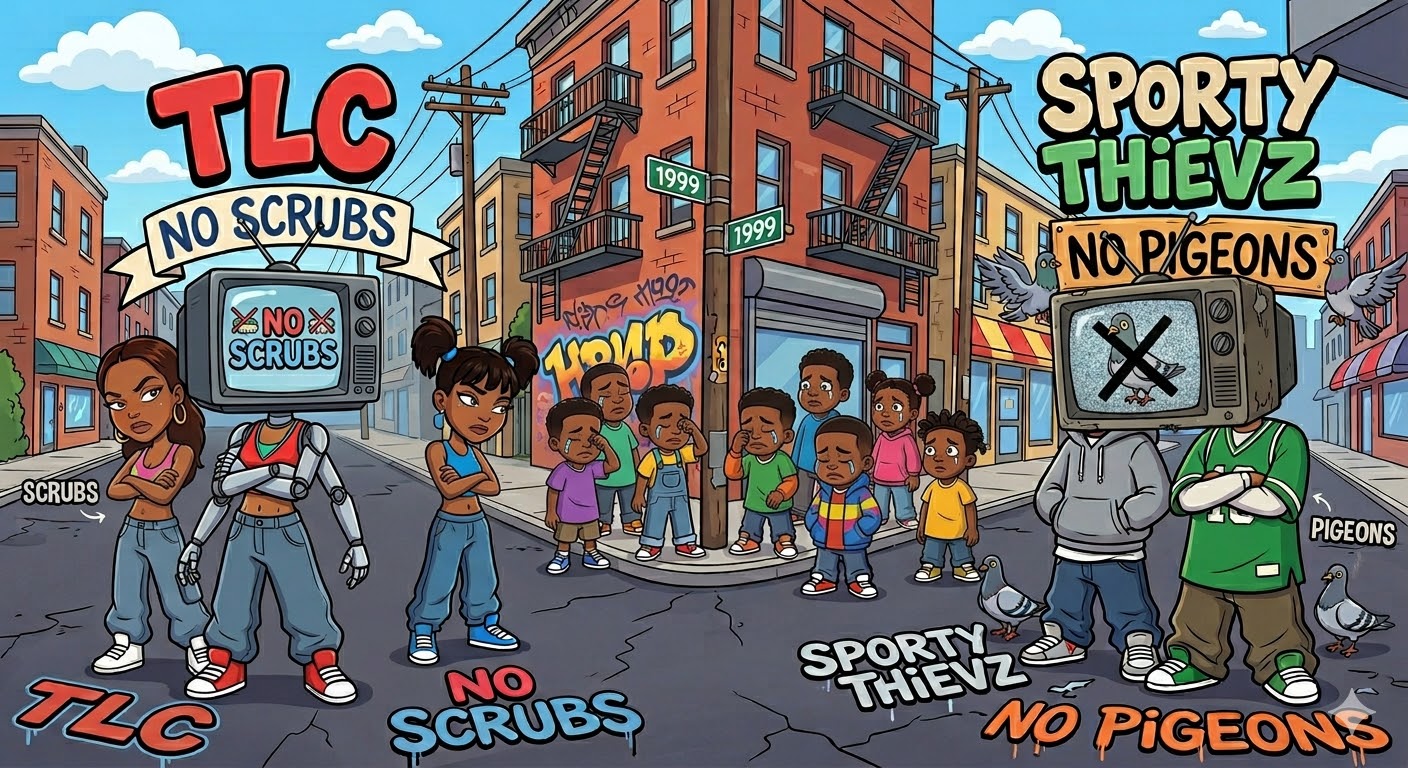
When the Music Changed: How “No Scrubs” and “No Pigeons” Reflected a Shift in Black Love

It is our duty to fight for our freedom. It is our duty to win. We must love each other and support each other. We have nothing to lose but our chains. – Assata Shakur

In February 1999, TLC released what would become one of the defining singles of their career. “No Scrubs” shot to number one on the Billboard Hot 100, where it remained for four consecutive weeks. The song’s message was clear and unapologetic: women were setting standards, and men who could not meet them need not apply. Within weeks, a relatively unknown rap group from Yonkers called Sporty Thievz fired back with “No Pigeons,” an answer record that used the same beat to deliver an equally scathing critique of women they deemed unworthy.

This exchange sparked what became known as a gender war on and off the airwaves, with radio stations playing both songs back-to-back and nightclubs dividing along battle lines — women shrieking in solidarity with TLC while men whooped for Sporty Thievz. Was this the inflection point where romantic and communal relationships between Black men and women began to fracture? Probably not. The roots run far deeper. But these songs crystallized something that had been building for years, a shift from celebration to criticism, from love songs to diss tracks, from the assumption of solidarity to the performance of mutual contempt.

Rewind a decade, and Black music told a fundamentally different story. The late 1980s and early 1990s gave us ballads that treated Black love not as a battlefield but as a sanctuary. Luther Vandross, Anita Baker, and Whitney Houston soundtracked weddings and anniversaries with a tenderness that affirmed the depth and dignity of Black romantic life. Mary J. Blige’s “Real Love” carried the longing of a generation. K-Ci & JoJo’s “All My Life” became a generational confession. Even within hip-hop, before the genre’s full commercial industrialization, there were moments of striking vulnerability. LL Cool J’s “I Need Love” in 1987 — a soft, earnest admission of emotional need — stood in productive tension with the bravado that would later become the genre’s commercial signature. These were not merely popular songs. They were cultural touchstones that told young Black people what love could look like, should look like. They were aspirational documents for a community’s interior life. And critically, the women in those songs, in those videos, on those album covers, looked like the community. They were Black women, centered and celebrated.

Something changed in the 1990s, and the change was not accidental. Dr. Dre and Snoop Dogg’s early albums codified a posture of romantic detachment, the deliberate rejection of love and respect for women, into hip-hop’s dominant vocabulary. This was compelling music that sold in enormous quantities, and in selling, it set a template. What had been one strand within a diverse genre became its commercial center of gravity. But the ideological shift ran deeper than misogyny alone. As hip-hop’s commercial footprint expanded through the mid-to-late 1990s and into the 2000s, something subtler and in some ways more psychologically damaging began appearing in the culture’s most visible spaces: the music video. The women cast as aspirational, as desirable, as worth pursuing began, with increasing frequency, to not be Black.

This was not happenstance. It was a pattern deliberate enough to be legible. As rap artists accumulated wealth and crossover appeal, the women featured alongside them in videos on yachts, in mansions, in the visual grammar of success skewed lighter, then non-Black altogether. The message embedded in those images was not subtle to anyone paying attention: arrival meant distance from Blackness. The highest expression of a Black man’s success, as the visual culture of the era constructed it, was access to women who were not Black. Video vixens of lighter complexions were elevated as the standard while dark-skinned Black women were marginalized or absent entirely. The beauty hierarchy being constructed in plain sight on BET and MTV was one in which Black women occupied an increasingly precarious position in the desirability calculus of their own community’s most prominent cultural exports.

By the time “No Scrubs” arrived in 1999, it landed in a culture already primed for conflict. Co-written by Kandi Burruss and Tameka “Tiny” Cottle during their downtime from Xscape, the song was a declaration of standards — women demanding ambition, respect, and genuine partnership rather than the attention of men riding in the passenger seat of someone else’s car. The demands were not unreasonable. Demands that ironically, many Black men would declare normal and reasonable from non-Black women. And within a media landscape designed to amplify division, what began as standard-setting quickly escalated into something more corrosive.

The response was immediate and polarizing. Radio stations hosted debates. BET reportedly edited both videos into a single seven-minute clip of gender war theater. MTV put both in heavy rotation. The media did not merely cover the conflict, it manufactured it into a cultural event, validating in the process the notion that Black men and women were not simply in disagreement but were fundamentally adversarial. Sporty Thievz’s rebuttal climbed to number 12 on the Billboard Hot 100, confirming that the antagonism resonated on both sides of the divide.

What made this moment significant was not the back-and-forth between two songs. It was what that back-and-forth revealed about the direction popular culture was pulling Black romantic life. These songs did not create the tensions between Black men and women. Economic dislocation, the carnage of the War on Drugs, and the structural dismantling of urban manufacturing bases had already placed enormous strain on Black households and Black partnership. Sociologist Elijah Anderson observed that young men in economically marginalized Black communities often pursued social status through the exploitation and diminishment of women, a pattern that commercial hip-hop both reflected and, once amplified at industrial scale, reinforced. The music industry, predominantly white-owned and indifferent to the social consequences of what it distributed, found conflict profitable and invested accordingly. What the community was living, the industry packaged and sold back to it as entertainment.

But HBCU Money still believes in love so enjoy….

The visual erasure of Black women from the aspirational imagination of hip-hop did not stay confined to the screen. It seeped into everyday life with a thoroughness that was difficult to track precisely because it moved through private conversation, social expectation, and the slow accumulation of cultural messaging rather than through any single declarable event. By the early 2000s, a certain strain of public Black male discourse had begun treating dating or marrying non-Black women not merely as a personal preference but as a marker of status, sophistication, or liberation — a signal that one had transcended the presumed limitations of the community one came from. The logic was sometimes stated explicitly, more often implied: that Black women were too difficult, too loud, too independent, too damaged by their own circumstances to be worthy partners for men who had achieved something. The very qualities that had allowed Black women to survive conditions designed to break them were reframed as character defects.

This was not a fringe conversation. It became, with the amplification of the internet and eventually social media, a mainstream one relitigated endlessly in think pieces, radio debates, YouTube channels, and the comment sections of platforms that rewarded provocation over nuance. Black women responded with a mixture of hurt, anger, and their own declarations of independence from a community they felt had devalued them. Some began openly discussing dating outside their race with the same performative energy that had been directed at them. What had begun as a visual preference embedded in music videos had, over the course of a decade and a half, become a full-scale public negotiation over the terms of Black romantic belonging conducted almost entirely in the register of grievance.

The accumulated effect on a generation was not trivial. The words used to describe each other shape how people see each other, expect from each other, and ultimately what they believe is possible between each other. When the dominant narrative in the music young people consumed shifted from devotion to suspicion, from partnership to transaction, from vulnerability to armor, those shifts did not stay contained within the space of entertainment. They became internalized frameworks for courtship, for conflict, for what intimacy was permitted to look like. Young Black women who grew up hearing themselves described as pigeons, hoes, or gold diggers, and who watched the women in their favorite artists’ videos grow progressively less likely to resemble them, absorbed messages about their worth that the external world was already working hard to diminish. Young Black men who absorbed the message that emotional openness was weakness, that Black women were adversaries to be outmaneuvered or obstacles to be bypassed on the road to something better, were being trained away from the very capacities that stable, sustaining relationships require.

Flash forward to 2026, and the cultural inheritance of that era is visible everywhere. Online spaces where Black men and women engage have become, in many corners, theaters of mutual grievance and elaborate performances of self-protective independence that leave little room for the kind of trust that partnership demands. Love songs have become harder to find in mainstream Black pop, as though tenderness has been deemed commercially unviable. Artists like PJ Morton, who make soulful music about Black love in its full complexity, play smaller rooms while music that treats romantic relationships as contests dominates the charts. This is not to suggest that beautiful expressions of Black love have disappeared. They have not. But they have been pushed to the margins of a culture that once placed them at its center.

The stakes of this cultural displacement extend well beyond the personal. As HBCU Money has documented, the marriage rate among African Americans has dropped precipitously over the past several decades, from roughly 60 percent in the 1960s to just 29 percent in 2021 and that decline carries direct economic consequences for the community’s long-term wealth position. Black married couples held a median net worth of $131,000 in 2019, compared to only $29,000 for Black single individuals — a fourfold gap that represents not merely a lifestyle difference but a structural disadvantage in capital accumulation, homeownership, and the ability to transfer wealth across generations. A culture that spent two decades using its most powerful media to communicate that Black women were not the preferred partners of successful Black men, and that Black men were not worthy of Black women’s investment, did not simply produce unhappy relationships. It produced an economic headwind that compounds over time and registers now in the net worth data of an entire community.

None of this means that “No Scrubs” and “No Pigeons” caused the decline of Black marriage or the erosion of Black wealth. They did not. But they were early, loud signals of a cultural drift that institutions like HBCUs, Black media, Black churches, Black family networks were too slow to name and too under-resourced to counter. The music reflected life. But music also shapes life, and the failure to contest the direction that shaping was taking was itself a strategic failure.

The question now is not how to assign blame for the past quarter century. It is whether the community has the institutional will to consciously reconstruct the cultural narrative that was lost. That means creating material and institutional conditions in which stable Black partnership can flourish such as relationship education, financial literacy, community infrastructure that treats Black family formation as a strategic priority rather than a private matter. It means supporting artists who treat Black love as a subject worthy of complexity and craft rather than caricature. It means being deliberate, in public spaces, about the language used to describe one another and understanding that those descriptions accumulate into the expectations young people carry into their most formative relationships.

Before the gender wars, before the videos, before mutual contempt became entertainment and the erasure of Black women from Black men’s aspirational imagination became a cultural norm, Black music told a different story, one in which men and women were engaged in a common project, in which love was not weakness but the foundation of collective strength, and in which the most natural expression of a Black man’s success was a Black woman beside him. That story was not naïve. It was aspirational in the deepest sense: it named what the community was capable of and invited people to live up to it.

That story is still available to be told. The beat can carry a different message. Whether it does depends on what the community decides to demand, to create, and to believe is still possible.

Disclaimer: This article was assisted by ClaudeAI.

HBCU Money’s 2025 African American Owned Credit Union Directory

African American-owned credit unions hold more than $8.15 billion in assets and serve 726,929 members in 2025, more than doubling their asset base from $3.81 billion in 2016. That growth confirms that Black-owned cooperative finance remains a living, expanding sector — not a historical artifact. Yet placed against the broader credit union landscape, the numbers tell a more sobering story. The federally insured credit union system holds $2.37 trillion in total assets across 4,411 institutions. African American-owned credit unions, with 205 active institutions down from 318 in 2016, control just 0.34 percent of that total asset base. The sector’s 453 Minority Depository Institution-designated peers collectively hold $95.1 billion in assets; African American institutions account for less than 9 percent of that figure. The gap is not closing fast enough.

The structural challenges are as significant as the asset gap. The median African American-owned credit union holds approximately $2.47 million in assets and serves roughly 618 members placing it squarely in the asset tier where the national system is contracting most aggressively, with institutions under $10 million posting declines in assets, membership, and net worth year over year. Only 40 percent of these institutions maintain an active public website, rendering the majority functionally invisible to younger and mobile-first members. An estimated 30 percent are affiliated with religious congregations, compared to approximately 5 percent of all U.S. credit unions, introducing succession and governance risks that extend well beyond normal institutional turnover. Meanwhile, the HBCU-based credit union subsector has seen five of its eleven institutions close or be absorbed since 2020, leaving six survivors holding a combined $76.8 million in assets — institutions that represent the most direct expression of university-anchored Black financial infrastructure and are quietly disappearing without coordinated intervention.

The sector’s geographic concentration compounds these institutional vulnerabilities. Maryland, Mississippi, Missouri, and Virginia together account for roughly 80 percent of all African American-owned credit union assets nationally, while states like California, Minnesota, and Wisconsin maintain only token institutional presences despite substantial African American populations. The South remains the geographic and institutional core, with Louisiana’s 25 institutions representing the largest state count and Mississippi’s Hope Credit Union standing as the sector’s clearest model of what scale and institutional commitment can produce. The path forward runs through consolidation where fragmentation cannot be reversed, digital investment where infrastructure is absent, geographic expansion where populations go unserved, and the fuller utilization of federal support mechanisms such as MDI designation, CDFI certification, and NCUA technical assistance that the sector has historically left on the table.


ADDITIONAL NOTES

  • African American-owned credit unions now hold $8.15 billion in total assets across 205 active institutions, representing 0.34 percent of the $2.37 trillion held by all federally insured credit unions nationally.
  • Total assets in the sector have more than doubled since 2016, rising from $3.81 billion — a 114 percent increase — while membership grew 39.5 percent from 521,078 to 726,929 members over the same period.
  • AACUs average assets per institution: approximately $39.8 million. AACUs median assets per institution: approximately $2.47 million. The gap between the mean and median reflects a sector dominated at the top by a small number of large institutions while the majority operate at a scale that limits their competitive viability.
  • AACUs average members per institution: approximately 3,546. AACUs median members per institution: approximately 618.
  • Only 40 percent of African American-owned credit unions maintain an active public website, representing a critical digital infrastructure deficit in an era of mobile-first financial services.
  • An estimated 30 percent of African American-owned credit unions are affiliated with religious congregations compared to approximately 5 percent of all U.S. credit unions introducing institutional succession risk as American religious participation continues its long-term demographic decline.
  • Louisiana has the largest number of active African American-owned credit union institutions (25), followed by Illinois (23), New York (15), Texas (14), Virginia (13), and Alabama and the District of Columbia with 12 and 10 respectively. Maryland leads all states in total sector assets at $4.47 billion, followed by Mississippi at $1.05 billion and Missouri at $480 million.
  • California — the most populous U.S. state and home to one of the largest African American populations in the country — has a single active African American-owned credit union with $318,105 in assets and 262 members, a presence that has contracted since 2016.
  • The sector’s credit union count has declined from 318 institutions in 2016 to 205 active institutions in 2025, a reduction of 35 percent, driven primarily by closures, mergers into non-Black institutions, and voluntary dissolutions.
  • For comparison, the national credit union system added 2.9 million members over the past year alone, reaching 143.2 million total members — nearly 200 times the total membership of all African American-owned credit unions combined.

Complete Directory

African American Owned Credit Unions by State:

Alabama


Arkansas


California


Connecticut


Delaware


District of Columbia


Florida


Georgia


Illinois


Indiana


Louisiana


Maryland


Michigan


Minnesota


Mississippi


Missouri


New Jersey


New York


North Carolina


Ohio


Oklahoma


Pennsylvania


South Carolina


Tennessee


Texas


Virgin Islands


Virginia


West Virginia


Wisconsin


Source: NCUA

The DEI Distraction: Why Black Business Leaders Are Defending the Wrong Battlefield

It is simple. Our talent and capital is either empowering and enriching our institutional ecosystem – or it is doing that for someone else. We are begging Others’ to let our talent and capital make them richer and more powerful. – William A. Foster, IV

When Bloomberg Businessweek convened a roundtable of prominent Black business executives in late March 2026 to discuss the Trump administration’s sweeping rollback of diversity, equity, and inclusion initiatives, the gathering carried an unmistakable weight. The participants — Ursula Burns of Integrum, Lisa Wardell of the American Express board, Jacob Walthour Jr. of Blueprint Capital Advisors, Nicole Reboe of Rich Talent Group, and Chris Williams of Siebert Williams Shank represent some of the most accomplished figures in American corporate life. Their concerns are real. Their frustrations are earned. And they are, with the greatest respect, focused on exactly the wrong problem.

The DEI debate has consumed enormous intellectual and political energy among Black business leadership. Executives like Burns have emphasized that DEI efforts historically helped address systemic barriers rather than provide unfair advantages. This is correct as far as it goes. But defending the legitimacy of DEI however righteous the argument is fundamentally an argument about access to other people’s institutions. It is a debate about whether African American talent will be permitted to generate wealth for corporate structures that it does not own, govern, or ultimately benefit from in proportion to its contribution. Winning that argument secures a seat at a table built by someone else, financed by someone else, and passed on to someone else’s heirs.

The more consequential question, one that the DEI debate reliably obscures is this: what is the strategic value of Black business ownership as the foundation of an autonomous African American institutional ecosystem, and why has that ecosystem remained so structurally underdeveloped compared to the scale of Black talent and labor flowing through the broader American economy?

The case against centering the DEI debate as the primary lens for Black economic advancement is, at its core, an argument about capital flows. Every dollar of Black labor and talent that enters a corporation it does not own produces returns that are retained, reinvested, and compounded within that corporation’s ownership structure. The wages extracted represent a fraction of the value created. This is not a critique unique to the experience of African Americans, it is the fundamental logic of capitalism. The distinction, however, is that other ethnic and national communities have historically used their productive capacity to capitalize their own institutional ecosystems: banks, insurance companies, real estate holding entities, research universities, and media operations that recirculate wealth within the community rather than exporting it.

Between 2017 and 2022, Black-owned employer businesses grew by nearly 57 percent, adding more than 70,000 new firms, injecting $212 billion into the economy and paying over $61 billion in salaries. That is not a trivial contribution. But its structural limitations are equally stark. Black Americans make up 14 percent of the U.S. population but own only 3.3 percent of businesses. More revealing still: if Black business ownership continues to grow at its current rate of 4.72 percent annually, it will take 256 years to reach parity with the share of Black people in America, a timeline that leaves racial wealth gaps entrenched across generations. No DEI program, however well-designed or vigorously defended, addresses that structural gap. DEI operates within the existing distribution of institutional ownership. It does not alter it. A Black executive ascending to the C-suite of a Fortune 500 company is a personal achievement of consequence, but it does not transfer a dollar of equity to the African American institutional ecosystem. The corporation retains its ownership structure, its compounding endowment, and its ability to extend opportunity to subsequent generations on its own terms.

This is not an argument that employment in major corporations is without value. It is an argument about strategic priority and institutional logic. The Bloomberg roundtable reflects the perspective of individuals who have navigated the highest levels of American corporate life with exceptional skill. But the very fact that their primary public posture is a defense of DEI — a program designed to manage the terms of Black participation in institutions owned by others — illustrates how thoroughly that framework has captured the strategic imagination of Black business leadership. White workers overall still hold 71 percent of executive jobs, 61 percent of manager positions, and 54 percent of professional roles. DEI, at its most effective, redistributed a fraction of corporate leadership positions without altering the underlying structure of institutional ownership. The wealth generated by those institutions through equity appreciation, retained earnings, and compounding investment portfolios continued to flow overwhelmingly to the same ownership class it always has.

The parallel structure that could generate equivalent wealth retention within the African American community requires not better access to existing institutions but the construction and capitalization of independent ones. HBCUs represent the most significant existing node in that potential ecosystem. They are anchor institutions with land assets, research capacity, and the ability to concentrate and retain Black talent. But they remain chronically undercapitalized relative to their peer institutions, in large part because the most financially productive graduates of HBCUs and of Black communities broadly are systematically routed into corporations and financial institutions that extract rather than recirculate their productive capacity.

Black households have, on average, 77 percent less wealth than white households — roughly $958,000 less per household, representing approximately 24 cents for every dollar of white family wealth. That gap is not primarily explained by differences in income or educational attainment. It is explained by differences in asset ownership, intergenerational wealth transfer, and institutional investment. The DEI framework, even at its most ambitious, addresses income. It does not address assets. If the share of Black employer businesses reached parity with the share of the Black population, cities across the country could see as many as 757,000 new businesses, 6.3 million more jobs, and an additional $824 billion in revenue circulating in local economies. That figure represents the economic magnitude of the ownership gap and none of it is captured by diversity metrics in corporate hiring. The structural barriers to closing that gap are not primarily political. They are financial. On average, 35 percent of white business owners received all the financing they applied for, compared to 16 percent of Black business owners. Black entrepreneurs are nearly three times more likely than white entrepreneurs to have business growth and profitability negatively impacted by a lack of financial capital, and 70.6 percent rely on personal and family savings for financing which means that lower household wealth creates a compounding disadvantage that no corporate diversity initiative is designed to resolve. This is the architecture of the problem: insufficient institutional wealth produces insufficient capital formation, which constrains business ownership, which perpetuates insufficient institutional wealth. DEI does not break that cycle because it operates entirely outside of it.

The African American institutional ecosystem: HBCUs and their endowments, African American owned banks and credit unions, Black-owned insurance and real estate entities, and community development financial institutions represents the structural alternative to the DEI framework. It is not a consolation prize for those excluded from mainstream corporate life. It is the only mechanism capable of generating the compounding institutional wealth that produces genuine economic sovereignty. HBCUs enroll approximately 10 percent of Black college students while producing a disproportionate share of Black professionals in STEM, law, medicine, and business. They hold land assets in some of the most economically dynamic metros in the South. They maintain alumni networks that, if systematically directed toward institutional investment rather than individual career advancement, could generate endowment growth and enterprise development at a scale currently untapped. The strategic argument is straightforward: every Black student who graduates from an HBCU and subsequently directs their career, capital, and philanthropic energy toward institutions within the aforementioned African American ecosystem compounds the institutional wealth available to the next generation. Every Black student who takes that same talent into a corporation it does not own, however successfully, contributes to the wealth of an institution that will not reciprocate at the ecosystem level.

This is not an argument for economic separatism. It is an argument for institutional density, the same logic that has guided the development of Jewish philanthropic networks, Korean rotating credit associations, and the university endowment strategies of the Ivy League. Strong communities maintain reinforcing networks of institutions that recirculate capital and concentrate talent. The DEI framework asks Black Americans to enrich other communities’ institutional networks on the condition of fairer treatment. The ownership framework asks Black Americans to build their own.

None of this is to diminish the real harm caused by the current administration’s DEI rollbacks. Black-owned businesses that relied on federal contracting set-asides have seen immediate, concrete losses with some small business owners reporting the loss of $15,000 to $20,000 per month due to reduced contract flows. The SBA admitted only 65 companies to its 8(a) business development program in 2025, compared with more than 2,000 admissions over the previous four years. These are real economic injuries that warrant legal and political challenge. But the defensive posture of protecting DEI within institutions that Black America does not control is insufficient as a long-term economic strategy. The Bloomberg roundtable produced eloquent testimony about the frustrations of Black executives navigating a hostile political environment. It produced very little discussion of what autonomous Black institutional infrastructure should look like, or how the talent assembled in that room of capital allocators, board directors, investment bankers, and talent executives might direct its resources toward building it.

The transition from a DEI-centered to an ownership-centered strategic framework requires institutional coordination that does not yet exist at scale. It requires HBCU endowments to function as patient capital for Black enterprise ecosystems rather than passive investment portfolios. It requires Black-owned financial institutions to be capitalized and connected to the deal flow generated by Black corporate executives. It requires alumni networks to function as economic infrastructure rather than social affinity groups. And it requires Black business leadership to measure its success not by representation metrics within institutions it does not own, but by the growth of institutional assets within the ecosystem it does. The DEI debate is real and the rollback is damaging. But the strategic imagination of Black business leadership will remain constrained so long as its primary horizon is defined by the terms of inclusion offered by others. The more consequential work — slower, less visible, and politically unrewarded — is the construction of institutions powerful enough that the terms of inclusion become irrelevant. That is the work HBCUs and the broader African American institutional ecosystem exist to support. It is the work that this moment demands.