
“The purpose of art is to lay bare the questions that have been hidden by the answers.” – James Baldwin
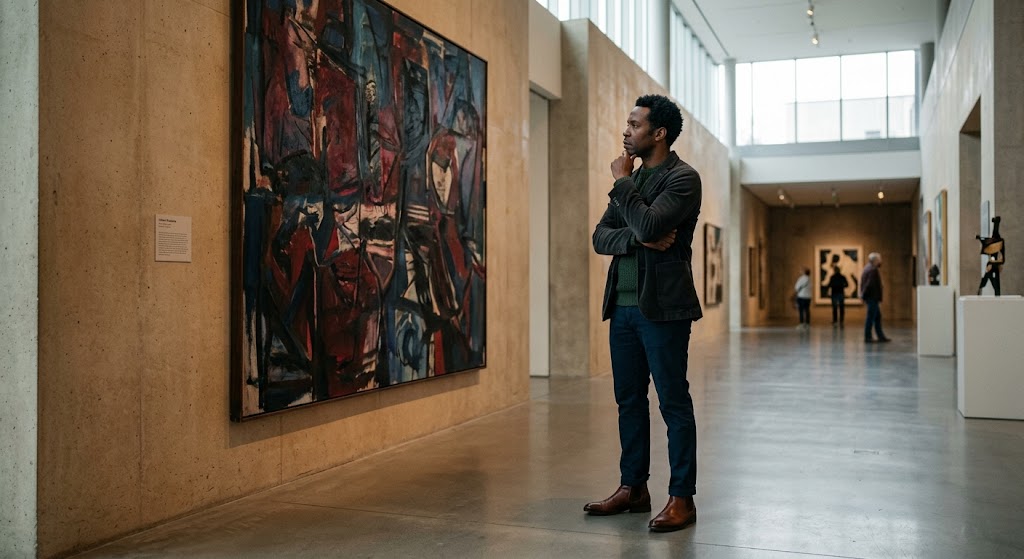
Every afternoon a sophomore offensive lineman walked through the lobby of a small college library in Alabama, going from the practice field to his three o’clock class. Like every student before him, he stepped around the ship set into the floor, because upperclassmen had told him nobody walks on it. No one had ever taken him to a museum as a boy, and for a year he never looked up. One October afternoon, early for class, he did. Above him, across canvases wider than a classroom, a revolt was unfolding: captives seizing a schooner, a courtroom in Connecticut, a return voyage to Africa. He stood there long enough to be late. The next week he came back to ask who painted it. The week after, he brought two teammates. By spring the three of them had driven to Atlanta to see where the painter had taught. The lineman had started reading history he was never assigned, and he had found words for grief and ambition, his own and his father’s, that he had not had the fall before. He came home that summer and took his younger brother to the city museum. He had found the door at nineteen and decided his brother would not have to wait that long.
Ask a cross-section of Black men when they first chose to walk into a museum, a gallery, or a theater as adults. School field trips don’t count. A striking number will answer some version of the same thing: with a girlfriend, or with a wife. The pattern is common enough among heterosexual men of every background that it has become a cultural cliché: the man trailing his partner through an exhibition, waiting to be released. Going together has real value, and a couple standing in front of a painting is a good thing. The problem is when the partner is the only door. When a man’s access to an entire category of intellectual and emotional development runs through one relationship, that access is borrowed, conditional, and easily lost. And when a man first walks through that door at thirty, it means no one opened it for him at eight. It means more invisible labor that women must bear and that they talk about in the arena of self-development that should have already happened for potential partners. HBCU Money argues that participation in arts and culture is a form of institutional membership, and the strongest memberships begin in boyhood. A community whose men and boys do not hold that membership in their own right leaves much of its human capital undeveloped and many of its cultural institutions without patrons.
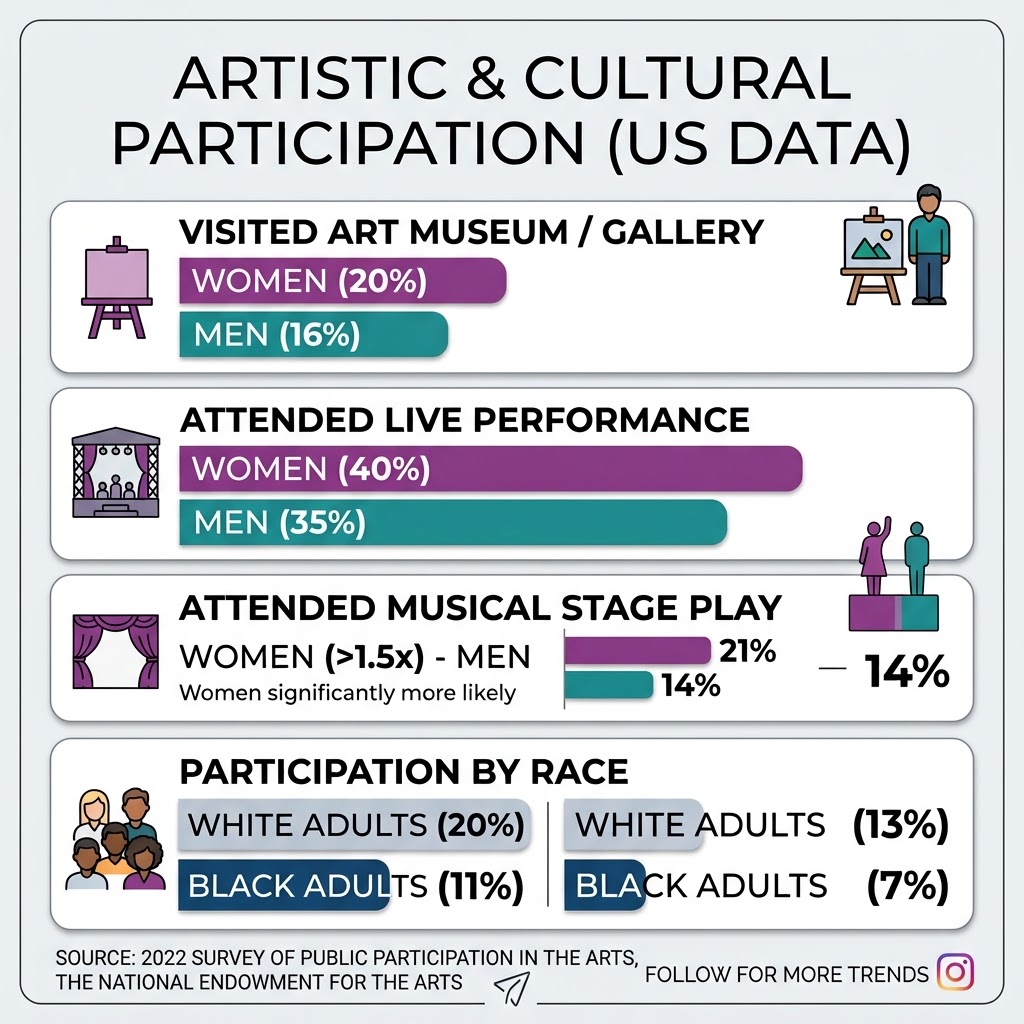
The national data shows the gap clearly. In the 2022 Survey of Public Participation in the Arts, the National Endowment for the Arts found no arts or cultural activity in which men participated at higher rates than women. Twenty percent of women visited an art museum or gallery, against 16 percent of men. Forty percent of women attended a live performance, against 35 percent of men. The racial data adds a second gap. Eleven percent of Black adults visited an art museum or gallery, compared with 20 percent of white adults, and 7 percent attended a musical stage play, compared with 13 percent. The survey does not break out results by race and sex together, but two shortfalls stacked on each other can only point one way. Black men are likely among the least present people in America’s cultural institutions, including those their own communities built.
The roots of that absence are in childhood. In a study for the NEA, Nick Rabkin and E.C. Hedberg of the University of Chicago’s National Opinion Research Center found that childhood arts education was the most significant predictor of adult arts attendance. Among adults who had any arts education as children, 57 percent attended a benchmark arts event, compared with 24 percent of those who had none. The same study documented a collapse in that early exposure. In 1982, 51 percent of African Americans reported receiving any arts education in childhood. By 2008 the figure had fallen to 26 percent. Taste, identity, and a sense of belonging in a room are largely formed before adulthood. A boy who never enters a gallery or a theater before eighteen does not simply miss an outing. He grows into a man who walks into those spaces as a guest at best, and more often stays out. The adult patterns in the NEA’s 2022 figures are, in large part, childhood patterns that arrived late.
Boys face a particular pressure on top of that loss of access. From an early age, many are taught that sports and a short list of approved masculine pursuits are the only legitimate arenas for male striving. Curiosity about painting, poetry, dance, or theater gets policed with ridicule by peers, and too often by the adult men around them. The result is not tougher men. It is men with a narrower emotional vocabulary and a narrower intellectual range, who reach adulthood waiting for someone else to give them permission to be curious. The costs show up in social life. The Survey Center on American Life found that the share of American men reporting no close friends rose from 3 percent in 1990 to 15 percent in 2021, and the share reporting six or more close friends fell from 55 percent to 27 percent. The Center pointed to traditional norms of masculinity as one reason men find it harder to be open with one another. A man without independent social and cultural venues ends up routing his emotional and intellectual life through a single partner. One relationship carries the load that a whole network of institutions once shared. That is the problem of institutional density, playing out inside a single life.
The case for art and culture in men’s development is concrete, and it begins with emotional intelligence. Theater is the most direct training ground. Psychologists Thalia Goldstein and Ellen Winner followed young adolescents through a year of instruction. Those taking acting classes gained more in empathy, in theory of mind (the capacity to read what another person is thinking and feeling), and in emotional regulation than peers studying other art forms. An actor, and to a lesser degree an engaged audience member, spends hours inside another person’s reasoning, fears, and motives. Daniel Bowen of Texas A&M and Brian Kisida of the University of Missouri showed the same effect at scale. They ran a randomized trial of Houston’s Arts Access Initiative across more than 10,000 students in 42 schools, mostly serving low-income students of color. Schools receiving more partnerships with museums, theaters, and teaching artists saw disciplinary infractions fall by 3.6 percentage points, along with gains in writing and in students’ compassion for others. The cost was roughly $15 per student. Anyone who has watched boys absorb most of the discipline in American schools should read that finding as an argument about boys.
Imagination is the second benefit, and it is often misread as an indulgence. Woodruff’s murals at Talladega span a hundred years, from a revolt at sea in 1839 to the opening of the library they hang in. To paint them, he had to picture a people’s history whole, at a time when the textbooks would not. That is the same capacity institution-builders need: the ability to see a bank, a hospital, or a research center that does not yet exist and work backward to build it. A boy who learns to hold an unfamiliar image in his mind, or to follow a story to its end, is practicing the discipline of envisioning what isn’t there yet. Communities that want founders need boys who were taught to imagine.
The third benefit is intellectual. The earlier study by Bowen, Kisida, and Jay Greene of school trips to an art museum found gains in critical thinking, historical empathy, and tolerance. A gallery asks a viewer to look closely at something ambiguous, form an interpretation, test it against evidence, and revise it. That is the structure of serious reasoning in any field. It is also the opposite of the scrolling, instant-verdict habits that now fill most boys’ free hours. Museums also make history physical. A boy who stands in front of Tanner’s The Banjo Lesson at Hampton, or the Amistad canvases at Talladega, holds a piece of the past that a textbook paragraph cannot hand him.
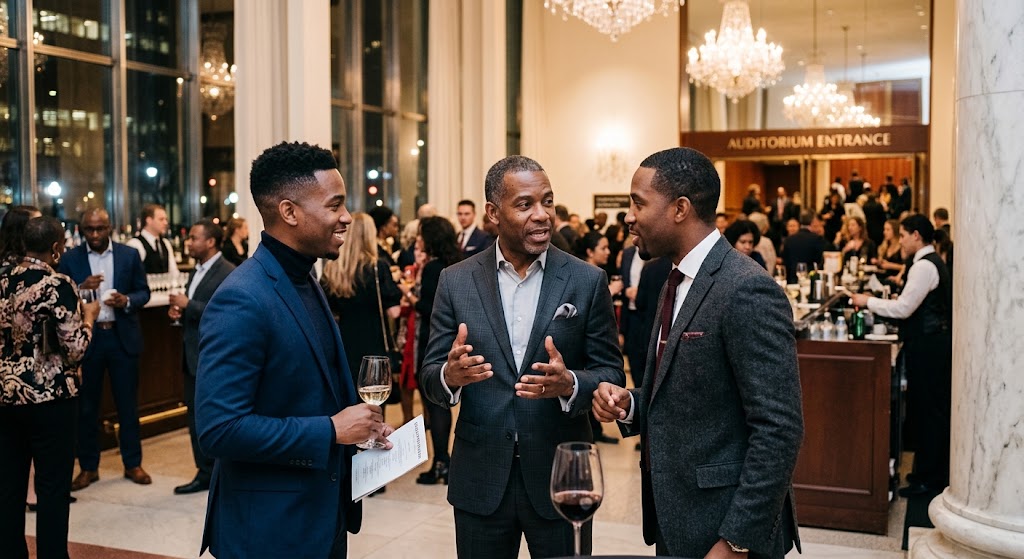
These capacities do not stay in the gallery. They become qualities of character: patience, attention, humility before what one does not yet understand, the ability to name a feeling before acting on it, and the willingness to sit with discomfort without lashing out. Those qualities pay off in three places. The first is the self. A man with an inner life of his own handles grief, failure, and long stretches of solitude better than one whose only outlets are competition and distraction. The second is the family. A father who can name his emotions can teach his son to name his. A husband who arrives at the museum as a fellow participant rather than a reluctant escort is a better partner. The date is better when both people chose to be there. The third is the community. Civic life runs on men who can listen to an argument, imagine another neighbor’s circumstances, and keep a meeting together when it turns tense. Those are learned skills, and the arts are among the oldest places to learn them.
The choice between athletics and the arts is also a recent invention. Dr. John Henrik Clarke’s study of Paul Robeson makes the point plainly. Clarke records that Robeson won fifteen varsity letters at Rutgers and was named a first-team All-American twice. He also earned Phi Beta Kappa honors, graduated as valedictorian, and was the debating champion all four years. Robeson then made his professional stage debut in 1920 at the Harlem YMCA, in a play called Simon, the Cyrenian. Clarke argues that Robeson was persecuted not because he was a famous singer or athlete, but because he was an artist who used his art to call for change. The same institution supported both the athlete and the actor. Clarke’s own life shows the same model. He writes that soon after arriving in New York at 18, in 1933, he became active in the Harlem History Club at the Harlem YMCA, a circle of young men building their intellectual lives together. Clarke later described a people’s culture as “the fuel that feeds the fires of their ambition, pride and self-esteem.” The same holds for the development of individual men, and for the institutions those men either sustain or abandon.
The HBCU ecosystem already has the assets. The Hampton University Museum, founded in 1868, is the oldest African American museum in the United States. It holds more than 9,000 works, including The Banjo Lesson, acquired in 1894, and the largest museum holdings of John Biggers, Elizabeth Catlett, Jacob Lawrence, and Samella Lewis. Admission is free, and the museum already runs a children’s Curiosity Room, school partnerships, and summer camps. Talladega College commissioned Hale Woodruff in 1938 to paint the murals in the parable above. In 1963, Tougaloo College became home to Mississippi’s first collection of modern art, assembled with the New York Art Committee for Tougaloo College during the height of the civil rights movement in Jackson. That collection now numbers more than a thousand works and has toured nationally as Art and Activism at Tougaloo College. Fisk University has its Jubilee Singers, whose 1871 tour kept the institution alive. North Carolina A&T has its Richard B. Harrison Players. Across the network, HBCU stages and galleries offer serious work at a fraction of the price of downtown institutions, often within driving distance of the boys who most need them.
The capital-retention stakes are concrete. Talladega College recently entered a partnership under which the Art Bridges Foundation and the Terra Foundation for American Art jointly acquired the three Amistad panels. The Toledo Museum of Art acquired The Underground Railroad, and the college retained the two remaining founding murals on campus. Whatever the financial reasoning in Talladega’s case, the general lesson holds: cultural assets go to the audiences and patrons able to sustain them. A Black public that does not attend, join, or give to HBCU museums leaves those institutions to be valued, funded, and eventually owned by others. Every membership, ticket, and gift keeps capital inside the ecosystem. Talent follows the same logic. Tougaloo has drawn Andrew W. Mellon Foundation support to train students in collections care, exhibition design, and arts administration, but programs like that produce talent only if young men show up to be trained. The pipeline of Black male curators, critics, playwrights, and arts administrators starts with Black boys who walk into these spaces and decide they belong there.
The remedies need to be institutional, and they need to start with boys.
First, alumni chapters and HBCU museums should fund early exposure for boys in nearby school districts. The Houston trial put the cost of a substantial arts experience at about $15 per student, so a single alumni chapter could underwrite a full cohort of elementary and middle-school boys from Hampton Roads, central Mississippi, or east Alabama for less than the cost of one gala table. Hampton’s existing school partnerships and summer camps are the obvious place to start. The goal is repeat visits rather than a single trip, because the Rabkin and Hedberg data shows that sustained early exposure is what builds an adult habit.
Second, HBCU theater departments should open their rehearsal rooms and matinees to boys. Youth matinees for local schools, and summer acting workshops for middle-school boys taught by theater faculty and student actors, would put the empathy and emotional-regulation gains that Goldstein and Winner measured within reach of boys who would never seek them out. Pairing these with a campus athletic program removes the stigma before it can take hold.
Third, HBCU athletic departments should build museum visits and theater attendance into team calendars. Robeson’s career is the precedent. A football program at Talladega, Hampton, or Tougaloo that walks its players through the campus collection once a semester, and attends the theater department’s spring production as a team, shows young men that curiosity is part of competing, not a betrayal of it. When local boys see college athletes in a gallery, the ridicule loses much of its force.
Fourth, fathers, uncles, coaches, and mentors should take boys to museums and plays themselves, without leaving it to mothers and teachers. A boy learns what men do by watching men do it. A father who brings his son to the Hampton museum on a Saturday, or a coach who brings his team to a campus play, teaches that this space belongs to them both. HBCU alumni associations, which are legally independent and free to act, can organize regular father-and-son and mentor outings as part of their calendars.
Fifth, adult men need the same habit. Alumni chapters should make cultural outings standing calendar items. That could mean buying a block of season tickets to an alma mater’s theater productions, organizing men’s trips to HBCU collections, or turning out in force when a traveling exhibition drawn from an HBCU collection reaches their city. HBCU museums should market directly to men, with group memberships priced for alumni chapters, fraternity alumni chapters, and church men’s ministries. Australia offers a useful model from outside the Black institutional world. The Men’s Shed movement, community workshops where men gather around shared projects, grew to more than a thousand sites and was recognized in the country’s 2010 National Male Health Policy. The Australian Men’s Shed Association’s motto is that men talk “shoulder to shoulder.” A gallery bench and a theater seat are shoulder-to-shoulder spaces too.
Sixth, the HBCU collections should coordinate. Hampton, Tougaloo, Talladega, Clark Atlanta, Fisk, and others hold work that tells a connected story. Clark Atlanta’s collection itself grew out of the Atlanta University Art Annuals that Woodruff started. A shared calendar and a coordinated touring schedule would let a school district, a men’s group, or a father plan a year of visits around the HBCU network. Isolated collections would become a circuit that a deliberate public can follow.
Clarke ended his teaching on Black heritage with a definition. Heritage, he wrote, is how people use their talents to create a history that gives them memories they can respect, and its purpose is self-awareness that equips a person to relate well to others. That is as good a description as any of what a cultivated man gains: memories he chose, a sense of himself that no one lent him, and the emotional and intellectual range to show up more fully for himself, his family, and his community. The lineman in the library found the door at nineteen. The institutional task is to make sure his younger brother finds it at nine, through a field trip, a father, a coach, or a matinee, and never thinks of it as anyone else’s door.
Disclaimer: This article was assisted by ClaudeAI.

