Category Archives: Banking & Credit Unions

The HBCU Card? Why the Community’s Institutional Dollar Constantly Fails to Circulate at the HBCU’s Front Door

Let us put our money together; let us use our money; let us put our money out at usury among ourselves, and reap the benefit ourselves. – Maggie Lena Walker

The HBCU Card routes HBCU community spending through a family-owned Minnesota bank. African American-owned financial institutions are watching from the sideline. HBCUs are institutions with balance sheets, alumni networks, and banking relationships. When those relationships run through a family-owned bank in St. Paul, Minnesota, the question is not whether the partnership is well-intentioned. The question is who is building institutional capacity for whom.

There is an old arrangement, familiar to the sharecropping South, called the company store. The employer owned the land, controlled the wages, and operated the only store within reach. The worker labored, earned, and spent and every dollar completed a circle that ended back in the employer’s pocket. The arrangement was not presented as exploitation. It was presented as convenience. As service. As the reasonable way things worked given the options available. The options, of course, were controlled by the same party that ran the store. HBCUs in 2026 are not sharecroppers. They are institutions with endowments, alumni networks, and balance sheets. Which makes it harder, not easier, to explain why they are running the company store model on their own communities.

A prepaid Mastercard called the HBCU Card is circulating in HBCU communities, issued through Sunrise Banks, N.A., a family-owned bank headquartered in St. Paul, Minnesota. It carries the logos of individual HBCUs. It returns a fraction of transaction fees to participating schools. The pitch is that HBCU students and alumni can express institutional pride through their spending and send a little money back to their alma mater in the process. That is the whole proposal. Read it twice if you need to.

It is not alignment. It is a licensing agreement dressed up as solidarity.

Sunrise Banks is a privately held, family-owned institution headquartered in St. Paul, Minnesota, wholly owned by University Financial Corp, GBC, led by CEO David Reiling and his father, Bill Reiling. The bank is a certified B Corporation and holds CDFI designation from the U.S. Treasury. Its social impact commitments are real. None of that is the point. Sunrise Banks is not an African American-owned institution. It has no ownership ties to the HBCU community. It is not part of the African American financial ecosystem in any structural sense. It is a vendor that found a distribution channel, and the distribution channel said yes. Banking is not a transaction. It is infrastructure. Deposits flow into balance sheets that fund mortgages, small business loans, and community reinvestment. When that capital is held by institutions with ownership accountability to the depositing community, it compounds within that ecosystem. When it flows to an outside institution, however well-certified, however socially conscious its marketing, it leaves. A branded card does not change the direction of the outflow. Pride does not reroute capital. Ownership does.

HBCUs are, by their founding logic, in the business of building something that lasts. Endowments. Land. Research infrastructure. Alumni networks that compound across generations. That is the institutional premise. Against that premise, the HBCU Card is an embarrassment. It asks HBCU communities to generate transaction fee revenue, a rounding error in any serious capital strategy — and hand the actual value of the arrangement to a Minnesota family bank. The HBCU gets logo placement. Sunrise Banks gets a branded distribution network across dozens of historically Black institutions, customer acquisition at scale, and the reputational association with one of African America’s most symbolically resonant set of institutions. That is not a partnership. That is a concession. This would be forgivable if there were no alternative. There is. There are 221 of them.

As of 2025, there are 205 active African American-owned credit unions holding more than $8.15 billion in assets and serving nearly 727,000 members across 29 states and the District of Columbia. There are 16 African American-owned banks holding $6.7 billion in combined assets. Louisiana alone has 25 African American-owned credit unions. Illinois has 23. Virginia has 13. These institutions are not obscure. They are documented, chartered, federally insured, and in many cases operating within miles of HBCU campuses. Six HBCU-affiliated credit unions, institutions built specifically to serve the campus financial community, are still active after five such institutions closed or were absorbed since 2020. Their combined assets total $76.8 million. They are contracting. The HBCU Card is expanding. This is the choice being made.

The six that remain deserve to be named because the institutions they were built to serve have apparently forgotten them. Southern Teachers & Parents Federal Credit Union, founded to serve the Southern University system across its Baton Rouge, New Orleans, and Shreveport campuses, is the largest of the survivors at $30.3 million in assets. Florida A&M University Federal Credit Union serves the flagship public HBCU in Florida. Virginia State University Federal Credit Union serves one of Virginia’s historically Black institutions. Councill Federal Credit Union serves the Alabama A&M University community. Arkansas A&M College Federal Credit Union serves the University of Arkansas at Pine Bluff. Xavier University of Louisiana Federal Credit Union serves the only historically Black Catholic university in the Western Hemisphere. These six institutions held a combined $76.8 million in assets as of the most recent reporting, a number that should be ten times larger given the campus communities they sit inside. Prairie View A&M University Federal Credit Union, founded in 1937 by sixteen people who built a financial institution to serve the employees of Texas’s first state-supported college for African Americans, did not survive. It was absorbed by Cy-Fair Federal Credit Union, the credit union of a Houston-area school district with a documented record of racial inequity in its own student discipline. An 85-year-old Black institution, built by and for a Black university community, became a subsidiary of a school district credit union. Prairie View A&M University has nothing publicly to say about it. These institutions are not disappearing because they failed their communities. They are disappearing because their communities’ own flagship institutions will not anchor them.

The scale of what coordinated HBCU engagement could mean to this sector is not theoretical. The median African American-owned credit union holds approximately $2.47 million in assets and serves roughly 618 members, operating at the margin of viability in an asset tier where the national system is contracting fastest. Only 40 percent have a functional public website. Thirty percent are congregation-affiliated, with succession risks that threaten their continuity across a single pastoral transition. These institutions are not failing for lack of purpose. They are failing for lack of the institutional anchor relationships that would capitalize and stabilize them. HBCUs are precisely that anchor. A single mid-sized HBCU redirecting its payroll processing and student financial services to an African American-owned financial institution is a capitalization event for that institution. Six HBCUs doing it in a coordinated way reshape a sector. Instead, the sector contracts and HBCUs sign prepaid card deals.

The HBCU Card requires nothing from the institution except a logo. There is no governance, no balance sheet commitment, no strategic partnership to build or manage. An administrator with a full calendar can execute it in an afternoon. That is the real explanation, and it is worth saying plainly: this is what institutional avoidance looks like when it has been dressed up with branding. Banking with an African American-owned institution requires relationships to be built, terms to be negotiated, and sometimes real advocacy inside a bureaucracy that defaults to the path of least resistance. It is harder. It is supposed to be harder. Institutions that will not do the harder work in service of their own community’s financial ecosystem are not being strategic. They are being comfortable.

The Jewish American institutional ecosystem did not build generational financial infrastructure by licensing its brand to well-intentioned outside vendors. It built banks. It built credit unions. It built investment vehicles and directed capital toward them, institution by institution, decade by decade. Cuban American financial infrastructure in South Florida did not emerge from branded prepaid cards issued by Anglo-owned banks. It emerged from institutional discipline from the deliberate decision to route deposits, payroll, and investment relationships toward institutions owned by the community they were meant to serve. African American institutions are capable of the same discipline. The question that must be asked plainly, at this point, is whether they intend to practice it.

Sunrise Banks will receive a branded distribution network across the HBCU ecosystem, customer acquisition at scale, and the reputational weight of an association with institutions that African America has defended, funded, and attended for over 150 years. HBCUs will receive a transaction fee drip. That is the deal, and anyone who has read a term sheet in their life can see which side of it they want to be on. The deeper insult is that the card’s central premise that cultural identity can be expressed through a branded payment instrument is not wrong. OneUnited Bank, one of the largest African American-owned bank in the country with $756 million in assets, already offers a full range of culturally branded debit card designs as part of its standard deposit product. The infrastructure to do this through a Black-owned bank already exists. HBCUs have simply chosen not to direct their communities toward it.

The alternative does not require building anything new. It requires redirecting what already moves. Payroll. Student fee processing. Operating accounts. Auxiliary enterprise banking. These are cash flows that exist at every HBCU right now, today, flowing through institutions with no ownership accountability to the African American community. Fort Valley State University in Georgia operates with Citizens Trust Bank and Carver State Bank in the same state. Edward Waters University in Jacksonville, Florida sits in a market with documented African American-owned financial institution presence. Bethune-Cookman University and Florida Memorial University operate in a Florida context where redirecting institutional banking relationships would register immediately and materially in the balance sheets of the African American-owned credit unions that are currently fighting to survive. None of this requires a capital campaign. It requires a decision.

Delaware State University sits in proximity to one of the most financially sophisticated African American communities on the East Coast and banks with institutions that have no structural accountability to that community. Cheyney University, the oldest HBCU in the country, founded in 1837, older than the Civil War, operates in Pennsylvania, a state with documented African American-owned financial institutions, without a formal banking relationship with a single one of them. These are not resource constraints. These are not governance complications. These are choices. Call them what they are.

This is not an indictment of Sunrise Banks. The Reiling family built a legitimate community development institution and its credentials are real. But good intentions held by people outside a community are not a substitute for ownership infrastructure inside it and this distinction should not have to be explained to the leadership of institutions that exist precisely because the African American community refused to accept the benevolence of outside institutions as a substitute for their own. The HBCU was the answer to that substitution. The HBCU Card reverses the logic entirely.

The pattern is not new and it is not subtle. African American institutions accept the role of distribution channel, brand partner, and program host for arrangements that deliver the primary economic value to someone else. The community benefit is always in the framing. It is often partially real. What it never builds is the ownership infrastructure that makes a community institutionally durable across generations. HBCU Money has documented this in research pipelines that route HBCU-generated intellectual capital into PWI commercialization structures. In philanthropic arrangements that deliver program dollars without governance rights. In workforce development partnerships that build human capital for employers with no reciprocal obligation to the communities supplying the talent. The HBCU Card is the same transaction in a different category. The African American community keeps accepting these terms. Its institutions keep modeling the acceptance. And then everyone wonders why the ecosystem does not compound.

HBCUs are not passive observers of the African American financial ecosystem. They are, or should be, its institutional anchors. A single HBCU redirecting its payroll, student financial services, and auxiliary enterprise banking to African American-owned institutions is a capitalization event for those institutions. Six doing it in coordination reshape the sector’s asset base. Twenty doing it is a structural transformation of African American financial infrastructure that no amount of philanthropic giving or federal grant-making has ever achieved. That is what is being traded away for transaction fee revenue from a prepaid card. Let that land.

The 205 African American-owned credit unions and 16 African American-owned banks — Liberty Bank and Trust, Citizens Trust Bank, Mechanics and Farmers Bank, Optus Bank, Industrial Bank, First Independence Bank, and the rest — are not waiting to be discovered. They are chartered, capitalized, and operational. They have been there. What they have not had is the institutional anchor relationships that HBCUs are positioned to provide and have repeatedly declined to provide. That is the record. It is not ambiguous.

The HBCU Card will keep finding takers. The path of least institutional resistance always does. What it will not build, what it cannot build, is the African American financial ecosystem that 150 years of HBCU existence should by now have helped to anchor. That ecosystem is being built, slowly and against the current, by institutions that have received none of the loyalty that their community’s flagship universities should be directing toward them. HBCUs were founded as an act of defiance against a system that refused to invest in Black institutional capacity. The HBCU Card is an act of surrender to the same logic, branded in school colors.

African America knows the statistic. It has been recited at every convocation, posted on every community Facebook page, cited in every financial literacy workshop for the last thirty years: a dollar circulates in the Jewish American community for an estimated 20 days, in Asian American communities for roughly 28 days, and exits the African American community in less than 6 hours. The room nods. The speaker moves on. And then the HBCU signs a deal with Sunrise Banks. This is the part that should produce institutional shame and does not. The circulation of the Black dollar has become African America’s most repeated and least practiced idea. It functions as a ritual, spoken to affirm shared values, set aside before the next institutional decision is made. And the institutional decisions are where the actual economy is built or surrendered. HBCUs are supposed to be different. They are the institutions African America built when it was not allowed to build them. They carry that founding act in their names. They commemorate it at every homecoming. And then Alabama State University hands a $125 million investment management contract to a European American-owned firm without a public accounting of whether a single African American-owned asset manager was seriously considered. And Howard University puts PNC’s name on a center for entrepreneurship. And HBCU after HBCU runs its student financial services through Wells Fargo or Bank of America while Liberty Bank, Citizens Trust, and Mechanics and Farmers Bank operate in the same states, serve the same communities, and wait for a relationship that does not come. “Buy Black” is the slogan. The institutional behavior is: accept the proposal from whoever shows up with the most polished deck. This cannot be fixed at the household level. Individual people buying Black cannot compensate for institutions that do not. When HBCUs alongside fraternities, sororities, churches, and every other pillar of African American institutional life model the extraction rather than the retention, the community internalizes the lesson being taught, not the slogan being chanted. The HBCU Card is not an isolated mistake. It is a current example of a durable institutional posture: perform solidarity, outsource the economics.

Disclaimer: This article was assisted by ClaudeAI.

HBCU Money’s 2025 African American Owned Credit Union Directory

African American-owned credit unions hold more than $8.15 billion in assets and serve 726,929 members in 2025, more than doubling their asset base from $3.81 billion in 2016. That growth confirms that Black-owned cooperative finance remains a living, expanding sector — not a historical artifact. Yet placed against the broader credit union landscape, the numbers tell a more sobering story. The federally insured credit union system holds $2.37 trillion in total assets across 4,411 institutions. African American-owned credit unions, with 205 active institutions down from 318 in 2016, control just 0.34 percent of that total asset base. The sector’s 453 Minority Depository Institution-designated peers collectively hold $95.1 billion in assets; African American institutions account for less than 9 percent of that figure. The gap is not closing fast enough.

The structural challenges are as significant as the asset gap. The median African American-owned credit union holds approximately $2.47 million in assets and serves roughly 618 members placing it squarely in the asset tier where the national system is contracting most aggressively, with institutions under $10 million posting declines in assets, membership, and net worth year over year. Only 40 percent of these institutions maintain an active public website, rendering the majority functionally invisible to younger and mobile-first members. An estimated 30 percent are affiliated with religious congregations, compared to approximately 5 percent of all U.S. credit unions, introducing succession and governance risks that extend well beyond normal institutional turnover. Meanwhile, the HBCU-based credit union subsector has seen five of its eleven institutions close or be absorbed since 2020, leaving six survivors holding a combined $76.8 million in assets — institutions that represent the most direct expression of university-anchored Black financial infrastructure and are quietly disappearing without coordinated intervention.

The sector’s geographic concentration compounds these institutional vulnerabilities. Maryland, Mississippi, Missouri, and Virginia together account for roughly 80 percent of all African American-owned credit union assets nationally, while states like California, Minnesota, and Wisconsin maintain only token institutional presences despite substantial African American populations. The South remains the geographic and institutional core, with Louisiana’s 25 institutions representing the largest state count and Mississippi’s Hope Credit Union standing as the sector’s clearest model of what scale and institutional commitment can produce. The path forward runs through consolidation where fragmentation cannot be reversed, digital investment where infrastructure is absent, geographic expansion where populations go unserved, and the fuller utilization of federal support mechanisms such as MDI designation, CDFI certification, and NCUA technical assistance that the sector has historically left on the table.


ADDITIONAL NOTES

  • African American-owned credit unions now hold $8.15 billion in total assets across 205 active institutions, representing 0.34 percent of the $2.37 trillion held by all federally insured credit unions nationally.
  • Total assets in the sector have more than doubled since 2016, rising from $3.81 billion — a 114 percent increase — while membership grew 39.5 percent from 521,078 to 726,929 members over the same period.
  • AACUs average assets per institution: approximately $39.8 million. AACUs median assets per institution: approximately $2.47 million. The gap between the mean and median reflects a sector dominated at the top by a small number of large institutions while the majority operate at a scale that limits their competitive viability.
  • AACUs average members per institution: approximately 3,546. AACUs median members per institution: approximately 618.
  • Only 40 percent of African American-owned credit unions maintain an active public website, representing a critical digital infrastructure deficit in an era of mobile-first financial services.
  • An estimated 30 percent of African American-owned credit unions are affiliated with religious congregations compared to approximately 5 percent of all U.S. credit unions introducing institutional succession risk as American religious participation continues its long-term demographic decline.
  • Louisiana has the largest number of active African American-owned credit union institutions (25), followed by Illinois (23), New York (15), Texas (14), Virginia (13), and Alabama and the District of Columbia with 12 and 10 respectively. Maryland leads all states in total sector assets at $4.47 billion, followed by Mississippi at $1.05 billion and Missouri at $480 million.
  • California — the most populous U.S. state and home to one of the largest African American populations in the country — has a single active African American-owned credit union with $318,105 in assets and 262 members, a presence that has contracted since 2016.
  • The sector’s credit union count has declined from 318 institutions in 2016 to 205 active institutions in 2025, a reduction of 35 percent, driven primarily by closures, mergers into non-Black institutions, and voluntary dissolutions.
  • For comparison, the national credit union system added 2.9 million members over the past year alone, reaching 143.2 million total members — nearly 200 times the total membership of all African American-owned credit unions combined.

Complete Directory

African American Owned Credit Unions by State:

Alabama


Arkansas


California


Connecticut


Delaware


District of Columbia


Florida


Georgia


Illinois


Indiana


Louisiana


Maryland


Michigan


Minnesota


Mississippi


Missouri


New Jersey


New York


North Carolina


Ohio


Oklahoma


Pennsylvania


South Carolina


Tennessee


Texas


Virgin Islands


Virginia


West Virginia


Wisconsin


Source: NCUA

Two Pillars Fall: The Loss of Columbia Savings and Adelphi Bank and What It Means for African American Communities

We are watching the absolute collapse of African American institutions and our absolute dependency on Others’ institutions. It once felt like a slow train wreck, now it feels like a supersonic missile. – William A. Foster, IV

The 2025 African American Owned Bank Directory carries an absence that numbers alone cannot fully convey. Two institutions that appeared in last year’s listing — Columbia Savings and Loan Association of Milwaukee, Wisconsin, and Adelphi Bank of Columbus, Ohio — are no longer among the ranks of African American-owned financial institutions. Together, they represented nearly $130 million in assets: Columbia Savings at approximately $22 million and Adelphi Bank at approximately $106 million. Their departure is not merely a bookkeeping change. It is a geographic and community wound, one that leaves both Ohio and Wisconsin without a single African American-owned bank.

Founded on January 1, 1924, Columbia Savings and Loan Association was one of the oldest African American-owned financial institutions in the United States. A savings and loan chartered over a century ago in Milwaukee, it survived the Great Depression, the urban upheavals of the mid-20th century, the savings and loan crisis of the 1980s, and the 2008 financial collapse. It did not survive 2025. In our 2024 directory, Columbia carried $24,097,000 in assets, already down 12.0 percent from the prior year. By the time 2025 data was compiled, its assets had further declined to approximately $21,998,000 — a figure that, alongside declining capital levels, signaled an institution under extraordinary strain. For a savings and loan of its size, operating in a competitive market without the capital buffers available to larger institutions, the math had become unforgiving.

Milwaukee’s African American community is substantial, Black residents make up roughly 39 percent of the city’s population and yet they now have no African American-owned bank to call their own. This is not a small thing. African American-owned banks and savings institutions have historically served as anchors for communities that mainstream financial institutions have underserved or outright ignored. They have written mortgages in redlined neighborhoods, provided small business loans to entrepreneurs who couldn’t get a second meeting at a downtown bank, and offered a financial home to people who needed more than a transaction they needed trust.

If the loss of Columbia Savings is a story of a century-old institution exhausted by time and capital constraints, the loss of Adelphi Bank carries a different kind of grief. Founded on January 18, 2023, in Columbus, Ohio, Adelphi was the newest African American-owned bank in the country at the time of our 2024 directory. Prior to its founding, no new African American-owned bank had been chartered in 23 years. Adelphi’s launch was celebrated for exactly that reason: it represented a renewal, a sign that the community had not given up on building the financial infrastructure it needs.

In 2024, Adelphi reported $68,154,000 in assets, up 55.1 percent from the year prior, a remarkable growth trajectory for a de novo bank. By 2025, that figure had risen further to $106,369,000. And yet, despite that asset growth, the bank was no longer majority African American-owned by the time 2025 statistics were compiled. A growing balance sheet does not automatically translate into ownership stability. New banks are capital-intensive, and the pressures to bring in outside investors can, over time, dilute or displace founding ownership structures.

The result is that Ohio, the state that just two years ago was celebrating the founding of its first new African American-owned bank in over two decades, now has none. Columbus, the state capital and one of the fastest-growing cities in the Midwest, has no African American-owned bank. And critically, neither does the surrounding region that includes two of Ohio’s most important Historically Black Colleges and Universities: Central State University and Wilberforce University.

The relationship between African American-owned banks and HBCUs has long been identified by HBCU Money as one of the most underdeveloped partnerships in the Black economic ecosystem. HBCUs are intellectual and economic anchors for their communities. African American-owned banks are the financial connective tissue that can translate education, entrepreneurship, and homeownership aspirations into capital. When both are present in a region, the possibilities compound. When one disappears, the other is diminished.

Central State University and Wilberforce University sit in Greene and Xenia, Ohio, both within the orbit of Columbus and Dayton. Their students, faculty, staff, and alumni represent tens of thousands of people who need mortgages, small business loans, car notes, savings accounts, and lines of credit. Without an African American-owned bank anywhere in Ohio, those needs will be met if they are met at all by institutions with no particular relationship to their communities, no cultural competency born of shared experience, and no structural incentive to reinvest in the neighborhoods and towns these HBCUs serve. And if they are met, the profits and institutional ownership and influence will be to the benefit of Others and not the African American ecosystem. Once again, we will be subsidizing everyone else.

This is not a hypothetical harm. Research has consistently shown that African American-owned banks direct a greater share of their lending to African American borrowers and African American-owned businesses than Others’ institutions. They are not perfect, and they are not substitutes for broader policy change. But they are irreplaceable in the role they play, and their absence is felt in the very specific, very practical ways that matter most: a loan denied, a mortgage not written, a business that never got started.

The 2025 directory does carry one encouraging entry: Redemption Bank of Salt Lake City, Utah, founded February 20, 1974, and now appearing in the African American-owned bank listing with approximately $72,205,000 in assets under the FDIC’s San Francisco region. Its inclusion partially offsets the $128 million in assets lost with Columbia and Adelphi. Redemption Bank’s presence in Utah is notable given the state’s relatively small African American population and its distance from the major African American economic corridors. Its listing is a reminder that African American financial institution-building can and does happen in unexpected places.

But Redemption Bank’s $72 million in assets does not replace what was lost in Ohio and Wisconsin. It does not fill the geographic gap. It does not serve the students at Central State or Wilberforce, or the African American residents of Milwaukee’s north side. The net loss to African American institutional financial capacity in the Midwest is real, and no amount of welcome news from the Mountain West changes the map that communities in Columbus and Milwaukee are now looking at.

As noted in our 2024 directory, African American-owned banks hold approximately $6.4 billion of America’s $23.6 trillion in bank assets — roughly 0.027 percent. The apex of African American-owned bank assets, as a share of total U.S. banking, was 1926, when the sector held 0.2 percent — ten times today’s proportion. Nearly a century later, the sector has not recovered.

The structural disadvantages are well-documented: chronic undercapitalization, concentration in communities with lower median wealth, limited access to the interbank credit markets that larger institutions tap freely, and a customer base that has been systematically excluded from wealth-building for generations. These are not problems that individual bank managers can solve through hustle and grit alone. They require deliberate policy support, sustained community deposits, and coordinated investment from the HBCU ecosystem, African American businesses, and public-sector partners.

The post-2020 wave of corporate pledges to African American financial institutions provided some relief. Many of the banks in our directory saw asset growth between 2023 and 2024 partly as a result of those deposits. But corporate commitments are not permanent, and the institutions that did not receive them or that received too little too late remained exposed. Columbia Savings, with $24 million in assets and a 12 percent annual decline already in evidence by 2024, was unlikely to attract the kind of large-scale corporate or philanthropic deposit that might have stabilized it.

The loss of Columbia Savings and Adelphi Bank should be understood as a call to action, not an occasion for eulogy alone. Several things must happen.

First, the HBCU community in Ohio must begin conversations now about what it would take to support a new African American-owned financial institution in the state. Central State and Wilberforce cannot simply wait for the private sector to solve this. HBCU endowments, alumni associations, and institutional deposits are tools of economic development. Directing even a fraction of those resources toward a future Ohio-based African American-owned bank would be a meaningful first step.

Second, community organizations, African American business associations, and civic leaders in Milwaukee must assess whether a new chartered institution, a credit union, or a community development financial institution (CDFI) can fill some of the void left by Columbia Savings’ departure. Milwaukee’s African American community is large enough and its economic needs acute enough that the absence of a community-controlled financial institution is not sustainable.

Third, the national conversation about African American-owned banks must move from celebration to infrastructure. Every time a new institution is chartered, and Adelphi’s founding in 2023 was genuinely exciting, it must be supported with the capitalization, deposit commitments, and technical assistance that give it a fighting chance past its first few years. A bank that grows in assets but loses its founding ownership structure has not fulfilled its promise. The community has to be in the room, and at the table, not just at the ribbon-cutting.

Finally, we should note what these two losses mean for the map of African American financial geography. States absent from our 2025 directory now include Ohio, Wisconsin, Maryland, Missouri, New York, and Virginia — a list that encompasses some of the largest African American urban populations in the country. That map is a challenge and an indictment in equal measure. African Americans live and work and build in every corner of this country. Their financial institutions should too.

Columbia Savings and Loan Association (Milwaukee, WI) — Founded January 1, 1924 | 2024 Assets: $24,097,000 | 2025 Assets: $21,998,000

Adelphi Bank (Columbus, OH) — Founded January 18, 2023 | 2024 Assets: $68,154,000 | 2025 Assets: $106,369,000

Redemption Bank (Salt Lake City, UT) — Founded February 20, 1974 | 2025 Assets: $72,205,000 [New to directory]

Disclaimer: This article was assisted by Claude (Anthropic).

HBCU Money’s 2025 African American Owned Bank Directory

All banks are listed by state. In order to be listed in our directory the bank must have at least 51 percent African American ownership. You can click on the bank name to go directly to their website.

KEY FINDINGS:

  • 12 of the 16 African American Owned Banks saw increases in assets from 2024.
  • African American Owned Banks (AAOBs) are in 14 states and territories. Key states absent are Maryland, Ohio, Wisconsin, Missouri, New York, and Virginia.
  • With the loss of Adelphi Bank (OH) from majority African American ownership, no African American owned bank has been started in 26 years.
  • Alabama and Georgia each have two AAOBs.
  • African American Owned Banks have approximately $6.7 billion of America’s $24.9 trillion bank assets (see below) or 0.027 percent. The apex of African American owned bank assets was in 1926 when AAOBs held 0.2 percent of America’s bank assets or 10 times the percentage they hold today.
  • African American Owned Banks comprise 11 percent of Minority-Owned Banks (154), but only control 1.73 percent of FDIC designated Minority-Owned Bank Assets.
  • 2025 Median AAOBs Assets: $255,112,000 ($191,590,000)
  • 2025 Average AAOBs Assets: $395,554,000 ($355,448,000)
  • TOTAL AFRICAN AMERICAN OWNED BANK ASSETS 2025: $6,724,410,000 ($6,398,070,000)

ALABAMA

BHM BANK

Location: Birmingham, Alabama

Founded: January 28, 2000

FDIC Region: Atlanta

Assets: $17,741,000

Asset Change (2023): UP 2.7%

COMMONWEALTH NATIONAL BANK

Location: Mobile, Alabama

Founded: February 19, 1976

FDIC Region: Atlanta

Assets: $66,375,000

Asset Change (2023): DOWN 0.8%

DISTRICT OF COLUMBIA

INDUSTRIAL BANK

Location: Washington, DC

Founded: August 18, 1934

FDIC Region: New York

Assets: $755,175,000

Asset Change (2023): UP 2.2%

GEORGIA

CARVER STATE BANK

Location: Savannah, Georgia

Founded: January 1, 1927

FDIC Region: Atlanta

Assets: $106,700,000

Asset Change (2023): UP 30.3%

CITIZENS TRUST BANK

Location: Atlanta, Georgia

Founded: June 18, 1921

FDIC Region: Atlanta

Assets: $793,469,000

Asset Change (2023): UP 7.0%

ILLINOIS

GN BANK

Location: Chicago, Illinois

Founded: January 01, 1934

FDIC Region: Chicago

Assets: $64,685,000

Asset Change (2023): UP 1.2%

LOUISIANA

LIBERTY BANK & TRUST COMPANY

Location: New Orleans, Louisiana

Founded: November 16, 1972

FDIC Region: Dallas

Assets: $1,076,349,000

Asset Change (2023): UP 2.6%

MASSACHUSETTS

ONEUNITED BANK

Location: Boston, Massachusetts

Founded: August 02, 1982

FDIC Region: New York

Assets: $756,367,000

Asset Change (2023): UP 0.1%

MICHIGAN

FIRST INDEPENDENCE BANK

Location: Detroit, Michigan

Founded: May 14, 1970

FDIC Region: Chicago

Assets: $644,122,000

Asset Change (2023): UP 6.1%

MISSISSIPPI

GRAND BANK FOR SAVINGS, FSB

Location: Hattiesburg, Mississippi

Founded: January 1, 1968

FDIC Region: Dallas

Assets: $252,934,000

Asset Change (2023): UP 57.0%

NORTH CAROLINA

MECHANICS & FARMERS BANK

Location: Durham, North Carolina

Founded: March 01, 1908

FDIC Region: Atlanta

Assets: $498,118,000

Asset Change (2023): UP 15.9% 

OKLAHOMA

FIRST SECURITY BANK & TRUST

Location: Oklahoma City, Oklahoma

Founded: April 06, 1951

FDIC Region: Dallas

Assets: $174,740,000

Asset Change (2023): UP 46.4%

PENNSYLVANIA

UNITED BANK OF PHILADELPHIA

Location: Philadelphia, Pennsylvania

Founded: March 23, 1992

FDIC Region: New York

Assets: $53,275,000

Asset Change (2023): DOWN 4.4%

SOUTH CAROLINA

OPTUS BANK

Location: Columbia, South Carolina

Founded: March 26, 1999

FDIC Region: Atlanta

Assets: $662,589,000

Asset Change (2023): UP 26.2%

TENNESSEE

CITIZENS SAVINGS B&T COMPANY

Location: Nashville, Tennessee

Founded: January 4, 1904

FDIC Region: Dallas

Assets: $181,740,000

Asset Change (2023): UP 3.1%

TEXAS

UNITY NB OF HOUSTON

Location: Houston, Texas

Founded: August 01, 1985

FDIC Region: Dallas

Assets: $201,440,000

Asset Change (2023): DOWN 3.6%

SOURCE: FDIC

Mapping the Gap: The Geography of African American Banks and Credit Unions in 2025

African Americans navigating their financial lives are operating inside two fundamentally different types of institutions, and understanding that difference is not academic it is strategic. JPMorgan Chase, the largest bank in the United States with over $3.9 trillion in assets, is a publicly traded corporation owned by shareholders. Its mandate is profit. It can accept corporate deposits, underwrite municipal bonds, finance international trade, issue letters of credit that move goods across oceans, syndicate billion-dollar loans, and operate in 100 countries. When a city government needs to finance a new highway, when a developer needs to close on a $200 million mixed-use project, when a corporation needs to hedge currency risk across three continents — JPMorgan is in that room. Navy Federal Credit Union, the largest credit union in the United States with approximately $180 billion in assets, is a member-owned cooperative. Its mandate is service to its members, who must meet eligibility requirements tied to military affiliation. It offers mortgages, car loans, checking accounts, and credit cards often at better rates and lower fees than JPMorgan but it cannot write a commercial real estate construction loan for a developer, cannot underwrite a municipal bond for a city, cannot finance an export contract for a manufacturer shipping goods to West Africa, and has no presence in international capital markets. Navy Federal is a powerful institution for what it does. It simply does not do what JPMorgan does, and JPMorgan does not do what Navy Federal does at the community level. For African Americans, this distinction carries enormous consequence. A community with only credit unions has access to consumer financial products; mortgages, auto loans, personal savings but lacks the commercial banking infrastructure needed to finance business growth, real estate development, institutional deposits, and economic expansion. A community with only banks, and specifically only large national banks with no cultural accountability, has access to products but not necessarily to equitable underwriting, community reinvestment, or the trust that comes from shared ownership. The absence of an African American-owned bank in Ohio or Wisconsin is not just symbolic. It means no institution with a community mandate is positioned to finance the next African American developer, fund the next HBCU-adjacent business corridor, or serve as a depository for the growing institutional wealth of Black organizations in those states.

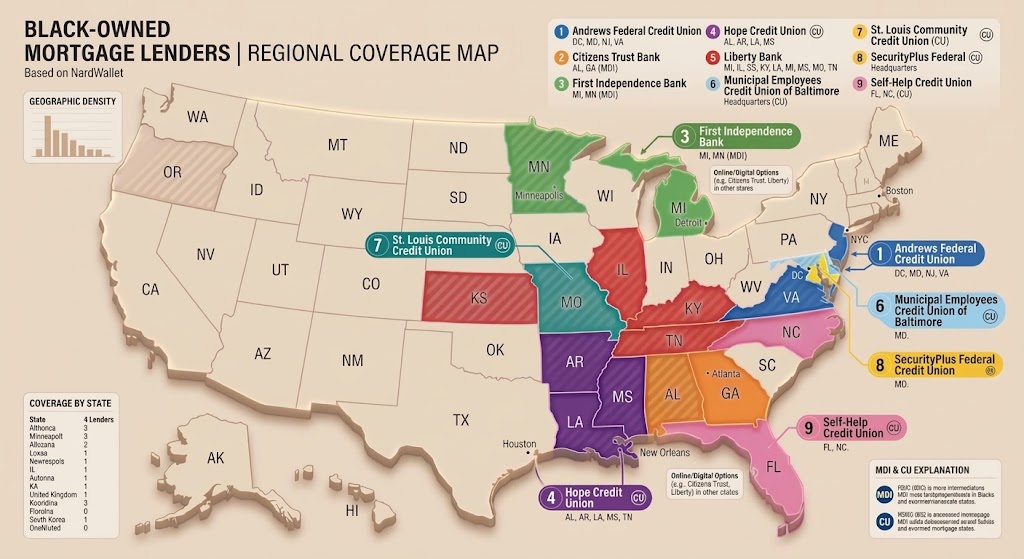
When the geography of African American banks and credit unions is examined together, a more complete — though still incomplete — picture of Black financial infrastructure emerges across the United States. The 2025 African American Owned Bank Directory covers 17 institutions across 15 states and territories. The 2025 NCUA data on African American credit unions adds 205 institutions across 29 states and territories, carrying $8.15 billion in assets and serving approximately 727,000 members. Combined, the two sectors represent over 220 institutions and more than $14.8 billion in assets operating across 31 states and territories. But geography, not just totals, is where the real story lives.

Thirteen states have both an African American-owned bank and at least one African American credit union: Alabama, the District of Columbia, Georgia, Illinois, Louisiana, Michigan, Mississippi, North Carolina, Oklahoma, Pennsylvania, South Carolina, Tennessee, and Texas. These are the states with the fullest financial ecosystem — where a community member can choose between a bank product and a credit union product from an institution with cultural roots in their community. Louisiana stands out, with one bank and 25 credit unions, the most of any state in the credit union count. Illinois follows with one bank and 23 credit unions.

Two states have African American banks but no African American credit unions in the NCUA data: Massachusetts, home to OneUnited Bank, and Utah, newly represented by Redemption Bank. These institutions serve their communities without the complementary infrastructure of a credit union network. Conversely, 16 states and territories have African American credit unions but no African American-owned bank: Arkansas, California, Connecticut, Delaware, Florida, Indiana, Maryland, Minnesota, Missouri, New Jersey, New York, Ohio, Virginia, the U.S. Virgin Islands, West Virginia, and Wisconsin.

The cases of Ohio and Wisconsin, discussed at length in the bank directory analysis, illustrate the limits of credit union coverage as a substitute for bank presence. Ohio has four African American credit unions with combined assets of approximately $18.3 million: Mahoning Valley in Youngstown, Mt. Zion Woodlawn in Cincinnati, Cleveland Church of Christ in Cleveland, and Toledo Urban in Toledo. Of these, Toledo Urban is the only institution of meaningful scale at $17.2 million in assets with 4,324 members. The other three are micro-institutions, each under $600,000 in assets and under 400 members. Wisconsin’s single credit union, Holy Redeemer Community of SE Wisconsin based in Milwaukee, holds just $764,689 in assets and serves 239 members. For a city where African Americans comprise roughly 39 percent of the population, that represents an institutional void that one small credit union cannot fill. Neither Ohio nor Wisconsin has an African American financial institution capable of writing a commercial real estate loan, funding a startup, or underwriting a mortgage for a first-generation homebuyer at any meaningful scale.

African American Financial Institutions by State, 2025

StateAfrican American BanksAfrican American Credit UnionsCombined Institutions
Alabama21214
Arkansas033
California011
Connecticut033
Delaware011
District of Columbia11011
Florida033
Georgia2911
Illinois12324
Indiana055
Louisiana12526
Maryland077
Massachusetts101
Michigan145
Minnesota022
Mississippi11112
Missouri044
New Jersey099
New York01515
North Carolina123
Ohio044
Oklahoma112
Pennsylvania189
South Carolina156
Tennessee156
Texas11415
Utah101
U.S. Virgin Islands044
Virginia01313
West Virginia011
Wisconsin011

Maryland presents a striking and instructive contrast. It has no African American-owned bank, a gap noted in the 2025 directory, yet it is the single largest state for African American credit union assets, hosting seven institutions with a combined $4.47 billion in assets. That figure is driven primarily by two institutions: Andrews Federal Credit Union in Suitland with $2.47 billion in assets and 142,076 members, and Municipal Employees Credit Union of Baltimore with $1.26 billion in assets and 98,358 members. Maryland’s credit union sector is, in asset terms, larger than the entire African American bank sector nationally. This is remarkable. It is also a reminder that credit unions and banks occupy different structural roles. Andrews Federal and MECU of Baltimore are large, sophisticated institutions with product offerings that approach commercial banking but they are member cooperatives, not banks, and their ownership structure, regulatory environment, and community lending mandates differ accordingly. Maryland’s absence from the bank directory is still a gap worth addressing, even with $4.47 billion in credit union assets in the state.

Virginia and Missouri follow a similar pattern to Maryland, albeit at smaller scale. Virginia has 13 African American credit unions with $471 million in assets but no African American-owned bank. Missouri has four credit unions with $481 million in assets, anchored by St. Louis Community Credit Union at $431.5 million, and also no bank. New York has 15 credit unions with $76 million in assets and no African American bank, a particularly stark figure given the size of New York’s African American population and its status as the financial capital of the country.

The states that are entirely absent from both the bank and credit union directories deserve attention. While the combined coverage of 31 states and territories is broader than either sector alone, large portions of the country remain without any African American-owned financial institution. States like Nevada, Arizona, Colorado, Washington, Oregon, and much of the Mountain West and Pacific Northwest have no representation in either directory. As African Americans continue to migrate to new metros — Las Vegas, Phoenix, Denver, Seattle — the absence of community-controlled financial institutions in those corridors becomes a growing concern.

The combined picture is this: African American banks and credit unions together hold approximately $14.8 billion in assets, serve over 700,000 credit union members and the deposit base of 17 banks, and operate across 31 states and territories. The credit union sector, at $8.15 billion in assets across 205 institutions, is actually slightly larger than the bank sector’s $6.72 billion across 17 institutions, a reflection of the credit union model’s greater accessibility and the longer runway some of these institutions have had to grow. But the two sectors are not interchangeable. Banks can hold commercial deposits, write business loans, issue letters of credit, and serve as the financial backbone of an entrepreneurial ecosystem in ways that most credit unions cannot. Credit unions, in turn, offer member ownership, lower fees, and community accountability that publicly or privately held banks may not. The African American community needs both, in every state where its population is substantial. Right now, it has neither in too many places that matter.

Sources: HBCU Money 2025 African American Owned Bank Directory; 2025 NCUA African American Credit Union Institutions data. Asset figures in U.S. dollars.

Disclaimer: This article was assisted by Claude (Anthropic).