Category Archives: Moneyball

The Color Line Was Never Broken: MLB’s Jackie Robinson Day and the Permanent Absence of Black Ownership

Blacks are the only group of people in America who have been taught to invest their time, talents, and resources into other people’s businesses and institutions rather than their own.– Dr. Claude Anderson

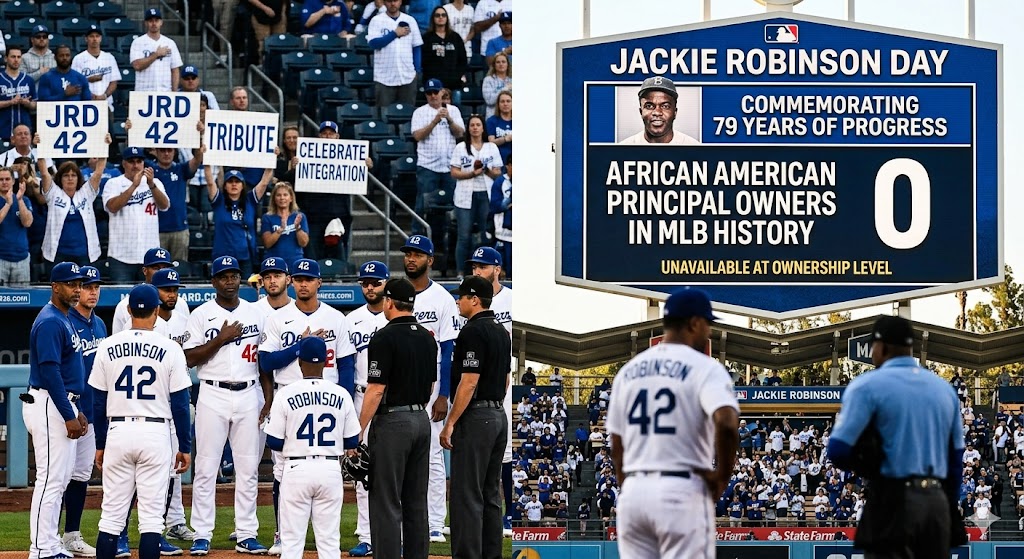
Every April 15th, Major League Baseball dresses itself in the iconography of racial progress. Every player, coach, manager, and umpire in the league wears number 42, the retired number of Jackie Robinson, in a league-wide act of commemorative solidarity. Stadiums host ceremonies. The commissioner issues statements. The Negro Leagues Baseball Museum is quoted in the wire copy. This year marked the 79th anniversary of Robinson’s debut with the Brooklyn Dodgers, and the ritual was performed with its usual solemnity and precision. Bob Kendrick, president of the Negro Leagues Baseball Museum, offered the occasion’s defining sentiment: every player of color who now enjoys the sport owes it to this man. It was the kind of statement that lands well precisely because it is true and precisely because it forecloses the question that actually matters: what do the owners of the sport owe?

The answer, measurable across 79 years, is nothing. Because in the entire recorded history of Major League Baseball, there has never been a single African American principal owner of a franchise. Not one. The league that wraps itself annually in the image of the man who broke its color barrier has never permitted Black Americans to sit at the table where the real decisions are made and the real wealth is accumulated. Jackie Robinson Day, in this light, is not a celebration. It is a ritual performance of symbolism in the absence of substance, a ceremony that honors a labor breakthrough while quietly burying the ownership catastrophe that labor breakthrough produced.

Dr. Claude Anderson diagnosed this dynamic with clinical precision in Black Labor, White Wealth: The Search for Power and Economic Justice. Anderson’s central thesis is that African Americans have historically been incorporated into American economic structures as labor inputs essential to the production of wealth but systematically excluded from its ownership and accumulation. The pattern Anderson traces across centuries of American economic life finds one of its most vivid contemporary illustrations in professional baseball. In 1947, there were zero African American owners in Major League Baseball. In 2026, there are zero African American owners in Major League Baseball. The number has not moved in nearly eight decades of ceremonies, commemorations, and retired jerseys. Whatever integration accomplished for those who could play, it accomplished nothing for those who might own.

The financial stakes of that absence are not abstract. The average MLB franchise value entering the 2026 season is $3.17 billion, a 12 percent increase from the prior year. The New York Yankees are valued at $9 billion; the Los Angeles Dodgers at $8 billion. Thirty franchises, each a multigenerational wealth vehicle, each appreciating at rates that make even the highest player salaries look modest by comparison. The mathematics of ownership versus labor in professional sports is not complicated: franchises compound wealth over generations, while athletic careers end, often before age 35, and rarely produce the kind of capital base required to enter the ownership market. George Steinbrenner paid $10 million for the New York Yankees in 1973; the team is now valued at nearly $9 billion — a 900-fold increase. No player’s salary trajectory has ever approximated that kind of return. The wealth gap between Black athletes and the owners who profit from their labor is not a gap it is a chasm, and it has been widening for eight decades while baseball holds its annual ceremony.

What made this chasm possible was the structural transformation that Robinson’s entry into MLB initiated. Rube Foster, considered the father of Negro League Baseball, was insistent as early as 1910 that Black teams should be owned by Black men. The Negro Leagues were not merely a segregated alternative to the major leagues they were an ownership infrastructure, an economic ecosystem, a complex of jobs, investment, and community capital that functioned precisely because it was self-contained. Virtually all of the initial Negro League ownership was Black, according to Garrick Kebede, a Houston-based financial adviser and Negro League Baseball historian. When Robinson crossed the color line under Branch Rickey’s terms, he did not negotiate a merger. He negotiated a labor transfer. African American talent, the asset that had built and sustained the Negro Leagues, departed for a structure in which African Americans held no ownership stake, no board seats, no equity, and no decision-making authority. The Negro Leagues, stripped of their best labor, collapsed. The ownership infrastructure they represented was dismantled. What remained was the arrangement that has persisted ever since: Black labor generating wealth for white ownership, with the annual ceremony serving as the cultural lubricant that makes the arrangement palatable.

This publication has argued before that what African Americans celebrate when they celebrate Robinson’s debut is better understood as a miscelebration, an uncritical embrace of a “first” that, examined structurally, represented institutional dispossession rather than institutional advancement. The framework is not complicated. A community’s economic power derives not from its ability to supply labor to others’ institutions, but from its capacity to build, own, and control institutions of its own. The Negro Leagues were such an institution. Their destruction produced precisely the outcome that Dr. Anderson’s framework would predict: a permanently subordinate position within an economic structure controlled by others, with symbolic inclusion substituting for actual power.

The percentage of Black players on Opening Day rosters increased from 6.0 percent in 2024 to 6.2 percent in 2025 to 6.8 percent in 2026 — the first back-to-back annual increases in at least two decades. MLB has invested in developmental programs aimed at reversing the long decline of Black players in the sport, and the league has used this uptick as evidence of progress on Jackie Robinson Day. The framing is instructive in its evasions. At the apex of Black participation in MLB, the figure reached 18.7 percent in 1981. Today’s 6.8 percent, celebrated as a milestone, remains less than half that peak and remains, critically, a measure only of labor participation. The ownership figure has not changed. It is zero. It has always been zero. The developmental programs that produce more Black players produce more labor for an ownership class that has never included a single African American. Whatever the developmental intention, the structural outcome is the same as it has always been: more Black men supplying the asset that generates wealth for others.

This is not, it must be stressed, an argument against Black Americans playing baseball. It is an argument about what the celebration of their playing, in the absence of ownership, actually signifies. It signifies that the arrangement Branch Rickey designed in 1947 one in which Black labor would integrate the league while Black ownership was never contemplated has proven durable across nearly eight decades and shows no sign of structural challenge. The 30 franchise owners whose combined wealth now runs into the hundreds of billions of dollars conduct their business in owners’ meetings that have never included an African American voice with the authority that ownership confers. The decisions made in those meetings about labor rules, revenue sharing, market expansion, franchise relocation, broadcast deals are made entirely without African American ownership participation. This is not an oversight. It is the design of the arrangement that Robinson’s entry formalized.

The institutional lessons of this history extend well beyond baseball. The Negro Leagues offer a template not for nostalgia but for analysis: what does it take to build an economic ecosystem that retains capital within a community rather than exporting it to others? The answer, in the Negro Leagues as in other domains, was ownership. When the Kansas City Monarchs played, the revenue stayed within a structure where Black owners, Black managers, Black vendors, and Black communities captured the economic return on Black athletic talent. That structure was dismantled not by force, but by the gravitational pull of integration on terms that never included ownership as a condition.

The HBCU athletic ecosystem faces an analogous set of choices in the present. The temptation to pursue visibility and validation within structures owned and controlled by others (the Power Five conferences, the NCAA tournament apparatus) reproduces the 1947 logic at the college level. As this publication has examined in detail, the HBCU Power Five has a combined all-time record of 4-55 in the NCAA tournament, and the SWAC and MEAC combined typically earn no more than approximately $680,000 in tournament payouts, roughly $34,000 per school when distributed across conference members. The alternative: owning the tournament, controlling the broadcast rights, building an HBCU Athletic Association would produce less spectacle and more capital. It would reproduce, in athletic governance, the logic that Rube Foster understood a century ago: the economic return on Black talent should accrue to Black institutions.

The broader African American institutional ecosystem — Black owned public and private companies, Black financial institutions, professional associations, fraternal organizations, and HBCUs themselves — contains the capacity for the kind of coordinated ownership strategy that MLB has never permitted and that the Negro League era briefly demonstrated was possible. The question is not whether that capacity exists. It is whether the community’s leadership is willing to pursue ownership as a strategic objective rather than labor participation as a cultural achievement. Dr. Anderson’s framework demands that distinction. So does the arithmetic of 30 MLB franchises averaging $3.17 billion in value, every one of them owned by someone who is not African American, generating their returns on a sport whose very mythology of racial progress was built on the back of a Black man who received no ownership stake in exchange for making the mythology possible.

Every April 15th, the number 42 appears on every jersey in Major League Baseball. It is, in its way, an honest accounting. Forty-two is the number of a man whose labor the league appropriated, whose institutional infrastructure it dismantled, and whose memory it now rents annually for its own legitimacy. What would constitute actual progress is the number of African American principal owners in MLB. That number is zero. It has always been zero. Until it changes, Jackie Robinson Day is not a celebration. It is an invoice of unpaid, and accumulating interest.

Disclaimer: This article was assisted by ClaudeAI.
More Than Sports: HBCU Conferences Need To Create Their Own Endowment Foundations

“If you want to go fast, go alone. If you want to go far, go together.” – African Proverb

In the world of HBCUs, sports are often the glittering front porch. The stadiums, the bands, the rivalries—they draw the crowds, the attention, the media. But behind that porch is a house often held together by financial duct tape. For decades, HBCU athletic conferences like the SWAC, MEAC, SIAC, and CIAA have focused on managing competition and culture. But the economic foundation underneath them is alarmingly thin.

The financial disparity between HBCU athletic institutions and their predominantly white peers is not simply about who has better training facilities or more ESPN airtime. It’s about the difference between operating with an endowment mindset versus a sponsorship mindset. PWIs leverage their conference structures to coordinate billions in collective endowments, research funding, and intellectual capital. Meanwhile, HBCU conferences still operate paycheck to paycheck, dependent on event-driven income, annual sponsors, and episodic corporate philanthropy.

It is time for that to change. The next great leap in HBCU economic sovereignty must come through the creation of endowment foundations at the conference level—independent yet cooperative financial vehicles that can invest in the long-term needs of HBCU institutions, students, and faculty.

The Forgotten Leverage of Collective Wealth

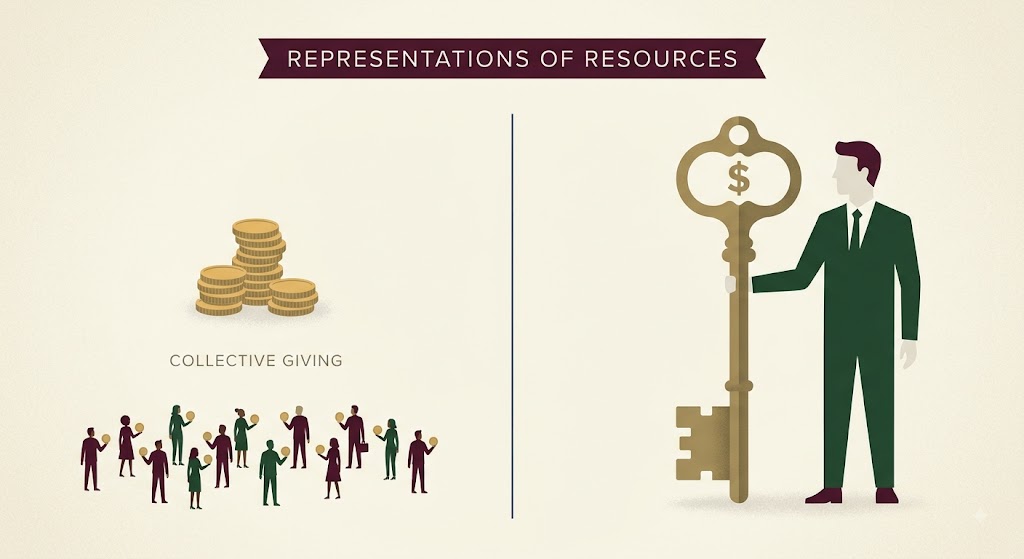
Historically, African American communities have mastered the art of doing more with less. From the Black Wall Streets of the early 20th century to mutual aid societies, pooling resources has long been a survival strategy. But in the modern higher education economy, survival is not enough. Institutions must thrive. And thriving requires capital—specifically, patient capital.

A conference-wide endowment foundation could be just that. It would allow HBCU conferences to strategically deploy financial resources where they are most needed—not only for athletics, but for academic innovation, student scholarships, research collaborations, alumni entrepreneurship, and faculty retention.

Each of the four major HBCU athletic conferences represents a combined student population of tens of thousands and a deep well of alumni, many of whom have entered the upper echelons of law, medicine, tech, government, and business. If each conference coordinated an endowment foundation targeting just 5% of its alumni giving annually and directed those funds into a permanent asset fund managed by Black-owned asset managers and banks, we would begin to see a fundamental shift in institutional leverage.

When The Game Ends, What Remains?

The problem is not talent. It’s time horizon.

HBCU conferences have too often focused on short-term visibility over long-term viability. A celebrity coach may raise a program’s profile for a season, but a well-capitalized endowment will sustain it for generations. PWIs understand this deeply. The Big Ten and SEC do not just operate athletic schedules. Their conference-level infrastructure includes powerful media rights contracts, legal teams, joint academic initiatives, and most importantly—shared wealth.

Take the Ivy League. Its member schools may not be athletic powerhouses, but collectively they manage over $200 billion in endowment assets. While HBCUs often compete against each other for grants, donors, and students, Ivy League and Big Ten schools collaborate to amplify their influence. Why can’t HBCUs do the same?

A SWAC Endowment Foundation, for example, could support:

  • Annual capital grants for member HBCUs to build dormitories, research centers, or innovation labs.
  • A Black student investment fund, empowering students to manage a real portfolio.
  • A faculty sabbatical and fellowship program to retain top talent within the HBCU ecosystem.
  • Grants to fund summer bridge and college prep programs across rural Black communities.
  • Ownership stakes in infrastructure projects in HBCU towns—student housing, broadband, and more.

A 21st Century Wealth Blueprint for HBCUs

The structure is not complicated, but the will must be. Each HBCU conference should establish an independent 501(c)(3) endowment foundation. The foundation would be governed by a board composed of conference commissioners, university presidents, HBCU alumni investment professionals, and student liaisons.

The foundation would start with a 10-year capital campaign. Initial targets? Raising $100 million per conference by year ten. This is modest. If 10,000 alumni gave $1,000 over a decade—just $100 a year—it would amount to $10 million. Pair that with philanthropic and corporate matching, estate giving, and mission-driven Black investors, and these endowments become engines of independence.

Critically, these endowment foundations should also commit to investing 100% of their assets with Black asset managers, banks, and venture capital firms. According to a 2021 Knight Foundation report, less than 1.4% of the over $80 trillion in asset management is controlled by diverse firms. HBCU conferences can help change that while keeping their dollars circulating within their own ecosystem.

Why It Matters: Ownership, Control, and The Power to Say No

The absence of financial infrastructure has often forced HBCUs to compromise. Take whatever TV deal is offered. Accept unfavorable game contracts. Cancel athletic seasons due to budget shortfalls. Move championship games to cities with no cultural or economic benefit to Black communities.

An endowment changes the game. With financial strength comes the power to say no—no to deals that don’t serve the community, no to external forces dictating priorities, and no to underestimating the value of HBCU brands.

It also allows for coordinated lobbying efforts. A conference endowment could fund policy centers and advocacy work in Washington to push for equitable funding, infrastructure investments, and higher education reform that centers Black institutions. Endowments are not just about dollars. They are about direction.

Cultural Buy-In & Structural Challenges

Skeptics will ask: who will manage it? Will universities compete instead of collaborate? Will presidents agree to hand over some control?

These are valid questions—but solvable ones. What’s required is a paradigm shift. The same way the United Negro College Fund (UNCF) once proved that HBCUs could raise money collectively, athletic conferences can prove that they can build wealth collectively. Trust can be built through transparency. Foundations must publish quarterly reports, undergo annual audits, and invite stakeholders to participate in governance.

The cultural buy-in must be intergenerational. Students should see themselves as builders of legacy, not just borrowers of opportunity. Alumni must view giving not as charity, but as strategic investment in their own institutional ecosystem.

And universities must remember: autonomy and alignment are not enemies. One HBCU’s success is every HBCU’s opportunity.

From Halftime Shows to Financial Shows of Strength

The world is watching HBCUs now more than ever. Celebrities are giving. TV deals are emerging. Black students are reconsidering PWI alternatives. But without institutional infrastructure—especially financial infrastructure—this moment may pass like many others before it.

We cannot build generational legacy off emotional moments alone. It requires structure, discipline, vision, and capital. Conference endowments offer the structure. Our community provides the capital. And our students are the vision.

Let this be the era where HBCU athletic conferences moved from entertainment to enterprise. From event coordination to economic coordination. From standing on the field to standing on financial foundations.

Because after the buzzer sounds, after the lights dim, and after the trophies are stored—what remains is what was built.

The Real Game: PWI Athletics Win with Wealth, Not Athletes—And HBCUs Can’t Chase That Model

“The wealthiest boosters and donors to a PWI rarely ever played sports, but they did go build companies and a lot of wealth. Boosters spend hundreds of millions a year to compete with their friends and business competition from rival schools. The money spent is a bigger game than what happens on the field.” – William A. Foster, IV

Courtesy of The Rich Eisen Show

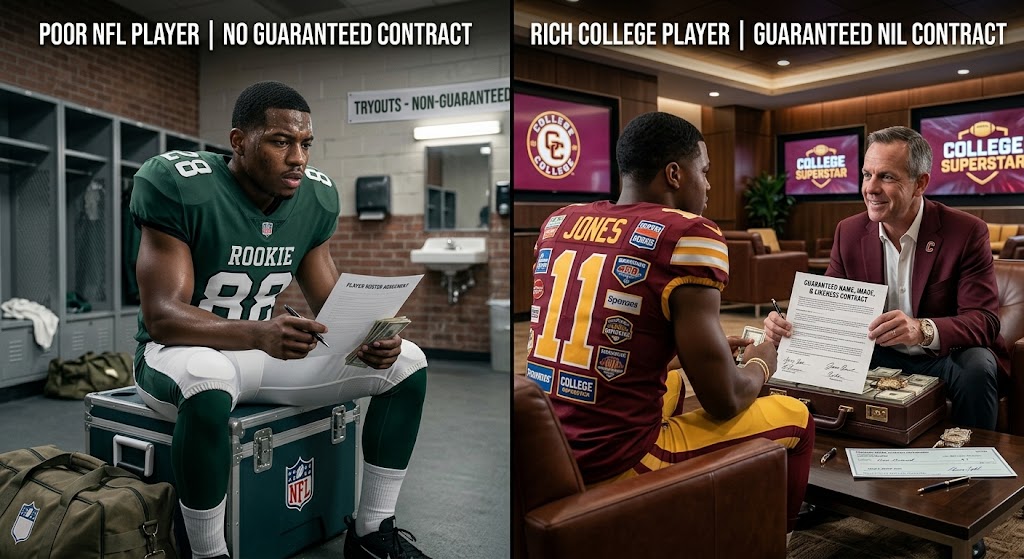
The image circulating across sports media this week says everything without trying to explain anything at all. LSU’s new contract offer to Lane Kiffin — seven years at $13 million annually, stacked with multimillion-dollar bonuses, home buyouts, and housing subsidies looks less like a coaching contract and more like a sovereign wealth transaction. It is the kind of deal only an institution backed by generational wealth, mega-boosters, and a national alumni base at the upper end of the economic ladder could produce. Yet every few months a familiar chorus resurfaces insisting that if “only the top African American athletes chose HBCUs,” the financial gap in college athletics would close. The narrative is compelling, emotional, and rooted in cultural longing, but it remains economically false.

The fantasy is seductive: if only more premier African American athletes chose HBCUs, our athletic programs could compete with Predominantly White Institutions (PWIs). If only we could land that five-star recruit, sign that top quarterback, or attract that elite basketball prospect, everything would change. The dream persists in alumni conversations, on social media, and in aspirational fundraising campaigns. But the dream is built on a fundamental misunderstanding of what actually drives college athletic success and it’s costing HBCUs resources they can’t afford to waste. The numbers tell a story that talent alone cannot rewrite.

Lane Kiffin’s new contract with LSU pays him approximately $13 million annually, making him one of the highest-paid coaches in college football. To put this in perspective, Southern University’s entire athletic department operates on total revenues of $18.2 million for fiscal year 2025-2026. One coach at a PWI earns over 70 percent of what an entire HBCU athletic department generates in revenue. This isn’t an aberration it’s the system working exactly as designed.

The disparity becomes even starker when you examine what funds these massive operations. According to an audit report, Southern University Athletics had total revenue of $17.3 million and expenses of $18.9 million in fiscal year 2023, creating a deficit of $1.5 million. Meanwhile, PWI athletic departments operate with budgets in the hundreds of millions. The athletes on the field, no matter how talented, cannot bridge this chasm.

What truly separates PWI athletic programs from HBCU programs isn’t the talent of 18-22 year-olds playing the games. It’s the economic power of the institutions behind them specifically, the size, wealth, and giving capacity of their alumni bases. According to Georgetown University, PWI graduates earn an average of $62,000 annually, compared to HBCU graduates who earn around $51,000. But the income gap is just the beginning of the story. The real disparity lies in generational wealth accumulation and the sheer number of potential donors.

Major PWIs have alumni bases numbering in the hundreds of thousands, often spanning generations of families who have accumulated significant wealth over decades. These institutions benefit from alumni who are CEOs, hedge fund managers, real estate developers, and executives at Fortune 500 companies. Their boosters can write seven-figure checks without blinking. When they want to retain a coach or upgrade facilities, they simply open their checkbooks.

HBCUs represent around 3% of America’s colleges, yet account for less than 1% of total U.S. endowment wealth. The endowment funding gap stands at approximately $100 to $1—for every $100 a PWI receives in endowment money, HBCUs receive $1. This isn’t just about annual giving; it’s about the compound interest of generational investment that HBCUs have never had the opportunity to build.

Corporate sponsors don’t pay for athletic excellence they pay for eyeballs and access to affluent consumer bases. When companies decide where to invest their marketing dollars, they’re calculating the purchasing power and professional networks they can reach through an institution’s alumni base. A company sponsoring a PWI athletic program gains access to hundreds of thousands of alumni with significant disposable income and decision-making power in corporations. The athletes are just the entertainment that delivers this audience. The actual product being sold is access to the alumni network—for recruiting employees, marketing products, and building business relationships.

This is why even if every top African American athlete chose HBCUs, the sponsorship dollars wouldn’t automatically follow. The economic fundamentals would remain unchanged. Companies invest based on return on investment calculations that are tied to alumni wealth and network size, not solely to on-field performance.

The belief that athletic success drives institutional prosperity is perhaps the most dangerous delusion facing HBCU leadership. Even among PWIs, only a tiny fraction of athletic programs actually turn a profit. Most operate at a loss that’s subsidized by the broader university budget, student fees, and institutional transfers. Southern University’s budget shows $2.2 million in “Non-Mandatory Transfer” and $1.4 million in “Athletic Subsidy”—meaning the institution itself must subsidize athletics with nearly $3.6 million in institutional funds. This is money diverted from academic programs, faculty salaries, research, and student services to keep athletic programs afloat.

The PWI athletic model works for PWIs not because athletics are inherently profitable, but because they can afford the losses. They have massive endowments, substantial state funding, and alumni donor bases that can absorb deficits while still funding academic excellence. HBCUs don’t have this luxury. When an HBCU runs a $1.5 million athletic deficit while struggling to pay competitive faculty salaries, upgrade outdated classroom technology, or fund research initiatives, the opportunity cost is devastating. That deficit represents scholarships not awarded, professors not hired, and academic programs not developed.

Some HBCU advocates point to conference television deals and NCAA tournament appearances as potential revenue sources. But here again, the math is unforgiving. Major PWI conferences negotiate billion-dollar television contracts because they deliver large, affluent viewing audiences that advertisers covet. The Big Ten and SEC don’t command massive TV deals because their athletes are more talented they command them because their alumni bases represent valuable consumer demographics. The SWAC and MEAC can’t replicate these deals because they don’t deliver the same audience size and purchasing power, regardless of the talent on the field. Even if HBCUs somehow assembled teams that won national championships, the structural economic advantages would remain with PWIs.

Here’s what proponents of athletic investment don’t want to acknowledge: the marginal difference in talent between a five-star recruit and a three-star recruit is minimal compared to the massive difference in institutional resources. A slightly more talented roster cannot overcome a 10-to-1 or 100-to-1 resource disadvantage.

Consider the logistics: While an HBCU football program might struggle to afford charter flights for the team, PWI programs have dedicated planes, state-of-the-art training facilities, nutritionists, sports psychologists, and medical staffs that rival professional franchises. They have recruiting budgets that allow them to identify and court prospects nationally. They have video coordinators, analysts, and support staff that outnumber many HBCU athletic departments entirely. The game is won with infrastructure, coaching depth, medical support, nutrition, facilities, and recovery technology not just with the athletes on scholarship. And these resources require the kind of sustained, massive funding that only comes from large, wealthy alumni bases and major corporate partnerships.

There is an alternative model that makes sense for HBCUs: the Ivy League approach. Ivy League schools have chosen not to compete in the athletic arms race. They don’t offer athletic scholarships for football. They emphasize academic excellence while maintaining competitive but not dominant athletic programs. Their alumni networks and institutional prestige are built on academic achievement, research output, and professional success not athletic championships.

For HBCUs, this model offers a realistic path forward. Focus resources on academic excellence, research capabilities, and entrepreneurship. Build prestige through intellectual output, not athletic performance. Create value through what HBCUs have always done best: developing future leaders, producing groundbreaking research, and serving their communities.

The Ivy League proves that institutional prestige and alumni loyalty can thrive without major athletic success. No one questions Harvard’s or Yale’s institutional value because their football teams don’t win national championships. Every dollar spent trying to compete in the PWI athletic model is a dollar not invested in what could actually transform HBCU economic outcomes: research infrastructure, entrepreneurship programs, endowment building, and academic excellence.

Research shows that more than half of all students at HBCUs experience some measure of upward mobility, and upward mobility is about 50 percent higher at HBCUs than PWIs. This is the actual competitive advantage HBCUs possess their ability to transform the economic trajectories of students from under-resourced communities. This mission deserves full investment, not the scraps left over after athletic departments consume resources. If HBCUs invested the millions currently subsidizing athletic deficits into research grants, business incubators, technology transfer offices, and endowed professorships, they could create sustainable revenue streams while fulfilling their core mission. They could become engines of wealth creation for African American communities rather than junior varsity versions of PWI athletic programs.

Admitting you can’t win an unwinnable game isn’t defeat it’s strategic wisdom. HBCUs should stop trying to beat PWIs at a game rigged by structural economic advantages they will never possess. Instead, they should redefine success on their own terms.

This means:

Rightsizing athletic budgets to reflect institutional resources and priorities, accepting that competing for national championships in revenue sports isn’t financially viable or strategically wise.

Investing in niche sports and athletic experiences that can be competitive without massive resource requirements and that build campus community without drowning budgets.

Redirecting resources toward academic distinction, particularly in high-demand fields like STEM, healthcare, and technology where HBCU graduates can command premium salaries and build generational wealth.

Building research infrastructure that attracts grants, creates intellectual property, and establishes HBCUs as innovation centers rather than athletic also-rans.

Developing entrepreneurship ecosystems that turn students into business owners and job creators, building the kind of economic power that generates sustained institutional support.

Creating HBCU-specific tournaments and competitions where these institutions can showcase their talents to their communities without subsidizing PWI athletic departments through guarantee games.

The African American community’s love for HBCU athletics is real and deep. The pageantry of HBCU homecomings, the tradition of the bands, the pride of seeing young Black excellence on display these matter. But love sometimes means making hard choices about where to invest limited resources for maximum impact. The question isn’t whether HBCUs should have athletic programs. The question is whether they should bankrupt their academic missions chasing a competitive model they can never win, designed by and for institutions with 100 times their resources.

One coach earning $13 million. One entire athletic department operating on $18 million. The math isn’t subtle. The choice shouldn’t be either.

Until HBCUs build alumni bases with the size, wealth, and giving capacity to compete in the modern college athletic arms race, pursuing the PWI model isn’t ambition it’s financial suicide. The path to HBCU prosperity runs through classrooms and laboratories, not football stadiums and basketball arenas. It’s time to stop chasing someone else’s game and start winning our own.

Disclaimer: This article was assisted by ClaudeAI.
Owning The Diamond: Why HBCU Women Entrepreneurs Should Buy a Women’s Pro Baseball Team

“Let us put our moneys together; let us use our moneys; let us put our moneys out at usury among ourselves, and reap the benefits ourselves.” – Maggie L. Walker, pioneering African American banker and businesswoman:

It is not enough to cheer from the stands.
IIt is not enough to cheer from the stands. If HBCU women entrepreneurs and the institutions that produced them are serious about building generational wealth, influence, and visibility in the global sports economy, then ownership, not participation, must be the goal. The emergence of the Women’s Pro Baseball League (WPBL) offers just such a moment. Four inaugural franchises in Los Angeles, San Francisco, New York, and Boston mark the first professional women’s baseball league in the United States since 1954. And yet, amid this historic announcement, one question should echo across the HBCU landscape: Who will own a piece of it?

Ownership in sports is about more than trophies it’s about capital, culture, and control. While athletes inspire, it is owners who shape the economic ecosystem: negotiating television contracts, setting standards for pay equity, deciding where teams are located, and determining which communities benefit from their presence. In American sports, Black ownership remains vanishingly rare. Fewer than a handful of African Americans have ever held majority stakes in professional teams across all major leagues. Among women, ownership representation is even smaller. Yet the HBCU ecosystem comprising over a hundred institutions, $4 billion in endowment capital (though still dwarfed by their PWI counterparts), and a growing class of wealthy and capable alumni possesses both the human and institutional capital to change that reality. Buying a WPBL franchise would be a powerful signal: that African American women are no longer content to merely play or support the game, but to own the infrastructure of it.

The WPBL represents a once-in-a-century opportunity. The last women’s professional baseball league folded in 1954 when postwar America reverted to its gendered labor norms and refused to institutionalize women’s success on the field. Today, that same sport returns in a vastly different economy one defined by media fragmentation, digital storytelling, and institutional investing that rewards niche audiences and strong narratives. Women’s sports are on the rise. The WNBA just received a $75 million investment round from Nike, Condoleezza Rice, Laurene Powell Jobs, and others. Women’s college basketball ratings have exploded, drawing more viewers than some men’s sports. The National Women’s Soccer League has seen team valuations grow fivefold in the past five years. Investors are realizing what the data already shows: undervalued leagues often yield outsized returns once visibility and infrastructure catch up.

The WPBL sits at this exact inflection point. Early investors will not just shape the league they will define its culture, inclusivity, and profitability. This is why HBCU women entrepreneurs, backed by HBCU endowments and alumni capital, should move swiftly. Ownership here is not a vanity project it is a long-term equity position in the fastest-growing frontier of professional sports.

Start-up sports franchises are not the billion-dollar investments of the NFL or NBA. The WPBL’s initial teams are expected to sell for figures in the mid-seven to low-eight figures: expensive, yes, but feasible through a syndicate model combining entrepreneurial capital and institutional backing. A $15 million franchise, for instance, could be financed with $5 million in equity from HBCU women entrepreneurs, $3 million in matching commitments from HBCU endowments through a joint-venture investment arm, $5 million in debt financing via an African American–owned bank or credit union consortium, and $2 million in naming rights, sponsorship pre-sales, and city incentives.

Such a structure distributes risk while maximizing institutional leverage. It also allows for a reinvestment loop: returns from franchise appreciation, media deals, or merchandising could feed back into the endowments that helped fund the acquisition, growing HBCU wealth through private equity in sports. At a modest ten percent annualized return over fifteen years, a $3 million endowment investment could grow to more than $12.5 million, even before accounting for franchise appreciation. The social return of visibility, leadership, and influence would be immeasurable.

HBCU women entrepreneurs already lead some of the most innovative ventures in the country from fintech to fashion to wellness. They have built companies with leaner budgets, higher risk tolerance, and community-driven missions. That same acumen could translate seamlessly into sports ownership. A women-led ownership group rooted in HBCU culture would bring authenticity to a league whose audience is already primed for inclusive storytelling. They would not merely own a team they would shape its identity around empowerment, intellect, and cultural sophistication. Imagine a team whose executive suite reflects Spelman’s academic rigor, Howard’s creative dynamism, and FAMU’s entrepreneurial grit.

Moreover, the investment aligns with HBCU women’s long history of institution building. From Mary McLeod Bethune’s founding of Bethune-Cookman University to Maggie Lena Walker’s creation of the first Black woman–owned bank, African American women have always been at the forefront of merging mission with market. Buying a professional sports franchise is simply a modern continuation of that legacy.

Most HBCU endowments remain undercapitalized. Collectively, they total roughly $4 billion, compared to Harvard’s $50 billion alone. That gap underscores why traditional endowment investing centered on conservative asset classes may not close the wealth chasm. Sports equity, particularly in emerging women’s leagues, represents a hybrid investment: cultural capital meets growth asset. Endowments could carve out a modest allocation for strategic co-investment vehicles aimed at ownership in minority- or women-led sports ventures. Such a move would not only produce potential returns but reposition HBCU endowments as active agents in wealth creation, mirroring how elite universities use their endowments as venture capital arms. The same institutions that once nurtured the first generations of African American scholars could now nurture the first generation of African American women sports owners.

The path to ownership would unfold in phases: coalition building, institutional partnerships, financial structuring, branding, and media engagement. The first step would be forming an HBCU Women Sports Ownership Council an alliance of HBCU alumnae entrepreneurs, investors, attorneys, and sports professionals. Its mission would be to identify a WPBL franchise opportunity, conduct due diligence, and negotiate terms. Next, endowments, foundations, and alumni associations could serve as anchor investors via a pooled HBCU Sports Ownership Fund. African American–owned financial institutions would provide credit facilities, ensuring that capital circulation strengthens Black banking. The team’s branding could reflect HBCU values of intellect, resilience, and excellence. Annual “HBCU Heritage Games,” scholarships for women in sports management, and partnerships with K–12 baseball programs would ensure the franchise deepens institutional impact.

By the time Opening Day 2027 arrives, the vision becomes real. A stadium in Atlanta or Houston cities with deep HBCU roots roars with excitement. The team, perhaps named The Monarchs in tribute to the Negro Leagues, takes the field in uniforms stitched by a Black-owned apparel company. The owner’s suite is filled not with venture capitalists, but HBCU women—founders, engineers, bankers, educators—raising glasses to history. Every ticket sold funds scholarships. Every broadcast includes HBCU branding. Every victory multiplies across the ecosystem, from the university’s endowment statement to the little girl in the stands whispering, “She looks like me.” That is the multiplier effect of ownership.

A defining mark of this ownership group’s legacy should not only be who owns the team but who benefits from it. When an HBCU-led syndicate buys a women’s professional baseball team, it must ensure that every dollar of the fan experience circulates through Black and HBCU-centered businesses. Ownership without ecosystem-building simply recreates dependency; real power multiplies through participation.

An HBCU women’s ownership group has the chance to build an authentically circular sports economy, where concession stands, catering services, and retail vendors reflect the same entrepreneurial DNA as the team itself. The model for this begins with women like Pinky Cole, founder of Slutty Vegan, who transformed plant-based dining into a cultural and economic phenomenon through purpose-driven branding and community investment. Her ability to merge food, culture, and empowerment offers a blueprint for how HBCU women entrepreneurs could anchor the ballpark experience in ownership and identity.

Complementing this vision is the role of HBCU-owned service enterprises like Perkins Management Services Company, founded by Nicholas Perkins, a Fayetteville State University alumnus and owner of Fuddruckers. Perkins Management operates food services across HBCUs and federal institutions, combining operational scale with cultural competence. Partnering with Perkins Management to run stadium concessions or hospitality would ensure that the team’s operations mirror the ownership group’s values efficiency, reinvestment, and excellence.

Such an approach would transform the stadium into an economic hub for HBCU enterprise. Food vendors would come from HBCU alumni-owned companies. Uniform suppliers could source from HBCU textile programs. Merchandise stands could feature HBCU student designs. Hospitality contracts would prioritize HBCU-affiliated culinary programs. The music during games could feature HBCU marching bands or alumni artists. Even the stadium’s artwork could highlight HBCU painters and photographers, ensuring every sensory detail honors the ecosystem that made the ownership possible. A fan buying food or merchandise would not just be a consumer they’d be participating in a shared mission to strengthen African American institutions.

This reimagined sports environment would also offer internships, apprenticeships, and consulting opportunities for HBCU students and faculty. Business students could study operations. Communication majors could intern with the PR team. Engineering departments could advise on stadium energy efficiency. Each partnership would turn the franchise into a living classroom of applied HBCU excellence.

At a time when major leagues outsource globally, a women’s baseball franchise owned by HBCU women could reimagine localization and reinvestment as competitive advantage. Every game day would circulate dollars through a self-sustaining ecosystem that feeds back into HBCU entrepreneurship. Because when the ballpark itself is powered by HBCU women’s enterprise from boardroom to concession stand it ceases to be a venue. It becomes a living institution.

If the Women’s Pro Baseball League truly takes off, early ownership will be the golden ticket. African American investors have often entered markets too late once valuations skyrocket and access narrows. Now, before the WPBL matures, is the time for HBCU institutions and their entrepreneurial alumnae to act collectively. The call is not for charity but for strategy. Pooling even a fraction of the capital that circulates annually among HBCU alumni could change the power dynamic in sports forever. Endowments could stake equity. Alumni could invest through private funds. Students could study the economics of their own institution’s franchise. The result would be a feedback loop of wealth, wisdom, and visibility.

The first women’s professional baseball league in seventy years deserves first-of-its-kind ownership and no community is more qualified to deliver it than HBCU women. Because when HBCU women own the field, the entire game changes.

Disclaimer: This article was assisted by ChatGPT.

Leave The Bands At Home: HBCU Football Should Leave Their Bands Behind For Road Games

“Pragmatism is good prevention for problems.” – Amit Kalantri

The unspeakable may be the fiscally responsible

It seems almost unthinkable. An HBCU football game without BOTH bands at halftime. It has happened before, though only in exceptional cases: an emergency back home, a suspended band, or budgetary chaos. But to purposely and preemptively not take one’s band on the road? In HBCU culture, it feels akin to breaking the thirteenth commandment—Thou Shall Not Not Make ‘Em Dance—or committing some kind of cultural apostasy. Yet, for all its sacredness, perhaps it is time to break the spell.

At the core of this radical idea lies a rather mundane but pressing question: money. Football remains a major cost centre for most HBCUs. Marching bands, while sources of school pride and cultural magnetism, are not cheap to move. Between buses, meals, lodging, uniforms, and instrument logistics, taking a full band of 150+ members on the road can easily cost upwards of $50,000 per trip—especially if the destination is cross-country or involves air travel. Multiply that over several away games and a program could be looking at a mid-six-figure expenditure for the season. For many financially struggling HBCUs, this is no longer tenable.

The Holy Trifecta: Football, Bands, and Black Culture

At HBCUs, the band is often a co-headliner alongside the football team. In fact, at many institutions, the halftime show garners more social media views than the football game itself. The human formations, the drumline cadences, the high-stepping majorettes—it is part performance art, part cultural ritual. This makes the suggestion to leave bands behind feel almost blasphemous. It would strip the game of a vital sensory component, some argue, and deflate the inter-institutional competition that thrives on the duality of football and music.

Yet, it is precisely because of the power and prestige of the band that its role should be more strategically deployed. Bands are brand equity, not just background music. And that equity can be preserved—even enhanced—by rationing its presence and reallocating its costs.

Opportunity Cost and the Marching Million

Take the example of a mid-tier HBCU football program with four away games and a 160-member band. Transporting that band to all four games (via coach buses and lodging in modest hotels) might cost around $45,000 per game, or $180,000 total. Now imagine what else $180,000 could fund:

  • A student internship fund supporting 60 summer internships with $3,000 stipends;
  • A marketing campaign aimed at boosting out-of-state recruitment;
  • Repairs to the music department’s aging instruments and facilities;
  • A reserve fund for the band itself, to increase scholarships or buy newer uniforms.

The fact that this trade-off rarely enters the conversation reflects how entrenched the band has become as a required amenity for HBCU athletics. But institutions facing increasing competition for enrollment, state budget cuts, and inflationary pressure must start examining what truly maximizes impact—and what has become tradition for tradition’s sake.

Enter the Bandlight Policy

A “Bandlight” policy—where the band does not travel to away games unless deemed a high-profile or high-impact matchup (such as classics or homecoming of an opposing school)—could preserve institutional pride while enabling budget reprioritization. To soften the cultural blow, this policy could be paired with livestreamed pregame performances from home, aired during halftime of away games, or partnerships with local high schools or community colleges to fill the halftime slot. In effect, HBCUs would still “show up” culturally—just not logistically.

Moreover, rival institutions could enter into alternating-year agreements where only one band travels per year to the same matchup, thereby cutting costs in half while preserving some tradition. Or the entire conference could collectively implement policies to standardize expectations.

Revenue Substitutes: Making Absence Profitable

There is also the question of replacement: if the band is not traveling, what can be put in its place—socially and economically?

  1. High School Recruitment Fairs: Away games, especially those in recruiting hotbeds like Atlanta, Dallas, or Memphis, could feature pre-game recruitment fairs or pop-up university expos that target prospective students. Hosted in the parking lots or auxiliary spaces near stadiums, these expos would draw interest beyond the usual alumni tailgating crowds and create a broader community impact.
  2. Alumni Investment Summits: Rather than just tailgates and chants, HBCUs could host micro-investment forums or alumni networking mixers tied to away games. These could feature information on planned giving, institutional capital needs, and legacy endowments. Such events reinforce the university’s brand as an enduring institution—not just a weekend pastime.
  3. Cultural Diplomacy Exchange: At many PWIs (Predominantly White Institutions), the visiting HBCU band often provides the primary Black cultural presence on campus. By not sending the band, HBCUs could instead host curated cultural experiences: pop-up film screenings of Black directors, panel discussions on African American history, or mini art exhibitions. These events would still showcase the university’s heritage—just in a different form.
  4. Digital Monetization: Finally, there is room for digital alternatives. Bands could record exclusive halftime content back on campus for broadcast during away game livestreams. With the right sponsorship and media packaging, this could even generate revenue—especially if made accessible to the broader HBCU diaspora via streaming platforms or partnerships with outlets like HBCU Go or KweliTV.

Making Room for Exceptions: The Classics, Championships, and Cultural Diplomacy

No policy should be absolute, and the “Bandlight” approach must leave room for strategic exceptions. Certain games carry weight not just in terms of school pride, but institutional visibility, alumni engagement, and revenue generation. These events—such as the Bayou Classic, Magic City Classic, Florida Classic, or Celebration Bowl—should remain exempt from the policy due to their national reach and cultural cachet.

In these cases, the financial and branding benefits of both bands being present far outweigh the costs. These events are often broadcast on national television, command six- or seven-figure sponsorships, and serve as major alumni gathering points. Not showing up in full force—band and all—would send the wrong message about the value of HBCU pageantry.

Similarly, championship games or playoffs should remain occasions where bands accompany the team, reinforcing institutional pride at the highest level of competition.

Lastly, special exceptions could be granted for “Cultural Diplomacy Games,” where HBCUs play PWIs in regions with limited exposure to African American cultural institutions. These matchups offer an opportunity to expand HBCU brand identity and cultural influence—missions that justify a larger financial investment.

By clearly defining such exceptions, institutions can retain flexibility without undermining the integrity of a more fiscally responsible standard for regular-season games.

From Brass to Bank: Strengthening Endowments Through Smart Savings

Perhaps the most compelling reason to consider limiting band travel is the long-term impact it could have on strengthening HBCU endowments—a chronic weakness in the financial armor of most historically Black colleges and universities. Endowments are not merely rainy-day funds; they are the bedrock of institutional independence, providing reliable income streams for scholarships, faculty retention, infrastructure improvements, and strategic initiatives. Yet, the vast majority of HBCUs remain dangerously undercapitalized.

As of 2024, only one HBCU—Howard University—has an endowment exceeding $1 billion. By comparison, over 50 predominantly white institutions boast endowments larger than $1 billion, and the average Ivy League endowment surpasses $10 billion. The gap in financial flexibility means that most HBCUs remain reliant on tuition, federal grants, and unpredictable philanthropic cycles. Closing this endowment divide must be a generational project—and rethinking every cost center, including football and band logistics, is a prudent step.

Let us revisit the travel cost scenario: an HBCU saves $180,000 annually by not sending its marching band to four away games. If that amount were instead directed into an endowment or investment fund yielding a 10% annual return, compounded over 30 years, the return on the first year’s investment alone would grow to approximately $3.1 million. But in practice, this contribution would not be a one-time deposit—it would be made every year for 30 years.

Each $180,000 annual deposit would compound over a different span of time—from 30 years down to 1 year for the final contribution. When we sum the compounded growth of all 30 annual contributions, the total value by year 30 is not merely $3.1 million, but a remarkable $32.6 million.

This is the true power of consistent, disciplined investing. What might seem like a relatively small annual sacrifice—foregoing band travel to four away games—can, when reinvested wisely, build a financial pillar for an HBCU that could support hundreds of scholarships, faculty lines, or capital improvements. Across multiple institutions, such strategy would not just close the endowment gap—it could transform it into a long-term competitive advantage. Using the future value formula:

FV = P × [(1 + r)^t – 1] / r
FV = $180,000 × [(1.10)^30 – 1] / 0.10
FV ≈ $3.1 million

Now imagine 40 HBCUs adopting this policy. If each institution redirected $180,000 annually into an endowment with a 10% annual return, the combined value of those contributions over 30 years would grow to an extraordinary $1.3 billion.

This isn’t speculative—it is mathematical certainty backed by compounding returns. What begins as a quiet cost-saving measure becomes a billion-dollar transformation of Black institutional capital. It is the kind of long-term vision HBCUs need to build financial independence and power. Leaving the bands at home, selectively and strategically, could finance a future where they never again play second fiddle to structural underfunding.

Such funds could be reserved for band scholarships, new instruments, music department endowments, or general institutional advancement. Equally important, this shift demonstrates fiscal maturity to large philanthropic donors who seek assurance of sustainability and capital stewardship. In this light, the silence of a band on one Saturday becomes a long crescendo toward institutional resilience.

Band Camp Economics and Reallocation Potential

Consider also the economic pressures on the bands themselves. Marching bands at HBCUs are often underfunded even as they serve as ambassadors and talent pipelines. Travel budgets could be redirected internally:

  • Higher stipends for band scholarships, which could attract more top talent;
  • Expanded outreach to middle and high school band programs to sustain the pipeline;
  • Better faculty-to-student ratios for music education;
  • New instrument purchases, particularly for percussion and brass sections, which endure high wear and tear.

An internal reallocation of $150,000–$250,000 annually per school could mean the difference between merely surviving and thriving for a band program.

The Cultural Blowback—and Counterarguments

Naturally, such a policy will meet resistance—not only from fans but from within. Band members may feel shortchanged on travel experiences. Alumni may bristle at what they see as a cultural dilution. Game promoters may worry about reduced ticket sales if the bands are not both present.

But it is precisely because bands matter so much that they should be protected from burnout and underinvestment. If leaving them home three or four times per year increases their overall budget, performance level, and recruitment reach, is that not a worthy trade?

Besides, culture evolves. Just as HBCUs have moved from AM radio to YouTube, from pamphlets to TikTok, so too can band culture adapt to a new hybrid reality—where physical presence is not the only measure of visibility or power.

A Conference-Wide Model: The SWAC and MEAC Could Lead

If this is to be implemented, it would ideally not be school by school, but as a conference-wide reform. Both the Southwestern Athletic Conference (SWAC) and the Mid-Eastern Athletic Conference (MEAC) could establish guidelines that limit band travel to key games while preserving equity among member institutions.

Such a policy might include:

  • A rotating system where each team brings its band to only half of its away games;
  • Revenue-sharing from livestreamed halftime performances;
  • Incentives for home teams to offer cultural hospitality to offset the absence of the visiting band.

It would also open new possibilities for sponsorship. Corporate partners who understand the influence of HBCU bands could be enlisted to underwrite digital halftime content or band scholarships—an easier pitch if funds are not being spent on transport and logistics.

March Differently, Spend Smarter

Culture is not weakened by strategy. In fact, when deployed wisely, it is made more resilient. Leaving the bands at home for select away games is not a betrayal of HBCU tradition—it is a restructuring of it to survive and thrive in a new era.

In a time when HBCUs are asked to do more with less, the question is not whether the bands should still matter. Of course they do. The question is whether they should have to march themselves into financial depletion to prove it.

Better to let them rest, regroup—and when they do appear, make it unforgettable.

Disclaimer: This article was assisted by ChatGPT.