Tag Archives: hbcu money

The Color Line Was Never Broken: MLB’s Jackie Robinson Day and the Permanent Absence of Black Ownership

Blacks are the only group of people in America who have been taught to invest their time, talents, and resources into other people’s businesses and institutions rather than their own.– Dr. Claude Anderson

Every April 15th, Major League Baseball dresses itself in the iconography of racial progress. Every player, coach, manager, and umpire in the league wears number 42, the retired number of Jackie Robinson, in a league-wide act of commemorative solidarity. Stadiums host ceremonies. The commissioner issues statements. The Negro Leagues Baseball Museum is quoted in the wire copy. This year marked the 79th anniversary of Robinson’s debut with the Brooklyn Dodgers, and the ritual was performed with its usual solemnity and precision. Bob Kendrick, president of the Negro Leagues Baseball Museum, offered the occasion’s defining sentiment: every player of color who now enjoys the sport owes it to this man. It was the kind of statement that lands well precisely because it is true and precisely because it forecloses the question that actually matters: what do the owners of the sport owe?

The answer, measurable across 79 years, is nothing. Because in the entire recorded history of Major League Baseball, there has never been a single African American principal owner of a franchise. Not one. The league that wraps itself annually in the image of the man who broke its color barrier has never permitted Black Americans to sit at the table where the real decisions are made and the real wealth is accumulated. Jackie Robinson Day, in this light, is not a celebration. It is a ritual performance of symbolism in the absence of substance, a ceremony that honors a labor breakthrough while quietly burying the ownership catastrophe that labor breakthrough produced.

Dr. Claude Anderson diagnosed this dynamic with clinical precision in Black Labor, White Wealth: The Search for Power and Economic Justice. Anderson’s central thesis is that African Americans have historically been incorporated into American economic structures as labor inputs essential to the production of wealth but systematically excluded from its ownership and accumulation. The pattern Anderson traces across centuries of American economic life finds one of its most vivid contemporary illustrations in professional baseball. In 1947, there were zero African American owners in Major League Baseball. In 2026, there are zero African American owners in Major League Baseball. The number has not moved in nearly eight decades of ceremonies, commemorations, and retired jerseys. Whatever integration accomplished for those who could play, it accomplished nothing for those who might own.

The financial stakes of that absence are not abstract. The average MLB franchise value entering the 2026 season is $3.17 billion, a 12 percent increase from the prior year. The New York Yankees are valued at $9 billion; the Los Angeles Dodgers at $8 billion. Thirty franchises, each a multigenerational wealth vehicle, each appreciating at rates that make even the highest player salaries look modest by comparison. The mathematics of ownership versus labor in professional sports is not complicated: franchises compound wealth over generations, while athletic careers end, often before age 35, and rarely produce the kind of capital base required to enter the ownership market. George Steinbrenner paid $10 million for the New York Yankees in 1973; the team is now valued at nearly $9 billion — a 900-fold increase. No player’s salary trajectory has ever approximated that kind of return. The wealth gap between Black athletes and the owners who profit from their labor is not a gap it is a chasm, and it has been widening for eight decades while baseball holds its annual ceremony.

What made this chasm possible was the structural transformation that Robinson’s entry into MLB initiated. Rube Foster, considered the father of Negro League Baseball, was insistent as early as 1910 that Black teams should be owned by Black men. The Negro Leagues were not merely a segregated alternative to the major leagues they were an ownership infrastructure, an economic ecosystem, a complex of jobs, investment, and community capital that functioned precisely because it was self-contained. Virtually all of the initial Negro League ownership was Black, according to Garrick Kebede, a Houston-based financial adviser and Negro League Baseball historian. When Robinson crossed the color line under Branch Rickey’s terms, he did not negotiate a merger. He negotiated a labor transfer. African American talent, the asset that had built and sustained the Negro Leagues, departed for a structure in which African Americans held no ownership stake, no board seats, no equity, and no decision-making authority. The Negro Leagues, stripped of their best labor, collapsed. The ownership infrastructure they represented was dismantled. What remained was the arrangement that has persisted ever since: Black labor generating wealth for white ownership, with the annual ceremony serving as the cultural lubricant that makes the arrangement palatable.

This publication has argued before that what African Americans celebrate when they celebrate Robinson’s debut is better understood as a miscelebration, an uncritical embrace of a “first” that, examined structurally, represented institutional dispossession rather than institutional advancement. The framework is not complicated. A community’s economic power derives not from its ability to supply labor to others’ institutions, but from its capacity to build, own, and control institutions of its own. The Negro Leagues were such an institution. Their destruction produced precisely the outcome that Dr. Anderson’s framework would predict: a permanently subordinate position within an economic structure controlled by others, with symbolic inclusion substituting for actual power.

The percentage of Black players on Opening Day rosters increased from 6.0 percent in 2024 to 6.2 percent in 2025 to 6.8 percent in 2026 — the first back-to-back annual increases in at least two decades. MLB has invested in developmental programs aimed at reversing the long decline of Black players in the sport, and the league has used this uptick as evidence of progress on Jackie Robinson Day. The framing is instructive in its evasions. At the apex of Black participation in MLB, the figure reached 18.7 percent in 1981. Today’s 6.8 percent, celebrated as a milestone, remains less than half that peak and remains, critically, a measure only of labor participation. The ownership figure has not changed. It is zero. It has always been zero. The developmental programs that produce more Black players produce more labor for an ownership class that has never included a single African American. Whatever the developmental intention, the structural outcome is the same as it has always been: more Black men supplying the asset that generates wealth for others.

This is not, it must be stressed, an argument against Black Americans playing baseball. It is an argument about what the celebration of their playing, in the absence of ownership, actually signifies. It signifies that the arrangement Branch Rickey designed in 1947 one in which Black labor would integrate the league while Black ownership was never contemplated has proven durable across nearly eight decades and shows no sign of structural challenge. The 30 franchise owners whose combined wealth now runs into the hundreds of billions of dollars conduct their business in owners’ meetings that have never included an African American voice with the authority that ownership confers. The decisions made in those meetings about labor rules, revenue sharing, market expansion, franchise relocation, broadcast deals are made entirely without African American ownership participation. This is not an oversight. It is the design of the arrangement that Robinson’s entry formalized.

The institutional lessons of this history extend well beyond baseball. The Negro Leagues offer a template not for nostalgia but for analysis: what does it take to build an economic ecosystem that retains capital within a community rather than exporting it to others? The answer, in the Negro Leagues as in other domains, was ownership. When the Kansas City Monarchs played, the revenue stayed within a structure where Black owners, Black managers, Black vendors, and Black communities captured the economic return on Black athletic talent. That structure was dismantled not by force, but by the gravitational pull of integration on terms that never included ownership as a condition.

The HBCU athletic ecosystem faces an analogous set of choices in the present. The temptation to pursue visibility and validation within structures owned and controlled by others (the Power Five conferences, the NCAA tournament apparatus) reproduces the 1947 logic at the college level. As this publication has examined in detail, the HBCU Power Five has a combined all-time record of 4-55 in the NCAA tournament, and the SWAC and MEAC combined typically earn no more than approximately $680,000 in tournament payouts, roughly $34,000 per school when distributed across conference members. The alternative: owning the tournament, controlling the broadcast rights, building an HBCU Athletic Association would produce less spectacle and more capital. It would reproduce, in athletic governance, the logic that Rube Foster understood a century ago: the economic return on Black talent should accrue to Black institutions.

The broader African American institutional ecosystem — Black owned public and private companies, Black financial institutions, professional associations, fraternal organizations, and HBCUs themselves — contains the capacity for the kind of coordinated ownership strategy that MLB has never permitted and that the Negro League era briefly demonstrated was possible. The question is not whether that capacity exists. It is whether the community’s leadership is willing to pursue ownership as a strategic objective rather than labor participation as a cultural achievement. Dr. Anderson’s framework demands that distinction. So does the arithmetic of 30 MLB franchises averaging $3.17 billion in value, every one of them owned by someone who is not African American, generating their returns on a sport whose very mythology of racial progress was built on the back of a Black man who received no ownership stake in exchange for making the mythology possible.

Every April 15th, the number 42 appears on every jersey in Major League Baseball. It is, in its way, an honest accounting. Forty-two is the number of a man whose labor the league appropriated, whose institutional infrastructure it dismantled, and whose memory it now rents annually for its own legitimacy. What would constitute actual progress is the number of African American principal owners in MLB. That number is zero. It has always been zero. Until it changes, Jackie Robinson Day is not a celebration. It is an invoice of unpaid, and accumulating interest.

Disclaimer: This article was assisted by ClaudeAI.
The Africa Travel Ban Is an HBCU Problem

Africans in the United States must remember that the slave ships brought no West Indians, no Caribbeans, no Jamaicans or Trinidadians or Barbadians to this hemisphere. The slave ships brought only African people and most of us took the semblance of nationality from the places where slave ships dropped us off. – Dr. John H. Clarke

Photo from the Wall Street Journal

The photograph of Majok Bior, a South Sudanese computer science sophomore at Duke University, stranded at his cousin’s home in Kampala after the Trump administration’s travel restrictions invalidated his visa — has circulated widely as a symbol of individual suffering. And it is that. But to read it only through the lens of personal tragedy is to miss the structural dimensions of what is unfolding across American higher education, and to miss, in particular, what this moment means for HBCUs.

The Trump administration’s travel ban, initially signed on June 4, 2025, targeted 12 countries and placed partial restrictions on seven more, covering a geography concentrated in Africa and the Middle East. By December 2025, that list had expanded to 39 countries and territories, with Nigeria, historically one of the top ten sources of international students in the United States, placed under partial restrictions effective January 1, 2026. Individuals in Nigeria will not be able to receive student visas beginning January 1. Secretary of State Marco Rubio has signaled further expansion, with a State Department memo identifying 36 additional countries for potential restriction, including 25 African nations as well as countries in the Caribbean, Central Asia, and the Pacific Islands. If that expansion proceeds, the policy will have effectively severed the institutional connection between American higher education and the African continent.

For HBCUs specifically, this is not a distant geopolitical event. It is a direct threat to an enrollment strategy, a revenue base, and a civilizational relationship that institutions have spent decades building.

To understand the financial stakes, one must first understand how international student enrollment became integral to the fiscal architecture of many HBCUs. In addition to the tuition money international students often bring, many foreign students pay the full sticker price, often aided by their home countries’ governments there are benefits for HBCUs’ American students as well. International students, particularly those arriving with government-funded scholarships from Nigeria, Ghana, Saudi Arabia, and other nations, have served as a reliable source of full-fare tuition revenue at institutions that chronically lack the endowment depth to absorb enrollment volatility.

Among HBCUs with ten or more international students, Morgan State had the most as of the 2017-18 academic year, with 945 students; Howard was second with 920; and Tennessee State third with 584, according to the Institute of International Education. These numbers have only grown. Tennessee State, for instance, went from 77 international undergraduate students in 2008-09 to 549 by fall 2016 representing roughly 8 percent of its undergraduate student body. Across the sector, African students from Nigeria and Ghana historically constituted a significant share of that international cohort.

The financial logic was sound. A university with modest endowment holdings and only one HBCU, Howard University, currently holds an endowment exceeding $1 billion, cannot easily absorb the loss of a tuition-paying population without triggering cascading institutional consequences. When full-fare international students leave an enrollment ledger, the institution must either raise tuition on domestic students who are often already Pell Grant-eligible, draw down reserves, reduce staffing, or curtail academic programs. In a sector where financial fragility is not the exception but the norm, any of those choices carries compounding institutional risk. Preliminary projections by NAFSA and international education research partner JB International predict a 30 to 40 percent decline in new international student enrollment, leading to a 15 percent decline in overall enrollment this fall and loss of $7 billion within local economies and more than 60,000 jobs. That system-wide figure masks the disproportionate exposure at institutions whose international student populations are concentrated in African countries now under restriction.

The financial dimension, however, is only the first tier of the problem. The more consequential loss may be strategic: the slow dismantling of an institutional relationship between HBCUs and Africa that has been a defining feature of both parties’ long-term development. For decades, HBCU campuses have served as one of the primary entry points for African students seeking American credentials and professional networks. The relationship has never been purely transactional. It has been civilizational, rooted in a shared recognition that the institutional capacity of the African diaspora, on both sides of the Atlantic, depends on the training and circulation of its most capable people. Howard University, Morgan State, Florida A&M, and Tennessee State have all cultivated significant African student communities that returned home as engineers, physicians, lawyers, economists, and public administrators, seeding institutions across the continent with HBCU-educated professionals.

That pipeline is now interrupted. Majok Bior is one face of the disruption. He is also, statistically, the kind of student, a full-scholarship computer science talent, whose skills and networks would have contributed meaningfully to either the American or the African institutional ecosystem over the subsequent decades. The State Department’s position is unambiguous. There is no appeals window, no informal pathway, no consular discretion available to students like Bior whose visas were invalidated mid-enrollment. The pipeline does not merely slow. It stops.

The administration has signaled it may further target sub-Saharan Africa for future travel bans. Twenty-four of the 36 countries identified as future ban candidates are in sub-Saharan Africa. If all 24 were to be hit with bans, an additional 71 percent of the region’s population would be affected. At that scale, the policy would not merely interrupt an enrollment channel. It would functionally close the institutional bridge between American HBCUs and the African continent.

The arrivals data make the stakes concrete. The number of new and returning African students arriving in the United States for the 2025 fall semester fell by nearly a third from the previous year, according to preliminary Commerce Department data. Arrivals from Nigeria and Ghana, which historically send more students to the United States than any other African countries, dropped by roughly half. Those are not marginal declines. They represent a structural break in the flow of talent that has sustained both HBCU campuses and the professional networks those campuses anchor.

The broader context amplifies the damage. HBCUs have been managing a long-running tension between their mission to serve African American students and the enrollment arithmetic that increasingly pushes them toward diversification. Black student enrollment at HBCUs increased by just 15 percent from 1976 to 2022, while enrollment of students from other racial and ethnic groups rose by a staggering 117 percent during the same period. Within that context, African international students have occupied an important, if underappreciated, position: they are enrolled students who are Black, who arrive often with external funding, and who align with the cultural mission of the institution in ways that students from other international communities do not. The loss of this population does not merely reduce headcount. It removes a category of student whose presence reinforces the intellectual and cultural identity of HBCU campuses while simultaneously contributing to their revenue base.

HBCU leaders should resist the temptation to treat the current moment as a policy problem requiring a policy solution that is, to wait for a change in administration or a favorable court ruling before taking action. The institutional response must be proactive, and it must be organized at the sector level rather than institution by institution.

The first imperative is legal and advocacy coordination. HBCUs should be visible participants in the coalition of higher education institutions pushing back against travel ban expansion. The legal challenges already filed by some universities have produced limited court-ordered exceptions. HBCU presidents, through their associations and individually, possess a particular moral authority in this argument: these institutions were founded on the principle that the state should not determine who deserves access to education. That founding logic has direct application to the current moment, and its articulation should not be left to the advocacy organizations of predominantly white institutions alone.

The second is the construction of alternative enrollment infrastructure. Several countries whose students are not currently restricted represent significant untapped pipelines for HBCUs including Kenya, Ethiopia, South Africa, and several francophone West African nations not yet under full restriction. Morgan State’s international enrollment tripling between 2014 and 2017, driven by a concerted recruitment strategy, demonstrates that rapid scaling is possible when institutions make it a priority. The question now is whether that kind of deliberate enrollment strategy can be retargeted toward countries where the policy environment remains navigable.

The third imperative, and the most consequential for the long run, is the development of transnational academic infrastructure that does not depend on American visa policy at all and here the sector does not need to theorize. It already has a model. Claflin University, an HBCU in Orangeburg, South Carolina, and Africa University in Zimbabwe have together built and delivered a fully online Master of Science program in Biotechnology and Climate Change, producing their first cohort of graduates in 2025. The program requires no visa, no transatlantic relocation, and no dependence on the goodwill of a State Department consular officer. It delivers graduate-level credentials, anchored to an HBCU’s academic infrastructure, to scholars who remain embedded in the African communities they will eventually serve. That is not a symbolic gesture. It is a replicable institutional architecture — one that severs the link between American immigration policy and the HBCU-Africa educational relationship at precisely the point where that link has proven most vulnerable. The disciplines selected are themselves strategic: biotechnology and climate change are among the fields where African scholars have the most urgent applied work to do, and where the absence of well-trained researchers carries the steepest institutional cost. What Claflin and Africa University have built is a proof of concept for the entire sector. Howard, Morgan State, Florida A&M, and Tennessee State, institutions that have already invested in African student pipelines and cultivated international enrollment are positioned to extend this model into additional disciplines, additional partner institutions, and additional countries. Students who were considering coming in 2026 will be discouraged and will be looking to other destinations, as one international education expert has observed. If those students go elsewhere, HBCUs should be competing to ensure that some of that “elsewhere” is a degree program bearing an HBCU’s name, delivered on African soil, through African partner institutions, and impervious to the policy preferences of any particular American administration.

The image of Majok Bior waiting in Kampala is a human document. But it is also an institutional document. It records the moment when an African student who had successfully navigated the American credentialing system, who had won a full scholarship, enrolled in computer science, played intramural soccer, and survived chemistry class was extracted from that system not by any failure of his own but by a federal policy aimed at restricting the movement of African people into American institutions. HBCUs were built precisely because such exclusions were once the default condition of American higher education. The institutional memory of that history is not a rhetorical resource. It is a strategic asset, a basis for understanding that the institutions which serve communities without consistent access to political protection must always be building structures that can survive the withdrawal of that protection. The Africa travel ban is an HBCU problem. The sector’s response to it will reveal something important about whether these institutions have developed the depth and coordination to meet a challenge that is, in its essential structure, the same challenge they were built to confront.

Disclaimer: This article was assisted by ClaudeAI.
The DEI Distraction: Why Black Business Leaders Are Defending the Wrong Battlefield

It is simple. Our talent and capital is either empowering and enriching our institutional ecosystem – or it is doing that for someone else. We are begging Others’ to let our talent and capital make them richer and more powerful. – William A. Foster, IV

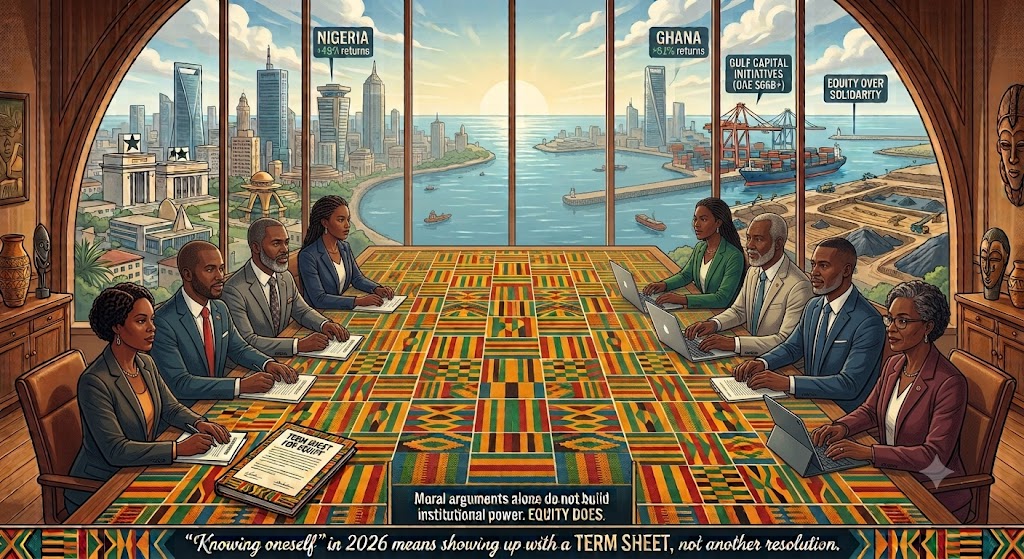
When Bloomberg Businessweek convened a roundtable of prominent Black business executives in late March 2026 to discuss the Trump administration’s sweeping rollback of diversity, equity, and inclusion initiatives, the gathering carried an unmistakable weight. The participants — Ursula Burns of Integrum, Lisa Wardell of the American Express board, Jacob Walthour Jr. of Blueprint Capital Advisors, Nicole Reboe of Rich Talent Group, and Chris Williams of Siebert Williams Shank represent some of the most accomplished figures in American corporate life. Their concerns are real. Their frustrations are earned. And they are, with the greatest respect, focused on exactly the wrong problem.

The DEI debate has consumed enormous intellectual and political energy among Black business leadership. Executives like Burns have emphasized that DEI efforts historically helped address systemic barriers rather than provide unfair advantages. This is correct as far as it goes. But defending the legitimacy of DEI however righteous the argument is fundamentally an argument about access to other people’s institutions. It is a debate about whether African American talent will be permitted to generate wealth for corporate structures that it does not own, govern, or ultimately benefit from in proportion to its contribution. Winning that argument secures a seat at a table built by someone else, financed by someone else, and passed on to someone else’s heirs.

The more consequential question, one that the DEI debate reliably obscures is this: what is the strategic value of Black business ownership as the foundation of an autonomous African American institutional ecosystem, and why has that ecosystem remained so structurally underdeveloped compared to the scale of Black talent and labor flowing through the broader American economy?

The case against centering the DEI debate as the primary lens for Black economic advancement is, at its core, an argument about capital flows. Every dollar of Black labor and talent that enters a corporation it does not own produces returns that are retained, reinvested, and compounded within that corporation’s ownership structure. The wages extracted represent a fraction of the value created. This is not a critique unique to the experience of African Americans, it is the fundamental logic of capitalism. The distinction, however, is that other ethnic and national communities have historically used their productive capacity to capitalize their own institutional ecosystems: banks, insurance companies, real estate holding entities, research universities, and media operations that recirculate wealth within the community rather than exporting it.

Between 2017 and 2022, Black-owned employer businesses grew by nearly 57 percent, adding more than 70,000 new firms, injecting $212 billion into the economy and paying over $61 billion in salaries. That is not a trivial contribution. But its structural limitations are equally stark. Black Americans make up 14 percent of the U.S. population but own only 3.3 percent of businesses. More revealing still: if Black business ownership continues to grow at its current rate of 4.72 percent annually, it will take 256 years to reach parity with the share of Black people in America, a timeline that leaves racial wealth gaps entrenched across generations. No DEI program, however well-designed or vigorously defended, addresses that structural gap. DEI operates within the existing distribution of institutional ownership. It does not alter it. A Black executive ascending to the C-suite of a Fortune 500 company is a personal achievement of consequence, but it does not transfer a dollar of equity to the African American institutional ecosystem. The corporation retains its ownership structure, its compounding endowment, and its ability to extend opportunity to subsequent generations on its own terms.

This is not an argument that employment in major corporations is without value. It is an argument about strategic priority and institutional logic. The Bloomberg roundtable reflects the perspective of individuals who have navigated the highest levels of American corporate life with exceptional skill. But the very fact that their primary public posture is a defense of DEI — a program designed to manage the terms of Black participation in institutions owned by others — illustrates how thoroughly that framework has captured the strategic imagination of Black business leadership. White workers overall still hold 71 percent of executive jobs, 61 percent of manager positions, and 54 percent of professional roles. DEI, at its most effective, redistributed a fraction of corporate leadership positions without altering the underlying structure of institutional ownership. The wealth generated by those institutions through equity appreciation, retained earnings, and compounding investment portfolios continued to flow overwhelmingly to the same ownership class it always has.

The parallel structure that could generate equivalent wealth retention within the African American community requires not better access to existing institutions but the construction and capitalization of independent ones. HBCUs represent the most significant existing node in that potential ecosystem. They are anchor institutions with land assets, research capacity, and the ability to concentrate and retain Black talent. But they remain chronically undercapitalized relative to their peer institutions, in large part because the most financially productive graduates of HBCUs and of Black communities broadly are systematically routed into corporations and financial institutions that extract rather than recirculate their productive capacity.

Black households have, on average, 77 percent less wealth than white households — roughly $958,000 less per household, representing approximately 24 cents for every dollar of white family wealth. That gap is not primarily explained by differences in income or educational attainment. It is explained by differences in asset ownership, intergenerational wealth transfer, and institutional investment. The DEI framework, even at its most ambitious, addresses income. It does not address assets. If the share of Black employer businesses reached parity with the share of the Black population, cities across the country could see as many as 757,000 new businesses, 6.3 million more jobs, and an additional $824 billion in revenue circulating in local economies. That figure represents the economic magnitude of the ownership gap and none of it is captured by diversity metrics in corporate hiring. The structural barriers to closing that gap are not primarily political. They are financial. On average, 35 percent of white business owners received all the financing they applied for, compared to 16 percent of Black business owners. Black entrepreneurs are nearly three times more likely than white entrepreneurs to have business growth and profitability negatively impacted by a lack of financial capital, and 70.6 percent rely on personal and family savings for financing which means that lower household wealth creates a compounding disadvantage that no corporate diversity initiative is designed to resolve. This is the architecture of the problem: insufficient institutional wealth produces insufficient capital formation, which constrains business ownership, which perpetuates insufficient institutional wealth. DEI does not break that cycle because it operates entirely outside of it.

The African American institutional ecosystem: HBCUs and their endowments, African American owned banks and credit unions, Black-owned insurance and real estate entities, and community development financial institutions represents the structural alternative to the DEI framework. It is not a consolation prize for those excluded from mainstream corporate life. It is the only mechanism capable of generating the compounding institutional wealth that produces genuine economic sovereignty. HBCUs enroll approximately 10 percent of Black college students while producing a disproportionate share of Black professionals in STEM, law, medicine, and business. They hold land assets in some of the most economically dynamic metros in the South. They maintain alumni networks that, if systematically directed toward institutional investment rather than individual career advancement, could generate endowment growth and enterprise development at a scale currently untapped. The strategic argument is straightforward: every Black student who graduates from an HBCU and subsequently directs their career, capital, and philanthropic energy toward institutions within the aforementioned African American ecosystem compounds the institutional wealth available to the next generation. Every Black student who takes that same talent into a corporation it does not own, however successfully, contributes to the wealth of an institution that will not reciprocate at the ecosystem level.

This is not an argument for economic separatism. It is an argument for institutional density, the same logic that has guided the development of Jewish philanthropic networks, Korean rotating credit associations, and the university endowment strategies of the Ivy League. Strong communities maintain reinforcing networks of institutions that recirculate capital and concentrate talent. The DEI framework asks Black Americans to enrich other communities’ institutional networks on the condition of fairer treatment. The ownership framework asks Black Americans to build their own.

None of this is to diminish the real harm caused by the current administration’s DEI rollbacks. Black-owned businesses that relied on federal contracting set-asides have seen immediate, concrete losses with some small business owners reporting the loss of $15,000 to $20,000 per month due to reduced contract flows. The SBA admitted only 65 companies to its 8(a) business development program in 2025, compared with more than 2,000 admissions over the previous four years. These are real economic injuries that warrant legal and political challenge. But the defensive posture of protecting DEI within institutions that Black America does not control is insufficient as a long-term economic strategy. The Bloomberg roundtable produced eloquent testimony about the frustrations of Black executives navigating a hostile political environment. It produced very little discussion of what autonomous Black institutional infrastructure should look like, or how the talent assembled in that room of capital allocators, board directors, investment bankers, and talent executives might direct its resources toward building it.

The transition from a DEI-centered to an ownership-centered strategic framework requires institutional coordination that does not yet exist at scale. It requires HBCU endowments to function as patient capital for Black enterprise ecosystems rather than passive investment portfolios. It requires Black-owned financial institutions to be capitalized and connected to the deal flow generated by Black corporate executives. It requires alumni networks to function as economic infrastructure rather than social affinity groups. And it requires Black business leadership to measure its success not by representation metrics within institutions it does not own, but by the growth of institutional assets within the ecosystem it does. The DEI debate is real and the rollback is damaging. But the strategic imagination of Black business leadership will remain constrained so long as its primary horizon is defined by the terms of inclusion offered by others. The more consequential work — slower, less visible, and politically unrewarded — is the construction of institutions powerful enough that the terms of inclusion become irrelevant. That is the work HBCUs and the broader African American institutional ecosystem exist to support. It is the work that this moment demands.

Two Pillars Fall: The Loss of Columbia Savings and Adelphi Bank and What It Means for African American Communities

We are watching the absolute collapse of African American institutions and our absolute dependency on Others’ institutions. It once felt like a slow train wreck, now it feels like a supersonic missile. – William A. Foster, IV

The 2025 African American Owned Bank Directory carries an absence that numbers alone cannot fully convey. Two institutions that appeared in last year’s listing — Columbia Savings and Loan Association of Milwaukee, Wisconsin, and Adelphi Bank of Columbus, Ohio — are no longer among the ranks of African American-owned financial institutions. Together, they represented nearly $130 million in assets: Columbia Savings at approximately $22 million and Adelphi Bank at approximately $106 million. Their departure is not merely a bookkeeping change. It is a geographic and community wound, one that leaves both Ohio and Wisconsin without a single African American-owned bank.

Founded on January 1, 1924, Columbia Savings and Loan Association was one of the oldest African American-owned financial institutions in the United States. A savings and loan chartered over a century ago in Milwaukee, it survived the Great Depression, the urban upheavals of the mid-20th century, the savings and loan crisis of the 1980s, and the 2008 financial collapse. It did not survive 2025. In our 2024 directory, Columbia carried $24,097,000 in assets, already down 12.0 percent from the prior year. By the time 2025 data was compiled, its assets had further declined to approximately $21,998,000 — a figure that, alongside declining capital levels, signaled an institution under extraordinary strain. For a savings and loan of its size, operating in a competitive market without the capital buffers available to larger institutions, the math had become unforgiving.

Milwaukee’s African American community is substantial, Black residents make up roughly 39 percent of the city’s population and yet they now have no African American-owned bank to call their own. This is not a small thing. African American-owned banks and savings institutions have historically served as anchors for communities that mainstream financial institutions have underserved or outright ignored. They have written mortgages in redlined neighborhoods, provided small business loans to entrepreneurs who couldn’t get a second meeting at a downtown bank, and offered a financial home to people who needed more than a transaction they needed trust.

If the loss of Columbia Savings is a story of a century-old institution exhausted by time and capital constraints, the loss of Adelphi Bank carries a different kind of grief. Founded on January 18, 2023, in Columbus, Ohio, Adelphi was the newest African American-owned bank in the country at the time of our 2024 directory. Prior to its founding, no new African American-owned bank had been chartered in 23 years. Adelphi’s launch was celebrated for exactly that reason: it represented a renewal, a sign that the community had not given up on building the financial infrastructure it needs.

In 2024, Adelphi reported $68,154,000 in assets, up 55.1 percent from the year prior, a remarkable growth trajectory for a de novo bank. By 2025, that figure had risen further to $106,369,000. And yet, despite that asset growth, the bank was no longer majority African American-owned by the time 2025 statistics were compiled. A growing balance sheet does not automatically translate into ownership stability. New banks are capital-intensive, and the pressures to bring in outside investors can, over time, dilute or displace founding ownership structures.

The result is that Ohio, the state that just two years ago was celebrating the founding of its first new African American-owned bank in over two decades, now has none. Columbus, the state capital and one of the fastest-growing cities in the Midwest, has no African American-owned bank. And critically, neither does the surrounding region that includes two of Ohio’s most important Historically Black Colleges and Universities: Central State University and Wilberforce University.

The relationship between African American-owned banks and HBCUs has long been identified by HBCU Money as one of the most underdeveloped partnerships in the Black economic ecosystem. HBCUs are intellectual and economic anchors for their communities. African American-owned banks are the financial connective tissue that can translate education, entrepreneurship, and homeownership aspirations into capital. When both are present in a region, the possibilities compound. When one disappears, the other is diminished.

Central State University and Wilberforce University sit in Greene and Xenia, Ohio, both within the orbit of Columbus and Dayton. Their students, faculty, staff, and alumni represent tens of thousands of people who need mortgages, small business loans, car notes, savings accounts, and lines of credit. Without an African American-owned bank anywhere in Ohio, those needs will be met if they are met at all by institutions with no particular relationship to their communities, no cultural competency born of shared experience, and no structural incentive to reinvest in the neighborhoods and towns these HBCUs serve. And if they are met, the profits and institutional ownership and influence will be to the benefit of Others and not the African American ecosystem. Once again, we will be subsidizing everyone else.

This is not a hypothetical harm. Research has consistently shown that African American-owned banks direct a greater share of their lending to African American borrowers and African American-owned businesses than Others’ institutions. They are not perfect, and they are not substitutes for broader policy change. But they are irreplaceable in the role they play, and their absence is felt in the very specific, very practical ways that matter most: a loan denied, a mortgage not written, a business that never got started.

The 2025 directory does carry one encouraging entry: Redemption Bank of Salt Lake City, Utah, founded February 20, 1974, and now appearing in the African American-owned bank listing with approximately $72,205,000 in assets under the FDIC’s San Francisco region. Its inclusion partially offsets the $128 million in assets lost with Columbia and Adelphi. Redemption Bank’s presence in Utah is notable given the state’s relatively small African American population and its distance from the major African American economic corridors. Its listing is a reminder that African American financial institution-building can and does happen in unexpected places.

But Redemption Bank’s $72 million in assets does not replace what was lost in Ohio and Wisconsin. It does not fill the geographic gap. It does not serve the students at Central State or Wilberforce, or the African American residents of Milwaukee’s north side. The net loss to African American institutional financial capacity in the Midwest is real, and no amount of welcome news from the Mountain West changes the map that communities in Columbus and Milwaukee are now looking at.

As noted in our 2024 directory, African American-owned banks hold approximately $6.4 billion of America’s $23.6 trillion in bank assets — roughly 0.027 percent. The apex of African American-owned bank assets, as a share of total U.S. banking, was 1926, when the sector held 0.2 percent — ten times today’s proportion. Nearly a century later, the sector has not recovered.

The structural disadvantages are well-documented: chronic undercapitalization, concentration in communities with lower median wealth, limited access to the interbank credit markets that larger institutions tap freely, and a customer base that has been systematically excluded from wealth-building for generations. These are not problems that individual bank managers can solve through hustle and grit alone. They require deliberate policy support, sustained community deposits, and coordinated investment from the HBCU ecosystem, African American businesses, and public-sector partners.

The post-2020 wave of corporate pledges to African American financial institutions provided some relief. Many of the banks in our directory saw asset growth between 2023 and 2024 partly as a result of those deposits. But corporate commitments are not permanent, and the institutions that did not receive them or that received too little too late remained exposed. Columbia Savings, with $24 million in assets and a 12 percent annual decline already in evidence by 2024, was unlikely to attract the kind of large-scale corporate or philanthropic deposit that might have stabilized it.

The loss of Columbia Savings and Adelphi Bank should be understood as a call to action, not an occasion for eulogy alone. Several things must happen.

First, the HBCU community in Ohio must begin conversations now about what it would take to support a new African American-owned financial institution in the state. Central State and Wilberforce cannot simply wait for the private sector to solve this. HBCU endowments, alumni associations, and institutional deposits are tools of economic development. Directing even a fraction of those resources toward a future Ohio-based African American-owned bank would be a meaningful first step.

Second, community organizations, African American business associations, and civic leaders in Milwaukee must assess whether a new chartered institution, a credit union, or a community development financial institution (CDFI) can fill some of the void left by Columbia Savings’ departure. Milwaukee’s African American community is large enough and its economic needs acute enough that the absence of a community-controlled financial institution is not sustainable.

Third, the national conversation about African American-owned banks must move from celebration to infrastructure. Every time a new institution is chartered, and Adelphi’s founding in 2023 was genuinely exciting, it must be supported with the capitalization, deposit commitments, and technical assistance that give it a fighting chance past its first few years. A bank that grows in assets but loses its founding ownership structure has not fulfilled its promise. The community has to be in the room, and at the table, not just at the ribbon-cutting.

Finally, we should note what these two losses mean for the map of African American financial geography. States absent from our 2025 directory now include Ohio, Wisconsin, Maryland, Missouri, New York, and Virginia — a list that encompasses some of the largest African American urban populations in the country. That map is a challenge and an indictment in equal measure. African Americans live and work and build in every corner of this country. Their financial institutions should too.

Columbia Savings and Loan Association (Milwaukee, WI) — Founded January 1, 1924 | 2024 Assets: $24,097,000 | 2025 Assets: $21,998,000

Adelphi Bank (Columbus, OH) — Founded January 18, 2023 | 2024 Assets: $68,154,000 | 2025 Assets: $106,369,000

Redemption Bank (Salt Lake City, UT) — Founded February 20, 1974 | 2025 Assets: $72,205,000 [New to directory]

Disclaimer: This article was assisted by Claude (Anthropic).

Mapping the Gap: The Geography of African American Banks and Credit Unions in 2025

African Americans navigating their financial lives are operating inside two fundamentally different types of institutions, and understanding that difference is not academic it is strategic. JPMorgan Chase, the largest bank in the United States with over $3.9 trillion in assets, is a publicly traded corporation owned by shareholders. Its mandate is profit. It can accept corporate deposits, underwrite municipal bonds, finance international trade, issue letters of credit that move goods across oceans, syndicate billion-dollar loans, and operate in 100 countries. When a city government needs to finance a new highway, when a developer needs to close on a $200 million mixed-use project, when a corporation needs to hedge currency risk across three continents — JPMorgan is in that room. Navy Federal Credit Union, the largest credit union in the United States with approximately $180 billion in assets, is a member-owned cooperative. Its mandate is service to its members, who must meet eligibility requirements tied to military affiliation. It offers mortgages, car loans, checking accounts, and credit cards often at better rates and lower fees than JPMorgan but it cannot write a commercial real estate construction loan for a developer, cannot underwrite a municipal bond for a city, cannot finance an export contract for a manufacturer shipping goods to West Africa, and has no presence in international capital markets. Navy Federal is a powerful institution for what it does. It simply does not do what JPMorgan does, and JPMorgan does not do what Navy Federal does at the community level. For African Americans, this distinction carries enormous consequence. A community with only credit unions has access to consumer financial products; mortgages, auto loans, personal savings but lacks the commercial banking infrastructure needed to finance business growth, real estate development, institutional deposits, and economic expansion. A community with only banks, and specifically only large national banks with no cultural accountability, has access to products but not necessarily to equitable underwriting, community reinvestment, or the trust that comes from shared ownership. The absence of an African American-owned bank in Ohio or Wisconsin is not just symbolic. It means no institution with a community mandate is positioned to finance the next African American developer, fund the next HBCU-adjacent business corridor, or serve as a depository for the growing institutional wealth of Black organizations in those states.

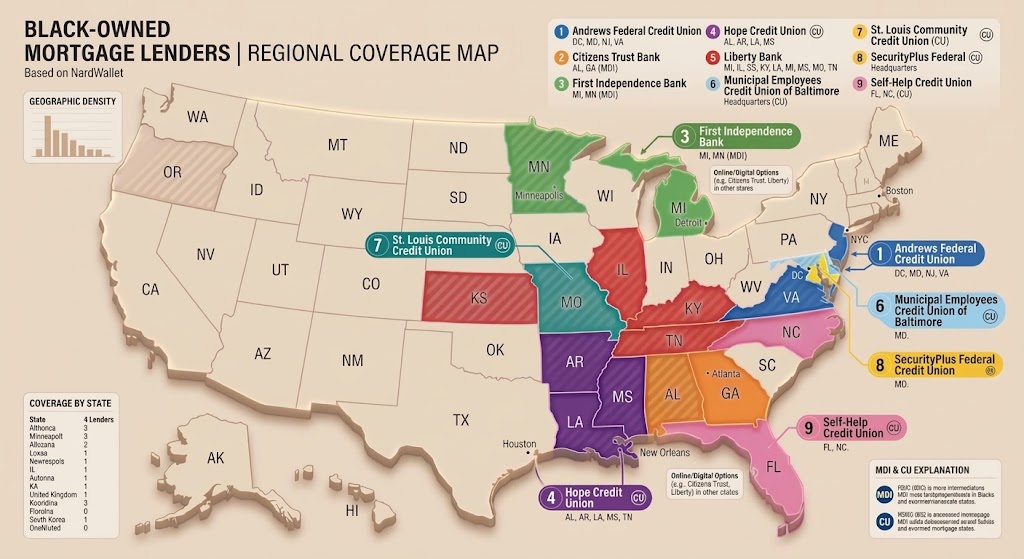
When the geography of African American banks and credit unions is examined together, a more complete — though still incomplete — picture of Black financial infrastructure emerges across the United States. The 2025 African American Owned Bank Directory covers 17 institutions across 15 states and territories. The 2025 NCUA data on African American credit unions adds 205 institutions across 29 states and territories, carrying $8.15 billion in assets and serving approximately 727,000 members. Combined, the two sectors represent over 220 institutions and more than $14.8 billion in assets operating across 31 states and territories. But geography, not just totals, is where the real story lives.

Thirteen states have both an African American-owned bank and at least one African American credit union: Alabama, the District of Columbia, Georgia, Illinois, Louisiana, Michigan, Mississippi, North Carolina, Oklahoma, Pennsylvania, South Carolina, Tennessee, and Texas. These are the states with the fullest financial ecosystem — where a community member can choose between a bank product and a credit union product from an institution with cultural roots in their community. Louisiana stands out, with one bank and 25 credit unions, the most of any state in the credit union count. Illinois follows with one bank and 23 credit unions.

Two states have African American banks but no African American credit unions in the NCUA data: Massachusetts, home to OneUnited Bank, and Utah, newly represented by Redemption Bank. These institutions serve their communities without the complementary infrastructure of a credit union network. Conversely, 16 states and territories have African American credit unions but no African American-owned bank: Arkansas, California, Connecticut, Delaware, Florida, Indiana, Maryland, Minnesota, Missouri, New Jersey, New York, Ohio, Virginia, the U.S. Virgin Islands, West Virginia, and Wisconsin.

The cases of Ohio and Wisconsin, discussed at length in the bank directory analysis, illustrate the limits of credit union coverage as a substitute for bank presence. Ohio has four African American credit unions with combined assets of approximately $18.3 million: Mahoning Valley in Youngstown, Mt. Zion Woodlawn in Cincinnati, Cleveland Church of Christ in Cleveland, and Toledo Urban in Toledo. Of these, Toledo Urban is the only institution of meaningful scale at $17.2 million in assets with 4,324 members. The other three are micro-institutions, each under $600,000 in assets and under 400 members. Wisconsin’s single credit union, Holy Redeemer Community of SE Wisconsin based in Milwaukee, holds just $764,689 in assets and serves 239 members. For a city where African Americans comprise roughly 39 percent of the population, that represents an institutional void that one small credit union cannot fill. Neither Ohio nor Wisconsin has an African American financial institution capable of writing a commercial real estate loan, funding a startup, or underwriting a mortgage for a first-generation homebuyer at any meaningful scale.

African American Financial Institutions by State, 2025

StateAfrican American BanksAfrican American Credit UnionsCombined Institutions
Alabama21214
Arkansas033
California011
Connecticut033
Delaware011
District of Columbia11011
Florida033
Georgia2911
Illinois12324
Indiana055
Louisiana12526
Maryland077
Massachusetts101
Michigan145
Minnesota022
Mississippi11112
Missouri044
New Jersey099
New York01515
North Carolina123
Ohio044
Oklahoma112
Pennsylvania189
South Carolina156
Tennessee156
Texas11415
Utah101
U.S. Virgin Islands044
Virginia01313
West Virginia011
Wisconsin011

Maryland presents a striking and instructive contrast. It has no African American-owned bank, a gap noted in the 2025 directory, yet it is the single largest state for African American credit union assets, hosting seven institutions with a combined $4.47 billion in assets. That figure is driven primarily by two institutions: Andrews Federal Credit Union in Suitland with $2.47 billion in assets and 142,076 members, and Municipal Employees Credit Union of Baltimore with $1.26 billion in assets and 98,358 members. Maryland’s credit union sector is, in asset terms, larger than the entire African American bank sector nationally. This is remarkable. It is also a reminder that credit unions and banks occupy different structural roles. Andrews Federal and MECU of Baltimore are large, sophisticated institutions with product offerings that approach commercial banking but they are member cooperatives, not banks, and their ownership structure, regulatory environment, and community lending mandates differ accordingly. Maryland’s absence from the bank directory is still a gap worth addressing, even with $4.47 billion in credit union assets in the state.

Virginia and Missouri follow a similar pattern to Maryland, albeit at smaller scale. Virginia has 13 African American credit unions with $471 million in assets but no African American-owned bank. Missouri has four credit unions with $481 million in assets, anchored by St. Louis Community Credit Union at $431.5 million, and also no bank. New York has 15 credit unions with $76 million in assets and no African American bank, a particularly stark figure given the size of New York’s African American population and its status as the financial capital of the country.

The states that are entirely absent from both the bank and credit union directories deserve attention. While the combined coverage of 31 states and territories is broader than either sector alone, large portions of the country remain without any African American-owned financial institution. States like Nevada, Arizona, Colorado, Washington, Oregon, and much of the Mountain West and Pacific Northwest have no representation in either directory. As African Americans continue to migrate to new metros — Las Vegas, Phoenix, Denver, Seattle — the absence of community-controlled financial institutions in those corridors becomes a growing concern.

The combined picture is this: African American banks and credit unions together hold approximately $14.8 billion in assets, serve over 700,000 credit union members and the deposit base of 17 banks, and operate across 31 states and territories. The credit union sector, at $8.15 billion in assets across 205 institutions, is actually slightly larger than the bank sector’s $6.72 billion across 17 institutions, a reflection of the credit union model’s greater accessibility and the longer runway some of these institutions have had to grow. But the two sectors are not interchangeable. Banks can hold commercial deposits, write business loans, issue letters of credit, and serve as the financial backbone of an entrepreneurial ecosystem in ways that most credit unions cannot. Credit unions, in turn, offer member ownership, lower fees, and community accountability that publicly or privately held banks may not. The African American community needs both, in every state where its population is substantial. Right now, it has neither in too many places that matter.

Sources: HBCU Money 2025 African American Owned Bank Directory; 2025 NCUA African American Credit Union Institutions data. Asset figures in U.S. dollars.

Disclaimer: This article was assisted by Claude (Anthropic).