Tag Archives: black wealth building

African American Tuition Valued At $64 Billion; But HBCUs Receive Less Than $6 Billion Annually

HBCUs are more than just schools, they are a home. – Chadwick Boseman

The paradox is impossible to ignore: African American communities consistently champion the importance of buying Black and supporting Black-owned businesses, yet when it comes to what may be the largest purchase of a lifetime, a college education, the overwhelming majority of Black families choose to invest those dollars elsewhere. This decision has profound consequences for the survival and strength of Historically Black Colleges and Universities, institutions that remain pillars of Black achievement, economic mobility, and community power.

As of Spring 2025, approximately 19.4 million students are enrolled in U.S. colleges and universities, with about 15 million undergraduates and over 3 million graduate students, according to data from the National Student Clearinghouse Research Center reported by NPR and BestColleges. This enrollment represents a recovery from pandemic-era declines, though numbers remain below 2010 peaks. African American students comprise roughly 13-15% of this total enrollment, representing approximately 2.5 to 2.9 million students across all institution types. When we calculate the economic value of these students based on current tuition rates, the numbers are staggering.

For the 2024-2025 academic year, public four-year institutions charge approximately $11,950 for in-state students and $31,880 for out-of-state students. Private nonprofit four-year schools average around $45,000 in tuition and fees. Public two-year colleges, which experienced a 3% enrollment increase in Fall 2024 according to USA Today reports, charge an average of $4,150 for in-district students. When you factor in room and board expenses, which averaged $13,310 for 2024-2025, the total cost of attendance reaches approximately $27,146 at public four-year institutions and $58,628 at private nonprofit four-year schools. Using a weighted average cost of attendance of approximately $26,000-$28,000 per year across all institution types, African American students and their families collectively spend approximately $64 billion annually on higher education. This represents enormous purchasing power—power that could transform Black institutions and communities if redirected strategically.

Here’s the uncomfortable truth: of that $64 billion, African American students at HBCUs represent only about $6 billion in tuition revenue and that $6 billion is essentially all HBCUs have to work with. Unlike predominantly white institutions with massive endowments, substantial state funding, and robust donor bases, HBCUs are almost entirely tuition-dependent. This means that more than 90% of African American education dollars approximately $58 billion annually flow to institutions that were not built for us, by us, or with our advancement as their primary mission.

We talk extensively about supporting Black businesses, banking Black, and keeping dollars circulating in our communities. Yet when families sit down to make college decisions, often the single largest financial investment they will make outside of purchasing a home, the conversation shifts. Suddenly, the narrative becomes about rankings, prestige, resources, and opportunities at predominantly white institutions, while HBCUs are considered as backup options or dismissed entirely.

This pattern has devastating consequences. The approximately 222,300 African American students currently enrolled at HBCUs generate roughly $6 billion in tuition revenue and for most HBCUs, that tuition revenue represents the vast majority of their operating budgets. Unlike well-endowed predominantly white institutions that rely heavily on endowment returns, substantial state appropriations, federal research grants, and robust alumni giving, HBCUs are critically dependent on tuition dollars just to keep their doors open. When Black students choose to take their tuition dollars elsewhere, it directly threatens these institutions’ survival, limiting their ability to maintain programs, hire faculty, upgrade facilities, and provide student services.

The impact extends far beyond immediate operating budgets. Every student who chooses a predominantly white institution over an HBCU represents not just lost tuition revenue today, but lost philanthropic potential tomorrow. Alumni giving is the lifeblood of institutional endowments, and alumni tend to give most generously to the institutions they attended. When successful Black professionals graduate from predominantly white institutions, their alumni donations when they give at all flow back to those schools. Harvard, Yale, Stanford, and other elite institutions benefit from the success of Black graduates who might have attended HBCUs if those institutions had received even a fraction of the resources concentrated at the top of higher education’s hierarchy. Meanwhile, HBCU endowments remain comparatively microscopic, not because their graduates are less successful, but because there are fewer of them writing checks back to their alma maters.

This creates a vicious cycle. Smaller enrollment means less tuition revenue and for institutions operating almost entirely on tuition, this is an existential threat. Fewer graduates means smaller donor pools. Smaller donor pools mean smaller endowments. Smaller endowments mean even greater dependence on tuition revenue and less money for scholarships, facilities, and programs. Less competitive resources make it harder to attract students. And the cycle continues, generation after generation.

The wealth gap between HBCU endowments and those of predominantly white institutions is staggering and growing. Howard University recently became the first HBCU to cross the $1 billion endowment mark, a milestone that should be celebrated but instead highlights the crisis. The top 10 HBCU endowments combined total approximately $2.6 billion. Meanwhile, Harvard University’s endowment alone exceeds $50 billion, and the top 10 predominantly white institutions hold a combined $336 billion in endowments. The PWI-to-HBCU endowment gap stands at 129 to 1. Only one HBCU has an endowment over $1 billion, while 148 predominantly white institutions have endowments exceeding that mark. This disparity means that while HBCUs scrape by on tuition revenue with minimal endowment support, elite PWIs can offer generous financial aid packages funded by massive investment returns, making them appear more affordable even as they siphon Black student dollars away from Black institutions.

In barbershops and beauty salons, at family gatherings and community events, the conversation about economic empowerment is constant. We discuss the importance of circulation of Black dollars, the need to build generational wealth, and the imperative of supporting institutions that support us. Social media amplifies calls to buy Black, support Black-owned restaurants, use Black banks, and patronize Black professionals. Yet somehow, this collective consciousness evaporates when it’s time to choose a college. Parents who wouldn’t think twice about driving across town to support a Black-owned business will encourage their children to attend predominantly white institutions without seriously considering HBCU alternatives. Students who wear “support Black business” t-shirts apply exclusively to schools where they will be a small minority, where their history may be marginalized, and where their dollars will fund institutions with no historical commitment to Black advancement.

This isn’t about judgment these are rational decisions made by families trying to secure the best possible future for their children in a competitive world. The problem is that these individual rational choices, when aggregated, produce a collective outcome that weakens the very institutions most committed to Black success.

Consider what HBCUs accomplish with their fraction of African American education dollars. These institutions enroll approximately 10% of all African American college students but produce nearly 20% of Black graduates. They generate an even higher percentage of Black professionals in critical fields like engineering, medicine, and education. The majority of Black doctors, a disproportionate share of Black lawyers, and a significant portion of Black educators earned their degrees from HBCUs. HBCUs create environments where Black students see themselves in positions of leadership, where their history and culture are centered rather than marginalized, and where they build networks that last lifetimes. Research consistently shows that Black students at HBCUs report higher levels of engagement, stronger sense of belonging, and greater confidence in their abilities compared to Black students at predominantly white institutions.

They accomplish all of this while operating on budgets that would be considered inadequate at any predominantly white institution. They make miracles happen with limited resources, outdated facilities, and faculty salaries that make it difficult to compete for top talent. Imagine what they could do with just a fraction of that $64 billion currently flowing elsewhere.

The numbers tell a stark story. Approximately 292,500 students currently attend HBCUs, with African American students comprising about 76% of that enrollment roughly 222,300 Black students. At an average cost of attendance of $26,000-$28,000 annually, these students represent approximately $6 billion in tuition revenue flowing to HBCUs each year. Meanwhile, the remaining 2.3 to 2.7 million African American college students roughly 90% of all Black college students generate approximately $58 billion in tuition revenue for predominantly white institutions.

Think about that ratio: $6 billion staying in Black institutions versus $58 billion leaving them. This isn’t about equity or fairness this is about economic power and where we choose to deploy it. Every semester, Black families collectively make purchasing decisions that send nearly ten times more money to institutions with no historical commitment to Black advancement than to institutions that were literally built to educate us when no one else would.

The enrollment landscape is shifting. Spring 2025’s 19.4 million total enrollment shows growth in both undergraduate and graduate programs. Particularly significant is the 3% surge in community college enrollment in Fall 2024, suggesting that cost considerations are increasingly driving educational decisions. This cost consciousness presents an opportunity. As families become more aware of student debt burdens and question the return on investment of expensive predominantly white institutions, HBCUs offer compelling value propositions. But they can only compete if they have the resources to tell their stories effectively, maintain quality programs, and provide the support services today’s students expect.

The net price reality adds another dimension. While published tuition rates provide a baseline, actual costs after financial aid vary significantly, typically ranging from $17,000 to $25,000 depending on institution type. However, African American students often face higher net prices than their peers at the same institutions due to lower family wealth and less access to non-loan aid. This means Black families are stretching further financially, taking on more debt, and working more hours often to attend institutions with no particular commitment to Black student success.

The solution requires a fundamental shift in how we think about educational choices. White families don’t agonize over whether to “give HBCUs a chance” they automatically prioritize their own institutions. They attend state flagships, legacy schools where their parents and grandparents went, institutions that have accumulated centuries of wealth from their community’s investment. They don’t need to be convinced to support their own. Yet somehow, Black families have internalized a narrative that HBCUs are noble but limited, worth considering but not prioritizing, respectable but not prestigious. This is the mental colonization that costs us $58 billion annually.

We need to be as intentional about our education spending as we claim to be about supporting Black businesses. This means making HBCUs the default choice, not the backup plan. It means understanding that when white families send their children to their flagship state universities and legacy institutions, they’re not making a sacrifice they’re making an investment in institutional power that compounds over generations. Black families deserve the same mindset. The choice of where to spend education dollars is an economic decision with ramifications far beyond individual degree attainment. It’s about building institutional power that can withstand political and social headwinds.

Institutional strength matters. Strong HBCUs create jobs in Black communities, anchor local economies, generate Black wealth through employment and contracts, and serve as catalysts for community development. They provide platforms for Black intellectual leadership, preserve and advance Black culture, and create networks of mutual support that span generations and geographies. In an increasingly uncertain social and political environment, the importance of strong Black institutions becomes even more apparent. When external support proves unreliable, when political winds shift, when social progress reverses, communities need institutions they control and can depend on. HBCUs represent exactly that kind of institutional foundation.

The question isn’t whether HBCUs deserve support their track record speaks for itself. The question is whether African American families will align their spending decisions with their stated values around Black economic empowerment. That $64 billion represents power—power to build, strengthen, and sustain institutions that have proven their commitment to Black success. How we choose to deploy that power will determine whether HBCUs merely survive or truly thrive in the generations ahead.

The choice is ours. The power has always been ours. The question is whether we’ll use it.

Disclaimer: This article was assisted by ClaudeAI.

That Kind of Man Is Never Poor: Why Educated, Enterprising, and Ambitious Black Love Demands Mutual Support

Being deeply loved by someone gives you strength, while loving someone deeply gives you courage. — Lao Tzu

When A Different World aired that exchange in the late 1980s, it landed at the intersection of two of Black America’s oldest and most contested conversations: what we owe each other in love, and what it means to build a life of purpose and prosperity together. Whitley wasn’t asking for a rich man. She was describing an orientation toward life — educated, enterprising, and ambitious — and asserting that a person who lives that way will never be poor in the ways that truly count. But there was always a condition embedded in that vision, one the show understood even if it didn’t always name it explicitly: that kind of life requires a partner who isn’t just admiring from the sidelines. It requires someone who is building alongside you, pushing when the vision dims, holding when the weight becomes too much, and trusting even when the outcome isn’t yet visible. The kind of Black love that produces educated, enterprising, and ambitious people is not passive. It is active, intentional, and deeply communal.

Educated. Enterprising. Ambitious. These words sit comfortably on a vision board. They sound aspirational. But strip away the aesthetics and examine what each one actually demands of a Black person navigating this country, and you quickly understand why none of them can be carried alone. To be educated in Black America is not simply to hold a degree. It is to have committed to a process of self-understanding and world-understanding that this society has never made free or easy. For the hundreds of thousands who chose an HBCU, it was a decision to be educated and loved at the same time — to develop intellectual rigor inside institutions that did not require them to leave their Blackness at the door. That experience shapes how you move through the world, how you build, and critically, what you need from a partner. You need someone who values what you carry from that formation, who sees your education not as a credential but as a worldview that deserves to be exercised. A partner who belittles your ambitions, dismisses your networks, or resents your growth is not a partner in any real sense. They are a ceiling. To be enterprising is to see possibilities where systems have deliberately created barriers. Black entrepreneurship in this country has always been an act of defiance and an act of community building simultaneously. But enterprising requires risk. It requires long stretches of uncertainty, of not knowing if the next quarter will hold. A partner who cannot sit in that uncertainty with you, who confuses instability with failure, who demands the comfort of a steady paycheck over the potential of a built thing — that partnership will eventually become a negotiation between your dreams and their fears. And in that negotiation, someone always loses. To be ambitious is to insist that your potential has no ceiling. In Black America, that insistence is both a personal conviction and a political act. Ambition burns a tremendous amount of fuel. It consumes time, emotional bandwidth, and sometimes the very relationships that were supposed to sustain it. A partner who cannot celebrate your wins because your wins somehow diminish them, who needs you to stay small so they feel safe, is not a companion in ambition. They are its opposite. This is why Whitley’s answer to Dwayne was so quietly radical. She was not describing a checklist. She was describing a compatibility of spirit — the recognition that two people with aligned orientations toward growth could build something neither could build alone.

It is easy to focus on Whitley in this conversation because her words were so precise. But Dwayne’s question deserves equal examination. He did not ask what Whitley wanted in a husband — as if cataloguing features — but what kind of husband she wanted. He was asking about character, about essence. Dwayne Wayne was himself educated, enterprising, and ambitious. A genius-level engineering student at Hillman, a man who went on to a career that took him literally around the world. But what made him a worthy partner for Whitley, and what made their fictional union one of the most enduring love stories in Black popular culture, was not just his individual achievement. It was what he did with his love. He showed up. He advocated. He flew to her wedding to another man and interrupted it because he knew — and she knew — that their partnership was bigger than the fear that had kept them apart. That is what mutual support looks like in its most dramatic form. But most of us will not have our moment at an altar with a ballroom watching. Most of us will have the quieter, harder moments: the conversation at 11pm when one partner has been passed over again at work and needs to hear that their worth is not determined by that institution’s blindness. The weekend when one partner is grinding on a business plan and the other has to carry the household without resentment. The year when one partner’s career accelerates and the other has to find their own footing without collapsing into competition. Those moments are where Black love either becomes what it was always capable of being — or where it begins to quietly erode.

There is a damaging script in some corners of our community that frames one partner’s support for the other as sacrifice — as if partnership is a zero-sum arrangement where one person’s advancement necessarily comes at the other’s expense. This script has done enormous harm. It has produced couples who keep score rather than build, who compete where they should collaborate, and who eventually sit across from each other with years of resentment between them. The couples and partnerships that thrive understand something different. They understand that support is strategy. When you invest in your partner’s growth, you are not losing; you are expanding the resources available to your shared life. When a husband supports his wife’s MBA program by increasing his domestic load for two years, he is not diminished. He is invested. When a wife believes in her husband’s business concept before the market does and holds the household steady while he builds, she is not sacrificing her own ambition. She is deploying it strategically, because she understands that what they are building together is bigger than what either could build alone. This is the economic logic of Black love, and it is powerful. The HBCU power couples who go on to build medical practices, investment funds, cultural institutions, and businesses that employ other Black people do not build those things in spite of their partnerships. They build them through their partnerships. The art empire, the medical group, the legal practice — these are not solo achievements. They are the products of two people who chose, over and over again, to take the other’s dreams seriously.

And here is where that vision expands into something even larger — because educated, enterprising, and ambitious Black love is never just about two people. It has always carried a community inside it, and when it is at its most powerful, it carries an entire Diaspora. When two HBCU graduates build a life together, they bring their networks, their institutions, their mentors, and their commitments with them. The Hillman alumni network that became the seed capital for a Pan-African art fund was not a business transaction. It was the activation of bonds formed through years of shared education and shared love for an institution. Those investors did not write checks because of a pitch deck. They wrote checks because they trusted each other, because Hillman had taught them to see their prosperity as connected. That is the genius embedded in the HBCU tradition — it does not just educate individuals, it builds the relational infrastructure through which communities can act collectively. And it is Black love, in both the romantic and communal sense, that activates that infrastructure over and over again across generations.

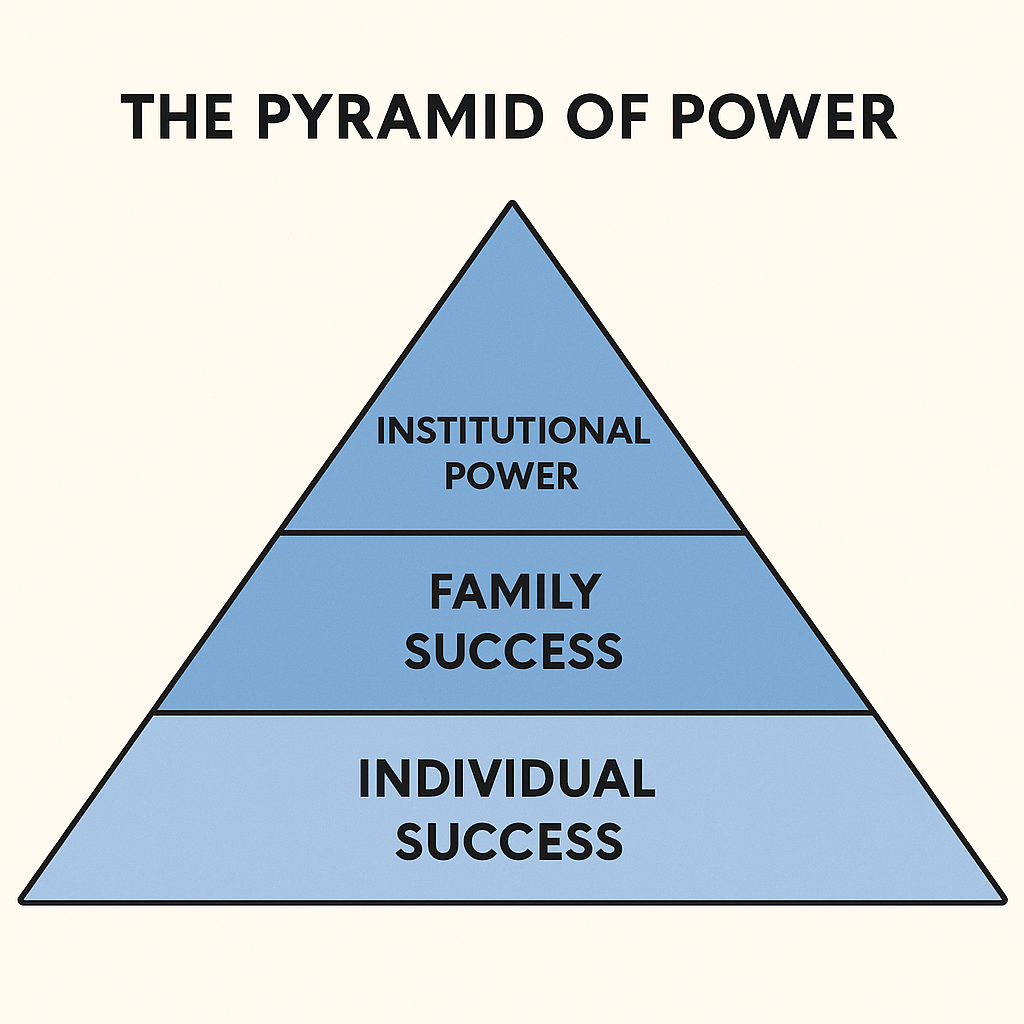
But the full scope of what that love can build becomes visible only when we follow it to its institutional conclusion. Individual success, however impressive, is ultimately fragile. Wealth concentrated in one person can be lost in a generation. Knowledge that lives in one mind leaves when that person does. Influence that depends on a single relationship dissolves when that relationship ends. What endures is what gets built into institutions — into ownership structures, endowments, programs, and organizations that outlast any individual and continue to serve the community long after the founders are gone. This is why the most consequential dimension of educated, enterprising, and ambitious Black love is not what it produces in a household. It is what it deposits into institutions. The Black couple that builds a business strong enough to employ a hundred people and endow a scholarship fund is not just building a legacy for their children. They are building infrastructure for a community. The pair that pours their professional expertise back into an HBCU — consulting, donating, recruiting, advocating — is strengthening an institution that will educate and love thousands of Black students for decades to come. The partnership that structures its wealth to include collective vehicles — investment funds, foundations, land trusts, community development corporations — is doing something that individual accumulation, no matter how impressive, simply cannot do. It is converting personal achievement into communal capacity.

The Diaspora dimension of this is not incidental. It is essential. Black America has never existed in isolation from the broader African Diaspora, and the most visionary HBCU partnerships have always understood this. When Whitley Gilbert-Wayne stood in a Tokyo gallery and asked why African Americans were not building art collections anchored in the work of artists from across the Diaspora — from Salvador to Senegal, from Detroit to Durban — she was asking a fundamentally institutional question. Not just who collects this art, but who owns the infrastructure through which it is valued, appraised, traded, and preserved. Not just who appreciates Black beauty, but who controls the institutions that define and protect it. The Pan-African Art Appraisal program she helped establish between an HBCU and the University of Namibia was not a cultural gesture. It was an institutional act — the creation of a pipeline that would train a new generation of appraisers with both the technical competence and the cultural fluency to set the value of Diaspora art on terms that served the Diaspora. That is institutional ownership. That is what educated, enterprising, and ambitious Black love looks like when it reaches its full expression. And it could not have been built by either Whitley or Dwayne alone. It required the engineering career that took them to Tokyo. It required the art history formation that gave Whitley the language to see what she was seeing. It required the Hillman network that provided the initial capital and the Hillman-forged trust that made that capital available. It required, underneath all of it, a partnership that held steady across continents and career pivots and the slow, difficult work of building something that had never existed before.

What Dwayne and Whitley modeled — in fiction, and what so many HBCU couples have modeled in fact — is that Black love at its most generative is not primarily a private arrangement. It is a public act. Every time a Black couple directs their business patronage to Black-owned firms, they are building Black enterprise. Every time they mentor a younger HBCU graduate, they are extending the network that made their own success possible. Every time they sit on a board, anchor a fund, or pressure an institution to collect and commission work by Diaspora artists, they are expanding the definition of who gets to own and control cultural and financial infrastructure. Every time they build a business with an exit strategy that includes employee ownership or community benefit, they are ensuring that the wealth they created does not simply exit the community when they do. This is not idealism. This is what institutional ownership actually looks like in practice, and it is built one educated, enterprising, ambitious Black partnership at a time.

This is what A Different World was always pointing toward, even in its lightest moments. The romance between Dwayne and Whitley existed inside a world populated by people who pushed each other, competed with each other, loved each other, and collectively embodied the argument that Black excellence is not a solitary achievement. It is produced in community, sustained in community, and ultimately returned to community — and to a Diaspora that has always been waiting for us to bring our full selves, and our full institutional capacity, home.

If you are educated, enterprising, and ambitious — or trying to become those things — you are carrying a vision that is bigger than your own comfort. You are carrying, whether you have named it this way or not, an argument about what Black people are capable of when given the space, the resources, and the love to fully become. That vision requires a partner who takes it seriously. Not someone who merely tolerates your ambition, but someone who sees it as part of what they fell in love with. Not someone who supports you when it is convenient, but someone who holds the ground when the terrain gets difficult. Not someone who loves you in spite of your drive, but someone whose own drive calls yours forward. And if you are that partner for someone else, understand the magnitude of what you are doing. The quiet support, the unanticipated covering, the refusal to compete where you should collaborate — these are not small acts. They are the infrastructure on which entire legacies, and entire institutions, are built. The spouse who holds the household while the other writes the dissertation. The partner who talks you back from quitting. The friend-turned-love who looks at your half-formed idea and says, without hesitation, “I see it. Let’s build it.” These acts do not always make headlines. But they make everything else possible — the businesses, the collections, the endowments, the programs, the institutions that will carry Black and Diaspora communities forward long after any of us are here to see it.

Whitley Gilbert was not describing a fantasy when she told Dwayne what she wanted. She was describing a reality she was already willing to be part of — a partnership defined not by the presence of wealth but by the presence of character. Educated. Enterprising. Ambitious. And underneath all of it, the kind of love that builds, holds, risks, believes, and ultimately deposits something permanent into the world. That kind of love is never poor. And the institutions it builds are the inheritance of a Diaspora that was always worth the investment.


HBCU Money covers economic, finance, and investment news from an HBCU perspective. Follow us at hbcumoney.com.

Disclaimer: This article was assisted by ClaudeAI.
From Hillman to the World: How Whitley Gilbert-Wayne Built a Pan-African Art Empire

You can go to school anyplace, but no school will love you, and teach you to love yourself and know yourself like Hillman. – Whitley Gilbert

When Whitley Gilbert-Wayne stepped off the plane in Tokyo alongside her husband Dwayne in the mid-1990s, she had no idea that a chance encounter at a contemporary art exhibition would transform her from a newlywed supporting her engineer husband’s career into one of the most influential voices in Pan-African art acquisition and investment. The former Hillman College art history major known during her undergraduate years for her impeccable style and occasional elitism had matured into a woman with vision that extended far beyond Virginia’s borders. What began as casual gallery visits in Tokyo’s vibrant Roppongi district evolved into a business idea that would eventually connect HBCU endowments, Black corporate America, and emerging artists across the African diaspora.

“I was standing in front of a piece by a Nigerian artist at this small gallery in Harajuku,” Whitley recalls of the moment that changed everything. “The gallery owner mentioned that wealthy Japanese collectors were increasingly investing in African contemporary art, and I realized if they see the value, why aren’t we, as African Americans, building these collections ourselves?” That revelation led Whitley to spend her remaining months in Japan studying the mechanics of art acquisition, investment, and appraisal. She networked with gallery owners, attended auctions, and built relationships with African artists who were making waves in Asia’s art markets. By the time she and Dwayne returned to the United States, she had a business plan, a network of artist contacts spanning three continents, and an unshakeable conviction that Black institutions and families deserved access to culturally relevant art investment opportunities.

Whitley’s first pitch wasn’t to venture capitalists or traditional investors, it was to her Hillman College alumni network. She reached out to former classmates who had established themselves in various industries: Dr. Kimberly Reese and Ron Johnson, the power couple behind the thriving Reese and Johnson Medical Group, Freddie Brooks in entertainment law, and even her college frenemy, Julian Pace, who had made his fortune in tech. “Whitley understood something fundamental,” says Ron Johnson, one of the fund’s founding investors. “She knew that we trusted each other because of our Hillman connection. She wasn’t asking us to just invest in art, she was asking us to invest in our cultural legacy.”

Dr. Kimberly Reese adds, “Ron and I had just completed our first major expansion of the medical group. We were looking for investment opportunities that aligned with our values. When Whitley presented her vision, it was clear this was about more than financial returns, it was about cultural preservation and long-term wealth building for our community.”

The Diaspora Art Investment Fund launched with $500,000 in seed capital from twenty Hillman alumni investors. Whitley’s model was revolutionary in its simplicity: identify emerging and mid-career artists from across the African diaspora from Salvador to Senegal, from Detroit to Durban acquire their works at fair market value, and create investment portfolios that would appreciate while supporting artists directly. Unlike traditional art investment funds that focused solely on returns, Whitley built in a mission-driven component. Ten percent of all profits would be reinvested in arts education programs at HBCUs and Historically Black Boarding Schools, creating a sustainable cycle of cultural wealth building.

Whitley’s most innovative contribution came when she approached her alma mater with an unconventional proposal: What if Hillman College built an art collection as part of its endowment strategy? “Most HBCUs had art on their walls, but it was rarely viewed as an asset class,” explains Dr. Terrence Mathis, Hillman’s Vice President for Advancement. “Whitley showed us that institutions like Yale and Harvard had art holdings worth hundreds of millions. She asked us why Hillman shouldn’t be acquiring works by contemporary Black artists that would appreciate in value while beautifying our campus and inspiring our students.”

Her consulting model for HBCUs was comprehensive. She would assess their existing collections, identify acquisition opportunities aligned with their budgets, negotiate directly with artists and galleries, handle authentication and appraisal, and develop exhibition strategies for campus galleries. Most importantly, she created educational programming that helped students understand art as both cultural expression and financial asset. Within five years, Whitley had consulted with fifteen HBCUs, helping them establish formal art acquisition programs. Texas College, Fisk University, and Savannah State University became early adopters, each building collections that now include works by Kehinde Wiley, Mickalene Thomas, and Wangechi Mutu—pieces that have appreciated significantly in value.

While institutional clients provided prestige, Whitley never forgot that wealth-building needed to extend to individual families. She developed a tiered service model specifically for HBCU alumni families who wanted to begin collecting art but didn’t know where to start. For clients with modest budgets, she offered educational workshops and access to emerging artists whose works started at $2,000-$5,000. For established collectors, she provided comprehensive acquisition services, including attendance at international art fairs, private viewings, and direct studio visits with prominent artists. “Whitley demystified art collecting for people like me,” says Kendra Williams, a North Carolina Central University alumna and corporate attorney. “I thought you needed to be a millionaire to collect meaningful art. She showed me that you could start small, build strategically, and create something beautiful and valuable for your family.” Her family services division has helped over 300 HBCU alumni families build personal collections, with many clients reporting that their acquisitions have tripled in value while providing immeasurable cultural enrichment to their homes.

Among her most enthusiastic clients are Kim and Ron themselves, who have used Whitley’s guidance to build an impressive collection for the Reese and Johnson Medical Group’s multiple locations. “Our patients commented immediately,” Dr. Reese notes. “Seeing artists who look like them, telling stories from our communities it changed the atmosphere of our practice entirely.” Whitley’s highest-profile work came through her corporate art advisory services. As Black-owned businesses expanded and Black executives ascended to C-suite positions across our own corporate African America, many began questioning why their physical spaces didn’t reflect the excellence and cultural richness of the people leading them. “Black CEOs and business owners would call me and say, ‘I just bought this building’ or ‘We’re opening our third location, and I refuse to have my walls look like every other corporate office,'” Whitley explains. “They wanted spaces that celebrated our heritage, that told our stories, that reminded their teams daily of the beauty and brilliance we come from.” Her corporate practice became a who’s who of Black entrepreneurial success from tech startups founded by young Morris College graduates to established manufacturing companies run by second and third-generation business owners. The Reese and Johnson Medical Group became one of her signature projects, transforming their practice locations into galleries that honored African and African American artistic traditions while creating healing, affirming spaces for their patients. As a corporate art broker and adviser, Whitley oversaw complete collection development for these companies, negotiating favorable terms, managing authentication, and ensuring proper insurance and conservation. Her approach combined aesthetic excellence with cultural competency, ensuring that corporate collections reflected the vision and values of Black leadership. “Working with the Reese and Johnson Medical Group was particularly meaningful,” Whitley says. “Here were two of my Hillman classmates who had built this incredible healthcare empire, and they wanted their spaces to reflect the excellence and beauty of Black culture. We curated pieces that spoke to healing, community, and resilience—themes that aligned perfectly with their mission.”

Perhaps Whitley’s most enduring legacy is the Pan-African Art Appraisal joint program she helped establish between Hillman College and the University of Namibia’s Department of Visual and Performing Arts. “Whitley recognized that the art world had a credibility problem when it came to valuing African and diaspora art,” notes Dr. Amara Okafor, program director at UNAM. “Too often, African art was undervalued or misunderstood by appraisers who lacked cultural context. She wanted to train a new generation of appraisers who understood both the technical aspects of valuation and the cultural significance of the works.” The program allows students to split their studies between Hillman’s art history department and UNAM’s Visual and Performing Arts department. Students gain hands-on experience with contemporary African art production, learn from artists addressing social issues through their work, and participate in exhibitions at the National Art Gallery of Namibia. Graduates of the program have gone on to work at major auction houses, establish their own galleries, and serve as in-house appraisers for museums and corporate collections. The program has become a model for other international partnerships, proving that HBCUs can lead in global arts education. The Reese and Johnson Medical Group has become a major supporter of the program, endowing two full scholarships annually for students pursuing careers in art appraisal and healthcare art therapy, a perfect synthesis of the couple’s medical expertise and their passion for the arts.

Today, Whitley maintains offices in New York and Johannesburg, traveling regularly between the continents she’s connected through art. The Diaspora Art Investment Fund manages over $50 million in assets, her consulting firm has worked with thirty HBCUs, and the Hillman-UNAM program graduates twenty-five students annually. But perhaps most telling is her personal collection, which she and Dwayne have assembled over the years. It includes works from artists they discovered in Tokyo decades ago, pieces by Hillman alumni artists, and acquisitions from UNAM student exhibitions. The collection represents not just financial investment, but relationships, memories, and a commitment to the vision that first struck her in that Tokyo gallery.

“I tell young people that building cultural wealth isn’t just about money,” Whitley reflects. “It’s about creating infrastructure, establishing standards, and ensuring that our stories, our beauty, and our creativity are valued literally and figuratively. That’s what I learned at Hillman, and that’s what I’m trying to build for the next generation.” From a student who once measured success by designer labels and social status, Whitley Gilbert-Wayne has become an entrepreneur who measures impact by artists supported, institutions strengthened, and communities empowered. It’s a transformation worthy of the art she champions and one that continues to inspire her fellow Hillman alumni, from the Reese and Johnson Medical Group to boardrooms and galleries across the diaspora.

From Four to Fifty: Rebuilding Black Boarding Schools and Day Schools for STEM Dominance

I have discovered few learning disabled students in my three decades of teaching. I have, however, discovered many, many victims of teaching inabilities. – Marva Collins

When the Eight Schools Association, comprising Phillips Exeter, Phillips Andover, Choate Rosemary Hall, and other elite boarding schools, sends delegations to the Intel International Science and Engineering Fair or MATHCOUNTS Championships, they arrive with institutional power behind them. Generations of alumni networks, endowments in the hundreds of millions, dedicated competition coaches, and a culture that expects excellence. These schools don’t just prepare students for competitions; they’ve built entire ecosystems that produce winners systematically.

The African American community needs the same—not to gain access to their institutions, but to build our own parallel ecosystem of excellence. This isn’t about integration into existing structures; it’s about developing Black-controlled educational institutions that create seamless pipelines from kindergarten through college, from HBCU undergraduate research to Black-owned businesses and laboratories. It’s about institutional sovereignty and generational wealth-building through education.

The infrastructure already exists in fragments: four remaining historic Black boarding schools fighting for survival, HBCU laboratory schools serving thousands of students on HBCU campuses, scattered private Black schools across the nation, and 101 HBCUs waiting to receive the next generation of Black scholars. What’s missing is the connective tissue—the strategic vision to link these institutions into a powerhouse network that rivals anything the Eight Schools Association offers, while recognizing that most Black families need day school options, not just boarding programs.

African American students’ underrepresentation in elite STEM competitions—Science Olympiad, USA Biology Olympiad, American Computer Science League, Conrad Challenge isn’t a talent problem. It’s an institutional problem. When majority-Black schools face closure rates nearly double that of other schools nationwide, according to Stanford research, competition programming becomes an afterthought, if it exists at all. Meanwhile, prestigious institutions treat competition success as institutional mandate. They hire Ph.D.-level coaches, fund unlimited travel to regional and national contests, maintain state-of-the-art laboratories and makerspaces, and celebrate academic victories with the same fervor as athletic championships. Most importantly, they’ve built alumni networks spanning decades that provide mentorship, internships, and career pathways for graduates.

The Eight Schools Association demonstrates what institutional coordination achieves. These schools share best practices, collaborate on programming, and maintain standards of excellence that elevate all members. Their graduates don’t just attend elite colleges; they create companies, endow professorships, and return resources to strengthen the institutions that launched them. African Americans need this same institutional architecture but built for us, by us, serving our community’s interests and priorities.

While boarding schools capture attention with their prestige and immersive environments, the reality is that most Black families want and need high-quality day schools. Boarding schools serve grades 9-12 and require families to send children away, a proposition that doesn’t align with many Black family structures, cultural values, or financial realities. The future of Black educational excellence must therefore be built on a foundation of elite private day schools serving Pre-K through 12, supplemented by strategic boarding school options for families who choose that path.

Only four historic African American boarding schools remain from the over 100 that once existed: The Piney Woods School in Mississippi, Laurinburg Institute in North Carolina, Pine Forge Academy in Pennsylvania, and Redemption Christian Academy in upstate New York. These institutions represent more than educational options—they embody Black self-determination in education. The decline from over 100 to just four is a catastrophic loss of Black educational infrastructure that demands urgent reversal. But the primary focus must be on establishing a network of at least fifty elite Black private day schools across the country within the next decade, complemented by fifteen boarding schools for families seeking that option. Together, these institutions would create a comprehensive ecosystem serving Pre-K through grade 12, explicitly designed to rival the Eight Schools Association and other elite networks in resources, reputation, and results.

The day school model solves multiple practical challenges. Families maintain daily contact with their children while accessing elite education. Schools can serve Pre-K through 12, creating 14-year pipelines instead of just four years. Geographic coverage can be broader, with schools in major metropolitan areas where Black families are concentrated. And costs per student are lower than boarding, making sustainability more achievable.

Each elite Black private day school in the network would be designed as a competition powerhouse from the ground up. This means recruiting PhD-level faculty and competition coaches—the same caliber of talent that elite institutions employ. Science programs need teachers with doctoral degrees who’ve conducted research and understand how to prepare students for Olympiad-level competition. Mathematics departments require faculty who’ve published in their fields and can coach students to MATHCOUNTS and AMC excellence. Computer science programs need instructors with both academic credentials and industry experience who can lead programming teams to national prominence.

The Eight Schools Association succeeds because they pay top dollar for elite talent. Black private schools must do the same, offering competitive salaries that attract the best minds to teach our students. This isn’t optional it’s the price of competing at the highest levels. A well-meaning teacher with a bachelor’s degree cannot compete against PhD coaches at elite institutions. We must match their investment in human capital.

Beyond faculty, these schools require world-class infrastructure. State-of-the-art science laboratories where students can conduct genuine research. Extensive libraries with digital and physical resources rivaling small colleges. Advanced makerspaces with 3D printers, laser cutters, and robotics equipment. Computer labs with the latest technology. Athletic facilities that support both physical education and competitive sports. These facilities cannot be afterthoughts they must be built from the beginning to match or exceed what elite independent schools offer.

These schools must be strategically distributed across the country, not hostage to HBCU locations. Major metropolitan areas with significant Black populations need multiple options. Atlanta should have at least three elite Black private day schools. The DMV area (D.C., Maryland, Virginia) needs at least four. Houston, Dallas, Chicago, Detroit, New Orleans, Memphis, Charlotte—each requires multiple institutions to serve their communities adequately. But the network must also extend to underserved regions. New Mexico, Maine, the Pacific Northwest, Montana—areas with smaller but growing Black populations deserve options beyond traditional centers. These schools serve dual purposes: providing excellent education to local Black families and attracting families willing to relocate for access to elite Black institutions.

Boarding schools, given their residential nature and focus on high school, can be even more geographically flexible. A boarding school in rural Vermont or coastal Oregon can draw students nationally, serving families across the country who choose that educational model for grades 9-12.

Each school—whether day or boarding—should partner with one or more HBCUs through strategic regional arrangements. For instance, Atlanta’s day schools could partner with Spelman, Morehouse, Clark Atlanta, and Morris Brown. A boarding school in Texas could be triangulated between Prairie View A&M, Texas Southern, Grambling, and Southern University, with all four institutions sharing governance and pipeline responsibilities.

This distributed partnership model offers several advantages. HBCU faculty from multiple institutions would serve on academic boards, bringing diverse expertise while ensuring curriculum rigor and alignment with college expectations. Students would have guaranteed pathways to any partner HBCU, expanding their options beyond a single institution. College students from partner HBCUs could supplement as residential advisors and tutors, gaining education experience while strengthening connections between institutions.

However, to truly compete with the Eight Schools Association, these boarding schools must recruit PhD-level faculty and coaches—the same caliber of talent that elite institutions employ. Science competition teams need coaches with doctoral degrees in their fields, not just enthusiasm. Mathematics programs require faculty who’ve published research and understand competition mathematics at the highest levels. Computer science teams need instructors with industry and academic credentials. The Eight Schools Association succeeds because they pay top dollar for elite talent; Black boarding schools must do the same, offering competitive salaries that attract the best minds to teach and coach our students.

These K-12 institutions cannot be dependent on HBCU facilities or resources. To truly compete with elite independent schools, they must build and maintain their own infrastructure and secure their own endowments. Each elite day school should target minimum endowments of $50-100 million. Each boarding school should aim for $100-200 million. These endowments ensure financial sustainability, enable need-blind admissions, support competitive faculty salaries, and provide unlimited resources for student opportunities. HBCU partnerships provide crucial academic connections and pipeline benefits, but the K-12 institutions themselves must stand as independently powerful schools capable of competing with the best in America.

For this ecosystem to succeed, competition excellence cannot be an extracurricular afterthought—it must be embedded in institutional DNA from day one. Every school in the network should mandate that students participate in at least one major STEM competition annually. This normalization is critical. When competition participation becomes expected rather than exceptional, students prepare differently, families support differently, and results follow.

Consider what this looks like in practice at an elite Black day school serving Pre-K through 12. Elementary students (grades 3-5) participate in regional Science Olympiad divisions, Math Kangaroo, and Lego robotics competitions. Middle schoolers (grades 6-8) compete in MATHCOUNTS, Science Bowl, National History Day, and American Computer Science League. High schoolers (grades 9-12) engage in USA Biology Olympiad, Chemistry Olympiad, Physics Olympiad, Congressional Debate, Model UN, and Intel Science Fair. Every student finds competitions aligned with their interests and abilities. The school’s culture celebrates competition success publicly and prominently—trophies in display cases, assemblies honoring winners, media coverage of achievements. Academic competition excellence becomes as central to institutional identity as athletics at traditional schools.

The network should also establish its own internal competitions. An annual Black Excellence Science Olympiad. A Black School Network MATHCOUNTS Championship. Computer science competitions exclusively for students in the pipeline. These internal competitions provide practice grounds while building institutional identity and healthy rivalry that elevates performance across all schools.

HBCU laboratory schools—at institutions like Alabama State University (which pioneered the model in 1920), Southern University, Florida A&M, Howard University, and North Carolina A&T—serve crucial roles in this ecosystem. Virginia’s recent incorporation of laboratory schools at Virginia Union University and Virginia State University shows continued commitment to the model. These schools can serve as proof-of-concept institutions, demonstrating what’s possible when Black schools receive adequate resources and maintain rigorous competition programming. Their success provides templates for independent day schools to replicate. A laboratory school that sends students to national Science Olympiad championships proves the model works; independent schools can study their methods and adapt them.

Laboratory schools should also function as regional hubs, establishing partnerships with at least five majority-Black schools in their areas. They share competition resources, coaching expertise, and best practices, elevating the entire region’s performance while identifying top talent. Southern University Lab School partners with New Orleans-area Black schools. FAMU’s developmental research school does the same in Florida. Howard Middle School anchors D.C.-area networks. This hub-and-spoke model accelerates ecosystem development beyond the schools the network directly controls. Within five years, hundreds of majority-Black schools have competition programming that didn’t exist before, creating a rising tide that lifts all boats.

None of this happens without resources, and HBCU alumni must lead the investment. Every HBCU has thousands of successful graduates—doctors, engineers, lawyers, business owners—who could fund this institutional development. The goal isn’t charity but investment in infrastructure that strengthens the entire Black community. Alumni funding priorities should include capitalizing day school construction in major metropolitan areas nationwide, establishing minimum $50-100 million endowments for each day school to ensure sustainability, endowing boarding school scholarships so talented students can attend regardless of family income, funding PhD-level faculty recruitment with competitive salary packages, constructing world-class facilities—laboratories, libraries, makerspaces, athletic complexes—that rival elite independent schools, and creating venture capital funds that support businesses founded by network graduates.

The Eight Schools Association’s power derives largely from alumni commitment. Exeter’s endowment exceeds $1.5 billion. Andover’s tops $1.3 billion. These resources enable need-blind admission, world-class faculty recruitment, and unlimited opportunities for students. Black schools need similar commitments scaled appropriately. What if Spelman and Morehouse alumni collectively committed $200 million to establish three elite Black day schools in Atlanta? What if Howard University graduates funded two D.C.-area day schools with combined endowments of $150 million? These numbers are achievable when alumni understand they’re not donating to charity but investing in institutional power that will serve generations.

Regional alumni coalitions should form specifically to capitalize schools in their areas. The Texas HBCU Alumni Coalition funds schools in Houston and Dallas. The Midwest HBCU Coalition establishes schools in Chicago and Detroit. The Southeast Coalition covers Atlanta, Charlotte, and Memphis. This regional approach creates ownership and ensures schools reflect their communities’ needs.

While building new elite institutions is essential, the network must also elevate existing Black private schools and support majority-Black public schools in developing competition cultures. Not every Black school can or should become a boarding institution, but every Black school can raise its educational rigor and competition participation. The network should establish a tiered certification system. Tier One schools meet the highest standards—PhD faculty, comprehensive competition programming, world-class facilities, and proven track records of sending students to top competitions and HBCUs as elite scholars. Tier Two schools are developing toward these standards with network support. Tier Three schools are beginning the journey, receiving mentorship and resources from established institutions.

This certification creates aspirational goals while providing roadmaps for schools at different development stages. A small Black private school in Birmingham might begin as Tier Three, receiving coaching expertise and competition funding from the network. Within five years, they achieve Tier Two status. Within a decade, they’re Tier One, competing nationally and serving as a regional hub themselves. The network succeeds not only by building new schools but by elevating all Black schools toward excellence. Every student in a majority-Black school—whether public, private, or laboratory school—should have access to competition programming, rigorous academics, and pathways to HBCUs and beyond.

The ultimate goal transcends competition trophies and college admissions. This ecosystem should produce a generation of Black scientists, engineers, and entrepreneurs who build institutions, create wealth, and invest back into the network that developed them. A student who attends an elite Black day school from Pre-K through 12, earns a degree from an HBCU, and then receives seed funding from the network’s venture capital arm to launch a tech company—that’s the full pipeline. Ten years later, that founder endows scholarships at their alma maters and hires exclusively from the network. This is how generational wealth builds and how communities transform economically.

The competition focus matters because STEM competitions lead to STEM careers, which offer the highest salaries and most secure employment in the American economy. But the jobs aren’t enough. The network must produce business owners, not just employees. Laboratory directors, not just lab technicians. University presidents, not just professors. The institutional ecosystem must aim for complete economic sovereignty. Black-owned research laboratories should hire preferentially from network schools. Black engineering firms should recruit from HBCU programs fed by network pipelines. Black investment funds should capitalize businesses founded by network graduates. This closed-loop system ensures wealth circulates within the Black community, building generational prosperity.

The vision is clear, but visions don’t implement themselves. This ecosystem requires institutional leadership with the authority, resources, and commitment to coordinate across decades. The answer must be a new entity—a Black Educational Excellence Consortium governed by a coalition of HBCU presidents, major HBCU alumni association leaders, Black philanthropists, and representatives from the four remaining boarding schools. This consortium would function similarly to how the Eight Schools Association coordinates among its members, but with broader scope covering day schools, boarding schools, and laboratory schools.

The consortium’s core responsibilities would include establishing and enforcing network standards and the tiered certification system, coordinating capital campaigns and alumni fundraising across regions, recruiting and vetting PhD-level faculty and leadership for new schools, managing the network-wide competition circuit and celebrating achievements, administering the venture capital fund for graduate entrepreneurs, ensuring HBCU partnership agreements are formalized and beneficial to all parties, and providing technical assistance to schools at all development tiers.

This consortium cannot be housed within a single HBCU—it must be an independent 501(c)(3) with its own board, staff, and budget. However, HBCUs should hold majority governance positions, ensuring the pipeline serves their institutional interests. Initial capitalization of the consortium itself would require $25-50 million to establish offices, hire expert staff, and begin coordinating the network’s development. Regional chapters of the consortium would operate in major areas—the Southeast Chapter, Texas Chapter, Midwest Chapter, West Coast Chapter—each responsible for school development in their territories. These chapters would be staffed by education experts, fundraisers, and facilities planners who understand both K-12 education and HBCU pipelines. The consortium model solves the coordination problem. Without it, well-meaning but disconnected efforts will struggle. With it, alumni know where to direct resources, new schools follow proven models, and the ecosystem develops strategically rather than haphazardly.

With leadership structure established, building this ecosystem requires coordinated action across a decade. Year one should focus on stabilizing and expanding the four remaining Black boarding schools with immediate capital infusions, launching five elite Black day schools in major metropolitan areas with full capitalization and endowments, and establishing formal partnerships between all K-12 institutions and nearby HBCUs. Year two should expand competition programming at all HBCU laboratory schools with PhD-level coaching staffs, launch ten additional elite day schools in strategic regions nationwide, and create the first network-wide competition circuit exclusively for member institutions.

By year three, the network should establish tiered certification for all participating Black schools, regardless of founding date, launch the first network venture capital fund for graduate entrepreneurs, and open five new boarding schools in geographically diverse locations. Year four should scale to thirty total elite day schools and ten boarding schools, establish PhD faculty recruitment pipelines specifically for network schools, and create comprehensive summer programs where students from all network schools can access intensive competition preparation. Finally, year five should see the graduation of the first full cohorts who experienced elementary through high school entirely within network institutions, the achievement of national competition championships by multiple network schools, and network endowments exceeding $2 billion collectively across all institutions.

Within a decade, this network produces tens of thousands of Black students annually receiving world-class education, wins national competition championships regularly, feeds HBCUs with exceptionally prepared students, and becomes self-sustaining through graduate giving and economic activity. The Eight Schools Association took over a century to build their institutional power. With strategic focus and adequate resources, the Black K-12-to-HBCU pipeline can achieve comparable influence in a fraction of that time.

The civil rights movement fought for integration, and those battles were necessary. But sixty years later, the results are mixed. Majority-Black schools face disproportionate closure. Black students in predominantly white institutions navigate isolation and microaggressions. The promise that integration would provide equal access has proven incomplete. The path forward isn’t abandoning integration but building powerful alternatives—Black-controlled institutions that offer excellence on our terms. When the Eight Schools Association sets standards, they do so for their community’s benefit. When they build pipelines to Ivy League schools, they’re securing their children’s futures. African Americans deserve the same institutional sovereignty.

This ecosystem—day schools, boarding schools, laboratory schools, HBCUs, research labs, businesses—creates options. A Black student should be able to receive world-class education from Pre-K through doctoral degree entirely within Black institutions, if they choose. That choice currently doesn’t exist at scale. Building it is the work. The competition focus is merely the entry point—a measurable goal that drives institutional development. But the vision extends far beyond Science Olympiad trophies. It’s about creating an ecosystem where Black excellence is systematically produced, celebrated, and leveraged to build generational wealth and institutional power.

Our children deserve day schools and boarding schools as prestigious as Exeter and Andover—schools that are ours. They deserve laboratory schools as innovative as the most progressive independent schools—schools that feed into our universities. They deserve competition networks as robust as any in America—networks that celebrate Black achievement unapologetically. The infrastructure exists in fragments. The model is proven. What’s required now is collective commitment—alumni investment, HBCU leadership, and community support to build an ecosystem of Black educational excellence that rivals any in the world. Not for integration into existing power structures, but to establish our own. Not just for high school, but from the earliest years through college and career. Not just for the few who can access boarding schools, but for the many who need excellent day schools in their communities. The time for this work is now. The resources exist. The need is urgent. Let’s build.

Disclaimer: This article was assisted by ClaudeAI.
Russell Wilson and Ciara Wilson: The Quiet Matchmakers Reshaping Black Love and Its Implications for African American Institutions

Love is or it ain’t. Thin love ain’t love at all. – Toni Morrison, Beloved

When Pittsburgh Steelers wide receiver DK Metcalf proposed to Grammy-nominated singer Normani in March 2025, everyone saw the romance. But few understood the deeper significance. Three years earlier, Russell Wilson and Ciara had orchestrated the introduction at a party where Ciara made sure Normani attended. “They was playing cupid, but it worked,” Normani later said. “If you could trust a couple [to set you up], that would be the couple.”

Four months later in July 2025, when NBA star Donovan Mitchell proposed to singer Coco Jones, the Wilsons were once again celebrating behind the scenes. Russell had helped plan the proposal, working with luxury event planners to create the perfect moment.

Two high-profile engagements. One couple quietly orchestrating connections. But this isn’t just celebrity matchmaking—it’s something more profound. Russell and Ciara Wilson are modeling what intentional Black love looks like, and the ripple effects could fundamentally reshape African American institutional capacity at a moment when our community desperately needs it.

What makes the Wilsons’ matchmaking significant isn’t the celebrity of the couples they bring together—it’s the deliberateness of it. They’re not hoping love happens. They’re creating the conditions for it. They’re investing three years of relationship before an engagement. They’re using their social capital to bridge different professional spheres, connecting successful Black professionals across industries who might never meet organically despite moving in similar circles.

This kind of intentionality around Black love has historical resonance. During the segregation era and Jim Crow, when every institution worked to keep Black families separated and destabilized, our communities survived by being deliberate about connection. Churches served as matchmakers. Family networks facilitated introductions. HBCUs became spaces where Black professionals met their future spouses. The community understood that strong marriages weren’t just about individual happiness—they were about survival and institutional building.

The data reveals something striking: marriage rates for Black adults were higher than for white adults in every U.S. Census from 1890 to 1940—the height of overt racism and segregation. Even in 1960, the marriage rate for Black adults was 61%, and two-thirds of Black children lived in two-parent households. Today, only 31% of Black Americans are married, and half have never been married at all.

What changed wasn’t racism—that existed then and persists now. What changed was the infrastructure of intentionality around Black love. The systems that deliberately brought people together, that supported young marriages, that made partnership formation a community priority—those eroded while the obstacles remained.

Understanding what the Wilsons are doing requires understanding what Black families have survived—and what continues to threaten our ability to build generational wealth and institutional power through stable partnerships.

The historical attacks on Black family formation were systematic and devastating. During segregation, redlining prevented Black families from buying homes in appreciating neighborhoods, which meant that even when Black couples married and saved, their wealth accumulated at a fraction of the rate of white families. Housing policies created by the federal government in the 1930s explicitly designated Black neighborhoods as too risky for mortgage lending, forcing Black families into predatory contracts that often ended in eviction.

But perhaps no threat has been more insidious than the systematic devaluation of Black women as romantic partners. Research consistently shows that Black women face unique marginalization in the dating market. Studies reveal that Black women receive the lowest desirability ratings on dating platforms from men of all races, with one 2014 OKCupid analysis finding Black women rated as “least attractive” compared to women of other races. These aren’t just numbers—they reflect deep-seated stereotypes that paint Black women as too masculine, too strong, too independent, too angry to be desirable partners.

The roots of these stereotypes trace directly to slavery, when Black femininity was deliberately contrasted against white femininity to justify Black women’s oppression and exploitation. When Black women assertively advocate for themselves, society—including some Black men—uses labels like “loud,” “angry,” and “emasculating” to question their worthiness for romantic relationships. The myth persists despite Black women’s clear desire for marriage and partnership.

This devaluation creates a devastating cycle. Black men face their own pressures and internalized racism, sometimes leading them to view relationships outside the Black community as aspirational—an “upgrade” that signals status and success. The data bears this out: among Black newlyweds with bachelor’s degrees, men are more than twice as likely as women to marry outside their race (30% versus 13%). Some Black men internalize colorism and Eurocentric beauty standards, further narrowing the pool of Black women they consider desirable partners.

When successful Black men choose partners outside the community without understanding the implications, they dilute the very networks and institutional capacity the Black community needs to build generational power. They reduce the already constrained supply of partners for Black women who, despite facing the most challenging dating environment of any demographic, remain the group most committed to intra-racial partnership. This isn’t about policing individual choice—it’s about recognizing that individual choices, aggregated across thousands of successful Black professionals, have community-level consequences for institutional sustainability.

When the Great Migration brought millions of Black families north seeking better opportunities, they found wages increasing but housing wealth eroding. Segregated housing markets meant Black families paid higher rents for deteriorating properties while watching their neighborhoods decline in value. The very act of Black families moving into a neighborhood triggered white flight, which collapsed property values. Homes that should have been vehicles for wealth accumulation became wealth traps.

Then came the deliberate destruction. The Tulsa Race Massacre of 1921 obliterated what was known as “Black Wall Street”—a thriving district where Black families owned land, operated businesses, and built wealth estimated at over $200 million in today’s dollars. Hundreds died, thousands were left homeless, and laws were passed to prevent survivors from rebuilding. This wasn’t unique. Chicago saw approximately 1,000 Black homes and businesses burned during the Red Summer of 1919. Across the country, thriving Black communities were systematically destroyed through racial violence that governments failed to prevent and often actively supported.

The wealth that did accumulate often couldn’t be transferred. Without access to estate planning services and facing discriminatory legal systems, many Black families lost property through “heirs property” designations that left land ownership unclear and prevented descendants from accessing the wealth their grandparents had built.

Today’s threats are more subtle but no less destructive. Mass incarceration has removed hundreds of thousands of Black men from their communities, destroying the gender balance needed for relationship formation. The student debt crisis hits Black families hardest—Black graduates owe an average of $25,000 more than their white peers—making the economic foundation for marriage more precarious. The wealth gap means young Black couples can’t fall back on family wealth during rough patches the way white couples can. Geographic dispersion means young Black professionals leave the high-marriage-rate states where HBCU ecosystems once facilitated connections, moving to cities where they’re isolated from institutional support networks.

But perhaps most damaging is the loss of cultural infrastructure around Black love. The deliberate community matchmaking of previous generations has largely disappeared. The social pressure and support for marriage has weakened. Dating apps have replaced friend introductions, optimizing for superficial attraction rather than shared values and compatible life goals. Young Black professionals, especially those who’ve left HBCU networks, often lack access to communities of Black peers navigating similar life stages.

The Wilsons understand something crucial: strong Black marriages aren’t just about personal fulfillment. They’re about building institutional capacity. When they facilitate a marriage between DK Metcalf and Normani, they’re not just creating a happy couple—they’re multiplying resources that could flow to Black institutions.

Consider the mathematics of it. Married couples don’t just have double the income of single individuals—they accumulate wealth exponentially faster. Black married couples have a median net worth of $131,000 compared to just $29,000 for single Black individuals. This isn’t because marriage magically creates money. It’s because marriage allows for coordinated financial strategy, shared expenses, combined networks, and the ability to take risks one income couldn’t support.

But the real multiplier effect extends beyond individual household wealth. Strong Black marriages create:

Coordinated Philanthropic Power: A married couple decides together where to direct resources. They create family foundations. They develop multi-year giving strategies to institutions they both value. They leverage their combined networks to recruit other donors. They become major benefactors rather than occasional contributors.

Intergenerational Institutional Commitment: Children from stable two-parent households inherit not just wealth but institutional loyalty. A child whose parents both attended HBCUs, both support Black cultural institutions, both invest in Black businesses—that child grows up with institutional commitment encoded in their identity. They become the next generation of supporters, leaders, and advocates.

Professional Network Effects: When two successful Black professionals marry, their networks merge. Different industries intersect, creating unexpected opportunities. Professional connections multiply. These network overlaps create opportunities for institutional partnerships, corporate sponsorships, business ventures, and talent pipelines that wouldn’t exist otherwise.

Resilience and Risk-Taking: Married couples can take risks single individuals cannot. They can invest in Black startups, fund untested ventures, support experimental programs, and make long-term commitments to institutions precisely because they have a partner sharing the risk. This risk-taking capacity is essential for institutional innovation and growth.

Cultural Modeling and Social Capital: Visible successful Black marriages change cultural narratives. They make marriage aspirational. They demonstrate what’s possible. They create social pressure in the positive sense—the expectation that successful Black professionals will find partners, build families, and invest in community. This cultural shift has compound effects across generations.

The geographic data supports this institutional impact. Seven of the top ten states with highest Black marriage rates—Virginia (34.0%), Maryland (33.2%), Texas and Delaware (32.8%), Florida and North Carolina (31.3%), and Georgia (30.9%)—are HBCU states. These states have thriving Black middle classes, strong African American institutions, and robust professional networks. The marriage rates aren’t coincidental—they’re evidence of how institutional ecosystems and family stability reinforce each other.

What the Wilsons are doing works because they understand marriage formation as network building. They’re not running a dating service. They’re curating a community of successful Black professionals who share values, understand each other’s pressures, and can build partnerships that transcend individual achievement.

Research shows people are still most likely to meet long-term partners through friends, family, or work rather than dating apps. The Wilsons are leveraging this truth at scale. Every couple they help create becomes a new node in an expanding network. Metcalf and Normani will introduce their single friends to each other. Mitchell and Jones will facilitate connections within their circles. The Wilsons’ nine-year marriage serves as the model and proof of concept.

This creates self-reinforcing cycles. Strong marriages produce stable families. Those families invest in institutions. Those institutions create spaces where the next generation forms relationships. Those relationships produce more strong marriages. The cycle builds momentum.

This is how communities accumulate power—not through individual success stories but through interconnected networks of families committed to collective advancement. During segregation, Black communities maintained this infrastructure deliberately because they had to. We knew that isolated success meant nothing if it couldn’t be transferred to the next generation or scaled across the community.

The Wilsons are reviving this model for the contemporary moment, when Black professionals are more economically successful than ever but often isolated from the institutional networks that would allow that success to compound.

Imagine if what the Wilsons are doing at the celebrity level was replicated across every tier of Black professional achievement. Imagine if young Black doctors, lawyers, engineers, educators, entrepreneurs were part of deliberate matchmaking networks that facilitated connections based on shared values and institutional commitment.

The compound effects would be staggering:

Economic Impact: Thousands of additional stable Black marriages would translate to billions in accumulated wealth. That wealth, properly channeled, could recapitalize Black institutions that have operated on shoestring budgets for generations. HBCUs could build endowments rivaling elite white institutions. Black hospitals could expand. Community development financial institutions could scale their lending. Black cultural institutions could thrive rather than merely survive.

Political Power: Married couples are more likely to vote, more likely to engage in civic life, more likely to serve on boards and run for office. A generation of politically engaged Black couples could fundamentally shift electoral dynamics and policy priorities in states with large Black populations.

Professional Advancement: The network effects of thousands of strategic Black marriages would create unprecedented opportunities for collaboration. Black entrepreneurs would have access to capital through their spouses’ networks. Black professionals would have insider information about opportunities through their partners’ connections. The “old boys network” that has excluded Black professionals for generations could be matched by networks of Black couples leveraging their combined social capital.

Cultural Renaissance: Stable Black families create the conditions for cultural production. Artists need economic security to take creative risks. Writers need time to develop their craft. Musicians need resources to experiment. When Black creative professionals have partners who can provide economic stability, the entire community benefits from their artistic output.

Institutional Sustainability: Perhaps most critically, networks of strong Black marriages ensure institutional continuity. When couples commit to supporting institutions together, those institutions can plan decades into the future. They can launch ambitious programs knowing they have committed donors. They can weather economic downturns because their supporter base is stable. They can dream bigger because their foundation is stronger.

But recognizing what’s possible raises uncomfortable questions about what’s missing. If the Wilsons can facilitate life-changing connections within celebrity circles, why doesn’t similar infrastructure exist for the thousands of Black professionals outside those circles? If marriage rates for Black adults were higher during Jim Crow than today, what infrastructure did we lose—and how do we rebuild it?

These questions don’t have simple answers, but they demand serious consideration:

How do we recreate the deliberate matchmaking infrastructure that sustained Black communities during segregation, adapted for contemporary circumstances? Church networks and family connections can’t carry the full weight when young Black professionals are geographically dispersed and disconnected from traditional institutions.

What would institutional investment in Black relationship formation look like? HBCUs, Black Greek organizations, professional associations, cultural institutions—these entities have the trust and access to facilitate connections. But do they recognize this as part of their mission? Do they allocate resources to it? Do they measure success by families formed, not just events hosted?

How do we address the structural barriers that make marriage economically precarious for young Black professionals? Student debt, wage gaps, wealth inequality, housing costs—these aren’t relationship problems, but they make relationship formation dramatically harder for Black Americans than for white Americans with similar educational attainment.

What role does media and culture play in shaping expectations around Black love? When the dominant narratives about Black relationships emphasize dysfunction and failure, when successful Black marriages are invisible, when young Black people grow up without models of healthy partnerships—this creates self-fulfilling prophecies that perpetuate the marriage gap.

How do we balance individual freedom and choice with community needs for strong families and institutions? Nobody should be pressured into marriage. But if the community loses the infrastructure that facilitates healthy relationship formation, individual freedom becomes isolation by default.

The Wilsons have shown what’s possible. Their intentional matchmaking, their sustained investment in couples’ success, their willingness to leverage their social capital for others’ benefit—this is the model. But celebrity circles can only accommodate so many couples. The question is how to scale this intentionality across the Black professional class.

The answer must be institutional, because only institutions can sustain infrastructure across generations. Individual matchmakers burn out. Informal networks fragment. But institutions—if properly designed and resourced—can maintain systems indefinitely.

What might institutional investment in Black love infrastructure look like?

HBCU Alumni Networks as Matchmaking Ecosystems: Alumni associations in major cities could host quarterly events specifically designed to facilitate connections among young Black professionals. Not awkward singles mixers, but sophisticated networking events, community service projects, cultural experiences where relationships form organically among people with shared backgrounds and values. Success could be measured not just by attendance but by marriages facilitated and families formed.

Black Professional Associations as Relationship Hubs: Organizations for Black lawyers, doctors, engineers, educators, entrepreneurs could recognize relationship facilitation as core to their mission. When successful Black professionals marry, their combined professional power benefits the entire community. These associations could create structured mentorship that pairs young professionals not just for career guidance but for life partnership modeling.

Technology Platforms Designed for Black Love: Dating apps optimize for engagement and superficial attraction. What if technology was designed specifically to facilitate meaningful connections among Black professionals committed to community building? Platforms that prioritize shared values, institutional loyalty, life goals, and cultural understanding over swipe-right dynamics.

Financial Incentives for Family Formation: What if institutions offered tangible support for young Black couples? Grants for couples pursuing marriage counseling. Low-interest loans for home purchases for alumni couples. Scholarships for children of HBCU alumni couples. These investments would pay dividends in institutional loyalty that compounds across generations.

Cultural Campaigns Celebrating Black Love: Media campaigns showcasing successful Black marriages, particularly among professionals committed to community advancement. Not aspirational fantasy but realistic portrayals of how successful couples navigate challenges, support each other’s growth, and invest in institutions. Make Black love visible, aspirational, and achievable.

Research Infrastructure: We lack basic data on what makes Black marriages successful. Which combinations of backgrounds, values, and life circumstances predict long-term partnership success? What interventions effectively support young Black couples through early marriage challenges? Hampton University’s National Center on African American Marriage and Parenting represents a start, but we need comprehensive research infrastructure that can inform evidence-based programming.

The answers won’t come from any single intervention but from a ecosystem of institutional support that makes Black love not just possible but probable. That makes stable marriages not just aspirational but expected. That makes family formation not just personal but communal.

Russell and Ciara Wilson didn’t set out to solve the Black marriage crisis or to transform African American institutional capacity. They’re simply two people who understand the value of healthy relationships and want to share that blessing with their friends.

But their efforts reveal what’s missing and what’s possible. They show that when influential people commit to facilitating connections within Black professional circles, life-changing partnerships form. They demonstrate that intentionality around Black love produces results that individual effort alone cannot achieve. They prove that building strong Black marriages is institution-building at its most fundamental level.

The viral social media pleas asking the Wilsons to expand their matchmaking aren’t just jokes. They reflect a genuine hunger for what the Wilsons provide—thoughtful facilitation of connections among Black professionals who share values and aspirations. They reveal the absence of infrastructure that our grandparents’ generation took for granted because it was built into the fabric of Black community life.

The declining marriage rate among African Americans isn’t inevitable. It’s the result of infrastructure collapse that can be reversed through deliberate institutional investment. The opportunity is to recognize that facilitating Black love isn’t tangential to institutional missions—it’s foundational to building the networks of stable families that will sustain Black institutions for generations.

Seven of the ten states with highest Black marriage rates are HBCU states, which means the foundation still exists. The communities are still present. The institutions still stand. What’s needed is leadership willing to acknowledge that the work of building Black institutional power begins with building Black families. That the work of building Black families requires intentional infrastructure. That the work of building that infrastructure is everyone’s responsibility who claims commitment to Black advancement.

The Wilsons are showing us what’s possible when two people commit to intentionally building Black love within their circles of influence. The question for the rest of us—for institutions, for leaders, for anyone with social capital and community commitment—is whether we’ll do the same within our own spheres. Whether we’ll recognize matchmaking as institution-building. Whether we’ll invest in the infrastructure that makes Black love not just possible but inevitable.

The fire is there. The Wilsons are fanning the flames. The question is whether the rest of us will add fuel until it becomes a blaze that lights the way for generations to come.

Disclaimer: This article was assisted by ClaudeAI.