Tag Archives: African American wealth gap

Broke & Dating: African Americans Cannot Afford to Date — Nor Can They Afford Not To

“The most important investment you can make is in yourself.” – Warren Buffett

There is a financial contradiction embedded in the romantic lives of African Americans that most personal finance commentators decline to address directly, because addressing it directly is uncomfortable. The contradiction is this: African Americans, as a group, occupy the most economically precarious position of any major demographic in the United States, which makes the cost of courtship a genuine strategic burden — and yet marriage, and the household formation it produces, remains one of the most powerful wealth-building mechanisms available to individuals operating without inherited capital. African Americans cannot afford to date the way the broader culture has normalized dating. And they cannot afford not to.

This is not a romantic observation. It is an institutional and economic one, and it deserves to be examined as such.

The arithmetic is brutal when you sit with it. According to a February 2025 survey by BMO Financial Group, the average American adult spends $2,279 on dates per year, with the all-in cost of a single date from pre-date grooming to gas money estimated at nearly $168. At one date per week, that annualized figure climbs well past $8,700. Set that against an African American median household income that, per the most recent Census data, sits at roughly $52,000 — still last among all major ethnic groups — and courtship is consuming somewhere in the range of 16 to 17 percent of African American median income. No other major demographic group faces that proportional burden. The cumulative cost is not simply personal; it is communal, because money extracted from the African American household through consumption-oriented dating is money that does not compound, does not build equity, and does not circulate within Black institutional ecosystems.

The crisis is compounded by employment fragility. African American men between the ages of 20 and 24 have historically carried unemployment rates roughly double those of their white male peers and these are the years during which romantic partnerships form with the most frequency and social intensity, and also the years of maximum economic vulnerability for the demographic most burdened by the cultural expectation of financing courtship. The collision of maximum relational pressure and minimum economic stability is not accidental. It is structural, and the consequences of navigating it poorly leading to the accumulating debt in pursuit of performed affluence, or deferring the relational investments that ultimately build household wealth reverberate for decades.

What is rarely said plainly enough is that courtship itself, when conducted without financial discipline, functions as a form of capital extraction. Every dollar spent performing prosperity in a relationship like the unnecessary dinner, the performative gift, the vacation financed on credit is a dollar transferred out of a community already operating with the thinnest capital base in the country. The African American community has constructed, over generations, a rich institutional infrastructure: HBCUs, Black-owned financial institutions, fraternities and sororities, professional associations, religious organizations, and community development organizations. The health of that infrastructure depends, at its foundation, on the accumulation of wealth within African American households. Romance, conducted poorly, undermines that foundation directly.

And yet the opposite error of treating financial precarity as a reason to defer relational commitment indefinitely is equally destructive, and arguably more so at the institutional level. Marriage, sociologists have long established, is not merely a romantic arrangement. It is the primary non-institutional mechanism through which ordinary Americans build wealth. The two-income household produces compounding effects on savings capacity that single-income households simply cannot replicate. The married couple that directs dual incomes toward an investment portfolio, a property, a business capitalization, or a child’s education produces generational effects that individual accumulation, however disciplined, rarely matches. Economists studying the racial wealth gap have identified the marriage rate differential between African Americans and other groups as one of the structural contributors to the persistence of that gap not because marriage is morally superior to other arrangements, but because household formation is a capital formation mechanism, and lower rates of stable household formation mean lower rates of capital accumulation across the community.

The data on African American marriage rates is now well established. Black Americans marry at lower rates than any other major demographic group in the country, and those who do marry do so later. The causes are multiple and structural with high male incarceration rates, chronic unemployment disparities, elevated student debt burdens concentrated among Black women who have simultaneously outpaced Black men in educational attainment but the consequences operate as a compounding disadvantage. Every generation that forms fewer stable households is a generation that produces less transferable wealth. Every household that dissolves under financial stress and financial incompatibility remains among the most commonly cited causes of relationship dissolution is a household that fails to produce the institutional legacy it might have otherwise built.

The tension, then, is genuinely bilateral. Dating as currently practiced by too many African Americans is financially unsustainable and institutionally corrosive. But the instinct to disengage from romantic partnership altogether, whether from economic discouragement or cultural frustration, forfeits the most accessible wealth-building mechanism available to people without inherited capital. The resolution of this tension is not a lifestyle choice. It is a strategic discipline.

What that discipline requires, practically, begins with a fundamental reorientation of what courtship is for. In the broader American consumer culture, dating has been commodified into a performance, a sequential escalation of expenditure designed to signal value, demonstrate seriousness, and compete for desirability. That model was designed for, and is subsidized by, demographics with higher income floors and different capital structures. African Americans who adopt it wholesale are importing a financial logic that was never calibrated for their economic reality. The more productive frame is to understand courtship as what it has always been, beneath the cultural noise: an evaluation of partnership potential. The question that dating should answer is not who can perform affluence most convincingly but who can build alongside you most effectively.

The previous guidance this publication offered to HBCU men to be honest about your finances, maintain an emergency fund scaled to the specific vulnerability of African American employment, set expectations within a budget rather than beyond it, and resist the conflation of income with wealth remains sound, but it is incomplete if read only as personal financial advice. Its deeper implication is institutional. The man or woman who enters a serious relationship without financial honesty, without emergency reserves, and without a clear orientation toward asset accumulation is not simply making a personal error. They are entering a partnership that is structurally likely to fail under economic stress, and the failure of that partnership will remove another household from the African American wealth-building ecosystem. The stakes are communal, not merely personal.

The same logic applies to partner selection. This is a dimension of the conversation that cultural politeness often forecloses, but institutional analysis cannot afford to ignore. The choice of a romantic partner is, among other things, a capital allocation decision. A partnership between two individuals who are aligned on financial values, who are both oriented toward asset accumulation rather than consumption performance, and who are capable of the financial transparency that stable households require, produces outcomes that misaligned partnerships simply do not. The HBCU graduate who selects a partner based on emotional chemistry while ignoring or minimizing financial incompatibility is not being romantic they are being strategically imprecise about one of the most consequential decisions they will make. Given the compounding nature of household economics, imprecision here has long time horizons.

This is not an argument for mercenary partnership or the subordination of genuine affection to spreadsheet optimization. It is an argument that the dichotomy between romance and financial strategy is false, and that maintaining it as if it were real is a luxury African Americans, as a community, cannot afford. Other communities have understood for generations that courtship and institutional continuity are related phenomena. The institution of marriage among Jewish American families, which social scientists have identified as one of the structural contributors to that community’s remarkable intergenerational wealth transfer, is not simply an artifact of religious tradition. It is reinforced by a dense network of institutional expectations, community norms, and financial literacy frameworks that treat household formation as a community-level priority rather than a purely private one. The same patterns, in different cultural registers, appear in other communities that have achieved disproportionate wealth accumulation relative to their initial American circumstances.

African American institutions such as HBCUs, fraternities, sororities, religious organizations, professional associations have the capacity to play this coordinating role. The HBCU campus, which has historically served not merely as an educational institution but as a marriage market and professional network, is an underutilized asset in this regard. When two HBCU graduates form a household, they are not just creating a family. They are activating a set of institutional networks, alumni relationships, professional associations, and community commitments that have real capital value. When that household builds wealth, and directs that wealth through Black-owned financial institutions, invests in Black-owned enterprises, and contributes to HBCU endowments, it completes a capital circulation loop that strengthens the entire ecosystem. The household is not the end of the story. It is the seed of a much larger institutional project.

But the institutional infrastructure currently available to support that project is insufficient to the scale of the problem. Providing personal finance guidance to individual graduates, or hosting mixers within existing alumni networks, addresses symptoms rather than causes. What is actually required are new institutions purpose-built to treat relationship formation and household financial stability as interconnected civic priorities and the African American community is now beginning to conceptualize what those institutions might look like.

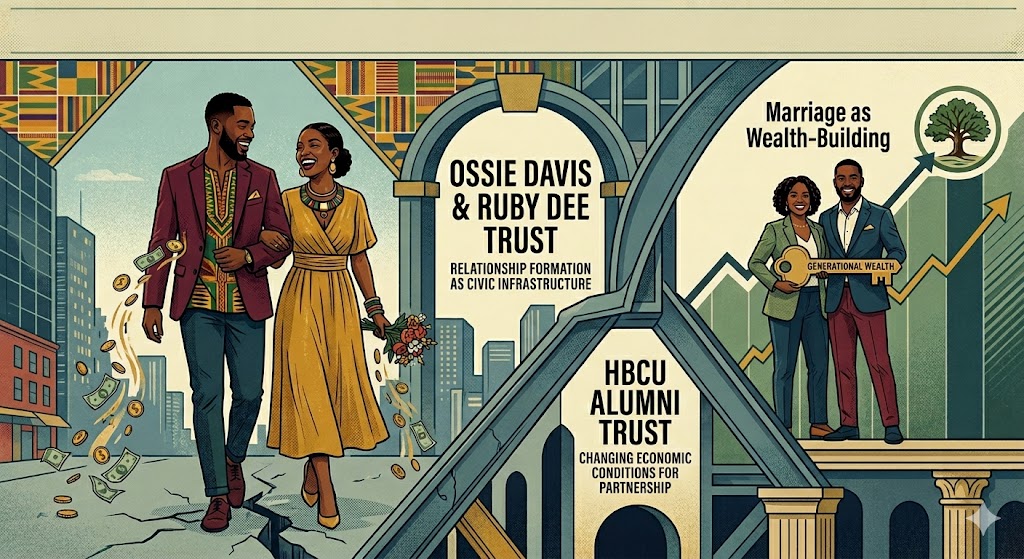
One framework that has emerged from this conceptual work is the proposed Ossie Davis and Ruby Dee Trust, a nonprofit structure designed to treat Black relationship formation as essential civic infrastructure. Rather than addressing individual behavior, it embeds an Institutional Matchmaking Network inside existing Black institutions such as HBCUs, Black Greek-letter organizations, and Black professional societies organizing participants into cohorts around values alignment and life stage rather than the transactional logic of dating apps. Institutional partners would be evaluated not by attendance but by households formed over time. Alongside this, the Trust’s proposed Black Marriage Economic Stabilization Fund directly attacks the structural barriers to marriage formation: student loan interest relief for married participants, down payment matching grants, emergency household stabilization funds, and cooperative legal planning tools. If society subsidizes corporate capitalization through tax structures and preferential credit, there is no principled argument against subsidizing household formation among the demographic most systematically denied access to those same structures.

A second emerging framework addresses what enters the household economically at the moment of formation. The proposed HBCU Alumni Trust would provide every HBCU graduate, at graduation, with a beneficial interest in a professionally managed irrevocable trust generating monthly income distributions for life, with 75 percent accessible and 25 percent mandatorily reinvested, and underlying assets protected by spendthrift provisions for a ten-year vesting period. Its purpose is not primarily about returns. It is about changing the conditions under which graduates enter the courtship market. A graduate carrying a monthly income stream is a categorically different actor than one entering post-graduation life with $40,000 in student debt and no liquidity buffer less likely to perform prosperity they do not possess, less likely to make partnership decisions driven by economic desperation, and more likely to be the kind of financially stable partner around whom a wealth-building household can actually be built.

The version of dating that is making African Americans broke, therefore, is not simply an individual failure of financial discipline. It is a community failure to have built and sustained the normative frameworks, the matchmaking infrastructure, and the financial tools within which courtship is understood as institutional preparation rather than consumption performance. Young African Americans inherit a culture of dating that was not designed with their economic realities or institutional interests in mind. The Ossie Davis and Ruby Dee Trust, the HBCU Alumni Trust, and the broader institutional imagination they represent are attempts to change that inheritance not through cultural policing or moral instruction, but through the construction of institutions that make the financially disciplined, partnership-oriented approach to courtship the path of least resistance rather than the path of greatest sacrifice.

The calculation, ultimately, is not whether African Americans can afford to date. They can, if they do it with discipline, honesty, and a clear-eyed understanding of what partnership is for. The calculation is whether African Americans can afford to continue treating courtship as a consumption category rather than a capital formation strategy and whether the institutions that serve African American life are willing to accept responsibility for building the infrastructure that makes the difference. The evidence of seven decades of compounding wealth gaps suggests, emphatically, that they cannot afford the former. The emergence of institutional frameworks designed to address the structural conditions of Black household formation suggests, cautiously, that some are beginning to accept the latter.

Disclaimer: This article was assisted by Claude AI.
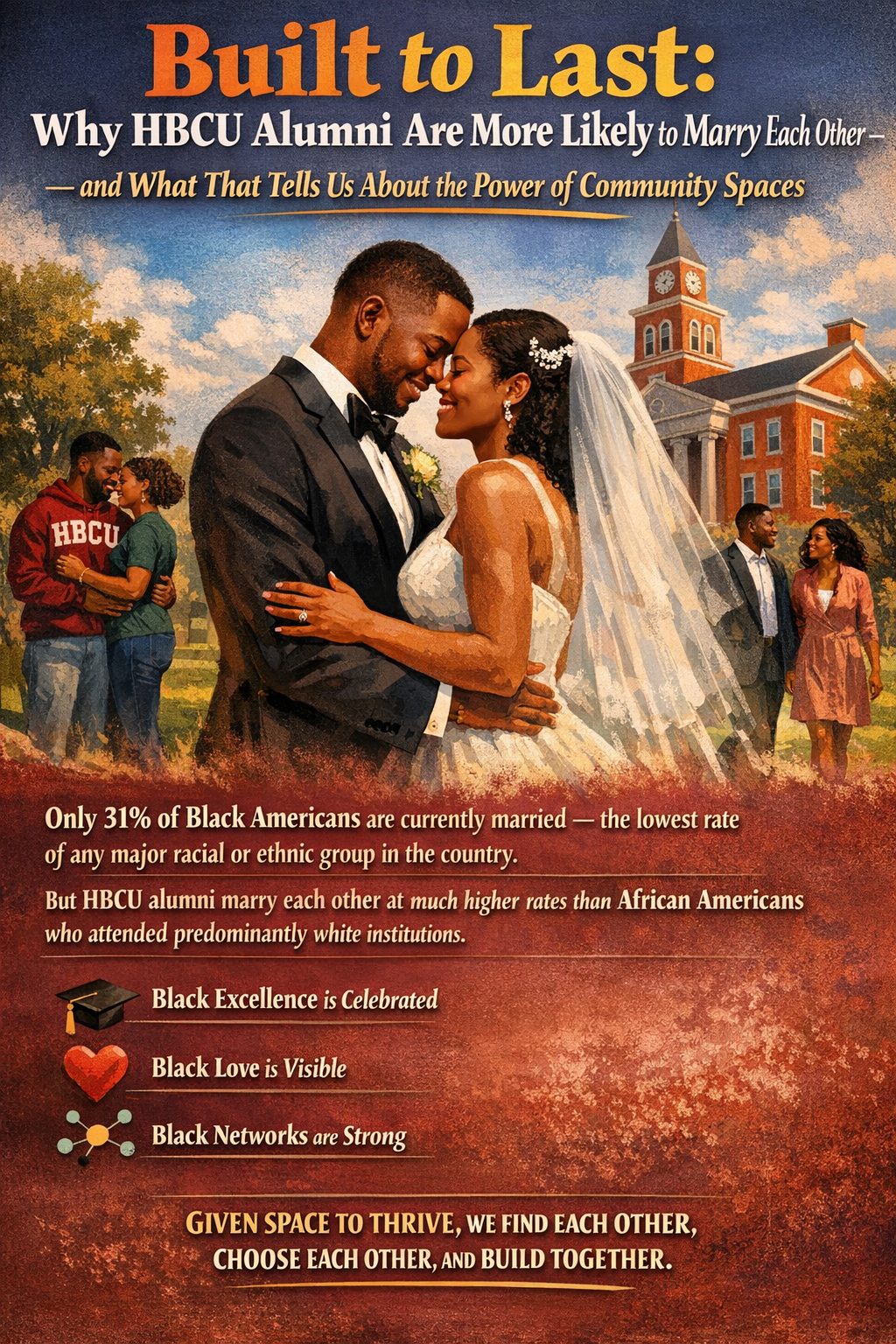
Built to Last: Why HBCU Alumni Are More Likely to Marry Each Other — and What That Tells Us About the Power of Community Spaces

This here, right now, at this very moment, is all that matters to me. I love you. That’s urgent like a motherf**ker. – Darius Lovehall

There is a particular kind of magic that happens when Black people are given the space to simply be to lead, to create, to fail and succeed without the exhausting weight of being a perpetual outsider. Historically Black Colleges and Universities have always understood this. For more than 150 years, HBCUs have offered something that no diversity initiative, no DEI task force, and no affinity group within a predominantly white institution can fully replicate: an entire ecosystem built in, by, and for Black people. The effects of that ecosystem ripple outward in ways we are still measuring including into who HBCU alumni choose to build their lives with.

Research into the marital patterns of African Americans reveals a striking divergence between HBCU graduates and their counterparts who attended predominantly white institutions. HBCU alumni marry each other — Black men marrying Black women, Black women marrying Black men at significantly higher rates than African Americans who attended PWIs, where interracial marriages are considerably more common. This is not a coincidence. It is the natural fruit of what intentional community spaces produce.

The baseline numbers are sobering. Only 31% of Black Americans are currently married, compared to 48% of all Americans. Half of African Americans have never been married, compared to 34% of the general population, making African Americans the least married of any major racial or ethnic group in the country. There are approximately 5.18 million Black married-couple families in the United States today. That number has room — significant room — to grow. Currently, about 9–10% of Black college students attend HBCUs. Among college-educated Black newlyweds at PWIs, roughly 21% marry someone from another racial or ethnic group, with that figure rising to 30% among college-educated Black men. The picture at HBCUs is markedly different, and the reasons are structural, not accidental.

The social architecture of an HBCU where Black students are the majority, the leadership, the faculty, the homecoming court, the engineering honor society, and the debate team means that the romantic world reflects the academic world. HBCU alumni who marry are overwhelmingly likely to have met their spouse within a Black social and professional network, often one that traces its roots directly back to campus. African Americans who attend PWIs, by contrast, are exposed to a social universe numerically and institutionally dominated by white peers. Friendships, romantic relationships, and professional networks form disproportionately across racial lines not through any individual fault, but as a straightforward consequence of who is in the room. When your environment is 85% white, the statistical likelihood of cross-racial coupling rises organically. The HBCU alumni network functions, among other things, as a long-running and remarkably effective matchmaking institution one whose impact on community formation has never been fully quantified.

Sociologists have long understood that residential and institutional proximity is one of the strongest predictors of who people marry. We meet our partners in the spaces we inhabit — at work, at school, in our neighborhoods, at our houses of worship. The institution you attend for four formative years, the one that shapes your professional ambitions, your intellectual identity, your social circle, and your sense of self, will inevitably shape who you consider a natural life partner. For HBCU students, those four years are spent in an environment where Black excellence is not exceptional it is expected. Where Black love is not a political statement but a daily reality, visible in the couples holding hands on the quad, in the married faculty members co-teaching courses, in the alumni couples who return to homecoming year after year. Love, like ambition and leadership, is modeled. Young people see what is possible and, consciously or not, begin to orient their own futures accordingly.

PWI environments, for all their academic prestige, rarely offer this. Black students at PWIs often describe a bifurcated social experience belonging to affinity groups and cultural organizations that provide community, while simultaneously navigating a broader campus culture in which they are the minority. Black love is possible at PWIs, of course, and it flourishes there too. But the structural conditions do not make it the default. They make it something you find in spite of your environment, not because of it.

This conversation extends well beyond marriage rates, though those rates are a particularly measurable indicator of something larger. What HBCUs demonstrate is the transformative power of institutions that a community owns, shapes, and sustains for itself. This principle has animated Black institution-building in America since Reconstruction from Black Wall Street in Tulsa to the network of Black-owned banks, newspapers, hospitals, and churches that constituted what historians call the “Black counterpublic.” When a community has its own institutions, it controls its own narratives. It defines its own standards of beauty, intelligence, leadership, and desirability. It produces its own role models, generates its own wealth pathways, and creates an internal ecosystem dense enough that community members can meet each other’s needs — economic, social, spiritual, romantic — without having to seek fulfillment exclusively in outside spaces. The higher intra-community marriage rate among HBCU alumni is one data point in a much larger argument: that Black institutions do not merely provide education or services. They produce belonging. And belonging, once cultivated, has a way of reproducing itself in careers built together, in communities sustained together, and in families formed together.

For a publication dedicated to the intersection of Black financial life and Black excellence, the marriage data carries specific economic weight. Marriage, when it functions well, is one of the most powerful wealth-building vehicles available to any household. Two incomes, shared expenses, combined assets, coordinated estate planning, and intergenerational wealth transfer — these are the mechanisms by which families accumulate and maintain economic stability across generations. The racial wealth gap in the United States is staggering and persistent. For Black families to close that gap through their own accumulated power, marriage stability within the community matters. When HBCU alumni marry each other, they are pooling Black wealth with Black wealth building households that invest in Black communities, buy homes in Black neighborhoods, fund Black businesses, and leave assets to Black children. This is not about exclusion. It is about the compounding power of economic solidarity.

HBCU alumni already tend to earn strong incomes, leverage their alumni networks for professional advancement, and demonstrate higher rates of giving back to their alma maters and communities. According to the Gallup-USA Funds Minority College Graduates Report, 40% of Black HBCU graduates report thriving in financial well-being, compared to just 29% of Black graduates from non-HBCUs — the largest well-being gap Gallup measured between the two groups. Economic stability is one of the strongest individual predictors of marriage. Add to that the wealth-building power of sustained intra-community partnership, and the picture that emerges is of a uniquely powerful pipeline, one that begins with a campus in a college town and ends, generations later, in families that have genuinely built something lasting.

The most compelling question the data raises is not descriptive it is projective. If the HBCU environment produces meaningfully higher rates of Black marriage and intra-community partnership, what would happen to African American marriage rates if the share of Black college students attending HBCUs grew from today’s 10% to 25%, 50%, or even 75%? The answer, modeled carefully against current demographic data, is striking. These projections are calibrated estimates rather than census findings — they are directionally honest and mathematically grounded, built from known marriage rate differentials, HBCU graduation advantages, and the share of college-educated adults within the total Black population. One additional factor amplifies every projection: research shows that Black students at HBCUs are 33% more likely to graduate than their counterparts at comparable institutions, meaning scaling HBCU enrollment also scales Black degree attainment itself.

At 25% HBCU enrollment, roughly where HBCU attendance stood in the mid-1970s, the overall Black marriage rate would likely move from 31% toward 33–34%. That may sound modest, but in a population of nearly 47 million Black Americans, a two-to-three point increase represents roughly 500,000 to 700,000 additional married Black households, with intra-community marriage among college-educated Black Americans rising from roughly 79–80% toward 82–83%. At 50%, a transformational shift where the majority of college-educated Black Americans are formed in Black-centered environments, the overall Black marriage rate would likely climb toward 36–38%, closing nearly a third of the gap with the national average. The HBCU alumni network, at this density, becomes a dominant force in Black professional and social life: a self-reinforcing ecosystem where Black partner exposure is high across the entire college-educated class, translating to roughly 1.2 to 1.5 million additional Black married households.

At 75% HBCU enrollment, history offers its own precedent. Before integration dispersed the Black college-going population into majority-white institutions, HBCUs educated virtually all Black college graduates and during that era, African Americans age 35 and older were actually more likely to be married than white Americans, a trend that held from 1890 until sometime in the 1960s. A return toward 75% HBCU enrollment would not be an experiment in an unknown direction. It would be a partial return to conditions that demonstrably worked with a projected Black marriage rate of 40–42%, approaching parity with the national average for the first time in over six decades, and as many as 2 to 2.5 million additional Black married households.

HBCU EnrollmentEst. Black Marriage RateIntra-Community MarriageNew Married Households
10% (Today)31%~79–80%Baseline
25%33–34%~82–83%+500K–700K
50%36–38%~86–88%+1.2M–1.5M
75%40–42%~90%++2M–2.5M

These projections carry honest caveats. Students who self-select HBCUs today may already have stronger pro-community cultural orientations, meaning the marginal effect per new HBCU enrollee may be somewhat smaller than current graduate data suggest. Marriage rates are also multi-causal — mass incarceration, income inequality, student debt, and campus gender ratio imbalances all independently shape outcomes. No single variable, however powerful, tells the whole story. But the directional conclusion is unmistakable: HBCU enrollment is a lever of community formation, not merely academic achievement. Pulling it harder produces more Black marriages, more Black wealth, and more Black families compounding across generations.

Every few years, critics question the continued relevance of HBCUs in an era of expanding integration and formal diversity efforts at major universities. The marriage data, alongside every other metric by which HBCU graduates outperform expectations relative to their socioeconomic backgrounds, is a decisive answer to that question. HBCUs are not relics of segregation. They are proof of concept — evidence that when Black people are given a fully resourced, culturally affirming environment to grow in, they flourish in ways that reverberate across every dimension of life. The lesson is not that PWIs should be abandoned or that integration was wrong. The lesson is that the goal was never assimilation — it was equity. And equity means Black people having their own institutions, not merely access to someone else’s. It means Tuskegee and Xavier and North Carolina A&T and Prairie View and Dillard and Morgan State existing not as alternatives of last resort but as premier, first-choice destinations that produce exactly the kind of human outcomes — professional, civic, familial — that their graduates embody.

The couples who meet at HBCU homecoming and marry a few years later are not a sentimental footnote to the HBCU story. They are a central chapter. They are what it looks like when a community invests in itself deeply enough that its members find each other, choose each other, and build together. The data suggests that with more investment — more students, more resources, more deliberate choice — the results scale. Two million additional Black married households is not a fantasy. It is arithmetic. And it starts with the decision of where to spend four years.

Disclaimer: This article was assisted by ClaudeAI.

Two Pillars Fall: The Loss of Columbia Savings and Adelphi Bank and What It Means for African American Communities

We are watching the absolute collapse of African American institutions and our absolute dependency on Others’ institutions. It once felt like a slow train wreck, now it feels like a supersonic missile. – William A. Foster, IV

The 2025 African American Owned Bank Directory carries an absence that numbers alone cannot fully convey. Two institutions that appeared in last year’s listing — Columbia Savings and Loan Association of Milwaukee, Wisconsin, and Adelphi Bank of Columbus, Ohio — are no longer among the ranks of African American-owned financial institutions. Together, they represented nearly $130 million in assets: Columbia Savings at approximately $22 million and Adelphi Bank at approximately $106 million. Their departure is not merely a bookkeeping change. It is a geographic and community wound, one that leaves both Ohio and Wisconsin without a single African American-owned bank.

Founded on January 1, 1924, Columbia Savings and Loan Association was one of the oldest African American-owned financial institutions in the United States. A savings and loan chartered over a century ago in Milwaukee, it survived the Great Depression, the urban upheavals of the mid-20th century, the savings and loan crisis of the 1980s, and the 2008 financial collapse. It did not survive 2025. In our 2024 directory, Columbia carried $24,097,000 in assets, already down 12.0 percent from the prior year. By the time 2025 data was compiled, its assets had further declined to approximately $21,998,000 — a figure that, alongside declining capital levels, signaled an institution under extraordinary strain. For a savings and loan of its size, operating in a competitive market without the capital buffers available to larger institutions, the math had become unforgiving.

Milwaukee’s African American community is substantial, Black residents make up roughly 39 percent of the city’s population and yet they now have no African American-owned bank to call their own. This is not a small thing. African American-owned banks and savings institutions have historically served as anchors for communities that mainstream financial institutions have underserved or outright ignored. They have written mortgages in redlined neighborhoods, provided small business loans to entrepreneurs who couldn’t get a second meeting at a downtown bank, and offered a financial home to people who needed more than a transaction they needed trust.

If the loss of Columbia Savings is a story of a century-old institution exhausted by time and capital constraints, the loss of Adelphi Bank carries a different kind of grief. Founded on January 18, 2023, in Columbus, Ohio, Adelphi was the newest African American-owned bank in the country at the time of our 2024 directory. Prior to its founding, no new African American-owned bank had been chartered in 23 years. Adelphi’s launch was celebrated for exactly that reason: it represented a renewal, a sign that the community had not given up on building the financial infrastructure it needs.

In 2024, Adelphi reported $68,154,000 in assets, up 55.1 percent from the year prior, a remarkable growth trajectory for a de novo bank. By 2025, that figure had risen further to $106,369,000. And yet, despite that asset growth, the bank was no longer majority African American-owned by the time 2025 statistics were compiled. A growing balance sheet does not automatically translate into ownership stability. New banks are capital-intensive, and the pressures to bring in outside investors can, over time, dilute or displace founding ownership structures.

The result is that Ohio, the state that just two years ago was celebrating the founding of its first new African American-owned bank in over two decades, now has none. Columbus, the state capital and one of the fastest-growing cities in the Midwest, has no African American-owned bank. And critically, neither does the surrounding region that includes two of Ohio’s most important Historically Black Colleges and Universities: Central State University and Wilberforce University.

The relationship between African American-owned banks and HBCUs has long been identified by HBCU Money as one of the most underdeveloped partnerships in the Black economic ecosystem. HBCUs are intellectual and economic anchors for their communities. African American-owned banks are the financial connective tissue that can translate education, entrepreneurship, and homeownership aspirations into capital. When both are present in a region, the possibilities compound. When one disappears, the other is diminished.

Central State University and Wilberforce University sit in Greene and Xenia, Ohio, both within the orbit of Columbus and Dayton. Their students, faculty, staff, and alumni represent tens of thousands of people who need mortgages, small business loans, car notes, savings accounts, and lines of credit. Without an African American-owned bank anywhere in Ohio, those needs will be met if they are met at all by institutions with no particular relationship to their communities, no cultural competency born of shared experience, and no structural incentive to reinvest in the neighborhoods and towns these HBCUs serve. And if they are met, the profits and institutional ownership and influence will be to the benefit of Others and not the African American ecosystem. Once again, we will be subsidizing everyone else.

This is not a hypothetical harm. Research has consistently shown that African American-owned banks direct a greater share of their lending to African American borrowers and African American-owned businesses than Others’ institutions. They are not perfect, and they are not substitutes for broader policy change. But they are irreplaceable in the role they play, and their absence is felt in the very specific, very practical ways that matter most: a loan denied, a mortgage not written, a business that never got started.

The 2025 directory does carry one encouraging entry: Redemption Bank of Salt Lake City, Utah, founded February 20, 1974, and now appearing in the African American-owned bank listing with approximately $72,205,000 in assets under the FDIC’s San Francisco region. Its inclusion partially offsets the $128 million in assets lost with Columbia and Adelphi. Redemption Bank’s presence in Utah is notable given the state’s relatively small African American population and its distance from the major African American economic corridors. Its listing is a reminder that African American financial institution-building can and does happen in unexpected places.

But Redemption Bank’s $72 million in assets does not replace what was lost in Ohio and Wisconsin. It does not fill the geographic gap. It does not serve the students at Central State or Wilberforce, or the African American residents of Milwaukee’s north side. The net loss to African American institutional financial capacity in the Midwest is real, and no amount of welcome news from the Mountain West changes the map that communities in Columbus and Milwaukee are now looking at.

As noted in our 2024 directory, African American-owned banks hold approximately $6.4 billion of America’s $23.6 trillion in bank assets — roughly 0.027 percent. The apex of African American-owned bank assets, as a share of total U.S. banking, was 1926, when the sector held 0.2 percent — ten times today’s proportion. Nearly a century later, the sector has not recovered.

The structural disadvantages are well-documented: chronic undercapitalization, concentration in communities with lower median wealth, limited access to the interbank credit markets that larger institutions tap freely, and a customer base that has been systematically excluded from wealth-building for generations. These are not problems that individual bank managers can solve through hustle and grit alone. They require deliberate policy support, sustained community deposits, and coordinated investment from the HBCU ecosystem, African American businesses, and public-sector partners.

The post-2020 wave of corporate pledges to African American financial institutions provided some relief. Many of the banks in our directory saw asset growth between 2023 and 2024 partly as a result of those deposits. But corporate commitments are not permanent, and the institutions that did not receive them or that received too little too late remained exposed. Columbia Savings, with $24 million in assets and a 12 percent annual decline already in evidence by 2024, was unlikely to attract the kind of large-scale corporate or philanthropic deposit that might have stabilized it.

The loss of Columbia Savings and Adelphi Bank should be understood as a call to action, not an occasion for eulogy alone. Several things must happen.

First, the HBCU community in Ohio must begin conversations now about what it would take to support a new African American-owned financial institution in the state. Central State and Wilberforce cannot simply wait for the private sector to solve this. HBCU endowments, alumni associations, and institutional deposits are tools of economic development. Directing even a fraction of those resources toward a future Ohio-based African American-owned bank would be a meaningful first step.

Second, community organizations, African American business associations, and civic leaders in Milwaukee must assess whether a new chartered institution, a credit union, or a community development financial institution (CDFI) can fill some of the void left by Columbia Savings’ departure. Milwaukee’s African American community is large enough and its economic needs acute enough that the absence of a community-controlled financial institution is not sustainable.

Third, the national conversation about African American-owned banks must move from celebration to infrastructure. Every time a new institution is chartered, and Adelphi’s founding in 2023 was genuinely exciting, it must be supported with the capitalization, deposit commitments, and technical assistance that give it a fighting chance past its first few years. A bank that grows in assets but loses its founding ownership structure has not fulfilled its promise. The community has to be in the room, and at the table, not just at the ribbon-cutting.

Finally, we should note what these two losses mean for the map of African American financial geography. States absent from our 2025 directory now include Ohio, Wisconsin, Maryland, Missouri, New York, and Virginia — a list that encompasses some of the largest African American urban populations in the country. That map is a challenge and an indictment in equal measure. African Americans live and work and build in every corner of this country. Their financial institutions should too.

Columbia Savings and Loan Association (Milwaukee, WI) — Founded January 1, 1924 | 2024 Assets: $24,097,000 | 2025 Assets: $21,998,000

Adelphi Bank (Columbus, OH) — Founded January 18, 2023 | 2024 Assets: $68,154,000 | 2025 Assets: $106,369,000

Redemption Bank (Salt Lake City, UT) — Founded February 20, 1974 | 2025 Assets: $72,205,000 [New to directory]

Disclaimer: This article was assisted by Claude (Anthropic).

Mapping the Gap: The Geography of African American Banks and Credit Unions in 2025

African Americans navigating their financial lives are operating inside two fundamentally different types of institutions, and understanding that difference is not academic it is strategic. JPMorgan Chase, the largest bank in the United States with over $3.9 trillion in assets, is a publicly traded corporation owned by shareholders. Its mandate is profit. It can accept corporate deposits, underwrite municipal bonds, finance international trade, issue letters of credit that move goods across oceans, syndicate billion-dollar loans, and operate in 100 countries. When a city government needs to finance a new highway, when a developer needs to close on a $200 million mixed-use project, when a corporation needs to hedge currency risk across three continents — JPMorgan is in that room. Navy Federal Credit Union, the largest credit union in the United States with approximately $180 billion in assets, is a member-owned cooperative. Its mandate is service to its members, who must meet eligibility requirements tied to military affiliation. It offers mortgages, car loans, checking accounts, and credit cards often at better rates and lower fees than JPMorgan but it cannot write a commercial real estate construction loan for a developer, cannot underwrite a municipal bond for a city, cannot finance an export contract for a manufacturer shipping goods to West Africa, and has no presence in international capital markets. Navy Federal is a powerful institution for what it does. It simply does not do what JPMorgan does, and JPMorgan does not do what Navy Federal does at the community level. For African Americans, this distinction carries enormous consequence. A community with only credit unions has access to consumer financial products; mortgages, auto loans, personal savings but lacks the commercial banking infrastructure needed to finance business growth, real estate development, institutional deposits, and economic expansion. A community with only banks, and specifically only large national banks with no cultural accountability, has access to products but not necessarily to equitable underwriting, community reinvestment, or the trust that comes from shared ownership. The absence of an African American-owned bank in Ohio or Wisconsin is not just symbolic. It means no institution with a community mandate is positioned to finance the next African American developer, fund the next HBCU-adjacent business corridor, or serve as a depository for the growing institutional wealth of Black organizations in those states.

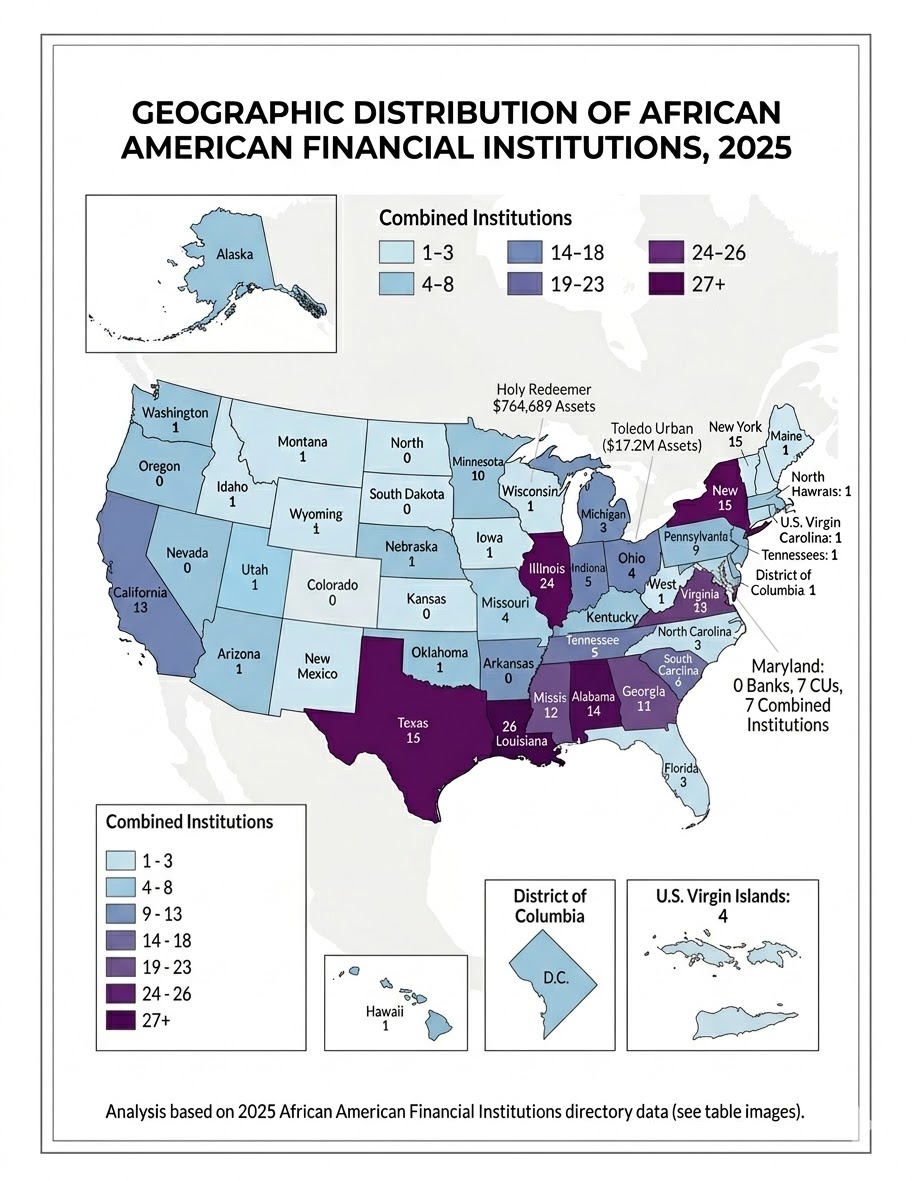
When the geography of African American banks and credit unions is examined together, a more complete — though still incomplete — picture of Black financial infrastructure emerges across the United States. The 2025 African American Owned Bank Directory covers 17 institutions across 15 states and territories. The 2025 NCUA data on African American credit unions adds 205 institutions across 29 states and territories, carrying $8.15 billion in assets and serving approximately 727,000 members. Combined, the two sectors represent over 220 institutions and more than $14.8 billion in assets operating across 31 states and territories. But geography, not just totals, is where the real story lives.

Thirteen states have both an African American-owned bank and at least one African American credit union: Alabama, the District of Columbia, Georgia, Illinois, Louisiana, Michigan, Mississippi, North Carolina, Oklahoma, Pennsylvania, South Carolina, Tennessee, and Texas. These are the states with the fullest financial ecosystem — where a community member can choose between a bank product and a credit union product from an institution with cultural roots in their community. Louisiana stands out, with one bank and 25 credit unions, the most of any state in the credit union count. Illinois follows with one bank and 23 credit unions.

Two states have African American banks but no African American credit unions in the NCUA data: Massachusetts, home to OneUnited Bank, and Utah, newly represented by Redemption Bank. These institutions serve their communities without the complementary infrastructure of a credit union network. Conversely, 16 states and territories have African American credit unions but no African American-owned bank: Arkansas, California, Connecticut, Delaware, Florida, Indiana, Maryland, Minnesota, Missouri, New Jersey, New York, Ohio, Virginia, the U.S. Virgin Islands, West Virginia, and Wisconsin.

The cases of Ohio and Wisconsin, discussed at length in the bank directory analysis, illustrate the limits of credit union coverage as a substitute for bank presence. Ohio has four African American credit unions with combined assets of approximately $18.3 million: Mahoning Valley in Youngstown, Mt. Zion Woodlawn in Cincinnati, Cleveland Church of Christ in Cleveland, and Toledo Urban in Toledo. Of these, Toledo Urban is the only institution of meaningful scale at $17.2 million in assets with 4,324 members. The other three are micro-institutions, each under $600,000 in assets and under 400 members. Wisconsin’s single credit union, Holy Redeemer Community of SE Wisconsin based in Milwaukee, holds just $764,689 in assets and serves 239 members. For a city where African Americans comprise roughly 39 percent of the population, that represents an institutional void that one small credit union cannot fill. Neither Ohio nor Wisconsin has an African American financial institution capable of writing a commercial real estate loan, funding a startup, or underwriting a mortgage for a first-generation homebuyer at any meaningful scale.

African American Financial Institutions by State, 2025

StateAfrican American BanksAfrican American Credit UnionsCombined Institutions
Alabama21214
Arkansas033
California011
Connecticut033
Delaware011
District of Columbia11011
Florida033
Georgia2911
Illinois12324
Indiana055
Louisiana12526
Maryland077
Massachusetts101
Michigan145
Minnesota022
Mississippi11112
Missouri044
New Jersey099
New York01515
North Carolina123
Ohio044
Oklahoma112
Pennsylvania189
South Carolina156
Tennessee156
Texas11415
Utah101
U.S. Virgin Islands044
Virginia01313
West Virginia011
Wisconsin011

Maryland presents a striking and instructive contrast. It has no African American-owned bank, a gap noted in the 2025 directory, yet it is the single largest state for African American credit union assets, hosting seven institutions with a combined $4.47 billion in assets. That figure is driven primarily by two institutions: Andrews Federal Credit Union in Suitland with $2.47 billion in assets and 142,076 members, and Municipal Employees Credit Union of Baltimore with $1.26 billion in assets and 98,358 members. Maryland’s credit union sector is, in asset terms, larger than the entire African American bank sector nationally. This is remarkable. It is also a reminder that credit unions and banks occupy different structural roles. Andrews Federal and MECU of Baltimore are large, sophisticated institutions with product offerings that approach commercial banking but they are member cooperatives, not banks, and their ownership structure, regulatory environment, and community lending mandates differ accordingly. Maryland’s absence from the bank directory is still a gap worth addressing, even with $4.47 billion in credit union assets in the state.

Virginia and Missouri follow a similar pattern to Maryland, albeit at smaller scale. Virginia has 13 African American credit unions with $471 million in assets but no African American-owned bank. Missouri has four credit unions with $481 million in assets, anchored by St. Louis Community Credit Union at $431.5 million, and also no bank. New York has 15 credit unions with $76 million in assets and no African American bank, a particularly stark figure given the size of New York’s African American population and its status as the financial capital of the country.

The states that are entirely absent from both the bank and credit union directories deserve attention. While the combined coverage of 31 states and territories is broader than either sector alone, large portions of the country remain without any African American-owned financial institution. States like Nevada, Arizona, Colorado, Washington, Oregon, and much of the Mountain West and Pacific Northwest have no representation in either directory. As African Americans continue to migrate to new metros — Las Vegas, Phoenix, Denver, Seattle — the absence of community-controlled financial institutions in those corridors becomes a growing concern.

The combined picture is this: African American banks and credit unions together hold approximately $14.8 billion in assets, serve over 700,000 credit union members and the deposit base of 17 banks, and operate across 31 states and territories. The credit union sector, at $8.15 billion in assets across 205 institutions, is actually slightly larger than the bank sector’s $6.72 billion across 17 institutions, a reflection of the credit union model’s greater accessibility and the longer runway some of these institutions have had to grow. But the two sectors are not interchangeable. Banks can hold commercial deposits, write business loans, issue letters of credit, and serve as the financial backbone of an entrepreneurial ecosystem in ways that most credit unions cannot. Credit unions, in turn, offer member ownership, lower fees, and community accountability that publicly or privately held banks may not. The African American community needs both, in every state where its population is substantial. Right now, it has neither in too many places that matter.

Sources: HBCU Money 2025 African American Owned Bank Directory; 2025 NCUA African American Credit Union Institutions data. Asset figures in U.S. dollars.

Disclaimer: This article was assisted by Claude (Anthropic).

Is the Love of Sports Costing African America the STEM Future It Desperately Needs?

The future will not belong to those who can jump the highest, but to those who can think the deepest.” — Anonymous (Modern African Proverb Reimagined)

For every hour a Black boy or girl spends practicing, playing, or watching sports, it becomes an hour not spent mastering math, science, literature, or history. Over time, those missed hours compound not just in skill gaps, but in confidence gaps. And confidence, in education as in life, is everything. The long-term consequence of this imbalance may be far greater than lost academic opportunities. It may be the loss of African America’s ability to compete in the 21st-century economy and the slow erosion of its intellectual sovereignty.

Sports are a cherished part of African American culture, woven through family traditions, community pride, and generational memory. From Jackie Robinson to Serena Williams, from Doug Williams to Simone Biles, athletic greatness has symbolized resilience and excellence in a world that too often sought to deny both. But beneath the surface of that cultural triumph lies an uncomfortable reality: the love of the game may have become too consuming, crowding out the time, attention, and aspiration needed for mastery in science, technology, engineering, and mathematics — the disciplines defining wealth and power in the modern world.

A study by GradePower Learning found that American students spend about 1,000 hours in school each year — and roughly the same amount watching screens. For African American youth, however, there’s an additional pull: sports participation, practices, and games can consume 10 to 20 hours a week, not counting the time spent watching sports media, highlights, or discussing the latest player stats. By the time a child reaches high school graduation, those hours can exceed 8,000 — the equivalent of four full years of math or science instruction. What might have been time spent learning quadratic equations or Newton’s laws becomes time devoted to perfecting a crossover dribble or memorizing playbooks.

In theory, sports are said to teach discipline, teamwork, and perseverance — invaluable traits for life and leadership. But decades of African American participation in sports have shown that, in practice, these virtues rarely translate into collective advancement or institutional power for the community. Sports teach many to endure, but not necessarily to build. They inspire personal excellence but often without structural returns. Meanwhile, other ethnic groups are compounding their time in STEM preparation. In Asian households, it is not uncommon for students to attend supplemental weekend academies for math and science. The same can be said of many immigrant families who prioritize educational mastery as a direct pathway to generational wealth.

This divergence begins early. By middle school, African American students already lag behind in math and science proficiency, and by high school, many have internalized the belief that they “aren’t math people.” Yet, that belief is not innate; it’s cultivated by the habits of time and attention society rewards.

The youth sports economy in the United States is now valued at over $30 billion, according to USA Today. Parents are spending thousands each year on club fees, travel tournaments, gear, and coaching — often with dreams of athletic scholarships or professional contracts that statistically almost never come. A 2025 USA Today report noted that many parents invest between $5,000 and $10,000 annually per child in competitive sports, hoping to secure a college scholarship. Yet, NCAA data show that less than 2% of high school athletes earn athletic scholarships, and an even smaller fraction go on to professional sports.

When those numbers are mapped against household wealth, the economic irony becomes staggering. The median net worth of African American families remains around $44,900, compared to $285,000 for White families. If the average family spends $10,000 per year on youth sports for a decade, they could instead have invested $100,000 into a 529 education savings plan or a family investment fund. Compounded annually at 7%, that investment would yield roughly $196,000 by the time their child turns 18 — enough to pay for college tuition, or serve as seed capital for a business. But the investment goes into jerseys, tournaments, and sneakers. Sports is not just a pastime anymore; it’s an industry — one that thrives on hope, marketing, and the dream of ascension. For African American families, that dream often overshadows a deeper one: intellectual independence.

From the earliest ages, children internalize the models of success they see. If every hero they admire dribbles, runs, or dunks, it subtly shapes what they believe they must become to matter. The African American community has created icons in every field, but sports icons receive disproportionate visibility, media coverage, and cultural veneration. Young boys can name more NFL quarterbacks than Black engineers, scientists, or inventors. This imbalance creates a quiet but powerful feedback loop. The more the community celebrates athletic success as the highest expression of Black excellence, the fewer young people will be inspired to emulate scientific or entrepreneurial greatness. The idolization of the athlete — rather than the innovator — becomes a generational tax on imagination.

STEM confidence, like athletic skill, is built through repetition and exposure. A child who spends thousands of hours practicing sports builds confidence in their athletic identity. A child who spends thousands of hours exploring robotics or chemistry develops confidence in their intellectual identity. The problem is not talent — it’s time allocation.

If African America’s endowments are to grow, its intellectual capital must first be rebalanced. STEM fields are not just high-paying; they are high-leverage. Engineers design cities, coders build economies, and scientists control the frontiers of technology and medicine. When African American students are absent from these sectors, it isn’t just a diversity gap — it’s a sovereignty gap. Every innovation African America fails to own is an innovation it must rent from others. Every algorithm not written, every patent not filed, every lab not funded contributes to institutional dependency. Historically Black Colleges and Universities sit at a unique crossroads. While they have been strong in liberal arts, education, and social sciences, they must now pivot aggressively toward STEM dominance. Yet even they face a cultural headwind — many incoming students have been nurtured to see physical performance as validation of worth, while intellectual rigor is often seen as a burden rather than a badge.

An HBCU graduate in engineering or computer science may go on to invent, design, and build. An HBCU athlete may entertain millions. But the wealth gap between those two trajectories is not just individual — it’s institutional. Consider the compound effect of lost hours: one hour per day diverted from academic enrichment equals 365 hours per year. Over 13 years of schooling (Pre-K through 12th grade), that’s nearly 4,750 hours — more than two full school years of instruction. That’s just for one hour. Many student-athletes spend much more time — often 10 or more hours weekly — on practice, travel, and games. By high school, this could exceed 10,000 hours — the exact amount Malcolm Gladwell famously cited as the threshold for mastery in any field.

African American students are becoming masters — just not in the fields where mastery translates into institutional control or generational wealth. Imagine if even half of those hours were redirected into robotics clubs, science fairs, financial literacy programs, or coding bootcamps. The shift in intellectual and economic trajectory would be profound. Culture cannot change overnight, but it can evolve intentionally. African American parents, educators, and institutions must begin redefining what excellence looks like — and where the applause should go. Families should celebrate as loudly when a child aces a chemistry exam or builds a mobile app as when they score a touchdown. Public affirmation must follow academic achievement with the same enthusiasm it gives athletic performance.

The money spent on club sports, travel, and equipment could be partially reallocated to STEM programs, tutoring, or even early college credit courses. Financial discipline must mirror the rigor of athletic discipline. Imagine a Saturday morning robotics league with the same energy as youth basketball — complete with team jerseys, community support, and trophies. Institutions like HBCUs could sponsor regional competitions to make intellectual pursuit a spectator event. HBCUs can create mentorship pipelines connecting student-athletes with STEM majors to promote balance. Athletic departments should collaborate with STEM departments on interdisciplinary projects that merge sports analytics, biomechanics, and data engineering. Families can begin small: a weekly science documentary, math challenges at the dinner table, or trips to museums and tech expos. What matters most is that curiosity and analysis become part of the household rhythm.

America’s future wealth and power will flow through those who master technology, not those who merely consume it. The engineers designing renewable energy grids, the programmers writing AI code, and the scientists developing space propulsion systems are the ones shaping the next civilization. African America cannot afford to be absent from that frontier — nor can it afford to lose another generation to the illusion of athletic access as a substitute for academic and economic power. The cultural love of sports, once a symbol of survival and community, must now evolve into a love of systems, science, and strategy. The same passion that drives the athlete can drive the engineer. The same discipline that fuels a 5 a.m. workout can fuel a 5 a.m. study session. But only if the institutions — families, schools, and HBCUs — are intentional in redirecting that energy.

The African American community once used sports as a pathway to dignity in a segregated world. Now, the challenge is to use STEM as a pathway to dominance in a digitized one. The scoreboard has changed, and so must the game. For every hour spent on a basketball court, a track, or a field, there should be an equal hour at a computer, in a lab, or under a microscope. Not because sports don’t matter, but because the future does. To win this century, African America must love the pursuit of knowledge more than the pursuit of applause. Its children must learn to compete not just on the field — but in the lab, the boardroom, and the data center. Otherwise, the highlight reels will continue to roll, but the ownership of the next generation’s wealth and innovation will belong to someone else.

Disclaimer: This article was assisted by ChatGPT.