Tag Archives: heirs property

The Collapse of African America’s Timber Companies Parallels Its Land Ownership Collapse

We are forced to trust the very institutions who stole the land in the first place because we have not developed and maintained our own. – William A. Foster, IV

A grandfather in Wilcox County plants loblolly pine on forty acres in 1961, the year the trees will outlive him being the whole point. He tells his children the timber is not for cutting; it is for holding. When he dies without a will, the forty acres become the property of nine heirs, then, a generation later, of thirty-one. No bank will lend against a title held by thirty-one people who cannot agree to sign the same document. The family calls the county forester listed on the state’s directory, the only one covering their district, because there is no other option in the phone book and no other name anyone in the family has ever heard mentioned with trust. The advice that comes back is vague, the timeline uncertain, and there is no second opinion to check it against, no other firm to call, no one who looks like the family sitting across the table. The pines keep growing, undermanaged not for lack of care but for lack of anywhere safe to take that care. Forty years after planting, a timber company buys out the confused heirs for a fraction of the standing timber’s value, and the grandfather’s patient capital becomes someone else’s harvest.

That scene is not a story about one bad forester or one unlucky family. It is a story about what happens when an entire asset class has exactly zero Black-owned institutions capable of serving it; no brokerage, no financing arm, no forestry consultancy, no appraisal firm built by and accountable to the community whose land is on the table. For nearly every other category of wealth-building infrastructure, HBCU Standard has documented at least a partial institutional base: Black-owned banks and credit unions, Black-owned commercial real estate firms, Black-owned construction companies. In rural land and timberland specifically, a category increasingly discussed as an inflation hedge, a carbon-credit asset, and a durable multigenerational holding — that base does not exist. Not a small one. Not a regional one. None. And the absence does not simply mean missed opportunity. It means that every African American family holding rural land, and every one considering buying it, is doing so without the single thing that would let them tell the difference between good advice and bad: a trusted counterparty inside the industry with something to lose if it gets that advice wrong.

This is the predicament worth naming plainly. A family that already holds land has, in most of the rural South, exactly one state district forester assigned to their county, no competing Black-owned firm to call for a second opinion, and no institutional recourse if that forester’s guidance turns out to serve someone else’s interests rather than theirs. A family looking to buy timberland as an asset has no Black-owned equivalent of a firm like Hall and Hall, which does not simply broker land but finances it directly, offering loan programs ranging from low variable rates to full thirty-year fixed terms so a client can originate, appraise, and fund an acquisition inside a single relationship. That vertical integration is precisely what makes an institution durable across a timber rotation: the same firm that helps a client find and value a parcel can also lend against it, rather than sending the client back out to a separate lender with no connection to the land or the deal.

To understand why that absence matters, it helps to see what a firm like Hall and Hall actually does, because it bears almost no resemblance to the real estate transaction most readers know from buying a house. A residential agent lists a property, compares it against recent sales of similar homes nearby, and hands the buyer off to a conventional mortgage lender who underwrites based on the buyer’s income and an appraiser’s estimate of the house’s value alone. None of those tools transfer to timberland. Valuing a working forest requires an actual cruise of the standing timber; a forester physically walking the property to inventory species, age, volume per acre, and growth rate because the trees themselves are a separate, living asset with their own market price, layered on top of the bare land value, changing every year whether anyone touches it or not. Financing the purchase means underwriting against decades of projected harvest income, and often against secondary income like grazing or hunting leases, rather than a buyer’s fixed monthly paycheck, which is why Hall and Hall runs its own loan programs instead of referring clients to a bank teller. And the transaction itself carries considerations a residential closing never touches: mineral rights that may or may not convey with the surface, water rights in Western states, conservation easements that permanently restrict future use in exchange for tax benefits, access easements across neighboring land, and a formal management plan for what happens to the timber over the next thirty years, not just what happens at the closing table. A firm built to handle all of that under one roof, continuously, is a fundamentally different kind of institution than a residential brokerage that occasionally lists rural acreage on the side and it is exactly why calling a local real estate agent, however well-intentioned, is not a substitute for the thing that’s missing.

No Black-owned firm offers any piece of that stack, let alone all of it. A family that finds its way past appraisal and negotiation on its own still has to secure financing from an institution outside the community entirely often the very kind of lender whose historical record with Black landowners is the reason for caution in the first place.

That wariness is not paranoia. It has a documented record behind it. Pigford v. Glickman, settled in 1999 as one of the largest civil rights settlements in American history, established in federal court that the USDA had systematically discriminated against Black farmers in the allocation of farm loans and disaster assistance between 1981 and 1996 delaying and denying credit that white farmers received routinely, and for over a decade failing to functionally operate the very civil rights office meant to investigate complaints about it. Congress appropriated another $1.2 billion in 2010 for a second settlement, Pigford II, because so many farmers with legitimate claims had been unable to file the first time. This is not ancient history from the era of outright land theft after emancipation. It is a pattern of institutional behavior toward Black landowners that persisted into living memory, inside the very federal agency structure that state and district foresters, county extension offices, and agricultural lenders all sit within. A family that has watched that pattern play out in the district office, in the bank, sometimes in their own family’s dealings with a local forester has every reason to want a trusted, accountable alternative before signing anything. The absence of that alternative is the actual risk, not an inconvenience layered on top of one.

Layer the heirs’ property problem on top of that trust deficit and the predicament compounds rather than adds. Research out of the University of Georgia’s Warnell School of Forestry has documented how clouded title land passed down without a will, held as an undivided interest among a growing number of descendants locks families out of financing, cost-share programs, and professional forest management, because no lender or agency wants to deal with an ownership structure that any single heir could blow up with a partition sale. Resolving that title requires legal expertise most families cannot afford and most local firms are not built to provide with any particular care. Mavis Gragg’s organization HeirShares exists specifically to clear these legal pathways, and the Federation of Southern Cooperatives has run a Land Assistance Fund toward the same end for decades. But neither is a brokerage, a lender, or a forestry management firm. They can help a family reach clean title. They cannot then walk that family through financing a thinning operation, negotiating a fair timber sale, or acquiring a second parcel to expand the holding, the actual services a firm like Hall and Hall provides continuously to the families who already trust it. Clearing title without a trusted destination to route the resulting clean parcel toward simply relocates the risk rather than resolving it.

The scale of what’s been lost while this institutional vacuum sat unfilled is worth stating plainly, in the register this publication uses for these numbers rather than the multi-trillion projections other outlets reach for. In 1910, according to the National Forest Foundation, Black Americans owned 195 timber companies and comprised roughly a quarter of all employees in the forest products industry. By 1920, per the Land Trust Alliance, African American farmers controlled approximately 14 percent of the nation’s farmland; today that figure is under 1 percent, and total African American land ownership across every category; timberland, farmland, residential, everything has fallen from an estimated 15 to 16 million acres to under 2 million. Set that number against a single entry on the Land Report’s 2025 ranking of America’s largest private landowners: the Emmerson family, through Sierra Pacific Industries, holds 2.44 million acres of timberland in California, Oregon, and Washington alone more than the entirety of Black land ownership nationwide, across every category, combined. John Malone holds roughly 2.2 million acres across four states. The Reed family’s Green Diamond Resource Company, built from a Pacific Northwest logging operation started in 1897, holds about 2.1 million acres. Each of those holdings is the product of a century or more of uninterrupted institutional continuity: clean title passed down without interruption, financing relationships maintained across generations, professional forestry management retained continuously rather than improvised family by family. That continuity is precisely what heirs’ property and the absence of a trusted institutional counterparty have made structurally difficult for Black landowners to replicate, no matter how much care any individual family brings to the effort.

None of this argues that timberland is a bad asset for African American families to hold or acquire. It argues the opposite: that the fundamentals of the asset class; steady periodic cash flow from harvests, low correlation with equity markets, a growing carbon-credit revenue stream for standing forest, and a purchase price still within reach of pooled institutional capital make it exactly the kind of holding worth building durable infrastructure around. And the talent to staff that infrastructure is not the missing piece. Alabama A&M University, one of the nineteen 1890 land-grant HBCUs rather than one of the handful of flagship HBCUs (Howard, Morehouse, Spelman) usually invoked in this conversation, runs the only professionally accredited forestry degree at an HBCU and operates as a USDA Forest Service Center of Excellence. Southern University and A&M College in Baton Rouge, part of the only historically Black land-grant university system in the country, offers a bachelor’s, master’s, and Ph.D. in Urban Forestry through a program it describes as the most comprehensive of its kind in the nation. Tuskegee University runs combined forestry programs with Auburn, Iowa State, the University of Michigan, and Idaho State, sending its students on to finish accredited degrees at partner institutions. And a partnership dating to 1993 between the U.S. Forest Service and four HBCUs; Alabama A&M, Southern, Tuskegee, and Florida A&M has, according to the Forest Service’s own national diversity student programs manager, trained two-thirds of the Black foresters currently working inside the agency. That is not a thin pipeline. It is a substantial, decades-old talent base, producing credentialed foresters at meaningful scale, virtually none of whom currently have the option of being hired into a private Black-owned brokerage, appraisal, or land-management firm because no such firm exists to hire them. The gap in this asset class was never expertise. It is the institution that expertise would staff.

What the Wilcox County family needed in 1961, and what a family looking to buy its first parcel of timberland needs today, is the same thing: an institution built specifically to hold this asset class the way Sierra Pacific and Green Diamond hold theirs, financed the way Hall and Hall finances its own clients’ acquisitions, staffed by graduates of Alabama A&M, Southern, and Tuskegee who are accountable to the community whose trust the industry has not yet earned, and structured to move a family from clouded title through financing through active management without ever requiring them to extend blind faith to a district office or an outside lender with no history of earning it. Every piece of that institution’s eventual capability already exists somewhere, disconnected from the others; title-clearing organizations, a credentialed forestry pipeline, cooperative land trusts, community capital sitting in Black-owned banks and HBCU endowments. Coordinating those pieces into one accountable, professionally staffed, vertically financed institution is not a distant aspiration. It is the specific, buildable answer to a specific, well-documented predicament.

The grandfather who planted loblolly pine in 1961 was making an institutional bet without an institution to back it, trusting that the trees, the family, and eventually someone trustworthy to manage them, would all still be standing when the rotation came due. The trees held up their end. What failed was everything around them: the title no bank would recognize, the forester no one had reason to trust, the financing that had to be sought from strangers, the firm that never got built to stand between the family and the forced sale. Until African America has its own version of the institution that holds land the way Sierra Pacific and Green Diamond hold theirs and finances it the way Hall and Hall finances its own, every acre already owned and every acre still to be bought carries a risk no amount of individual caution can fully offset.

Disclaimer: This article was assisted by ClaudeAI.

The Five Evergreen Acres: A Land Investment Framework for Every Stage of African American Life

Land is the only thing in the world that amounts to anything, for it’s the only thing in this world that lasts. It’s the only thing worth working for, worth fighting for… – Ted Turner

Raw land is among the oldest and most durable asset classes available to private investors. For the HBCU community — individuals, families, alumni associations, and institutional partners — it is also among the most underutilized.

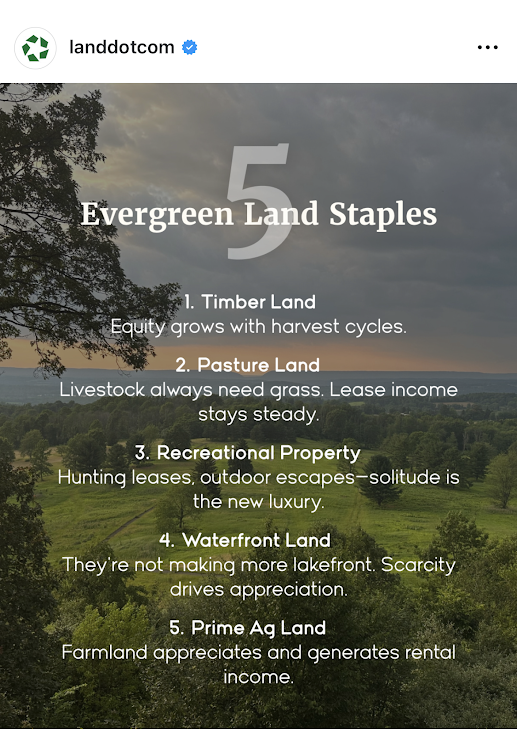
There is a social media post circulating in land investment circles that reads simply: “Forget the luck of the Irish. We prefer the certainty of a deed.” Beneath that caption sits a framework titled “5 Evergreen Land Staples” — timberland, pastureland, recreational property, waterfront land, and prime agricultural ground — each chosen for the same fundamental quality: enduring income or appreciation that does not require the daily volatility management of equities or the tenant fragility of residential real estate. The post is from Land.com, a mainstream marketplace catering primarily to rural landowners. The audience it implicitly addresses is white, rural, and generationally landed. Yet the analytical framework it articulates is precisely what the African American institutional ecosystem needs to operationalize and the HBCU community, with its networks of graduates, alumni chapters, and anchor institutions spread across the American South and beyond, is uniquely positioned to execute it at scale.

The stakes are not trivial. As the Federation of Southern Cooperatives Land Assistance Fund has documented, African Americans own less than 1% of all privately owned rural land in the United States. That figure represents one of the most consequential economic collapses in modern American history, a loss that accelerated across the 20th century through discriminatory lending, heirs’ property dispossession, and the systematic exclusion of Black farmers from federal agricultural credit systems. Between 1910 and 2020, African American land ownership fell by roughly 90%, from an estimated 15–16 million acres to less than 2 million today. Reversing even a fraction of that trajectory requires not only individual decision-making but coordinated institutional action. This article maps a practical framework anchored in the five evergreen land categories for how African Americans at every life stage, and HBCU-affiliated institutions at every organizational level, can begin to build durable land portfolios through structures that keep capital inside the ecosystem.

Before addressing who should invest and how, it is worth establishing why the five categories on that social media post represent genuinely strategic holdings rather than speculative fashions. Timberland is distinctive because its primary asset — standing timber — continues growing in value as long as it stands. As one institutional investor noted at the 2009 Timberland Investment World Summit, timber was the only major asset class not to decline during the Great Recession: “As long as the sun is shining trees will grow and your timber’s value will increase.” For long-horizon investors, which includes endowments, alumni foundations, and family trusts, timberland offers inflation protection, biological growth as a return mechanism, and periodic harvest income that can be timed to liquidity needs. Pastureland generates recurring lease income from ranchers and livestock operators with relatively low management overhead, while the underlying land appreciates over time and the lessee carries operational risk. For a first-generation land investor or a young family with limited bandwidth for active management, a leased pasture parcel generates cash flow from day one. Recreational property, including hunting and fishing grounds, has benefited from the structural shift toward experiential consumption, outdoor recreation spending in the United States now exceeds $780 billion annually and the demand for private access through leased hunting rights or short-term rentals has made rural recreational parcels a viable income source even at modest scale. Waterfront land commands a persistent scarcity premium, as lakefront, riverfront, and coastal parcels face an absolute supply constraint that no amount of construction can remedy, with appreciation rates for quality holdings historically outpacing inland equivalents by substantial margins. Prime agricultural land, the fifth category, combines appreciation and income in proportions that no other asset class consistently replicates, with farmland producing positive real returns in nearly every decade since World War II while the growing global demand for food production adds a structural tailwind that shows no sign of abating.

For the African American individual investor, particularly recent HBCU graduates entering the workforce, raw land is rarely the first investment that financial advisors recommend. Equities, retirement accounts, and residential real estate occupy the conventional hierarchy. This is understandable but strategically incomplete. Raw land, particularly rural parcels in the 10–100 acre range, is far more accessible in price terms than most urban professionals realize. In many parts of the rural South and Midwest, quality pastureland or timberland can be acquired for $1,500–$4,000 per acre, meaning a 20-acre parcel may require a down payment comparable to what urban renters spend in twelve months on housing. The critical discipline for individual investors is to treat the first land acquisition not as a lifestyle purchase but as a strategic asset. A 20-acre timberland parcel generates modest income while the timber matures but builds balance sheet equity that can later be pledged as collateral for subsequent acquisitions, a mechanism that generationally landed families have used for centuries. The key to making this work is choosing land that produces some income immediately, whether through a hunting lease, a hay-cutting arrangement, or a grazing license, so that carrying costs do not exceed cash flow while long-term appreciation accrues. Structurally, individuals should acquire rural land through a single-member LLC rather than in personal name, for both liability protection and eventual transfer efficiency. The LLC structure also allows for the clean addition of family members as equity holders over time, laying the legal groundwork for the next stage of ownership.

A young family with children faces a different calculus than a single investor. The time horizon extends to 30 or 40 years, the need for tax-efficient transfer becomes relevant, and the question of heirs’ property known as the informal, undivided ownership arrangement that has caused the dispossession of millions of acres of Black-owned land must be proactively addressed from the first deed. Heirs’ property arrangements leave undivided interests in land vulnerable to partition sales, through which any one heir can force a sale often to outside buyers at below-market prices. A young family acquiring land today should structure the purchase inside a family LLC or land trust from inception, with a clear operating agreement specifying decision-making rights, buyout provisions, and management authority. This structural discipline costs several hundred dollars in legal fees at formation but eliminates the single greatest mechanism by which Black-owned land has historically been lost. For young families, pastureland and prime agricultural ground are the most suitable of the five categories. Leased to a working farmer on an annual or multi-year cash rent arrangement, these parcels generate predictable income typically $100–$300 per acre annually in productive regions while the family’s equity compounds. Agricultural land near HBCUs, particularly the 1890 land-grant institutions with active extension programs, offers an additional advantage: the university’s agronomic and soil science resources can improve the land’s productivity and rental value over time, particularly where a formal university-farmer partnership exists.

For African American households in the wealth-accumulation or pre-retirement phase, typically those between 45 and 65 with existing equity in residential real estate or retirement accounts, raw land fills a specific portfolio gap. It provides non-correlated returns, inflation protection, and estate planning flexibility that equity-heavy portfolios lack. At this stage, the five-category framework can be pursued more deliberately. Waterfront land and timberland, which require longer holding periods to realize full appreciation, are most appropriate for mature investors who do not need near-term liquidity. A modest timber holding, held for 20 years through a managed investment timberland organization, can produce both periodic harvest income and terminal land value appreciation that substantially outpaces a bond portfolio over the same horizon. Conservation easements on qualifying land parcels offer an additional mechanism: by granting a qualified land trust a permanent easement that restricts development, the landowner receives a federal income tax deduction equal to the value of the development rights surrendered, a tool that high-income African American professionals have underutilized relative to white rural landowners who have deployed it extensively. This is also the stage at which entry into private Real Estate Investment Trust structures becomes viable. A private REIT organized around agricultural or timberland holdings allows a group of accredited investors like friends, family members, or professional associates to pool capital into a formal investment vehicle with a shared land portfolio, professional management, and pass-through tax treatment. Unlike publicly traded REITs, a private land REIT can be sized for a community of 10–50 investors, managed by a professional trustee, and built specifically around the five evergreen categories. The formation cost is meaningful but amortizes quickly across the investor pool, and the structure creates a formal institutional container for what would otherwise remain fragmented individual decisions.

Not every land investment begins with a formal institutional structure. Some of the most durable private wealth in America was built by small groups of trusted individuals such as former college roommates, fraternity and sorority members, professional cohort peers who pooled capital informally before any institution took notice. For the HBCU community, this peer-to-peer investment model is both historically familiar and structurally underdeployed. A group of five former classmates, each contributing $10,000, creates a $50,000 acquisition fund. In rural land markets across the South, that capital is sufficient to purchase 15–30 acres of quality pastureland or recreational property with room for closing costs and an operating reserve. The land is titled inside a jointly owned LLC, the operating agreement governs decision-making and buyout rights, and the group begins building a shared balance sheet that none of them could have assembled individually on the same timeline. The social infrastructure already exists. HBCU alumni networks are among the most tight-knit in American higher education, and the bonds forged between classmates across Greek organizations, residence halls, student government, and athletic programs carry the relational trust that small investment partnerships require above all else. What is missing is not the social capital but the financial framework to convert it into land equity. The practical steps are straightforward: the group agrees on an investment policy covering land category, geographic focus, minimum hold period, and income distribution schedule; forms an LLC with an operating agreement drafted by a real estate attorney; designates a managing member responsible for vendor relationships, lease management, and annual reporting; and commits to a first acquisition within a defined timeframe, preventing the initiative from dissolving into indefinite planning. Over time, these peer land partnerships can grow through reinvested income, additional capital calls, and the addition of new members at formally appraised entry valuations. A group that begins with five classmates and 25 acres can, within a decade of disciplined reinvestment, hold a diversified portfolio spanning multiple land categories across several states anchored not by institutional mandate but by the simple decision of like-minded people to build something together.

HBCU alumni associations sit at the intersection of institutional loyalty and latent investment capital. Most chapters hold reserve funds that have been accumulated through dues, fundraising, and event revenue that are parked in bank accounts earning negligible interest. Very few chapters have formalized investment policies, and this represents one of the most tractable missed opportunities in the HBCU ecosystem. An alumni chapter with $200,000 in reserves can, with proper legal structuring, become a founding limited partner in a private land REIT or a land investment LLC alongside other chapters. Five chapters pooling $200,000 each creates a $1 million acquisition fund capable of purchasing 250–500 acres of quality pastureland, timberland, or agricultural ground in rural markets adjacent to HBCUs. That land, leased and managed professionally, generates annual income that returns to the chapters while the underlying asset appreciates. Over a 15-year horizon, the portfolio can be refinanced to fund new acquisitions replicating the leverage cycle that institutional endowments have used with alternative assets for decades. The governance structure matters enormously. An alumni land partnership should be organized as a limited partnership or private REIT with an independent general partner or trustee, clear investment policy statements, annual audited financial statements, and a defined liquidity event horizon. The informality that characterizes most alumni chapter finances is incompatible with institutional land ownership at scale. But with proper structuring, the alumni network becomes what it has always had the potential to be: a distributed institutional investor class with shared objectives and collective bargaining power. Nationally coordinated alumni associations, the general alumni bodies of the major HBCU systems, are positioned to act at an even larger scale. A national alumni association with 50,000 dues-paying members and a modest per-member investment program could capitalize a seven-figure land acquisition fund within a single fiscal year. Structured as a private REIT with a land-grant mission overlay, specifically acquiring land adjacent to 1890 HBCU campuses or in counties with high concentrations of African American agricultural heritage, such a fund would generate financial returns while simultaneously reinforcing the geographic and economic footprint of the institutions themselves.

The structure of land acquisition matters as much as the acquisition itself, and for the African American investor at every level — individual, family, peer partnership, or alumni association — the financing institution is a strategic choice, not merely a transactional convenience. African American-owned banks hold just $6.4 billion in assets, while African American credit unions hold $8.2 billion, meaning these institutions together control less than $15 billion in combined lending capacity despite serving a market of more than 40 million people — insufficient to exert meaningful influence in national credit markets without deliberate capital infusion from within the community itself. When an African American investor finances a land purchase through a Black-owned bank or credit union rather than a mainstream white-owned lender, the mortgage deposit strengthens that institution’s liquidity ratio, expands its lending capacity through fractional reserve multiplication, and keeps the interest income circulating within the ecosystem rather than exiting to a Wall Street balance sheet. Every dollar deposited into an African American financial institution can translate into multiples of additional lending capacity once multiplied through the banking system — meaning that the collective financing decisions of HBCU alumni and community investors are not merely personal financial choices but acts of institutional capitalization. A community that builds land equity through Black-owned financial institutions simultaneously strengthens two pillars of its economic architecture: the land base that generates long-term wealth and the banking infrastructure that finances the next generation of acquisition.

At the institutional tier, the strategic imperative is even more pronounced. As of 2014, Tuskegee University controlled approximately 5,000 acres, ranking 12th among all American colleges in total land holdings, while Alabama A&M (2,300 acres), Alcorn State (1,756 acres), Prairie View A&M (1,502 acres), Kentucky State (915 acres), and Southern University (884 acres) collectively controlled more than 12,000 acres, placing all six among the top 100 college landowners in the United States. Those figures have not been comprehensively updated in the intervening decade, and the actual current land position of these institutions accounting for acquisitions, dispositions, and reclassifications likely differs. What has not changed is the strategic imperative to treat that land base as a productive investment asset rather than passive institutional real estate. A coordinated commitment of $1 million from each of the nineteen 1890 land-grant HBCUs would create a $19 million revolving fund capable, through its placement in African American banks and credit unions, of generating $7–$10 in agricultural lending capacity for every dollar committed financing not just land acquisition but the full productive cycle of African American farming. That mechanism addresses credit access. The complementary challenge is equity accumulation: deploying HBCU endowment capital, alongside alumni and friends’ capital, into the five evergreen land categories through a structured private REIT. An HBCU-anchored land REIT, capitalized with institutional endowment commitments as the senior tranche and alumni association and individual investor capital as subordinate tranches, would create a properly tiered investment structure with aligned incentives. The endowment’s priority return on its senior capital is protected; alumni investors participate in the upside above that hurdle; and the land itself remains in community-aligned ownership regardless of which investor class holds primacy at any given moment. Over time, the REIT’s land holdings can be diversified across all five evergreen categories — timberland for long-horizon appreciation, pastureland and agricultural ground for current income, waterfront parcels for high-appreciation positioning, and recreational property for near-term income generation — creating a portfolio whose income streams are non-correlated and whose asset values compound independently of equity market cycles.

The five evergreen land categories are individually sound investment ideas. Their strategic power for the HBCU community, however, lies not in isolated individual transactions but in the construction of a layered, coordinated ecosystem from the 22-year-old HBCU graduate purchasing her first 20-acre pasture parcel in Alabama, to the alumni chapter launching a multi-state agricultural REIT, to the 1890 HBCUs deploying endowment capital as the institutional anchor of a Black-managed timberland fund. At the most fundamental level, virtually every economic system man has ever created relies on one undeniable truth: whoever controls the land controls the system. The African American institutional ecosystem has the networks, the talent, and increasingly the structured financial vehicles to re-enter land ownership at meaningful scale. What it requires now is the strategic coordination to treat land not as a nostalgic aspiration but as a compounding institutional asset — one deed, one acre, one fund at a time.

Disclaimer: This article was assisted by ClaudeAI.