
Tag Archives: HBCU funding

African American Tuition Valued At $64 Billion; But HBCUs Receive Less Than $6 Billion Annually

HBCUs are more than just schools, they are a home. – Chadwick Boseman
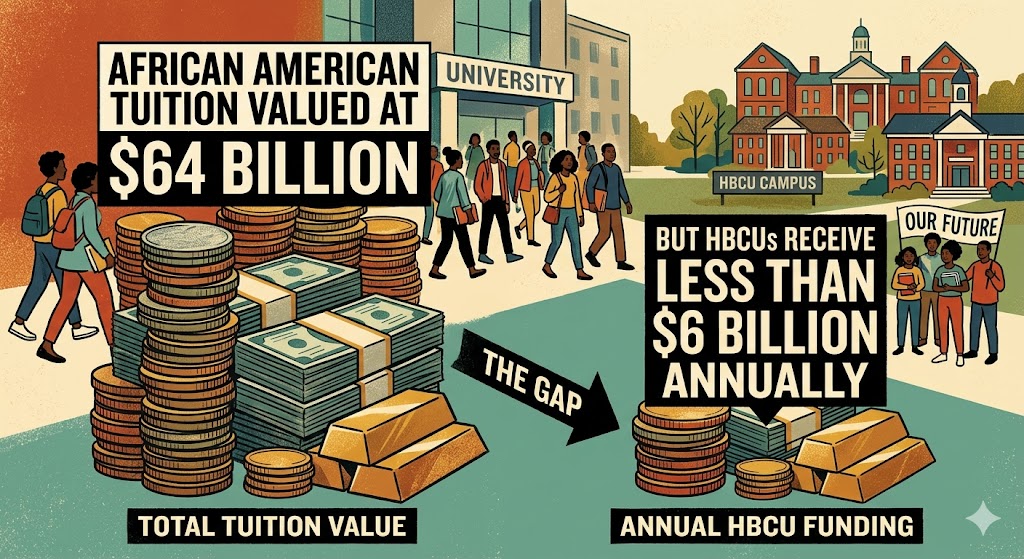
The paradox is impossible to ignore: African American communities consistently champion the importance of buying Black and supporting Black-owned businesses, yet when it comes to what may be the largest purchase of a lifetime, a college education, the overwhelming majority of Black families choose to invest those dollars elsewhere. This decision has profound consequences for the survival and strength of Historically Black Colleges and Universities, institutions that remain pillars of Black achievement, economic mobility, and community power.

As of Spring 2025, approximately 19.4 million students are enrolled in U.S. colleges and universities, with about 15 million undergraduates and over 3 million graduate students, according to data from the National Student Clearinghouse Research Center reported by NPR and BestColleges. This enrollment represents a recovery from pandemic-era declines, though numbers remain below 2010 peaks. African American students comprise roughly 13-15% of this total enrollment, representing approximately 2.5 to 2.9 million students across all institution types. When we calculate the economic value of these students based on current tuition rates, the numbers are staggering.

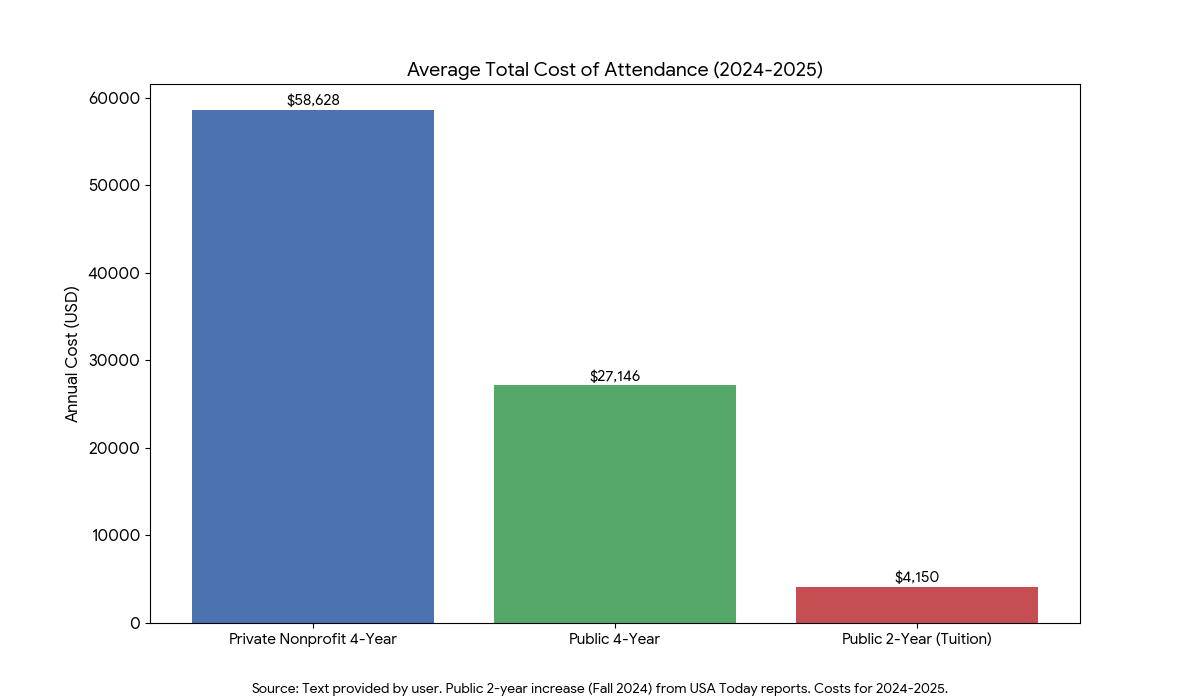
For the 2024-2025 academic year, public four-year institutions charge approximately $11,950 for in-state students and $31,880 for out-of-state students. Private nonprofit four-year schools average around $45,000 in tuition and fees. Public two-year colleges, which experienced a 3% enrollment increase in Fall 2024 according to USA Today reports, charge an average of $4,150 for in-district students. When you factor in room and board expenses, which averaged $13,310 for 2024-2025, the total cost of attendance reaches approximately $27,146 at public four-year institutions and $58,628 at private nonprofit four-year schools. Using a weighted average cost of attendance of approximately $26,000-$28,000 per year across all institution types, African American students and their families collectively spend approximately $64 billion annually on higher education. This represents enormous purchasing power—power that could transform Black institutions and communities if redirected strategically.
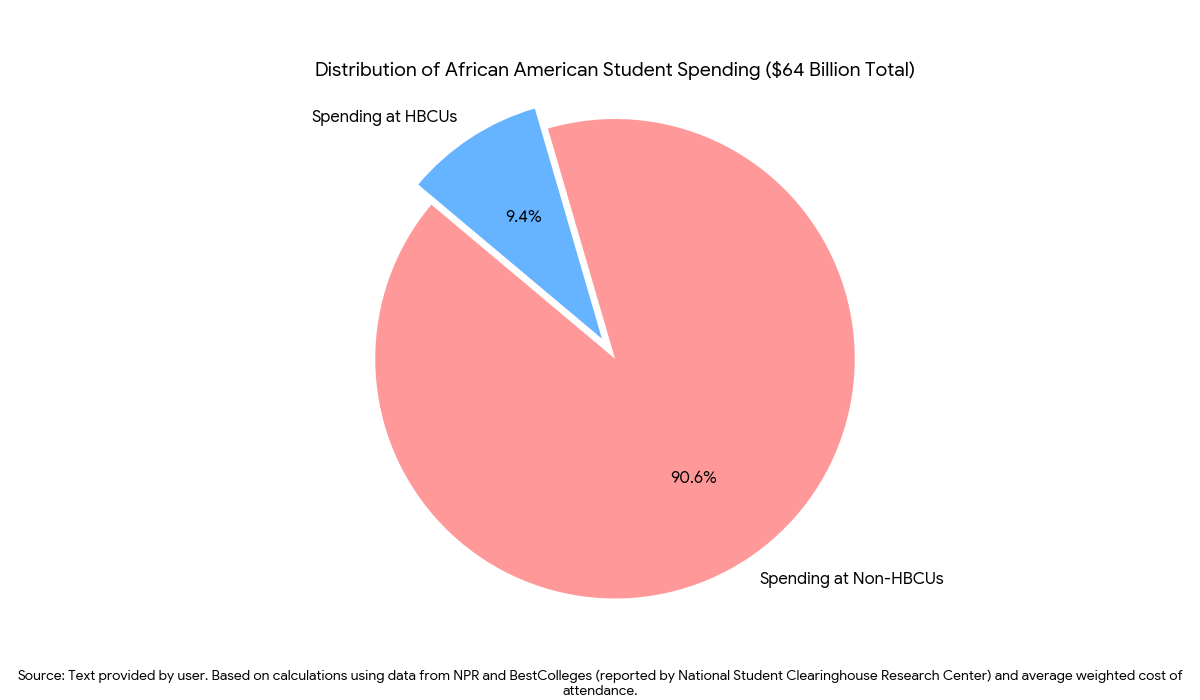
Here’s the uncomfortable truth: of that $64 billion, African American students at HBCUs represent only about $6 billion in tuition revenue and that $6 billion is essentially all HBCUs have to work with. Unlike predominantly white institutions with massive endowments, substantial state funding, and robust donor bases, HBCUs are almost entirely tuition-dependent. This means that more than 90% of African American education dollars approximately $58 billion annually flow to institutions that were not built for us, by us, or with our advancement as their primary mission.

We talk extensively about supporting Black businesses, banking Black, and keeping dollars circulating in our communities. Yet when families sit down to make college decisions, often the single largest financial investment they will make outside of purchasing a home, the conversation shifts. Suddenly, the narrative becomes about rankings, prestige, resources, and opportunities at predominantly white institutions, while HBCUs are considered as backup options or dismissed entirely.

This pattern has devastating consequences. The approximately 222,300 African American students currently enrolled at HBCUs generate roughly $6 billion in tuition revenue and for most HBCUs, that tuition revenue represents the vast majority of their operating budgets. Unlike well-endowed predominantly white institutions that rely heavily on endowment returns, substantial state appropriations, federal research grants, and robust alumni giving, HBCUs are critically dependent on tuition dollars just to keep their doors open. When Black students choose to take their tuition dollars elsewhere, it directly threatens these institutions’ survival, limiting their ability to maintain programs, hire faculty, upgrade facilities, and provide student services.

The impact extends far beyond immediate operating budgets. Every student who chooses a predominantly white institution over an HBCU represents not just lost tuition revenue today, but lost philanthropic potential tomorrow. Alumni giving is the lifeblood of institutional endowments, and alumni tend to give most generously to the institutions they attended. When successful Black professionals graduate from predominantly white institutions, their alumni donations when they give at all flow back to those schools. Harvard, Yale, Stanford, and other elite institutions benefit from the success of Black graduates who might have attended HBCUs if those institutions had received even a fraction of the resources concentrated at the top of higher education’s hierarchy. Meanwhile, HBCU endowments remain comparatively microscopic, not because their graduates are less successful, but because there are fewer of them writing checks back to their alma maters.

This creates a vicious cycle. Smaller enrollment means less tuition revenue and for institutions operating almost entirely on tuition, this is an existential threat. Fewer graduates means smaller donor pools. Smaller donor pools mean smaller endowments. Smaller endowments mean even greater dependence on tuition revenue and less money for scholarships, facilities, and programs. Less competitive resources make it harder to attract students. And the cycle continues, generation after generation.
The wealth gap between HBCU endowments and those of predominantly white institutions is staggering and growing. Howard University recently became the first HBCU to cross the $1 billion endowment mark, a milestone that should be celebrated but instead highlights the crisis. The top 10 HBCU endowments combined total approximately $2.6 billion. Meanwhile, Harvard University’s endowment alone exceeds $50 billion, and the top 10 predominantly white institutions hold a combined $336 billion in endowments. The PWI-to-HBCU endowment gap stands at 129 to 1. Only one HBCU has an endowment over $1 billion, while 148 predominantly white institutions have endowments exceeding that mark. This disparity means that while HBCUs scrape by on tuition revenue with minimal endowment support, elite PWIs can offer generous financial aid packages funded by massive investment returns, making them appear more affordable even as they siphon Black student dollars away from Black institutions.

In barbershops and beauty salons, at family gatherings and community events, the conversation about economic empowerment is constant. We discuss the importance of circulation of Black dollars, the need to build generational wealth, and the imperative of supporting institutions that support us. Social media amplifies calls to buy Black, support Black-owned restaurants, use Black banks, and patronize Black professionals. Yet somehow, this collective consciousness evaporates when it’s time to choose a college. Parents who wouldn’t think twice about driving across town to support a Black-owned business will encourage their children to attend predominantly white institutions without seriously considering HBCU alternatives. Students who wear “support Black business” t-shirts apply exclusively to schools where they will be a small minority, where their history may be marginalized, and where their dollars will fund institutions with no historical commitment to Black advancement.

This isn’t about judgment these are rational decisions made by families trying to secure the best possible future for their children in a competitive world. The problem is that these individual rational choices, when aggregated, produce a collective outcome that weakens the very institutions most committed to Black success.

Consider what HBCUs accomplish with their fraction of African American education dollars. These institutions enroll approximately 10% of all African American college students but produce nearly 20% of Black graduates. They generate an even higher percentage of Black professionals in critical fields like engineering, medicine, and education. The majority of Black doctors, a disproportionate share of Black lawyers, and a significant portion of Black educators earned their degrees from HBCUs. HBCUs create environments where Black students see themselves in positions of leadership, where their history and culture are centered rather than marginalized, and where they build networks that last lifetimes. Research consistently shows that Black students at HBCUs report higher levels of engagement, stronger sense of belonging, and greater confidence in their abilities compared to Black students at predominantly white institutions.

They accomplish all of this while operating on budgets that would be considered inadequate at any predominantly white institution. They make miracles happen with limited resources, outdated facilities, and faculty salaries that make it difficult to compete for top talent. Imagine what they could do with just a fraction of that $64 billion currently flowing elsewhere.

The numbers tell a stark story. Approximately 292,500 students currently attend HBCUs, with African American students comprising about 76% of that enrollment roughly 222,300 Black students. At an average cost of attendance of $26,000-$28,000 annually, these students represent approximately $6 billion in tuition revenue flowing to HBCUs each year. Meanwhile, the remaining 2.3 to 2.7 million African American college students roughly 90% of all Black college students generate approximately $58 billion in tuition revenue for predominantly white institutions.

Think about that ratio: $6 billion staying in Black institutions versus $58 billion leaving them. This isn’t about equity or fairness this is about economic power and where we choose to deploy it. Every semester, Black families collectively make purchasing decisions that send nearly ten times more money to institutions with no historical commitment to Black advancement than to institutions that were literally built to educate us when no one else would.

The enrollment landscape is shifting. Spring 2025’s 19.4 million total enrollment shows growth in both undergraduate and graduate programs. Particularly significant is the 3% surge in community college enrollment in Fall 2024, suggesting that cost considerations are increasingly driving educational decisions. This cost consciousness presents an opportunity. As families become more aware of student debt burdens and question the return on investment of expensive predominantly white institutions, HBCUs offer compelling value propositions. But they can only compete if they have the resources to tell their stories effectively, maintain quality programs, and provide the support services today’s students expect.

The net price reality adds another dimension. While published tuition rates provide a baseline, actual costs after financial aid vary significantly, typically ranging from $17,000 to $25,000 depending on institution type. However, African American students often face higher net prices than their peers at the same institutions due to lower family wealth and less access to non-loan aid. This means Black families are stretching further financially, taking on more debt, and working more hours often to attend institutions with no particular commitment to Black student success.

The solution requires a fundamental shift in how we think about educational choices. White families don’t agonize over whether to “give HBCUs a chance” they automatically prioritize their own institutions. They attend state flagships, legacy schools where their parents and grandparents went, institutions that have accumulated centuries of wealth from their community’s investment. They don’t need to be convinced to support their own. Yet somehow, Black families have internalized a narrative that HBCUs are noble but limited, worth considering but not prioritizing, respectable but not prestigious. This is the mental colonization that costs us $58 billion annually.

We need to be as intentional about our education spending as we claim to be about supporting Black businesses. This means making HBCUs the default choice, not the backup plan. It means understanding that when white families send their children to their flagship state universities and legacy institutions, they’re not making a sacrifice they’re making an investment in institutional power that compounds over generations. Black families deserve the same mindset. The choice of where to spend education dollars is an economic decision with ramifications far beyond individual degree attainment. It’s about building institutional power that can withstand political and social headwinds.

Institutional strength matters. Strong HBCUs create jobs in Black communities, anchor local economies, generate Black wealth through employment and contracts, and serve as catalysts for community development. They provide platforms for Black intellectual leadership, preserve and advance Black culture, and create networks of mutual support that span generations and geographies. In an increasingly uncertain social and political environment, the importance of strong Black institutions becomes even more apparent. When external support proves unreliable, when political winds shift, when social progress reverses, communities need institutions they control and can depend on. HBCUs represent exactly that kind of institutional foundation.

The question isn’t whether HBCUs deserve support their track record speaks for itself. The question is whether African American families will align their spending decisions with their stated values around Black economic empowerment. That $64 billion represents power—power to build, strengthen, and sustain institutions that have proven their commitment to Black success. How we choose to deploy that power will determine whether HBCUs merely survive or truly thrive in the generations ahead.

The choice is ours. The power has always been ours. The question is whether we’ll use it.

Disclaimer: This article was assisted by ClaudeAI.

HBCUs Can Fill the Void: How America’s Retreat from Polar Research Creates an Unprecedented Opportunity for Black Academic Leadership

“When I’m asked about the relevance to Black people of what I do, I take that as an affront. It presupposes that Black people have never been involved in exploring the heavens, but this is not so. Ancient African empires – Mali, Songhai, Egypt – had scientists, astronomers. The fact is that space and its resources belong to us, not to any one group.” – Mae Jemison

The United States government’s recent decision to withdraw its only research vessel from Antarctica represents more than a logistical setback for American science it signals a historic opportunity for Historically Black Colleges and Universities to claim leadership in one of the world’s most critical research frontiers.

When scientists like Alison Murray learned their Antarctic diving research would be indefinitely postponed due to the vessel withdrawal, it exposed a troubling reality: America is ceding scientific leadership in polar regions at precisely the moment when climate research has become existentially urgent. Yet within this crisis lies an opening that forward-thinking HBCU leaders and initiatives like the proposed HBCU Exploration Institute (HEI) should seize immediately.

The withdrawal of U.S. research capabilities from Antarctica isn’t happening in isolation. It reflects broader federal retreat from exploratory science across multiple domains from deep-sea mapping to atmospheric research to space exploration. As scientists told The Washington Post, building a replacement vessel could take years, leaving a generation of young researchers without access to critical field sites and diminishing American influence on a continent where geopolitical and scientific stakes are rising rapidly.

Currently, only a handful of nations operate dedicated Antarctic vessels capable of navigating the continent’s treacherous ice-choked waters. As America pulls back, countries including China, Russia, and even smaller nations are expanding their polar research fleets and infrastructure. This isn’t merely about scientific prestige it’s about who shapes climate policy, who controls access to research sites, who sets international standards for environmental stewardship, and ultimately, who benefits from discoveries made in these frontier regions.

For HBCUs, this federal abandonment creates a three-fold opportunity: to fill genuine research gaps with immediate societal value, to establish institutional leadership in high-stakes scientific domains, and to fundamentally reframe the narrative about who leads exploration and discovery in the 21st century.

The HBCU Exploration Institute concept outlined in its founding business plan isn’t simply about participating in exploration it’s about transforming who controls the means of discovery. The proposed organization would operate research vessels, aircraft, field stations, and space payloads governed and staffed by HBCU talent, creating a parallel infrastructure to traditional federal research systems. This model offers several strategic advantages in the current moment. First, HBCUs can move with greater institutional agility than large federal bureaucracies. While government agencies debate budget allocations and political appointees shift priorities with each administration, a Pan-African, HBCU-led exploration organization could secure diverse funding streams—from philanthropic foundations to international partnerships to corporate sponsors—that insulate research from political winds.

HBCUs bring essential perspectives to exploration science that mainstream institutions have historically marginalized. The concept of “exploration power” examining whose data is gathered, who gathers it, and who benefits is central to HEI’s mission. This isn’t abstract ethics; it’s practical strategy. Research conducted in partnership with African and Caribbean institutions, for example, can build diplomatic relationships and shared intellectual property frameworks that strengthen both African American and African Diaspora scientific capacity. The HBCU network represents untapped human capital. Talented Black students and faculty have faced persistent barriers to entry in traditional exploration fields, from oceanography to aerospace. An HBCU-led initiative could create direct pipelines from undergraduate research to polar expeditions to faculty positions, bypassing gatekeeping mechanisms that have kept exploration science predominantly white and economically privileged.

Perhaps most significantly, launching an HBCU exploration initiative at this moment positions these institutions as leaders not just in American higher education, but within the global African diaspora’s intellectual ecosystem. African and Caribbean nations are rapidly expanding their own scientific capabilities. The African Union Space Agency, launched in recent years, coordinates satellite programs and space research across the continent. Caribbean nations are investing in climate resilience research essential to their survival. Yet many of these institutions lack the infrastructure, funding, and international partnerships that even modestly-resourced American HBCUs can access.

An HBCU Exploration Institute operating polar icebreakers, conducting deep-sea research, and launching satellite payloads wouldn’t just advance American science it would establish HBCUs as anchor institutions for Pan-African scientific collaboration. Imagine Howard University leading joint oceanographic research with the University of Ghana, or Spelman College coordinating atmospheric monitoring stations across the Caribbean. The reputational gains would be transformative. This matters for recruitment, fundraising, and influence. Prospective students choosing between HBCUs v. PWIs would see real HBCU ships, real HBCU expeditions, and real HBCU career pathways into exploration science. Donors and foundations seeking to support climate research and diversity initiatives simultaneously would find a natural home. And HBCU presidents would have new platforms for thought leadership on issues from climate power to space policy to scientific diplomacy.

Here’s an uncomfortable truth: this initiative will only succeed if HBCU alumni associations mobilize with the same intensity, pride, and financial commitment they bring to homecoming football games and basketball tournaments. Every fall, HBCU alumni pour millions into athletics for season tickets, tailgate sponsorships, facility upgrades, coaching staff salaries. Alumni associations organize elaborate events, coordinate donor campaigns, and celebrate athletic achievements with genuine institutional pride. The Battle of the Real HU generates more alumni engagement and media attention than most academic programs receive in a decade. That energy, that organizational capacity, that willingness to invest must now be redirected toward exploration science with the same fervor.

Imagine if Howard University’s alumni association launched a “Name a Research Station” campaign with the same production value as a homecoming concert. Picture Spelman graduates organizing Antarctic expedition watch parties with the same enthusiasm as NCAA tournament viewing events. Envision FAMU’s National Alumni Association creating an “Explorers Circle” giving society that receives the same social prestige as premium athletic booster clubs. This isn’t criticism of HBCU athletics culture it’s a call to expand that culture to encompass scientific exploration. The infrastructure already exists. Alumni associations know how to run capital campaigns, coordinate reunion giving, leverage social networks, and create moments of collective pride. These skills transfer directly to funding research vessels and field stations.

The proposed HBCU Exploration Institute requires $102 million over three years. That sounds daunting until you consider that HBCU athletic programs collectively generate hundreds of millions annually, most of it from student fees. A coordinated campaign across major HBCU alumni networks—Howard, Spelman, Morehouse, Hampton, Tuskegee, FAMU, North Carolina A&T, Southern, Jackson State, Prairie View A&M—could realistically raise $25-30 million in year one if alumni leadership treats this with athletic-level urgency. Some institutions have already demonstrated this model. When North Carolina A&T needed to upgrade its engineering facilities, alumni responded with major gifts because they understood engineering excellence as core to institutional identity. Spelman’s alumni have funded science facilities and research programs. But these efforts have remained institution-specific and episodic. What’s needed now is collective, sustained mobilization.

Alumni associations must take several concrete actions immediately. First, every major HBCU alumni organization should establish an Exploration Science Committee with the same organizational status as athletic support committees. These groups would coordinate giving campaigns, identify potential major donors from alumni ranks, and create visibility for exploration research. Second, alumni homecoming and reunion events must begin celebrating scientific exploration with the same pageantry as athletics. Feature returning researchers presenting expedition findings. Honor alumni working in climate science, oceanography, and aerospace with the same recognition as athletic hall of fame inductees. Create traditions around scientific achievement that become part of institutional identity.

Third, alumni networks must leverage their professional positions to open doors. HBCU graduates work throughout corporate America, foundation leadership, and government agencies. An organized alumni effort could secure corporate sponsorships, foundation meetings, and federal partnership discussions that individual institutions struggle to access. When Hampton alumni at NASA advocate for HBCU partnerships, or Spelman graduates at the Mellon Foundation champion exploration science grants, institutional barriers dissolve. Fourth, alumni giving must be restructured to prioritize exploration infrastructure. Many alumni give to scholarship funds or general operating budgets, which is valuable but doesn’t build transformative capacity. Alumni associations should create specific endowments for vessel operations, expedition funding, and fellowship programs—tangible assets that generate sustained visibility and research output.

The cultural shift required is significant but not unprecedented. HBCU alumni already understand institutional pride, collective identity, and the power of coordinated action. They’ve built that culture around athletics because athletics has been positioned as central to HBCU identity and excellence. Exploration science must now be positioned the same way. This means changing the narrative from “HBCUs need better STEM programs” to “HBCUs will lead humanity’s next era of discovery.” It means alumni bragging about their school’s Antarctic expedition with the same pride they show for conference championships. It means young alumni seeing paths to exploration careers at their alma maters, not just at mainstream institutions.

The financial model becomes achievable when viewed through this lens. If each of the top 20 HBCU alumni associations committed to raising just $5 million over three years for exploration science—less than many spend on athletic facility upgrades—the startup capital is secured. Add foundation grants and federal partnerships, and the budget is covered. But more than money, alumni provide legitimacy, momentum, and accountability. When alumni demand progress on exploration science initiatives with the same intensity they demand winning seasons, institutional leadership responds. When alumni celebrate research expeditions with the same enthusiasm as rivalry games, prospective students take notice. When alumni networks coordinate giving and advocacy, transformation becomes possible.

The HEI business plan proposes a $102 million startup budget over three years to acquire vessels, establish field stations, fund expeditions, and build fellowship programs. That’s substantial, but it’s also achievable given current philanthropic interest in both climate research and HBCU development. The Bezos Earth Fund has committed billions to climate research. The Mellon Foundation has prioritized HBCU infrastructure investment. NASA and NOAA, despite federal constraints, actively seek diverse institutional partnerships. A well-organized HBCU consortium could secure multi-year commitments from these sources, particularly by framing the initiative as addressing federal research gaps.

The immediate focus should be marine research, where the vessel shortage is acute. Acquiring or leasing even one ocean-capable research ship—potentially a refitted commercial vessel—would allow HBCUs to begin Antarctic and Arctic research within two years rather than waiting for federal capacity to rebuild. Partnering with international research programs could offset operational costs while building the diplomatic relationships that strengthen HBCU global standing. Field stations in strategic locations like the Gulf Coast, Alaska, Ghana, the U.S. Virgin Islands would serve multiple functions: research platforms, student training sites, and hubs for international collaboration. These don’t require massive funding; even modest facilities become transformative when they provide HBCU students access to environments and equipment unavailable on their home campuses.

The fellowship and expedition programs are equally critical. Summer research academies focusing on polar, marine, and aerospace exploration would create immediate visibility and impact. Graduate fellowships with guaranteed expedition participation would attract top-tier students who might otherwise choose mainstream programs. Faculty sabbaticals at international field sites would bring research capacity and publications that elevate institutional rankings.

Predictable objections will emerge: HBCUs lack the expertise, the infrastructure, the established research networks. But these arguments mistake historical exclusion for inherent incapacity. HBCUs have produced astronauts, oceanographers, and polar scientists they’ve simply done so while their parent institutions received minimal support for exploration science infrastructure. Moreover, the proposed model explicitly builds on existing strengths. Many HBCUs have robust Earth science, environmental science, and physics programs that lack only field research opportunities. The institute wouldn’t create scientific capacity from nothing; it would provide the ships, stations, and funding to activate capacity that already exists but remains underutilized. The real risk isn’t that HBCUs might fail at exploration science it’s that by not trying, they’ll watch other institutions and nations claim leadership in domains that will define 21st-century research prestige and funding.

Federal withdrawal from Antarctic research won’t reverse quickly. Budget constraints, political dysfunction, and competing priorities mean the vessel gap could persist for a decade or more. That timeline perfectly matches the HEI five-year development plan, which envisions operational vessels and field stations by year three and landmark research publications by year four. HBCUs face a choice. They can wait for federal capacity to rebuild, competing for scarce berths on research vessels if and when they return to service. Or they can recognize this moment as the opportunity it is: a chance to build independent exploration infrastructure, establish diaspora research leadership, and fundamentally shift the narrative about who belongs in humanity’s most ambitious scientific endeavors.

But this choice isn’t just for presidents and administrators it’s for the millions of HBCU alumni whose collective power remains largely untapped for scientific advancement. The same alumni networks that fill stadiums, fund athletic scholarships, and travel across the country for homecoming games must now channel that organizational capacity toward building research fleets and exploration programs. The motto proposed for the HBCU Exploration Institute is “To Discover, To Lead, To Belong.” That sequence matters. Discovery creates the intellectual foundation. Leadership transforms institutions and influences policy. But belonging establishing permanent presence in exploration science requires infrastructure, commitment, and the willingness to act when opportunities emerge.

America’s retreat from Antarctica isn’t just a setback for researchers like Alison Murray. It’s an invitation for institutions that have been systematically excluded from exploration science to step forward and claim the leadership role they’ve always been capable of holding. The question is whether HBCU leaders and, crucially, whether HBCU alumni will recognize this moment and seize it before it passes. The energy, pride, and resources are already there mobilized. Now they must be redirected toward putting HBCU names on research vessels sailing to Antarctica, field stations conducting climate research, and satellite payloads orbiting Earth. That’s a legacy worth more than any championship trophy.