Tag Archives: hbcu vs pwi

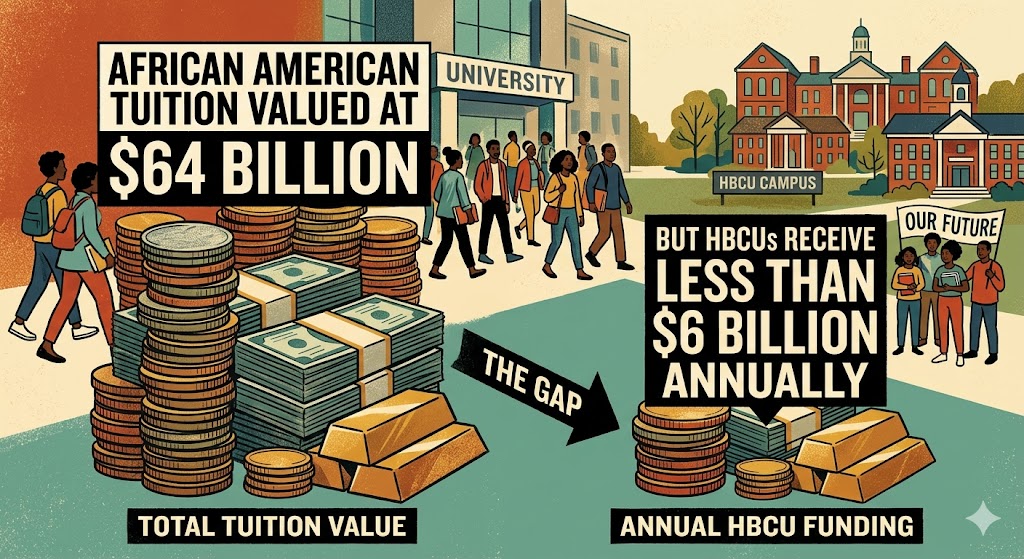
African American Tuition Valued At $64 Billion; But HBCUs Receive Less Than $6 Billion Annually

HBCUs are more than just schools, they are a home. – Chadwick Boseman

The paradox is impossible to ignore: African American communities consistently champion the importance of buying Black and supporting Black-owned businesses, yet when it comes to what may be the largest purchase of a lifetime, a college education, the overwhelming majority of Black families choose to invest those dollars elsewhere. This decision has profound consequences for the survival and strength of Historically Black Colleges and Universities, institutions that remain pillars of Black achievement, economic mobility, and community power.

As of Spring 2025, approximately 19.4 million students are enrolled in U.S. colleges and universities, with about 15 million undergraduates and over 3 million graduate students, according to data from the National Student Clearinghouse Research Center reported by NPR and BestColleges. This enrollment represents a recovery from pandemic-era declines, though numbers remain below 2010 peaks. African American students comprise roughly 13-15% of this total enrollment, representing approximately 2.5 to 2.9 million students across all institution types. When we calculate the economic value of these students based on current tuition rates, the numbers are staggering.

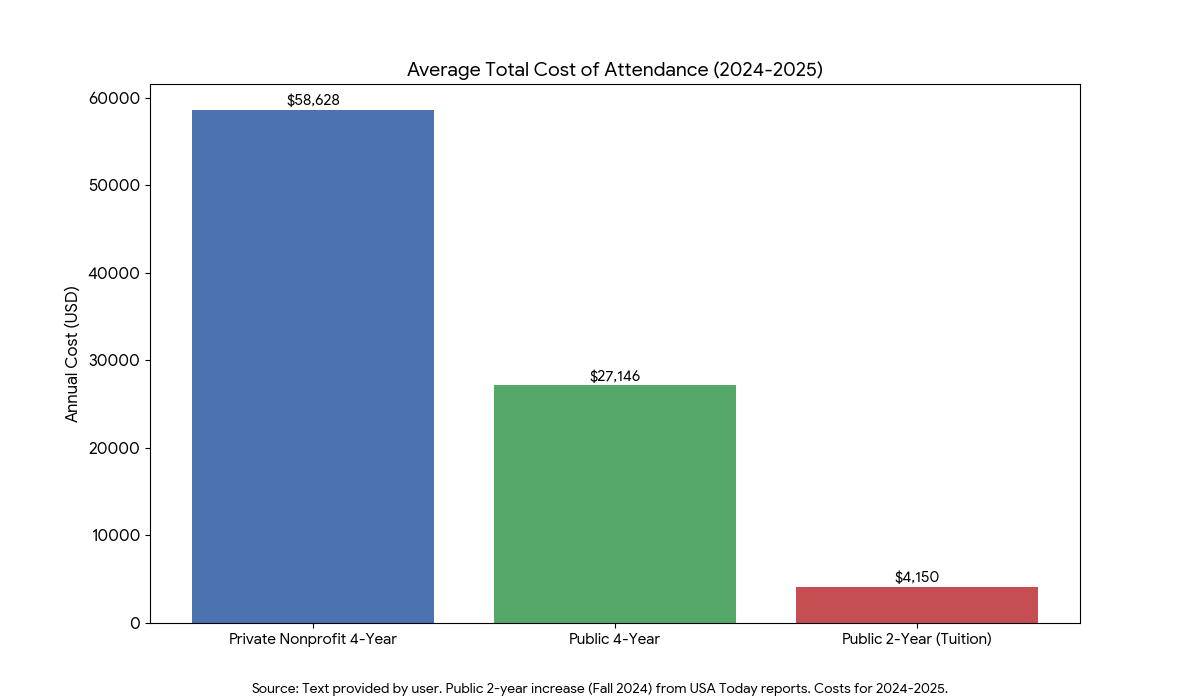
For the 2024-2025 academic year, public four-year institutions charge approximately $11,950 for in-state students and $31,880 for out-of-state students. Private nonprofit four-year schools average around $45,000 in tuition and fees. Public two-year colleges, which experienced a 3% enrollment increase in Fall 2024 according to USA Today reports, charge an average of $4,150 for in-district students. When you factor in room and board expenses, which averaged $13,310 for 2024-2025, the total cost of attendance reaches approximately $27,146 at public four-year institutions and $58,628 at private nonprofit four-year schools. Using a weighted average cost of attendance of approximately $26,000-$28,000 per year across all institution types, African American students and their families collectively spend approximately $64 billion annually on higher education. This represents enormous purchasing power—power that could transform Black institutions and communities if redirected strategically.

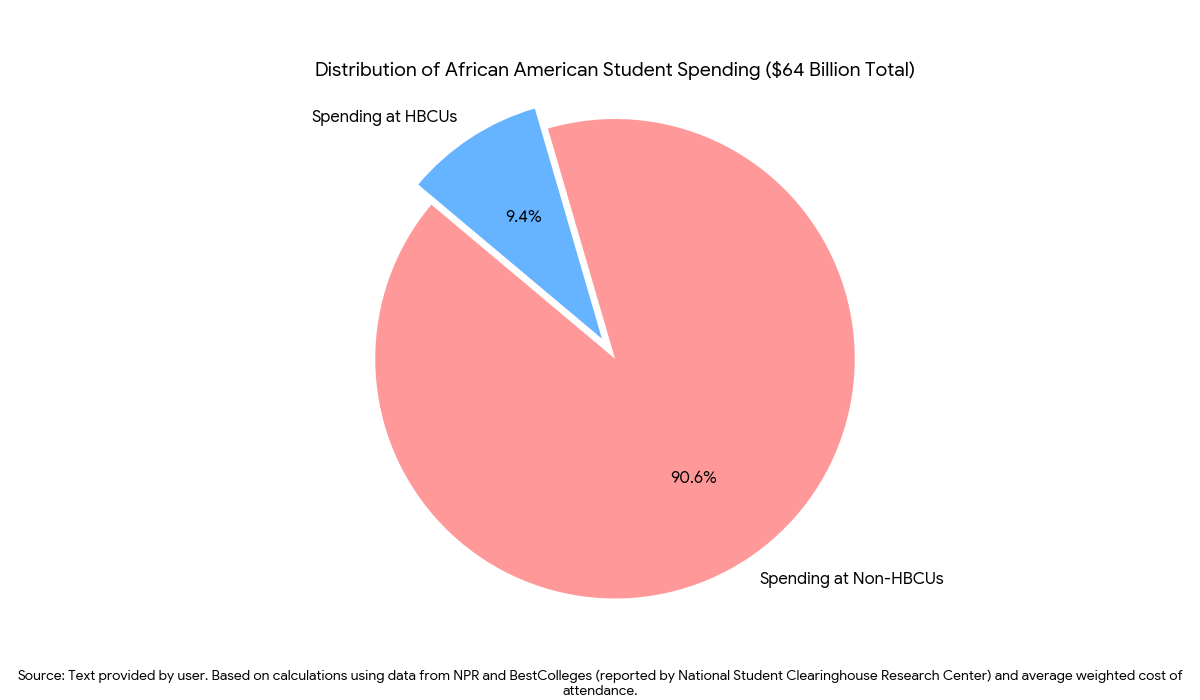
Here’s the uncomfortable truth: of that $64 billion, African American students at HBCUs represent only about $6 billion in tuition revenue and that $6 billion is essentially all HBCUs have to work with. Unlike predominantly white institutions with massive endowments, substantial state funding, and robust donor bases, HBCUs are almost entirely tuition-dependent. This means that more than 90% of African American education dollars approximately $58 billion annually flow to institutions that were not built for us, by us, or with our advancement as their primary mission.

We talk extensively about supporting Black businesses, banking Black, and keeping dollars circulating in our communities. Yet when families sit down to make college decisions, often the single largest financial investment they will make outside of purchasing a home, the conversation shifts. Suddenly, the narrative becomes about rankings, prestige, resources, and opportunities at predominantly white institutions, while HBCUs are considered as backup options or dismissed entirely.

This pattern has devastating consequences. The approximately 222,300 African American students currently enrolled at HBCUs generate roughly $6 billion in tuition revenue and for most HBCUs, that tuition revenue represents the vast majority of their operating budgets. Unlike well-endowed predominantly white institutions that rely heavily on endowment returns, substantial state appropriations, federal research grants, and robust alumni giving, HBCUs are critically dependent on tuition dollars just to keep their doors open. When Black students choose to take their tuition dollars elsewhere, it directly threatens these institutions’ survival, limiting their ability to maintain programs, hire faculty, upgrade facilities, and provide student services.

The impact extends far beyond immediate operating budgets. Every student who chooses a predominantly white institution over an HBCU represents not just lost tuition revenue today, but lost philanthropic potential tomorrow. Alumni giving is the lifeblood of institutional endowments, and alumni tend to give most generously to the institutions they attended. When successful Black professionals graduate from predominantly white institutions, their alumni donations when they give at all flow back to those schools. Harvard, Yale, Stanford, and other elite institutions benefit from the success of Black graduates who might have attended HBCUs if those institutions had received even a fraction of the resources concentrated at the top of higher education’s hierarchy. Meanwhile, HBCU endowments remain comparatively microscopic, not because their graduates are less successful, but because there are fewer of them writing checks back to their alma maters.

This creates a vicious cycle. Smaller enrollment means less tuition revenue and for institutions operating almost entirely on tuition, this is an existential threat. Fewer graduates means smaller donor pools. Smaller donor pools mean smaller endowments. Smaller endowments mean even greater dependence on tuition revenue and less money for scholarships, facilities, and programs. Less competitive resources make it harder to attract students. And the cycle continues, generation after generation.

The wealth gap between HBCU endowments and those of predominantly white institutions is staggering and growing. Howard University recently became the first HBCU to cross the $1 billion endowment mark, a milestone that should be celebrated but instead highlights the crisis. The top 10 HBCU endowments combined total approximately $2.6 billion. Meanwhile, Harvard University’s endowment alone exceeds $50 billion, and the top 10 predominantly white institutions hold a combined $336 billion in endowments. The PWI-to-HBCU endowment gap stands at 129 to 1. Only one HBCU has an endowment over $1 billion, while 148 predominantly white institutions have endowments exceeding that mark. This disparity means that while HBCUs scrape by on tuition revenue with minimal endowment support, elite PWIs can offer generous financial aid packages funded by massive investment returns, making them appear more affordable even as they siphon Black student dollars away from Black institutions.

In barbershops and beauty salons, at family gatherings and community events, the conversation about economic empowerment is constant. We discuss the importance of circulation of Black dollars, the need to build generational wealth, and the imperative of supporting institutions that support us. Social media amplifies calls to buy Black, support Black-owned restaurants, use Black banks, and patronize Black professionals. Yet somehow, this collective consciousness evaporates when it’s time to choose a college. Parents who wouldn’t think twice about driving across town to support a Black-owned business will encourage their children to attend predominantly white institutions without seriously considering HBCU alternatives. Students who wear “support Black business” t-shirts apply exclusively to schools where they will be a small minority, where their history may be marginalized, and where their dollars will fund institutions with no historical commitment to Black advancement.

This isn’t about judgment these are rational decisions made by families trying to secure the best possible future for their children in a competitive world. The problem is that these individual rational choices, when aggregated, produce a collective outcome that weakens the very institutions most committed to Black success.

Consider what HBCUs accomplish with their fraction of African American education dollars. These institutions enroll approximately 10% of all African American college students but produce nearly 20% of Black graduates. They generate an even higher percentage of Black professionals in critical fields like engineering, medicine, and education. The majority of Black doctors, a disproportionate share of Black lawyers, and a significant portion of Black educators earned their degrees from HBCUs. HBCUs create environments where Black students see themselves in positions of leadership, where their history and culture are centered rather than marginalized, and where they build networks that last lifetimes. Research consistently shows that Black students at HBCUs report higher levels of engagement, stronger sense of belonging, and greater confidence in their abilities compared to Black students at predominantly white institutions.

They accomplish all of this while operating on budgets that would be considered inadequate at any predominantly white institution. They make miracles happen with limited resources, outdated facilities, and faculty salaries that make it difficult to compete for top talent. Imagine what they could do with just a fraction of that $64 billion currently flowing elsewhere.

The numbers tell a stark story. Approximately 292,500 students currently attend HBCUs, with African American students comprising about 76% of that enrollment roughly 222,300 Black students. At an average cost of attendance of $26,000-$28,000 annually, these students represent approximately $6 billion in tuition revenue flowing to HBCUs each year. Meanwhile, the remaining 2.3 to 2.7 million African American college students roughly 90% of all Black college students generate approximately $58 billion in tuition revenue for predominantly white institutions.

Think about that ratio: $6 billion staying in Black institutions versus $58 billion leaving them. This isn’t about equity or fairness this is about economic power and where we choose to deploy it. Every semester, Black families collectively make purchasing decisions that send nearly ten times more money to institutions with no historical commitment to Black advancement than to institutions that were literally built to educate us when no one else would.

The enrollment landscape is shifting. Spring 2025’s 19.4 million total enrollment shows growth in both undergraduate and graduate programs. Particularly significant is the 3% surge in community college enrollment in Fall 2024, suggesting that cost considerations are increasingly driving educational decisions. This cost consciousness presents an opportunity. As families become more aware of student debt burdens and question the return on investment of expensive predominantly white institutions, HBCUs offer compelling value propositions. But they can only compete if they have the resources to tell their stories effectively, maintain quality programs, and provide the support services today’s students expect.

The net price reality adds another dimension. While published tuition rates provide a baseline, actual costs after financial aid vary significantly, typically ranging from $17,000 to $25,000 depending on institution type. However, African American students often face higher net prices than their peers at the same institutions due to lower family wealth and less access to non-loan aid. This means Black families are stretching further financially, taking on more debt, and working more hours often to attend institutions with no particular commitment to Black student success.

The solution requires a fundamental shift in how we think about educational choices. White families don’t agonize over whether to “give HBCUs a chance” they automatically prioritize their own institutions. They attend state flagships, legacy schools where their parents and grandparents went, institutions that have accumulated centuries of wealth from their community’s investment. They don’t need to be convinced to support their own. Yet somehow, Black families have internalized a narrative that HBCUs are noble but limited, worth considering but not prioritizing, respectable but not prestigious. This is the mental colonization that costs us $58 billion annually.

We need to be as intentional about our education spending as we claim to be about supporting Black businesses. This means making HBCUs the default choice, not the backup plan. It means understanding that when white families send their children to their flagship state universities and legacy institutions, they’re not making a sacrifice they’re making an investment in institutional power that compounds over generations. Black families deserve the same mindset. The choice of where to spend education dollars is an economic decision with ramifications far beyond individual degree attainment. It’s about building institutional power that can withstand political and social headwinds.

Institutional strength matters. Strong HBCUs create jobs in Black communities, anchor local economies, generate Black wealth through employment and contracts, and serve as catalysts for community development. They provide platforms for Black intellectual leadership, preserve and advance Black culture, and create networks of mutual support that span generations and geographies. In an increasingly uncertain social and political environment, the importance of strong Black institutions becomes even more apparent. When external support proves unreliable, when political winds shift, when social progress reverses, communities need institutions they control and can depend on. HBCUs represent exactly that kind of institutional foundation.

The question isn’t whether HBCUs deserve support their track record speaks for itself. The question is whether African American families will align their spending decisions with their stated values around Black economic empowerment. That $64 billion represents power—power to build, strengthen, and sustain institutions that have proven their commitment to Black success. How we choose to deploy that power will determine whether HBCUs merely survive or truly thrive in the generations ahead.

The choice is ours. The power has always been ours. The question is whether we’ll use it.

Disclaimer: This article was assisted by ClaudeAI.
HBCU B-Schools’ Leadership Still Embarrassingly Lacking In HBCU Alumni

The most difficult thing in life is to know yourself. — Thales

The Graham Principle: Why HBCU Business Schools Must Lead From Within

Warren Buffett’s rejection by Benjamin Graham is more than a quaint footnote in the history of American finance. It is a parable about institutional loyalty, strategic insulation, and the deliberate construction of parallel economic power. Graham, the architect of value investing, declined to hire the future Oracle of Omaha not for lack of qualification but for reasons of principle. At a moment when Wall Street’s doors remained firmly closed to European American Jews, Graham made a conscious decision to build from within his own community. His hiring practices were not sentimental. They were strategic—an act of institutional self-preservation in a market structured against him. He understood that talent required more than identification; it required cultivation, protection, and deliberate positioning within institutions the community itself controlled.

A decade has passed since anyone undertook a comprehensive examination of leadership trends within HBCU business schools. The intervening years might reasonably have produced a renaissance of internal cultivation—an era defined by deliberate succession planning, alumni-led governance, and a clear institutional commitment to developing leadership from within. That hope has gone largely unrealized. Across the landscape of HBCU business education, the preference for external hires persists, the pipeline for internal leadership development remains thin, and the governing logic of these schools continues to defer, implicitly or explicitly, to standards of excellence defined by the very institutions that historically excluded Black scholars from full participation.

The appointment of deans and senior faculty from predominantly white institutions is routinely framed as a commitment to excellence—the familiar rhetoric of meritocracy dressed in the language of best practices. What this framing systematically obscures is the structural disadvantage HBCU graduates face in academic and professional labor markets, disadvantages produced not by deficiency but by decades of underfunding, network exclusion, and credential discrimination. When HBCU business schools accept this framing uncritically, they do not rise above structural inequality; they reproduce it within their own walls. The result is a business education ecosystem that remains institutionally disconnected from the communities it is chartered to serve.

Of the 85 accredited HBCU business schools and departments operating under the latest available data, fewer than 20 percent are led by HBCU alumni. Of that minority, fewer than half hold both undergraduate and graduate degrees from HBCUs, further attenuating the institutional knowledge that might otherwise be reinvested across the ecosystem. The contrast with elite PWI practice is clarifying. Approximately 75 percent of business school deans at Ivy League institutions hold at least one degree from an Ivy League school. This is not coincidence. It reflects a deliberate institutional philosophy that prizes continuity, internal network loyalty, and cultural capital accumulated within the institution itself. These schools understand that leadership is not merely a management function. It is an expression of institutional identity and a mechanism for transmitting values across generations of students and faculty.

HBCU business schools have not absorbed that lesson with equivalent seriousness. The absence of a deliberate succession strategy—one that identifies, mentors, and elevates internal talent over sustained periods—constitutes a structural failure that compounds over time. When young Black scholars do not see themselves reflected in the senior leadership of their own institutions, the implicit signal is that the path to authority runs elsewhere. And so it does. Promising scholars educated at HBCUs routinely migrate to PWIs for higher compensation, greater prestige, or more robust professional infrastructure. When those scholars eventually ascend to positions of institutional leadership, their loyalty and networks do not reliably return. The brain drain becomes self-reinforcing, and the institutions that initially formed these scholars see little of the compounded return on that investment.

This pattern might be called institutional amnesia—a collective failure to study, internalize, and replicate the strategies through which other minority communities have built durable institutional ecosystems. Jewish, Catholic, and Mormon institutions have each constructed powerful networks by systematically aligning leadership selection with community identity, concentrating institutional resources within their own structures, and maintaining cultural continuity across leadership transitions. They benchmark their performance against their own historical trajectories and communal objectives, not against the preferences of institutions oriented toward different communities and different purposes. HBCU business schools, by contrast, frequently evaluate themselves against ranking systems and accreditation frameworks built around metrics that reflect neither their mission nor the specific market failures their students are positioned to address.

The strategic costs of this posture are substantial and compounding. Recruitment searches for business school deans, when conducted through executive search firms, routinely exceed $250,000 in direct expense. When that investment produces a dean with limited institutional loyalty and no deep roots in the community the school serves, the organization is exposed to the further costs of short tenures, strategic discontinuity, and misaligned fundraising. Business schools function as economic engines—engines that generate networks, direct student talent toward particular career paths, shape research agendas, and produce or fail to produce the intellectual infrastructure that sustains community-level economic development. Leadership that lacks genuine cultural and strategic commitment to the HBCU mission cannot be expected to operate that engine in the community’s interest.

The curriculum consequences are equally significant. HBCU business schools exist in a moment when the structural dimensions of Black economic life—persistent wealth gaps, discriminatory access to capital, the collapse of Black-owned financial institutions, the chronic underdevelopment of Black neighborhoods—constitute some of the most pressing and tractable problems in American political economy. Addressing those problems requires not merely academic competence but institutional orientation. Who is designing curricula around cooperative economics and community wealth retention? Who is building research programs on Black entrepreneurship, the historical function of Black banking, and the mechanics of financial exclusion? Who is developing partnerships with Black-owned financial institutions, investment funds, and real estate developers that would allow students to graduate with network capital as well as intellectual credentials? These priorities require leadership that has been formed within the ecosystem, that understands its history, and that has a personal stake in its long-term trajectory.

The Graham analogy holds at precisely this level of analysis. Graham’s decision to hire from within his community was not a concession to sentiment. It was a calculated judgment that institutional effectiveness depended on leadership whose values, networks, and long-term interests were structurally aligned with the institution’s mission. He was not interested in demonstrating that his firm could attract talent validated by mainstream institutions. He was interested in building something that would compound over time within his own community’s orbit. The question for HBCU business school leadership is whether a comparable institutional logic is possible—and whether the will exists to pursue it.

The remedies are neither mysterious nor beyond reach, but they require deliberate institutional action sustained over years rather than episodic declarations of intent. HBCU business schools must establish formal succession pipelines that identify promising alumni early, support their doctoral training and early-career development, and create structured pathways back into institutional leadership. Mentorship programs, leadership fellowships, and transparent internal promotion tracks are the instruments through which this pipeline is built and maintained. Without them, talented HBCU alumni will continue to be absorbed by institutions with superior infrastructure, and the cycle of external dependence will continue.

Boards of trustees and presidential leadership must also reckon honestly with the hiring criteria that have produced current outcomes. Cultural alignment, mission literacy, and demonstrated investment in HBCU communities should carry weight commensurate with academic credentials in dean and faculty searches. These are not competing values. They are complementary ones, and institutions that treat them as such will find that the pool of qualified, mission-aligned candidates is larger than conventional search processes have suggested.

The benchmarks against which HBCU business schools measure their progress require reconstruction as well. Chasing rankings defined by and for PWIs produces strategic mimicry rather than institutional distinctiveness. The appropriate comparators are institutions that have used internal leadership and community alignment to produce durable economic outcomes for the communities they serve. The relevant question is not whether an HBCU business school resembles Wharton. It is whether that school is building the human capital, research infrastructure, and network density that the African American institutional ecosystem requires to become economically self-reinforcing.

Alumni hold a particular form of leverage in this process that has been insufficiently exercised. Philanthropic capital directed toward HBCU business schools carries with it the legitimate expectation of institutional integrity. Alumni who fund these schools are entitled to ask whether the institutions are investing in their own—whether succession planning exists, whether internal candidates are being developed and promoted, whether the school’s research and curricular agenda reflects the community’s strategic needs. These are not hostile demands. They are the expressions of institutional ownership that any serious donor community directs toward the organizations it sustains.

The broader HBCU ecosystem has long understood, at least in principle, that institutional density is the precondition for community resilience. Strong communities are not produced by exceptional individuals operating in isolation. They are produced by networks of reinforcing institutions—universities, banks, hospitals, media organizations, research centers—that retain capital, concentrate talent, and coordinate strategically across organizational boundaries. Business schools are a critical node in that network. They are the institutions most directly positioned to translate academic investment into economic infrastructure, to convert tuition into entrepreneurial capacity, and to channel philanthropic capital into research that serves the community’s long-term interests. Their leadership must reflect that position.

The failure to develop and elevate HBCU alumni into business school leadership is not simply an administrative oversight. It is a strategic error with consequences that extend well beyond the schools themselves. Every dean recruited from outside the ecosystem without a plan to develop internal successors is a missed compounding opportunity. Every promising scholar who departs for a PWI without a pathway back represents a loss of accumulated institutional knowledge that will not return on its own. Every curriculum designed to satisfy external accreditation standards at the expense of community-relevant content is a semester in which the institution’s potential as an engine of economic development goes partially unrealized.

Graham built his firm on the premise that talent required institutional protection to reach its full potential—that external markets, structured against your community, could not be trusted to recognize or reward what you were building. That premise has lost none of its force. HBCU business schools that internalize it, and act on it with the rigor and consistency it demands, will be better positioned to fulfill the extraordinary institutional promise that their founding represented. Those that continue to defer to external validation and outsourced leadership will find that the promise remains exactly that—unrealized, and over time, increasingly difficult to recover.

Disclaimer: This article was assisted by ClaudeAI.
From Classrooms to Cleanrooms: What HBCUs Must Do to Compete with PWIs in Deep Tech and Semiconductor Innovation

“A lot of kids growing up today aren’t told that you can be whatever you want to be. I am living proof you can do that. If you have the talent and the passion, you can build the future.” – Mark Dean, Black IBM engineer and inventor who co-created the personal computer and holds three of IBM’s original nine PC patents

In late June 2025, HEXAspec—a Rice University spinout—captured a $500,000 National Science Foundation (NSF) Partnership for Innovation grant for its breakthrough work in thermal management for GPUs. In a tech world grappling with the environmental and efficiency challenges of artificial intelligence (AI) and high-performance computing, the achievement turned heads across academic, investment, and scientific communities alike. Yet amid the applause lies a hard truth: not one HBCU was remotely close to competing for that same prize. Not because HBCUs lack talent, but because they lack the systemic infrastructure to harvest, incubate, and capitalize on that talent.

The chasm between HBCUs and predominantly white institutions (PWIs) in deep tech commercialization is as wide as it is worrisome. Deep tech—defined by transformative innovation in areas like semiconductors, quantum computing, and climate technology—requires long-term capital, robust research infrastructure, and high-trust, high-dollar partnerships with government and industry. These are precisely the things HBCUs have historically been denied or underinvested in. The question now is not whether HBCUs can catch up—but whether they will prioritize institutional shifts necessary to stop losing by default.

The Innovation Economy: The New Gateway to Power

Today’s innovation economy is no longer driven by consumer startups hawking mobile apps. Instead, it is being shaped by semiconductors, AI infrastructure, clean energy technologies, and advanced materials. These domains form the core of what the Department of Commerce calls “national critical capabilities”—a short list of sectors that will dictate U.S. competitiveness in the coming century.

The federal government, through the CHIPS and Science Act, the Inflation Reduction Act, and NSF initiatives like the Engines program, has made clear where it will direct its attention—and money. However, most of that funding has flowed to elite PWIs like MIT, Stanford, and Rice. Why? Because those institutions have built systems that convert faculty research into startups, license technologies to Fortune 500 companies, and aggressively pursue government grants through dedicated offices with seasoned staff and alumni connections.

HBCUs, by contrast, often find themselves trapped in subsistence mode—juggling shrinking state funding, donor droughts, and outdated infrastructure. Even when they do produce brilliant scientists and engineers, they are often siphoned off by PWIs, venture capital firms, or federal labs where their IP contributions enrich other institutions.

The goal for HBCUs is not just to get a slice of the pie—it is to own the bakery.

Why HBCUs Are Losing in Deep Tech (And How To Fix It)

1. No Institutionalized Commercialization Pathways

Rice University’s HEXAspec didn’t win a grant because of luck. It emerged from the university’s Liu Idea Lab for Innovation and Entrepreneurship (Lilie), which exists solely to help faculty and students translate research into viable companies. Most HBCUs do not have such a lab—or even a dedicated Office of Technology Transfer.

To compete, HBCUs must institutionalize commercialization in their mission. This means establishing:

  • Internal seed funding mechanisms for promising research
  • Technology transfer offices with experienced patent lawyers and startup advisors
  • Accelerator programs targeting deep tech verticals
  • Alumni angel networks to fund spinouts

Without these, ideas will remain trapped in the lab—and the economic fruits will go elsewhere.

2. Lack of Research Infrastructure in Key Industries

Semiconductors, materials science, and energy storage require state-of-the-art labs, cleanrooms, and expensive machinery. These are multi-million-dollar commitments most HBCUs currently lack. But waiting for philanthropy or state generosity to fund them is a losing strategy.

Instead, HBCUs should pursue regional consortia to co-own such infrastructure. For example, a Deep South Semiconductor Consortium could bring together Jackson State, Tuskegee, Southern University, and Prairie View A&M to jointly invest in fabrication labs, wafer testing facilities, and AI research clusters. Land-grant HBCUs have both the land and the federal designation to attract such funding—if they are organized and bold.

3. Underleveraged Alumni Networks

MIT alumni fund startups before most even have a name. At HBCUs, alumni often wait for a call to contribute to scholarships or athletic departments. There is little systemic cultivation of alumni as early-stage investors, strategic partners, or board members in research spinouts.

This must change. Institutions like Howard, Morehouse, and NC A&T should be grooming alumni with industry experience to invest in campus spinouts. HBCU endowments should allocate a small percentage to internal venture capital—seeding their own companies instead of investing in white-led VC funds that ignore Black founders.

4. Faculty Incentives and Sabbaticals

Many HBCU faculty juggle overwhelming teaching loads, with little time or incentive for research commercialization. Unlike PWIs, where professors routinely take sabbaticals to commercialize research or sit on startup boards, HBCUs rarely support such flexibility.

Presidents and provosts must restructure faculty contracts to reward commercialization, encourage patent filings, and support teaching reductions for faculty leading deep tech ventures. Faculty must become institutional entrepreneurs, not just employees.

Federal Funding Alone Won’t Save Us

Yes, HBCUs have been historically underfunded. Yes, they face structural racism. But federal funding, when it comes, should meet us halfway—not pull us from the basement. Competing for NSF grants requires grant writers, internal review committees, and aggressive outreach. When Rice University wins NSF money, it’s because the institution has a playbook.

HBCUs need a playbook. The White House’s Initiative on HBCUs can fund technical assistance centers focused on grant acquisition, proposal design, and intellectual property strategy. These centers should live at HBCUs, not just be managed by consulting firms and retired PWI administrators with no stake in HBCU sovereignty.

Deep Tech is a Strategic Asset. HBCUs Must Treat it as Such.

In 2025, global supply chains are being rewritten. Semiconductor control is no longer just an industry issue—it is national security. Nations are forming tech alliances. Cities are building innovation districts. And investors are backing companies with decade-long R&D timelines because the rewards are generational.

HBCUs must enter this arena with the same clarity and urgency as any geopolitical actor. The institutions that helped engineer Black America’s ascent during segregation must now help engineer Black America’s role in the Fourth Industrial Revolution. That means going far beyond DEI rhetoric and focusing on institutional capital, not just human capital.

What a Competitive HBCU Ecosystem Could Look Like

Imagine this:

  • Howard University launches a Deep Tech Lab with funding from Black-led venture capital firms.
  • NC A&T, already a top producer of Black engineers, builds a quantum computing facility co-owned with MIT Lincoln Lab, with graduates flowing into DARPA-backed projects.
  • Fisk University, with its elite physics tradition, leads a semiconductor materials initiative funded through an HBCU Engines grant from NSF.
  • HBCU United, a new consortium of 30 HBCUs, pools $100M in alumni capital to invest in research commercialization, faculty sabbaticals, and patent acquisition.

This is not fantasy. It is simply the result of what happens when HBCUs start behaving like institutions of power—not institutions asking for inclusion.

Compete or Be Colonized (Again)

The innovation economy is not just about startups and science. It is about who will own the 21st century. If HBCUs do not build internal capacity to compete in the deep tech space, they will become labor farms—training brilliant Black minds who will go on to build white wealth.

Rice University’s HEXAspec is a signal — and a threat. It tells us what’s possible. The question is whether HBCUs will treat it as a wake-up call or another missed opportunity.

In the words of Frederick Douglass, “Power concedes nothing without a demand.” It’s time HBCUs demand more—of themselves and of the systems they are meant to challenge. The lab coats may be new, but the game remains the same: compete, or be colonized.

Disclaimer: This article was assisted by ChatGPT.