
This here, right now, at this very moment, is all that matters to me. I love you. That’s urgent like a motherf**ker. – Darius Lovehall
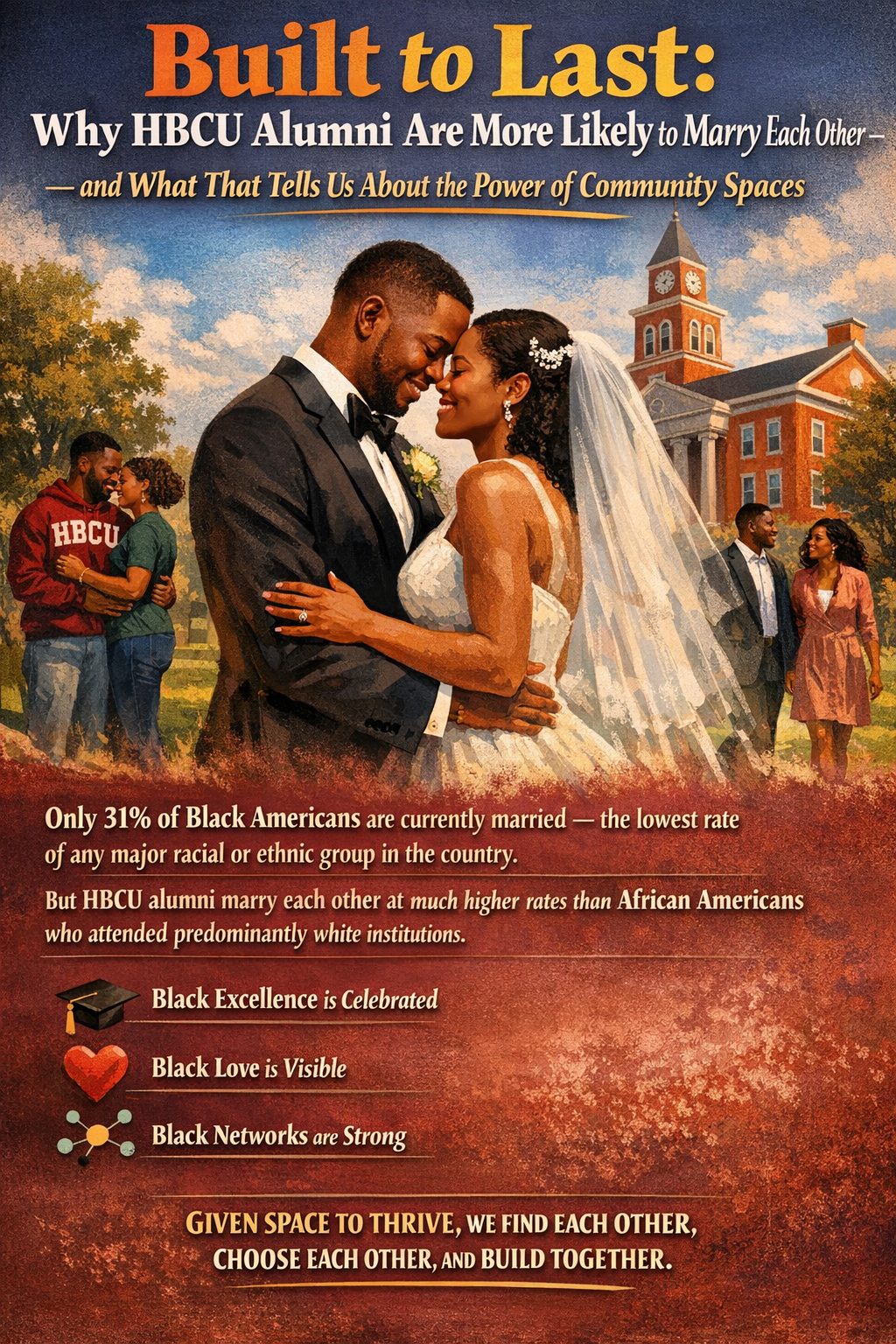
There is a particular kind of magic that happens when Black people are given the space to simply be to lead, to create, to fail and succeed without the exhausting weight of being a perpetual outsider. Historically Black Colleges and Universities have always understood this. For more than 150 years, HBCUs have offered something that no diversity initiative, no DEI task force, and no affinity group within a predominantly white institution can fully replicate: an entire ecosystem built in, by, and for Black people. The effects of that ecosystem ripple outward in ways we are still measuring including into who HBCU alumni choose to build their lives with.
Research into the marital patterns of African Americans reveals a striking divergence between HBCU graduates and their counterparts who attended predominantly white institutions. HBCU alumni marry each other — Black men marrying Black women, Black women marrying Black men at significantly higher rates than African Americans who attended PWIs, where interracial marriages are considerably more common. This is not a coincidence. It is the natural fruit of what intentional community spaces produce.
The baseline numbers are sobering. Only 31% of Black Americans are currently married, compared to 48% of all Americans. Half of African Americans have never been married, compared to 34% of the general population, making African Americans the least married of any major racial or ethnic group in the country. There are approximately 5.18 million Black married-couple families in the United States today. That number has room — significant room — to grow. Currently, about 9–10% of Black college students attend HBCUs. Among college-educated Black newlyweds at PWIs, roughly 21% marry someone from another racial or ethnic group, with that figure rising to 30% among college-educated Black men. The picture at HBCUs is markedly different, and the reasons are structural, not accidental.
The social architecture of an HBCU where Black students are the majority, the leadership, the faculty, the homecoming court, the engineering honor society, and the debate team means that the romantic world reflects the academic world. HBCU alumni who marry are overwhelmingly likely to have met their spouse within a Black social and professional network, often one that traces its roots directly back to campus. African Americans who attend PWIs, by contrast, are exposed to a social universe numerically and institutionally dominated by white peers. Friendships, romantic relationships, and professional networks form disproportionately across racial lines not through any individual fault, but as a straightforward consequence of who is in the room. When your environment is 85% white, the statistical likelihood of cross-racial coupling rises organically. The HBCU alumni network functions, among other things, as a long-running and remarkably effective matchmaking institution one whose impact on community formation has never been fully quantified.
Sociologists have long understood that residential and institutional proximity is one of the strongest predictors of who people marry. We meet our partners in the spaces we inhabit — at work, at school, in our neighborhoods, at our houses of worship. The institution you attend for four formative years, the one that shapes your professional ambitions, your intellectual identity, your social circle, and your sense of self, will inevitably shape who you consider a natural life partner. For HBCU students, those four years are spent in an environment where Black excellence is not exceptional it is expected. Where Black love is not a political statement but a daily reality, visible in the couples holding hands on the quad, in the married faculty members co-teaching courses, in the alumni couples who return to homecoming year after year. Love, like ambition and leadership, is modeled. Young people see what is possible and, consciously or not, begin to orient their own futures accordingly.
PWI environments, for all their academic prestige, rarely offer this. Black students at PWIs often describe a bifurcated social experience belonging to affinity groups and cultural organizations that provide community, while simultaneously navigating a broader campus culture in which they are the minority. Black love is possible at PWIs, of course, and it flourishes there too. But the structural conditions do not make it the default. They make it something you find in spite of your environment, not because of it.
This conversation extends well beyond marriage rates, though those rates are a particularly measurable indicator of something larger. What HBCUs demonstrate is the transformative power of institutions that a community owns, shapes, and sustains for itself. This principle has animated Black institution-building in America since Reconstruction from Black Wall Street in Tulsa to the network of Black-owned banks, newspapers, hospitals, and churches that constituted what historians call the “Black counterpublic.” When a community has its own institutions, it controls its own narratives. It defines its own standards of beauty, intelligence, leadership, and desirability. It produces its own role models, generates its own wealth pathways, and creates an internal ecosystem dense enough that community members can meet each other’s needs — economic, social, spiritual, romantic — without having to seek fulfillment exclusively in outside spaces. The higher intra-community marriage rate among HBCU alumni is one data point in a much larger argument: that Black institutions do not merely provide education or services. They produce belonging. And belonging, once cultivated, has a way of reproducing itself in careers built together, in communities sustained together, and in families formed together.
For a publication dedicated to the intersection of Black financial life and Black excellence, the marriage data carries specific economic weight. Marriage, when it functions well, is one of the most powerful wealth-building vehicles available to any household. Two incomes, shared expenses, combined assets, coordinated estate planning, and intergenerational wealth transfer — these are the mechanisms by which families accumulate and maintain economic stability across generations. The racial wealth gap in the United States is staggering and persistent. For Black families to close that gap through their own accumulated power, marriage stability within the community matters. When HBCU alumni marry each other, they are pooling Black wealth with Black wealth building households that invest in Black communities, buy homes in Black neighborhoods, fund Black businesses, and leave assets to Black children. This is not about exclusion. It is about the compounding power of economic solidarity.
HBCU alumni already tend to earn strong incomes, leverage their alumni networks for professional advancement, and demonstrate higher rates of giving back to their alma maters and communities. According to the Gallup-USA Funds Minority College Graduates Report, 40% of Black HBCU graduates report thriving in financial well-being, compared to just 29% of Black graduates from non-HBCUs — the largest well-being gap Gallup measured between the two groups. Economic stability is one of the strongest individual predictors of marriage. Add to that the wealth-building power of sustained intra-community partnership, and the picture that emerges is of a uniquely powerful pipeline, one that begins with a campus in a college town and ends, generations later, in families that have genuinely built something lasting.
The most compelling question the data raises is not descriptive it is projective. If the HBCU environment produces meaningfully higher rates of Black marriage and intra-community partnership, what would happen to African American marriage rates if the share of Black college students attending HBCUs grew from today’s 10% to 25%, 50%, or even 75%? The answer, modeled carefully against current demographic data, is striking. These projections are calibrated estimates rather than census findings — they are directionally honest and mathematically grounded, built from known marriage rate differentials, HBCU graduation advantages, and the share of college-educated adults within the total Black population. One additional factor amplifies every projection: research shows that Black students at HBCUs are 33% more likely to graduate than their counterparts at comparable institutions, meaning scaling HBCU enrollment also scales Black degree attainment itself.
At 25% HBCU enrollment, roughly where HBCU attendance stood in the mid-1970s, the overall Black marriage rate would likely move from 31% toward 33–34%. That may sound modest, but in a population of nearly 47 million Black Americans, a two-to-three point increase represents roughly 500,000 to 700,000 additional married Black households, with intra-community marriage among college-educated Black Americans rising from roughly 79–80% toward 82–83%. At 50%, a transformational shift where the majority of college-educated Black Americans are formed in Black-centered environments, the overall Black marriage rate would likely climb toward 36–38%, closing nearly a third of the gap with the national average. The HBCU alumni network, at this density, becomes a dominant force in Black professional and social life: a self-reinforcing ecosystem where Black partner exposure is high across the entire college-educated class, translating to roughly 1.2 to 1.5 million additional Black married households.
At 75% HBCU enrollment, history offers its own precedent. Before integration dispersed the Black college-going population into majority-white institutions, HBCUs educated virtually all Black college graduates and during that era, African Americans age 35 and older were actually more likely to be married than white Americans, a trend that held from 1890 until sometime in the 1960s. A return toward 75% HBCU enrollment would not be an experiment in an unknown direction. It would be a partial return to conditions that demonstrably worked with a projected Black marriage rate of 40–42%, approaching parity with the national average for the first time in over six decades, and as many as 2 to 2.5 million additional Black married households.
| HBCU Enrollment | Est. Black Marriage Rate | Intra-Community Marriage | New Married Households |
|---|---|---|---|
| 10% (Today) | 31% | ~79–80% | Baseline |
| 25% | 33–34% | ~82–83% | +500K–700K |
| 50% | 36–38% | ~86–88% | +1.2M–1.5M |
| 75% | 40–42% | ~90%+ | +2M–2.5M |
These projections carry honest caveats. Students who self-select HBCUs today may already have stronger pro-community cultural orientations, meaning the marginal effect per new HBCU enrollee may be somewhat smaller than current graduate data suggest. Marriage rates are also multi-causal — mass incarceration, income inequality, student debt, and campus gender ratio imbalances all independently shape outcomes. No single variable, however powerful, tells the whole story. But the directional conclusion is unmistakable: HBCU enrollment is a lever of community formation, not merely academic achievement. Pulling it harder produces more Black marriages, more Black wealth, and more Black families compounding across generations.
Every few years, critics question the continued relevance of HBCUs in an era of expanding integration and formal diversity efforts at major universities. The marriage data, alongside every other metric by which HBCU graduates outperform expectations relative to their socioeconomic backgrounds, is a decisive answer to that question. HBCUs are not relics of segregation. They are proof of concept — evidence that when Black people are given a fully resourced, culturally affirming environment to grow in, they flourish in ways that reverberate across every dimension of life. The lesson is not that PWIs should be abandoned or that integration was wrong. The lesson is that the goal was never assimilation — it was equity. And equity means Black people having their own institutions, not merely access to someone else’s. It means Tuskegee and Xavier and North Carolina A&T and Prairie View and Dillard and Morgan State existing not as alternatives of last resort but as premier, first-choice destinations that produce exactly the kind of human outcomes — professional, civic, familial — that their graduates embody.
The couples who meet at HBCU homecoming and marry a few years later are not a sentimental footnote to the HBCU story. They are a central chapter. They are what it looks like when a community invests in itself deeply enough that its members find each other, choose each other, and build together. The data suggests that with more investment — more students, more resources, more deliberate choice — the results scale. Two million additional Black married households is not a fantasy. It is arithmetic. And it starts with the decision of where to spend four years.
Disclaimer: This article was assisted by ClaudeAI.

