“Marriage is not just about two people. It is about generations. It is about legacy. It is about survival.” – Dr. Claudine Gay, former Harvard President
In a village that depended on a single hearth for warmth, the keeping of the fire was once a taught craft passed from elder to apprentice, tended with discipline, understood as the difference between a community that endured winter and one that scattered. Over generations, the village built schools for hunting, schools for building, schools for trade. But no one built a school for the fire. Slowly, fewer hands knew how to keep it lit. Neighbors blamed the wind, the wet wood, the weather. Few asked why the village had stopped teaching the one skill that kept every other institution warm enough to function. The fire did not go out because the people stopped valuing it. It went out because no institution took responsibility for keeping the knowledge alive.
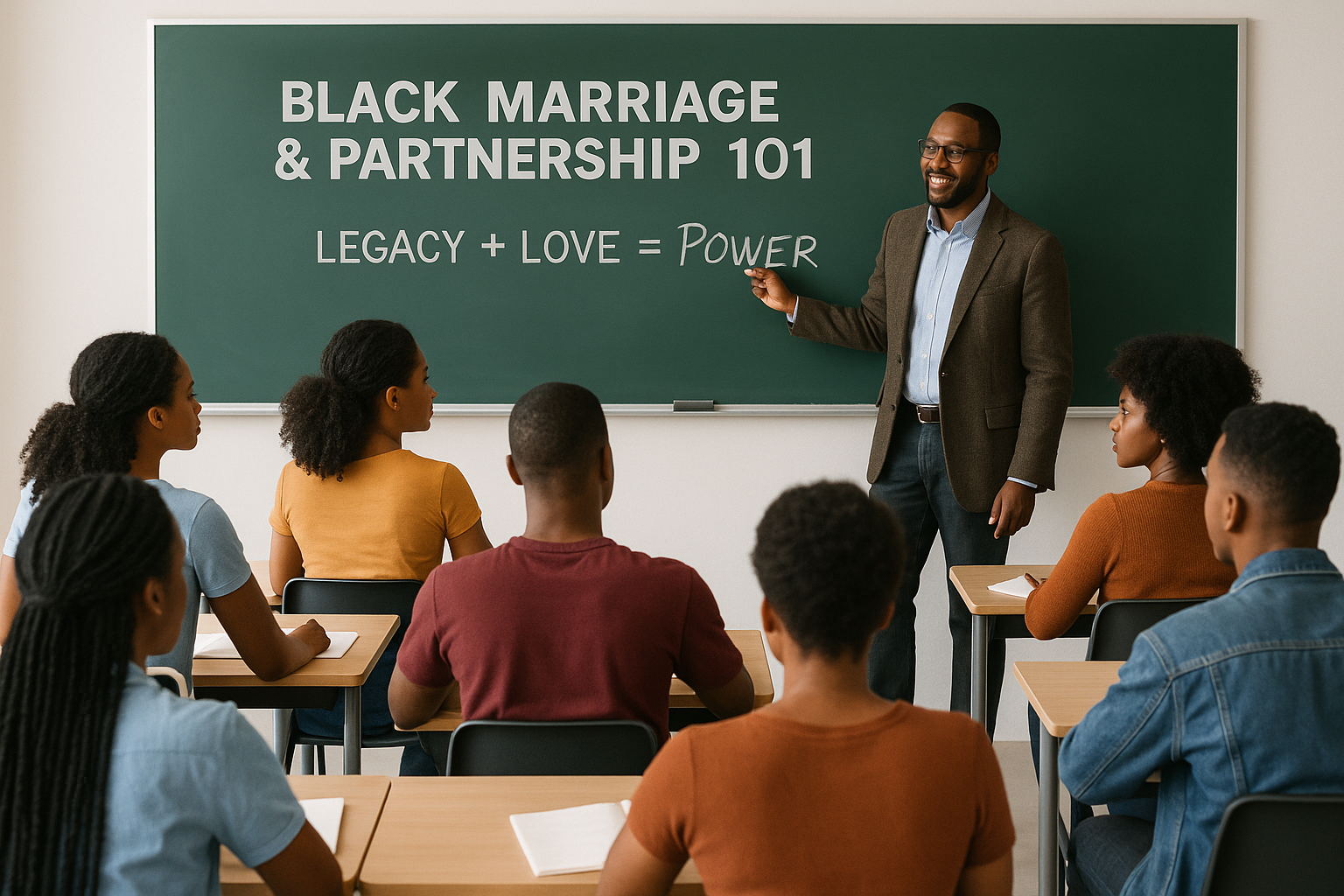
African American marriage is that fire, and the data on its decline describes an institutional failure rather than a cultural one. According to Census Bureau figures, roughly 30 percent of African American adults were married as of the most recent American Community Survey data, compared with 48 percent of the general population, a gap that has widened steadily since the 1960s, when Black marriage rates were comparable to or higher than the national average. This is not a story about African Americans falling out of love with the institution of marriage. It is a story about an institution — Black marriage — losing the infrastructure that once supported it, without any comparable institution stepping in to replace that support.
The consequences extend well beyond the household. Marriage has historically functioned as one of the more reliable engines of capital retention available to any community: pooled income, shared debt reduction, dual-earner asset accumulation, and consolidated intergenerational transfer. Brookings Institution research has repeatedly found that married-couple households experience substantially lower poverty rates than single-parent households, and that children raised in stable two-parent homes show measurably better outcomes in educational attainment and economic mobility. For a community already contending with a fractional share of national wealth relative to population, the erosion of marriage as a mainstream institution is not incidental to the wealth gap — it is one of its active mechanisms. Every dissolved partnership typically means divided assets, duplicated housing costs, and a disrupted trajectory toward the kind of multigenerational capital formation that built family land holdings, small businesses, and college funds in prior generations.
The historical record makes clear that this was not always the pattern. W.E.B. Du Bois, in his early sociological studies of Black family life, documented how enslavement had deliberately disrupted African American marriage and kinship structures, and how formerly enslaved people responded to emancipation in part by rushing to formalize marriages that slavery had denied them any legal standing to protect. The Reconstruction-era freedpeople who built schools, mutual aid societies, and land cooperatives were frequently organized around married households functioning as economic units; the marital pair was, in a very literal sense, load-bearing infrastructure for Black institution-building in that era. What has since eroded is not the aspiration toward that model but the institutional scaffolding that made it achievable: stable employment, intact communities, and critically any structured space where the skills of sustaining a marriage were taught with the same seriousness as a trade.
This is precisely the vacuum HBCUs are positioned to fill, and the case for doing so does not require sentimental appeals to romance or nostalgia. It requires only that HBCUs apply the same institutional logic to family formation that they already apply to workforce development. An HBCU curriculum trains accountants, engineers, and physicians because the community needs functioning professionals; the same community needs functioning households, and no other institution in the African American ecosystem (not churches, not employers, not government agencies) is as well positioned to deliver rigorous, scaled, cross-disciplinary instruction on the mechanics of sustaining a marriage. Fisk University’s long tradition in sociology, Tougaloo College’s history of community-facing scholarship, and Grambling State’s applied family and consumer sciences programs all suggest existing academic infrastructure that could be redirected toward this purpose without requiring new departments built from scratch.
A serious marriage curriculum at an HBCU would resemble a professional program more than a personal-development seminar. It would draw faculty from economics departments to teach household financial planning and joint asset management; from psychology and counseling programs to address conflict resolution and intergenerational trauma; from history departments to contextualize how slavery, segregation, and mass incarceration shaped contemporary Black relationship patterns; and from business schools to examine how marital partnership functions as a structural input into family enterprise, drawing on the same case-study method used to teach corporate strategy. Institutions like Delaware State University and Norfolk State University, both of which maintain applied social science and business programs, could pilot such coursework without significant new capital investment. Coppin State and Savannah State, serving urban populations directly affected by the economic pressures driving marriage decline, would be logical sites for community-facing certificate offerings rather than undergraduate electives alone.
That continuing-education dimension matters as much as the classroom version. HBCUs already operate certificate programs in fields like nonprofit management and workforce development; a Certificate in Household Formation and Family Economics, offered through evening or weekend cohorts, could extend access to alumni, local community members, and couples well past traditional college age. Institutions such as Alcorn State and Fort Valley State, both deeply embedded in the agricultural economies of their regions, could frame this instruction around the long Black Southern tradition of the marital household as an economic production unit — a farm run by a married couple, a family business built jointly — rather than importing a therapeutic model disconnected from economic reality. Xavier University of Louisiana and Dillard University, both with strong pre-professional pipelines, could position the coursework alongside career preparation, treating relationship stability as a professional competency rather than a private matter.
None of this should be mistaken for a claim that curriculum alone resolves a decline rooted in economic insecurity, mass incarceration, and structural exclusion from stable employment. Those forces are real, and no fifteen-week course reverses them. But HBCUs have never waited for surrounding conditions to be favorable before building institutions; the founding of Black colleges in the aftermath of emancipation happened precisely because no one else was going to build the educational infrastructure African Americans needed, regardless of how hostile the broader environment was. Treating marriage education as a fringe offering, best left to churches or private counseling, concedes an institutional responsibility that HBCUs are better resourced to carry at scale. Cheyney University and Lincoln University, as the nation’s oldest HBCUs, carry a particular symbolic weight in reclaiming this ground, institutions whose founding generation understood family stability as inseparable from the broader project of Black institutional survival.
The strategic case is ultimately about capital retention and institutional density, the same throughlines that govern every other domain of HBCU strategy. A stable married household retains capital inside the family rather than losing it to divided assets and duplicated costs. It concentrates two incomes, two networks, and two sets of institutional relationships rather than diffusing them. And it strengthens the density of Black institutional life by producing the next generation of donors, alumni, and community stakeholders from intact family units with the resources to sustain that engagement. HBCUs already understand that they are training more than individual professionals, they are building the institutional backbone of a community. Treating marriage as infrastructure worth teaching, rather than a private matter outside the university’s mandate, is a natural extension of that mission, not a departure from it.
Disclaimer: This article was assisted by ClaudeAI.
It is our duty to fight for our freedom. It is our duty to win. We must love each other and support each other. We have nothing to lose but our chains. – Assata Shakur
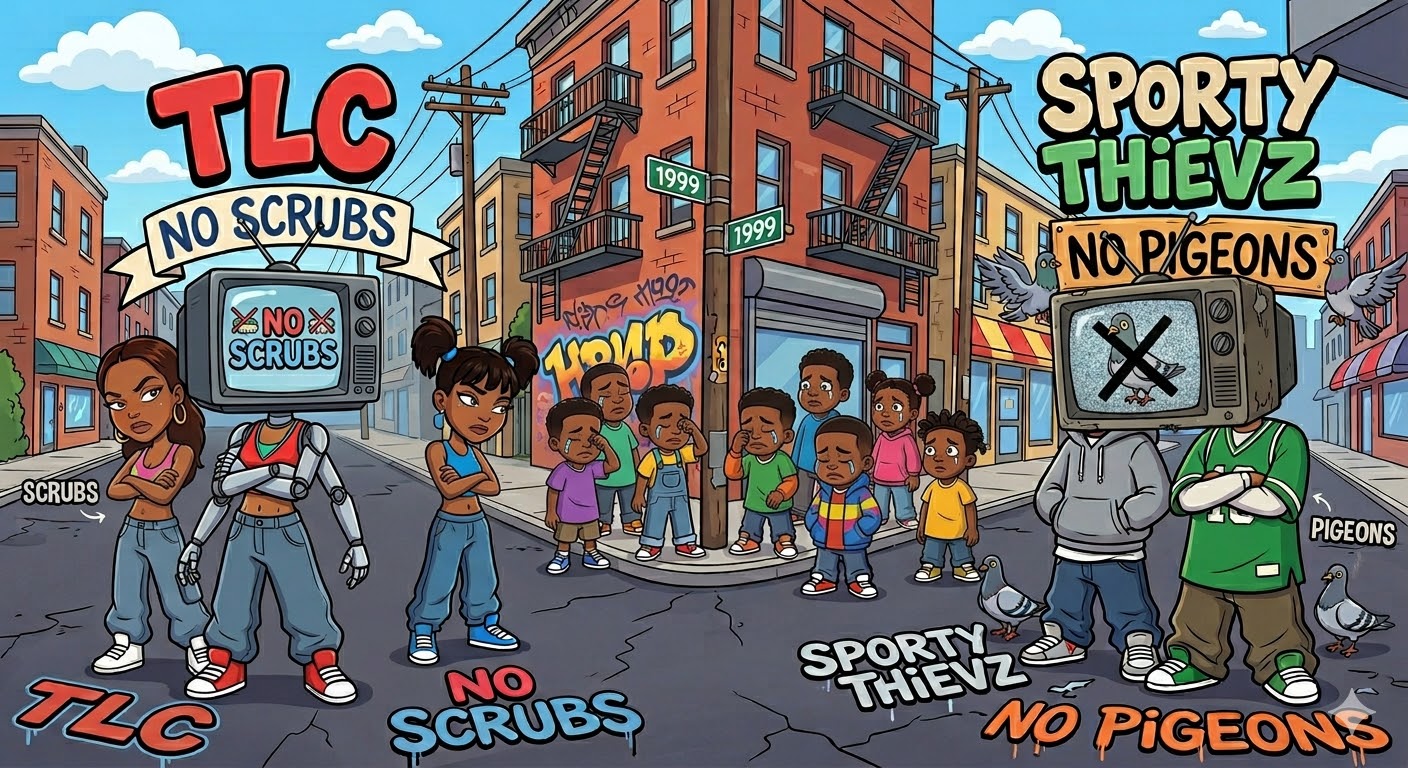
In February 1999, TLC released what would become one of the defining singles of their career. “No Scrubs” shot to number one on the Billboard Hot 100, where it remained for four consecutive weeks. The song’s message was clear and unapologetic: women were setting standards, and men who could not meet them need not apply. Within weeks, a relatively unknown rap group from Yonkers called Sporty Thievz fired back with “No Pigeons,” an answer record that used the same beat to deliver an equally scathing critique of women they deemed unworthy.
This exchange sparked what became known as a gender war on and off the airwaves, with radio stations playing both songs back-to-back and nightclubs dividing along battle lines — women shrieking in solidarity with TLC while men whooped for Sporty Thievz. Was this the inflection point where romantic and communal relationships between Black men and women began to fracture? Probably not. The roots run far deeper. But these songs crystallized something that had been building for years, a shift from celebration to criticism, from love songs to diss tracks, from the assumption of solidarity to the performance of mutual contempt.
Rewind a decade, and Black music told a fundamentally different story. The late 1980s and early 1990s gave us ballads that treated Black love not as a battlefield but as a sanctuary. Luther Vandross, Anita Baker, and Whitney Houston soundtracked weddings and anniversaries with a tenderness that affirmed the depth and dignity of Black romantic life. Mary J. Blige’s “Real Love” carried the longing of a generation. K-Ci & JoJo’s “All My Life” became a generational confession. Even within hip-hop, before the genre’s full commercial industrialization, there were moments of striking vulnerability. LL Cool J’s “I Need Love” in 1987 — a soft, earnest admission of emotional need — stood in productive tension with the bravado that would later become the genre’s commercial signature. These were not merely popular songs. They were cultural touchstones that told young Black people what love could look like, should look like. They were aspirational documents for a community’s interior life. And critically, the women in those songs, in those videos, on those album covers, looked like the community. They were Black women, centered and celebrated.
Something changed in the 1990s, and the change was not accidental. Dr. Dre and Snoop Dogg’s early albums codified a posture of romantic detachment, the deliberate rejection of love and respect for women, into hip-hop’s dominant vocabulary. This was compelling music that sold in enormous quantities, and in selling, it set a template. What had been one strand within a diverse genre became its commercial center of gravity. But the ideological shift ran deeper than misogyny alone. As hip-hop’s commercial footprint expanded through the mid-to-late 1990s and into the 2000s, something subtler and in some ways more psychologically damaging began appearing in the culture’s most visible spaces: the music video. The women cast as aspirational, as desirable, as worth pursuing began, with increasing frequency, to not be Black.
This was not happenstance. It was a pattern deliberate enough to be legible. As rap artists accumulated wealth and crossover appeal, the women featured alongside them in videos on yachts, in mansions, in the visual grammar of success skewed lighter, then non-Black altogether. The message embedded in those images was not subtle to anyone paying attention: arrival meant distance from Blackness. The highest expression of a Black man’s success, as the visual culture of the era constructed it, was access to women who were not Black. Video vixens of lighter complexions were elevated as the standard while dark-skinned Black women were marginalized or absent entirely. The beauty hierarchy being constructed in plain sight on BET and MTV was one in which Black women occupied an increasingly precarious position in the desirability calculus of their own community’s most prominent cultural exports.
By the time “No Scrubs” arrived in 1999, it landed in a culture already primed for conflict. Co-written by Kandi Burruss and Tameka “Tiny” Cottle during their downtime from Xscape, the song was a declaration of standards — women demanding ambition, respect, and genuine partnership rather than the attention of men riding in the passenger seat of someone else’s car. The demands were not unreasonable. Demands that ironically, many Black men would declare normal and reasonable from non-Black women. And within a media landscape designed to amplify division, what began as standard-setting quickly escalated into something more corrosive.
The response was immediate and polarizing. Radio stations hosted debates. BET reportedly edited both videos into a single seven-minute clip of gender war theater. MTV put both in heavy rotation. The media did not merely cover the conflict, it manufactured it into a cultural event, validating in the process the notion that Black men and women were not simply in disagreement but were fundamentally adversarial. Sporty Thievz’s rebuttal climbed to number 12 on the Billboard Hot 100, confirming that the antagonism resonated on both sides of the divide.
What made this moment significant was not the back-and-forth between two songs. It was what that back-and-forth revealed about the direction popular culture was pulling Black romantic life. These songs did not create the tensions between Black men and women. Economic dislocation, the carnage of the War on Drugs, and the structural dismantling of urban manufacturing bases had already placed enormous strain on Black households and Black partnership. Sociologist Elijah Anderson observed that young men in economically marginalized Black communities often pursued social status through the exploitation and diminishment of women, a pattern that commercial hip-hop both reflected and, once amplified at industrial scale, reinforced. The music industry, predominantly white-owned and indifferent to the social consequences of what it distributed, found conflict profitable and invested accordingly. What the community was living, the industry packaged and sold back to it as entertainment.
But HBCU Money still believes in love so enjoy….
The visual erasure of Black women from the aspirational imagination of hip-hop did not stay confined to the screen. It seeped into everyday life with a thoroughness that was difficult to track precisely because it moved through private conversation, social expectation, and the slow accumulation of cultural messaging rather than through any single declarable event. By the early 2000s, a certain strain of public Black male discourse had begun treating dating or marrying non-Black women not merely as a personal preference but as a marker of status, sophistication, or liberation — a signal that one had transcended the presumed limitations of the community one came from. The logic was sometimes stated explicitly, more often implied: that Black women were too difficult, too loud, too independent, too damaged by their own circumstances to be worthy partners for men who had achieved something. The very qualities that had allowed Black women to survive conditions designed to break them were reframed as character defects.
This was not a fringe conversation. It became, with the amplification of the internet and eventually social media, a mainstream one relitigated endlessly in think pieces, radio debates, YouTube channels, and the comment sections of platforms that rewarded provocation over nuance. Black women responded with a mixture of hurt, anger, and their own declarations of independence from a community they felt had devalued them. Some began openly discussing dating outside their race with the same performative energy that had been directed at them. What had begun as a visual preference embedded in music videos had, over the course of a decade and a half, become a full-scale public negotiation over the terms of Black romantic belonging conducted almost entirely in the register of grievance.
The accumulated effect on a generation was not trivial. The words used to describe each other shape how people see each other, expect from each other, and ultimately what they believe is possible between each other. When the dominant narrative in the music young people consumed shifted from devotion to suspicion, from partnership to transaction, from vulnerability to armor, those shifts did not stay contained within the space of entertainment. They became internalized frameworks for courtship, for conflict, for what intimacy was permitted to look like. Young Black women who grew up hearing themselves described as pigeons, hoes, or gold diggers, and who watched the women in their favorite artists’ videos grow progressively less likely to resemble them, absorbed messages about their worth that the external world was already working hard to diminish. Young Black men who absorbed the message that emotional openness was weakness, that Black women were adversaries to be outmaneuvered or obstacles to be bypassed on the road to something better, were being trained away from the very capacities that stable, sustaining relationships require.
Flash forward to 2026, and the cultural inheritance of that era is visible everywhere. Online spaces where Black men and women engage have become, in many corners, theaters of mutual grievance and elaborate performances of self-protective independence that leave little room for the kind of trust that partnership demands. Love songs have become harder to find in mainstream Black pop, as though tenderness has been deemed commercially unviable. Artists like PJ Morton, who make soulful music about Black love in its full complexity, play smaller rooms while music that treats romantic relationships as contests dominates the charts. This is not to suggest that beautiful expressions of Black love have disappeared. They have not. But they have been pushed to the margins of a culture that once placed them at its center.
The stakes of this cultural displacement extend well beyond the personal. As HBCU Money has documented, the marriage rate among African Americans has dropped precipitously over the past several decades, from roughly 60 percent in the 1960s to just 29 percent in 2021 and that decline carries direct economic consequences for the community’s long-term wealth position. Black married couples held a median net worth of $131,000 in 2019, compared to only $29,000 for Black single individuals — a fourfold gap that represents not merely a lifestyle difference but a structural disadvantage in capital accumulation, homeownership, and the ability to transfer wealth across generations. A culture that spent two decades using its most powerful media to communicate that Black women were not the preferred partners of successful Black men, and that Black men were not worthy of Black women’s investment, did not simply produce unhappy relationships. It produced an economic headwind that compounds over time and registers now in the net worth data of an entire community.
None of this means that “No Scrubs” and “No Pigeons” caused the decline of Black marriage or the erosion of Black wealth. They did not. But they were early, loud signals of a cultural drift that institutions like HBCUs, Black media, Black churches, Black family networks were too slow to name and too under-resourced to counter. The music reflected life. But music also shapes life, and the failure to contest the direction that shaping was taking was itself a strategic failure.
The question now is not how to assign blame for the past quarter century. It is whether the community has the institutional will to consciously reconstruct the cultural narrative that was lost. That means creating material and institutional conditions in which stable Black partnership can flourish such as relationship education, financial literacy, community infrastructure that treats Black family formation as a strategic priority rather than a private matter. It means supporting artists who treat Black love as a subject worthy of complexity and craft rather than caricature. It means being deliberate, in public spaces, about the language used to describe one another and understanding that those descriptions accumulate into the expectations young people carry into their most formative relationships.
Before the gender wars, before the videos, before mutual contempt became entertainment and the erasure of Black women from Black men’s aspirational imagination became a cultural norm, Black music told a different story, one in which men and women were engaged in a common project, in which love was not weakness but the foundation of collective strength, and in which the most natural expression of a Black man’s success was a Black woman beside him. That story was not naïve. It was aspirational in the deepest sense: it named what the community was capable of and invited people to live up to it.
That story is still available to be told. The beat can carry a different message. Whether it does depends on what the community decides to demand, to create, and to believe is still possible.
Disclaimer: This article was assisted by ClaudeAI.
This here, right now, at this very moment, is all that matters to me. I love you. That’s urgent like a motherf**ker. – Darius Lovehall
There is a particular kind of magic that happens when Black people are given the space to simply be to lead, to create, to fail and succeed without the exhausting weight of being a perpetual outsider. Historically Black Colleges and Universities have always understood this. For more than 150 years, HBCUs have offered something that no diversity initiative, no DEI task force, and no affinity group within a predominantly white institution can fully replicate: an entire ecosystem built in, by, and for Black people. The effects of that ecosystem ripple outward in ways we are still measuring including into who HBCU alumni choose to build their lives with.
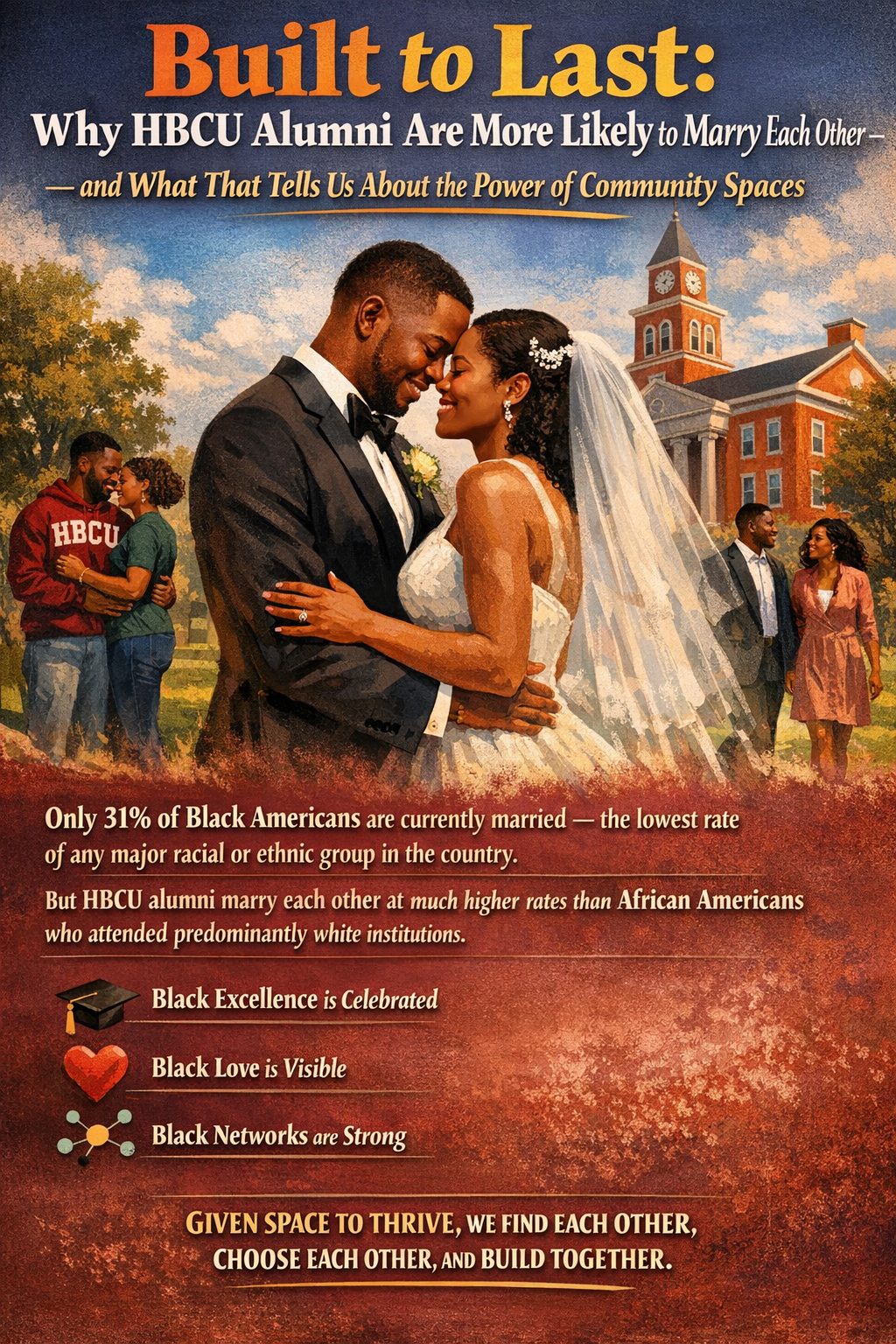
Research into the marital patterns of African Americans reveals a striking divergence between HBCU graduates and their counterparts who attended predominantly white institutions. HBCU alumni marry each other — Black men marrying Black women, Black women marrying Black men at significantly higher rates than African Americans who attended PWIs, where interracial marriages are considerably more common. This is not a coincidence. It is the natural fruit of what intentional community spaces produce.
The baseline numbers are sobering. Only 31% of Black Americans are currently married, compared to 48% of all Americans. Half of African Americans have never been married, compared to 34% of the general population, making African Americans the least married of any major racial or ethnic group in the country. There are approximately 5.18 million Black married-couple families in the United States today. That number has room — significant room — to grow. Currently, about 9–10% of Black college students attend HBCUs. Among college-educated Black newlyweds at PWIs, roughly 21% marry someone from another racial or ethnic group, with that figure rising to 30% among college-educated Black men. The picture at HBCUs is markedly different, and the reasons are structural, not accidental.
The social architecture of an HBCU where Black students are the majority, the leadership, the faculty, the homecoming court, the engineering honor society, and the debate team means that the romantic world reflects the academic world. HBCU alumni who marry are overwhelmingly likely to have met their spouse within a Black social and professional network, often one that traces its roots directly back to campus. African Americans who attend PWIs, by contrast, are exposed to a social universe numerically and institutionally dominated by white peers. Friendships, romantic relationships, and professional networks form disproportionately across racial lines not through any individual fault, but as a straightforward consequence of who is in the room. When your environment is 85% white, the statistical likelihood of cross-racial coupling rises organically. The HBCU alumni network functions, among other things, as a long-running and remarkably effective matchmaking institution one whose impact on community formation has never been fully quantified.
Sociologists have long understood that residential and institutional proximity is one of the strongest predictors of who people marry. We meet our partners in the spaces we inhabit — at work, at school, in our neighborhoods, at our houses of worship. The institution you attend for four formative years, the one that shapes your professional ambitions, your intellectual identity, your social circle, and your sense of self, will inevitably shape who you consider a natural life partner. For HBCU students, those four years are spent in an environment where Black excellence is not exceptional it is expected. Where Black love is not a political statement but a daily reality, visible in the couples holding hands on the quad, in the married faculty members co-teaching courses, in the alumni couples who return to homecoming year after year. Love, like ambition and leadership, is modeled. Young people see what is possible and, consciously or not, begin to orient their own futures accordingly.
PWI environments, for all their academic prestige, rarely offer this. Black students at PWIs often describe a bifurcated social experience belonging to affinity groups and cultural organizations that provide community, while simultaneously navigating a broader campus culture in which they are the minority. Black love is possible at PWIs, of course, and it flourishes there too. But the structural conditions do not make it the default. They make it something you find in spite of your environment, not because of it.
This conversation extends well beyond marriage rates, though those rates are a particularly measurable indicator of something larger. What HBCUs demonstrate is the transformative power of institutions that a community owns, shapes, and sustains for itself. This principle has animated Black institution-building in America since Reconstruction from Black Wall Street in Tulsa to the network of Black-owned banks, newspapers, hospitals, and churches that constituted what historians call the “Black counterpublic.” When a community has its own institutions, it controls its own narratives. It defines its own standards of beauty, intelligence, leadership, and desirability. It produces its own role models, generates its own wealth pathways, and creates an internal ecosystem dense enough that community members can meet each other’s needs — economic, social, spiritual, romantic — without having to seek fulfillment exclusively in outside spaces. The higher intra-community marriage rate among HBCU alumni is one data point in a much larger argument: that Black institutions do not merely provide education or services. They produce belonging. And belonging, once cultivated, has a way of reproducing itself in careers built together, in communities sustained together, and in families formed together.
For a publication dedicated to the intersection of Black financial life and Black excellence, the marriage data carries specific economic weight. Marriage, when it functions well, is one of the most powerful wealth-building vehicles available to any household. Two incomes, shared expenses, combined assets, coordinated estate planning, and intergenerational wealth transfer — these are the mechanisms by which families accumulate and maintain economic stability across generations. The racial wealth gap in the United States is staggering and persistent. For Black families to close that gap through their own accumulated power, marriage stability within the community matters. When HBCU alumni marry each other, they are pooling Black wealth with Black wealth building households that invest in Black communities, buy homes in Black neighborhoods, fund Black businesses, and leave assets to Black children. This is not about exclusion. It is about the compounding power of economic solidarity.
HBCU alumni already tend to earn strong incomes, leverage their alumni networks for professional advancement, and demonstrate higher rates of giving back to their alma maters and communities. According to the Gallup-USA Funds Minority College Graduates Report, 40% of Black HBCU graduates report thriving in financial well-being, compared to just 29% of Black graduates from non-HBCUs — the largest well-being gap Gallup measured between the two groups. Economic stability is one of the strongest individual predictors of marriage. Add to that the wealth-building power of sustained intra-community partnership, and the picture that emerges is of a uniquely powerful pipeline, one that begins with a campus in a college town and ends, generations later, in families that have genuinely built something lasting.
The most compelling question the data raises is not descriptive it is projective. If the HBCU environment produces meaningfully higher rates of Black marriage and intra-community partnership, what would happen to African American marriage rates if the share of Black college students attending HBCUs grew from today’s 10% to 25%, 50%, or even 75%? The answer, modeled carefully against current demographic data, is striking. These projections are calibrated estimates rather than census findings — they are directionally honest and mathematically grounded, built from known marriage rate differentials, HBCU graduation advantages, and the share of college-educated adults within the total Black population. One additional factor amplifies every projection: research shows that Black students at HBCUs are 33% more likely to graduate than their counterparts at comparable institutions, meaning scaling HBCU enrollment also scales Black degree attainment itself.
At 25% HBCU enrollment, roughly where HBCU attendance stood in the mid-1970s, the overall Black marriage rate would likely move from 31% toward 33–34%. That may sound modest, but in a population of nearly 47 million Black Americans, a two-to-three point increase represents roughly 500,000 to 700,000 additional married Black households, with intra-community marriage among college-educated Black Americans rising from roughly 79–80% toward 82–83%. At 50%, a transformational shift where the majority of college-educated Black Americans are formed in Black-centered environments, the overall Black marriage rate would likely climb toward 36–38%, closing nearly a third of the gap with the national average. The HBCU alumni network, at this density, becomes a dominant force in Black professional and social life: a self-reinforcing ecosystem where Black partner exposure is high across the entire college-educated class, translating to roughly 1.2 to 1.5 million additional Black married households.
At 75% HBCU enrollment, history offers its own precedent. Before integration dispersed the Black college-going population into majority-white institutions, HBCUs educated virtually all Black college graduates and during that era, African Americans age 35 and older were actually more likely to be married than white Americans, a trend that held from 1890 until sometime in the 1960s. A return toward 75% HBCU enrollment would not be an experiment in an unknown direction. It would be a partial return to conditions that demonstrably worked with a projected Black marriage rate of 40–42%, approaching parity with the national average for the first time in over six decades, and as many as 2 to 2.5 million additional Black married households.
HBCU Enrollment
Est. Black Marriage Rate
Intra-Community Marriage
New Married Households
10% (Today)
31%
~79–80%
Baseline
25%
33–34%
~82–83%
+500K–700K
50%
36–38%
~86–88%
+1.2M–1.5M
75%
40–42%
~90%+
+2M–2.5M
These projections carry honest caveats. Students who self-select HBCUs today may already have stronger pro-community cultural orientations, meaning the marginal effect per new HBCU enrollee may be somewhat smaller than current graduate data suggest. Marriage rates are also multi-causal — mass incarceration, income inequality, student debt, and campus gender ratio imbalances all independently shape outcomes. No single variable, however powerful, tells the whole story. But the directional conclusion is unmistakable: HBCU enrollment is a lever of community formation, not merely academic achievement. Pulling it harder produces more Black marriages, more Black wealth, and more Black families compounding across generations.
Every few years, critics question the continued relevance of HBCUs in an era of expanding integration and formal diversity efforts at major universities. The marriage data, alongside every other metric by which HBCU graduates outperform expectations relative to their socioeconomic backgrounds, is a decisive answer to that question. HBCUs are not relics of segregation. They are proof of concept — evidence that when Black people are given a fully resourced, culturally affirming environment to grow in, they flourish in ways that reverberate across every dimension of life. The lesson is not that PWIs should be abandoned or that integration was wrong. The lesson is that the goal was never assimilation — it was equity. And equity means Black people having their own institutions, not merely access to someone else’s. It means Tuskegee and Xavier and North Carolina A&T and Prairie View and Dillard and Morgan State existing not as alternatives of last resort but as premier, first-choice destinations that produce exactly the kind of human outcomes — professional, civic, familial — that their graduates embody.
The couples who meet at HBCU homecoming and marry a few years later are not a sentimental footnote to the HBCU story. They are a central chapter. They are what it looks like when a community invests in itself deeply enough that its members find each other, choose each other, and build together. The data suggests that with more investment — more students, more resources, more deliberate choice — the results scale. Two million additional Black married households is not a fantasy. It is arithmetic. And it starts with the decision of where to spend four years.
Disclaimer: This article was assisted by ClaudeAI.
Being deeply loved by someone gives you strength, while loving someone deeply gives you courage. — Lao Tzu
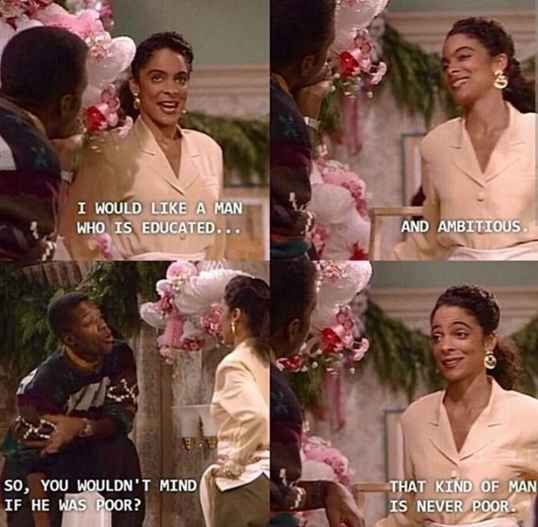
When A Different World aired that exchange in the late 1980s, it landed at the intersection of two of Black America’s oldest and most contested conversations: what we owe each other in love, and what it means to build a life of purpose and prosperity together. Whitley wasn’t asking for a rich man. She was describing an orientation toward life — educated, enterprising, and ambitious — and asserting that a person who lives that way will never be poor in the ways that truly count. But there was always a condition embedded in that vision, one the show understood even if it didn’t always name it explicitly: that kind of life requires a partner who isn’t just admiring from the sidelines. It requires someone who is building alongside you, pushing when the vision dims, holding when the weight becomes too much, and trusting even when the outcome isn’t yet visible. The kind of Black love that produces educated, enterprising, and ambitious people is not passive. It is active, intentional, and deeply communal.
Educated. Enterprising. Ambitious. These words sit comfortably on a vision board. They sound aspirational. But strip away the aesthetics and examine what each one actually demands of a Black person navigating this country, and you quickly understand why none of them can be carried alone. To be educated in Black America is not simply to hold a degree. It is to have committed to a process of self-understanding and world-understanding that this society has never made free or easy. For the hundreds of thousands who chose an HBCU, it was a decision to be educated and loved at the same time — to develop intellectual rigor inside institutions that did not require them to leave their Blackness at the door. That experience shapes how you move through the world, how you build, and critically, what you need from a partner. You need someone who values what you carry from that formation, who sees your education not as a credential but as a worldview that deserves to be exercised. A partner who belittles your ambitions, dismisses your networks, or resents your growth is not a partner in any real sense. They are a ceiling. To be enterprising is to see possibilities where systems have deliberately created barriers. Black entrepreneurship in this country has always been an act of defiance and an act of community building simultaneously. But enterprising requires risk. It requires long stretches of uncertainty, of not knowing if the next quarter will hold. A partner who cannot sit in that uncertainty with you, who confuses instability with failure, who demands the comfort of a steady paycheck over the potential of a built thing — that partnership will eventually become a negotiation between your dreams and their fears. And in that negotiation, someone always loses. To be ambitious is to insist that your potential has no ceiling. In Black America, that insistence is both a personal conviction and a political act. Ambition burns a tremendous amount of fuel. It consumes time, emotional bandwidth, and sometimes the very relationships that were supposed to sustain it. A partner who cannot celebrate your wins because your wins somehow diminish them, who needs you to stay small so they feel safe, is not a companion in ambition. They are its opposite. This is why Whitley’s answer to Dwayne was so quietly radical. She was not describing a checklist. She was describing a compatibility of spirit — the recognition that two people with aligned orientations toward growth could build something neither could build alone.
It is easy to focus on Whitley in this conversation because her words were so precise. But Dwayne’s question deserves equal examination. He did not ask what Whitley wanted in a husband — as if cataloguing features — but what kind of husband she wanted. He was asking about character, about essence. Dwayne Wayne was himself educated, enterprising, and ambitious. A genius-level engineering student at Hillman, a man who went on to a career that took him literally around the world. But what made him a worthy partner for Whitley, and what made their fictional union one of the most enduring love stories in Black popular culture, was not just his individual achievement. It was what he did with his love. He showed up. He advocated. He flew to her wedding to another man and interrupted it because he knew — and she knew — that their partnership was bigger than the fear that had kept them apart. That is what mutual support looks like in its most dramatic form. But most of us will not have our moment at an altar with a ballroom watching. Most of us will have the quieter, harder moments: the conversation at 11pm when one partner has been passed over again at work and needs to hear that their worth is not determined by that institution’s blindness. The weekend when one partner is grinding on a business plan and the other has to carry the household without resentment. The year when one partner’s career accelerates and the other has to find their own footing without collapsing into competition. Those moments are where Black love either becomes what it was always capable of being — or where it begins to quietly erode.
There is a damaging script in some corners of our community that frames one partner’s support for the other as sacrifice — as if partnership is a zero-sum arrangement where one person’s advancement necessarily comes at the other’s expense. This script has done enormous harm. It has produced couples who keep score rather than build, who compete where they should collaborate, and who eventually sit across from each other with years of resentment between them. The couples and partnerships that thrive understand something different. They understand that support is strategy. When you invest in your partner’s growth, you are not losing; you are expanding the resources available to your shared life. When a husband supports his wife’s MBA program by increasing his domestic load for two years, he is not diminished. He is invested. When a wife believes in her husband’s business concept before the market does and holds the household steady while he builds, she is not sacrificing her own ambition. She is deploying it strategically, because she understands that what they are building together is bigger than what either could build alone. This is the economic logic of Black love, and it is powerful. The HBCU power couples who go on to build medical practices, investment funds, cultural institutions, and businesses that employ other Black people do not build those things in spite of their partnerships. They build them through their partnerships. The art empire, the medical group, the legal practice — these are not solo achievements. They are the products of two people who chose, over and over again, to take the other’s dreams seriously.
And here is where that vision expands into something even larger — because educated, enterprising, and ambitious Black love is never just about two people. It has always carried a community inside it, and when it is at its most powerful, it carries an entire Diaspora. When two HBCU graduates build a life together, they bring their networks, their institutions, their mentors, and their commitments with them. The Hillman alumni network that became the seed capital for a Pan-African art fund was not a business transaction. It was the activation of bonds formed through years of shared education and shared love for an institution. Those investors did not write checks because of a pitch deck. They wrote checks because they trusted each other, because Hillman had taught them to see their prosperity as connected. That is the genius embedded in the HBCU tradition — it does not just educate individuals, it builds the relational infrastructure through which communities can act collectively. And it is Black love, in both the romantic and communal sense, that activates that infrastructure over and over again across generations.
But the full scope of what that love can build becomes visible only when we follow it to its institutional conclusion. Individual success, however impressive, is ultimately fragile. Wealth concentrated in one person can be lost in a generation. Knowledge that lives in one mind leaves when that person does. Influence that depends on a single relationship dissolves when that relationship ends. What endures is what gets built into institutions — into ownership structures, endowments, programs, and organizations that outlast any individual and continue to serve the community long after the founders are gone. This is why the most consequential dimension of educated, enterprising, and ambitious Black love is not what it produces in a household. It is what it deposits into institutions. The Black couple that builds a business strong enough to employ a hundred people and endow a scholarship fund is not just building a legacy for their children. They are building infrastructure for a community. The pair that pours their professional expertise back into an HBCU — consulting, donating, recruiting, advocating — is strengthening an institution that will educate and love thousands of Black students for decades to come. The partnership that structures its wealth to include collective vehicles — investment funds, foundations, land trusts, community development corporations — is doing something that individual accumulation, no matter how impressive, simply cannot do. It is converting personal achievement into communal capacity.
The Diaspora dimension of this is not incidental. It is essential. Black America has never existed in isolation from the broader African Diaspora, and the most visionary HBCU partnerships have always understood this. When Whitley Gilbert-Wayne stood in a Tokyo gallery and asked why African Americans were not building art collections anchored in the work of artists from across the Diaspora — from Salvador to Senegal, from Detroit to Durban — she was asking a fundamentally institutional question. Not just who collects this art, but who owns the infrastructure through which it is valued, appraised, traded, and preserved. Not just who appreciates Black beauty, but who controls the institutions that define and protect it. The Pan-African Art Appraisal program she helped establish between an HBCU and the University of Namibia was not a cultural gesture. It was an institutional act — the creation of a pipeline that would train a new generation of appraisers with both the technical competence and the cultural fluency to set the value of Diaspora art on terms that served the Diaspora. That is institutional ownership. That is what educated, enterprising, and ambitious Black love looks like when it reaches its full expression. And it could not have been built by either Whitley or Dwayne alone. It required the engineering career that took them to Tokyo. It required the art history formation that gave Whitley the language to see what she was seeing. It required the Hillman network that provided the initial capital and the Hillman-forged trust that made that capital available. It required, underneath all of it, a partnership that held steady across continents and career pivots and the slow, difficult work of building something that had never existed before.
What Dwayne and Whitley modeled — in fiction, and what so many HBCU couples have modeled in fact — is that Black love at its most generative is not primarily a private arrangement. It is a public act. Every time a Black couple directs their business patronage to Black-owned firms, they are building Black enterprise. Every time they mentor a younger HBCU graduate, they are extending the network that made their own success possible. Every time they sit on a board, anchor a fund, or pressure an institution to collect and commission work by Diaspora artists, they are expanding the definition of who gets to own and control cultural and financial infrastructure. Every time they build a business with an exit strategy that includes employee ownership or community benefit, they are ensuring that the wealth they created does not simply exit the community when they do. This is not idealism. This is what institutional ownership actually looks like in practice, and it is built one educated, enterprising, ambitious Black partnership at a time.
This is what A Different World was always pointing toward, even in its lightest moments. The romance between Dwayne and Whitley existed inside a world populated by people who pushed each other, competed with each other, loved each other, and collectively embodied the argument that Black excellence is not a solitary achievement. It is produced in community, sustained in community, and ultimately returned to community — and to a Diaspora that has always been waiting for us to bring our full selves, and our full institutional capacity, home.
If you are educated, enterprising, and ambitious — or trying to become those things — you are carrying a vision that is bigger than your own comfort. You are carrying, whether you have named it this way or not, an argument about what Black people are capable of when given the space, the resources, and the love to fully become. That vision requires a partner who takes it seriously. Not someone who merely tolerates your ambition, but someone who sees it as part of what they fell in love with. Not someone who supports you when it is convenient, but someone who holds the ground when the terrain gets difficult. Not someone who loves you in spite of your drive, but someone whose own drive calls yours forward. And if you are that partner for someone else, understand the magnitude of what you are doing. The quiet support, the unanticipated covering, the refusal to compete where you should collaborate — these are not small acts. They are the infrastructure on which entire legacies, and entire institutions, are built. The spouse who holds the household while the other writes the dissertation. The partner who talks you back from quitting. The friend-turned-love who looks at your half-formed idea and says, without hesitation, “I see it. Let’s build it.” These acts do not always make headlines. But they make everything else possible — the businesses, the collections, the endowments, the programs, the institutions that will carry Black and Diaspora communities forward long after any of us are here to see it.
Whitley Gilbert was not describing a fantasy when she told Dwayne what she wanted. She was describing a reality she was already willing to be part of — a partnership defined not by the presence of wealth but by the presence of character. Educated. Enterprising. Ambitious. And underneath all of it, the kind of love that builds, holds, risks, believes, and ultimately deposits something permanent into the world. That kind of love is never poor. And the institutions it builds are the inheritance of a Diaspora that was always worth the investment.
HBCU Money covers economic, finance, and investment news from an HBCU perspective. Follow us at hbcumoney.com.
Disclaimer: This article was assisted by ClaudeAI.
Love is or it ain’t. Thin love ain’t love at all. – Toni Morrison, Beloved
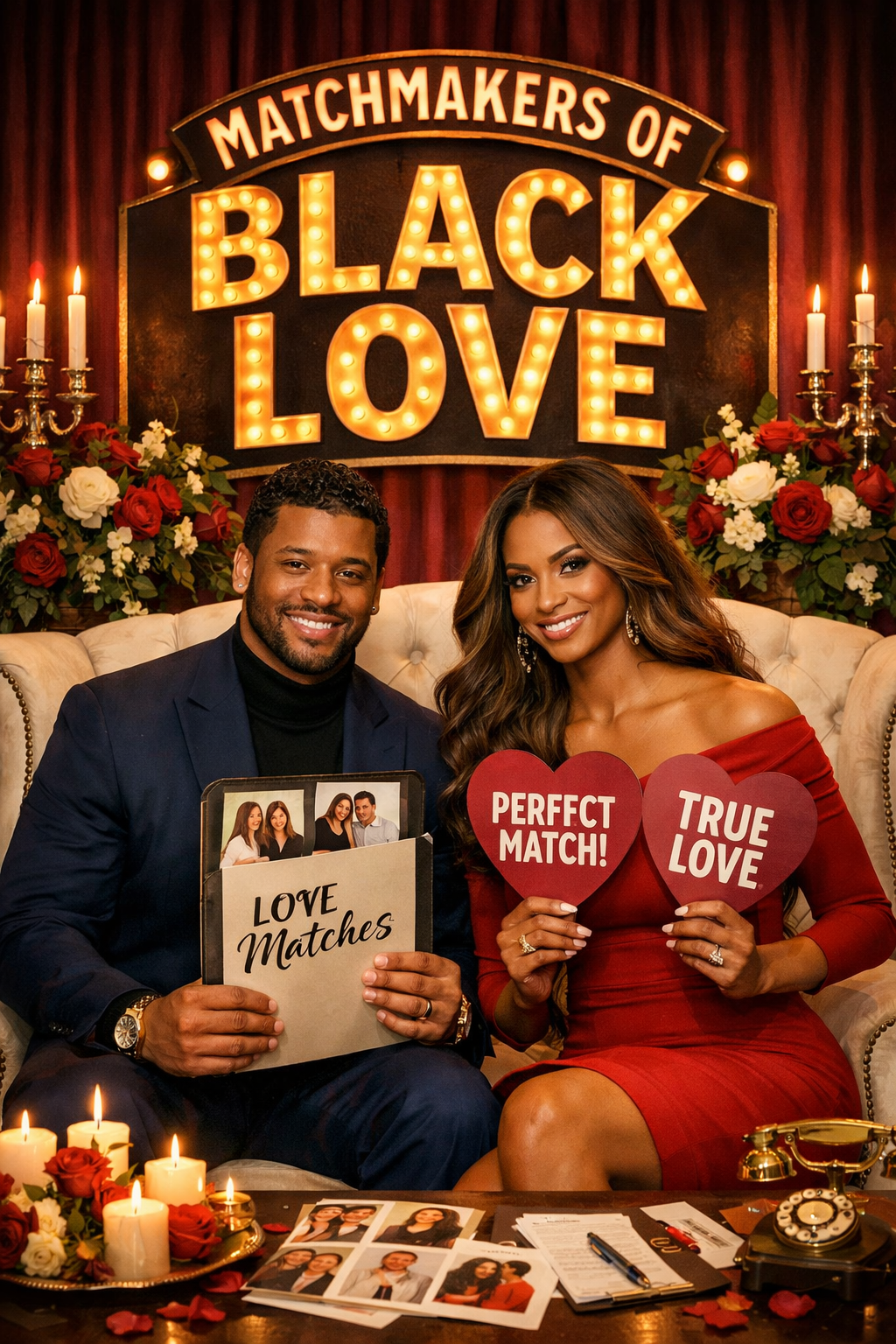
When Pittsburgh Steelers wide receiver DK Metcalf proposed to Grammy-nominated singer Normani in March 2025, everyone saw the romance. But few understood the deeper significance. Three years earlier, Russell Wilson and Ciara had orchestrated the introduction at a party where Ciara made sure Normani attended. “They was playing cupid, but it worked,” Normani later said. “If you could trust a couple [to set you up], that would be the couple.”
Four months later in July 2025, when NBA star Donovan Mitchell proposed to singer Coco Jones, the Wilsons were once again celebrating behind the scenes. Russell had helped plan the proposal, working with luxury event planners to create the perfect moment.
Two high-profile engagements. One couple quietly orchestrating connections. But this isn’t just celebrity matchmaking—it’s something more profound. Russell and Ciara Wilson are modeling what intentional Black love looks like, and the ripple effects could fundamentally reshape African American institutional capacity at a moment when our community desperately needs it.
What makes the Wilsons’ matchmaking significant isn’t the celebrity of the couples they bring together—it’s the deliberateness of it. They’re not hoping love happens. They’re creating the conditions for it. They’re investing three years of relationship before an engagement. They’re using their social capital to bridge different professional spheres, connecting successful Black professionals across industries who might never meet organically despite moving in similar circles.
This kind of intentionality around Black love has historical resonance. During the segregation era and Jim Crow, when every institution worked to keep Black families separated and destabilized, our communities survived by being deliberate about connection. Churches served as matchmakers. Family networks facilitated introductions. HBCUs became spaces where Black professionals met their future spouses. The community understood that strong marriages weren’t just about individual happiness—they were about survival and institutional building.
The data reveals something striking: marriage rates for Black adults were higher than for white adults in every U.S. Census from 1890 to 1940—the height of overt racism and segregation. Even in 1960, the marriage rate for Black adults was 61%, and two-thirds of Black children lived in two-parent households. Today, only 31% of Black Americans are married, and half have never been married at all.
What changed wasn’t racism—that existed then and persists now. What changed was the infrastructure of intentionality around Black love. The systems that deliberately brought people together, that supported young marriages, that made partnership formation a community priority—those eroded while the obstacles remained.
Understanding what the Wilsons are doing requires understanding what Black families have survived—and what continues to threaten our ability to build generational wealth and institutional power through stable partnerships.
The historical attacks on Black family formation were systematic and devastating. During segregation, redlining prevented Black families from buying homes in appreciating neighborhoods, which meant that even when Black couples married and saved, their wealth accumulated at a fraction of the rate of white families. Housing policies created by the federal government in the 1930s explicitly designated Black neighborhoods as too risky for mortgage lending, forcing Black families into predatory contracts that often ended in eviction.
But perhaps no threat has been more insidious than the systematic devaluation of Black women as romantic partners. Research consistently shows that Black women face unique marginalization in the dating market. Studies reveal that Black women receive the lowest desirability ratings on dating platforms from men of all races, with one 2014 OKCupid analysis finding Black women rated as “least attractive” compared to women of other races. These aren’t just numbers—they reflect deep-seated stereotypes that paint Black women as too masculine, too strong, too independent, too angry to be desirable partners.
The roots of these stereotypes trace directly to slavery, when Black femininity was deliberately contrasted against white femininity to justify Black women’s oppression and exploitation. When Black women assertively advocate for themselves, society—including some Black men—uses labels like “loud,” “angry,” and “emasculating” to question their worthiness for romantic relationships. The myth persists despite Black women’s clear desire for marriage and partnership.
This devaluation creates a devastating cycle. Black men face their own pressures and internalized racism, sometimes leading them to view relationships outside the Black community as aspirational—an “upgrade” that signals status and success. The data bears this out: among Black newlyweds with bachelor’s degrees, men are more than twice as likely as women to marry outside their race (30% versus 13%). Some Black men internalize colorism and Eurocentric beauty standards, further narrowing the pool of Black women they consider desirable partners.
When successful Black men choose partners outside the community without understanding the implications, they dilute the very networks and institutional capacity the Black community needs to build generational power. They reduce the already constrained supply of partners for Black women who, despite facing the most challenging dating environment of any demographic, remain the group most committed to intra-racial partnership. This isn’t about policing individual choice—it’s about recognizing that individual choices, aggregated across thousands of successful Black professionals, have community-level consequences for institutional sustainability.
When the Great Migration brought millions of Black families north seeking better opportunities, they found wages increasing but housing wealth eroding. Segregated housing markets meant Black families paid higher rents for deteriorating properties while watching their neighborhoods decline in value. The very act of Black families moving into a neighborhood triggered white flight, which collapsed property values. Homes that should have been vehicles for wealth accumulation became wealth traps.
Then came the deliberate destruction. The Tulsa Race Massacre of 1921 obliterated what was known as “Black Wall Street”—a thriving district where Black families owned land, operated businesses, and built wealth estimated at over $200 million in today’s dollars. Hundreds died, thousands were left homeless, and laws were passed to prevent survivors from rebuilding. This wasn’t unique. Chicago saw approximately 1,000 Black homes and businesses burned during the Red Summer of 1919. Across the country, thriving Black communities were systematically destroyed through racial violence that governments failed to prevent and often actively supported.
The wealth that did accumulate often couldn’t be transferred. Without access to estate planning services and facing discriminatory legal systems, many Black families lost property through “heirs property” designations that left land ownership unclear and prevented descendants from accessing the wealth their grandparents had built.
Today’s threats are more subtle but no less destructive. Mass incarceration has removed hundreds of thousands of Black men from their communities, destroying the gender balance needed for relationship formation. The student debt crisis hits Black families hardest—Black graduates owe an average of $25,000 more than their white peers—making the economic foundation for marriage more precarious. The wealth gap means young Black couples can’t fall back on family wealth during rough patches the way white couples can. Geographic dispersion means young Black professionals leave the high-marriage-rate states where HBCU ecosystems once facilitated connections, moving to cities where they’re isolated from institutional support networks.
But perhaps most damaging is the loss of cultural infrastructure around Black love. The deliberate community matchmaking of previous generations has largely disappeared. The social pressure and support for marriage has weakened. Dating apps have replaced friend introductions, optimizing for superficial attraction rather than shared values and compatible life goals. Young Black professionals, especially those who’ve left HBCU networks, often lack access to communities of Black peers navigating similar life stages.
The Wilsons understand something crucial: strong Black marriages aren’t just about personal fulfillment. They’re about building institutional capacity. When they facilitate a marriage between DK Metcalf and Normani, they’re not just creating a happy couple—they’re multiplying resources that could flow to Black institutions.
Consider the mathematics of it. Married couples don’t just have double the income of single individuals—they accumulate wealth exponentially faster. Black married couples have a median net worth of $131,000 compared to just $29,000 for single Black individuals. This isn’t because marriage magically creates money. It’s because marriage allows for coordinated financial strategy, shared expenses, combined networks, and the ability to take risks one income couldn’t support.
But the real multiplier effect extends beyond individual household wealth. Strong Black marriages create:
Coordinated Philanthropic Power: A married couple decides together where to direct resources. They create family foundations. They develop multi-year giving strategies to institutions they both value. They leverage their combined networks to recruit other donors. They become major benefactors rather than occasional contributors.
Intergenerational Institutional Commitment: Children from stable two-parent households inherit not just wealth but institutional loyalty. A child whose parents both attended HBCUs, both support Black cultural institutions, both invest in Black businesses—that child grows up with institutional commitment encoded in their identity. They become the next generation of supporters, leaders, and advocates.
Professional Network Effects: When two successful Black professionals marry, their networks merge. Different industries intersect, creating unexpected opportunities. Professional connections multiply. These network overlaps create opportunities for institutional partnerships, corporate sponsorships, business ventures, and talent pipelines that wouldn’t exist otherwise.
Resilience and Risk-Taking: Married couples can take risks single individuals cannot. They can invest in Black startups, fund untested ventures, support experimental programs, and make long-term commitments to institutions precisely because they have a partner sharing the risk. This risk-taking capacity is essential for institutional innovation and growth.
Cultural Modeling and Social Capital: Visible successful Black marriages change cultural narratives. They make marriage aspirational. They demonstrate what’s possible. They create social pressure in the positive sense—the expectation that successful Black professionals will find partners, build families, and invest in community. This cultural shift has compound effects across generations.
The geographic data supports this institutional impact. Seven of the top ten states with highest Black marriage rates—Virginia (34.0%), Maryland (33.2%), Texas and Delaware (32.8%), Florida and North Carolina (31.3%), and Georgia (30.9%)—are HBCU states. These states have thriving Black middle classes, strong African American institutions, and robust professional networks. The marriage rates aren’t coincidental—they’re evidence of how institutional ecosystems and family stability reinforce each other.
What the Wilsons are doing works because they understand marriage formation as network building. They’re not running a dating service. They’re curating a community of successful Black professionals who share values, understand each other’s pressures, and can build partnerships that transcend individual achievement.
Research shows people are still most likely to meet long-term partners through friends, family, or work rather than dating apps. The Wilsons are leveraging this truth at scale. Every couple they help create becomes a new node in an expanding network. Metcalf and Normani will introduce their single friends to each other. Mitchell and Jones will facilitate connections within their circles. The Wilsons’ nine-year marriage serves as the model and proof of concept.
This creates self-reinforcing cycles. Strong marriages produce stable families. Those families invest in institutions. Those institutions create spaces where the next generation forms relationships. Those relationships produce more strong marriages. The cycle builds momentum.
This is how communities accumulate power—not through individual success stories but through interconnected networks of families committed to collective advancement. During segregation, Black communities maintained this infrastructure deliberately because they had to. We knew that isolated success meant nothing if it couldn’t be transferred to the next generation or scaled across the community.
The Wilsons are reviving this model for the contemporary moment, when Black professionals are more economically successful than ever but often isolated from the institutional networks that would allow that success to compound.
Imagine if what the Wilsons are doing at the celebrity level was replicated across every tier of Black professional achievement. Imagine if young Black doctors, lawyers, engineers, educators, entrepreneurs were part of deliberate matchmaking networks that facilitated connections based on shared values and institutional commitment.
The compound effects would be staggering:
Economic Impact: Thousands of additional stable Black marriages would translate to billions in accumulated wealth. That wealth, properly channeled, could recapitalize Black institutions that have operated on shoestring budgets for generations. HBCUs could build endowments rivaling elite white institutions. Black hospitals could expand. Community development financial institutions could scale their lending. Black cultural institutions could thrive rather than merely survive.
Political Power: Married couples are more likely to vote, more likely to engage in civic life, more likely to serve on boards and run for office. A generation of politically engaged Black couples could fundamentally shift electoral dynamics and policy priorities in states with large Black populations.
Professional Advancement: The network effects of thousands of strategic Black marriages would create unprecedented opportunities for collaboration. Black entrepreneurs would have access to capital through their spouses’ networks. Black professionals would have insider information about opportunities through their partners’ connections. The “old boys network” that has excluded Black professionals for generations could be matched by networks of Black couples leveraging their combined social capital.
Cultural Renaissance: Stable Black families create the conditions for cultural production. Artists need economic security to take creative risks. Writers need time to develop their craft. Musicians need resources to experiment. When Black creative professionals have partners who can provide economic stability, the entire community benefits from their artistic output.
Institutional Sustainability: Perhaps most critically, networks of strong Black marriages ensure institutional continuity. When couples commit to supporting institutions together, those institutions can plan decades into the future. They can launch ambitious programs knowing they have committed donors. They can weather economic downturns because their supporter base is stable. They can dream bigger because their foundation is stronger.
But recognizing what’s possible raises uncomfortable questions about what’s missing. If the Wilsons can facilitate life-changing connections within celebrity circles, why doesn’t similar infrastructure exist for the thousands of Black professionals outside those circles? If marriage rates for Black adults were higher during Jim Crow than today, what infrastructure did we lose—and how do we rebuild it?
These questions don’t have simple answers, but they demand serious consideration:
How do we recreate the deliberate matchmaking infrastructure that sustained Black communities during segregation, adapted for contemporary circumstances? Church networks and family connections can’t carry the full weight when young Black professionals are geographically dispersed and disconnected from traditional institutions.
What would institutional investment in Black relationship formation look like? HBCUs, Black Greek organizations, professional associations, cultural institutions—these entities have the trust and access to facilitate connections. But do they recognize this as part of their mission? Do they allocate resources to it? Do they measure success by families formed, not just events hosted?
How do we address the structural barriers that make marriage economically precarious for young Black professionals? Student debt, wage gaps, wealth inequality, housing costs—these aren’t relationship problems, but they make relationship formation dramatically harder for Black Americans than for white Americans with similar educational attainment.
What role does media and culture play in shaping expectations around Black love? When the dominant narratives about Black relationships emphasize dysfunction and failure, when successful Black marriages are invisible, when young Black people grow up without models of healthy partnerships—this creates self-fulfilling prophecies that perpetuate the marriage gap.
How do we balance individual freedom and choice with community needs for strong families and institutions? Nobody should be pressured into marriage. But if the community loses the infrastructure that facilitates healthy relationship formation, individual freedom becomes isolation by default.
The Wilsons have shown what’s possible. Their intentional matchmaking, their sustained investment in couples’ success, their willingness to leverage their social capital for others’ benefit—this is the model. But celebrity circles can only accommodate so many couples. The question is how to scale this intentionality across the Black professional class.
The answer must be institutional, because only institutions can sustain infrastructure across generations. Individual matchmakers burn out. Informal networks fragment. But institutions—if properly designed and resourced—can maintain systems indefinitely.
What might institutional investment in Black love infrastructure look like?
HBCU Alumni Networks as Matchmaking Ecosystems: Alumni associations in major cities could host quarterly events specifically designed to facilitate connections among young Black professionals. Not awkward singles mixers, but sophisticated networking events, community service projects, cultural experiences where relationships form organically among people with shared backgrounds and values. Success could be measured not just by attendance but by marriages facilitated and families formed.
Black Professional Associations as Relationship Hubs: Organizations for Black lawyers, doctors, engineers, educators, entrepreneurs could recognize relationship facilitation as core to their mission. When successful Black professionals marry, their combined professional power benefits the entire community. These associations could create structured mentorship that pairs young professionals not just for career guidance but for life partnership modeling.
Technology Platforms Designed for Black Love: Dating apps optimize for engagement and superficial attraction. What if technology was designed specifically to facilitate meaningful connections among Black professionals committed to community building? Platforms that prioritize shared values, institutional loyalty, life goals, and cultural understanding over swipe-right dynamics.
Financial Incentives for Family Formation: What if institutions offered tangible support for young Black couples? Grants for couples pursuing marriage counseling. Low-interest loans for home purchases for alumni couples. Scholarships for children of HBCU alumni couples. These investments would pay dividends in institutional loyalty that compounds across generations.
Cultural Campaigns Celebrating Black Love: Media campaigns showcasing successful Black marriages, particularly among professionals committed to community advancement. Not aspirational fantasy but realistic portrayals of how successful couples navigate challenges, support each other’s growth, and invest in institutions. Make Black love visible, aspirational, and achievable.
Research Infrastructure: We lack basic data on what makes Black marriages successful. Which combinations of backgrounds, values, and life circumstances predict long-term partnership success? What interventions effectively support young Black couples through early marriage challenges? Hampton University’s National Center on African American Marriage and Parenting represents a start, but we need comprehensive research infrastructure that can inform evidence-based programming.
The answers won’t come from any single intervention but from a ecosystem of institutional support that makes Black love not just possible but probable. That makes stable marriages not just aspirational but expected. That makes family formation not just personal but communal.
Russell and Ciara Wilson didn’t set out to solve the Black marriage crisis or to transform African American institutional capacity. They’re simply two people who understand the value of healthy relationships and want to share that blessing with their friends.
But their efforts reveal what’s missing and what’s possible. They show that when influential people commit to facilitating connections within Black professional circles, life-changing partnerships form. They demonstrate that intentionality around Black love produces results that individual effort alone cannot achieve. They prove that building strong Black marriages is institution-building at its most fundamental level.
The viral social media pleas asking the Wilsons to expand their matchmaking aren’t just jokes. They reflect a genuine hunger for what the Wilsons provide—thoughtful facilitation of connections among Black professionals who share values and aspirations. They reveal the absence of infrastructure that our grandparents’ generation took for granted because it was built into the fabric of Black community life.
The declining marriage rate among African Americans isn’t inevitable. It’s the result of infrastructure collapse that can be reversed through deliberate institutional investment. The opportunity is to recognize that facilitating Black love isn’t tangential to institutional missions—it’s foundational to building the networks of stable families that will sustain Black institutions for generations.
Seven of the ten states with highest Black marriage rates are HBCU states, which means the foundation still exists. The communities are still present. The institutions still stand. What’s needed is leadership willing to acknowledge that the work of building Black institutional power begins with building Black families. That the work of building Black families requires intentional infrastructure. That the work of building that infrastructure is everyone’s responsibility who claims commitment to Black advancement.
The Wilsons are showing us what’s possible when two people commit to intentionally building Black love within their circles of influence. The question for the rest of us—for institutions, for leaders, for anyone with social capital and community commitment—is whether we’ll do the same within our own spheres. Whether we’ll recognize matchmaking as institution-building. Whether we’ll invest in the infrastructure that makes Black love not just possible but inevitable.
The fire is there. The Wilsons are fanning the flames. The question is whether the rest of us will add fuel until it becomes a blaze that lights the way for generations to come.
Disclaimer: This article was assisted by ClaudeAI.