
Tag Archives: Black generational wealth

Homeownership and Power: Why African American Men Should Be Inspired—Not Intimidated—By African American Women Who Buy Homes

Black men like all men need to recognize that their worth in a relationship is and should be more than financial. That being said, for African America who has never reached 50% homeownership rate, to have men upset is on a level of a Eddie Murphy comedy – or Shakespeare tragegy. Take your pick. — William A. Foster, IV

In 1903, Maggie Lena Walker chartered the St. Luke Penny Savings Bank in Richmond, Virginia, becoming the first woman of any race in the United States to found and preside over a bank. She did not build it as a monument to her own ambition. She built it as infrastructure, a vessel through which the pennies of domestic workers and laundresses could become mortgages, storefronts, and a department store on Broad Street. Walker understood a principle African America has had to relearn in every generation since: an asset only compounds if there is an institution designed to hold it. A single woman’s initiative was never the story. The structure she built around it was.

That principle — asset first, institution second — is the correct lens for a trend now reshaping African American household formation, and it is being widely misread as a referendum on Black manhood rather than what it actually is. According to the National Association of Realtors’ 2025 Profile of Home Buyers and Sellers, single women account for 39 percent of all Black home purchases, nearly matching the 42 percent share held by married couples and far exceeding the single-women share among White (20 percent), Asian American/Pacific Islander (19 percent), or Hispanic (18 percent) buyers. NAR’s deputy chief economist Jessica Lautz notes that Black women have consistently outpaced women of every other racial and ethnic group as homebuyers — a pattern she attributes to a demographic “leaning especially hard on property as a tool for long-term wealth and stability.”

That explanation is accurate as far as it goes, but a rigorous accounting of the data requires a second layer Lautz’s framing does not reach: is this trend driven primarily by preference, or is it also driven by a contracting marriage market that leaves a growing share of Black women building wealth alone by structural necessity rather than by choice? Both can be true simultaneously, and treating them as mutually exclusive is the same interpretive error HBCU Money has flagged before when Black men cite the 75 percent figure, the share of married Black men wed to Black women, as proof that no structural shift is underway in Black partnership formation. That figure is real. So is the fact that Black men have posted the fastest-growing intermarriage rate of any male demographic group in the country, tripling from 8 percent of newly married Black men in 1980 to 24 percent by 2015, concentrated heavily among the most educated and highest-earning men. Among newly married Black adults overall, the gender gap in intermarriage runs 12 points in men’s favor — 24 percent of men to 12 percent of women. Among college graduates specifically, that gap widens to 17 points: 30 percent of Black male college graduates intermarry, against 13 percent of Black female college graduates.

Read against the NAR data, this is not a coincidence sitting beside another coincidence. It is one mechanism producing two visible outcomes. A marriage market in which credentialed Black women face a same-race partner pool contracting faster than any other group’s, compounded by incarceration’s well-documented effect on the available Black male population and a decades-long educational attainment gap that has moved decisively in women’s favor, is a marriage market with a measurable supply-demand imbalance on the women’s side of the ledger. Homeownership is one of the few asset classes a person can acquire entirely alone, without waiting on a partner who may not arrive on the expected timeline or at all. Framed this way, the surge in single Black women’s home purchases looks less like elective wealth-building and more like an institutionally rational hedge against a partnership market that is not behaving the way it does for other groups of women.

This is an accounting, not an accusation, and the distinction matters for how the community responds to it. It is not a claim that any individual man has abandoned anyone, and it is not a claim that any individual woman is buying a home out of desperation rather than ambition — both things NAR’s own qualitative data contradict, since single women report treating homeownership as a deliberate, prioritized financial goal, not a fallback. It is a claim that the aggregate pattern has a structural driver worth naming honestly, because institutions built to respond to “women choosing wealth-building” and institutions built to respond to “a rising share of women building wealth alone because the partnership market has structurally narrowed for them” are not the same institutions, and African America needs the second kind at least as much as the first.

Every functioning institution has a balance sheet, a division of roles based on comparative advantage, and a mechanism for retaining and compounding the capital that enters it. HBCU Money applies this logic routinely to banks, universities, and credit unions. It applies with equal force to the family and it requires the family, as an institution, to be designed for two distinct entry conditions rather than one: capital entering through a partnership, and capital entering through a woman building alone who may or may not partner later. A family-governance framework that only knows how to receive equity once a marriage has already formed is a framework that fails a growing share of the very women generating the equity it is supposed to hold.

Where partnership does form, the economics remain exactly as favorable as they were before this data was added to the picture. A household in which one partner already holds home equity is not a household where one officer outranks another; it is a balance sheet that begins with collateral instead of without it, refinanceable into business capital, deployable as a down payment on a second unit, combinable with a partner’s income to acquire block-level property neither could reach alone. None of that requires the man’s asset to arrive first or match hers in size; it requires a governance norm that allocates roles by comparative advantage rather than gender-coded ego, the same norm any competently run institution already applies to its officers. The men who read a partner’s equity as a threat rather than as capital entering the household are the ones least equipped to benefit from precisely this kind of coordination.

But the institutional response cannot stop at “coordinate better once partnered,” because the data says a meaningful and growing share of the ecosystem’s most credentialed women will be building wealth solo, for a period that may not be temporary. That is where African America’s institutional thinness compounds the problem. A Black-owned bank or credit union — a Citizens Trust, a OneUnited, a Hope Credit Union — is well positioned to build savings and refinance products for solo women building equity as a first-class household unit, not merely as a pre-partnership placeholder waiting to merge into someone else’s balance sheet. Family governance infrastructure; trusts, estate documentation, succession planning for how a solo-acquired home transfers to children, siblings, or reinvests into a next acquisition has to be built around the reality that a growing number of these estates will not have a second adult name on the deed, ever. HBCU business and law programs at Tougaloo, at Fort Valley State, at Coppin State, at Savannah State are positioned to teach family financial governance as a competency that includes solo wealth-holding as a designed-for outcome, not an edge case.

None of this changes the invitation at the center of this piece. A man who understands the full accounting, that Black women are buying homes at a record pace both because they are choosing to and because a structurally contracting partner pool makes solo acquisition a rational institutional hedge has more reason to be inspired, not less. Her closing is not a verdict on him individually; in aggregate, it is a population-level response to conditions that include, among other things, the very intermarriage pattern concentrated among men with his own credentials. That 12-point gap among the overall population widens to 17 points among the college-educated, unmatched by any other racial group in the country, and grows precisely with the credentials, a bachelor’s degree, a stable income, that also predict homeownership readiness. The honest response to that accounting is not resentment and it is not denial. It is building the coordination where partnership exists and building the infrastructure to support solo wealth-holding where it does not because both are now permanent features of the same institutional landscape, and the family, understood as an institution, has to be designed for both.

Maggie Lena Walker did not build her bank for women who were waiting on a partner to arrive before their savings counted. She built it to hold the capital of women who were already building, on whatever timeline their circumstances gave them. The single Black woman closing on a home in 2026 has done her part twice over; she has cleared discriminatory underwriting alone, and she has done it inside a marriage market that data shows is measurably tighter for her than for women of any other group. Whether that asset becomes the founding capital of a functioning family institution, or simply one more well-earned equity position with no institutional structure built to receive it, depends on whether the ecosystem is honest enough to build for the conditions that actually produced it.

Disclaimer: This article was assisted by ClaudeAI.
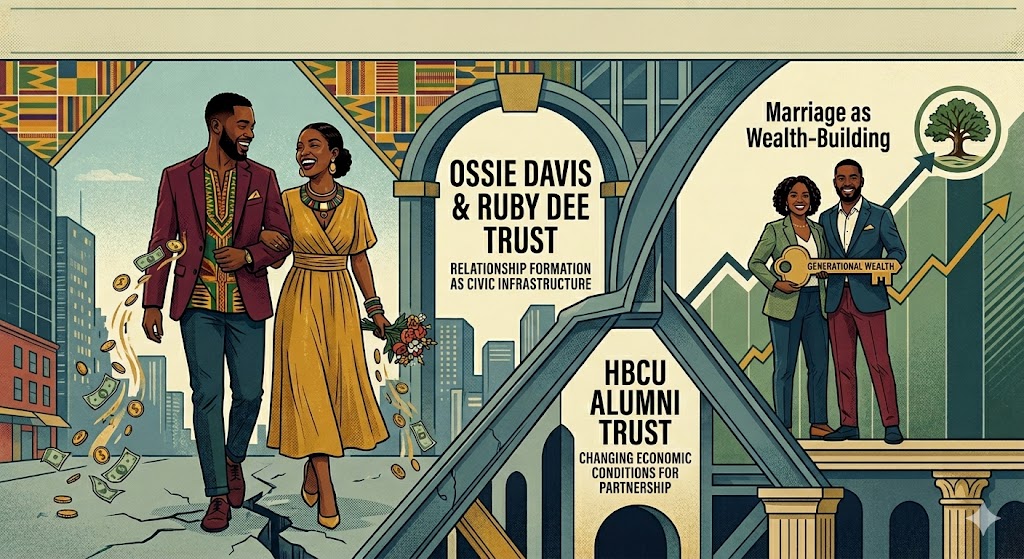
Broke & Dating: African Americans Cannot Afford to Date — Nor Can They Afford Not To

“The most important investment you can make is in yourself.” – Warren Buffett

There is a financial contradiction embedded in the romantic lives of African Americans that most personal finance commentators decline to address directly, because addressing it directly is uncomfortable. The contradiction is this: African Americans, as a group, occupy the most economically precarious position of any major demographic in the United States, which makes the cost of courtship a genuine strategic burden — and yet marriage, and the household formation it produces, remains one of the most powerful wealth-building mechanisms available to individuals operating without inherited capital. African Americans cannot afford to date the way the broader culture has normalized dating. And they cannot afford not to.

This is not a romantic observation. It is an institutional and economic one, and it deserves to be examined as such.

The arithmetic is brutal when you sit with it. According to a February 2025 survey by BMO Financial Group, the average American adult spends $2,279 on dates per year, with the all-in cost of a single date from pre-date grooming to gas money estimated at nearly $168. At one date per week, that annualized figure climbs well past $8,700. Set that against an African American median household income that, per the most recent Census data, sits at roughly $52,000 — still last among all major ethnic groups — and courtship is consuming somewhere in the range of 16 to 17 percent of African American median income. No other major demographic group faces that proportional burden. The cumulative cost is not simply personal; it is communal, because money extracted from the African American household through consumption-oriented dating is money that does not compound, does not build equity, and does not circulate within Black institutional ecosystems.

The crisis is compounded by employment fragility. African American men between the ages of 20 and 24 have historically carried unemployment rates roughly double those of their white male peers and these are the years during which romantic partnerships form with the most frequency and social intensity, and also the years of maximum economic vulnerability for the demographic most burdened by the cultural expectation of financing courtship. The collision of maximum relational pressure and minimum economic stability is not accidental. It is structural, and the consequences of navigating it poorly leading to the accumulating debt in pursuit of performed affluence, or deferring the relational investments that ultimately build household wealth reverberate for decades.

What is rarely said plainly enough is that courtship itself, when conducted without financial discipline, functions as a form of capital extraction. Every dollar spent performing prosperity in a relationship like the unnecessary dinner, the performative gift, the vacation financed on credit is a dollar transferred out of a community already operating with the thinnest capital base in the country. The African American community has constructed, over generations, a rich institutional infrastructure: HBCUs, Black-owned financial institutions, fraternities and sororities, professional associations, religious organizations, and community development organizations. The health of that infrastructure depends, at its foundation, on the accumulation of wealth within African American households. Romance, conducted poorly, undermines that foundation directly.

And yet the opposite error of treating financial precarity as a reason to defer relational commitment indefinitely is equally destructive, and arguably more so at the institutional level. Marriage, sociologists have long established, is not merely a romantic arrangement. It is the primary non-institutional mechanism through which ordinary Americans build wealth. The two-income household produces compounding effects on savings capacity that single-income households simply cannot replicate. The married couple that directs dual incomes toward an investment portfolio, a property, a business capitalization, or a child’s education produces generational effects that individual accumulation, however disciplined, rarely matches. Economists studying the racial wealth gap have identified the marriage rate differential between African Americans and other groups as one of the structural contributors to the persistence of that gap not because marriage is morally superior to other arrangements, but because household formation is a capital formation mechanism, and lower rates of stable household formation mean lower rates of capital accumulation across the community.

The data on African American marriage rates is now well established. Black Americans marry at lower rates than any other major demographic group in the country, and those who do marry do so later. The causes are multiple and structural with high male incarceration rates, chronic unemployment disparities, elevated student debt burdens concentrated among Black women who have simultaneously outpaced Black men in educational attainment but the consequences operate as a compounding disadvantage. Every generation that forms fewer stable households is a generation that produces less transferable wealth. Every household that dissolves under financial stress and financial incompatibility remains among the most commonly cited causes of relationship dissolution is a household that fails to produce the institutional legacy it might have otherwise built.

The tension, then, is genuinely bilateral. Dating as currently practiced by too many African Americans is financially unsustainable and institutionally corrosive. But the instinct to disengage from romantic partnership altogether, whether from economic discouragement or cultural frustration, forfeits the most accessible wealth-building mechanism available to people without inherited capital. The resolution of this tension is not a lifestyle choice. It is a strategic discipline.

What that discipline requires, practically, begins with a fundamental reorientation of what courtship is for. In the broader American consumer culture, dating has been commodified into a performance, a sequential escalation of expenditure designed to signal value, demonstrate seriousness, and compete for desirability. That model was designed for, and is subsidized by, demographics with higher income floors and different capital structures. African Americans who adopt it wholesale are importing a financial logic that was never calibrated for their economic reality. The more productive frame is to understand courtship as what it has always been, beneath the cultural noise: an evaluation of partnership potential. The question that dating should answer is not who can perform affluence most convincingly but who can build alongside you most effectively.

The previous guidance this publication offered to HBCU men to be honest about your finances, maintain an emergency fund scaled to the specific vulnerability of African American employment, set expectations within a budget rather than beyond it, and resist the conflation of income with wealth remains sound, but it is incomplete if read only as personal financial advice. Its deeper implication is institutional. The man or woman who enters a serious relationship without financial honesty, without emergency reserves, and without a clear orientation toward asset accumulation is not simply making a personal error. They are entering a partnership that is structurally likely to fail under economic stress, and the failure of that partnership will remove another household from the African American wealth-building ecosystem. The stakes are communal, not merely personal.

The same logic applies to partner selection. This is a dimension of the conversation that cultural politeness often forecloses, but institutional analysis cannot afford to ignore. The choice of a romantic partner is, among other things, a capital allocation decision. A partnership between two individuals who are aligned on financial values, who are both oriented toward asset accumulation rather than consumption performance, and who are capable of the financial transparency that stable households require, produces outcomes that misaligned partnerships simply do not. The HBCU graduate who selects a partner based on emotional chemistry while ignoring or minimizing financial incompatibility is not being romantic they are being strategically imprecise about one of the most consequential decisions they will make. Given the compounding nature of household economics, imprecision here has long time horizons.

This is not an argument for mercenary partnership or the subordination of genuine affection to spreadsheet optimization. It is an argument that the dichotomy between romance and financial strategy is false, and that maintaining it as if it were real is a luxury African Americans, as a community, cannot afford. Other communities have understood for generations that courtship and institutional continuity are related phenomena. The institution of marriage among Jewish American families, which social scientists have identified as one of the structural contributors to that community’s remarkable intergenerational wealth transfer, is not simply an artifact of religious tradition. It is reinforced by a dense network of institutional expectations, community norms, and financial literacy frameworks that treat household formation as a community-level priority rather than a purely private one. The same patterns, in different cultural registers, appear in other communities that have achieved disproportionate wealth accumulation relative to their initial American circumstances.

African American institutions such as HBCUs, fraternities, sororities, religious organizations, professional associations have the capacity to play this coordinating role. The HBCU campus, which has historically served not merely as an educational institution but as a marriage market and professional network, is an underutilized asset in this regard. When two HBCU graduates form a household, they are not just creating a family. They are activating a set of institutional networks, alumni relationships, professional associations, and community commitments that have real capital value. When that household builds wealth, and directs that wealth through Black-owned financial institutions, invests in Black-owned enterprises, and contributes to HBCU endowments, it completes a capital circulation loop that strengthens the entire ecosystem. The household is not the end of the story. It is the seed of a much larger institutional project.

But the institutional infrastructure currently available to support that project is insufficient to the scale of the problem. Providing personal finance guidance to individual graduates, or hosting mixers within existing alumni networks, addresses symptoms rather than causes. What is actually required are new institutions purpose-built to treat relationship formation and household financial stability as interconnected civic priorities and the African American community is now beginning to conceptualize what those institutions might look like.

One framework that has emerged from this conceptual work is the proposed Ossie Davis and Ruby Dee Trust, a nonprofit structure designed to treat Black relationship formation as essential civic infrastructure. Rather than addressing individual behavior, it embeds an Institutional Matchmaking Network inside existing Black institutions such as HBCUs, Black Greek-letter organizations, and Black professional societies organizing participants into cohorts around values alignment and life stage rather than the transactional logic of dating apps. Institutional partners would be evaluated not by attendance but by households formed over time. Alongside this, the Trust’s proposed Black Marriage Economic Stabilization Fund directly attacks the structural barriers to marriage formation: student loan interest relief for married participants, down payment matching grants, emergency household stabilization funds, and cooperative legal planning tools. If society subsidizes corporate capitalization through tax structures and preferential credit, there is no principled argument against subsidizing household formation among the demographic most systematically denied access to those same structures.

A second emerging framework addresses what enters the household economically at the moment of formation. The proposed HBCU Alumni Trust would provide every HBCU graduate, at graduation, with a beneficial interest in a professionally managed irrevocable trust generating monthly income distributions for life, with 75 percent accessible and 25 percent mandatorily reinvested, and underlying assets protected by spendthrift provisions for a ten-year vesting period. Its purpose is not primarily about returns. It is about changing the conditions under which graduates enter the courtship market. A graduate carrying a monthly income stream is a categorically different actor than one entering post-graduation life with $40,000 in student debt and no liquidity buffer less likely to perform prosperity they do not possess, less likely to make partnership decisions driven by economic desperation, and more likely to be the kind of financially stable partner around whom a wealth-building household can actually be built.

The version of dating that is making African Americans broke, therefore, is not simply an individual failure of financial discipline. It is a community failure to have built and sustained the normative frameworks, the matchmaking infrastructure, and the financial tools within which courtship is understood as institutional preparation rather than consumption performance. Young African Americans inherit a culture of dating that was not designed with their economic realities or institutional interests in mind. The Ossie Davis and Ruby Dee Trust, the HBCU Alumni Trust, and the broader institutional imagination they represent are attempts to change that inheritance not through cultural policing or moral instruction, but through the construction of institutions that make the financially disciplined, partnership-oriented approach to courtship the path of least resistance rather than the path of greatest sacrifice.

The calculation, ultimately, is not whether African Americans can afford to date. They can, if they do it with discipline, honesty, and a clear-eyed understanding of what partnership is for. The calculation is whether African Americans can afford to continue treating courtship as a consumption category rather than a capital formation strategy and whether the institutions that serve African American life are willing to accept responsibility for building the infrastructure that makes the difference. The evidence of seven decades of compounding wealth gaps suggests, emphatically, that they cannot afford the former. The emergence of institutional frameworks designed to address the structural conditions of Black household formation suggests, cautiously, that some are beginning to accept the latter.

Disclaimer: This article was assisted by Claude AI.