
Tag Archives: Black love and money

Broke & Dating: African Americans Cannot Afford to Date — Nor Can They Afford Not To

“The most important investment you can make is in yourself.” – Warren Buffett
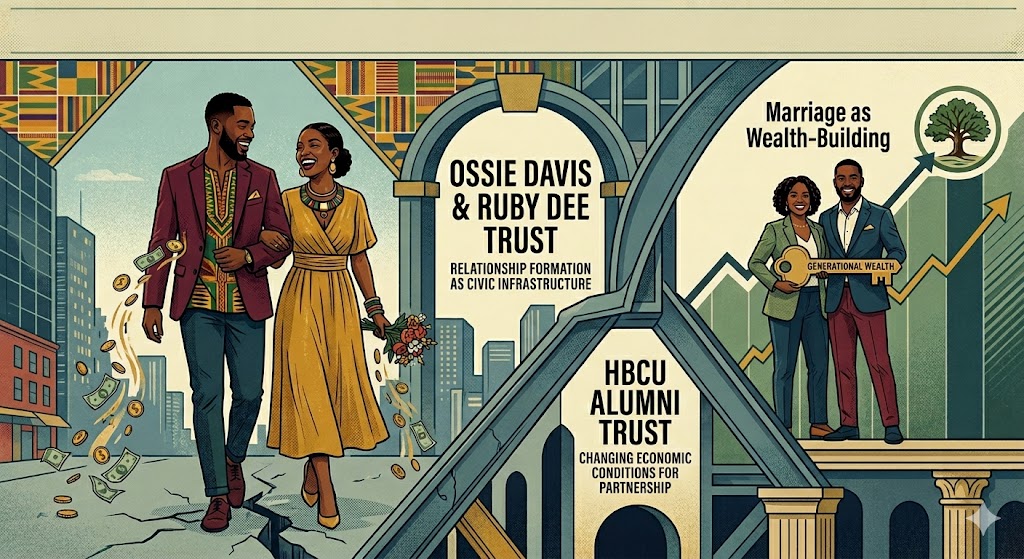
There is a financial contradiction embedded in the romantic lives of African Americans that most personal finance commentators decline to address directly, because addressing it directly is uncomfortable. The contradiction is this: African Americans, as a group, occupy the most economically precarious position of any major demographic in the United States, which makes the cost of courtship a genuine strategic burden — and yet marriage, and the household formation it produces, remains one of the most powerful wealth-building mechanisms available to individuals operating without inherited capital. African Americans cannot afford to date the way the broader culture has normalized dating. And they cannot afford not to.

This is not a romantic observation. It is an institutional and economic one, and it deserves to be examined as such.

The arithmetic is brutal when you sit with it. According to a February 2025 survey by BMO Financial Group, the average American adult spends $2,279 on dates per year, with the all-in cost of a single date from pre-date grooming to gas money estimated at nearly $168. At one date per week, that annualized figure climbs well past $8,700. Set that against an African American median household income that, per the most recent Census data, sits at roughly $52,000 — still last among all major ethnic groups — and courtship is consuming somewhere in the range of 16 to 17 percent of African American median income. No other major demographic group faces that proportional burden. The cumulative cost is not simply personal; it is communal, because money extracted from the African American household through consumption-oriented dating is money that does not compound, does not build equity, and does not circulate within Black institutional ecosystems.

The crisis is compounded by employment fragility. African American men between the ages of 20 and 24 have historically carried unemployment rates roughly double those of their white male peers and these are the years during which romantic partnerships form with the most frequency and social intensity, and also the years of maximum economic vulnerability for the demographic most burdened by the cultural expectation of financing courtship. The collision of maximum relational pressure and minimum economic stability is not accidental. It is structural, and the consequences of navigating it poorly leading to the accumulating debt in pursuit of performed affluence, or deferring the relational investments that ultimately build household wealth reverberate for decades.

What is rarely said plainly enough is that courtship itself, when conducted without financial discipline, functions as a form of capital extraction. Every dollar spent performing prosperity in a relationship like the unnecessary dinner, the performative gift, the vacation financed on credit is a dollar transferred out of a community already operating with the thinnest capital base in the country. The African American community has constructed, over generations, a rich institutional infrastructure: HBCUs, Black-owned financial institutions, fraternities and sororities, professional associations, religious organizations, and community development organizations. The health of that infrastructure depends, at its foundation, on the accumulation of wealth within African American households. Romance, conducted poorly, undermines that foundation directly.

And yet the opposite error of treating financial precarity as a reason to defer relational commitment indefinitely is equally destructive, and arguably more so at the institutional level. Marriage, sociologists have long established, is not merely a romantic arrangement. It is the primary non-institutional mechanism through which ordinary Americans build wealth. The two-income household produces compounding effects on savings capacity that single-income households simply cannot replicate. The married couple that directs dual incomes toward an investment portfolio, a property, a business capitalization, or a child’s education produces generational effects that individual accumulation, however disciplined, rarely matches. Economists studying the racial wealth gap have identified the marriage rate differential between African Americans and other groups as one of the structural contributors to the persistence of that gap not because marriage is morally superior to other arrangements, but because household formation is a capital formation mechanism, and lower rates of stable household formation mean lower rates of capital accumulation across the community.

The data on African American marriage rates is now well established. Black Americans marry at lower rates than any other major demographic group in the country, and those who do marry do so later. The causes are multiple and structural with high male incarceration rates, chronic unemployment disparities, elevated student debt burdens concentrated among Black women who have simultaneously outpaced Black men in educational attainment but the consequences operate as a compounding disadvantage. Every generation that forms fewer stable households is a generation that produces less transferable wealth. Every household that dissolves under financial stress and financial incompatibility remains among the most commonly cited causes of relationship dissolution is a household that fails to produce the institutional legacy it might have otherwise built.

The tension, then, is genuinely bilateral. Dating as currently practiced by too many African Americans is financially unsustainable and institutionally corrosive. But the instinct to disengage from romantic partnership altogether, whether from economic discouragement or cultural frustration, forfeits the most accessible wealth-building mechanism available to people without inherited capital. The resolution of this tension is not a lifestyle choice. It is a strategic discipline.

What that discipline requires, practically, begins with a fundamental reorientation of what courtship is for. In the broader American consumer culture, dating has been commodified into a performance, a sequential escalation of expenditure designed to signal value, demonstrate seriousness, and compete for desirability. That model was designed for, and is subsidized by, demographics with higher income floors and different capital structures. African Americans who adopt it wholesale are importing a financial logic that was never calibrated for their economic reality. The more productive frame is to understand courtship as what it has always been, beneath the cultural noise: an evaluation of partnership potential. The question that dating should answer is not who can perform affluence most convincingly but who can build alongside you most effectively.

The previous guidance this publication offered to HBCU men to be honest about your finances, maintain an emergency fund scaled to the specific vulnerability of African American employment, set expectations within a budget rather than beyond it, and resist the conflation of income with wealth remains sound, but it is incomplete if read only as personal financial advice. Its deeper implication is institutional. The man or woman who enters a serious relationship without financial honesty, without emergency reserves, and without a clear orientation toward asset accumulation is not simply making a personal error. They are entering a partnership that is structurally likely to fail under economic stress, and the failure of that partnership will remove another household from the African American wealth-building ecosystem. The stakes are communal, not merely personal.

The same logic applies to partner selection. This is a dimension of the conversation that cultural politeness often forecloses, but institutional analysis cannot afford to ignore. The choice of a romantic partner is, among other things, a capital allocation decision. A partnership between two individuals who are aligned on financial values, who are both oriented toward asset accumulation rather than consumption performance, and who are capable of the financial transparency that stable households require, produces outcomes that misaligned partnerships simply do not. The HBCU graduate who selects a partner based on emotional chemistry while ignoring or minimizing financial incompatibility is not being romantic they are being strategically imprecise about one of the most consequential decisions they will make. Given the compounding nature of household economics, imprecision here has long time horizons.

This is not an argument for mercenary partnership or the subordination of genuine affection to spreadsheet optimization. It is an argument that the dichotomy between romance and financial strategy is false, and that maintaining it as if it were real is a luxury African Americans, as a community, cannot afford. Other communities have understood for generations that courtship and institutional continuity are related phenomena. The institution of marriage among Jewish American families, which social scientists have identified as one of the structural contributors to that community’s remarkable intergenerational wealth transfer, is not simply an artifact of religious tradition. It is reinforced by a dense network of institutional expectations, community norms, and financial literacy frameworks that treat household formation as a community-level priority rather than a purely private one. The same patterns, in different cultural registers, appear in other communities that have achieved disproportionate wealth accumulation relative to their initial American circumstances.

African American institutions such as HBCUs, fraternities, sororities, religious organizations, professional associations have the capacity to play this coordinating role. The HBCU campus, which has historically served not merely as an educational institution but as a marriage market and professional network, is an underutilized asset in this regard. When two HBCU graduates form a household, they are not just creating a family. They are activating a set of institutional networks, alumni relationships, professional associations, and community commitments that have real capital value. When that household builds wealth, and directs that wealth through Black-owned financial institutions, invests in Black-owned enterprises, and contributes to HBCU endowments, it completes a capital circulation loop that strengthens the entire ecosystem. The household is not the end of the story. It is the seed of a much larger institutional project.

But the institutional infrastructure currently available to support that project is insufficient to the scale of the problem. Providing personal finance guidance to individual graduates, or hosting mixers within existing alumni networks, addresses symptoms rather than causes. What is actually required are new institutions purpose-built to treat relationship formation and household financial stability as interconnected civic priorities and the African American community is now beginning to conceptualize what those institutions might look like.

One framework that has emerged from this conceptual work is the proposed Ossie Davis and Ruby Dee Trust, a nonprofit structure designed to treat Black relationship formation as essential civic infrastructure. Rather than addressing individual behavior, it embeds an Institutional Matchmaking Network inside existing Black institutions such as HBCUs, Black Greek-letter organizations, and Black professional societies organizing participants into cohorts around values alignment and life stage rather than the transactional logic of dating apps. Institutional partners would be evaluated not by attendance but by households formed over time. Alongside this, the Trust’s proposed Black Marriage Economic Stabilization Fund directly attacks the structural barriers to marriage formation: student loan interest relief for married participants, down payment matching grants, emergency household stabilization funds, and cooperative legal planning tools. If society subsidizes corporate capitalization through tax structures and preferential credit, there is no principled argument against subsidizing household formation among the demographic most systematically denied access to those same structures.

A second emerging framework addresses what enters the household economically at the moment of formation. The proposed HBCU Alumni Trust would provide every HBCU graduate, at graduation, with a beneficial interest in a professionally managed irrevocable trust generating monthly income distributions for life, with 75 percent accessible and 25 percent mandatorily reinvested, and underlying assets protected by spendthrift provisions for a ten-year vesting period. Its purpose is not primarily about returns. It is about changing the conditions under which graduates enter the courtship market. A graduate carrying a monthly income stream is a categorically different actor than one entering post-graduation life with $40,000 in student debt and no liquidity buffer less likely to perform prosperity they do not possess, less likely to make partnership decisions driven by economic desperation, and more likely to be the kind of financially stable partner around whom a wealth-building household can actually be built.

The version of dating that is making African Americans broke, therefore, is not simply an individual failure of financial discipline. It is a community failure to have built and sustained the normative frameworks, the matchmaking infrastructure, and the financial tools within which courtship is understood as institutional preparation rather than consumption performance. Young African Americans inherit a culture of dating that was not designed with their economic realities or institutional interests in mind. The Ossie Davis and Ruby Dee Trust, the HBCU Alumni Trust, and the broader institutional imagination they represent are attempts to change that inheritance not through cultural policing or moral instruction, but through the construction of institutions that make the financially disciplined, partnership-oriented approach to courtship the path of least resistance rather than the path of greatest sacrifice.

The calculation, ultimately, is not whether African Americans can afford to date. They can, if they do it with discipline, honesty, and a clear-eyed understanding of what partnership is for. The calculation is whether African Americans can afford to continue treating courtship as a consumption category rather than a capital formation strategy and whether the institutions that serve African American life are willing to accept responsibility for building the infrastructure that makes the difference. The evidence of seven decades of compounding wealth gaps suggests, emphatically, that they cannot afford the former. The emergence of institutional frameworks designed to address the structural conditions of Black household formation suggests, cautiously, that some are beginning to accept the latter.

Disclaimer: This article was assisted by Claude AI.
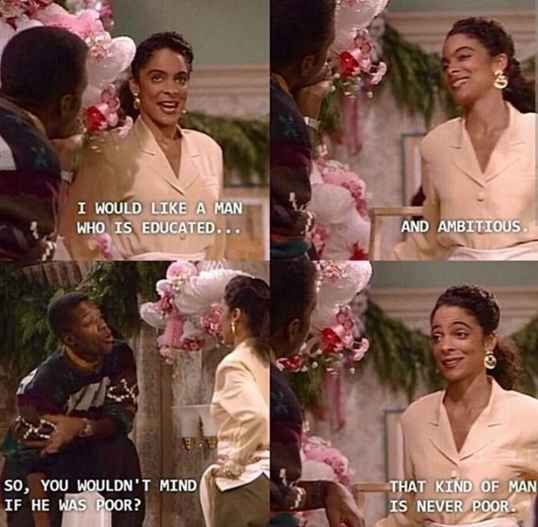
That Kind of Man Is Never Poor: Why Educated, Enterprising, and Ambitious Black Love Demands Mutual Support

Being deeply loved by someone gives you strength, while loving someone deeply gives you courage. — Lao Tzu

When A Different World aired that exchange in the late 1980s, it landed at the intersection of two of Black America’s oldest and most contested conversations: what we owe each other in love, and what it means to build a life of purpose and prosperity together. Whitley wasn’t asking for a rich man. She was describing an orientation toward life — educated, enterprising, and ambitious — and asserting that a person who lives that way will never be poor in the ways that truly count. But there was always a condition embedded in that vision, one the show understood even if it didn’t always name it explicitly: that kind of life requires a partner who isn’t just admiring from the sidelines. It requires someone who is building alongside you, pushing when the vision dims, holding when the weight becomes too much, and trusting even when the outcome isn’t yet visible. The kind of Black love that produces educated, enterprising, and ambitious people is not passive. It is active, intentional, and deeply communal.

Educated. Enterprising. Ambitious. These words sit comfortably on a vision board. They sound aspirational. But strip away the aesthetics and examine what each one actually demands of a Black person navigating this country, and you quickly understand why none of them can be carried alone. To be educated in Black America is not simply to hold a degree. It is to have committed to a process of self-understanding and world-understanding that this society has never made free or easy. For the hundreds of thousands who chose an HBCU, it was a decision to be educated and loved at the same time — to develop intellectual rigor inside institutions that did not require them to leave their Blackness at the door. That experience shapes how you move through the world, how you build, and critically, what you need from a partner. You need someone who values what you carry from that formation, who sees your education not as a credential but as a worldview that deserves to be exercised. A partner who belittles your ambitions, dismisses your networks, or resents your growth is not a partner in any real sense. They are a ceiling. To be enterprising is to see possibilities where systems have deliberately created barriers. Black entrepreneurship in this country has always been an act of defiance and an act of community building simultaneously. But enterprising requires risk. It requires long stretches of uncertainty, of not knowing if the next quarter will hold. A partner who cannot sit in that uncertainty with you, who confuses instability with failure, who demands the comfort of a steady paycheck over the potential of a built thing — that partnership will eventually become a negotiation between your dreams and their fears. And in that negotiation, someone always loses. To be ambitious is to insist that your potential has no ceiling. In Black America, that insistence is both a personal conviction and a political act. Ambition burns a tremendous amount of fuel. It consumes time, emotional bandwidth, and sometimes the very relationships that were supposed to sustain it. A partner who cannot celebrate your wins because your wins somehow diminish them, who needs you to stay small so they feel safe, is not a companion in ambition. They are its opposite. This is why Whitley’s answer to Dwayne was so quietly radical. She was not describing a checklist. She was describing a compatibility of spirit — the recognition that two people with aligned orientations toward growth could build something neither could build alone.

It is easy to focus on Whitley in this conversation because her words were so precise. But Dwayne’s question deserves equal examination. He did not ask what Whitley wanted in a husband — as if cataloguing features — but what kind of husband she wanted. He was asking about character, about essence. Dwayne Wayne was himself educated, enterprising, and ambitious. A genius-level engineering student at Hillman, a man who went on to a career that took him literally around the world. But what made him a worthy partner for Whitley, and what made their fictional union one of the most enduring love stories in Black popular culture, was not just his individual achievement. It was what he did with his love. He showed up. He advocated. He flew to her wedding to another man and interrupted it because he knew — and she knew — that their partnership was bigger than the fear that had kept them apart. That is what mutual support looks like in its most dramatic form. But most of us will not have our moment at an altar with a ballroom watching. Most of us will have the quieter, harder moments: the conversation at 11pm when one partner has been passed over again at work and needs to hear that their worth is not determined by that institution’s blindness. The weekend when one partner is grinding on a business plan and the other has to carry the household without resentment. The year when one partner’s career accelerates and the other has to find their own footing without collapsing into competition. Those moments are where Black love either becomes what it was always capable of being — or where it begins to quietly erode.

There is a damaging script in some corners of our community that frames one partner’s support for the other as sacrifice — as if partnership is a zero-sum arrangement where one person’s advancement necessarily comes at the other’s expense. This script has done enormous harm. It has produced couples who keep score rather than build, who compete where they should collaborate, and who eventually sit across from each other with years of resentment between them. The couples and partnerships that thrive understand something different. They understand that support is strategy. When you invest in your partner’s growth, you are not losing; you are expanding the resources available to your shared life. When a husband supports his wife’s MBA program by increasing his domestic load for two years, he is not diminished. He is invested. When a wife believes in her husband’s business concept before the market does and holds the household steady while he builds, she is not sacrificing her own ambition. She is deploying it strategically, because she understands that what they are building together is bigger than what either could build alone. This is the economic logic of Black love, and it is powerful. The HBCU power couples who go on to build medical practices, investment funds, cultural institutions, and businesses that employ other Black people do not build those things in spite of their partnerships. They build them through their partnerships. The art empire, the medical group, the legal practice — these are not solo achievements. They are the products of two people who chose, over and over again, to take the other’s dreams seriously.

And here is where that vision expands into something even larger — because educated, enterprising, and ambitious Black love is never just about two people. It has always carried a community inside it, and when it is at its most powerful, it carries an entire Diaspora. When two HBCU graduates build a life together, they bring their networks, their institutions, their mentors, and their commitments with them. The Hillman alumni network that became the seed capital for a Pan-African art fund was not a business transaction. It was the activation of bonds formed through years of shared education and shared love for an institution. Those investors did not write checks because of a pitch deck. They wrote checks because they trusted each other, because Hillman had taught them to see their prosperity as connected. That is the genius embedded in the HBCU tradition — it does not just educate individuals, it builds the relational infrastructure through which communities can act collectively. And it is Black love, in both the romantic and communal sense, that activates that infrastructure over and over again across generations.

But the full scope of what that love can build becomes visible only when we follow it to its institutional conclusion. Individual success, however impressive, is ultimately fragile. Wealth concentrated in one person can be lost in a generation. Knowledge that lives in one mind leaves when that person does. Influence that depends on a single relationship dissolves when that relationship ends. What endures is what gets built into institutions — into ownership structures, endowments, programs, and organizations that outlast any individual and continue to serve the community long after the founders are gone. This is why the most consequential dimension of educated, enterprising, and ambitious Black love is not what it produces in a household. It is what it deposits into institutions. The Black couple that builds a business strong enough to employ a hundred people and endow a scholarship fund is not just building a legacy for their children. They are building infrastructure for a community. The pair that pours their professional expertise back into an HBCU — consulting, donating, recruiting, advocating — is strengthening an institution that will educate and love thousands of Black students for decades to come. The partnership that structures its wealth to include collective vehicles — investment funds, foundations, land trusts, community development corporations — is doing something that individual accumulation, no matter how impressive, simply cannot do. It is converting personal achievement into communal capacity.

The Diaspora dimension of this is not incidental. It is essential. Black America has never existed in isolation from the broader African Diaspora, and the most visionary HBCU partnerships have always understood this. When Whitley Gilbert-Wayne stood in a Tokyo gallery and asked why African Americans were not building art collections anchored in the work of artists from across the Diaspora — from Salvador to Senegal, from Detroit to Durban — she was asking a fundamentally institutional question. Not just who collects this art, but who owns the infrastructure through which it is valued, appraised, traded, and preserved. Not just who appreciates Black beauty, but who controls the institutions that define and protect it. The Pan-African Art Appraisal program she helped establish between an HBCU and the University of Namibia was not a cultural gesture. It was an institutional act — the creation of a pipeline that would train a new generation of appraisers with both the technical competence and the cultural fluency to set the value of Diaspora art on terms that served the Diaspora. That is institutional ownership. That is what educated, enterprising, and ambitious Black love looks like when it reaches its full expression. And it could not have been built by either Whitley or Dwayne alone. It required the engineering career that took them to Tokyo. It required the art history formation that gave Whitley the language to see what she was seeing. It required the Hillman network that provided the initial capital and the Hillman-forged trust that made that capital available. It required, underneath all of it, a partnership that held steady across continents and career pivots and the slow, difficult work of building something that had never existed before.

What Dwayne and Whitley modeled — in fiction, and what so many HBCU couples have modeled in fact — is that Black love at its most generative is not primarily a private arrangement. It is a public act. Every time a Black couple directs their business patronage to Black-owned firms, they are building Black enterprise. Every time they mentor a younger HBCU graduate, they are extending the network that made their own success possible. Every time they sit on a board, anchor a fund, or pressure an institution to collect and commission work by Diaspora artists, they are expanding the definition of who gets to own and control cultural and financial infrastructure. Every time they build a business with an exit strategy that includes employee ownership or community benefit, they are ensuring that the wealth they created does not simply exit the community when they do. This is not idealism. This is what institutional ownership actually looks like in practice, and it is built one educated, enterprising, ambitious Black partnership at a time.

This is what A Different World was always pointing toward, even in its lightest moments. The romance between Dwayne and Whitley existed inside a world populated by people who pushed each other, competed with each other, loved each other, and collectively embodied the argument that Black excellence is not a solitary achievement. It is produced in community, sustained in community, and ultimately returned to community — and to a Diaspora that has always been waiting for us to bring our full selves, and our full institutional capacity, home.

If you are educated, enterprising, and ambitious — or trying to become those things — you are carrying a vision that is bigger than your own comfort. You are carrying, whether you have named it this way or not, an argument about what Black people are capable of when given the space, the resources, and the love to fully become. That vision requires a partner who takes it seriously. Not someone who merely tolerates your ambition, but someone who sees it as part of what they fell in love with. Not someone who supports you when it is convenient, but someone who holds the ground when the terrain gets difficult. Not someone who loves you in spite of your drive, but someone whose own drive calls yours forward. And if you are that partner for someone else, understand the magnitude of what you are doing. The quiet support, the unanticipated covering, the refusal to compete where you should collaborate — these are not small acts. They are the infrastructure on which entire legacies, and entire institutions, are built. The spouse who holds the household while the other writes the dissertation. The partner who talks you back from quitting. The friend-turned-love who looks at your half-formed idea and says, without hesitation, “I see it. Let’s build it.” These acts do not always make headlines. But they make everything else possible — the businesses, the collections, the endowments, the programs, the institutions that will carry Black and Diaspora communities forward long after any of us are here to see it.

Whitley Gilbert was not describing a fantasy when she told Dwayne what she wanted. She was describing a reality she was already willing to be part of — a partnership defined not by the presence of wealth but by the presence of character. Educated. Enterprising. Ambitious. And underneath all of it, the kind of love that builds, holds, risks, believes, and ultimately deposits something permanent into the world. That kind of love is never poor. And the institutions it builds are the inheritance of a Diaspora that was always worth the investment.


HBCU Money covers economic, finance, and investment news from an HBCU perspective. Follow us at hbcumoney.com.

Disclaimer: This article was assisted by ClaudeAI.