This here, right now, at this very moment, is all that matters to me. I love you. That’s urgent like a motherf**ker. – Darius Lovehall
There is a particular kind of magic that happens when Black people are given the space to simply be to lead, to create, to fail and succeed without the exhausting weight of being a perpetual outsider. Historically Black Colleges and Universities have always understood this. For more than 150 years, HBCUs have offered something that no diversity initiative, no DEI task force, and no affinity group within a predominantly white institution can fully replicate: an entire ecosystem built in, by, and for Black people. The effects of that ecosystem ripple outward in ways we are still measuring including into who HBCU alumni choose to build their lives with.
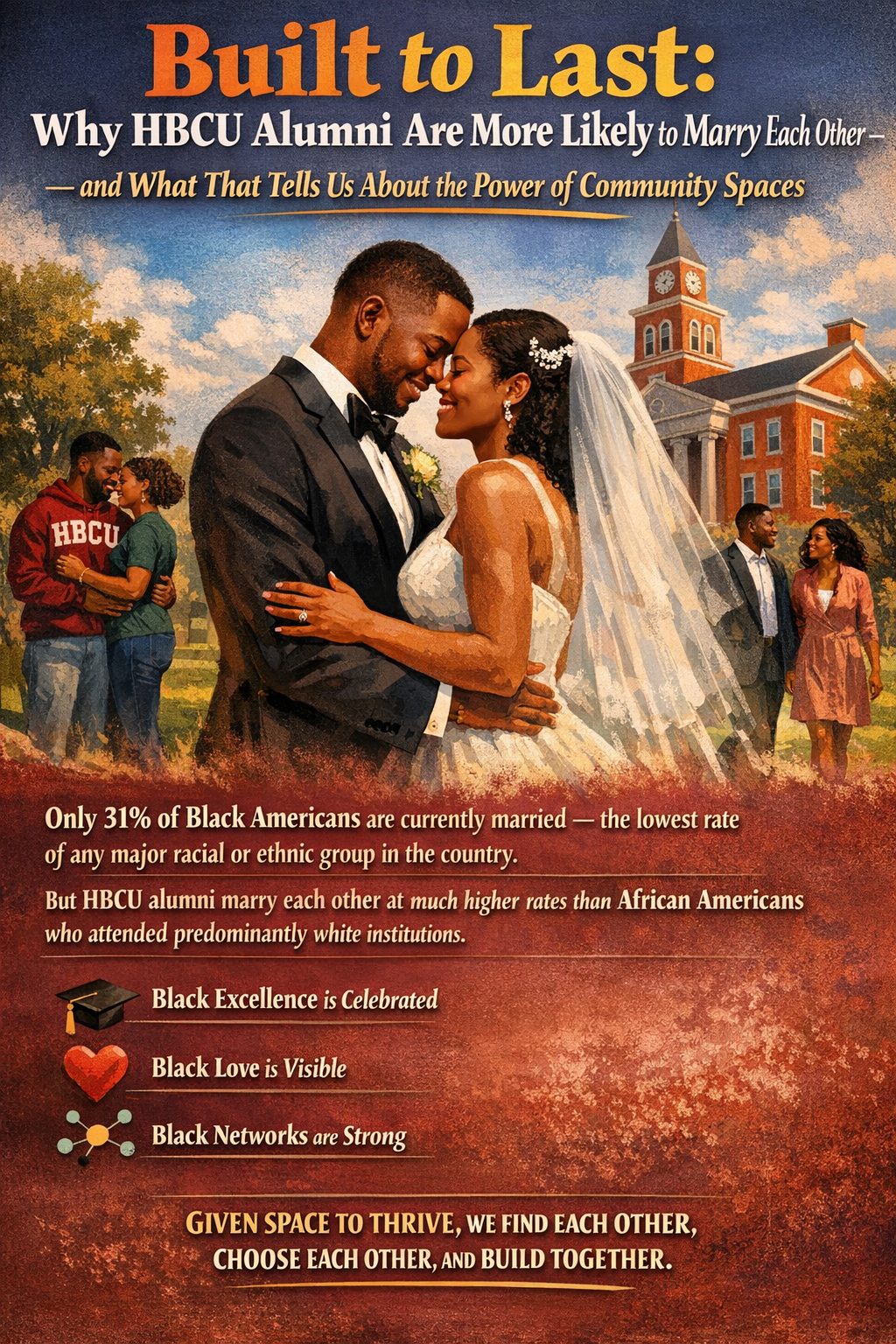
Research into the marital patterns of African Americans reveals a striking divergence between HBCU graduates and their counterparts who attended predominantly white institutions. HBCU alumni marry each other — Black men marrying Black women, Black women marrying Black men at significantly higher rates than African Americans who attended PWIs, where interracial marriages are considerably more common. This is not a coincidence. It is the natural fruit of what intentional community spaces produce.
The baseline numbers are sobering. Only 31% of Black Americans are currently married, compared to 48% of all Americans. Half of African Americans have never been married, compared to 34% of the general population, making African Americans the least married of any major racial or ethnic group in the country. There are approximately 5.18 million Black married-couple families in the United States today. That number has room — significant room — to grow. Currently, about 9–10% of Black college students attend HBCUs. Among college-educated Black newlyweds at PWIs, roughly 21% marry someone from another racial or ethnic group, with that figure rising to 30% among college-educated Black men. The picture at HBCUs is markedly different, and the reasons are structural, not accidental.
The social architecture of an HBCU where Black students are the majority, the leadership, the faculty, the homecoming court, the engineering honor society, and the debate team means that the romantic world reflects the academic world. HBCU alumni who marry are overwhelmingly likely to have met their spouse within a Black social and professional network, often one that traces its roots directly back to campus. African Americans who attend PWIs, by contrast, are exposed to a social universe numerically and institutionally dominated by white peers. Friendships, romantic relationships, and professional networks form disproportionately across racial lines not through any individual fault, but as a straightforward consequence of who is in the room. When your environment is 85% white, the statistical likelihood of cross-racial coupling rises organically. The HBCU alumni network functions, among other things, as a long-running and remarkably effective matchmaking institution one whose impact on community formation has never been fully quantified.
Sociologists have long understood that residential and institutional proximity is one of the strongest predictors of who people marry. We meet our partners in the spaces we inhabit — at work, at school, in our neighborhoods, at our houses of worship. The institution you attend for four formative years, the one that shapes your professional ambitions, your intellectual identity, your social circle, and your sense of self, will inevitably shape who you consider a natural life partner. For HBCU students, those four years are spent in an environment where Black excellence is not exceptional it is expected. Where Black love is not a political statement but a daily reality, visible in the couples holding hands on the quad, in the married faculty members co-teaching courses, in the alumni couples who return to homecoming year after year. Love, like ambition and leadership, is modeled. Young people see what is possible and, consciously or not, begin to orient their own futures accordingly.
PWI environments, for all their academic prestige, rarely offer this. Black students at PWIs often describe a bifurcated social experience belonging to affinity groups and cultural organizations that provide community, while simultaneously navigating a broader campus culture in which they are the minority. Black love is possible at PWIs, of course, and it flourishes there too. But the structural conditions do not make it the default. They make it something you find in spite of your environment, not because of it.
This conversation extends well beyond marriage rates, though those rates are a particularly measurable indicator of something larger. What HBCUs demonstrate is the transformative power of institutions that a community owns, shapes, and sustains for itself. This principle has animated Black institution-building in America since Reconstruction from Black Wall Street in Tulsa to the network of Black-owned banks, newspapers, hospitals, and churches that constituted what historians call the “Black counterpublic.” When a community has its own institutions, it controls its own narratives. It defines its own standards of beauty, intelligence, leadership, and desirability. It produces its own role models, generates its own wealth pathways, and creates an internal ecosystem dense enough that community members can meet each other’s needs — economic, social, spiritual, romantic — without having to seek fulfillment exclusively in outside spaces. The higher intra-community marriage rate among HBCU alumni is one data point in a much larger argument: that Black institutions do not merely provide education or services. They produce belonging. And belonging, once cultivated, has a way of reproducing itself in careers built together, in communities sustained together, and in families formed together.
For a publication dedicated to the intersection of Black financial life and Black excellence, the marriage data carries specific economic weight. Marriage, when it functions well, is one of the most powerful wealth-building vehicles available to any household. Two incomes, shared expenses, combined assets, coordinated estate planning, and intergenerational wealth transfer — these are the mechanisms by which families accumulate and maintain economic stability across generations. The racial wealth gap in the United States is staggering and persistent. For Black families to close that gap through their own accumulated power, marriage stability within the community matters. When HBCU alumni marry each other, they are pooling Black wealth with Black wealth building households that invest in Black communities, buy homes in Black neighborhoods, fund Black businesses, and leave assets to Black children. This is not about exclusion. It is about the compounding power of economic solidarity.
HBCU alumni already tend to earn strong incomes, leverage their alumni networks for professional advancement, and demonstrate higher rates of giving back to their alma maters and communities. According to the Gallup-USA Funds Minority College Graduates Report, 40% of Black HBCU graduates report thriving in financial well-being, compared to just 29% of Black graduates from non-HBCUs — the largest well-being gap Gallup measured between the two groups. Economic stability is one of the strongest individual predictors of marriage. Add to that the wealth-building power of sustained intra-community partnership, and the picture that emerges is of a uniquely powerful pipeline, one that begins with a campus in a college town and ends, generations later, in families that have genuinely built something lasting.
The most compelling question the data raises is not descriptive it is projective. If the HBCU environment produces meaningfully higher rates of Black marriage and intra-community partnership, what would happen to African American marriage rates if the share of Black college students attending HBCUs grew from today’s 10% to 25%, 50%, or even 75%? The answer, modeled carefully against current demographic data, is striking. These projections are calibrated estimates rather than census findings — they are directionally honest and mathematically grounded, built from known marriage rate differentials, HBCU graduation advantages, and the share of college-educated adults within the total Black population. One additional factor amplifies every projection: research shows that Black students at HBCUs are 33% more likely to graduate than their counterparts at comparable institutions, meaning scaling HBCU enrollment also scales Black degree attainment itself.
At 25% HBCU enrollment, roughly where HBCU attendance stood in the mid-1970s, the overall Black marriage rate would likely move from 31% toward 33–34%. That may sound modest, but in a population of nearly 47 million Black Americans, a two-to-three point increase represents roughly 500,000 to 700,000 additional married Black households, with intra-community marriage among college-educated Black Americans rising from roughly 79–80% toward 82–83%. At 50%, a transformational shift where the majority of college-educated Black Americans are formed in Black-centered environments, the overall Black marriage rate would likely climb toward 36–38%, closing nearly a third of the gap with the national average. The HBCU alumni network, at this density, becomes a dominant force in Black professional and social life: a self-reinforcing ecosystem where Black partner exposure is high across the entire college-educated class, translating to roughly 1.2 to 1.5 million additional Black married households.
At 75% HBCU enrollment, history offers its own precedent. Before integration dispersed the Black college-going population into majority-white institutions, HBCUs educated virtually all Black college graduates and during that era, African Americans age 35 and older were actually more likely to be married than white Americans, a trend that held from 1890 until sometime in the 1960s. A return toward 75% HBCU enrollment would not be an experiment in an unknown direction. It would be a partial return to conditions that demonstrably worked with a projected Black marriage rate of 40–42%, approaching parity with the national average for the first time in over six decades, and as many as 2 to 2.5 million additional Black married households.
HBCU Enrollment
Est. Black Marriage Rate
Intra-Community Marriage
New Married Households
10% (Today)
31%
~79–80%
Baseline
25%
33–34%
~82–83%
+500K–700K
50%
36–38%
~86–88%
+1.2M–1.5M
75%
40–42%
~90%+
+2M–2.5M
These projections carry honest caveats. Students who self-select HBCUs today may already have stronger pro-community cultural orientations, meaning the marginal effect per new HBCU enrollee may be somewhat smaller than current graduate data suggest. Marriage rates are also multi-causal — mass incarceration, income inequality, student debt, and campus gender ratio imbalances all independently shape outcomes. No single variable, however powerful, tells the whole story. But the directional conclusion is unmistakable: HBCU enrollment is a lever of community formation, not merely academic achievement. Pulling it harder produces more Black marriages, more Black wealth, and more Black families compounding across generations.
Every few years, critics question the continued relevance of HBCUs in an era of expanding integration and formal diversity efforts at major universities. The marriage data, alongside every other metric by which HBCU graduates outperform expectations relative to their socioeconomic backgrounds, is a decisive answer to that question. HBCUs are not relics of segregation. They are proof of concept — evidence that when Black people are given a fully resourced, culturally affirming environment to grow in, they flourish in ways that reverberate across every dimension of life. The lesson is not that PWIs should be abandoned or that integration was wrong. The lesson is that the goal was never assimilation — it was equity. And equity means Black people having their own institutions, not merely access to someone else’s. It means Tuskegee and Xavier and North Carolina A&T and Prairie View and Dillard and Morgan State existing not as alternatives of last resort but as premier, first-choice destinations that produce exactly the kind of human outcomes — professional, civic, familial — that their graduates embody.
The couples who meet at HBCU homecoming and marry a few years later are not a sentimental footnote to the HBCU story. They are a central chapter. They are what it looks like when a community invests in itself deeply enough that its members find each other, choose each other, and build together. The data suggests that with more investment — more students, more resources, more deliberate choice — the results scale. Two million additional Black married households is not a fantasy. It is arithmetic. And it starts with the decision of where to spend four years.
Disclaimer: This article was assisted by ClaudeAI.
Africans in the United States must remember that the slave ships brought no West Indians, no Caribbeans, no Jamaicans or Trinidadians or Barbadians to this hemisphere. The slave ships brought only African people and most of us took the semblance of nationality from the places where slave ships dropped us off. – Dr. John H. Clarke
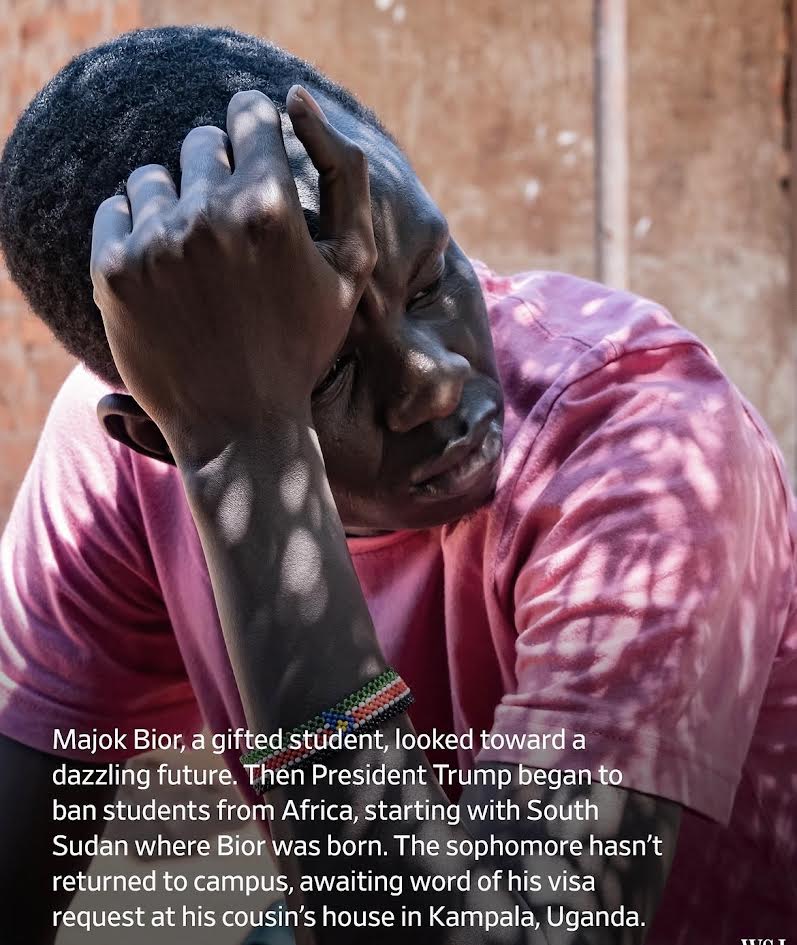
Photo from the Wall Street Journal
The photograph of Majok Bior, a South Sudanese computer science sophomore at Duke University, stranded at his cousin’s home in Kampala after the Trump administration’s travel restrictions invalidated his visa — has circulated widely as a symbol of individual suffering. And it is that. But to read it only through the lens of personal tragedy is to miss the structural dimensions of what is unfolding across American higher education, and to miss, in particular, what this moment means for HBCUs.
The Trump administration’s travel ban, initially signed on June 4, 2025, targeted 12 countries and placed partial restrictions on seven more, covering a geography concentrated in Africa and the Middle East. By December 2025, that list had expanded to 39 countries and territories, with Nigeria, historically one of the top ten sources of international students in the United States, placed under partial restrictions effective January 1, 2026. Individuals in Nigeria will not be able to receive student visas beginning January 1. Secretary of State Marco Rubio has signaled further expansion, with a State Department memo identifying 36 additional countries for potential restriction, including 25 African nations as well as countries in the Caribbean, Central Asia, and the Pacific Islands. If that expansion proceeds, the policy will have effectively severed the institutional connection between American higher education and the African continent.
For HBCUs specifically, this is not a distant geopolitical event. It is a direct threat to an enrollment strategy, a revenue base, and a civilizational relationship that institutions have spent decades building.
To understand the financial stakes, one must first understand how international student enrollment became integral to the fiscal architecture of many HBCUs. In addition to the tuition money international students often bring, many foreign students pay the full sticker price, often aided by their home countries’ governments there are benefits for HBCUs’ American students as well. International students, particularly those arriving with government-funded scholarships from Nigeria, Ghana, Saudi Arabia, and other nations, have served as a reliable source of full-fare tuition revenue at institutions that chronically lack the endowment depth to absorb enrollment volatility.
Among HBCUs with ten or more international students, Morgan State had the most as of the 2017-18 academic year, with 945 students; Howard was second with 920; and Tennessee State third with 584, according to the Institute of International Education. These numbers have only grown. Tennessee State, for instance, went from 77 international undergraduate students in 2008-09 to 549 by fall 2016 representing roughly 8 percent of its undergraduate student body. Across the sector, African students from Nigeria and Ghana historically constituted a significant share of that international cohort.
The financial logic was sound. A university with modest endowment holdings and only one HBCU, Howard University, currently holds an endowment exceeding $1 billion, cannot easily absorb the loss of a tuition-paying population without triggering cascading institutional consequences. When full-fare international students leave an enrollment ledger, the institution must either raise tuition on domestic students who are often already Pell Grant-eligible, draw down reserves, reduce staffing, or curtail academic programs. In a sector where financial fragility is not the exception but the norm, any of those choices carries compounding institutional risk. Preliminary projections by NAFSA and international education research partner JB International predict a 30 to 40 percent decline in new international student enrollment, leading to a 15 percent decline in overall enrollment this fall and loss of $7 billion within local economies and more than 60,000 jobs. That system-wide figure masks the disproportionate exposure at institutions whose international student populations are concentrated in African countries now under restriction.
The financial dimension, however, is only the first tier of the problem. The more consequential loss may be strategic: the slow dismantling of an institutional relationship between HBCUs and Africa that has been a defining feature of both parties’ long-term development. For decades, HBCU campuses have served as one of the primary entry points for African students seeking American credentials and professional networks. The relationship has never been purely transactional. It has been civilizational, rooted in a shared recognition that the institutional capacity of the African diaspora, on both sides of the Atlantic, depends on the training and circulation of its most capable people. Howard University, Morgan State, Florida A&M, and Tennessee State have all cultivated significant African student communities that returned home as engineers, physicians, lawyers, economists, and public administrators, seeding institutions across the continent with HBCU-educated professionals.
That pipeline is now interrupted. Majok Bior is one face of the disruption. He is also, statistically, the kind of student, a full-scholarship computer science talent, whose skills and networks would have contributed meaningfully to either the American or the African institutional ecosystem over the subsequent decades. The State Department’s position is unambiguous. There is no appeals window, no informal pathway, no consular discretion available to students like Bior whose visas were invalidated mid-enrollment. The pipeline does not merely slow. It stops.
The administration has signaled it may further target sub-Saharan Africa for future travel bans. Twenty-four of the 36 countries identified as future ban candidates are in sub-Saharan Africa. If all 24 were to be hit with bans, an additional 71 percent of the region’s population would be affected. At that scale, the policy would not merely interrupt an enrollment channel. It would functionally close the institutional bridge between American HBCUs and the African continent.
The arrivals data make the stakes concrete. The number of new and returning African students arriving in the United States for the 2025 fall semester fell by nearly a third from the previous year, according to preliminary Commerce Department data. Arrivals from Nigeria and Ghana, which historically send more students to the United States than any other African countries, dropped by roughly half. Those are not marginal declines. They represent a structural break in the flow of talent that has sustained both HBCU campuses and the professional networks those campuses anchor.
The broader context amplifies the damage. HBCUs have been managing a long-running tension between their mission to serve African American students and the enrollment arithmetic that increasingly pushes them toward diversification. Black student enrollment at HBCUs increased by just 15 percent from 1976 to 2022, while enrollment of students from other racial and ethnic groups rose by a staggering 117 percent during the same period. Within that context, African international students have occupied an important, if underappreciated, position: they are enrolled students who are Black, who arrive often with external funding, and who align with the cultural mission of the institution in ways that students from other international communities do not. The loss of this population does not merely reduce headcount. It removes a category of student whose presence reinforces the intellectual and cultural identity of HBCU campuses while simultaneously contributing to their revenue base.
HBCU leaders should resist the temptation to treat the current moment as a policy problem requiring a policy solution that is, to wait for a change in administration or a favorable court ruling before taking action. The institutional response must be proactive, and it must be organized at the sector level rather than institution by institution.
The first imperative is legal and advocacy coordination. HBCUs should be visible participants in the coalition of higher education institutions pushing back against travel ban expansion. The legal challenges already filed by some universities have produced limited court-ordered exceptions. HBCU presidents, through their associations and individually, possess a particular moral authority in this argument: these institutions were founded on the principle that the state should not determine who deserves access to education. That founding logic has direct application to the current moment, and its articulation should not be left to the advocacy organizations of predominantly white institutions alone.
The second is the construction of alternative enrollment infrastructure. Several countries whose students are not currently restricted represent significant untapped pipelines for HBCUs including Kenya, Ethiopia, South Africa, and several francophone West African nations not yet under full restriction. Morgan State’s international enrollment tripling between 2014 and 2017, driven by a concerted recruitment strategy, demonstrates that rapid scaling is possible when institutions make it a priority. The question now is whether that kind of deliberate enrollment strategy can be retargeted toward countries where the policy environment remains navigable.
The third imperative, and the most consequential for the long run, is the development of transnational academic infrastructure that does not depend on American visa policy at all and here the sector does not need to theorize. It already has a model. Claflin University, an HBCU in Orangeburg, South Carolina, and Africa University in Zimbabwe have together built and delivered a fully online Master of Science program in Biotechnology and Climate Change, producing their first cohort of graduates in 2025. The program requires no visa, no transatlantic relocation, and no dependence on the goodwill of a State Department consular officer. It delivers graduate-level credentials, anchored to an HBCU’s academic infrastructure, to scholars who remain embedded in the African communities they will eventually serve. That is not a symbolic gesture. It is a replicable institutional architecture — one that severs the link between American immigration policy and the HBCU-Africa educational relationship at precisely the point where that link has proven most vulnerable. The disciplines selected are themselves strategic: biotechnology and climate change are among the fields where African scholars have the most urgent applied work to do, and where the absence of well-trained researchers carries the steepest institutional cost. What Claflin and Africa University have built is a proof of concept for the entire sector. Howard, Morgan State, Florida A&M, and Tennessee State, institutions that have already invested in African student pipelines and cultivated international enrollment are positioned to extend this model into additional disciplines, additional partner institutions, and additional countries. Students who were considering coming in 2026 will be discouraged and will be looking to other destinations, as one international education expert has observed. If those students go elsewhere, HBCUs should be competing to ensure that some of that “elsewhere” is a degree program bearing an HBCU’s name, delivered on African soil, through African partner institutions, and impervious to the policy preferences of any particular American administration.
The image of Majok Bior waiting in Kampala is a human document. But it is also an institutional document. It records the moment when an African student who had successfully navigated the American credentialing system, who had won a full scholarship, enrolled in computer science, played intramural soccer, and survived chemistry class was extracted from that system not by any failure of his own but by a federal policy aimed at restricting the movement of African people into American institutions. HBCUs were built precisely because such exclusions were once the default condition of American higher education. The institutional memory of that history is not a rhetorical resource. It is a strategic asset, a basis for understanding that the institutions which serve communities without consistent access to political protection must always be building structures that can survive the withdrawal of that protection. The Africa travel ban is an HBCU problem. The sector’s response to it will reveal something important about whether these institutions have developed the depth and coordination to meet a challenge that is, in its essential structure, the same challenge they were built to confront.
Disclaimer: This article was assisted by ClaudeAI.
Timidity does not inspire bold acts. – Dr. Mae Jemison
The college fair model is broken — at least for HBCUs. Here’s how alumni chapters can build a pipeline that starts long before a student ever picks up a brochure. Walk into any college fair in a major American city and you’ll find the same scene: rows of tables draped in school colors, stacks of glossy brochures, and admissions representatives competing for the attention of juniors and seniors who, by that point in their academic journey, have already largely made up their minds. For predominantly white institutions with billion-dollar endowments and national name recognition, the college fair model works well enough. For Historically Black Colleges and Universities, it represents a fundamental misalignment between the urgency of the moment and the passivity of the approach.
HBCU enrollment has seen encouraging upticks in recent years, but the long-term pipeline challenge remains real. Alumni chapters, often the most energized, locally embedded advocates for their institutions are still overwhelmingly operating in reactive mode. They show up to fairs. They host the occasional scholarship gala. They cheer at homecoming. What we are not doing, with nearly enough intentionality, is going to where the students are, years before those students are old enough to apply. That has to change. And the blueprint for changing it is hiding in plain sight.
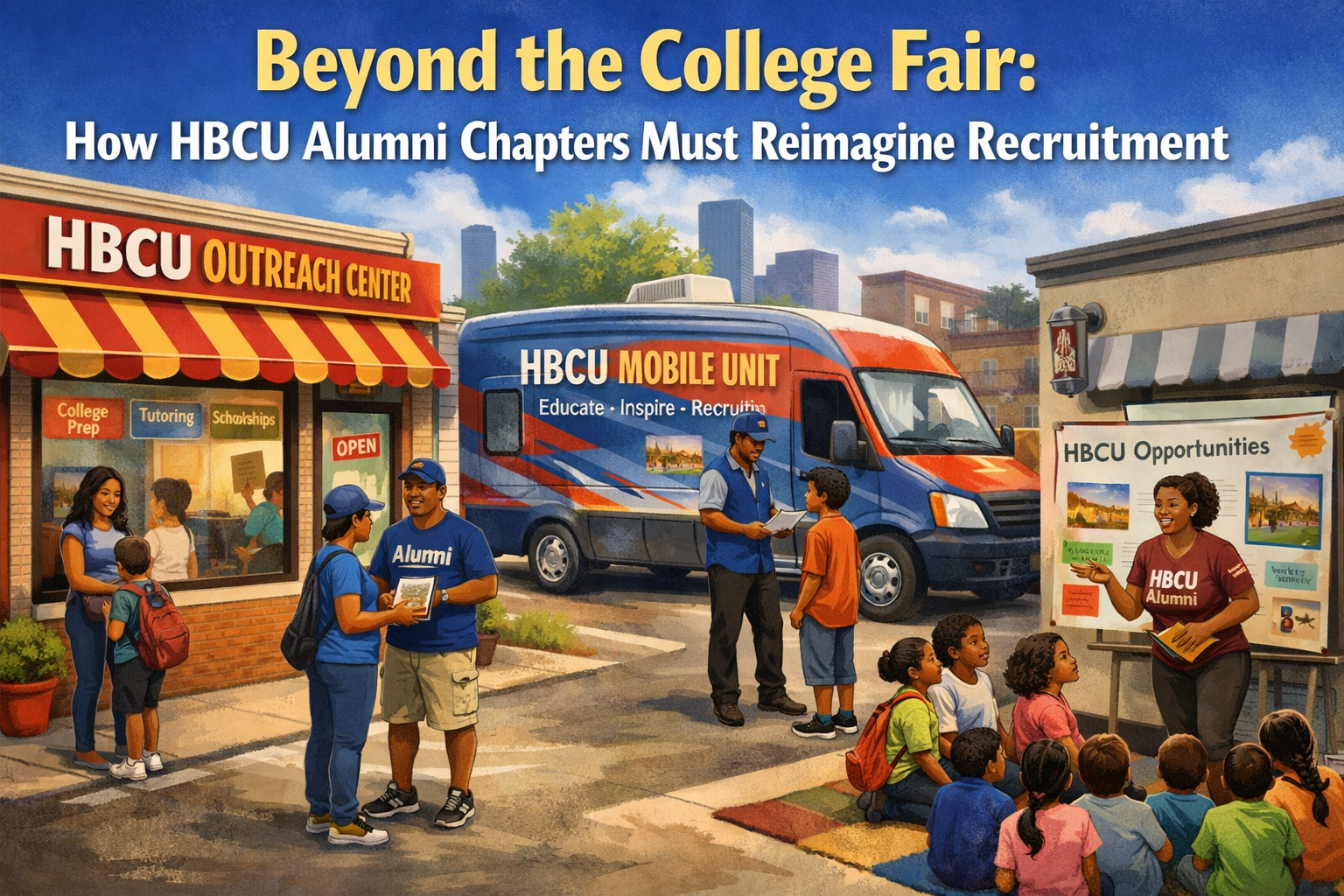
Imagine walking down a commercial corridor in Atlanta’s West End, Houston’s Third Ward, Baltimore’s Park Heights, the five buroughs in New York, or Chicago’s South Side and seeing a storefront with the colors and seal of a prominent HBCU. Inside, a welcoming space offers something radical in its simplicity: free help.
Help filling out college applications. Help navigating the FAFSA. Tutoring for high school students. Information sessions on academic programs, scholarship opportunities, and campus life. GED preparation for adult learners. GMAT and GRE prep for prospective graduate students. A community room where a kid can sit down after school and do homework, surrounded by images of Black excellence in cap and gown.
This is not a fantasy. It is a strategic infrastructure play that HBCU alumni chapters can begin building right now and the financial logic is stronger than many chapters realize.
Alumni chapters that have built up reserves, or that are willing to pool resources with neighboring chapters, should be actively exploring storefront leases in high-traffic African American neighborhoods. The cost of leasing modest commercial space in many urban corridors, while not trivial, is within reach for chapters with organized fundraising operations. More importantly, this model transforms the alumni chapter from a social organization into a community institution — and community institutions attract donors, partnerships, and long-term sustainability.
For chapters with the financial sophistication and appetite, ownership rather than leasing should be the goal. A storefront property that houses an HBCU recruitment and support center is also a real estate asset. It appreciates. It can be refinanced. It generates community goodwill that translates into alumni donations and corporate sponsorships. Forward-thinking chapters should be thinking about their real estate portfolio the same way a small nonprofit thinks about its balance sheet — as a long-term instrument of mission and sustainability.
But the case for ownership goes well beyond the chapter’s balance sheet. When an HBCU alumni chapter purchases a commercial property in a Black neighborhood, it is making a statement that is felt far beyond the four walls of the building. Vacant storefronts are one of the most visible symptoms of disinvestment in African American communities. They signal to residents, businesses, and young people that nobody believes in the block — that the neighborhood is somewhere to leave, not somewhere to build. An alumni chapter that acquires and activates one of those properties is doing something that no amount of college fair attendance can accomplish: it is demonstrating, physically and permanently, that Black institutional investment is real.
This is the chapter functioning as a community developer — not just a recruiter. The presence of a professionally staffed, well-maintained HBCU center on a commercial corridor raises the standard for the surrounding block. It attracts foot traffic. It gives neighboring businesses a reason to invest in their own storefronts. It signals to prospective residents and entrepreneurs that the community has anchors worth building around. Property values in the immediate vicinity benefit. The narrative of the neighborhood begins to shift.
Alumni chapters that think this way are not simply supporting their alma mater — they are exercising the kind of place-based economic power that Black communities have historically been denied. Every dollar that goes toward acquiring and improving a property in the community stays in the community. The chapter builds equity. The neighborhood builds stability. And the students who walk through that door every day see, in the most tangible terms possible, what organized Black investment looks like. That lesson alone is worth the price of the building.
Chapters that cannot yet afford standalone locations should explore co-location models: shared space with Black-owned businesses, community centers, or even jointly operated centers with two or three HBCU chapters that maintain separate branding but share overhead. A joint Virginia State-Morgan State-Cheyney recruitment center in a major metro is not just a cost-saving measure — it is a statement about the HBCU ecosystem as a unified force.
The single biggest reason community-based recruitment initiatives fail is that they are built on volunteerism alone. Volunteers are essential — but they cannot open the doors at 9 a.m. on a Tuesday, maintain records, follow up with prospective students, or manage institutional partnerships. A storefront that is going to deliver consistent, professional service to the community needs a full-time core team. It does not need to be large. It needs to be right.
The foundation of the storefront operation is the Executive Director / Center Director, a full-time salaried role that carries the weight of the entire operation. This person manages the relationship with the alumni chapter board and the parent institution, oversees staff, builds and maintains community and school district partnerships, and is ultimately responsible for the center’s recruitment numbers and programming outcomes. This is not an entry-level position. The ideal candidate has a background in higher education administration, community organizing, nonprofit management, or some combination of the three — and they are a proud, vocal HBCU product. Salary range: $70,000–$80,000 depending on market and chapter resources.
Supporting the director is a Recruitment and Admissions Counselor, a full-time role dedicated entirely to student-facing work. This person guides prospective students through the entire application process — from first contact to submitted application to financial aid completion. They manage the center’s student database, track pipeline metrics, and are the primary point of contact for high school counselors and community college advisors in the region. A background in college admissions or student affairs is ideal, and again, HBCU alumni status is a meaningful qualification. Salary range: $60,000–$68,000.
The third full-time position is a Financial Aid and Resource Navigator. The financial aid process is where more students fall out of the pipeline than anywhere else — not because they cannot afford college, but because the system is confusing, intimidating, and unforgiving of missed deadlines. This staff member specializes in FAFSA completion, scholarship identification, financial literacy education, and connecting adult learners with workforce funding and employer tuition benefits. They serve every lifecycle stage the center touches. A background in financial aid administration, social work, or community financial services is the right profile. Salary range: $60,000–$68,000.
These three full-time positions form the operational spine of the storefront. Beyond them, part-time staff and alumni volunteers extend the center’s capacity without extending its payroll. A part-time academic tutor or tutoring coordinator — ideally a current graduate student or recently graduated HBCU alumna — can run afternoon and evening tutoring sessions. Alumni volunteers with professional backgrounds in law, medicine, business, and education rotate through the center for workshops, panel discussions, and one-on-one advising sessions. A volunteer coordinator role, which can be managed by the Executive Director in the early stages, ensures that the volunteer corps is organized, scheduled, and recognized for their contributions.
The total full-time annual personnel cost for the storefront, including modest benefits, runs approximately $190,000–$220,000. That is a real number, and chapters should treat it as such when approaching their institution, corporate partners, and grant funders. It is also the number that separates a serious operation from a well-intentioned hobby.
For communities and schools that cannot easily access a storefront location, the chapter must come to them. This is where the concept of the HBCU mobile recruitment unit becomes a game-changer.
Alumni chapters should be looking seriously at purchasing used charter or transit buses and retrofitting them as mobile engagement vehicles. The cost of a used bus is often in the range of $30,000 to $80,000 depending on age and condition, with retrofitting adding additional investment. But the return in community presence, recruitment reach, and alumni chapter identity is enormous.
A properly outfitted mobile unit becomes a rolling admissions office. Equipped with laptops, tablets, printed materials, and onboard programming capability, the bus can park outside middle schools during dismissal, set up at community festivals and church parking lots on weekends, and roll through neighborhoods that college admissions representatives have never set foot in. It can run FAFSA completion workshops at community centers, host financial literacy sessions for parents, and bring the campus — virtually, through screens and presentations directly to families who may have never considered that a college education is within their reach.
A bus without a dedicated crew is a very expensive parking lot ornament. The mobile unit, to function as a true outreach vehicle rather than an occasional showpiece, requires its own committed staffing structure — lean but professional.
The non-negotiable full-time role is the Mobile Outreach Coordinator, who is simultaneously the unit’s program lead and its logistical engine. This person owns the deployment schedule, manages school district and community partner relationships, leads or facilitates on-site programming when the bus is in the field, and tracks every student interaction for follow-up and pipeline reporting. Critically, they serve as the bridge between the bus and the storefront — ensuring that students engaged in the field are handed off cleanly into the center’s formal services. This role requires someone who is equally comfortable presenting to a room of eighth graders, negotiating access with a school principal, and updating a CRM database. Salary range: $55,000–$65,000.
The second essential role is the full-time Commercial Driver / Logistics Coordinator. This is not simply a bus driver. The right person for this role holds a commercial driver’s license (CDL) and also takes ownership of vehicle maintenance scheduling, equipment inventory, and supply logistics for the unit. On deployment days, they are a visible, welcoming presence — often the first face a student or parent sees when approaching the bus. Many alumni chapters will find this person within their own membership: a retired transit worker, a logistics professional, or a veteran with transportation experience who is deeply invested in the mission. Salary range: $45,000–$55,000.
These two full-time positions are the core of the mobile unit. On high-volume deployment days — school visit days, large community events, or multi-stop weekends — part-time Recruitment Ambassadors supplement the crew. These are ideally current HBCU students or recent graduates who can speak authentically to the college experience, assist with application and FAFSA walkthroughs on the bus’s onboard stations, and engage peers in a way that no administrator can replicate. They are paid hourly and scheduled based on the deployment calendar.
The storefront’s Recruitment and Admissions Counselor and Financial Aid Navigator should also rotate onto the bus for targeted events — particularly FAFSA completion drives and high school senior nights — ensuring that students who need deeper guidance get it in the field, not just at a fixed location.
The full-time annual personnel cost for the mobile unit runs approximately $100,000–$140,000, excluding the bus acquisition and retrofit. Chapters that operate both a storefront and a mobile unit under one organizational roof — sharing the Executive Director’s oversight and administrative infrastructure — realize meaningful efficiencies. The combined full-time staff across both operations totals five to six people, with a total annual personnel investment in the range of $300,000–$400,000. That is a community development organization of real consequence, and it should be funded and governed as one.
The most important shift in mindset this article is calling for is one of timeline. HBCU alumni chapters cannot afford to think of recruitment as something that begins in 11th grade. The pipeline has to start much earlier — and it has to serve learners at every stage of life.
Head Start (Ages 0–5): Before a child ever sets foot in a kindergarten classroom, their relationship with learning and with the adults who shepherd it is already being shaped. This is why HBCU alumni chapters must engage Head Start programs, and why that engagement represents one of the highest-leverage opportunities in the entire pipeline.
Head Start is the federal early childhood program serving primarily low-income children ages birth to five, and Black children are among its most significant constituencies. According to the most recent federal program data, 29 percent of Head Start enrollment is Black or African American, non-Hispanic making it one of the largest organized points of contact with Black families in America at the earliest stage of a child’s development. Yet the program is dramatically under-serving the eligible population it is meant to reach: nationally, only 54 percent of eligible Black children are served by Head Start preschool, a gap driven in part by residential segregation and the uneven geographic distribution of Head Start centers.
That gap is itself an opportunity for HBCU alumni chapters. A storefront-based center located in a Black community can serve as a trusted navigator helping families find, apply for, and access Head Start services while simultaneously introducing those same families to the HBCU pipeline that begins long before a child can read.
The engagement strategy at this stage is not academic. It is relational. Head Start programs already operate with a strong family engagement model — approximately 378,000 adults volunteered in their local Head Start programs in a recent program year, of whom 295,000 were parents of Head Start children. Alumni chapters should be plugging into that existing network of engaged parents, not waiting for those parents to find them. Partnering with local Head Start centers to host family nights, read-aloud events, and college aspiration programming for parents creates touchpoints that are warm, community-rooted, and years ahead of any college fair.
The parents of Head Start children are also, frequently, prospective students themselves. Many are in their twenties or early thirties, may have some college credit, and are navigating the competing demands of parenthood and economic insecurity. An HBCU alumni chapter that shows up at a Head Start family event with information about degree completion programs, flexible scheduling, financial aid for adult learners, and the life-changing potential of an HBCU education is not just planting seeds for the next generation — it is recruiting for this one. The storefront’s Financial Aid and Resource Navigator is a natural liaison here, building relationships with Head Start family service coordinators who are already helping parents navigate social services and can add educational pathways to that conversation.
Alumni chapter members who are educators, social workers, pediatricians, or child development professionals should be the face of this engagement. Reading to children at a Head Start center, facilitating a workshop for parents on school readiness and early literacy, or simply being a visible, joyful presence in the community establishes the HBCU brand as one that cares about Black children from the very beginning not just when they are old enough to fill out an application.
Elementary School (K–5): The goal at this stage is not recruitment it is aspiration. But there is a deeper and more urgent reason why HBCU alumni chapters must show up here: elementary school is where the majority of Black boys are lost academically, and the window to intervene is narrow.
The data is unambiguous and devastating. According to the National Assessment of Educational Progress, only about 17 percent of Black fourth-grade students are reading at or above grade-level proficiency. For Black boys specifically, the numbers are worse. Only 13 percent of fourth-grade Black boys scored proficient in reading on the NAEP, compared to 40 percent of fourth-grade White boys. Research from the Annie E. Casey Foundation shows that children who are not reading proficiently by third grade are four times more likely to drop out of high school. And the cliff is steep: schools stop teaching children how to read after third grade and expect them to read to learn — for Black boys who missed early reading milestones, the system rarely slows down to help them catch up.
The academic struggle is compounded by the discipline crisis that runs parallel to it. Black boys represent just 8 percent of total K–12 enrollment but account for 15 percent of students receiving in-school suspensions and 18 percent of those receiving out-of-school suspensions. It starts before kindergarten: Black boys account for 9 percent of preschool enrollment but represent 23 percent of preschool children who received one or more out-of-school suspensions. Every day a Black boy spends outside the classroom is a day the reading gap widens. Black boys lost 132 days of instruction per 100 students enrolled due to out-of-school suspensions — a staggering accumulation of lost learning that trails these students for years. The research also shows that Black boys are markedly less likely to be subjected to exclusionary discipline when taught by Black teachers — a finding that speaks directly to the power of representation, and to what an HBCU alumnus standing in a classroom or community center can mean to a young Black boy who has rarely seen himself reflected in a position of educational authority.
This is why HBCU alumni chapters must be present in elementary schools — not with brochures, but with people. Reading programs, mentorship initiatives, and “college visit days” that introduce young children to the very concept of higher education are not extracurricular niceties; they are interventions. Seeing an HBCU alumnus or alumna in a professional role, wearing their school colors, and speaking with pride about their college experience plants a seed that can survive years of discouragement and doubt and provides a counter-narrative to a system that, by fourth grade, has already written too many Black boys off. Chapters should be cultivating relationships with school principals and PTA organizations to create recurring, sustained programming access. The presence has to be consistent, not occasional. A single visit does not change a trajectory. A relationship does.
Middle School (6th–8th Grade): By middle school, academic identity is forming and peer influence is at its peak. This is the moment to introduce students to HBCU culture, legacy, and opportunity in a way that makes it feel aspirational and cool. Alumni chapters should be running summer enrichment programs, college campus tours, and after-school STEM or arts programming tied to their institution’s academic strengths. Students who visit an HBCU campus at age 13 are far more likely to apply at 17.
High School (9th–12th Grade): This is the traditional recruitment window, but even here the storefront and mobile unit models change the game. Rather than waiting for students to find them at a fair, chapters are already embedded in these students’ communities. The work at this stage is conversion: helping students who are already HBCU-curious move through the application process, understand their financial aid options, and see themselves as belonging on campus. Chapters should have alumni assigned as informal advisors to high school college counselors — a presence that keeps HBCUs top of mind when counselors are guiding students toward school lists.
Adult Learners and Working Professionals: The traditional 18-to-22 pipeline is not the only one that matters. Millions of Black adults in American cities have some college credit but no degree. Alumni chapters that operate storefronts can become hubs for adult learner recruitment — connecting prospective students with their institution’s degree completion programs, online offerings, and evening or weekend formats. The FAFSA is available to adult learners. Institutional scholarships often target this population. Alumni chapters are uniquely positioned to be the trusted intermediary that convinces a 32-year-old with two kids and a job that finishing their degree is still possible.
Transfer Students: Community colleges in major metros serve enormous numbers of Black students who are academically capable of completing a four-year degree. Alumni chapters should have formal relationships with the counseling offices of every community college in their region, providing materials, hosting information sessions, and facilitating articulation agreement information that helps students understand how their credits will transfer to an HBCU.
Prospective Graduate Students: HBCUs are increasingly building out competitive graduate and professional programs. Alumni chapters can serve this market by hosting networking events that connect Black professionals with information about MBA, law, public health, and social work programs at their institution. The storefront model works exceptionally well here: an evening panel of HBCU-credentialed professionals discussing the value of their graduate degree, hosted at a community location, is both a recruitment event and an alumni engagement opportunity.
None of this is free, and alumni chapters should be honest with themselves about the resource requirements. A combined storefront and mobile operation with a full-time staff of five to six people, housed in leased or owned commercial space, represents a total annual operating budget — personnel, facilities, programming, and vehicle costs — likely in the range of $400,000 to $550,000 depending on market. That is a real community development organization, and it needs to be funded like one.
The good news is that the funding landscape is more favorable than many chapters realize — particularly for chapters willing to do the work of building a formal organizational structure, a board of directors, and a documented impact model.
Corporate partners, particularly those with HBCU engagement programs, represent another significant funding channel. Black-owned businesses in the communities where storefronts would operate should be natural co-investors: they benefit from a more educated local workforce and a more vibrant community anchor institution. Faith communities, which often have both facilities and congregational fundraising capacity, are underutilized partners for HBCU alumni chapters in nearly every city.
State and federal workforce development funding including Workforce Innovation and Opportunity Act dollars can support adult learner programming and the Financial Aid Navigator role at storefront locations. Chapters with 501(c)(3) status or fiscal sponsorship arrangements can access this funding stream, as well as philanthropic grants from foundations focused on educational equity, Black wealth building, and community development. The mobile unit may also qualify for transportation equity and community access grants available through state education agencies and private foundations.
Here is the harder conversation that most alumni chapters are not having: grants run out, corporate partners change priorities, and institutional support is subject to the whims of university budget cycles. Any operational model built entirely on external funding is one budget cut away from collapse. The chapters that will sustain these operations for decades not just launch them with fanfare are the ones that build their own financial engine.
This means HBCU alumni chapters need to stop thinking of themselves purely as fundraising organizations and start thinking of themselves as investors. The distinction is critical. Fundraising asks others to fund your mission. Investing builds assets that fund your mission in perpetuity.
The first and most immediate step is the establishment of a formal chapter endowment. An endowment is not a reserve fund or a savings account, it is a permanently invested pool of capital whose principal is kept intact while the annual investment income is distributed for operations and programs. Most endowments are designed to keep the principal corpus intact so it can grow over time, while allowing the nonprofit to use the annual investment income for programs and operations. A chapter endowment seeded with $500,000 and professionally managed at a conservative annual return of 5 percent generates $25,000 per year in perpetuity — money that never has to be raised again. Scaled to $2 million, that is $100,000 annually without a single grant application. The endowment is built through major gifts from alumni, planned giving and bequest programs, proceeds from chapter events reinvested rather than consumed, and targeted endowment campaigns run every three to five years.
Beyond the endowment, chapters with the organizational maturity to do so should be seriously exploring the creation of a dedicated investment arm, a separate but affiliated entity structured as a 501(c)(3) foundation or a for-profit LLC depending on the chapter’s strategic goals, whose mandate is to build and manage a diversified portfolio of assets that generates income to fund chapter operations and community programs. Most endowments are set up as separate entities from the nonprofit they support, paying formal grants to the nonprofit, with a structure that requires a separate board of directors, officers, mission statement, and internal policies. This structure gives the investment arm its own governance, its own fiduciary standards, and its own identity while keeping the mission connection to the chapter clear and documented.
What does the portfolio of an HBCU alumni chapter investment arm look like in practice? Good old stocks and bonds to begin with to get the asset train rolling. Real estate comes next as a natural mission-aligned asset class as discussed. The storefront properties this article has already discussed are the starting point but the vision should not stop there. A chapter that owns its storefront, then acquires a second commercial property that it leases to a Black-owned business, then participates as a co-investor in a mixed-use affordable housing development in its target community, is building a real estate portfolio that generates rental income, appreciates in value, and reinforces the chapter’s identity as a community developer. Every property the chapter owns is a statement that Black institutional capital is permanent in this neighborhood.
Beyond real estate, chapter investment arms should be exploring mission-aligned equity investments in Black-owned businesses, HBCU-affiliated startups, and community development financial institutions. Alumni Ventures, a model pioneered in the broader higher education alumni space, has demonstrated that alumni funds can blend community focus with rigorous portfolio construction, leveraging deal flow to ensure quality and diversification. An HBCU alumni chapter investment fund that pools capital from members with minimum investment thresholds accessible to working professionals, not just the wealthy — democratizes wealth-building while directing capital toward enterprises that reflect the community’s values.
The chapters that will build these operations are the ones that stop thinking of themselves as social clubs with a community service component and start thinking of themselves as the community development and wealth-building arm of one of America’s most important institutional legacies. The storefront and the mobile unit are the mission. The endowment and the investment portfolio are what keep the mission alive when the grants run out and the corporate partners move on. Both are necessary. Neither is optional.
Every year that HBCU alumni chapters spend waiting at tables at college fairs is a year that students who could have found their way to a transformative HBCU education do not. The competition for Black students is fierce, well-funded, and increasingly present in the very communities where HBCUs have historically drawn their greatest strength.
The answer is not to compete on those terms. The answer is to go deeper, go earlier, and go to where the community lives. Storefronts and mobile units are not just recruitment tactics they are acts of institutional love and community investment. They say, loudly and visibly, that this HBCU is not waiting for students to find it. It is coming for them in the best possible way.
Alumni chapters have the people, the passion, and increasingly the resources to make this happen. What they need now is the will to think bigger than a folding table and a stack of brochures.
HBCU Money is the leading personal finance and business news platform focused on the HBCU community. To learn more about HBCU financial strategies, alumni engagement, and institutional development, visit hbcumoney.com.
Ideas that extend the physical infrastructure already proposed:
1. HBCU Alumni Chapter Media Studio — A small podcast/video production corner inside the storefront that creates original content: student success stories, “day in the life” campus videos, financial aid explainers, and alumni career spotlights. Content goes directly to YouTube, TikTok, and Instagram and keeps the chapter’s brand alive in the community 24/7 — long after the doors close. It serves as a recruitment tool that never sleeps and costs relatively little to set up.
2. Career and Internship Pipeline Desk — A formalized partnership structure between the storefront and local employers, specifically focused on creating internship and first-job pathways for HBCU students and graduates. The storefront becomes a local talent pipeline desk — something corporate partners can co-fund in exchange for access to HBCU talent. This also keeps alumni coming back after graduation and turns the center into a lifelong resource, not just an admissions office.
3. HBCU Health and Wellness Partnership — Several HBCU alumni alliances already do this. Given that health disparities in Black communities are severe, the storefront can host free health screenings, mental health workshops, and wellness programming co-sponsored by HBCU nursing and public health programs. This embeds the storefront even deeper in community trust and brings in foot traffic from people who may not initially be thinking about college at all — but who are now in the building.
Ideas that use the alumni chapter’s organizational capacity:
4. Returning Citizens / Reentry Pipeline — Formerly incarcerated individuals represent one of the most underserved and educationally motivated populations in Black communities. HBCUs that accept returning citizens and the Pell Grant restoration (reinstated in 2023) make this timely. The storefront is a natural hub for partnering with reentry organizations to connect this population with HBCU degree programs, adult learning pathways, and financial aid navigation.
5. HBCU Alumni Chapter Financial Cooperative — Rather than each chapter independently funding operations, HBCU chapters in a metro area or region could form a financial cooperative or CDFI (Community Development Financial Institution) to pool capital for real estate acquisition, bus purchases, and storefront buildouts. This turns the funding challenge from a per-chapter burden into a shared institutional strategy.
6. “HBCU House” Cultural Programming — Modeled loosely on cultural centers that exist in cities, the storefront runs regular cultural programming — film screenings, lectures, art exhibitions, Juneteenth and Black History Month events — that make it a destination even for community members with no immediate college interest. The goal is sustained foot traffic and community ownership of the space. The people who come for the film screening become the people who bring their kids back for tutoring.
Disclaimer: This article was assisted by ClaudeAI.
“When you control a man’s thinking you do not have to worry about his actions. He will find his ‘proper place’ and will stay in it. You do not need to send him to the back door. He will go without being told; in fact, if there is no back door, he will cut one for his special benefit.” — Carter G. Woodson, The Mis-Education of the Negro
For generations, African American families have been told a myth that has become so pervasive it often passes without challenge: the idea that sending their children to predominantly white institutions (PWIs) of higher education better prepares them for the “real world.” On its surface, the reasoning sounds practical. Parents believe that if their child learns how to navigate white spaces, acquires the habits and codes of those spaces, and builds networks with white peers, they will be more successful in corporate America and society at large. It is a calculation born of centuries of survival in a society structured against African Americans.
But this calculation, when examined deeply, does not hold up to scrutiny. Instead of preparing African American students for the “real world,” the widespread preference for PWIs undermines the institutional power of African Americans and deprives HBCUs of the very human and financial capital they need to thrive.
The “real world” itself is not a fixed entity. It is not a monolith that African Americans must prepare to join on white terms. The real world is what a group of people make it. White Americans have defined their world and fortified it through their institutions such as universities, banks, hospitals, corporations, and foundations. Asian Americans, Jewish Americans, and other groups have done similarly, leveraging their educational and economic institutions to shape their reality. Yet, African America, too often, has internalized the belief that its institutions are insufficient, opting instead to send its brightest students and most valuable tuition dollars into the coffers of PWIs.
This is not simply a matter of personal choice. It is a collective decision with collective consequences. The more African American families buy into the “real world” myth, the weaker HBCUs become, and the less capable African America is of shaping its own real world.
The PWI Path and Its Assumptions
African American parents who choose PWIs for their children often do so with good intentions. They want their children to access elite resources, prestigious networks, and the perceived stamp of approval that comes with a degree from a PWI. They assume that because the U.S. labor market is majority white, exposure to that environment early on is critical to future success.
But these assumptions reveal several contradictions. White students do not consider attending an HBCU to balance their cultural experiences. They do not think, “I’ve had too much whiteness; I need a more balanced education.” Instead, they progress from a PWI undergraduate degree to a PWI graduate school, then into PWI-dominated corporate and institutional spaces. Their cultural immersion is never questioned, because their institutions define normalcy.
Meanwhile, African Americans alone have been conditioned to believe that too much African American immersion is dangerous, insular, or unrepresentative of the “real world.” The irony is sharp: a student may attend an HBCU, which is itself a diverse universe of African American culture, class, geography, and ideology, and still be told they have not had enough “exposure.” Yet a white student who grows up in an all-white town, attends an all-white PWI, and joins all-white firms is never told they lack “diversity of experience.”
This asymmetry is not accidental. It is a reflection of who controls institutional narratives in America. African Americans who absorb the “real world” myth are effectively outsourcing their children’s futures to white institutions, all while their own institutions wither from neglect.
The Diversity Within HBCUs
Another overlooked dimension of this myth is the assumption that HBCUs are homogeneous, insular spaces. This could not be further from the truth. The African American experience itself is vast. It includes children of Caribbean immigrants, descendants of enslaved Africans, first-generation college students from rural Mississippi, affluent families from Washington, D.C., African students from Nigeria and Ghana, Afro-Latinx students from Puerto Rico and the Dominican Republic, and more.
To attend an HBCU is not to encounter “less” diversity; it is to engage with the broad spectrum of the African Diaspora in concentrated form. These institutions are living laboratories of cultural exchange, intellectual competition, and class interaction.
By contrast, a PWI often provides African American students with only a sliver of diversity: they are frequently tokenized, expected to represent their entire race, and shuffled into diversity programming that centers their marginalization. Their peers may never learn about African American life beyond stereotypes, because the institution itself was never designed to illuminate African American experiences.
Thus, the African American student at an HBCU receives not just an education, but an immersion in African American pluralism is a preparation for engaging the world on African American terms. The PWI student, meanwhile, often internalizes the idea that their presence is conditional, exceptional, or peripheral.
Institutional Power and the Capital Flight from HBCUs
Every African American student who chooses a PWI over an HBCU represents more than an individual choice. It is the redirection of tuition dollars, alumni loyalty, and future endowment contributions away from African American institutions.
Imagine if even half of the African American students currently enrolled at PWIs redirected themselves to HBCUs. The financial impact would be transformative. Endowments would grow, faculty recruitment would expand, research capacity would increase, and the prestige of HBCUs would rise proportionally. These gains would compound over decades, creating a feedback loop of institutional strength.
Instead, what we have is a leakage of capital and talent into institutions that do not prioritize African American empowerment. PWIs benefit from African American enrollment statistics, which they parade as evidence of diversity, while offering little in terms of institutional reciprocity. They gain the reputational boost, while HBCUs lose the enrollment and financial stability they desperately need.
The result is predictable: HBCUs remain underfunded, under-endowed, and under-appreciated, not because they lack quality, but because too many African American families believe the myth that their children will be better off elsewhere.
The Real World Is What We Make It
The central flaw in the “real world” argument is the assumption that African Americans must adapt to a world built by others rather than shape their own. The real world is not an objective standard but it is the result of group will, institutional building, and cultural reinforcement.
White Americans shaped their “real world” through the sustained investment in Harvard, Yale, Princeton, and thousands of other institutions that center their history, culture, and power. Jewish Americans created their “real world” through a network of universities, foundations, and cultural centers that prioritize their collective survival. Asian Americans are building their own “real world” through business networks, educational pipelines, and capital flows that stretch across the Pacific.
If African Americans accept the premise that their children must be trained in white institutions to succeed, they have already conceded that they cannot or will not shape their own real world. They have abandoned the project of institutional power in favor of individual adaptation. This is not preparation; it is surrender.
Beyond the economic impact, the myth has deep psychological consequences. African American students raised on the belief that HBCUs are not “the real world” internalize a subtle but corrosive idea: that their own culture is insufficient. They may carry degrees from elite PWIs, but the cost is often an alienation from African American institutional life.
The psychological message is clear—white spaces are the pinnacle of preparation, while African American spaces are something to escape. This creates a generational feedback loop where each successive cohort of African American parents pushes harder for PWIs, believing they are giving their children an advantage, while in reality they are weakening the very institutions that could make African America self-sufficient.
It also distorts identity. An African American child who grows up believing they must leave their community to succeed will often view their success as individual rather than collective. They may become comfortable being the “only one in the room,” rather than building the rooms where African Americans are not tokens but owners.
The Comparative Case: No Other Group Thinks This Way
No other racial or ethnic group in America sends its children away from its own institutions to gain “real world” experience. White families do not think Harvard students lack preparation because they have spent too much time around other white students. Jewish families do not believe their children need to avoid Jewish institutions to be competitive. Chinese Americans do not view Chinese language schools or cultural institutions as a liability to their children’s preparation.
It is only African Americans who accept this self-defeating logic. This uniqueness underscores the lingering effects of centuries of racial conditioning. From slavery to Jim Crow to modern structural racism, African Americans have been taught that their own institutions are inferior. The “real world” myth is simply the modernized version of this lesson.
By contrast, when other groups send their children to institutions, they do so with the understanding that these institutions will strengthen their cultural identity while equipping them to engage broader society on their own terms. For African Americans, the task must be the same: build HBCUs into the kind of institutions that define, rather than defer to, the real world.
Rethinking the “Preparation” Narrative
If the goal of higher education is preparation, then the question is: preparation for what? For African Americans, preparation should not simply mean being employable in someone else’s institution. It should mean being capable of building, leading, and sustaining African American institutions.
An HBCU graduate is not less prepared for corporate America than a PWI graduate; in many cases, they are more resilient, more culturally grounded, and more aware of systemic barriers. The difference is that the HBCU graduate, if supported by their community, is positioned to reinvest in African American institutional life.
The narrative that PWIs uniquely prepare African Americans for the “real world” ignores the fact that many HBCU alumni have gone on to excel in every imaginable field from politics, science, business, culture while also strengthening the institutions of African America. The preparation HBCUs offer is not narrow; it is holistic, rooted in both academic rigor and cultural affirmation.
A Call to Reclaim Institutional Power
For African Americans to continue believing in the “real world” myth is to ensure that the next century looks much like the last: individual success stories amid collective institutional weakness. To break this cycle, African American families must reorient their thinking.
Sending a child to an HBCU is not a limitation; it is an investment in collective power. It is a statement that African Americans will not only participate in the real world but will define it. It is a recognition that every tuition dollar, every alumni donation, and every student enrollment strengthens the institutional backbone of African America.
The time has come to retire the myth once and for all. The real world is not something African Americans must be prepared for by others. It is something African Americans must build for themselves, through the strengthening of HBCUs and the rejection of narratives that undermine them.
Until that shift happens, African America will remain trapped in a paradox: sending its children to PWIs in search of preparation, only to find that the institutions that could truly empower them are being starved of the very resources they need.
The “real world” is not out there waiting. It is in our hands to create.