Tag Archives: african american land ownership

The Five Evergreen Acres: A Land Investment Framework for Every Stage of African American Life

Land is the only thing in the world that amounts to anything, for it’s the only thing in this world that lasts. It’s the only thing worth working for, worth fighting for… – Ted Turner
Raw land is among the oldest and most durable asset classes available to private investors. For the HBCU community — individuals, families, alumni associations, and institutional partners — it is also among the most underutilized.

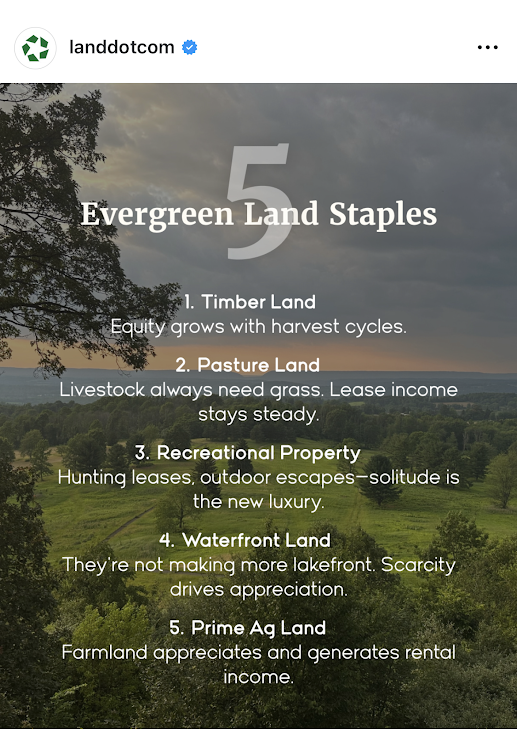
There is a social media post circulating in land investment circles that reads simply: “Forget the luck of the Irish. We prefer the certainty of a deed.” Beneath that caption sits a framework titled “5 Evergreen Land Staples” — timberland, pastureland, recreational property, waterfront land, and prime agricultural ground — each chosen for the same fundamental quality: enduring income or appreciation that does not require the daily volatility management of equities or the tenant fragility of residential real estate. The post is from Land.com, a mainstream marketplace catering primarily to rural landowners. The audience it implicitly addresses is white, rural, and generationally landed. Yet the analytical framework it articulates is precisely what the African American institutional ecosystem needs to operationalize and the HBCU community, with its networks of graduates, alumni chapters, and anchor institutions spread across the American South and beyond, is uniquely positioned to execute it at scale.

The stakes are not trivial. As the Federation of Southern Cooperatives Land Assistance Fund has documented, African Americans own less than 1% of all privately owned rural land in the United States. That figure represents one of the most consequential economic collapses in modern American history, a loss that accelerated across the 20th century through discriminatory lending, heirs’ property dispossession, and the systematic exclusion of Black farmers from federal agricultural credit systems. Between 1910 and 2020, African American land ownership fell by roughly 90%, from an estimated 15–16 million acres to less than 2 million today. Reversing even a fraction of that trajectory requires not only individual decision-making but coordinated institutional action. This article maps a practical framework anchored in the five evergreen land categories for how African Americans at every life stage, and HBCU-affiliated institutions at every organizational level, can begin to build durable land portfolios through structures that keep capital inside the ecosystem.

Before addressing who should invest and how, it is worth establishing why the five categories on that social media post represent genuinely strategic holdings rather than speculative fashions. Timberland is distinctive because its primary asset — standing timber — continues growing in value as long as it stands. As one institutional investor noted at the 2009 Timberland Investment World Summit, timber was the only major asset class not to decline during the Great Recession: “As long as the sun is shining trees will grow and your timber’s value will increase.” For long-horizon investors, which includes endowments, alumni foundations, and family trusts, timberland offers inflation protection, biological growth as a return mechanism, and periodic harvest income that can be timed to liquidity needs. Pastureland generates recurring lease income from ranchers and livestock operators with relatively low management overhead, while the underlying land appreciates over time and the lessee carries operational risk. For a first-generation land investor or a young family with limited bandwidth for active management, a leased pasture parcel generates cash flow from day one. Recreational property, including hunting and fishing grounds, has benefited from the structural shift toward experiential consumption, outdoor recreation spending in the United States now exceeds $780 billion annually and the demand for private access through leased hunting rights or short-term rentals has made rural recreational parcels a viable income source even at modest scale. Waterfront land commands a persistent scarcity premium, as lakefront, riverfront, and coastal parcels face an absolute supply constraint that no amount of construction can remedy, with appreciation rates for quality holdings historically outpacing inland equivalents by substantial margins. Prime agricultural land, the fifth category, combines appreciation and income in proportions that no other asset class consistently replicates, with farmland producing positive real returns in nearly every decade since World War II while the growing global demand for food production adds a structural tailwind that shows no sign of abating.

For the African American individual investor, particularly recent HBCU graduates entering the workforce, raw land is rarely the first investment that financial advisors recommend. Equities, retirement accounts, and residential real estate occupy the conventional hierarchy. This is understandable but strategically incomplete. Raw land, particularly rural parcels in the 10–100 acre range, is far more accessible in price terms than most urban professionals realize. In many parts of the rural South and Midwest, quality pastureland or timberland can be acquired for $1,500–$4,000 per acre, meaning a 20-acre parcel may require a down payment comparable to what urban renters spend in twelve months on housing. The critical discipline for individual investors is to treat the first land acquisition not as a lifestyle purchase but as a strategic asset. A 20-acre timberland parcel generates modest income while the timber matures but builds balance sheet equity that can later be pledged as collateral for subsequent acquisitions, a mechanism that generationally landed families have used for centuries. The key to making this work is choosing land that produces some income immediately, whether through a hunting lease, a hay-cutting arrangement, or a grazing license, so that carrying costs do not exceed cash flow while long-term appreciation accrues. Structurally, individuals should acquire rural land through a single-member LLC rather than in personal name, for both liability protection and eventual transfer efficiency. The LLC structure also allows for the clean addition of family members as equity holders over time, laying the legal groundwork for the next stage of ownership.

A young family with children faces a different calculus than a single investor. The time horizon extends to 30 or 40 years, the need for tax-efficient transfer becomes relevant, and the question of heirs’ property known as the informal, undivided ownership arrangement that has caused the dispossession of millions of acres of Black-owned land must be proactively addressed from the first deed. Heirs’ property arrangements leave undivided interests in land vulnerable to partition sales, through which any one heir can force a sale often to outside buyers at below-market prices. A young family acquiring land today should structure the purchase inside a family LLC or land trust from inception, with a clear operating agreement specifying decision-making rights, buyout provisions, and management authority. This structural discipline costs several hundred dollars in legal fees at formation but eliminates the single greatest mechanism by which Black-owned land has historically been lost. For young families, pastureland and prime agricultural ground are the most suitable of the five categories. Leased to a working farmer on an annual or multi-year cash rent arrangement, these parcels generate predictable income typically $100–$300 per acre annually in productive regions while the family’s equity compounds. Agricultural land near HBCUs, particularly the 1890 land-grant institutions with active extension programs, offers an additional advantage: the university’s agronomic and soil science resources can improve the land’s productivity and rental value over time, particularly where a formal university-farmer partnership exists.

For African American households in the wealth-accumulation or pre-retirement phase, typically those between 45 and 65 with existing equity in residential real estate or retirement accounts, raw land fills a specific portfolio gap. It provides non-correlated returns, inflation protection, and estate planning flexibility that equity-heavy portfolios lack. At this stage, the five-category framework can be pursued more deliberately. Waterfront land and timberland, which require longer holding periods to realize full appreciation, are most appropriate for mature investors who do not need near-term liquidity. A modest timber holding, held for 20 years through a managed investment timberland organization, can produce both periodic harvest income and terminal land value appreciation that substantially outpaces a bond portfolio over the same horizon. Conservation easements on qualifying land parcels offer an additional mechanism: by granting a qualified land trust a permanent easement that restricts development, the landowner receives a federal income tax deduction equal to the value of the development rights surrendered, a tool that high-income African American professionals have underutilized relative to white rural landowners who have deployed it extensively. This is also the stage at which entry into private Real Estate Investment Trust structures becomes viable. A private REIT organized around agricultural or timberland holdings allows a group of accredited investors like friends, family members, or professional associates to pool capital into a formal investment vehicle with a shared land portfolio, professional management, and pass-through tax treatment. Unlike publicly traded REITs, a private land REIT can be sized for a community of 10–50 investors, managed by a professional trustee, and built specifically around the five evergreen categories. The formation cost is meaningful but amortizes quickly across the investor pool, and the structure creates a formal institutional container for what would otherwise remain fragmented individual decisions.

Not every land investment begins with a formal institutional structure. Some of the most durable private wealth in America was built by small groups of trusted individuals such as former college roommates, fraternity and sorority members, professional cohort peers who pooled capital informally before any institution took notice. For the HBCU community, this peer-to-peer investment model is both historically familiar and structurally underdeployed. A group of five former classmates, each contributing $10,000, creates a $50,000 acquisition fund. In rural land markets across the South, that capital is sufficient to purchase 15–30 acres of quality pastureland or recreational property with room for closing costs and an operating reserve. The land is titled inside a jointly owned LLC, the operating agreement governs decision-making and buyout rights, and the group begins building a shared balance sheet that none of them could have assembled individually on the same timeline. The social infrastructure already exists. HBCU alumni networks are among the most tight-knit in American higher education, and the bonds forged between classmates across Greek organizations, residence halls, student government, and athletic programs carry the relational trust that small investment partnerships require above all else. What is missing is not the social capital but the financial framework to convert it into land equity. The practical steps are straightforward: the group agrees on an investment policy covering land category, geographic focus, minimum hold period, and income distribution schedule; forms an LLC with an operating agreement drafted by a real estate attorney; designates a managing member responsible for vendor relationships, lease management, and annual reporting; and commits to a first acquisition within a defined timeframe, preventing the initiative from dissolving into indefinite planning. Over time, these peer land partnerships can grow through reinvested income, additional capital calls, and the addition of new members at formally appraised entry valuations. A group that begins with five classmates and 25 acres can, within a decade of disciplined reinvestment, hold a diversified portfolio spanning multiple land categories across several states anchored not by institutional mandate but by the simple decision of like-minded people to build something together.

HBCU alumni associations sit at the intersection of institutional loyalty and latent investment capital. Most chapters hold reserve funds that have been accumulated through dues, fundraising, and event revenue that are parked in bank accounts earning negligible interest. Very few chapters have formalized investment policies, and this represents one of the most tractable missed opportunities in the HBCU ecosystem. An alumni chapter with $200,000 in reserves can, with proper legal structuring, become a founding limited partner in a private land REIT or a land investment LLC alongside other chapters. Five chapters pooling $200,000 each creates a $1 million acquisition fund capable of purchasing 250–500 acres of quality pastureland, timberland, or agricultural ground in rural markets adjacent to HBCUs. That land, leased and managed professionally, generates annual income that returns to the chapters while the underlying asset appreciates. Over a 15-year horizon, the portfolio can be refinanced to fund new acquisitions replicating the leverage cycle that institutional endowments have used with alternative assets for decades. The governance structure matters enormously. An alumni land partnership should be organized as a limited partnership or private REIT with an independent general partner or trustee, clear investment policy statements, annual audited financial statements, and a defined liquidity event horizon. The informality that characterizes most alumni chapter finances is incompatible with institutional land ownership at scale. But with proper structuring, the alumni network becomes what it has always had the potential to be: a distributed institutional investor class with shared objectives and collective bargaining power. Nationally coordinated alumni associations, the general alumni bodies of the major HBCU systems, are positioned to act at an even larger scale. A national alumni association with 50,000 dues-paying members and a modest per-member investment program could capitalize a seven-figure land acquisition fund within a single fiscal year. Structured as a private REIT with a land-grant mission overlay, specifically acquiring land adjacent to 1890 HBCU campuses or in counties with high concentrations of African American agricultural heritage, such a fund would generate financial returns while simultaneously reinforcing the geographic and economic footprint of the institutions themselves.

The structure of land acquisition matters as much as the acquisition itself, and for the African American investor at every level — individual, family, peer partnership, or alumni association — the financing institution is a strategic choice, not merely a transactional convenience. African American-owned banks hold just $6.4 billion in assets, while African American credit unions hold $8.2 billion, meaning these institutions together control less than $15 billion in combined lending capacity despite serving a market of more than 40 million people — insufficient to exert meaningful influence in national credit markets without deliberate capital infusion from within the community itself. When an African American investor finances a land purchase through a Black-owned bank or credit union rather than a mainstream white-owned lender, the mortgage deposit strengthens that institution’s liquidity ratio, expands its lending capacity through fractional reserve multiplication, and keeps the interest income circulating within the ecosystem rather than exiting to a Wall Street balance sheet. Every dollar deposited into an African American financial institution can translate into multiples of additional lending capacity once multiplied through the banking system — meaning that the collective financing decisions of HBCU alumni and community investors are not merely personal financial choices but acts of institutional capitalization. A community that builds land equity through Black-owned financial institutions simultaneously strengthens two pillars of its economic architecture: the land base that generates long-term wealth and the banking infrastructure that finances the next generation of acquisition.

At the institutional tier, the strategic imperative is even more pronounced. As of 2014, Tuskegee University controlled approximately 5,000 acres, ranking 12th among all American colleges in total land holdings, while Alabama A&M (2,300 acres), Alcorn State (1,756 acres), Prairie View A&M (1,502 acres), Kentucky State (915 acres), and Southern University (884 acres) collectively controlled more than 12,000 acres, placing all six among the top 100 college landowners in the United States. Those figures have not been comprehensively updated in the intervening decade, and the actual current land position of these institutions accounting for acquisitions, dispositions, and reclassifications likely differs. What has not changed is the strategic imperative to treat that land base as a productive investment asset rather than passive institutional real estate. A coordinated commitment of $1 million from each of the nineteen 1890 land-grant HBCUs would create a $19 million revolving fund capable, through its placement in African American banks and credit unions, of generating $7–$10 in agricultural lending capacity for every dollar committed financing not just land acquisition but the full productive cycle of African American farming. That mechanism addresses credit access. The complementary challenge is equity accumulation: deploying HBCU endowment capital, alongside alumni and friends’ capital, into the five evergreen land categories through a structured private REIT. An HBCU-anchored land REIT, capitalized with institutional endowment commitments as the senior tranche and alumni association and individual investor capital as subordinate tranches, would create a properly tiered investment structure with aligned incentives. The endowment’s priority return on its senior capital is protected; alumni investors participate in the upside above that hurdle; and the land itself remains in community-aligned ownership regardless of which investor class holds primacy at any given moment. Over time, the REIT’s land holdings can be diversified across all five evergreen categories — timberland for long-horizon appreciation, pastureland and agricultural ground for current income, waterfront parcels for high-appreciation positioning, and recreational property for near-term income generation — creating a portfolio whose income streams are non-correlated and whose asset values compound independently of equity market cycles.

The five evergreen land categories are individually sound investment ideas. Their strategic power for the HBCU community, however, lies not in isolated individual transactions but in the construction of a layered, coordinated ecosystem from the 22-year-old HBCU graduate purchasing her first 20-acre pasture parcel in Alabama, to the alumni chapter launching a multi-state agricultural REIT, to the 1890 HBCUs deploying endowment capital as the institutional anchor of a Black-managed timberland fund. At the most fundamental level, virtually every economic system man has ever created relies on one undeniable truth: whoever controls the land controls the system. The African American institutional ecosystem has the networks, the talent, and increasingly the structured financial vehicles to re-enter land ownership at meaningful scale. What it requires now is the strategic coordination to treat land not as a nostalgic aspiration but as a compounding institutional asset — one deed, one acre, one fund at a time.

Disclaimer: This article was assisted by ClaudeAI.

Revisiting Red Summer: Bloodshed, Black Land, and the Battle for America’s Soil

“I had crossed the line. I was free; but there was no one to welcome me to the land of freedom. I was a stranger in a strange land.” – Harriet Tubman

Race riots or rural reckoning? The answer lies beneath the surface—and often beneath the soil itself.

In the blistering summer of 1919, the United States erupted in racial violence unlike anything the country had witnessed since Reconstruction. From Washington, D.C. to Chicago, from Norfolk to Omaha, from Knoxville to the cotton fields of Arkansas, more than three dozen cities and rural towns became sites of bloodshed as white mobs attacked African American communities with a ferocity that was, in many instances, organized, deliberate, and unrelenting. Historians dubbed it the Red Summer, invoking both the color of blood and the communist anxieties of the era. For more than a century, the dominant explanation has centered on racial tensions stoked by the Great Migration, post-war competition for jobs, and white anxiety over African American assertiveness. But a deeper, more unsettling question lingers beneath those textbook explanations: was Red Summer not merely about urban unrest or racial animosity, but about land?

That question has returned with renewed urgency in recent years, amid a widening reexamination of Black land ownership and its deliberate erosion over the past century. As calls for reparations grow louder and more specific, so too does the need to reassess the forces that helped decimate Black wealth and autonomy in America. And when Red Summer is placed in that context, it begins to look less like a spontaneous explosion of racial rage and more like the bloodiest chapter in a longer, quieter war — a war fought not only over race but over soil.

The idea that African Americans were only victims of economic exclusion in early 20th-century America is a distortion that history has been slow to correct. By 1910, African Americans owned more than 15 million acres of land, largely concentrated in the South. Black farmers — most of them formerly enslaved or their direct descendants — had managed to accumulate land against crushing odds, frequently purchasing it collectively, through church cooperatives, fraternal organizations, or from white landowners seeking to offload marginal plots. These holdings were not merely symbolic achievements. They were strategic infrastructure.

Land ownership among Black Americans was more than a pathway to individual wealth; it was a bulwark against white supremacy. Land meant food security, political leverage, and a degree of independence in a nation otherwise constructed around Black dependency and racial domination. In some areas of the South, land ownership translated into Black-majority townships and counties, Black-controlled local economies, and the fragile but real possibility of a parallel civic sovereignty. Black landowners could vote with greater difficulty for whites to suppress. They could withhold labor. They could resist eviction. They could educate their children. They were, in a word, ungovernable in ways that landless sharecroppers were not.

African Americans were not simply asking for equality; in some places, they were building it. And that may have been the greatest threat of all.

Virginia-born coachman Thomas A. Dillon and his wife, Margaret, a domestic servant and native of Newton, Massachusetts, pose in the parlor of their home at 4 Dewey Street with children Thomas, Margaret, and Mary in 1904.

Nowhere is the link between land and lethal violence more clearly illustrated than in the massacre at Elaine, Arkansas — one of the deadliest and least discussed events of the entire Red Summer. On the night of September 30, 1919, African American sharecroppers gathered in a church in Phillips County to organize a union, the Progressive Farmers and Household Union of America. Their goals were modest by any democratic standard: they wanted transparent accounting from the plantation owners who controlled the cotton market, an end to the rigged ledger systems that kept sharecroppers in perpetual debt, and the ability to sell their crops independently on the open market. It was a meeting about fair contracts, not rebellion. What descended upon them was a massacre.

White mobs, augmented by federal troops dispatched from Little Rock, swept through the area for days. An estimated 100 to 200 Black men, women, and children were killed, though the official tallies — sanitized for public consumption — counted only a handful of white deaths and labeled the episode a Black insurrection. The real insurrection was economic. The plantation economy of the Delta had been built on the enforced ignorance and powerlessness of its Black labor force. If Black sharecroppers could collectively organize, access fair markets, and demand accurate accounting, some of them might eventually become landowners themselves. That possibility — not armed revolt — was what the white establishment could not tolerate.

The Elaine massacre exposed a hidden economic architecture underlying Southern racial terror. Violence was not just an expression of hatred; it was a tool of market control. When the ledger failed to keep Black workers in debt, the mob stepped in. When the law was too slow, the rifle arrived first.

Though most of the events of Red Summer are framed through an urban lens — riots in Chicago, Washington, and Knoxville dominating the historical imagination — the violence cannot be disentangled from broader efforts to contain and reverse Black economic advancement. Indeed, many of the African Americans who had migrated to Northern cities were themselves displaced farmers or sharecroppers whose rural land ownership efforts had been stymied, swindled, or literally burned to the ground. The Great Migration was not only a story of aspiration; it was also a story of flight.

In Chicago, where violence erupted in late July after a Black teenager named Eugene Williams drowned after being struck by stones thrown by white men when he accidentally drifted past an informal racial boundary in Lake Michigan, the precipitating incident masked deeper structural conflicts. African Americans had begun purchasing homes and moving into previously all-white neighborhoods. Black entrepreneurs were opening businesses. The color line in Chicago was not just social — it was economic, and it was being crossed. What followed Williams’s death was a week of brutal violence that left 38 people dead and more than 500 injured. The riot was sparked by a beach dispute, but what it expressed was white terror at the prospect of Black economic mobility in the urban North.

Property rights were at the center of the Chicago conflict in ways that have only grown clearer with time. Redlining would not be formalized by the federal government until the 1930s, but the ideology animating it — that Black habitation diminished property values, that Black ownership was a form of invasion — was already operating through mob violence in 1919. White homeowners’ associations, some of which had explicitly bombed Black homes in the years leading up to the riot, continued their campaigns of intimidation with renewed license after the summer’s bloodshed. The message was consistent whether it came from the Delta or the Midwest: African Americans had no rightful claim to the land, whether in field or neighborhood.

What made Red Summer different from previous episodes of racial terror, and what made it so culturally resonant, was that it came at a moment when African American self-determination was not just a dream but a demonstrable reality. The years surrounding World War I had seen an extraordinary flowering of Black institutional life: newspapers like the Chicago Defender and the NAACP’s Crisis magazine reached hundreds of thousands of readers; the Universal Negro Improvement Association under Marcus Garvey was drawing mass followings with its message of African sovereignty; and Black veterans returning from the battlefields of France, having fought for democracy abroad, were unwilling to accept its absence at home. Many of these veterans would become central figures in the armed resistance that communities mounted against white mobs in 1919. They met violence with violence, and the White establishment found the combination of Black assertiveness, Black organization, and Black land deeply alarming.

The economic threat extended well beyond individual plots of farmland. In Tulsa, Oklahoma — whose 1921 Greenwood massacre falls just outside the official boundaries of Red Summer but belongs to the same continuum of violence — an entire district of Black economic life was leveled. Greenwood, known as Black Wall Street, was home to hundreds of Black-owned businesses, banks, law offices, and hotels. It was the product of deliberate community investment and collective self-determination. When white mobs descended in May 1921, aided by the Tulsa Police Department and private aircraft that reportedly dropped incendiary materials on the district, they did not merely kill people. They destroyed an economic ecosystem that had taken a generation to build. The land was seized. The insurance claims were denied. The neighborhood was never fully restored.

The pattern repeated itself, with local variations, across decades. What Red Summer initiated, the legal and bureaucratic infrastructure of mid-20th century America codified. Heirs’ property laws — in which land passed down without a formal will became jointly owned by all descendants — rendered Black landholdings acutely vulnerable to partition sales. A developer or speculator who purchased a single heir’s fractional share could force the sale of the entire property, often at below-market prices, with no recourse for the remaining family members. These laws, ostensibly race-neutral, operated with devastating specificity against Black families whose distrust of white legal institutions, forged over generations of documented fraud and violence, led them to avoid formal probate processes.

The federal government was often a direct participant in dispossession. The United States Department of Agriculture systematically denied Black farmers access to loans and subsidies that were extended routinely to their white counterparts. From the New Deal agricultural programs of the 1930s through the farm credit crisis of the 1980s, Black farmers were excluded, underfunded, and allowed to fail at rates far exceeding their white peers. In 1999, the Pigford v. Glickman class action settlement acknowledged decades of discriminatory lending by the USDA and resulted in payouts to tens of thousands of Black farmers — but by then, most of the land was already gone.

Numbers are beyond staggering in their finality. African Americans owned approximately 15 to 19 million acres of land at the peak of Black land ownership around 1910. By 1997, that figure had collapsed to fewer than 2 million acres — a loss of nearly 90 percent over the course of a single century. The USDA itself acknowledged that this loss was not driven solely by economic forces. Discrimination, fraud, violence, and legal manipulation played decisive roles in transferring land from Black families to white institutions and individuals.

The state of Black land ownership in America today reflects the accumulated weight of that century of dispossession. African Americans currently own less than 1 percent of rural land in the United States, despite constituting approximately 14 percent of the national population. In the South, where Black land ownership once represented a genuine counter-economy, the erasure is especially pronounced. In Mississippi, Alabama, and Georgia — states where Black farmers built substantial holdings after Emancipation — Black land ownership has been reduced to a thin remnant. Entire family lineages have been severed from the soil their ancestors purchased with freedom wages, war bonuses, and borrowed hope.

Consequences extend far beyond sentiment. Land is the primary vehicle through which intergenerational wealth is transferred in the United States. Home equity and real property account for the majority of household net worth for most American families. The racial wealth gap — the persistent, yawning disparity between Black and white household wealth, which current estimates place at a ratio of roughly 1 to 8 — cannot be understood without accounting for the systematic denial of land and property rights to African Americans. Every generation of a Black family that was driven from its land, or swindled out of it, or watched it seized through partition sale or eminent domain, is a generation that could not pass on the compounding advantages of ownership. The wealth gap is not an accident of markets. It is the arithmetic of dispossession.

Contemporary efforts to address this reality operate at the margins of what is needed. Organizations like the Federation of Southern Cooperatives, founded in 1967, have worked for decades to help Black farmers retain land through legal assistance and cooperative economics. The Land Loss Prevention Project in North Carolina has challenged fraudulent partition sales and helped heirs navigate probate processes designed for a legal culture that was never built with them in mind. The Black Farmers Fund and similar initiatives provide capital and technical assistance to a dwindling population of Black agriculturalists. In 2021, Congress included provisions in the American Rescue Plan Act to provide debt relief to socially disadvantaged farmers — provisions that were subsequently challenged in federal court by white farmers who argued that race-conscious relief violated the Equal Protection Clause, a stunning inversion of the history that made such relief necessary.ve increasingly focused on this disparity. But to properly assess the scale of restitution, history must be rewritten to acknowledge not just the loss of life, but the loss of land. If Red Summer is reframed as a land war not only a race war, then it demands a different response.

Programs such as the Black Farmers Fund, the Federation of Southern Cooperatives, and the work of legal nonprofits like the Land Loss Prevention Project have begun to claw back some ground. Yet without a federal reckoning one that links racial violence to economic theft the narrative remains incomplete.

Reparations proposals have increasingly focused on land as the foundational unit of redress. Scholars like Thomas Mitchell, who pioneered the Uniform Partition of Heirs Property Act — now adopted in more than a dozen states — have worked to close the legal loopholes that enabled generations of Black land theft. Others have proposed direct federal land grants or land trusts as a more durable form of repair than cash payments alone. The argument is both pragmatic and historical: if land was what was taken, land is what must be restored.

But to make that argument with the force it deserves requires an honest reckoning with Red Summer as something more than a riot. It requires understanding 1919 not as an aberration but as an acceleration — the moment when informal systems of racial violence were enlisted on a national scale to reverse Black economic progress. The targets were not random. They were selected. Churches where sharecroppers organized were burned. Prosperous Black neighborhoods were razed. Landowners were murdered and their deeds contested in their absence. The land did not transfer by accident. It was taken by design, and the taking was protected, in county courthouses and federal offices alike, for decades afterward.

Malcolm X once observed that land is the basis of all independence. He was not speaking metaphorically. He was speaking from a tradition of Black political thought that understood, from Reconstruction onward, that the promises of American citizenship were hollow without the material foundation that land provides. The freedpeople who demanded forty acres understood this. The sharecroppers of Elaine who organized for fair prices understood it. The Greenwood entrepreneurs who built Black Wall Street understood it. And the white mobs, the plantation owners, the local sheriffs, the federal troops, and the discriminatory bureaucracies that systematically dismantled what Black Americans built — they understood it too.

Red Summer was not simply a spasm of postwar bigotry, nor an understandable if deplorable expression of racial anxiety. It was a calculated and coordinated assertion of dominance over a people who were, against every structural obstacle, building something that looked like sovereignty. The violence of 1919 did not emerge from nowhere, and it did not end with the cooling of summer temperatures. It opened a door that the legal and economic machinery of the 20th century walked through for decades, quietly completing the dispossession that the mobs had begun.

In the end, Red Summer may be remembered not only for its flames but for the fertile ground those flames sought permanently to char. It was not only a summer of blood. It was a war over soil — and the aftershocks of that war continue to shape the contours of American inequality today, in the wealth gaps, the landlessness, the severed inheritances, and the unanswered demands for repair that echo across every serious conversation about racial justice in this country.

📅 Visual Timeline: The Red Summer of 1919

April 13, 1919 – Jenkins County, Georgia

A violent confrontation erupts in Millen, Georgia, resulting in the deaths of six individuals and the destruction of African American churches and lodges.

May 10, 1919 – Charleston, South Carolina

White sailors initiate a riot, leading to the deaths of three African Americans and injuries to numerous others. Martial law is declared in response.

July 19–24, 1919 – Washington, D.C.

Racial violence breaks out as white mobs attack Black neighborhoods. African American residents organize self-defense efforts.

July 27–August 3, 1919 – Chicago, Illinois

The Chicago Race Riot begins after a Black teenager is killed for swimming in a “whites-only” area. The violence results in 38 deaths and over 500 injuries.

September 30–October 1, 1919 – Elaine, Arkansas

African American sharecroppers meeting to discuss fair compensation are attacked, leading to a massacre where estimates of Black fatalities range from 100 to 800.

October 4, 1919 – Gary, Indiana

Racial tensions escalate amid a steel strike, resulting in clashes between Black and white workers.

November 2, 1919 – Macon, Georgia

A Black man is lynched, highlighting the ongoing racial terror during this period.

Disclaimer: This article was assisted by ClaudeAI.

Why 1890 HBCUs Must Develop A Joint Tree Nursery: Sowing Legacy, Profit, and Power

“Since new developments are the products of a creative mind, we must therefore stimulate and encourage that type of mind in every way possible.” – George Washington Carver

The 1890 Land-Grant HBCUs were created not out of generosity but from segregation. And yet, over 130 years later, these institutions have carved out vital roles in agricultural education, food systems innovation, and land stewardship within the African American community. With the ever-growing climate crisis, shrinking agricultural landholdings for African Americans, and a glaring need for sustainable economic engines, the case for a joint tree nursery among the 1890 HBCUs is less an idea and more an imperative. The time for silos is over. A joint nursery would allow the 1890s to consolidate resources, amplify research, and plant the seeds—literally and economically—of a new generational legacy.

The Decline of African American Landownership and Ongoing Discrimination

In 1910, African Americans owned between 16–19 million acres of farmland. The years around this period would also see the Red Summer of 1919, when African Americans were violently targeted and lynched—many as punishment for owning land and asserting agency. Today, that number has dwindled to just 5.3 million acres as of 2022, according to the USDA’s Census of Agriculture, representing less than 0.6% of all U.S. farmland.

The decline is not just the result of economic shifts—it is the result of orchestrated policies and racially motivated practices. From the USDA’s long-standing discriminatory loan denials to heirs’ property laws that have gutted intergenerational land transfer, the path of African American landownership has been riddled with legal landmines. The Pigford v. Glickman settlement acknowledged this in part, but much of the damage remains.

The 2022 USDA Census also shows that Black producers make up just 1.4% of all U.S. farmers and generate only 0.5% of all farm-related income. These are not just agricultural figures—they are a ledger of institutional neglect.

A tree nursery jointly stewarded by the 1890 HBCUs could serve as a bulwark against further erosion. It would offer seedlings, training, and enterprise development that support African American landowners, reinforcing land retention, sustainable usage, and intergenerational economic viability.

Political Hostilities Facing HBCUs

Despite their vital role in education, research, and community development, HBCUs—especially 1890 land-grant institutions—have faced persistent political and financial challenges. These institutions continue to experience disparities in state and federal funding compared to predominantly white institutions (PWIs). Some of the key political hostilities facing HBCUs include:

  • Underfunding and Resource Disparities: Many 1890 HBCUs receive significantly less funding than their 1862 land-grant counterparts. Studies have shown that some states fail to allocate matching funds as required by federal law, putting HBCUs at a financial disadvantage.
  • Legislative Attacks on DEI Initiatives: In recent years, political efforts to limit diversity, equity, and inclusion (DEI) programs have targeted HBCUs and other minority-serving institutions. These measures threaten scholarship opportunities, faculty recruitment, and student support services.
  • Land-Grant Inequities: Unlike 1862 land-grant universities, 1890 HBCUs were historically excluded from receiving direct land allocations, resulting in fewer resources to develop agricultural research and extension programs. This inequity continues to hinder the growth of HBCU-led agricultural initiatives.
  • Institutional Wealth Gap: A stark difference exists between the endowments of 1890 HBCUs and their 1862 counterparts. Many 1862 land-grant universities have endowments in the billions, while 1890 HBCUs often operate with significantly smaller financial reserves. This gap limits their ability to invest in infrastructure, research, and large-scale agricultural projects. By collaborating, 1890 HBCUs can leverage collective resources to overcome these financial disparities.
  • Bureaucratic Challenges in Federal Funding: While the federal government provides grants and research funding for HBCUs, bureaucratic red tape often delays disbursement, limiting their ability to expand programs and infrastructure.
  • Hostile Political Climates in Some States: Certain state governments have attempted to merge or close HBCUs under the guise of budget cuts, despite the institutions’ strong academic contributions. These efforts undermine the historical and cultural significance of HBCUs in providing equitable education.

By establishing a joint tree nursery, 1890 HBCUs can leverage collective power to secure funding, build partnerships, and showcase the tangible benefits of investing in Black-led agricultural and environmental initiatives.

Benefits of Developing a Joint 1890 HBCU Tree Nursery

Environmental Sustainability and Climate Change Mitigation

Deforestation and land degradation disproportionately affect African American communities, contributing to environmental injustices such as poor air quality and increased vulnerability to natural disasters. A joint tree nursery among all 1890 HBCUs would:

  • Provide seedlings for reforestation projects in Black-owned lands and underserved communities
  • Help mitigate climate change by sequestering carbon dioxide through afforestation and agroforestry initiatives
  • Promote soil conservation and reduce erosion, particularly in the South, where agricultural practices have historically led to soil depletion

Economic Empowerment and Job Creation

A tree nursery initiative would not only benefit HBCU students and faculty but also offer economic opportunities to local landowners. Potential benefits include:

  • Revenue Generation: HBCUs can sell tree seedlings to farmers, municipalities, and reforestation programs, creating an additional income stream
  • Employment Opportunities: These nurseries can provide jobs for students, alumni, and community members in nursery management, forestry, and agribusiness sectors
  • Support for Black Farmers: Providing affordable seedlings and training on agroforestry practices can help African American landowners diversify their income and maximize land productivity

The Economic Benefits of the Timber Industry

The timber industry presents a lucrative opportunity for African American landowners and HBCUs. A joint tree nursery can serve as a foundation for engaging in sustainable forestry and timber production. Some key economic benefits include:

  • High Market Demand: The U.S. timber industry generates over $300 billion annually, with growing demand for sustainable wood products in construction, paper, and bioenergy sectors
  • Long-Term Investment: Timberland is a valuable asset that appreciates over time, providing generational wealth-building opportunities for Black landowners
  • Carbon Credit Market: African American landowners can participate in carbon credit programs by managing timberlands for carbon sequestration, receiving financial incentives for maintaining forests
  • HBCU Forestry Programs: Expanding forestry education at HBCUs can produce a new generation of Black professionals in timber management, conservation, and agribusiness
  • Sustainable Agroforestry: Integrating tree farming with traditional agriculture can enhance soil health, improve biodiversity, and create additional revenue streams for small-scale farmers

Enhancing Agricultural Education and Research

Many 1890 HBCUs already have robust agricultural programs. Establishing a joint tree nursery would further enrich their curricula by:

  • Offering hands-on training in silviculture, agroforestry, and nursery management
  • Creating research opportunities in sustainable land management, biodiversity conservation, and climate resilience
  • Facilitating collaborations with government agencies, non-profits, and private sector partners in reforestation and urban greening initiatives

Cross-Institutional Leverage: Strength in Numbers

A joint venture allows for economies of scale. Rather than every 1890 HBCU creating a small, under-resourced nursery, a consortium-based model allows for regional specialization and centralized management. One school could lead genetic research, another logistics, and another economic modeling. By specializing within the larger system, each institution contributes to a whole far greater than its parts.

Shared governance would also model cooperative economics for students and landowners alike—an important lesson in collective power for African American institutions that have long been made to compete rather than collaborate.

Community Wealth Building

The ultimate beneficiaries of this nursery aren’t just students or the HBCUs themselves—but the millions of African American families with access to underutilized or at-risk land. With the right training, seedlings, and partnerships, that land can be revitalized. It can produce not only timber but herbs, fruits, shade, and carbon credits.

The nursery becomes the beginning of a longer story—of community land trusts, green business corridors, and intergenerational financial literacy built around land-based wealth.

Seeding Sovereignty: A Strategic Call to Action

Developing a joint tree nursery among all 1890 HBCUs is more than an agricultural endeavor. It is an act of economic strategy, cultural restoration, environmental justice, and institutional collaboration. It’s about controlling the seed, the soil, and the story.

HBCUs have always been tasked with doing more with less. The joint nursery is an opportunity to do more—together—and build an enduring institutional asset rooted in cooperation, conservation, and community wealth.

Moreover, this initiative holds symbolic power. In the act of planting trees, 1890 HBCUs will be planting legacy—sending a signal that African American institutions are prepared not only to survive hostile economic climates, but to thrive through collective will. Trees are not short-term investments; they require long-term vision, care, and commitment—just like the kind of intergenerational institution-building African America must embrace.

The nursery would also be an anchor institution for Black innovation in climate tech, agroforestry finance, and regional ecosystem services. The act of growing trees connects economics with ecology, and by anchoring that process within the halls and lands of 1890 HBCUs, we bring knowledge production, carbon markets, and green workforce development under African American institutional ownership.

This is more than sustainability—it is sovereignty. The type of sovereignty that rewrites narratives around Black land loss, economic disempowerment, and environmental marginalization. In a future where climate, capital, and culture will increasingly intersect, the 1890 HBCUs must see a joint tree nursery not as a boutique project but as a national imperative rooted in Pan-African strategy and local resilience.

The seeds of sovereignty are ready. The land is waiting. The only question is whether the institutions tasked with leading our communities into the future will plant now, or later—when the cost of delay may be too great to bear.

How the Government Helped White Americans Steal Black Farmland – And Why 1890 HBCUs Are Partially To Blame

Every good citizen makes his country’s honor his own, and cherishes it not only as precious but as sacred. He is willing to risk his life in its defense and is conscious that he gains protection while he gives it. – Andrew Jackson

Ukraine has been preparing for years for the eventual invasion that would come from Russia. It has been so even prior to Russia’s invasion and capture of Crimea in 2014. Why? Ukraine’s intelligence for one, President Vladamir Putin’s writings that expressed sentiment that the breakup of the Soviet Union was a great tragedy of the 20th century, Russia’s 2008 invasion of Georgia, and because well that is WHO Russia is and has shown itself to be. It would have been more of a shock were Ukraine to act shocked at Russia invading more than Russia invading. Put another way, if Ike Turner slapped someone and they were surprised, who is crazier – them or Ike Turner?

This seems to be African America always when it comes to European America though. Constantly surprised by consistent behavior. Harlem, Houston’s Third Ward, New Orleans, Compton, Roxbury, so on and so forth. What do all of these have in common? They were once thriving African American strongholds until gentrification. Each time the gentrification wave came, African Americans in those communities were caught off guard, unable and unprepared to launch a counterattack (or offensive).

In a recent article by The New Republic titled, “How the Government Helped White Americans Steal Black Farmland”, in detailed fashion we learned about one of the most vital departments of any country, agriculture, which impacts land, development, life expectancy, water and mineral rights, and so much more was used by the U.S. government through the USDA to spearhead the wealth transfer of African American farmland into European America’s hands. “Black farmers not only lost out on these massive subsidies—they have been effectively disenfranchised within the modern agricultural system. Under conditions of savage oppression, Black families emerged in the early 1900s with almost 20 million acres of farmland and “the largest amount of property they would ever own within the United States,” according to the historian Manning Marable. Since then, they have lost roughly 90 percent of that acreage” says New Republic. According to New Republic, there will be a study put out soon by the American Economic Association’s Papers and Proceedings journal that will value the land lost between 1920 and 1997 at approximately $326 billion. An amount that is equal to over 20 percent of African America’s $1.6 trillion buying power. The $326 billion valuation excludes the 160 million acres that Africa Americans who were enslaved were owed post Civil War from Special Order No. 15 that guaranteed the former enslaved population of around 4 million 40 acres apiece, but was reneged upon by the U.S. government ultimately making the loss arguably worth trillions today. Yes, trillions. The economic loss has had catastrophic social, economic, and political echoing impacts for generations. “Revolution is based on land. Land is the basis of all independence. Land is the basis of freedom, justice, and equality”, Malcolm X said. This alluded to the belief that every revolution was and is about land given that it impacts everything that lays to bear on any group, community, country, and diaspora. African American institutions, especially those focused on agriculture, should have made the protection of African American land a strategic priority.

Enter the 1890 HBCUs, which were created with the Second Morrill Act of 1890. There were 19 HBCUs created under this act (and two HBCUs which were created under the First Morrill Act of 1862, which primarily created HWCU agriculturally focused colleges and universities). For all intents and purpose, 1862 and 1890 colleges and universities were created with an emphasis on agriculture. Tuskegee, through the political clout of Booker T. Washington, is the only private HBCU that has land-grant status. The other two private universities that are land-grant institutions are Cornell and MIT. Among the 1890 HBCUs, they have three of the six HBCU law schools housed at Florida A&M University, Southern University System, and University of the District of the Columbia. Despite this, based on their websites none of three have any focus/concentration on agricultural law. This means that more than likely African American farmers and landowners are in the hands of lawyers who are both non-African American and trained at an HWCU/PWI institution. Given historical behavior, it is not hard to assume that those lawyers do not work in the best interest of our community. It also once again poses the question of the lack of strategy among African America at using its institutions to protect its social, economic, and political interest. Stemming the tide requires a change in HBCU strategy and realizing the purpose of our institutions is to serve and protect the other parts of the African American ecosystem.

There are a few pointed pivots that 1890 HBCUs can do to serve and protect the agricultural interest of African America. First, the three 1890 law schools (FAMU, SUS, and UDC) can create an African American agriculture concentration in their law schools. Again, to be clear, an African American agriculture concentration is not the same as general agriculture, which tends to be from a Eurocentric perspective. Focusing on agricultural law from the African American agricultural perspective and interest is paramount. Secondly, the three 1890 law schools can create a joint organization for African American Agriculture Defense Fund that will serve as a means to fund law defense for African American farmers, lobbying efforts towards African American agriculture, and regional African American agriculture legal research. Thirdly, all of the 1890 HBCUs needs to create master’s programs in agricultural law and policy focused on their respective local, state, and regional geographies. They can then push for alumni to create scholarships that will allow for a pipeline of agriculture majors to pursue law degrees at the three 1890 HBCU law schools. Lastly (but not all), a concerted emphasis on offering courses, lectures, and seminars on the purchase and maintenance of African American land ownership emphasized to students and alumni and available to our entire community.

If HBCUs are not going to be part of the institutional ecosystem built to serve and protect African American interest, then what is their purpose? Without protecting African American land, what little is left of it, then what is to come of African America? Protecting African American land takes more than just HBCUs, it also requires African American owned financial institutions, real estate organizations, families, communities, and more. However, 1890 HBCUs must take the vanguard and protect what we have so that we can start to stem the tide and move the trend upward again. The notion that land theft and assaults have been happening to African America for 100 years and we still have yet to respond with a counterattack or an offensive of our own is telling. HBCUs also are becoming more and more vulnerable to their land and the communities they are in, which are typically African American, being gentrified and the use of predatory land theft and assaults heightened. Howard University, Prairie View A&M University, and Texas Southern University all are witnessing land theft and assaults on the land surrounding their institutions. Unfortunately, there was and continues to be no unified strategic planning to protect them. In Howard University’s case, white residents have even been so gall as to suggest that the school be moved. This is just one example of over a century of attitudes that have helped lead to others justifying land assaults on African American landownership. We know who are our enemies are, we have the intelligence and tools, now is the time to start urgently preparing our troops to defend our lands.

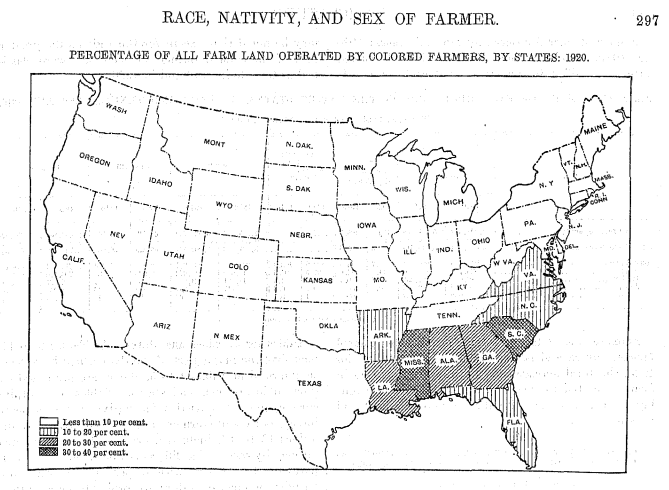
HBCU Money™ Histronomics: 1920 Agricultural Census Of Colored Farms & Land Ownership

Screen Shot 2014-07-12 at 12.25.42 PM

HIGHLIGHTS

  • Total American Farm Acres in 1920 – 956 million acres
  • Economic value of Total American Farm Acres – $66 billion
  • Total Colored Acres in 1920 – 45 million acres
  • Economic value of Total Colored Farm Acres – $2.5 billion
  • % of Total Farm Land Owned by Colored in 1920 – 4.7%
  • Average Colored Farm Acreage in 1920 – 47.3 acres
  • Average Economic Value of African American Farms in 1920 – $2 063

*Colored in the census encompasses African, Native, Japanese, and Chinese Americans. African Americans comprised 97.5% of the colored farm operators in 1920.

Screen Shot 2014-07-12 at 11.58.35 AM