Tag Archives: HBCU

The Africa Travel Ban Is an HBCU Problem

Africans in the United States must remember that the slave ships brought no West Indians, no Caribbeans, no Jamaicans or Trinidadians or Barbadians to this hemisphere. The slave ships brought only African people and most of us took the semblance of nationality from the places where slave ships dropped us off. – Dr. John H. Clarke

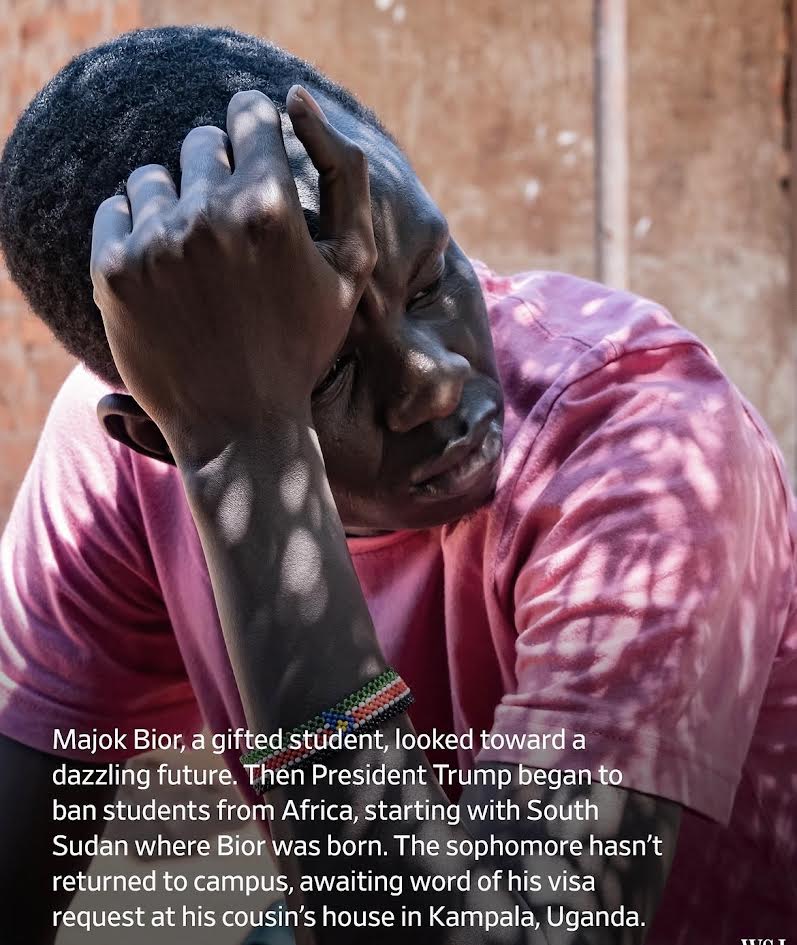
Photo from the Wall Street Journal

The photograph of Majok Bior, a South Sudanese computer science sophomore at Duke University, stranded at his cousin’s home in Kampala after the Trump administration’s travel restrictions invalidated his visa — has circulated widely as a symbol of individual suffering. And it is that. But to read it only through the lens of personal tragedy is to miss the structural dimensions of what is unfolding across American higher education, and to miss, in particular, what this moment means for HBCUs.

The Trump administration’s travel ban, initially signed on June 4, 2025, targeted 12 countries and placed partial restrictions on seven more, covering a geography concentrated in Africa and the Middle East. By December 2025, that list had expanded to 39 countries and territories, with Nigeria, historically one of the top ten sources of international students in the United States, placed under partial restrictions effective January 1, 2026. Individuals in Nigeria will not be able to receive student visas beginning January 1. Secretary of State Marco Rubio has signaled further expansion, with a State Department memo identifying 36 additional countries for potential restriction, including 25 African nations as well as countries in the Caribbean, Central Asia, and the Pacific Islands. If that expansion proceeds, the policy will have effectively severed the institutional connection between American higher education and the African continent.

For HBCUs specifically, this is not a distant geopolitical event. It is a direct threat to an enrollment strategy, a revenue base, and a civilizational relationship that institutions have spent decades building.

To understand the financial stakes, one must first understand how international student enrollment became integral to the fiscal architecture of many HBCUs. In addition to the tuition money international students often bring, many foreign students pay the full sticker price, often aided by their home countries’ governments there are benefits for HBCUs’ American students as well. International students, particularly those arriving with government-funded scholarships from Nigeria, Ghana, Saudi Arabia, and other nations, have served as a reliable source of full-fare tuition revenue at institutions that chronically lack the endowment depth to absorb enrollment volatility.

Among HBCUs with ten or more international students, Morgan State had the most as of the 2017-18 academic year, with 945 students; Howard was second with 920; and Tennessee State third with 584, according to the Institute of International Education. These numbers have only grown. Tennessee State, for instance, went from 77 international undergraduate students in 2008-09 to 549 by fall 2016 representing roughly 8 percent of its undergraduate student body. Across the sector, African students from Nigeria and Ghana historically constituted a significant share of that international cohort.

The financial logic was sound. A university with modest endowment holdings and only one HBCU, Howard University, currently holds an endowment exceeding $1 billion, cannot easily absorb the loss of a tuition-paying population without triggering cascading institutional consequences. When full-fare international students leave an enrollment ledger, the institution must either raise tuition on domestic students who are often already Pell Grant-eligible, draw down reserves, reduce staffing, or curtail academic programs. In a sector where financial fragility is not the exception but the norm, any of those choices carries compounding institutional risk. Preliminary projections by NAFSA and international education research partner JB International predict a 30 to 40 percent decline in new international student enrollment, leading to a 15 percent decline in overall enrollment this fall and loss of $7 billion within local economies and more than 60,000 jobs. That system-wide figure masks the disproportionate exposure at institutions whose international student populations are concentrated in African countries now under restriction.

The financial dimension, however, is only the first tier of the problem. The more consequential loss may be strategic: the slow dismantling of an institutional relationship between HBCUs and Africa that has been a defining feature of both parties’ long-term development. For decades, HBCU campuses have served as one of the primary entry points for African students seeking American credentials and professional networks. The relationship has never been purely transactional. It has been civilizational, rooted in a shared recognition that the institutional capacity of the African diaspora, on both sides of the Atlantic, depends on the training and circulation of its most capable people. Howard University, Morgan State, Florida A&M, and Tennessee State have all cultivated significant African student communities that returned home as engineers, physicians, lawyers, economists, and public administrators, seeding institutions across the continent with HBCU-educated professionals.

That pipeline is now interrupted. Majok Bior is one face of the disruption. He is also, statistically, the kind of student, a full-scholarship computer science talent, whose skills and networks would have contributed meaningfully to either the American or the African institutional ecosystem over the subsequent decades. The State Department’s position is unambiguous. There is no appeals window, no informal pathway, no consular discretion available to students like Bior whose visas were invalidated mid-enrollment. The pipeline does not merely slow. It stops.

The administration has signaled it may further target sub-Saharan Africa for future travel bans. Twenty-four of the 36 countries identified as future ban candidates are in sub-Saharan Africa. If all 24 were to be hit with bans, an additional 71 percent of the region’s population would be affected. At that scale, the policy would not merely interrupt an enrollment channel. It would functionally close the institutional bridge between American HBCUs and the African continent.

The arrivals data make the stakes concrete. The number of new and returning African students arriving in the United States for the 2025 fall semester fell by nearly a third from the previous year, according to preliminary Commerce Department data. Arrivals from Nigeria and Ghana, which historically send more students to the United States than any other African countries, dropped by roughly half. Those are not marginal declines. They represent a structural break in the flow of talent that has sustained both HBCU campuses and the professional networks those campuses anchor.

The broader context amplifies the damage. HBCUs have been managing a long-running tension between their mission to serve African American students and the enrollment arithmetic that increasingly pushes them toward diversification. Black student enrollment at HBCUs increased by just 15 percent from 1976 to 2022, while enrollment of students from other racial and ethnic groups rose by a staggering 117 percent during the same period. Within that context, African international students have occupied an important, if underappreciated, position: they are enrolled students who are Black, who arrive often with external funding, and who align with the cultural mission of the institution in ways that students from other international communities do not. The loss of this population does not merely reduce headcount. It removes a category of student whose presence reinforces the intellectual and cultural identity of HBCU campuses while simultaneously contributing to their revenue base.

HBCU leaders should resist the temptation to treat the current moment as a policy problem requiring a policy solution that is, to wait for a change in administration or a favorable court ruling before taking action. The institutional response must be proactive, and it must be organized at the sector level rather than institution by institution.

The first imperative is legal and advocacy coordination. HBCUs should be visible participants in the coalition of higher education institutions pushing back against travel ban expansion. The legal challenges already filed by some universities have produced limited court-ordered exceptions. HBCU presidents, through their associations and individually, possess a particular moral authority in this argument: these institutions were founded on the principle that the state should not determine who deserves access to education. That founding logic has direct application to the current moment, and its articulation should not be left to the advocacy organizations of predominantly white institutions alone.

The second is the construction of alternative enrollment infrastructure. Several countries whose students are not currently restricted represent significant untapped pipelines for HBCUs including Kenya, Ethiopia, South Africa, and several francophone West African nations not yet under full restriction. Morgan State’s international enrollment tripling between 2014 and 2017, driven by a concerted recruitment strategy, demonstrates that rapid scaling is possible when institutions make it a priority. The question now is whether that kind of deliberate enrollment strategy can be retargeted toward countries where the policy environment remains navigable.

The third imperative, and the most consequential for the long run, is the development of transnational academic infrastructure that does not depend on American visa policy at all and here the sector does not need to theorize. It already has a model. Claflin University, an HBCU in Orangeburg, South Carolina, and Africa University in Zimbabwe have together built and delivered a fully online Master of Science program in Biotechnology and Climate Change, producing their first cohort of graduates in 2025. The program requires no visa, no transatlantic relocation, and no dependence on the goodwill of a State Department consular officer. It delivers graduate-level credentials, anchored to an HBCU’s academic infrastructure, to scholars who remain embedded in the African communities they will eventually serve. That is not a symbolic gesture. It is a replicable institutional architecture — one that severs the link between American immigration policy and the HBCU-Africa educational relationship at precisely the point where that link has proven most vulnerable. The disciplines selected are themselves strategic: biotechnology and climate change are among the fields where African scholars have the most urgent applied work to do, and where the absence of well-trained researchers carries the steepest institutional cost. What Claflin and Africa University have built is a proof of concept for the entire sector. Howard, Morgan State, Florida A&M, and Tennessee State, institutions that have already invested in African student pipelines and cultivated international enrollment are positioned to extend this model into additional disciplines, additional partner institutions, and additional countries. Students who were considering coming in 2026 will be discouraged and will be looking to other destinations, as one international education expert has observed. If those students go elsewhere, HBCUs should be competing to ensure that some of that “elsewhere” is a degree program bearing an HBCU’s name, delivered on African soil, through African partner institutions, and impervious to the policy preferences of any particular American administration.

The image of Majok Bior waiting in Kampala is a human document. But it is also an institutional document. It records the moment when an African student who had successfully navigated the American credentialing system, who had won a full scholarship, enrolled in computer science, played intramural soccer, and survived chemistry class was extracted from that system not by any failure of his own but by a federal policy aimed at restricting the movement of African people into American institutions. HBCUs were built precisely because such exclusions were once the default condition of American higher education. The institutional memory of that history is not a rhetorical resource. It is a strategic asset, a basis for understanding that the institutions which serve communities without consistent access to political protection must always be building structures that can survive the withdrawal of that protection. The Africa travel ban is an HBCU problem. The sector’s response to it will reveal something important about whether these institutions have developed the depth and coordination to meet a challenge that is, in its essential structure, the same challenge they were built to confront.

Disclaimer: This article was assisted by ClaudeAI.
The Fairy Tale That Wasn’t Meant for Everyone: Pretty Woman and the Racialized Grace Denied to Black Women

“Nobody ever helps me into carriages, or over mud-puddles, or gives me any best place! And ain’t I a woman?” – Sojourner Truth

An Analysis of How White Womanhood Receives Redemption While Black Women Face Permanent Condemnation

When Julia Roberts climbed into Richard Gere’s Lotus Esprit on Hollywood Boulevard in 1990’s Pretty Woman, she embarked on a journey that would transform her from streetwalker to America’s sweetheart. The film grossed $463 million worldwide, launched Roberts into superstardom, and cemented itself as one of the most beloved romantic comedies in cinematic history. But beneath its glossy veneer of designer shopping bags and opera dates lies a troubling reality: this fairy tale was only ever written for white women.

The premise is deceptively simple. Vivian Ward, a Hollywood prostitute, is hired by wealthy businessman Edward Lewis for a week of companionship. What begins as a transactional arrangement blossoms into love, culminating in Edward rescuing Vivian from her fire escape—the knight in shining armor arriving in a white limousine. The audience cheers. America swoons. And a sex worker becomes a princess.

Now, imagine if Vivian Ward had been Black.

Pretty Woman operates on a fundamental assumption: that its protagonist deserves redemption, transformation, and ultimately, love. Vivian is presented as a victim of circumstance, a woman who “ended up” in sex work, whose intelligence and charm were simply waiting to be discovered by the right man. The film invites us to see past her profession, to recognize her inherent worth, and to celebrate her elevation into respectability. This grace, the permission to be flawed, to make mistakes, to be seen as complex and worthy despite one’s past is a privilege historically reserved for white women in American culture. It is the same grace that allows a reality television star to build a billion-dollar empire after a sex tape, while a Black woman who tells her own story about the entertainment industry becomes permanently marked.

The comparison between Kim Kardashian and Karrine Steffans (also known as Elisabeth Ovesen) illuminates this disparity with devastating clarity. Both women became famous through their connections to the entertainment industry and their sexuality. Yet their trajectories could not be more different. In 2007, a sex tape featuring Kim Kardashian and singer Ray J was leaked to the public. Rather than becoming a scarlet letter, this moment became the launchpad for one of the most successful media empires in modern history. Kardashian settled her lawsuit against the distributor for a reported $5 million, and months later, Keeping Up with the Kardashians premiered on E!.

Today, Kardashian is a billionaire businesswoman worth an estimated $1.7 billion. She has founded multiple successful companies including Skims, valued at over $4 billion. She has graced the covers of Vogue, been named to Time’s 100 Most Influential People, and received the Innovation Award at the prestigious CFDA Awards. She is pursuing a law degree and advocates for criminal justice reform, meeting with presidents and earning praise for her activism. The media narrative around Kardashian has evolved from scandal to legitimacy, from reality star to mogul. While critics occasionally invoke her sex tape, it exists largely as historical context rather than permanent condemnation. She has been granted the space to grow, to rebrand, to become something more than her past. Like Vivian Ward, Kim Kardashian has been rescued not by a wealthy man, but by a culture willing to let her write her own redemption arc.

In 2005, Karrine Steffans published Confessions of a Video Vixen, a memoir detailing her experiences in the hip-hop industry, including her work as a video vixen and her relationships with various entertainers. The book became a New York Times bestseller and sparked important conversations about the exploitation of women in the music industry, power dynamics, and female agency. But unlike Kardashian’s ascent, Steffans faced immediate and sustained backlash. She was vilified, ostracized, and permanently labeled. In a recent interview with Essence magazine commemorating the 20th anniversary edition of her book, Steffans who now using her birth name, Elisabeth Ovesen—reflected on the devastating impact: “Make no mistake about it, the way the public has treated me, the way the press has treated me, and the way that everyone has talked about me, made up lies about me, vicious lies that are still circulating in the press today, have ruined a lot of my relationships.”

Ovesen describes two decades of being “physically and emotionally beaten by the people in my life” and fighting “to stay alive.” She notes that “there’s been this cloud over me for 20 years,” affecting her ability to work, to form relationships, to simply exist without the weight of public condemnation. The contrast is stark. Kardashian parlayed a sex tape into a multi-billion dollar empire. Steffans wrote about her own experiences and became a pariah. One woman was granted grace and opportunity; the other faced professional exile and personal destruction. The difference in their treatment cannot be separated from race. American culture has long operated on a racialized system of respectability politics in which white womanhood is protected, salvageable, and worthy of redemption, while Black womanhood is disposable, permanently marked, and beyond repair.

This dynamic is rooted in historical systems of oppression. During slavery, white women were placed on pedestals as symbols of purity that needed protection, while Black women were systematically raped and denied any claim to virtue or protection. These ideologies didn’t disappear with emancipation they evolved, shaping everything from Jim Crow laws to contemporary media representations. Pretty Woman is a cinematic embodiment of these racial hierarchies. The film’s entire premise depends on the audience believing that Vivian deserves to be saved, that her circumstances don’t define her worth, that she is capable of transformation. This narrative of redemption is inherently tied to her whiteness.

A Black Vivian Ward would never have made it past the hotel lobby. The same Rodeo Drive saleswomen who snubbed Vivian for her appearance would have called security. The opera patrons who glanced at her with mild curiosity would have stared with open hostility. And Edward Lewis—wealthy, powerful, white—would never have seen her as a potential partner worthy of rescue. More likely, she would have remained a transaction, an object, a stereotype. But here’s the deeper, more painful truth: even if Edward Lewis had been Black, the fairy tale likely still wouldn’t have worked. A wealthy Black businessman might have hired a Black Vivian for the week, might have enjoyed her company, might have been attracted to her but the progression from transaction to transformation, from escort to equal partner, from sex worker to wife would have been profoundly unlikely.

This isn’t speculation it’s a pattern borne out in real-world dynamics. Successful Black men, particularly those who have achieved wealth and status in predominantly white spaces, often internalize the same white supremacist beauty standards and respectability politics that devalue Black women. They pursue white partners as status symbols, as evidence of their arrival, as markers of their distance from the “ghetto” or the “struggle.” A Black woman with a complicated past, with a history of survival sex work, with anything less than a perfect respectability résumé, is often deemed unworthy of the ring even, and sometimes especially, by Black men.

The real-life example of Kim Kardashian demonstrates this dynamic perfectly. Kanye West, a Black man from Chicago’s South Side who achieved massive success in music and fashion, married a white woman with a publicly distributed sex tape, elevated her, celebrated her, called her his muse, and gave her his children and his name. He saw past her history to her potential as a partner. Meanwhile, Karrine Steffans, a Black woman who survived childhood rape, domestic violence, and exploitation in the same entertainment industry, has been systematically rejected, abused, and deemed unworthy of commitment by the Black men in her life.

This reveals something devastating about internalized racism and misogynoir (the specific hatred of Black women). Black men who would marry white women “despite” their pasts often cannot extend that same grace to Black women. The white woman’s transgressions are forgivable, even invisible as evidence of her complexity, her journey, her humanity. The Black woman’s identical or lesser transgressions are permanent stains as evidence of her unworthiness, her damage, her fundamental unfitness for respectability.

So even in an imagined version of Pretty Woman with a Black Edward Lewis, the barriers facing a Black Vivian would remain nearly insurmountable. He might desire her, might enjoy the fantasy, might even genuinely care for her but marry her? Introduce her to his business associates? Make her the mother of his children? The social, psychological, and cultural obstacles would be formidable. She would still be fighting against centuries of messaging that Black women are sexually available but emotionally disposable, useful for pleasure but unworthy of partnership, good enough for right now but never for forever.

Perhaps nowhere is this racialized double standard more painful than in the realm of romantic relationships with Black men. Kim Kardashian has been married to and in long-term relationships with multiple Black men, most notably music producer Damon Thomas (her first husband), NFL player Reggie Bush, and the aforementioned rapper Kanye West (with whom she had four children) and none of whom held her past against her. Her sex tape, her reality television persona, her public relationships none of these factors prevented her from being pursued, married, and elevated by Black men in the entertainment industry. Kanye West collaborated with her professionally, and defended her publicly. Their 2014 wedding in Florence was described by The New York Times as “a historic blizzard of celebrity.” Despite their eventual divorce, West treated Kardashian as worthy of commitment, partnership, and the prestige of his name. Her past was irrelevant to her worthiness as a wife and mother in his eyes.

In stark contrast, Karrine Steffans has faced systematic rejection and abuse from Black men, both publicly and privately. Ovesen describes in the Essence interview spending “a lot of the last 20 years being physically and emotionally beaten by the people in my life; by the men in my life, by my former husbands, by my fiancés, by people just really treating me like garbage everywhere I go.” The message is clear: a white woman with a publicly documented sexual past can marry multiple Black men and be treated as a prize. A Black woman who speaks honestly about her experiences in the same entertainment industry becomes unmarriageable, unworthy of basic respect, deserving of violence and abandonment.

This dynamic reveals a disturbing truth about how Black men despite their own experiences with racism often participate in the devaluation of Black women while extending grace to white women that they deny their own. The same men who might celebrate Kardashian’s beauty, entrepreneurship, and motherhood have labeled Steffans as damaged goods, a cautionary tale, someone who violated the code by speaking truth to power. This individual disparity reflects broader statistical realities about marriage and relationship opportunities for white versus Black women. According to sociological research, white women are significantly more likely to be married than Black women across all education and income levels. In fact, white women who enter into relationships with Black men have higher marriage rates than Black women generally, a devastating indicator of how racial hierarchies shape intimate partnerships.

Even when controlling for comparable backgrounds and circumstances, a white woman is more likely to secure marriage and long-term commitment than a Black woman. This reality holds true whether that white woman is partnering with a white man or a Black man. The common denominator is not the race of the male partner, but the racial privilege of white womanhood itself. Kardashian’s romantic history exemplifies this phenomenon. Despite a sex tape, despite a 72-day marriage that many suspected was a publicity stunt, despite the constant media scrutiny of her relationships and body, she has never struggled to find partners willing to commit to her. She has been engaged multiple times, married three times, and has consistently attracted high-profile men who treat her past as irrelevant to her present worthiness. Meanwhile, Ovesen notes that the cloud over her reputation “has stopped me from doing certain things and caused certain people to not want to work with me, be around me, or get to know me.” The permanent scarlet letter she carries has affected every aspect of her life, including her ability to form healthy romantic relationships.

This disparity speaks to how Black women are uniquely devalued in American society. They face discrimination from white men who may fetishize them but rarely see them as worthy of commitment. They face rejection from Black men who have internalized white supremacist standards of beauty and respectability. And they face judgment from society at large that denies them the grace, forgiveness, and second chances routinely extended to white women. The differential treatment of Kardashian and Steffans reveals the impossible bind facing Black women. When Kardashian capitalized on her sexuality and media attention, she was entrepreneurial, savvy, taking control of her narrative. When Steffans wrote honestly about her experiences in an industry that commodified her body, she was a “tell-all” author, a betrayer, someone who violated unspoken codes by speaking her truth.

This reflects a broader pattern in which Black women are held to standards that are simultaneously more rigid and more dismissive than those applied to white women. Black women must be twice as good to get half as far, yet even perfection offers no protection from racism and misogyny. And when women transgress respectability politics as both Steffans and Kardashian did, albeit in different ways only one is granted the opportunity for redemption. The Eurocentric beauty standards that pervade American culture compound this injustice. Pretty Woman‘s transformation scenes emphasize Vivian’s adherence to conventional (read: white) standards of beauty—her hair, her clothes, her manner of speaking. These scenes suggest that respectability and worthiness are achieved through proximity to whiteness. Black women navigating these same spaces face additional barriers. Natural Black hair is deemed “unprofessional.” Black bodies are simultaneously hypersexualized and demonized. Black women’s anger is characterized as threatening rather than justified. The path to respectability that Vivian walks is not available to women who cannot or will not conform to white cultural norms.

Pretty Woman ultimately sells a meritocratic fantasy: that Vivian’s intelligence, charm, and inherent goodness allow her to transcend her circumstances. It suggests that worth is innate and will be recognized by those with the power to elevate it. This is the American Dream in romantic comedy form. But this dream is not equally accessible. Ovesen’s experience demonstrates that Black women can possess all the talent, intelligence, and determination in the world and still face insurmountable obstacles not because they lack merit, but because the system is designed to exclude them.

Ovesen is a bestselling author who has written multiple books, including The Vixen Manual and The Vixen Diaries. She is a literary coach helping other writers. She has been in therapy since 2006, working on her healing and growth. Yet she remains defined by decisions made decades ago, unable to escape the narrative that was written about her rather than by her. Meanwhile, Kardashian who has faced her share of criticism has been allowed to evolve. She is a businesswoman, a mother, an advocate, a law student. Her past is acknowledged but doesn’t define her present. She embodies the Pretty Woman promise: that transformation is possible, that redemption is available, that one’s history doesn’t have to determine one’s future.

The 20th anniversary edition of Confessions of a Video Vixen arrives at a moment when conversations about women’s autonomy, exploitation in entertainment, and the power of storytelling are more urgent than ever. Ovesen’s reflections on her journey offer profound insights into the costs of truth-telling for Black women. “I believe in speaking up loudly and often, I believe in saying what’s true and what is right, no matter what the consequences are,” Ovesen told Essence. This courage to speak despite knowing the price, to refuse silence even when silence might have been safer deserves recognition and respect. Ovesen’s story also challenges us to reconsider whose narratives we celebrate and whose we condemn. Pretty Woman asks us to sympathize with a white sex worker, to root for her happy ending, to believe in her worthiness of love and transformation. Yet when a Black woman shares her own experiences navigating exploitation and commodification, she faces derision rather than empathy.

This double standard extends beyond individual women to shape cultural narratives about who deserves grace, who can be redeemed, and whose humanity is recognized. It reflects deeper structural inequalities in which Blackness and particularly Black womanhood is constructed as incompatible with innocence, worthiness, or complexity. Pretty Woman ends with Edward climbing Vivian’s fire escape, conquering his fear of heights to rescue the woman he loves. “She rescues him right back,” Vivian tells him, suggesting a partnership of equals. It’s a romantic conclusion that has captivated audiences for more than three decades. But this ending was never written for Black women. There is no knight coming to rescue Black women from systemic oppression, from racialized misogyny, from the impossible standards that demand perfection while denying opportunity. There is no fairy godmother to transform them, no shopping montage to signal their worthiness, no opera scene to demonstrate their hidden sophistication.

Instead, Black women like Ovesen must rescue themselves. They must heal in a world that continues to wound them. They must build lives and careers despite clouds that follow them for decades. They must center themselves, as Ovesen describes doing during the pandemic, because no one else will. “I spent a lot of the last 20 years being physically and emotionally beaten by the people in my life,” Ovesen shared. “I’ve just been fighting to stay alive, and it wasn’t until the pandemic that I was able to hyperfocus on my healing.” Her survival is its own form of triumph, even if it looks nothing like Hollywood’s version.

Thirty-five years after Pretty Woman premiered, we must reckon with the stories we tell and whose experiences they center. We must examine the grace we extend to some women while withholding it from others. We must acknowledge that race fundamentally shapes whose humanity is recognized, whose past can be overcome, and whose future holds possibility. Kim Kardashian’s success is not illegitimate (but even that is worthy of discussion) she has demonstrated business acumen, resilience, and strategic thinking. But her trajectory has been facilitated by structural advantages unavailable to Black women in similar circumstances. Her story is a Pretty Woman narrative because she had access to the grace economy, the benefit of the doubt, the cultural permission to evolve beyond her past.

Karrine Steffans deserves that same grace. So do countless other Black women who have been denied the opportunity to grow, to change, to be seen as more than their worst moments or their most difficult circumstances. Their stories matter. Their humanity matters. And the systems that determine whose redemption is possible and whose is permanently out of reach must be challenged and dismantled. The fairy tale ending of Pretty Woman was never meant for everyone. But perhaps it’s time to stop accepting that inequality as inevitable and start demanding that grace, opportunity, and redemption become truly universal. Because every woman regardless of race deserves the chance to rescue herself and be rescued in return.

Disclaimer: This article was assisted by ClaudeAI.

Dr. King’s Dream is Dead: African America Must Focus On Its Own Institutional Sovereignty and Survival

“I fear I may have integrated my people into a burning house.” – Dr. Martin Luther King, Jr.

By William A. Foster, IV

For my parents and grandparents not many years ago, it was the White Citizens Council, Ku Klux Klan, Bull Connor, George Wallace, and more. Today, it is MAGA, ICE, Donald Trump, Charlie Kirk, and more. African America long held out hope that we would be in someway accepted into America’s fabric. We contributed centries of free labor capital, centuries of cultural capital, and did it all under an umbrella of racial terrorism. This hope was held without so much as an apology or reparation. The Civil Rights Movement of which much of my family was a part of from my mother’s letter to Dr. King himself that now sits in the archives of Boston College to part of our family that was forced to relocate to Jamaica by the US government, likely Hoover’s FBI. They fought for equal protections and equal opportunities, but it was and has always been a fool’s errand. A group in power will never voluntarily relinquish that power and European Americans are no exception to that rule. The problem is and has always been that only African America was fighting for reconciliation. It has been a dance between two dance partners where one is constantly stomping on the feet of the other, stealing money out of our pockets as they swirl us around, and smiling at us while putting a knife nine inches in our back and pulling it out six inches while calling it progress.

As a child, my sister and I had the privilege of attending Wee Care, an African American primary school in Prairie View, Texas in the town where our family’s illustrious HBCU, Prairie View A&M University is located and where my mother has taught students, developed faculty, and served in leadership for almost five decades. Unfortunately for us, the school only went up to the first grade at which time my mother was forced to choose her “best” option. My mother’s best option was an overwhelmingly European American Catholic school in the heart of Tomball, Texas, at the time a fairly known small Texas town – with all of the small town Texas dynamics when it came to race. Only my second and fifth grade teachers were nice to me. One was really young and the other a hippy. In sixth and seventh grade at another predominantly European American Catholic school I would experience the first time being called the N word by a fellow classmate. Even in the resulting aftermath of the fight I was blamed by the principal for being violent. Imagine that. The African American private schools were limited and given the distance from where we lived almost impossible for my mother to change us to an African American school where we would be culturally safe. That though was not the whole story. You see my classmates through elementary in particular were thought to be lifetime friends, but in my later years I would learn a valuable lesson from a graduate program I would attend in Boston at a Jewish institution. Do not confuse friendship and loyalty. I am thankful to this day for the lessons from that institution because it opened my eyes to so much in the world of navigating power dynamics. It was in those lessons that I realized that many of my so called friends from elementary were also loyal to causes that would see me and my family back on a plantation if the winds blew in the right direction and they saw no moral or ideological conflict.

From that point on, I realized that what I must lean into is the institutional development of my own people. From African America to the African Diaspora and that the connectivity of our institutions would be our strength and saving grace. But alas, many of us still yearned for acceptance into PWIs, European American corporations even though we do not think of them as such that is exactly who they are owned by when you examine their ownership, and predominantly European American neighborhoods. To access whiteness is seen as progress and success. In every place we lived, I largely remember us always being the only African American family in the neighborhood. Something I know that none of my childhood “friends” ever thought about or crossed their mind. Their families would never move into an African American community and be the only one. They saw our spaces as hostile even though we have always been overly welcoming even to our detriment, but as I said being the only African American family in a predominantly European American community was often seen as “progress” for many in our community. It was a mistake, a violent psychological mistake that still harms many of us to this day. The same way Ruby Bridges, a six-year old child, had to be escorted by Federal agents into a school because we assumed the fight for desegregation was making America true to its values. We were wrong then and we have been wrong about what Ameria’s values actually are.

Dr. King said in his famous speech, “I have a dream that one day this nation will rise up and live out the true meaning of its creed. We hold these truths to be self-evident that all men are created equal. I have a dream that one day out in the red hills of Georgia the sons of former slaves and the sons of former slaveowners will be able to sit down together at the table of brotherhood. I have a dream that one day even the state of Mississippi, a state sweltering with the heat of oppression, will be transformed into an oasis of freedom and justice. I have a dream that my four little children will one day live in a nation where they will not be judged by the color of their skin but by their character. I have a dream today. I have a dream that one day down in Alabama, with its vicious racists, with its governor having his lips dripping with the words of interposition and nullification; that one day right down in Alabama little black boys and black girls will be able to join hands with little white boys and white girls as sisters and brothers. I have a dream today.”

The dream is dead. It was a dream that required two parties to reconcile their past with only one willing to do so while suffering the brutality that has persisted since 1619. Dr. King’s speech was given on August 28, 1963 and two weeks later on September 15, 1963, the KKK bombed 16th Street Baptist Church and killed four African American girls: Addie Mae Collins (age 14, born April 18, 1949), Carol Denise McNair (age 11, born November 17, 1951), Carole Rosamond Robertson (age 14, born April 24, 1949), and Cynthia Dionne Wesley (age 14, born April 30, 1949). My mother was born in 1949. It could have easily been her. There are countless African American deaths at the hands of racial terrorism that we will never know about. The Red Summer of 1919 when the most African Americans (on record) were lynched. An entire Civil War just decades prior was waged over whether or not the United States should or should continue to be a country rooted in the slave economy. The complexity by which the North and South were guilty of profiting from – looking at you Harvard and others and have never rectified. The bloodshed, terror, and violence has been endless and it has not receded.

“I wouldn’t give it no more thought than wringing a cat’s neck! And there ain’t a court in Mississippi that’d convict me for it.” Frank Bailey’s, a character in Mississippi Burning, quote in regards to killing African Americans. This is and has been America’s attitude towards African America in its entirety. Not just individuals, but our institutions and communities as well. The underfunding of HBCUs or the burning of countless towns from Rosewood to Tulsa, our death and demise is sport and entertainment. African America has constantly believed that we could appeal to the morality of fellow Americans and “Christians”. We could work hard enough and show them our humanity. Imagine us thinking we need to prove to them we were hard working, civil, or human. It is both comical and insulting. But like many centuries ago, we have since the end of the Civil Rights Movement returns to working hard for everyone but ourselves and our institutions. That time needs to be over and we need to return to the principles and efforts that built towns like Rosewood, Greenwood, 100 HBCUs, 100 African American boarding schools, and over 500 African American owned hospitals. It is time to abandon any hope that peace can be achieved. Our sovereignty and survival is all that matters going forward. There are no more olive branches to be had. Not even from those that call themselves moderates or liberals because far too often we have seen them fall silent or pushed us to assimilate into spaces that did not empower us, did not provide institutional ownership to us, and often were spaces that were paternalistic and just as hostile to us as their conservative cousins. No, there are no more olive branches to be had because our survival depends on it.

Dr. John Henrik Clarke, a noted Pan-African historian, and someone who I consider an unofficial mentor said that any African American who is looking to devise a plan must look at our communities as nation-states and therefore must consider these fundamental pillars:

How will my people be housed?

How will my people be educated?

How will my people be fed?

How will my people be defended?

The answers to these questions can no longer be grassroots, they have to be institutional and they have to be thought about in a way that recognizes that our sovereign nation-state is adjacent to an adversary who has and will invade us. It is not a question of if they will, but when will they because they have so many times before. Unfortuantely, we cannot ask Dr. King what his thoughts about his “Dream” for America would be today because at the age of 39 he was assassinated. He was assassinated three years after his contemporary Malcolm X was assasinated and five years after Medgar Evers was assassinated in his driveway. Medgar Evers just two months before the “I Have A Dream” speech would take place. He was not blind to what America was for African America and he was certainly not blind to how our adversaries saw us or the lengths they were willing to go to in order to silence us. For the last 50 plus years since Dr. King’s passing African America has tried to make a peace that we should now see is not possible. It is time for the Dream Redefined and that dream should start and stop with actions that provide for the institutional sovereignty and survial of African America period.

A Merger of (Potential) Might: Why Prairie View A&M and Texas Southern Should Combine Their Foundations to Challenge the Endowment Establishment

It is reason, and not passion, which must guide our deliberations, guide our debate, and guide our decision. – Barbara Jordan

In the gilded halls of America’s elite universities, financial firepower is both a symbol and source of dominance. Endowments—the great silent engines of academia—determine not only which students get scholarships but which schools can recruit Nobel-calibre faculty, fund original research, and shape public policy. At the apex of this order stands UTIMCO, the University of Texas and Texas A&M’s investment juggernaut, with more than $70 billion under management. Below, far below, exist the undercapitalised yet ambitious Historically Black Colleges and Universities (HBCUs) of Texas.

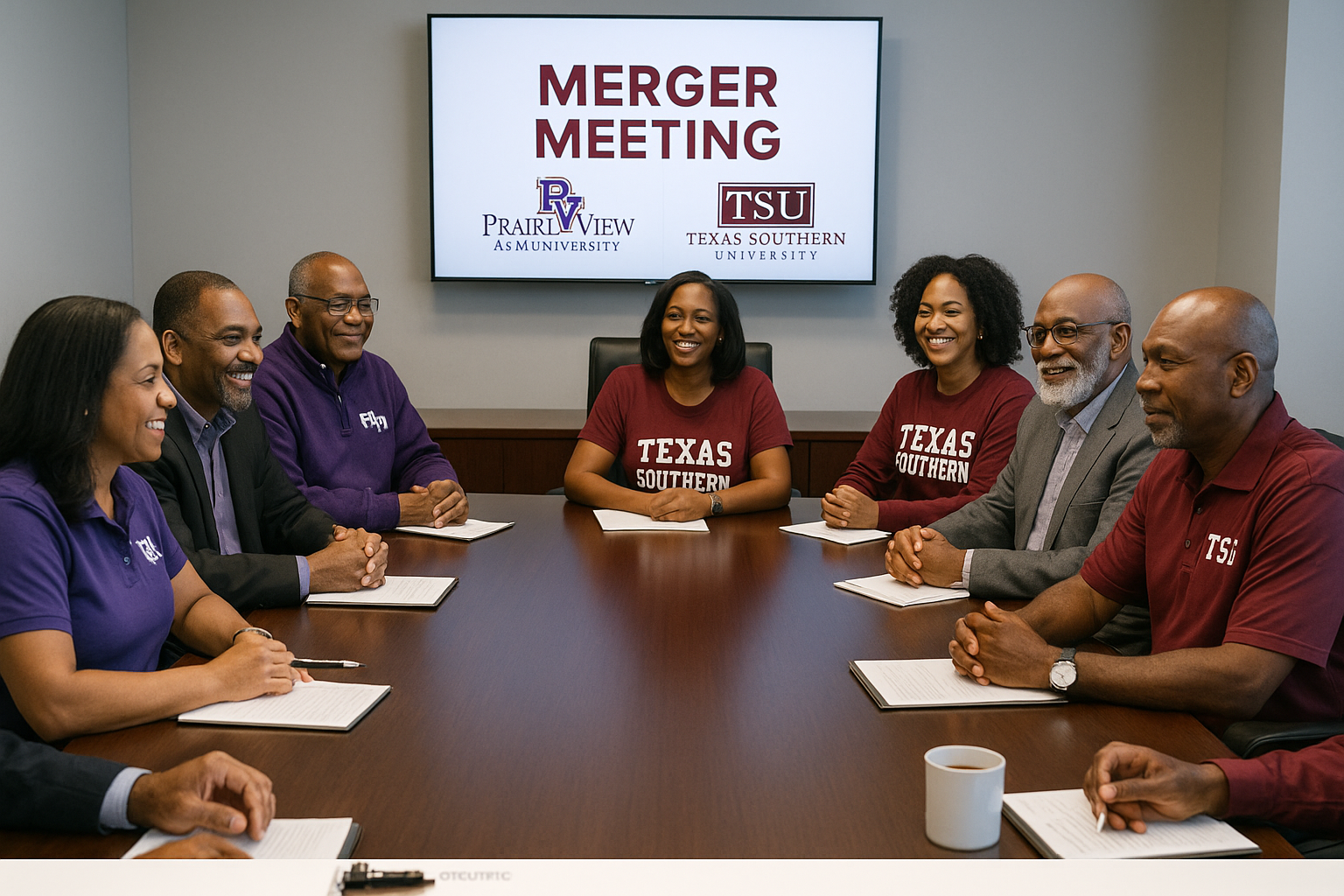
Two of the state’s largest HBCUs—Prairie View A&M University (PVAMU) and Texas Southern University (TSU)—have long histories, loyal alumni, and vital missions. What they do not have is institutional wealth. PVAMU’s foundation reported a modest $1.83 million in net assets in 2022. TSU’s foundation, better capitalised, holds $22.7 million. Combined, that amounts to just $24.5 million. For comparison, Rice University, less than 50 miles from either campus, holds an endowment north of $7.8 billion.

That yawning disparity matters. But it also presents an opportunity: a merger of the two foundations into a single, more potent philanthropic and investment entity. Done properly, it could reorient how Black higher education competes—not by appealing to fairness or guilt, but through scale, strategy, and institutional force.

A Rebalancing Act

To understand the potential of a PVAMU-TSU foundation merger, one must first grasp the dynamics of university endowments. Large endowments benefit from economies of scale, granting them access to exclusive investment opportunities—private equity, venture capital, hedge funds—often unavailable to smaller players. They attract the best fund managers, demand lower fees, and can weather market volatility without compromising their missions. Small foundations, by contrast, tend to be conservatively invested, costly to manage per dollar, and too fragmented to punch above their weight.

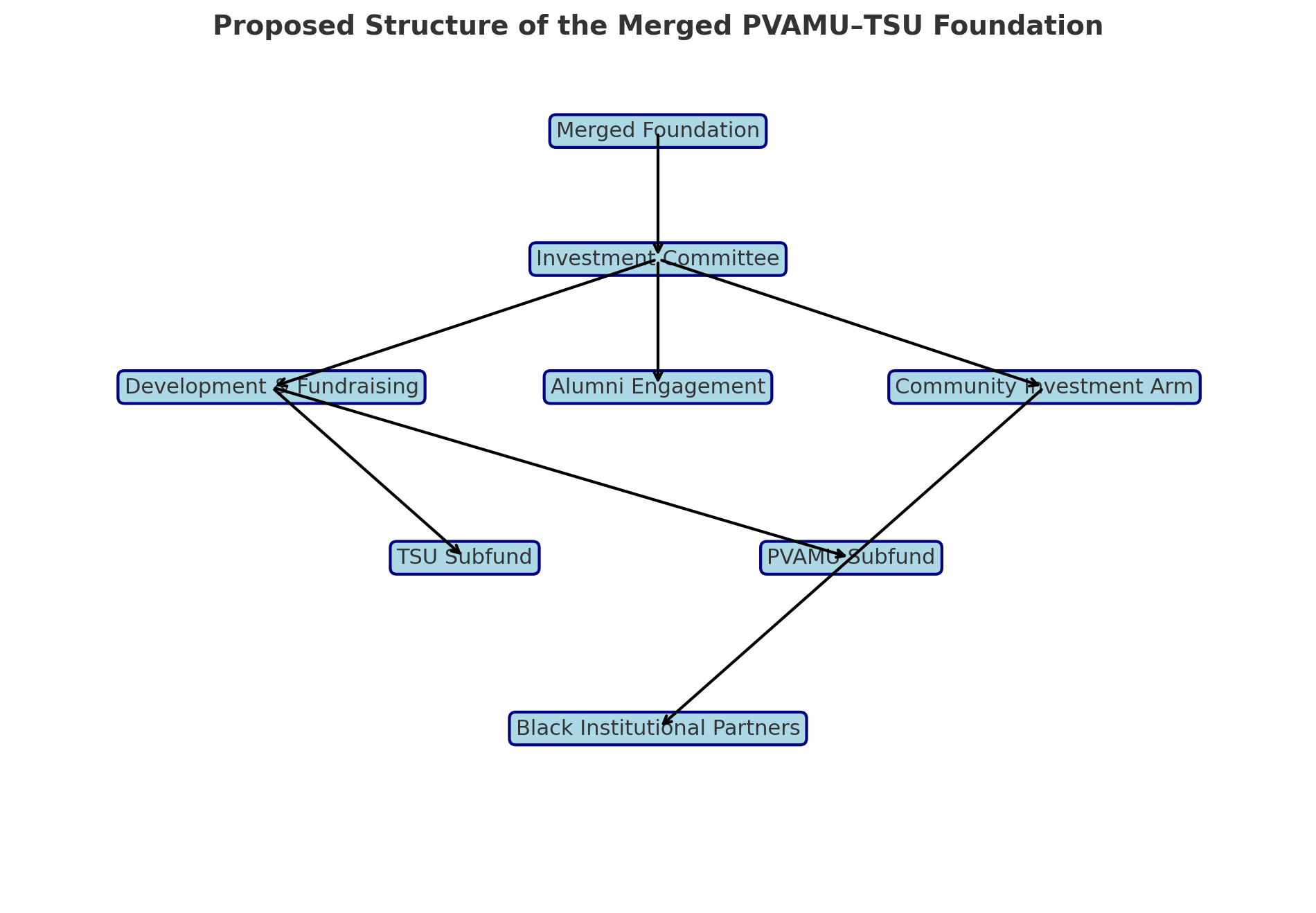
A consolidated HBCU foundation in Texas would be small compared to UTIMCO, but large relative to its peers. With a $25 million corpus as a starting point, the new entity could position itself for growth by professionalising its investment strategy, adopting a more ambitious donor engagement plan, and forming partnerships with Black-owned banks, family offices, and community institutions. Call it the Texas Black Excellence Fund, or perhaps, more simply, the TexHBCU Endowment.

To be sure, the legal and logistical barriers to such a merger are real. Foundation boards guard their autonomy jealously. Alumni pride can turn parochial. Governance models would need careful negotiation to ensure representation and avoid turf wars. But the arguments in favour are compelling.

The Power of One

First, a merger would cut overhead. Legal, accounting, auditing, and compliance costs—duplicated today—could be streamlined. A joint fundraising apparatus could create a single point of entry for corporate partners and high-net-worth donors. Branding efforts would gain coherence: instead of competing for attention, the institutions would stand together as a symbol of Black institutional unity and strength.

Second, scale invites leverage. A $25 million foundation cannot change the world overnight, but it can attract co-investments, engage in pooled funds, and perhaps even launch a purpose-driven asset management firm in the model of UTIMCO. If successful, this would be the first Black-led institutional investor of serious size in Texas—capable not only of managing endowment funds but of influencing broader economic flows across Black Texas.

Third, the merger would send a strategic signal to policymakers and philanthropic networks. It would say, in effect: “We are no longer asking for permission to grow. We are building the engine ourselves.” That tone matters. Too often, HBCUs are framed as needing rescue. A merged foundation flips that narrative. It becomes an asset allocator, a market participant, a builder of capital rather than a petitioner of it.

UTIMCO: A Goliath in the Crosshairs?

No one expects a $25 million fund to challenge a $70 billion behemoth. But that is not the point. UTIMCO’s dominance is as much political as it is financial. Its influence flows from its role as gatekeeper to resources, shaping everything from campus architecture to graduate fellowships. The merged HBCU foundation would not dethrone UTIMCO—it would decentralise power by becoming a second pole.

Indeed, the comparison may inspire mimicry. Just as UTIMCO serves multiple institutions, so too could a joint HBCU foundation. Prairie View and Texas Southern are only the beginning. Over time, the model could scale to include other Black-serving institutions across Texas and the South. This would amplify investment impact and accelerate institutional wealth-building.

Moreover, such a foundation could adopt an unapologetically developmental investment strategy. Where UTIMCO optimises for returns, the TexHBCU fund could optimise for both returns and racial equity—by investing in Black entrepreneurs, affordable housing, climate-resilient infrastructure, or educational tech. The dual mandate—profit and purpose—would not be a hindrance but a hallmark.

Regional Stakes

Prairie View sits on a rural hilltop. Texas Southern sprawls in urban Houston. But their communities are deeply connected—culturally, economically, demographically. A combined foundation could create regional development strategies that go beyond scholarship aid.

Imagine a venture fund seeding Black-owned start-ups in Houston’s Third Ward. A real estate initiative turning vacant lots into mixed-income housing for PVAMU students and local residents. A workforce development fund retraining returning citizens for green jobs across both cities. Each dollar invested becomes more than a balance sheet entry; it becomes a force for transformation.

This matters not just to students and faculty, but to the broader Texas economy. Black Texans make up 13% of the state population but own less than 3% of its small businesses. Educational attainment gaps persist. Institutional neglect deepens. The merger would not fix all this—but it would give the community a new tool for shaping its destiny.

Copy, Then Paste

If the model works, it would not stay in Texas. Southern University in Louisiana has multiple campuses and foundations that could benefit from consolidation. So does the University System of Maryland’s HBCUs. Indeed, the entire sector could adopt a federated endowment strategy—unified in purpose but distributed in governance.

HBCUs have long suffered from institutional atomisation. They are asked to compete individually in a system that rewards consolidation. Merging foundations is not just a finance play—it is a strategy for survival and sovereignty.

The Alternative: Stagnation

Critics may say a merger is too ambitious. That it risks alumni backlash or donor confusion. That it could take years to execute. But delay is itself a cost. Each year the foundations remain separate is another year of opportunity lost. Another year where millions in potential returns go unrealised. Another year where larger institutions deepen their lead.

PVAMU and TSU have histories to be proud of. But institutional pride must not become institutional inertia. A merger is not surrender—it is evolution.

In the long arc of higher education, moments of boldness define legacy. This is one of those moments. Two foundations. One future. Let the uniting begin.

Balancing the Ledger: A Comprehensive Analysis of Athletics vs. Research Spending (MEAC/SWAC vs. SEC/Big 10)

“Since new developments are the products of a creative mind, we must therefore stimulate and encourage that type of mind in every way possible.” – George Washington Carver

In the financially stratified ecosystem of American higher education, institutions are increasingly confronted with a binary tension: to invest in athletic visibility or academic viability. For universities across the NCAA spectrum, especially those in the MEAC and SWAC conferences compared to their counterparts in the SEC and Big Ten, this decision is less about preference and more about resource constraints and strategic direction. Yet, data reveals a persistent imbalance in how these priorities manifest, and more critically, the long-term costs of these choices.

Conference Dynamics: Institutional Identity and Capital Exposure

The MEAC and SWAC are defined by institutions that are predominantly Historically Black Colleges and Universities (HBCUs). These universities have traditionally operated under capital scarcity, navigating chronic underfunding while serving as incubators of social mobility for African American communities. Their mission, often grounded in equity and community uplift, limits their ability to generate large commercial revenues through athletics. This is not due to a lack of talent or audience, but because media deals, booster contributions, and government funding disproportionately favor PWI institutions.

By contrast, the SEC and Big Ten represent the economic elite of collegiate athletics and academia. With flagship state universities at their helm, these conferences are buttressed by multi-billion-dollar endowments, large donor bases, and lucrative broadcast contracts. Their budgets allow for investments in both athletics and research without having to cannibalize one to fund the other. In essence, they play the game with more capital and fewer trade-offs.

Athletics Budgets: Symbolism vs. Strategy

MEAC and SWAC institutions report average athletics expenditures between $11 million and $12 million annually. Notable programs like North Carolina A&T and Prairie View A&M may hover slightly higher, but Mississippi Valley State and others operate on budgets as low as $3.9 million. These figures pale in comparison to SEC schools like Alabama or Texas A&M, where athletic spending exceeds $150 million. The Big Ten’s Ohio State leads all with $215 million dedicated to athletics alone.

While athletic programs at HBCUs serve as cultural centers and enrollment drivers, their limited revenue-generating capacity renders them economically unsustainable without substantial subsidization. Many are forced to divert institutional funds, raise student fees, or solicit local donations just to keep programs afloat. In contrast, SEC and Big Ten programs function as media properties, brand engines, and financial assets, often contributing revenue back to their academic institutions.

Athletics at HBCUs carry significant intangible value, cultural pride, alumni engagement, community identity, but these cannot substitute for financial sustainability. The opportunity cost of maintaining expensive athletic programs without equivalent return on investment demands strategic scrutiny.

Research Spending: The Forgotten Core

Where the real divergence occurs is in research investment. MEAC and SWAC research expenditures are overwhelmingly modest. With the exceptions of Howard University ($122 million) and Florida A&M ($41 million), most institutions sit between $2 million and $25 million in annual research activity. These figures reflect decades of underinvestment and insufficient infrastructure, not a lack of capacity or talent.

Meanwhile, SEC and Big Ten institutions routinely surpass $500 million in annual research outlays. Schools like Michigan ($1.67 billion), Wisconsin ($1.36 billion), and Penn State ($996 million) operate on a scale comparable to government agencies and national labs. They attract large NIH, NSF, and Department of Defense grants. They lead clinical trials, generate patents, and build interdisciplinary research parks.

This disparity is not simply numerical; it is strategic. Research drives federal grants, patents, corporate partnerships, and endowment growth. It also attracts high-performing faculty and students, serving as the foundation of institutional longevity and economic influence.

The Ratio That Tells the Future

The athletics-to-research spending ratio offers a lens into institutional philosophy:

  • Norfolk State: 2:1 athletics to research
  • Jackson State: 0.7:1
  • Mississippi Valley State: 6:1
  • Alabama: 0.15:1
  • Michigan: 0.11:1
  • Wisconsin: 0.11:1

While SEC and Big Ten schools spend more on athletics than HBCUs, they also spend exponentially more on research. The imbalance within HBCUs is a reflection not of poor prioritization, but of systemic capital deprivation. These ratios also underscore how HBCUs are often forced to choose between visibility and viability, between entertainment and innovation, because they lack the financial bandwidth to pursue both.

Research as Revenue: Commercialization and the Innovation Economy

University research is not merely an academic endeavor it is a gateway to commercialization. Inventions born in labs often become patents. Patents become licensing agreements. Licensing revenue, in turn, flows back into the institution. The University of Florida’s development and commercialization of Gatorade yielded more than $280 million over time. Stanford’s involvement in launching Google and Hewlett-Packard has helped fuel its $36 billion endowment. Wisconsin’s WARF fund manages $4 billion in research-derived assets.

This model is not just aspirational; it is replicable. But replication requires infrastructure, policy, and intention.

Building the Infrastructure: A Two-Track Strategy for HBCUs

Campus Infrastructure

  1. Strengthen Technology Transfer Offices (TTOs): These serve as the conversion points from research to revenue. TTOs are responsible for managing patents, evaluating commercial potential, and negotiating licensing agreements.
  2. Invest in Innovation Facilities: Makerspaces, incubators, wet labs, and data science centers can all be built in underused buildings or retrofitted spaces.
  3. Embed Commercialization in Curriculum: Courses in IP law, venture creation, product development, and ethics should be available to both undergraduates and graduate students.
  4. Create Campus Accelerators: Provide seed funding, pitch competitions, and alumni mentorship. These accelerators can be industry-specific (e.g., AgTech at Tuskegee, FinTech at Howard).
  5. Celebrate Wins: Every patent, startup, or licensing deal should be internally recognized and externally marketed. Visibility breeds validation and investment.

Capital Infrastructure

  1. Black-Owned Banks: Offer startup lines of credit and financial education embedded in innovation ecosystems. These institutions can also hold endowment funds or manage cash flow from royalty revenues.
  2. Diaspora Sovereign Wealth Funds: Channel African and Caribbean capital into HBCU startups and joint ventures. Funds like Nigeria’s NSIA or Pan-African VC firms could provide growth capital.
  3. HBCU Venture & Endowment Funds: Seeded by Black VC firms, family offices, and institutional investors. These funds can create co-investment syndicates for promising faculty or student ventures.
  4. Donor-Advised Funds (DAFs): Enable alumni to contribute to IP pipelines through tax-efficient giving. DAFs could also be matched by corporate sponsors or philanthropic partners.

Building Strategic Partnerships for Scale

HBCUs need not operate in silos. Strategic collaboration can accelerate commercialization and R&D outcomes:

  • Inter-HBCU R&D Collaboratives: Morgan State and FAMU could co-sponsor patent consortiums.
  • Cross-registration commercialization programs with PWIs like Johns Hopkins or Emory.
  • Statewide HBCU innovation districts tied to workforce pipelines and rural development.

From the Lab to the Ledger: Case Studies in ROI

  1. University of Florida – Gatorade: In the 1960s, UF researchers developed a hydration drink to help football players endure Florida’s brutal heat. The result, Gatorade, has yielded over $280 million in licensing revenue. These funds helped UF build research infrastructure, attract top scientists, and grow its endowment.
  2. Stanford University – Silicon Valley: Stanford was not always wealthy. Its proximity to innovation and its open policies toward student and faculty entrepreneurship led to the creation of Google, Cisco, and more. Today, Stanford’s alumni-founded companies generate trillions in global market value.
  3. University of Wisconsin – WARF: Established in 1925, the Wisconsin Alumni Research Foundation has monetized research in Vitamin D, stem cells, and imaging. With over $4 billion in assets, WARF reinvests in faculty, students, and commercialization pipelines.
  4. MIT – Ecosystem Builders: MIT’s Deshpande Center and The Engine Fund act as innovation pipelines that commercialize tough tech. MIT startups have created over 4.6 million jobs globally.

What HBCUs Must Avoid: Dependency Without Ownership

Too often, HBCUs have served as intellectual suppliers while other institutions and corporations reap the financial rewards. Faculty develop ideas, only for those patents to be captured by universities with larger TTOs. Students build prototypes, only to license them under incubators unaffiliated with their home campus.

To shift this paradigm, ownership must be embedded from the start. That means building institutional IP portfolios and teaching students the economics of invention.

A Circular Ecosystem Rooted in Culture and Capital

StakeholderRole in the Pipeline
Black-Owned BanksStartup capital, credit access, and embedded finance literacy
Diaspora Wealth FundsStrategic investment, global partnerships, and joint IP deals
African American NPOsStakeholder investors, endowment builders, and R&D supporters
Black Media & AlumniNarrative shaping, promotional power, and advocacy
HBCU TTOs & LeadershipPatent management, research development, and startup formation

Final Calculations: Wealth Is Institutional, Not Individual

The data from MEAC, SWAC, SEC, and Big Ten schools paints a vivid picture of the financial landscape of higher education. While SEC and Big Ten schools show that it is possible to be excellent in both athletics and academics, MEAC and SWAC institutions face tougher choices due to structural inequalities and historical underfunding.

As conversations around equity, student success, and public accountability continue, this kind of comparative data is essential. Whether aiming for a championship or a Nobel Prize, universities must remember that their ultimate mission is to educate, innovate, and uplift communities.

University research isn’t just about publications and academic prestige it’s a launchpad for innovation, economic growth, and financial sustainability. When strategically supported, it becomes a core driver of commercialization, entrepreneurship, and long-term prosperity through patents and endowment growth.

Many HBCUs and smaller institutions already are incubators of brilliance but they’ve been left out of the research-to-wealth pipeline due to underfunding and limited infrastructure. With targeted investments and smart policy, they can flip the script and become not just engines of education, but engines of innovation and wealth creation.

Disclaimer: This article was assisted by ChatGPT.