
“If you raise your children to be happy, they may or may not be productive. But if you raise them to be productive, happiness tends to follow. Not the fleeting kind, but the self-earned kind.” — William A. Foster, IV
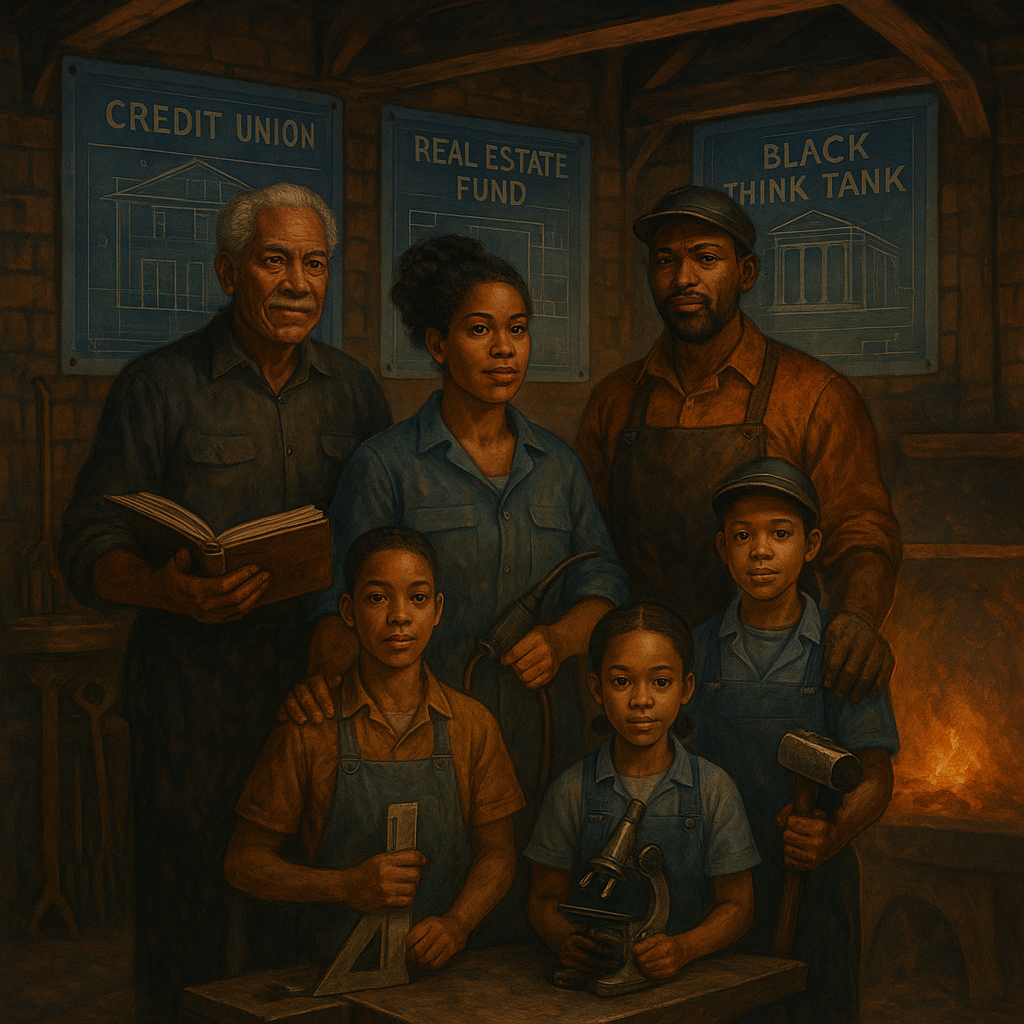
In 1867, a formerly enslaved family in the Alabama Black Belt pooled its first wages into a single ledger kept by the eldest daughter, who could read. Every dollar earned by every member of the household was recorded, and every dollar spent required a reason written beside it. Within a decade, that ledger had financed forty acres, a one-room schoolhouse, and tuition for two children at a normal school two counties over. The family did not think of itself as remarkable. It thought of itself as an operation. That distinction between a family that raises individuals and a family that runs an institution is the one African America has largely lost, and it is the one this generation of parents must recover.
The debate over how to raise Black children has, in recent years, narrowed into a contest between two imported frameworks. One is gentle parenting, an approach built around emotional attunement, negotiated boundaries, and the primacy of the child’s internal experience. The other is the disciplined, achievement-maximizing model popularized under the label “tiger parenting,” associated with East Asian immigrant households and organized around the assumption that excellence must be engineered, not discovered. Both frameworks have something to offer. Neither was built for the problem African America actually has, which is not a deficit of individual achievement but a deficit of institutional ownership and neither, notably, asks what a child owes to anything larger than a household.
This is a structural distinction, not a rhetorical one. African American households have, over the past sixty years, produced physicians, engineers, federal judges, university presidents, and Fortune 500 executives at rates that would have been unimaginable to the family keeping that 1867 ledger. And yet the balance sheet of the community as a whole; its share of bank assets, its landholdings, its endowed research capacity, its control of the institutions that educate, capitalize, and govern it has not moved in proportion to that individual advancement. The gap between individual credentialing and institutional ownership is the central economic fact of postwar Black America, and it is a fact that parenting philosophy, as currently imported and debated, does nothing to address.
The reason is straightforward. Gentle parenting and tiger parenting are both, at bottom, individual-optimization frameworks. They differ on method where one prioritizes emotional regulation, the other prioritizes output but they share an assumption: that the unit of success is the child, and that the family’s job is to produce the best possible version of that child for the child’s own benefit. Neither framework asks what the child owes back to the institutions that produced them, or what the family itself is building as an ongoing concern. A household organized around either model can raise a child into a six-figure salary and a rented apartment in a city with no connection to the family’s origin, and count that as complete success. Historically, African American households did not have the luxury of treating the family as merely a launching pad for individual departure. The family was itself an institution, often the only one fully under Black control, and children were raised as its future officers, not its former residents.
What African American families need, then, is not a synthesis of two individual-optimization models but a third model organized around a different unit of analysis: the household as an institution with a balance sheet, a governance structure, and a multigenerational mandate. But the household cannot be the terminal unit in this model, and this is where most versions of “legacy-minded” parenting stop short. A family that builds its own capital and stops at its own front door has replicated, at smaller scale, the same isolation that has weakened Black institutions generally; a landholding without a bank, a bank without a university, a university without a diaspora partner. The household is the first institution in a chain, not the last one, and children raised inside it need to understand early that the chain runs outward: from family, to the Black-owned bank or credit union that holds the family’s deposits, to the HBCU or community institution that trained its members, to the broader network of African-descended institutions on the continent and across the Diaspora that this ecosystem is, whether acknowledged or not, already entangled with.
This outward extension is not sentimental. Diaspora institutions; universities, exchanges, development banks, and enterprises across what this publication designates Africa Core represent both a market and a set of potential partners that African American capital has been almost entirely absent from, even as African American households have accumulated more collective wealth than at any point in the community’s history. A family that trains its children to think only as far as the neighborhood or the HBCU that produced them is training them to operate inside a smaller institutional universe than the one actually available to them. A family that trains its children to understand Africa Core institutions as legitimate strategic partners; not as a heritage destination or a charitable cause, but as counterparties in trade, education, and finance is preparing them for a considerably larger field of institutional play. This is a matter of literacy as much as intention: a child who can explain why an African Depository Receipt structure might allow a Black-owned enterprise to list on an African exchange has a materially different frame than one who was simply told to “know their African history.”
This reframes what “cultural confidence” should mean inside the household. It is common, and not wrong, to want children to know Black history and African history. But that knowledge functions very differently depending on whether it is transmitted as heritage or as strategy. A child who knows that the Mali Empire under Mansa Musa possessed wealth on a scale historians still struggle to estimate, but does not also understand why that wealth left no durable institutional apparatus behind it, has learned a fact without learning the lesson. The lesson is that capital without institutions is temporary, however large it is at its peak — a lesson equally applicable to a family’s household wealth and to a civilization’s. Children raised with this frame do not treat diaspora history as content to be proud of; they treat it as a cautionary case study in what their own family and community are still at risk of repeating.
Several concrete practices distinguish this model from either import, and each one now needs a diaspora dimension that is usually missing. The first is treating family meetings as governance rather than logistics; regular sessions, monthly is typical among families that sustain this practice, in which children are present for real discussion of what the family owns, owes, and is building toward. Extended properly, these meetings also address where the family’s capital sits in relation to Black-owned financial institutions rather than mainstream white-owned lenders by default, and whether any portion of family investment, however small, is directed toward diaspora-linked opportunity rather than exclusively domestic and mainstream markets.
The second practice is treating a child’s education and career as a capital allocation decision made by the household, with the question reframed from “what do you want to be” to “what institution or system do you want to be capable of building or running” and that system should be understood to include Africa Core institutions as a live option, not an afterthought. A child who becomes a physician under this model might be asked not only whether the family should fund a scholarship at the HBCU that trained them, but whether a medical partnership or exchange with an African Core institution is within reach. Fisk, Xavier of Louisiana, Meharry, and Morehouse School of Medicine have each supplied physicians into families that made exactly this domestic calculation; very few have extended the same calculation across the Atlantic, and that is the gap this model asks families to close.
The third practice is structuring rites of passage around economic contribution rather than consumption pairing major life transitions with a corresponding step in managing capital, drafting a business plan, or taking a formal role in family enterprise. Norfolk State, Bethune-Cookman, and Alcorn State each sit inside regional economies where family enterprise remains viable, and families near those institutions have more opportunity than most to make this practice concrete.
The fourth practice is explicit instruction in the mechanics of collective capital; family investment clubs, the dangers of heirs’ property and forced partition, the function of a family trust or LLC in holding assets across generations without fragmentation. This is not financial literacy as a slogan; it is mechanism-specific instruction, and the same instruction should extend to the mechanics of diaspora capital circulation, so that a child understands not only how to protect family land in the Mississippi Delta but how African American enterprise might eventually list, trade, or partner across Africa Core markets.
None of this requires treating children purely as instruments, and a household that does so will produce resentment and eventual defection, which defeats the purpose. Emotional security and individual flourishing remain conditions for sustained institutional contribution, not competitors with it. The correction is one of scope as much as sequencing: the mandate a household transmits should not terminate at the family’s own advancement, or even at the advancement of the nearest HBCU or Black bank, but should understand itself as one node in a coordinated ecosystem that includes the full institutional Diaspora.
The comparison that clarifies the stakes is between two children who end up in different relationships to that ecosystem. One child is trained from an individual-optimization frame, secures a strong salary, and directs the returns on that investment toward personal consumption and geographic departure. A second child, raised inside a household organized institutionally and taught to see the Diaspora as a coordinated system rather than a collection of disconnected causes, may follow a similar career path but returns capacity to family, to community institutions, and where the opportunity exists to Africa Core partners as well. Both may report comparable personal satisfaction. Only one outcome adds to the institutional density of African America and the wider Diaspora it is part of.
This is the argument for institutional parenting, and it should be understood as strategic rather than moral: households that stop at their own advancement, or even at their own neighborhood’s advancement, are not failing their children, but they are failing to build the multi-tiered asset base — familial, communal, and diasporic — that the ecosystem as a whole requires to close its institutional-ownership gap. That gap will not close through individual achievement, however impressive it continues to be, and it will not close through household wealth-building that stops at the water’s edge. It closes only when families begin raising children who understand themselves as heirs not just to a household, but to an entire, interconnected institutional Diaspora they are responsible for strengthening.
Editor’s Note: To make this concrete rather than conceptual; a family investment club that currently allocates purely to domestic equities or a home-purchase fund could, without restructuring, designate a small, fixed percentage of new contributions (a family might set this at five or ten percent, reviewed annually rather than left open-ended) to a “Diaspora allocation” line, tracked separately in the club’s ledger the same way a 1867 household ledger tracked land money apart from schooling money. That line does not require access to instruments that do not yet exist. It can fund things available now: a stake in an African American-owned enterprise already doing business in an Africa Core market, a deposit or investment product offered by one of the African American-owned banks or credit unions active in diaspora trade finance, attendance at an Africa Core trade or investment conference where a family member makes direct contact with counterparts on the continent, or a subscription that keeps the family current on African exchange and policy developments rather than reliant on secondhand summary. The point of naming the line item now, while children are still watching the ledger, is not to bet on a future instrument. It is to build the habit of treating the Diaspora as a place the family’s capital already goes, in small and specific ways, so that when larger mechanisms for cross-listing and cross-investment do mature, the household has years of practice allocating toward that horizon rather than a decision to make from a standing start.
Disclaimer: This article was assisted by ClaudeAI.





 HBCU Money