Tag Archives: Minority Depository Institutions

Where Black-Owned Lending Doesn’t Reach: Mapping the (Primary) Mortgage Gap

“How do we think about buying the home, but not who is supplying the mortgage? The capital, the very thing we constantly say needs to circulate more we give no thought too. We give no thought to who owns the mortgage company, title company, the real estate brokerage company our agent works for. All we know is – we are buying a house and unfortunately we think that is enough and we could not be more wrong.” – William A. Foster, IV
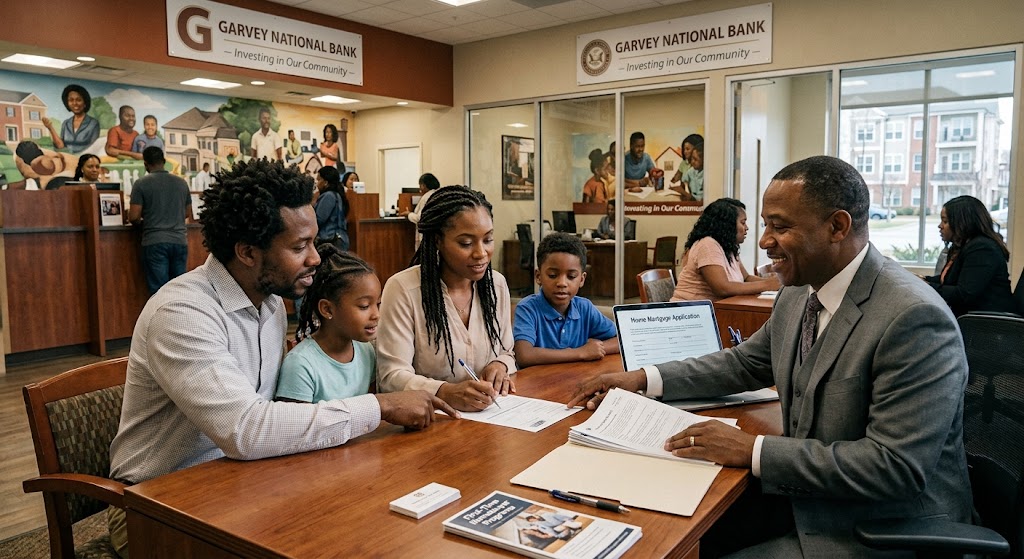
Draw a map of the United States and mark every county with a Black population share above fifteen percent. The shading will run thick down the Mississippi Delta, wrap around the Chesapeake, spill across the Piedmont Carolinas, thicken again in Houston and Dallas, and pool densely in New York, Philadelphia, and the Bay Area. Now draw a second map, this one marking every mortgage lender in America that is actually owned — not merely led, not merely branded, not merely marketed — by African Americans, and actively originating home loans for the house a borrower actually lives in. The second map is nearly blank. Nine dots, clustered in a dozen states, mostly small cities, mostly credit unions. Overlay the two maps and the mismatch becomes the argument: the geography of Black homeownership demand and the geography of Black-owned mortgage capital do not correspond. For most African American home buyers in the country’s largest Black population centers, the choice to bank Black on the single largest financial transaction of their lives does not exist. It was never offered.

This is not a complaint about willingness. It is a diagnosis of capacity. HBCU Money has argued consistently that Black wealth-building runs through institutions, not sentiment, and nowhere is that clearer than in the mortgage market, where the difference between origination by a Black-owned lender and origination by a mainstream white-owned lender is not cosmetic. It is the difference between interest payments compounding inside the African American institutional ecosystem; funding future loans, future branches, future capital reserves and interest payments leaving it permanently, financing balance sheets with no obligation to reinvest. A mortgage is a thirty-year capital-retention decision disguised as a housing decision, and right now the overwhelming majority of that decision is being made by institutions with no stake in Black community reinvestment.

Start with what actually exists. According to NerdWallet’s most recent accounting of lenders serving Black communities, published in January 2026, ten institutions make the list. One of them, Legacy Home Loans, is Black-led and does meaningful volume and it is licensed to operate in twenty-nine states plus Washington, D.C. but it is not Black-owned; it is a nonbank mortgage company, not a depository institution held by African American shareholders or member-owners. It belongs in a different conversation, one about Black executive leadership inside a financial system still substantially owned by others. It should not be counted alongside the nine that are actually owned by African Americans, because ownership, not leadership, is what determines whether profit and reinvestment obligations stay inside the ecosystem or exit it. And even Legacy’s twenty-nine-state reach should be read against the actual scale of the mortgage industry it operates inside: Rocket Mortgage alone originated roughly 429,000 loans worth $116.2 billion in 2025, and the ten largest lenders in the country together accounted for more than a quarter of all mortgage dollar volume originated nationally that year. A single top lender’s annual dollar volume dwarfs the combined asset base of every African American-owned bank and credit union in the country several times over.

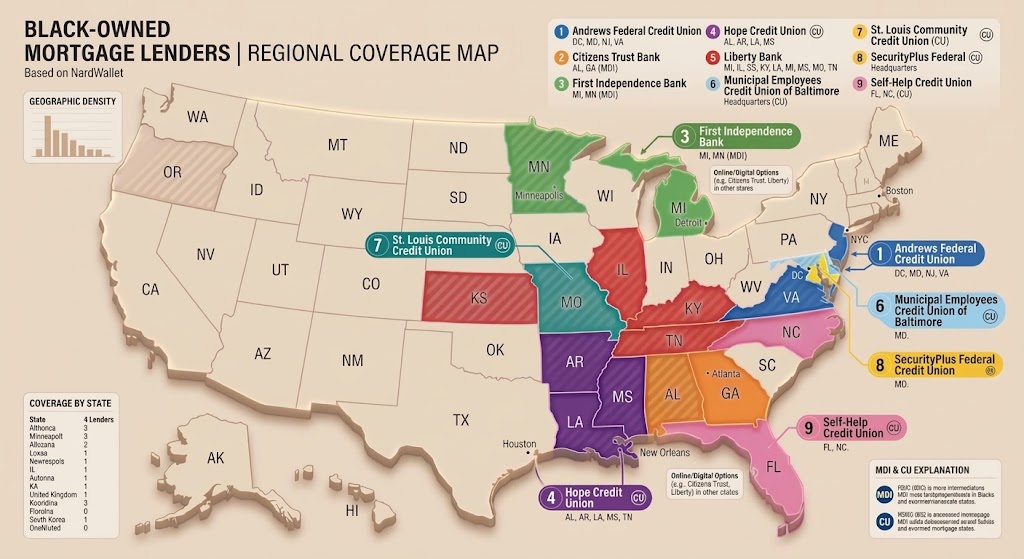
The nine that are actually Black-owned are, without exception, small and regional. Andrews Federal Credit Union serves Maryland, New Jersey, Virginia, and Washington, D.C., with a natural base among military members and veterans. Citizens Trust Bank operates out of Atlanta, serving Alabama and Georgia, with a first-time buyer program built on partnership with the Federal Home Loan Bank of Atlanta. First Independence Bank serves Detroit and Minneapolis. Hope Credit Union covers a five-state footprint across the Deep South (Alabama, Arkansas, Louisiana, Mississippi, and Tennessee) with underwriting flexibility built for lower-income borrowers, including ITIN loans for those without Social Security numbers. Liberty Bank has the widest reach of the nine, touching Alabama, Illinois, Kansas, Kentucky, Louisiana, Michigan, Mississippi, Missouri, and Tennessee, and runs a Detroit-specific restoration and acquisition program. Municipal Employees Credit Union of Baltimore and SecurityPlus Federal Credit Union both concentrate on Baltimore. St. Louis Community Credit Union concentrates on St. Louis. Self-Help Credit Union serves Florida and North Carolina, with no-down-payment products designed for borrowers with thin or alternative credit files. What unites all nine, and distinguishes them from the banks discussed below, is that a borrower can walk in the door and finance the home they intend to live in directly with the institution; not a commercial building, not a rental property, not a construction loan against a development, but the primary residence itself.

Compress that list into a set of states and the coverage runs to roughly seventeen states plus the District of Columbia: Alabama, Arkansas, Florida, Georgia, Illinois, Kansas, Kentucky, Louisiana, Maryland, Michigan, Minnesota, Mississippi, Missouri, North Carolina, New Jersey, Tennessee, and Virginia. That is the entire national footprint of Black-owned primary-residence mortgage lending capacity in America.
Now compare it against where African Americans actually live in the largest numbers, and against the fuller picture of where Black-owned banks and credit unions operate at all, primary mortgages or not. Texas holds the largest Black population of any state in the country, concentrated in Houston, Dallas-Fort Worth, and San Antonio. Houston is home to Unity National Bank, and the state carries fourteen active Black-owned credit unions, the fourth-highest count nationally, yet the distinction here has to be precise. Unity does lend against real estate, and lends actively: by its own account, its loan portfolio runs heaviest in commercial and industrial lending, commercial real estate, and small business loans, and it offers financing for owner-occupied and investor commercial buildings, housing development and construction, and SBA-backed acquisitions. What it does not do is originate primary-residence home mortgages directly. Unity’s own materials describe that product as handled “through a trusted third-party partnership” rather than underwritten and held by the bank itself which means a Black family in Houston can finance a commercial building or a construction project through a Black-owned bank, but not, in any direct sense, the house they intend to live in. That is a meaningfully different thing from Citizens Trust, Hope Credit Union, or Liberty Bank actually closing a primary-residence loan in their own name, and it is the precise reason Unity does not appear among the nine even though it is a real, active, community-rooted Black-owned bank. New York tells a related story: no Black-owned bank operates in the state at all, but fifteen active Black-owned credit unions do, the third-highest concentration in the country, serving a Black population that ranks fourth largest nationally and carries the historic institutional density of Harlem, Brooklyn, Buffalo, and Rochester and still, none of those fifteen institutions reach the national primary-mortgage-lender list. Pennsylvania is home to United Bank of Philadelphia, one of the country’s African American-owned banks, and to two of the HBCUs this publication takes care to highlight rather than ignore in Cheyney University, the nation’s first degree-granting HBCU, and Lincoln University, the first degree-granting HBCU for men, yet whatever its lending mix, it does not appear on the active primary-mortgage list either. South Carolina follows a similar pattern: Optus Bank operates out of Columbia, in a state where African Americans make up one of the highest population shares in the country and where Claflin, Voorhees, Allen, Benedict, Morris College, and South Carolina State together form one of the densest HBCU clusters anywhere, but Optus does not appear on that list. California is the thinnest case in this group by far. OneUnited Bank, headquartered in Boston, operates branches and does considerable business in the state, serving a Black population of well over two million people concentrated in Los Angeles, Oakland, and the Bay Area but OneUnited does not offer mortgages anywhere, and California’s own credit union sector amounts to a single active institution holding $318,105 in assets and 262 members, a presence that has contracted since 2016 rather than grown. In each of these five states, the absence is not institutional absence; it is a narrower and in some ways more troubling gap between capital existing, and in some cases lending actively, and that capital being deployed specifically into the primary-residence mortgage product that would make it meaningful to a home buyer rather than a developer or a business owner.

Delaware, Ohio, and Wisconsin sit in a starker category, and two of the three arrived there only this year. Delaware, which by population share ranks among the most heavily African American states in the union and is home to Delaware State University, has no Black-owned bank on record. Ohio, home to Central State University and Wilberforce University, lost its last African American-owned bank, Adelphi Bank, when the institution’s ownership diluted below majority African American control in 2025; a particularly bitter loss because Adelphi had been the first new African American-owned bank chartered anywhere in the country in twenty-three years, and its growing asset base made the loss of ownership control, rather than a closure, the actual wound. Wisconsin’s loss came from the opposite direction: Columbia Savings and Loan Association of Milwaukee, chartered in 1924 and one of the oldest African American-owned financial institutions in the country, survived the Depression, the savings-and-loan crisis, and the 2008 collapse, only to close in 2025 after its capital base finally gave out. Milwaukee’s Black population runs to roughly thirty-nine percent of the city, and it now has no African American-owned bank of any kind, a fact HBCU Money’s own reporting names directly. Together, Ohio and Wisconsin’s losses erased nearly $130 million in Black-owned banking assets in a single year, offset only partly by the addition of Redemption Bank in Salt Lake City, Utah; a welcome new entrant, but one whose presence in a state with a comparatively small Black population does nothing for the students at Central State and Wilberforce or the residents of Milwaukee’s north side. Missouri, notably, does not belong in this category at all while it has no Black-owned bank, but it is one of only four states, alongside Maryland, Mississippi, and Virginia, that together hold roughly eighty percent of all African American-owned credit union assets nationally, with St. Louis Community Credit Union anchoring real capacity in the state even without a bank of its own.

This is the pattern the institutional lens is built to catch and the individual-success lens is built to miss. It is not that Black home buyers in Houston, Harlem, Philadelphia, Columbia, or Los Angeles lack the income, the credit profiles, or the desire to build wealth through homeownership. It is that the institutional infrastructure to let them do it through an ownership structure aligned with their own community’s capital retention simply does not exist where they live, or exists and does real business there, sometimes real estate business, without that business ever reaching the specific product that would make the ownership meaningful to a family buying a home to live in, or existed until this year and has now been lost outright. The absence is structural, and structural absences do not close through individual effort; they close through institutional construction, merger, and expansion or they do not close at all.

The scale problem compounds the geography problem. HBCU Money’s own 2025 directories count African American-owned banks holding $6.7 billion in assets, and 205 active African American-owned credit unions holding $8.15 billion in assets and serving 726,929 members, a combined $14.85 billion in Black-owned depository capital against nearly $25 trillion in total American bank assets alone. The credit union count has fallen from 318 institutions in 2016 to 205 today, a 35 percent decline in the number of institutions even as combined assets more than doubled over the same period, a sector consolidating around its strongest players while losing breadth, not one expanding into new geography. The bank sector tells the same story in sharper relief: two of its oldest and newest institutions, a century-old Milwaukee thrift and a two-year-old Columbus startup, both vanished from the ranks in the same year. Of this already-thin universe, only a handful of institutions actively originate primary-residence consumer mortgages at any real volume; many of the rest, like Unity National, are real and active lenders in commercial and investment real estate without extending that activity into owner-occupied home loans, while others are simply not underwriting real estate credit as a core product line at all, whether from capital constraints, risk appetite, or the absence of the correspondent relationships and secondary-market infrastructure that make mortgage lending viable at scale for a small institution. HBCU Money’s own Annual Wealth Report puts African American household net worth at roughly $5.6 trillion, a figure that makes plain how thin the institutional base is relative to the capital it would need to absorb if African American mortgage demand were redirected toward it in any serious volume. Nine primary-mortgage lenders drawing on $14.85 billion in combined sector assets cannot underwrite home purchases for a population of over forty million people concentrated in dozens of metropolitan areas outside their combined footprint, particularly against an industry where a single national lender moves more than $100 billion in loans in one year. The mismatch is not a marketing problem to be solved with a “bank Black” campaign. It is a balance-sheet, charter, product-line, and geographic-coverage problem that campaigns cannot fix.

What follows from this is not resignation but a specific set of institutional priorities. First, expansion of primary-mortgage capacity into states where Black-owned depository institutions already operate including in adjacent real estate lending, as Unity National does in Texas but do not lend on owner-occupied homes, should be treated as a nearer-term strategic objective than chartering new institutions from scratch, since the regulatory relationship, the deposit base, the real estate underwriting expertise, and in New York’s and Texas’s cases a double-digit count of existing credit unions already exist; what is missing is a specific product line, which is a narrower and more solvable gap than institutional absence. Second, the roughly two hundred active Black-owned credit unions nationally represent underused latent capacity concentrated too heavily in four states; a coordinated push through NCUA guidance, CDFI Fund support, or philanthropic capital specifically earmarked for mortgage-program buildout to bring a meaningful share of the New York and Texas credit union bases into primary-mortgage origination would multiply national coverage without requiring a single new charter. Third, secondary-market aggregation matters more for this sector than for almost any other segment of American banking: a consortium structure that allows small Black-owned institutions to originate loans locally while pooling them for sale or securitization through a shared, mission-aligned intermediary would let a nine-lender map become a fifty-state map without requiring each institution to carry mortgage risk alone on an undersized balance sheet. Fourth, HBCUs themselves properly understood as one node in the broader African American institutional ecosystem rather than its center sit inside several of the exact metropolitan areas where lending capacity is absent, dormant, commercial-only, or newly lost, and alumni associations, endowment offices, and institutional banking relationships at schools in Texas, South Carolina, Pennsylvania, California, and Ohio could function as anchor depositors and referral partners, giving a Unity National, an Optus Bank, or a New York credit union the local relationship base and deposit volume needed to justify building out a primary-mortgage division that does not currently exist.

Fifth, and perhaps most directly actionable, the sector needs its own version of what Legacy Home Loans already proves is possible: a dedicated, Black-owned nonbank mortgage company, built by an entrepreneur with outside investment capital, licensed to originate across multiple states, and structured from the outset to correspond with rather than compete against the depository institutions already discussed. Legacy demonstrates the model works at scale: twenty-nine states plus Washington, D.C., built without ever taking a deposit or carrying a bank charter. What Legacy does not solve is ownership; profit and control sit with a Black-led company, not a Black-owned one, and the model’s success has not yet been replicated in Black-owned form. A founder pursuing this path would not need to invent underwriting or licensing from scratch — nonbank mortgage companies operate on well-established regulatory rails — but would need enough capital to meet state net-worth and bonding requirements across a meaningful footprint, and enough underwriting and secondary-market discipline to sell originated loans forward rather than hold them on a balance sheet the company does not have. The natural distribution partners for such a company are exactly the institutions already identified in this piece as active in real estate or deposits but not in primary mortgages: Unity National Bank in Houston, whose existing commercial real estate lending relationships and third-party mortgage referral arrangement could be absorbed directly into a Black-owned originator rather than an outside partner; United Bank of Philadelphia; Optus Bank in Columbia; OneUnited’s branch network in California; and the credit union bases in New York and Texas. None of them would need to build a primary-mortgage division of their own if a Black-owned originator existed to take the referral, close the loan under a shared or co-branded relationship, and let the deposit-taking institution keep the account and the trust while the mortgage company carries the origination expertise and risk. That structure — bank or credit union as the front door, a dedicated Black-owned originator as the engine behind it — would close more of the map faster than waiting for seventeen banks and two hundred credit unions to each build mortgage capacity independently, and it is the one recommendation on this list that does not depend on an existing institution changing its strategy first; it only requires someone to build it.

None of this requires new instruments that do not yet exist. It requires existing Black-owned banks and credit unions to treat mortgage buildout and geographic expansion as core strategy rather than incidental growth, it requires an entrepreneur and investment capital willing to build the origination company that connects them, and it requires the broader institutional ecosystem such as HBCUs, Black chambers of commerce, Black professional networks to function as coordinated infrastructure for that expansion rather than as separate, isolated actors each solving a piece of the same problem independently. The map of nine dots is not a permanent feature of the landscape. It is the current state of an institutional sector that lost two of its members in a single year, has not gained a stable new charter in over two decades, has shed a third of its credit unions since 2016, and has not yet been asked, systematically, to turn the capital and the real estate expertise it already has into mortgages for the families it was built to serve. Reversing it is a matter of capital, coordination, and institutional will not of finding more good customers, who have never been the scarce resource in this equation.

Disclaimer: This article was assisted by ClaudeAI.
HBCU Money’s 2025 African American Owned Credit Union Directory

African American-owned credit unions hold more than $8.15 billion in assets and serve 726,929 members in 2025, more than doubling their asset base from $3.81 billion in 2016. That growth confirms that Black-owned cooperative finance remains a living, expanding sector — not a historical artifact. Yet placed against the broader credit union landscape, the numbers tell a more sobering story. The federally insured credit union system holds $2.37 trillion in total assets across 4,411 institutions. African American-owned credit unions, with 205 active institutions down from 318 in 2016, control just 0.34 percent of that total asset base. The sector’s 453 Minority Depository Institution-designated peers collectively hold $95.1 billion in assets; African American institutions account for less than 9 percent of that figure. The gap is not closing fast enough.

The structural challenges are as significant as the asset gap. The median African American-owned credit union holds approximately $2.47 million in assets and serves roughly 618 members placing it squarely in the asset tier where the national system is contracting most aggressively, with institutions under $10 million posting declines in assets, membership, and net worth year over year. Only 40 percent of these institutions maintain an active public website, rendering the majority functionally invisible to younger and mobile-first members. An estimated 30 percent are affiliated with religious congregations, compared to approximately 5 percent of all U.S. credit unions, introducing succession and governance risks that extend well beyond normal institutional turnover. Meanwhile, the HBCU-based credit union subsector has seen five of its eleven institutions close or be absorbed since 2020, leaving six survivors holding a combined $76.8 million in assets — institutions that represent the most direct expression of university-anchored Black financial infrastructure and are quietly disappearing without coordinated intervention.

The sector’s geographic concentration compounds these institutional vulnerabilities. Maryland, Mississippi, Missouri, and Virginia together account for roughly 80 percent of all African American-owned credit union assets nationally, while states like California, Minnesota, and Wisconsin maintain only token institutional presences despite substantial African American populations. The South remains the geographic and institutional core, with Louisiana’s 25 institutions representing the largest state count and Mississippi’s Hope Credit Union standing as the sector’s clearest model of what scale and institutional commitment can produce. The path forward runs through consolidation where fragmentation cannot be reversed, digital investment where infrastructure is absent, geographic expansion where populations go unserved, and the fuller utilization of federal support mechanisms such as MDI designation, CDFI certification, and NCUA technical assistance that the sector has historically left on the table.


ADDITIONAL NOTES

  • African American-owned credit unions now hold $8.15 billion in total assets across 205 active institutions, representing 0.34 percent of the $2.37 trillion held by all federally insured credit unions nationally.
  • Total assets in the sector have more than doubled since 2016, rising from $3.81 billion — a 114 percent increase — while membership grew 39.5 percent from 521,078 to 726,929 members over the same period.
  • AACUs average assets per institution: approximately $39.8 million. AACUs median assets per institution: approximately $2.47 million. The gap between the mean and median reflects a sector dominated at the top by a small number of large institutions while the majority operate at a scale that limits their competitive viability.
  • AACUs average members per institution: approximately 3,546. AACUs median members per institution: approximately 618.
  • Only 40 percent of African American-owned credit unions maintain an active public website, representing a critical digital infrastructure deficit in an era of mobile-first financial services.
  • An estimated 30 percent of African American-owned credit unions are affiliated with religious congregations compared to approximately 5 percent of all U.S. credit unions introducing institutional succession risk as American religious participation continues its long-term demographic decline.
  • Louisiana has the largest number of active African American-owned credit union institutions (25), followed by Illinois (23), New York (15), Texas (14), Virginia (13), and Alabama and the District of Columbia with 12 and 10 respectively. Maryland leads all states in total sector assets at $4.47 billion, followed by Mississippi at $1.05 billion and Missouri at $480 million.
  • California — the most populous U.S. state and home to one of the largest African American populations in the country — has a single active African American-owned credit union with $318,105 in assets and 262 members, a presence that has contracted since 2016.
  • The sector’s credit union count has declined from 318 institutions in 2016 to 205 active institutions in 2025, a reduction of 35 percent, driven primarily by closures, mergers into non-Black institutions, and voluntary dissolutions.
  • For comparison, the national credit union system added 2.9 million members over the past year alone, reaching 143.2 million total members — nearly 200 times the total membership of all African American-owned credit unions combined.

Complete Directory

African American Owned Credit Unions by State:

Alabama


Arkansas


California


Connecticut


Delaware


District of Columbia


Florida


Georgia


Illinois


Indiana


Louisiana


Maryland


Michigan


Minnesota


Mississippi


Missouri


New Jersey


New York


North Carolina


Ohio


Oklahoma


Pennsylvania


South Carolina


Tennessee


Texas


Virgin Islands


Virginia


West Virginia


Wisconsin


Source: NCUA

Two Pillars Fall: The Loss of Columbia Savings and Adelphi Bank and What It Means for African American Communities

We are watching the absolute collapse of African American institutions and our absolute dependency on Others’ institutions. It once felt like a slow train wreck, now it feels like a supersonic missile. – William A. Foster, IV

The 2025 African American Owned Bank Directory carries an absence that numbers alone cannot fully convey. Two institutions that appeared in last year’s listing — Columbia Savings and Loan Association of Milwaukee, Wisconsin, and Adelphi Bank of Columbus, Ohio — are no longer among the ranks of African American-owned financial institutions. Together, they represented nearly $130 million in assets: Columbia Savings at approximately $22 million and Adelphi Bank at approximately $106 million. Their departure is not merely a bookkeeping change. It is a geographic and community wound, one that leaves both Ohio and Wisconsin without a single African American-owned bank.

Founded on January 1, 1924, Columbia Savings and Loan Association was one of the oldest African American-owned financial institutions in the United States. A savings and loan chartered over a century ago in Milwaukee, it survived the Great Depression, the urban upheavals of the mid-20th century, the savings and loan crisis of the 1980s, and the 2008 financial collapse. It did not survive 2025. In our 2024 directory, Columbia carried $24,097,000 in assets, already down 12.0 percent from the prior year. By the time 2025 data was compiled, its assets had further declined to approximately $21,998,000 — a figure that, alongside declining capital levels, signaled an institution under extraordinary strain. For a savings and loan of its size, operating in a competitive market without the capital buffers available to larger institutions, the math had become unforgiving.

Milwaukee’s African American community is substantial, Black residents make up roughly 39 percent of the city’s population and yet they now have no African American-owned bank to call their own. This is not a small thing. African American-owned banks and savings institutions have historically served as anchors for communities that mainstream financial institutions have underserved or outright ignored. They have written mortgages in redlined neighborhoods, provided small business loans to entrepreneurs who couldn’t get a second meeting at a downtown bank, and offered a financial home to people who needed more than a transaction they needed trust.

If the loss of Columbia Savings is a story of a century-old institution exhausted by time and capital constraints, the loss of Adelphi Bank carries a different kind of grief. Founded on January 18, 2023, in Columbus, Ohio, Adelphi was the newest African American-owned bank in the country at the time of our 2024 directory. Prior to its founding, no new African American-owned bank had been chartered in 23 years. Adelphi’s launch was celebrated for exactly that reason: it represented a renewal, a sign that the community had not given up on building the financial infrastructure it needs.

In 2024, Adelphi reported $68,154,000 in assets, up 55.1 percent from the year prior, a remarkable growth trajectory for a de novo bank. By 2025, that figure had risen further to $106,369,000. And yet, despite that asset growth, the bank was no longer majority African American-owned by the time 2025 statistics were compiled. A growing balance sheet does not automatically translate into ownership stability. New banks are capital-intensive, and the pressures to bring in outside investors can, over time, dilute or displace founding ownership structures.

The result is that Ohio, the state that just two years ago was celebrating the founding of its first new African American-owned bank in over two decades, now has none. Columbus, the state capital and one of the fastest-growing cities in the Midwest, has no African American-owned bank. And critically, neither does the surrounding region that includes two of Ohio’s most important Historically Black Colleges and Universities: Central State University and Wilberforce University.

The relationship between African American-owned banks and HBCUs has long been identified by HBCU Money as one of the most underdeveloped partnerships in the Black economic ecosystem. HBCUs are intellectual and economic anchors for their communities. African American-owned banks are the financial connective tissue that can translate education, entrepreneurship, and homeownership aspirations into capital. When both are present in a region, the possibilities compound. When one disappears, the other is diminished.

Central State University and Wilberforce University sit in Greene and Xenia, Ohio, both within the orbit of Columbus and Dayton. Their students, faculty, staff, and alumni represent tens of thousands of people who need mortgages, small business loans, car notes, savings accounts, and lines of credit. Without an African American-owned bank anywhere in Ohio, those needs will be met if they are met at all by institutions with no particular relationship to their communities, no cultural competency born of shared experience, and no structural incentive to reinvest in the neighborhoods and towns these HBCUs serve. And if they are met, the profits and institutional ownership and influence will be to the benefit of Others and not the African American ecosystem. Once again, we will be subsidizing everyone else.

This is not a hypothetical harm. Research has consistently shown that African American-owned banks direct a greater share of their lending to African American borrowers and African American-owned businesses than Others’ institutions. They are not perfect, and they are not substitutes for broader policy change. But they are irreplaceable in the role they play, and their absence is felt in the very specific, very practical ways that matter most: a loan denied, a mortgage not written, a business that never got started.

The 2025 directory does carry one encouraging entry: Redemption Bank of Salt Lake City, Utah, founded February 20, 1974, and now appearing in the African American-owned bank listing with approximately $72,205,000 in assets under the FDIC’s San Francisco region. Its inclusion partially offsets the $128 million in assets lost with Columbia and Adelphi. Redemption Bank’s presence in Utah is notable given the state’s relatively small African American population and its distance from the major African American economic corridors. Its listing is a reminder that African American financial institution-building can and does happen in unexpected places.

But Redemption Bank’s $72 million in assets does not replace what was lost in Ohio and Wisconsin. It does not fill the geographic gap. It does not serve the students at Central State or Wilberforce, or the African American residents of Milwaukee’s north side. The net loss to African American institutional financial capacity in the Midwest is real, and no amount of welcome news from the Mountain West changes the map that communities in Columbus and Milwaukee are now looking at.

As noted in our 2024 directory, African American-owned banks hold approximately $6.4 billion of America’s $23.6 trillion in bank assets — roughly 0.027 percent. The apex of African American-owned bank assets, as a share of total U.S. banking, was 1926, when the sector held 0.2 percent — ten times today’s proportion. Nearly a century later, the sector has not recovered.

The structural disadvantages are well-documented: chronic undercapitalization, concentration in communities with lower median wealth, limited access to the interbank credit markets that larger institutions tap freely, and a customer base that has been systematically excluded from wealth-building for generations. These are not problems that individual bank managers can solve through hustle and grit alone. They require deliberate policy support, sustained community deposits, and coordinated investment from the HBCU ecosystem, African American businesses, and public-sector partners.

The post-2020 wave of corporate pledges to African American financial institutions provided some relief. Many of the banks in our directory saw asset growth between 2023 and 2024 partly as a result of those deposits. But corporate commitments are not permanent, and the institutions that did not receive them or that received too little too late remained exposed. Columbia Savings, with $24 million in assets and a 12 percent annual decline already in evidence by 2024, was unlikely to attract the kind of large-scale corporate or philanthropic deposit that might have stabilized it.

The loss of Columbia Savings and Adelphi Bank should be understood as a call to action, not an occasion for eulogy alone. Several things must happen.

First, the HBCU community in Ohio must begin conversations now about what it would take to support a new African American-owned financial institution in the state. Central State and Wilberforce cannot simply wait for the private sector to solve this. HBCU endowments, alumni associations, and institutional deposits are tools of economic development. Directing even a fraction of those resources toward a future Ohio-based African American-owned bank would be a meaningful first step.

Second, community organizations, African American business associations, and civic leaders in Milwaukee must assess whether a new chartered institution, a credit union, or a community development financial institution (CDFI) can fill some of the void left by Columbia Savings’ departure. Milwaukee’s African American community is large enough and its economic needs acute enough that the absence of a community-controlled financial institution is not sustainable.

Third, the national conversation about African American-owned banks must move from celebration to infrastructure. Every time a new institution is chartered, and Adelphi’s founding in 2023 was genuinely exciting, it must be supported with the capitalization, deposit commitments, and technical assistance that give it a fighting chance past its first few years. A bank that grows in assets but loses its founding ownership structure has not fulfilled its promise. The community has to be in the room, and at the table, not just at the ribbon-cutting.

Finally, we should note what these two losses mean for the map of African American financial geography. States absent from our 2025 directory now include Ohio, Wisconsin, Maryland, Missouri, New York, and Virginia — a list that encompasses some of the largest African American urban populations in the country. That map is a challenge and an indictment in equal measure. African Americans live and work and build in every corner of this country. Their financial institutions should too.

Columbia Savings and Loan Association (Milwaukee, WI) — Founded January 1, 1924 | 2024 Assets: $24,097,000 | 2025 Assets: $21,998,000

Adelphi Bank (Columbus, OH) — Founded January 18, 2023 | 2024 Assets: $68,154,000 | 2025 Assets: $106,369,000

Redemption Bank (Salt Lake City, UT) — Founded February 20, 1974 | 2025 Assets: $72,205,000 [New to directory]

Disclaimer: This article was assisted by Claude (Anthropic).

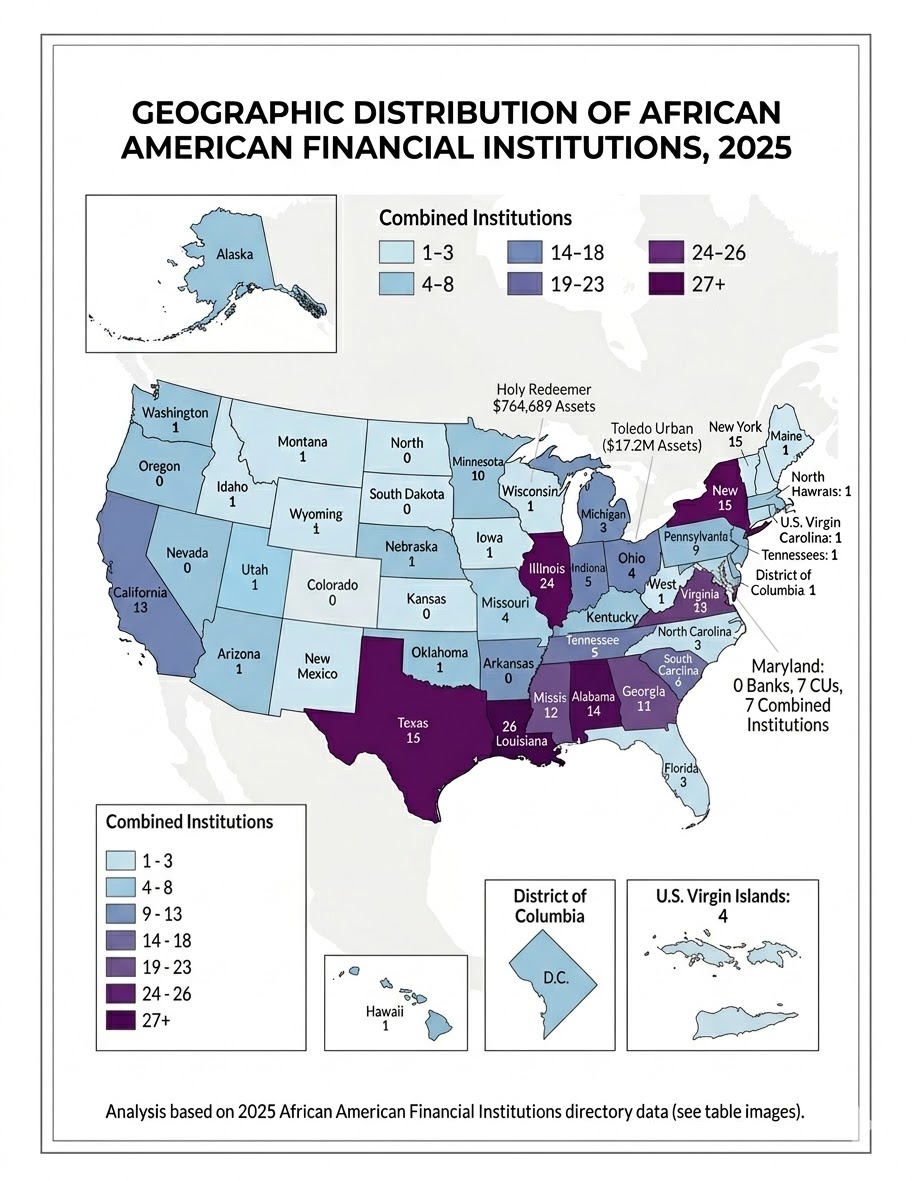
Mapping the Gap: The Geography of African American Banks and Credit Unions in 2025

African Americans navigating their financial lives are operating inside two fundamentally different types of institutions, and understanding that difference is not academic it is strategic. JPMorgan Chase, the largest bank in the United States with over $3.9 trillion in assets, is a publicly traded corporation owned by shareholders. Its mandate is profit. It can accept corporate deposits, underwrite municipal bonds, finance international trade, issue letters of credit that move goods across oceans, syndicate billion-dollar loans, and operate in 100 countries. When a city government needs to finance a new highway, when a developer needs to close on a $200 million mixed-use project, when a corporation needs to hedge currency risk across three continents — JPMorgan is in that room. Navy Federal Credit Union, the largest credit union in the United States with approximately $180 billion in assets, is a member-owned cooperative. Its mandate is service to its members, who must meet eligibility requirements tied to military affiliation. It offers mortgages, car loans, checking accounts, and credit cards often at better rates and lower fees than JPMorgan but it cannot write a commercial real estate construction loan for a developer, cannot underwrite a municipal bond for a city, cannot finance an export contract for a manufacturer shipping goods to West Africa, and has no presence in international capital markets. Navy Federal is a powerful institution for what it does. It simply does not do what JPMorgan does, and JPMorgan does not do what Navy Federal does at the community level. For African Americans, this distinction carries enormous consequence. A community with only credit unions has access to consumer financial products; mortgages, auto loans, personal savings but lacks the commercial banking infrastructure needed to finance business growth, real estate development, institutional deposits, and economic expansion. A community with only banks, and specifically only large national banks with no cultural accountability, has access to products but not necessarily to equitable underwriting, community reinvestment, or the trust that comes from shared ownership. The absence of an African American-owned bank in Ohio or Wisconsin is not just symbolic. It means no institution with a community mandate is positioned to finance the next African American developer, fund the next HBCU-adjacent business corridor, or serve as a depository for the growing institutional wealth of Black organizations in those states.

When the geography of African American banks and credit unions is examined together, a more complete — though still incomplete — picture of Black financial infrastructure emerges across the United States. The 2025 African American Owned Bank Directory covers 17 institutions across 15 states and territories. The 2025 NCUA data on African American credit unions adds 205 institutions across 29 states and territories, carrying $8.15 billion in assets and serving approximately 727,000 members. Combined, the two sectors represent over 220 institutions and more than $14.8 billion in assets operating across 31 states and territories. But geography, not just totals, is where the real story lives.

Thirteen states have both an African American-owned bank and at least one African American credit union: Alabama, the District of Columbia, Georgia, Illinois, Louisiana, Michigan, Mississippi, North Carolina, Oklahoma, Pennsylvania, South Carolina, Tennessee, and Texas. These are the states with the fullest financial ecosystem — where a community member can choose between a bank product and a credit union product from an institution with cultural roots in their community. Louisiana stands out, with one bank and 25 credit unions, the most of any state in the credit union count. Illinois follows with one bank and 23 credit unions.

Two states have African American banks but no African American credit unions in the NCUA data: Massachusetts, home to OneUnited Bank, and Utah, newly represented by Redemption Bank. These institutions serve their communities without the complementary infrastructure of a credit union network. Conversely, 16 states and territories have African American credit unions but no African American-owned bank: Arkansas, California, Connecticut, Delaware, Florida, Indiana, Maryland, Minnesota, Missouri, New Jersey, New York, Ohio, Virginia, the U.S. Virgin Islands, West Virginia, and Wisconsin.

The cases of Ohio and Wisconsin, discussed at length in the bank directory analysis, illustrate the limits of credit union coverage as a substitute for bank presence. Ohio has four African American credit unions with combined assets of approximately $18.3 million: Mahoning Valley in Youngstown, Mt. Zion Woodlawn in Cincinnati, Cleveland Church of Christ in Cleveland, and Toledo Urban in Toledo. Of these, Toledo Urban is the only institution of meaningful scale at $17.2 million in assets with 4,324 members. The other three are micro-institutions, each under $600,000 in assets and under 400 members. Wisconsin’s single credit union, Holy Redeemer Community of SE Wisconsin based in Milwaukee, holds just $764,689 in assets and serves 239 members. For a city where African Americans comprise roughly 39 percent of the population, that represents an institutional void that one small credit union cannot fill. Neither Ohio nor Wisconsin has an African American financial institution capable of writing a commercial real estate loan, funding a startup, or underwriting a mortgage for a first-generation homebuyer at any meaningful scale.

African American Financial Institutions by State, 2025

StateAfrican American BanksAfrican American Credit UnionsCombined Institutions
Alabama21214
Arkansas033
California011
Connecticut033
Delaware011
District of Columbia11011
Florida033
Georgia2911
Illinois12324
Indiana055
Louisiana12526
Maryland077
Massachusetts101
Michigan145
Minnesota022
Mississippi11112
Missouri044
New Jersey099
New York01515
North Carolina123
Ohio044
Oklahoma112
Pennsylvania189
South Carolina156
Tennessee156
Texas11415
Utah101
U.S. Virgin Islands044
Virginia01313
West Virginia011
Wisconsin011

Maryland presents a striking and instructive contrast. It has no African American-owned bank, a gap noted in the 2025 directory, yet it is the single largest state for African American credit union assets, hosting seven institutions with a combined $4.47 billion in assets. That figure is driven primarily by two institutions: Andrews Federal Credit Union in Suitland with $2.47 billion in assets and 142,076 members, and Municipal Employees Credit Union of Baltimore with $1.26 billion in assets and 98,358 members. Maryland’s credit union sector is, in asset terms, larger than the entire African American bank sector nationally. This is remarkable. It is also a reminder that credit unions and banks occupy different structural roles. Andrews Federal and MECU of Baltimore are large, sophisticated institutions with product offerings that approach commercial banking but they are member cooperatives, not banks, and their ownership structure, regulatory environment, and community lending mandates differ accordingly. Maryland’s absence from the bank directory is still a gap worth addressing, even with $4.47 billion in credit union assets in the state.

Virginia and Missouri follow a similar pattern to Maryland, albeit at smaller scale. Virginia has 13 African American credit unions with $471 million in assets but no African American-owned bank. Missouri has four credit unions with $481 million in assets, anchored by St. Louis Community Credit Union at $431.5 million, and also no bank. New York has 15 credit unions with $76 million in assets and no African American bank, a particularly stark figure given the size of New York’s African American population and its status as the financial capital of the country.

The states that are entirely absent from both the bank and credit union directories deserve attention. While the combined coverage of 31 states and territories is broader than either sector alone, large portions of the country remain without any African American-owned financial institution. States like Nevada, Arizona, Colorado, Washington, Oregon, and much of the Mountain West and Pacific Northwest have no representation in either directory. As African Americans continue to migrate to new metros — Las Vegas, Phoenix, Denver, Seattle — the absence of community-controlled financial institutions in those corridors becomes a growing concern.

The combined picture is this: African American banks and credit unions together hold approximately $14.8 billion in assets, serve over 700,000 credit union members and the deposit base of 17 banks, and operate across 31 states and territories. The credit union sector, at $8.15 billion in assets across 205 institutions, is actually slightly larger than the bank sector’s $6.72 billion across 17 institutions, a reflection of the credit union model’s greater accessibility and the longer runway some of these institutions have had to grow. But the two sectors are not interchangeable. Banks can hold commercial deposits, write business loans, issue letters of credit, and serve as the financial backbone of an entrepreneurial ecosystem in ways that most credit unions cannot. Credit unions, in turn, offer member ownership, lower fees, and community accountability that publicly or privately held banks may not. The African American community needs both, in every state where its population is substantial. Right now, it has neither in too many places that matter.

Sources: HBCU Money 2025 African American Owned Bank Directory; 2025 NCUA African American Credit Union Institutions data. Asset figures in U.S. dollars.

Disclaimer: This article was assisted by Claude (Anthropic).

Credit Card Rate Caps Could Deepen Financial Inequality for African American Households

Our credit system, like almost institutional reality we have is very much dependent on Others. Until we realize and work towards infrastructure of our own institutional ownership within the credit landscape, then we will continue to be prey for predators and subsidizers that enriches others and their institutions. – William A. Foster, IV

When President Donald Trump announced a proposed 10% cap on credit card interest rates in January 2026, most Americans greeted the news with skeptical hope. The move seemed like a potential lifeline for families struggling with debt burdens and interest rates that often exceed 20%, even as many questioned whether it could actually happen. But for African American households, this well-intentioned policy could become another barrier in a financial system that has historically excluded and disadvantaged them.

The challenge lies not in the intention behind rate caps, but in their likely consequences. While lower interest rates sound beneficial on the surface, the economic reality of credit markets means that banks facing reduced profitability will respond by restricting who can access credit in the first place. For African American families already fighting against systemic barriers to financial services, this could close doors that were only partially open to begin with.

African American households face dramatically different credit market realities than their white counterparts. According to the FDIC’s 2023 survey, more than 10% of Black Americans lack access to basic checking or savings accounts, compared to just 2% of white Americans. This banking gap represents more than inconvenience it fundamentally limits the ability to build the credit history that determines access to affordable loans, mortgages, and yes, credit cards.

The wealth disparity tells an even starker story. The median net worth of white households stands at approximately $188,200, nearly eight times the $24,100 median for Black households. This gap isn’t accidental it’s the product of generations of discriminatory policies from redlining to predatory lending, compounded by the deterioration of African American-owned banks and credit unions. As Black ownership of financial institutions has declined, the community has become more reliant on external institutions for credit, creating conditions that invited more predatory lending into African American neighborhoods. When African Americans do access credit, they consistently face higher interest rates than white borrowers with similar incomes. High-income Black homeowners, for instance, receive mortgage rates comparable to low-income white homeowners.

The dependence on consumer credit has reached critical levels in African American households. Recent analysis from HBCU Money’s 2024 African America Annual Wealth Report reveals that consumer credit has surged to $740 billion, now representing nearly half of all African American household debt and approaching parity with home mortgage obligations of $780 billion. This near 1:1 ratio between consumer credit and mortgage debt represents a fundamental inversion of healthy household finance. For white households, the ratio stands at approximately 3:1 in favor of mortgage debt over consumer credit. The African American community stands alone in this precarious position, where high-interest, unsecured borrowing rivals the debt secured by appreciating assets.

These disparities matter enormously when considering how banks will respond to rate caps. Credit card companies operate on risk-based pricing models, charging higher rates to borrowers they perceive as riskier based on credit scores, income stability, and banking relationships. African American borrowers, because of structural disadvantages in each of these areas, already cluster in categories that receive higher interest rates. When banks can no longer charge those rates, they will simply stop offering credit to these borrowers entirely.

The banking industry’s response to Trump’s proposal has been swift and unequivocal: a 10% interest rate cap would force them to dramatically restrict credit availability. Analysis from the American Bankers Association suggests that nearly 95% of subprime borrowers, those with credit scores below 680 would lose access to credit cards under even a 15% cap. With rates currently averaging around 20%, a 10% ceiling would affect even more borrowers. Industry analysts estimate that between 82% and 88% of credit cardholders could see their cards eliminated or their credit limits drastically reduced. The Electronic Payments Coalition warns that low to moderate income consumers would be hit hardest, precisely the demographic where African American households are disproportionately represented.

This isn’t just industry fearmongering. Historical evidence supports these concerns. When Illinois implemented a 36% APR cap on all borrowing, lending to subprime borrowers plummeted. Similar patterns emerged from 19th-century usury laws and research on payday loan restrictions. The consistent pattern is clear: when rate caps make lending unprofitable, lenders exit the market or tighten requirements. For African American households, this creates a devastating catch-22. They’re more likely to need credit due to lower wealth levels and less access to family financial support. Yet they’re also more likely to be denied that credit or pushed into predatory alternatives when traditional sources dry up.

The credit card industry categorizes borrowers by risk, with subprime borrowers facing the highest rates but also the greatest need for access to credit. African American consumers are overrepresented in subprime categories, not because of personal failing but because of systemic factors that suppress credit scores. Historical discrimination in housing, employment, and lending created wealth gaps that persist through generations. Lower wealth means less ability to weather financial shocks, leading to missed payments that damage credit scores.

When major banks stop serving subprime borrowers, those families don’t suddenly stop needing credit. They turn to alternative sources and here’s where the rate cap could cause real harm. Payday lenders, pawn shops, auto title loans, and other fringe financial services often charge effective annual percentage rates far exceeding credit card rates, sometimes reaching 300% to 400% or higher. These services operate in a less regulated space where consumer protections are weaker and predatory practices more common.

African American neighborhoods already contain disproportionately high concentrations of these alternative lenders, a modern echo of historical redlining patterns. Bank branches are scarce in many predominantly Black communities, while check-cashing outlets and payday loan storefronts proliferate. A rate cap that drives more families into this unregulated market would exacerbate existing inequities. The irony is profound. A policy designed to protect consumers from high interest rates could push vulnerable families toward even higher costs and fewer protections. JPMorgan analysts warned that the rate cap could redirect borrowing away from regulated banks toward pawn shops and non-bank consumer lenders, increasing risks for consumers already under financial strain.

The consequences of restricted credit access extend far beyond the immediate inability to make purchases. Credit cards serve as emergency funds for families without substantial savings, a category that includes a disproportionate number of African American households. For many Black families facing persistent income gaps, credit cards function not just as a convenience but as an income supplemental tool, helping to bridge the gap between earnings and the actual cost of living. When a car breaks down, a medical bill arrives, or a job loss creates temporary income disruption, credit cards can mean the difference between weathering the storm and falling into a debt spiral that damages credit for years.

The reality is that consumer credit has become essential infrastructure for African American household finance. With consumer credit growing by 10.4% in 2024, more than double the 4.0% growth in mortgage debt, Black families are increasingly dependent on expensive borrowing to maintain living standards. This isn’t a choice so much as a structural reality of trying to survive on incomes that remain roughly 60% of median white household income while facing higher costs for everything from insurance to groceries in predominantly Black neighborhoods.

Small business ownership represents another critical pathway to wealth building where African Americans face systemic barriers. Black entrepreneurs already struggle to access business loans, with approval rates significantly lower than for white business owners with similar qualifications, another systemic issue from African American banks and credit unions having limited deposits and being unable to extend loans and credit. Many small business owners use personal credit cards to fund startup costs, inventory purchases, and cash flow gaps. Restricting credit card access would eliminate this crucial financing option for aspiring Black entrepreneurs.

The rewards and benefits ecosystem could also shift dramatically. Banks have indicated they would likely reduce or eliminate rewards programs to offset lost interest income from rate caps. While this might seem minor compared to interest savings, rewards programs have become an important tool for building value, particularly for higher-credit consumers who pay balances in full monthly. The Vanderbilt Policy Accelerator research found that borrowers with credit scores of 760 or lower would see reductions in credit card rewards under a rate cap. Perhaps most concerning is the potential for credit scoring and financial history deterioration. When credit lines are closed or limits reduced, credit utilization ratios increase, which damages credit scores. This creates a downward spiral where reduced access leads to worse credit, which leads to further reduced access. For African American families working to build credit and financial stability, this could set progress back by years.

The genuine problem of high credit card interest rates and mounting consumer debt deserves serious policy attention. But effective solutions must account for how credit markets actually function and who would be most affected by reduced access. Rather than interest rate caps, policymakers should consider approaches that expand access while addressing affordability. Strengthening African American-owned banks, credit unions, and community development financial institutions would restore economic self-determination to communities that once had thriving financial ecosystems. These institutions don’t just serve African American communities they’re owned by them, led by them, and invested in their long-term prosperity. Historically, Black-owned banks have proven they can maintain sound lending practices while understanding the full context of their customers’ financial lives in ways that large, distant institutions simply cannot.

Currently, there are only 18 Black or African American owned banks with combined assets of just $6.4 billion, a tiny fraction of the industry. The absence of robust Black-owned financial institutions means that virtually all of the $740 billion in consumer credit carried by African American households flows to institutions outside the community. With African American-owned banks holding assets equivalent to less than 1% of Black household debt, the overwhelming majority of interest payments—potentially $120 billion annually—enriches predominantly white-owned institutions with no vested interest in Black wealth creation or community reinvestment. This extraction mechanism operates continuously, draining capital that could otherwise be intermediated through Black-owned institutions to support local lending and community development.

Strengthening requirements for transparent pricing, fee limitations, and responsible lending standards could protect consumers without eliminating credit availability. Regulators could mandate clearer disclosure of total costs, limit penalty fees that disproportionately burden those already struggling, and establish guardrails against predatory terms while preserving access to credit itself. Yet even these modest reforms face an uphill battle in the current political climate. The reality is that meaningful policy solutions require political will that simply doesn’t exist right now for addressing racial economic disparities directly. This makes the unintended consequences of blunt instruments like interest rate caps even more dangerous—they can restrict credit access under the banner of consumer protection while offering no viable alternatives.

The fundamental reality is clear: waiting for federal policy to solve credit access problems is a losing strategy. African American households face a specific set of economic challenges rooted in a specific history, and the solutions must be equally specific not generic approaches that treat all groups the same. The path forward requires African American communities to build their own financial infrastructure. This means capitalizing and expanding Black-owned banks and credit unions that can offer credit products designed for the actual economic realities of their customers, not risk models built on white wealth patterns. It means creating community-based lending circles and cooperative credit arrangements that leverage collective resources. It means developing alternative credit scoring systems that account for rent payments, utility bills, and other financial behaviors that traditional models ignore.

Rebuilding this sector isn’t about charity or inclusion; it’s about economic self-determination. Black-owned financial institutions have historically understood that a credit score doesn’t tell the whole story of a person’s creditworthiness, and they’ve made sound lending decisions based on relationship banking and community knowledge that large institutions can’t replicate. The challenge isn’t convincing European American owned banks to be fairer, it’s building the capacity to not need them as much. When African American communities had stronger networks of Black-owned banks, insurance companies, and credit unions, they had more options and more power. Rebuilding that infrastructure, combined with individual financial strategies that emphasize building assets and reducing dependence on consumer credit, offers a more sustainable path than hoping for beneficial federal intervention.

A 10% interest rate cap might sound appealing in the abstract, but for African American households, it likely means one thing: less access to the credit system entirely. The question then becomes not whether mainstream banks will treat Black borrowers fairly, but how communities can create their own credit access systems that serve their actual needs. That’s not a policy problem it’s a community capacity problem, and it requires community-driven solutions.

Disclaimer: This article was assisted by ClaudeAI.