Tag Archives: HBCU Money lifestyle

Is the Love of Sports Costing African America the STEM Future It Desperately Needs?

The future will not belong to those who can jump the highest, but to those who can think the deepest.” — Anonymous (Modern African Proverb Reimagined)

For every hour a Black boy or girl spends practicing, playing, or watching sports, it becomes an hour not spent mastering math, science, literature, or history. Over time, those missed hours compound not just in skill gaps, but in confidence gaps. And confidence, in education as in life, is everything. The long-term consequence of this imbalance may be far greater than lost academic opportunities. It may be the loss of African America’s ability to compete in the 21st-century economy and the slow erosion of its intellectual sovereignty.

Sports are a cherished part of African American culture, woven through family traditions, community pride, and generational memory. From Jackie Robinson to Serena Williams, from Doug Williams to Simone Biles, athletic greatness has symbolized resilience and excellence in a world that too often sought to deny both. But beneath the surface of that cultural triumph lies an uncomfortable reality: the love of the game may have become too consuming, crowding out the time, attention, and aspiration needed for mastery in science, technology, engineering, and mathematics — the disciplines defining wealth and power in the modern world.

A study by GradePower Learning found that American students spend about 1,000 hours in school each year — and roughly the same amount watching screens. For African American youth, however, there’s an additional pull: sports participation, practices, and games can consume 10 to 20 hours a week, not counting the time spent watching sports media, highlights, or discussing the latest player stats. By the time a child reaches high school graduation, those hours can exceed 8,000 — the equivalent of four full years of math or science instruction. What might have been time spent learning quadratic equations or Newton’s laws becomes time devoted to perfecting a crossover dribble or memorizing playbooks.

In theory, sports are said to teach discipline, teamwork, and perseverance — invaluable traits for life and leadership. But decades of African American participation in sports have shown that, in practice, these virtues rarely translate into collective advancement or institutional power for the community. Sports teach many to endure, but not necessarily to build. They inspire personal excellence but often without structural returns. Meanwhile, other ethnic groups are compounding their time in STEM preparation. In Asian households, it is not uncommon for students to attend supplemental weekend academies for math and science. The same can be said of many immigrant families who prioritize educational mastery as a direct pathway to generational wealth.

This divergence begins early. By middle school, African American students already lag behind in math and science proficiency, and by high school, many have internalized the belief that they “aren’t math people.” Yet, that belief is not innate; it’s cultivated by the habits of time and attention society rewards.

The youth sports economy in the United States is now valued at over $30 billion, according to USA Today. Parents are spending thousands each year on club fees, travel tournaments, gear, and coaching — often with dreams of athletic scholarships or professional contracts that statistically almost never come. A 2025 USA Today report noted that many parents invest between $5,000 and $10,000 annually per child in competitive sports, hoping to secure a college scholarship. Yet, NCAA data show that less than 2% of high school athletes earn athletic scholarships, and an even smaller fraction go on to professional sports.

When those numbers are mapped against household wealth, the economic irony becomes staggering. The median net worth of African American families remains around $44,900, compared to $285,000 for White families. If the average family spends $10,000 per year on youth sports for a decade, they could instead have invested $100,000 into a 529 education savings plan or a family investment fund. Compounded annually at 7%, that investment would yield roughly $196,000 by the time their child turns 18 — enough to pay for college tuition, or serve as seed capital for a business. But the investment goes into jerseys, tournaments, and sneakers. Sports is not just a pastime anymore; it’s an industry — one that thrives on hope, marketing, and the dream of ascension. For African American families, that dream often overshadows a deeper one: intellectual independence.

From the earliest ages, children internalize the models of success they see. If every hero they admire dribbles, runs, or dunks, it subtly shapes what they believe they must become to matter. The African American community has created icons in every field, but sports icons receive disproportionate visibility, media coverage, and cultural veneration. Young boys can name more NFL quarterbacks than Black engineers, scientists, or inventors. This imbalance creates a quiet but powerful feedback loop. The more the community celebrates athletic success as the highest expression of Black excellence, the fewer young people will be inspired to emulate scientific or entrepreneurial greatness. The idolization of the athlete — rather than the innovator — becomes a generational tax on imagination.

STEM confidence, like athletic skill, is built through repetition and exposure. A child who spends thousands of hours practicing sports builds confidence in their athletic identity. A child who spends thousands of hours exploring robotics or chemistry develops confidence in their intellectual identity. The problem is not talent — it’s time allocation.

If African America’s endowments are to grow, its intellectual capital must first be rebalanced. STEM fields are not just high-paying; they are high-leverage. Engineers design cities, coders build economies, and scientists control the frontiers of technology and medicine. When African American students are absent from these sectors, it isn’t just a diversity gap — it’s a sovereignty gap. Every innovation African America fails to own is an innovation it must rent from others. Every algorithm not written, every patent not filed, every lab not funded contributes to institutional dependency. Historically Black Colleges and Universities sit at a unique crossroads. While they have been strong in liberal arts, education, and social sciences, they must now pivot aggressively toward STEM dominance. Yet even they face a cultural headwind — many incoming students have been nurtured to see physical performance as validation of worth, while intellectual rigor is often seen as a burden rather than a badge.

An HBCU graduate in engineering or computer science may go on to invent, design, and build. An HBCU athlete may entertain millions. But the wealth gap between those two trajectories is not just individual — it’s institutional. Consider the compound effect of lost hours: one hour per day diverted from academic enrichment equals 365 hours per year. Over 13 years of schooling (Pre-K through 12th grade), that’s nearly 4,750 hours — more than two full school years of instruction. That’s just for one hour. Many student-athletes spend much more time — often 10 or more hours weekly — on practice, travel, and games. By high school, this could exceed 10,000 hours — the exact amount Malcolm Gladwell famously cited as the threshold for mastery in any field.

African American students are becoming masters — just not in the fields where mastery translates into institutional control or generational wealth. Imagine if even half of those hours were redirected into robotics clubs, science fairs, financial literacy programs, or coding bootcamps. The shift in intellectual and economic trajectory would be profound. Culture cannot change overnight, but it can evolve intentionally. African American parents, educators, and institutions must begin redefining what excellence looks like — and where the applause should go. Families should celebrate as loudly when a child aces a chemistry exam or builds a mobile app as when they score a touchdown. Public affirmation must follow academic achievement with the same enthusiasm it gives athletic performance.

The money spent on club sports, travel, and equipment could be partially reallocated to STEM programs, tutoring, or even early college credit courses. Financial discipline must mirror the rigor of athletic discipline. Imagine a Saturday morning robotics league with the same energy as youth basketball — complete with team jerseys, community support, and trophies. Institutions like HBCUs could sponsor regional competitions to make intellectual pursuit a spectator event. HBCUs can create mentorship pipelines connecting student-athletes with STEM majors to promote balance. Athletic departments should collaborate with STEM departments on interdisciplinary projects that merge sports analytics, biomechanics, and data engineering. Families can begin small: a weekly science documentary, math challenges at the dinner table, or trips to museums and tech expos. What matters most is that curiosity and analysis become part of the household rhythm.

America’s future wealth and power will flow through those who master technology, not those who merely consume it. The engineers designing renewable energy grids, the programmers writing AI code, and the scientists developing space propulsion systems are the ones shaping the next civilization. African America cannot afford to be absent from that frontier — nor can it afford to lose another generation to the illusion of athletic access as a substitute for academic and economic power. The cultural love of sports, once a symbol of survival and community, must now evolve into a love of systems, science, and strategy. The same passion that drives the athlete can drive the engineer. The same discipline that fuels a 5 a.m. workout can fuel a 5 a.m. study session. But only if the institutions — families, schools, and HBCUs — are intentional in redirecting that energy.

The African American community once used sports as a pathway to dignity in a segregated world. Now, the challenge is to use STEM as a pathway to dominance in a digitized one. The scoreboard has changed, and so must the game. For every hour spent on a basketball court, a track, or a field, there should be an equal hour at a computer, in a lab, or under a microscope. Not because sports don’t matter, but because the future does. To win this century, African America must love the pursuit of knowledge more than the pursuit of applause. Its children must learn to compete not just on the field — but in the lab, the boardroom, and the data center. Otherwise, the highlight reels will continue to roll, but the ownership of the next generation’s wealth and innovation will belong to someone else.

Disclaimer: This article was assisted by ChatGPT.

Are New Mexico, Maine, Puerto Rico, and the U.S. Virgin Islands the Only Social, Economic, and Politically Safe Territories for African Americans?

“Every great dream begins with a dreamer. Always remember, you have within you the strength, the patience, and the passion to reach for the stars to change the world.” — Harriet Tubman

For African Americans, safety has never been an assumed part of citizenship. It has always been an earned condition won through vigilance, strategy, and often migration. Whether fleeing the violent collapse of Reconstruction or the economic despair of the Jim Crow South, Black Americans have long measured geography as a question of survival. Today, in an America increasingly polarized by race, ideology, and inequality, that calculation has returned. Many are quietly asking: where can African Americans live, work, and raise families with peace of mind? The answer, surprisingly, may not be in traditional Black strongholds like Atlanta, Washington, D.C., or Houston, but in four unlikely places—New Mexico, Maine, Puerto Rico, and the U.S. Virgin Islands—where moderation, multicultural coexistence, and relative political calm offer something rare: a sense of safety that is not performative, but lived.

New Mexico’s reputation as a cultural crossroads has made it one of the few states where African Americans can exist without being framed entirely through America’s racial binary. Its tri-cultural balance among Native American, Hispanic, and White populations disperses dominance. Here, no single identity owns the political landscape. For African Americans who comprise about two percent of the population that means a degree of breathing room. Racial prejudice still exists, but it rarely defines every interaction. The social climate is cooperative, rooted in shared marginalization rather than supremacy. Albuquerque, Las Cruces, and Santa Fe have become quiet havens for African American educators, small-business owners, and retirees seeking both affordability and dignity.

Economically, New Mexico offers something most metropolitan centers have lost: a manageable cost of living and accessible capital. Housing remains attainable. Land ownership long denied to African Americans through discriminatory lending remains within reach for the working and middle class. The rise of renewable energy, sustainable agriculture, and technology hubs has also created new entry points for Black entrepreneurship. In Albuquerque’s South Valley or near Santa Fe’s art cooperatives, one can find a small but visible community of African Americans carving lives that are not merely about surviving but thriving without the constant defensive posture that characterizes so many other states. Safety here is less about walls and more about balance, a social equilibrium where race is a fact, not a fault line.

Maine, on the other hand, is proof that peace can coexist with isolation. Its African American population is minuscule, but its civic culture is built on moderation and integrity. The state’s “town meeting” governance style, where citizens vote directly on local issues, nurtures accountability rarely seen elsewhere. For African Americans who relocate to Portland, Bangor, or Augusta, that transparency matters. Racism in Maine exists, but it lacks institutional depth. More often, African Americans report curiosity over hostility, and when discrimination does occur, it tends to meet public rebuke rather than official silence.

Politically, Maine is refreshingly pragmatic. It elects moderates and independents, resists extremist rhetoric, and maintains a social compact where neighbors generally still speak to each other across ideological lines. For African Americans weary of coded politics, it feels like a return to something America once promised, a functioning democracy. The result is a form of safety rooted not in numbers, but in governance. A place where you can walk, vote, and live without fearing that tomorrow’s election will determine whether your humanity is negotiable.

But safety does not always mean the mainland. Beyond the continental U.S., Puerto Rico and the U.S. Virgin Islands present another dimension of refuge one built on shared African lineage and the lived realities of Caribbean identity. For African Americans seeking both cultural familiarity and distance from America’s racial fatigue, these territories offer a paradoxical safety: not post-racial, but post-obsessive.

Puerto Rico, long a bridge between Latin America and the U.S., exists in an in-between space that defies racial simplification. Its majority Afro-Latino population gives race a different vocabulary one where color is noticed but hierarchy is more fluid. African Americans arriving there encounter both kinship and complexity. In cities like San Juan or Ponce, African American expatriates blend into an Afro-diasporic continuum that feels familiar yet distinct. The island’s economic struggles are real: bankruptcy, hurricanes, and colonial neglect have left deep scars but its community resilience and shared sense of oppression produce solidarity rather than hostility. For African Americans, that means an environment where “Blackness” is neither exoticized nor demonized, but part of the island’s social DNA.

Economically, Puerto Rico also provides opportunities for African Americans seeking new beginnings in real estate, tourism, or renewable energy sectors. The island’s special tax status and evolving investment laws have attracted mainland professionals and entrepreneurs, some of whom are African American innovators bringing capital and ideas into local partnerships. In this sense, Puerto Rico is not only a sanctuary but also a frontier, a place where the African Diaspora’s ingenuity can meet an economy in reinvention. For those seeking cultural reconnection, the island’s Afro-Boricua traditions like bomba music, Loíza’s festivals, and the rhythms of African pride create an echo of belonging that many African Americans have long been denied in the continental United States.

Then there is the U.S. Virgin Islands, a cluster of Caribbean jewels that quietly symbolize what safe, small-scale Black governance can look like. On St. Thomas, St. Croix, and St. John, African-descended people form the majority. That demographic fact changes everything. Here, African Americans are not minorities but members of a larger Black polity with its own traditions, institutions, and history. The islands’ governance, while tied to Washington, reflects local leadership rooted in Afro-Caribbean sensibilities. For African Americans relocating from the mainland, this translates into a rare psychological experience: existing in a majority-Black jurisdiction where public policy, education, and business life are not filtered through White validation. Safety here is political self-determination.

Economically, the U.S. Virgin Islands are not without challenge like high import costs, hurricane vulnerability, and limited diversification test resilience but they offer something profound in return: cultural sovereignty. African Americans who move there often describe an adjustment period followed by a deep sense of exhale. The smallness of scale fosters community accountability, and the absence of constant racial tension allows ambition to flow without invisible friction. One can walk into a bank, a classroom, or a government office and see reflections rather than reminders of marginalization.

Taken together, New Mexico, Maine, Puerto Rico, and the U.S. Virgin Islands form a loose constellation of calm, a diaspora of safety within the larger storm of American contradiction. What unites them is not homogeneity, but a commitment to civility and shared humanity. Each location offers a different version of safety: political moderation in Maine, cultural equilibrium in New Mexico, diasporic kinship in Puerto Rico, and demographic sovereignty in the Virgin Islands. For African Americans navigating the exhaustion of a national identity under siege, these places suggest that peace might still be found without surrendering pride or progress.

The broader question, however, remains: why must African Americans still seek safety within the very nation they helped build? The resurgence of racial authoritarianism, book bans, and economic inequality reveals a hard truth that safety for African Americans is still conditional, still regional, still a choice rather than a guarantee. Yet, migration has always been the community’s answer to oppression. From the Underground Railroad to the Great Migration, movement has been both resistance and renaissance. Harriet Tubman’s words remain instructive: “Every great dream begins with a dreamer.” Migration, for African Americans, has always been dreaming in motion.

New Mexico and Maine show what governance without racial hysteria looks like. Puerto Rico and the Virgin Islands show what culture looks like when Blackness is normalized rather than marginalized. Together, they present a vision of what the United States could be if its diversity were truly reconciled with its democracy. They remind African America that safety is not about retreating from the nation but reimagining its geography of belonging.

Still, each of these places carries limitations. In New Mexico and Maine, African Americans may find safety but also scarcity with few cultural institutions, churches, or schools designed with them in mind. In Puerto Rico and the Virgin Islands, economic instability and natural disaster risks complicate long-term security. Yet, in all four, there exists something invaluable: the absence of daily racial siege. That reprieve can be transformative. It gives space for creativity, family stability, and the rebuilding of wealth without the constant drag of social mistrust.

As the nation’s politics grow more volatile, African American institutions (HBCUs, banks, and foundations) should view these geographies not simply as refuges but as development frontiers. Instead of imagining new HBCU presences in the Caribbean, they can expand partnerships with the University of the Virgin Islands already a proud HBCU anchoring the region to create joint research programs, faculty exchanges, and diasporic economic initiatives that strengthen both the mainland and the islands or research partnerships with Puerto Rican universities. Imagine Black-owned renewable energy firms anchoring in New Mexico, or a cooperative investment network expanding into Maine’s emerging industries. Safety, after all, is not just the absence of harm it’s the presence of opportunity.

There is a growing possibility that the 21st-century African American migration will not be toward cities of hustle, but toward territories of harmony. Where one can walk into a classroom, café, or coastal market and not feel their presence as provocation. Where the conversation around “diversity” is not theoretical but lived. The call of these four places is subtle but powerful: build where you can breathe.

If history is cyclical, then the current search for safety is not retreat but renewal. Each of these geographies offers a mirror to what African America has always done transform uncertainty into community. From the deserts of the Southwest to the coasts of New England and the Caribbean, a new map of refuge is emerging. Whether the destination is the Sandia Mountains, Casco Bay, San Juan’s Old Town, or Charlotte Amalie’s harbor, the journey is the same: toward dignity.

In the end, the question may not be whether these are the only safe places, but whether they are the first to show what safety could mean in practice. For a people whose freedom has always been self-forged, safety is never static it is strategy. And in that strategy, migration remains both memory and mission.

Disclaimer: This article was assisted by ChatGPT.

No, Your (Black) Parents Are Never Giving You Your Birth Certificate

“History is not everything, but it is a starting point. History is a clock that people use to tell their political and cultural time of day.” – Dr. John H. Clarke

When J.J. McAvoy posted that she had called her parents for her birth certificate — she is 32 years old, married, and had just given birth — and received a photocopy in return, the laughter that swept across social media was immediate and recognizable. The joke landed because so many African Americans already lived it. But McAvoy herself was quick to reframe what she had set in motion. She noted that many of those taking the post with undue gravity were, in her observation, mostly white and that within Black communities, and among children of immigrants broadly, the hoarding of vital documents is less a dysfunction than a cultural inheritance, a running joke with serious roots.

She was right to make the distinction, and right not to dwell on it. The gap in comprehension she identified is real, but it is a symptom rather than a subject. The more substantive question is what that document like a birth certificate, a social security card, a passport held at the airport by a father who will not be reasoned with has historically meant to the people who guard it so fiercely.

The story of documentation and Black life in America is, at its core, a story about legal existence being contingent and contested. In the antebellum South, free Black Americans were required to carry freedom papers at all times, documents that proved they were not property. The absence of those papers whether lost, stolen, or destroyed by someone who stood to profit from the confusion could mean re-enslavement regardless of the truth. Men and women who had purchased their freedom, who had been manumitted by slaveholders, who had been born free, were reduced to the credibility of their paperwork in a system that had already decided their testimony was worth less than the word of any white stranger. That terror was not abstract. It had names and dates and courthouses attached to it.

After emancipation, the Freedmen’s Bureau attempted to register the formerly enslaved — births, marriages, labor contracts — in part because these populations had been deliberately excluded from the civic record-keeping that gave other Americans legal standing and recognizition as humans and not property. The effort was incomplete and short-lived, terminated by a federal government that lost its appetite for Reconstruction before the work was finished. For much of the late nineteenth and early twentieth centuries, Black births in the rural South were irregularly registered or not registered at all, and the consequences were not merely administrative. They affected access to public education, to Social Security benefits when the program launched in 1935, to military service documentation, and ultimately to the GI Bill, the single largest wealth-generating policy instrument of the twentieth century, from which Black veterans were largely excluded in practice even when nominally included in law. A generation of men who had served their country returned home and were told, in the language of paperwork and procedure, that the country did not fully recognize them in return.

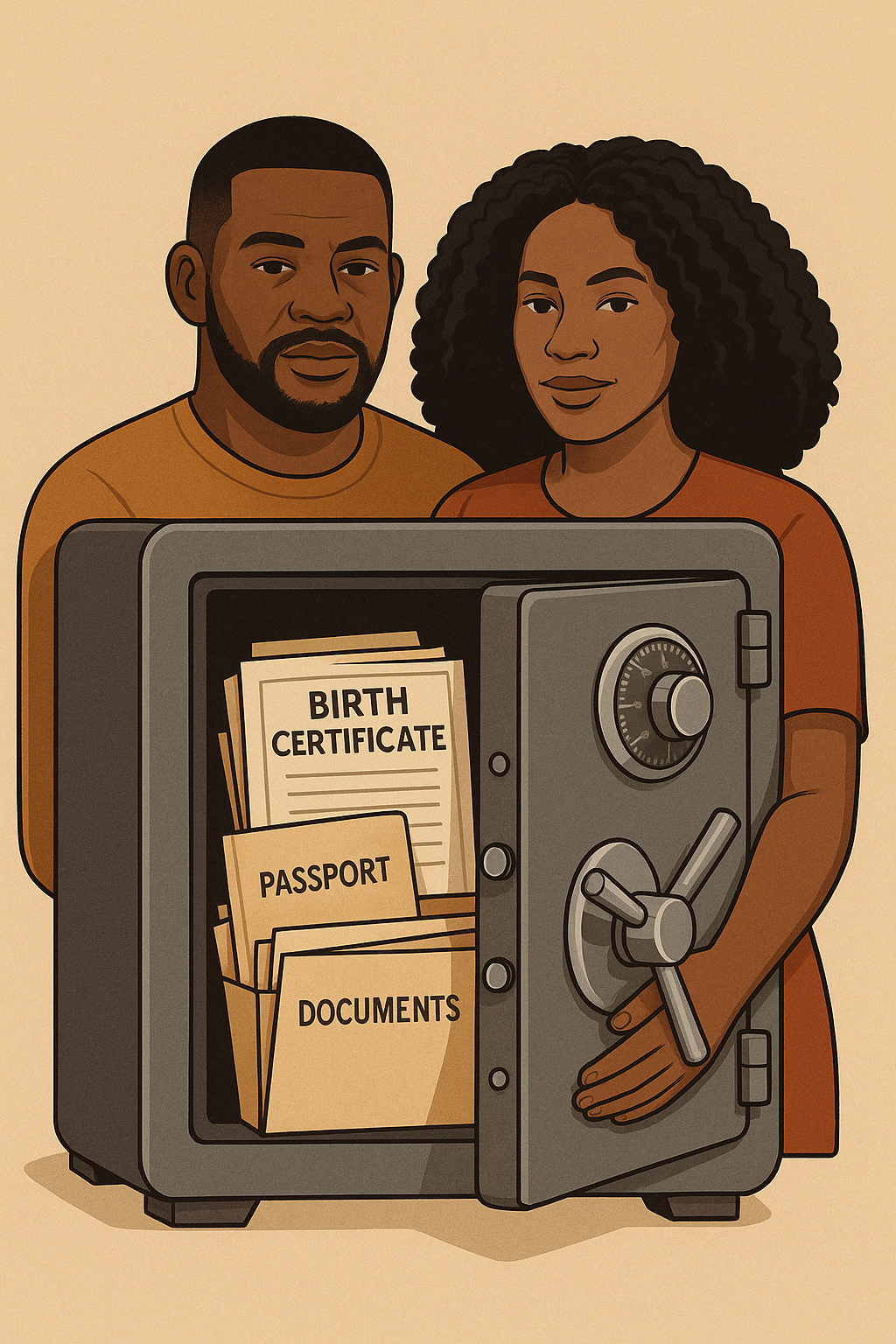
To understand what that does to a family’s relationship with documents is to understand why a mother in 2025 hands her 32-year-old daughter a photocopy with the quiet conviction that she is doing the right thing. The original stays home. It always has. It always will.

The immigrant dimension that McAvoy raised adds a distinct but parallel layer. Across the African diaspora from the Caribbean to West Africa to East Africa bureaucratic records have historically been instruments of colonial administration, tools used to enumerate populations for taxation, labor extraction, and political control rather than for their benefit. The post-independence period did not always improve the relationship between these communities and their states’ record-keeping capacities. Families who migrated to the United Kingdom, Canada, or the United States brought with them a highly practical awareness that official documentation was difficult to obtain, slow to replace, and potentially decisive at border crossings, immigration hearings, and employment offices. The father who holds all the passports at the airport is not performing control for its own sake. He is managing risk in an environment where he has learned, from experience or inheritance, that the cost of a lost document may be measured in years, not inconvenience.

The white commenters who read McAvoy’s post and felt something like offense who interpreted the photocopy as a slight against her autonomy, a failure of parental trust, or evidence of some controlling dynamic in need of correction were responding from a place of privilege, one so ambient and unexamined that it had long since stopped announcing itself. The comfort of never having needed to fear a document, or its absence, had quietly become their baseline assumption about how the world works and baselines, by nature, are invisible to the people standing on them. This is not to say that white American parents never hold onto their children’s documents many do, and for reasons that are practical, sentimental, or simply habitual. But the framework underneath that habit is categorically different. When a Black mother keeps the original and hands her daughter a photocopy, she is participating in a tradition of protective custodianship that was forged under conditions of genuine institutional threat. When the behavior appears in other communities, it tends to reflect preference or personality rather than the accumulated memory of a legal system that spent generations using paperwork as an instrument of exclusion. The gesture may look the same from the outside. The history behind it is not.

But that experience has a shape, and its shape matters here. For many white Americans, particularly those whose families arrived in earlier waves of European immigration and were absorbed into the documented mainstream within a generation or two, vital records have long been administrative conveniences rather than instruments of survival. A birth certificate sits in a drawer until it is needed for a passport, then returns to the drawer. The state is presumed, on the whole, to be a reliable record-keeper and a reasonably neutral one. When something is lost, it can be replaced without particular consequence. What that experience does not contain and therefore cannot easily imagine the gravity of is the long American tradition of using documentation not to protect Black people but to control, exclude, and erase them.

This is not ancient history dressed up for rhetorical effect. It is a through line. In the postbellum South, the absence of a birth certificate was used to deny Black children access to public schools. Across the early twentieth century, irregular birth registration in Black communities, a product of deliberate neglect rather than accident, was later used to disqualify those same people from New Deal programs, Social Security, and veterans’ benefits. The administrative record was never neutral. It was a gate, and the gatekeepers were selective about who they waved through. In more recent decades, voter ID laws have disproportionately affected Black Americans in part because the chain of documentation required to obtain qualifying identification — a birth certificate to get a state ID, a state ID to get further documentation collapses for people whose births were never properly registered or whose records were lost, damaged, or bureaucratically stranded across county lines. The Kafkaesque quality of that loop is not incidental. It is the contemporary expression of a system that has historically found it useful to keep certain people difficult to verify. To be undocumented, in the eyes of the American state, has too often meant being unentitled to vote, to own, to claim what was owed.

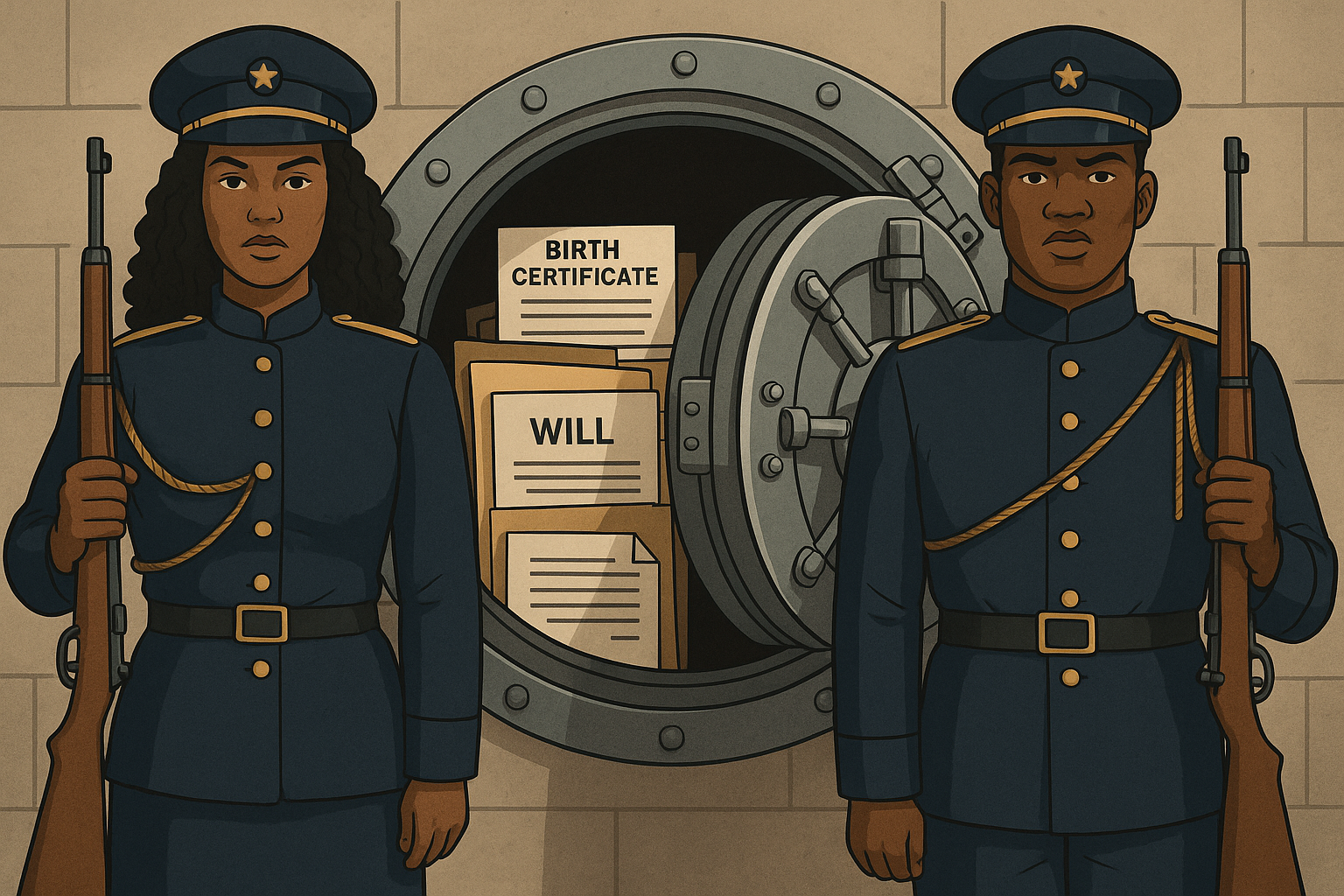
The land tells the same story. Heirs property, land passed down across generations without a will or clear legal title is, at its root, a documentation failure that was never accidental. During the Jim Crow era, many Black families deliberately avoided formal documentation of their land holdings out of a well-founded distrust of white attorneys and a court system that had shown them repeatedly it was not a venue for justice but another instrument of exploitation. The bitter irony is that the very avoidance of a system designed to harm them created a vulnerability that system then moved to exploit. The U.S. Department of Agriculture has called heirs property the leading cause of Black involuntary land loss, estimating it contributed to a 90 percent decline in Black-owned farmland between 1910 and 1997. Today, heirs property is estimated to make up more than a third of Southern Black-owned land — some 3.5 million acres worth more than $28 billion — with owners left particularly vulnerable to speculators and developers who can exploit partition laws to acquire their property, in some cases by purchasing the interest of a single heir and then forcing a full sale as a fractional owner. In Brazos County, Texas, African American families lost long-held acreage to men who weaponized arcane documents to acquire plots potentially worth millions, land that in some cases had been held since before living memory, worked by hand across multiple generations. What was taken was not simply real estate. It was the accumulated wealth of people who had been denied nearly every other avenue for building it. The birth certificate in the fireproof box and the deed that was never drawn up are expressions of the same wound, the wound of a people who learned, at great cost, that the law’s paperwork could be turned against them, and who then had to decide, with imperfect information and scarce resources, whether engaging with it or avoiding it posed the greater danger. Both choices carried consequences. The system ensured that.

That presumption of institutional reliability, then, is itself a form of inherited privilege not dramatic or visible, but structural, and so deeply internalized that its absence in others can read as pathology rather than history. To look at a Black mother handing her adult daughter a photocopy and see dysfunction is to see only the surface of an arrangement whose foundations run several centuries deep. The offense taken in those comments was, in a sense, the product of a history too comfortable to have produced the habit being observed, a history in which the document was never a weapon aimed at you, and so you cannot quite believe it was ever aimed at anyone.

This dynamic plays out in notable ways within the culture of Historically Black Colleges and Universities. Move-in day at an HBCU is, among many things, a study in the document-as-heirloom. Parents arrive not just with linens and storage bins but with accordion folders thick with immunization records, financial aid correspondence, and original birth certificates that will not be staying in any dorm room drawer. Admissions counselors at HBCUs have long understood the architecture of this arrangement — when a student answers a records request with “my mom has that,” it is not treated as negligence but recognized as a family system functioning exactly as designed. Financial aid officers are accustomed to parents appearing at the table for signings long past the age of legal majority, not because the student is incapable but because the family has not yet completed its own internal transfer of authority. Registrars learn, over years of practice, that some students cannot recite their Social Security numbers from memory because those numbers live in a locked cabinet several states away. At HBCUs, these realities are met with institutional familiarity rather than bureaucratic impatience, a quiet advantage compared to the more rigid cultures of predominantly white institutions, where the assumption of individual administrative independence can feel, to students carrying this inheritance, like a form of alienation.

It is worth noting, as McAvoy did briefly, that this behavior can also carry a more complicated valence that can be control over adult children expressed through the withholding of legal personhood, a dynamic that is not unique to any community but takes on particular texture where independence has historically been constrained by external forces. The refusal of a parent to release a document can be love and caution in equal measure, but it can also be an assertion of ongoing authority that outlasts its original justification. Both things are true and coexist without contradiction.

What the joke obscures, and what the history illuminates, is the quiet administrative heroism that this behavior represents across generations. Grandmothers who maintained informal genealogies because census records were incomplete or falsified. Church ledgers that served as the only registration of births in communities where the county courthouse was not a safe place. Families who kept originals under mattresses and in kitchen cabinets because they had learned the hard way that institutions lose things, or make things disappear. The photocopy McAvoy received is not a failure of trust in her, it is an artifact of that long vigilance, passed down intact.

Eventually, there comes a time when the document must change hands. Whether it is applying for a passport, enrolling a child in school, or as in McAvoy’s case giving birth to the next generation, adulthood makes its administrative demands, and the family archive must begin its transfer. The transition is rarely smooth, because what is being transferred is not merely paper. The most effective approach is one that frames the conversation not as a retrieval but as a succession signaling to the parent that the custodial function they have performed for decades is not being dismissed but inherited. A request built around the language of responsibility, of building a family file and carrying the record forward, lands with considerably more weight than a casual ask between other errands. Offering to digitize the entire family archive to scan and organize every document the household holds reframes the transaction as continuation rather than extraction, and gives the parent something to receive rather than simply something to surrender. And beneath any practical negotiation, there is the recognition that their reluctance was never spite. It was stewardship, practiced under conditions that made stewardship necessary.

The gap this dynamic reveals also represents an opening. A culturally responsive document safekeeping and digital archiving service built specifically for African American families sitting somewhere between a secure cloud vault, a legacy planning firm, and a notarial service, and animated by the particular anxieties and histories this community carries does not yet exist at meaningful scale. Black-owned banks and credit unions are especially well-positioned to move into this space, bundling document protection and vital records vaulting with existing wealth-building and financial literacy programs. The vision is not complicated: a family opens a savings account and, alongside it, receives access to a secure repository for their vital records, estate documents, and generational paperwork all of it portable, encrypted, and governed by the family rather than an institution with a different set of interests. In a community where trust has been earned slowly and lost quickly, that kind of service is not merely a product. It is a cultural preservation mission with a business model attached.

What a viral moment like this one surfaces, beneath the laughter, is that communities navigate the world differently depending on what history has taught them the stakes of navigation are. For those who have never had reason to doubt that the state would honor their existence when called upon to do so, a birth certificate is a formality. For those whose families have lived through its denial, its destruction, or its instrumentalization against them, it is something considerably more serious and the person who holds it is performing a function that goes well beyond filing.

So yes, laugh at the photocopy. The humor is earned and it is real. But when the original finally passes into your hands embossed seal, official signature, the full weight of the state’s acknowledgment that you exist — take a moment to understand what your parents were holding all those years. They were not just keeping a document safe. They were keeping you legible in a world that has not always been eager to read you. That is not bureaucracy. That is love with a filing system.

Disclaimer: This article was assisted by ClaudeAI.