Tag Archives: history

The Africa Travel Ban Is an HBCU Problem

Africans in the United States must remember that the slave ships brought no West Indians, no Caribbeans, no Jamaicans or Trinidadians or Barbadians to this hemisphere. The slave ships brought only African people and most of us took the semblance of nationality from the places where slave ships dropped us off. – Dr. John H. Clarke

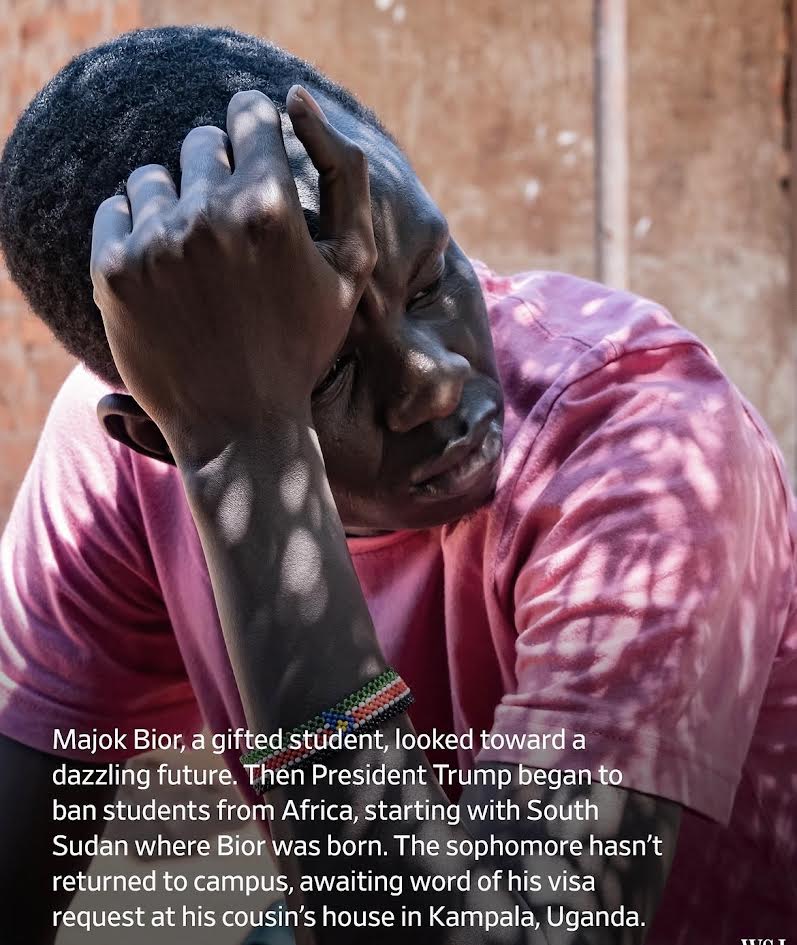
Photo from the Wall Street Journal

The photograph of Majok Bior, a South Sudanese computer science sophomore at Duke University, stranded at his cousin’s home in Kampala after the Trump administration’s travel restrictions invalidated his visa — has circulated widely as a symbol of individual suffering. And it is that. But to read it only through the lens of personal tragedy is to miss the structural dimensions of what is unfolding across American higher education, and to miss, in particular, what this moment means for HBCUs.

The Trump administration’s travel ban, initially signed on June 4, 2025, targeted 12 countries and placed partial restrictions on seven more, covering a geography concentrated in Africa and the Middle East. By December 2025, that list had expanded to 39 countries and territories, with Nigeria, historically one of the top ten sources of international students in the United States, placed under partial restrictions effective January 1, 2026. Individuals in Nigeria will not be able to receive student visas beginning January 1. Secretary of State Marco Rubio has signaled further expansion, with a State Department memo identifying 36 additional countries for potential restriction, including 25 African nations as well as countries in the Caribbean, Central Asia, and the Pacific Islands. If that expansion proceeds, the policy will have effectively severed the institutional connection between American higher education and the African continent.

For HBCUs specifically, this is not a distant geopolitical event. It is a direct threat to an enrollment strategy, a revenue base, and a civilizational relationship that institutions have spent decades building.

To understand the financial stakes, one must first understand how international student enrollment became integral to the fiscal architecture of many HBCUs. In addition to the tuition money international students often bring, many foreign students pay the full sticker price, often aided by their home countries’ governments there are benefits for HBCUs’ American students as well. International students, particularly those arriving with government-funded scholarships from Nigeria, Ghana, Saudi Arabia, and other nations, have served as a reliable source of full-fare tuition revenue at institutions that chronically lack the endowment depth to absorb enrollment volatility.

Among HBCUs with ten or more international students, Morgan State had the most as of the 2017-18 academic year, with 945 students; Howard was second with 920; and Tennessee State third with 584, according to the Institute of International Education. These numbers have only grown. Tennessee State, for instance, went from 77 international undergraduate students in 2008-09 to 549 by fall 2016 representing roughly 8 percent of its undergraduate student body. Across the sector, African students from Nigeria and Ghana historically constituted a significant share of that international cohort.

The financial logic was sound. A university with modest endowment holdings and only one HBCU, Howard University, currently holds an endowment exceeding $1 billion, cannot easily absorb the loss of a tuition-paying population without triggering cascading institutional consequences. When full-fare international students leave an enrollment ledger, the institution must either raise tuition on domestic students who are often already Pell Grant-eligible, draw down reserves, reduce staffing, or curtail academic programs. In a sector where financial fragility is not the exception but the norm, any of those choices carries compounding institutional risk. Preliminary projections by NAFSA and international education research partner JB International predict a 30 to 40 percent decline in new international student enrollment, leading to a 15 percent decline in overall enrollment this fall and loss of $7 billion within local economies and more than 60,000 jobs. That system-wide figure masks the disproportionate exposure at institutions whose international student populations are concentrated in African countries now under restriction.

The financial dimension, however, is only the first tier of the problem. The more consequential loss may be strategic: the slow dismantling of an institutional relationship between HBCUs and Africa that has been a defining feature of both parties’ long-term development. For decades, HBCU campuses have served as one of the primary entry points for African students seeking American credentials and professional networks. The relationship has never been purely transactional. It has been civilizational, rooted in a shared recognition that the institutional capacity of the African diaspora, on both sides of the Atlantic, depends on the training and circulation of its most capable people. Howard University, Morgan State, Florida A&M, and Tennessee State have all cultivated significant African student communities that returned home as engineers, physicians, lawyers, economists, and public administrators, seeding institutions across the continent with HBCU-educated professionals.

That pipeline is now interrupted. Majok Bior is one face of the disruption. He is also, statistically, the kind of student, a full-scholarship computer science talent, whose skills and networks would have contributed meaningfully to either the American or the African institutional ecosystem over the subsequent decades. The State Department’s position is unambiguous. There is no appeals window, no informal pathway, no consular discretion available to students like Bior whose visas were invalidated mid-enrollment. The pipeline does not merely slow. It stops.

The administration has signaled it may further target sub-Saharan Africa for future travel bans. Twenty-four of the 36 countries identified as future ban candidates are in sub-Saharan Africa. If all 24 were to be hit with bans, an additional 71 percent of the region’s population would be affected. At that scale, the policy would not merely interrupt an enrollment channel. It would functionally close the institutional bridge between American HBCUs and the African continent.

The arrivals data make the stakes concrete. The number of new and returning African students arriving in the United States for the 2025 fall semester fell by nearly a third from the previous year, according to preliminary Commerce Department data. Arrivals from Nigeria and Ghana, which historically send more students to the United States than any other African countries, dropped by roughly half. Those are not marginal declines. They represent a structural break in the flow of talent that has sustained both HBCU campuses and the professional networks those campuses anchor.

The broader context amplifies the damage. HBCUs have been managing a long-running tension between their mission to serve African American students and the enrollment arithmetic that increasingly pushes them toward diversification. Black student enrollment at HBCUs increased by just 15 percent from 1976 to 2022, while enrollment of students from other racial and ethnic groups rose by a staggering 117 percent during the same period. Within that context, African international students have occupied an important, if underappreciated, position: they are enrolled students who are Black, who arrive often with external funding, and who align with the cultural mission of the institution in ways that students from other international communities do not. The loss of this population does not merely reduce headcount. It removes a category of student whose presence reinforces the intellectual and cultural identity of HBCU campuses while simultaneously contributing to their revenue base.

HBCU leaders should resist the temptation to treat the current moment as a policy problem requiring a policy solution that is, to wait for a change in administration or a favorable court ruling before taking action. The institutional response must be proactive, and it must be organized at the sector level rather than institution by institution.

The first imperative is legal and advocacy coordination. HBCUs should be visible participants in the coalition of higher education institutions pushing back against travel ban expansion. The legal challenges already filed by some universities have produced limited court-ordered exceptions. HBCU presidents, through their associations and individually, possess a particular moral authority in this argument: these institutions were founded on the principle that the state should not determine who deserves access to education. That founding logic has direct application to the current moment, and its articulation should not be left to the advocacy organizations of predominantly white institutions alone.

The second is the construction of alternative enrollment infrastructure. Several countries whose students are not currently restricted represent significant untapped pipelines for HBCUs including Kenya, Ethiopia, South Africa, and several francophone West African nations not yet under full restriction. Morgan State’s international enrollment tripling between 2014 and 2017, driven by a concerted recruitment strategy, demonstrates that rapid scaling is possible when institutions make it a priority. The question now is whether that kind of deliberate enrollment strategy can be retargeted toward countries where the policy environment remains navigable.

The third imperative, and the most consequential for the long run, is the development of transnational academic infrastructure that does not depend on American visa policy at all and here the sector does not need to theorize. It already has a model. Claflin University, an HBCU in Orangeburg, South Carolina, and Africa University in Zimbabwe have together built and delivered a fully online Master of Science program in Biotechnology and Climate Change, producing their first cohort of graduates in 2025. The program requires no visa, no transatlantic relocation, and no dependence on the goodwill of a State Department consular officer. It delivers graduate-level credentials, anchored to an HBCU’s academic infrastructure, to scholars who remain embedded in the African communities they will eventually serve. That is not a symbolic gesture. It is a replicable institutional architecture — one that severs the link between American immigration policy and the HBCU-Africa educational relationship at precisely the point where that link has proven most vulnerable. The disciplines selected are themselves strategic: biotechnology and climate change are among the fields where African scholars have the most urgent applied work to do, and where the absence of well-trained researchers carries the steepest institutional cost. What Claflin and Africa University have built is a proof of concept for the entire sector. Howard, Morgan State, Florida A&M, and Tennessee State, institutions that have already invested in African student pipelines and cultivated international enrollment are positioned to extend this model into additional disciplines, additional partner institutions, and additional countries. Students who were considering coming in 2026 will be discouraged and will be looking to other destinations, as one international education expert has observed. If those students go elsewhere, HBCUs should be competing to ensure that some of that “elsewhere” is a degree program bearing an HBCU’s name, delivered on African soil, through African partner institutions, and impervious to the policy preferences of any particular American administration.

The image of Majok Bior waiting in Kampala is a human document. But it is also an institutional document. It records the moment when an African student who had successfully navigated the American credentialing system, who had won a full scholarship, enrolled in computer science, played intramural soccer, and survived chemistry class was extracted from that system not by any failure of his own but by a federal policy aimed at restricting the movement of African people into American institutions. HBCUs were built precisely because such exclusions were once the default condition of American higher education. The institutional memory of that history is not a rhetorical resource. It is a strategic asset, a basis for understanding that the institutions which serve communities without consistent access to political protection must always be building structures that can survive the withdrawal of that protection. The Africa travel ban is an HBCU problem. The sector’s response to it will reveal something important about whether these institutions have developed the depth and coordination to meet a challenge that is, in its essential structure, the same challenge they were built to confront.

Disclaimer: This article was assisted by ClaudeAI.

Mapping the Gap: The Geography of African American Banks and Credit Unions in 2025

African Americans navigating their financial lives are operating inside two fundamentally different types of institutions, and understanding that difference is not academic it is strategic. JPMorgan Chase, the largest bank in the United States with over $3.9 trillion in assets, is a publicly traded corporation owned by shareholders. Its mandate is profit. It can accept corporate deposits, underwrite municipal bonds, finance international trade, issue letters of credit that move goods across oceans, syndicate billion-dollar loans, and operate in 100 countries. When a city government needs to finance a new highway, when a developer needs to close on a $200 million mixed-use project, when a corporation needs to hedge currency risk across three continents — JPMorgan is in that room. Navy Federal Credit Union, the largest credit union in the United States with approximately $180 billion in assets, is a member-owned cooperative. Its mandate is service to its members, who must meet eligibility requirements tied to military affiliation. It offers mortgages, car loans, checking accounts, and credit cards often at better rates and lower fees than JPMorgan but it cannot write a commercial real estate construction loan for a developer, cannot underwrite a municipal bond for a city, cannot finance an export contract for a manufacturer shipping goods to West Africa, and has no presence in international capital markets. Navy Federal is a powerful institution for what it does. It simply does not do what JPMorgan does, and JPMorgan does not do what Navy Federal does at the community level. For African Americans, this distinction carries enormous consequence. A community with only credit unions has access to consumer financial products; mortgages, auto loans, personal savings but lacks the commercial banking infrastructure needed to finance business growth, real estate development, institutional deposits, and economic expansion. A community with only banks, and specifically only large national banks with no cultural accountability, has access to products but not necessarily to equitable underwriting, community reinvestment, or the trust that comes from shared ownership. The absence of an African American-owned bank in Ohio or Wisconsin is not just symbolic. It means no institution with a community mandate is positioned to finance the next African American developer, fund the next HBCU-adjacent business corridor, or serve as a depository for the growing institutional wealth of Black organizations in those states.

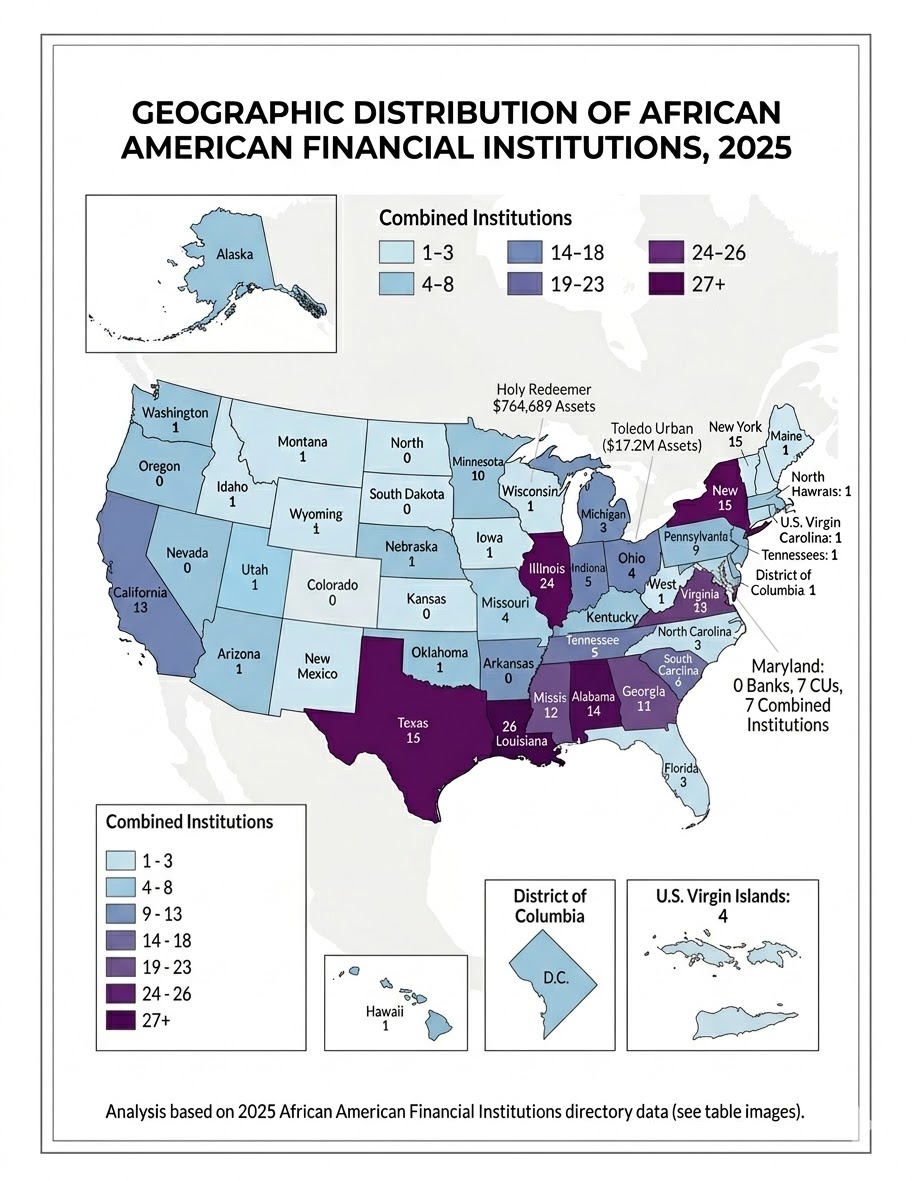
When the geography of African American banks and credit unions is examined together, a more complete — though still incomplete — picture of Black financial infrastructure emerges across the United States. The 2025 African American Owned Bank Directory covers 17 institutions across 15 states and territories. The 2025 NCUA data on African American credit unions adds 205 institutions across 29 states and territories, carrying $8.15 billion in assets and serving approximately 727,000 members. Combined, the two sectors represent over 220 institutions and more than $14.8 billion in assets operating across 31 states and territories. But geography, not just totals, is where the real story lives.

Thirteen states have both an African American-owned bank and at least one African American credit union: Alabama, the District of Columbia, Georgia, Illinois, Louisiana, Michigan, Mississippi, North Carolina, Oklahoma, Pennsylvania, South Carolina, Tennessee, and Texas. These are the states with the fullest financial ecosystem — where a community member can choose between a bank product and a credit union product from an institution with cultural roots in their community. Louisiana stands out, with one bank and 25 credit unions, the most of any state in the credit union count. Illinois follows with one bank and 23 credit unions.

Two states have African American banks but no African American credit unions in the NCUA data: Massachusetts, home to OneUnited Bank, and Utah, newly represented by Redemption Bank. These institutions serve their communities without the complementary infrastructure of a credit union network. Conversely, 16 states and territories have African American credit unions but no African American-owned bank: Arkansas, California, Connecticut, Delaware, Florida, Indiana, Maryland, Minnesota, Missouri, New Jersey, New York, Ohio, Virginia, the U.S. Virgin Islands, West Virginia, and Wisconsin.

The cases of Ohio and Wisconsin, discussed at length in the bank directory analysis, illustrate the limits of credit union coverage as a substitute for bank presence. Ohio has four African American credit unions with combined assets of approximately $18.3 million: Mahoning Valley in Youngstown, Mt. Zion Woodlawn in Cincinnati, Cleveland Church of Christ in Cleveland, and Toledo Urban in Toledo. Of these, Toledo Urban is the only institution of meaningful scale at $17.2 million in assets with 4,324 members. The other three are micro-institutions, each under $600,000 in assets and under 400 members. Wisconsin’s single credit union, Holy Redeemer Community of SE Wisconsin based in Milwaukee, holds just $764,689 in assets and serves 239 members. For a city where African Americans comprise roughly 39 percent of the population, that represents an institutional void that one small credit union cannot fill. Neither Ohio nor Wisconsin has an African American financial institution capable of writing a commercial real estate loan, funding a startup, or underwriting a mortgage for a first-generation homebuyer at any meaningful scale.

African American Financial Institutions by State, 2025

StateAfrican American BanksAfrican American Credit UnionsCombined Institutions
Alabama21214
Arkansas033
California011
Connecticut033
Delaware011
District of Columbia11011
Florida033
Georgia2911
Illinois12324
Indiana055
Louisiana12526
Maryland077
Massachusetts101
Michigan145
Minnesota022
Mississippi11112
Missouri044
New Jersey099
New York01515
North Carolina123
Ohio044
Oklahoma112
Pennsylvania189
South Carolina156
Tennessee156
Texas11415
Utah101
U.S. Virgin Islands044
Virginia01313
West Virginia011
Wisconsin011

Maryland presents a striking and instructive contrast. It has no African American-owned bank, a gap noted in the 2025 directory, yet it is the single largest state for African American credit union assets, hosting seven institutions with a combined $4.47 billion in assets. That figure is driven primarily by two institutions: Andrews Federal Credit Union in Suitland with $2.47 billion in assets and 142,076 members, and Municipal Employees Credit Union of Baltimore with $1.26 billion in assets and 98,358 members. Maryland’s credit union sector is, in asset terms, larger than the entire African American bank sector nationally. This is remarkable. It is also a reminder that credit unions and banks occupy different structural roles. Andrews Federal and MECU of Baltimore are large, sophisticated institutions with product offerings that approach commercial banking but they are member cooperatives, not banks, and their ownership structure, regulatory environment, and community lending mandates differ accordingly. Maryland’s absence from the bank directory is still a gap worth addressing, even with $4.47 billion in credit union assets in the state.

Virginia and Missouri follow a similar pattern to Maryland, albeit at smaller scale. Virginia has 13 African American credit unions with $471 million in assets but no African American-owned bank. Missouri has four credit unions with $481 million in assets, anchored by St. Louis Community Credit Union at $431.5 million, and also no bank. New York has 15 credit unions with $76 million in assets and no African American bank, a particularly stark figure given the size of New York’s African American population and its status as the financial capital of the country.

The states that are entirely absent from both the bank and credit union directories deserve attention. While the combined coverage of 31 states and territories is broader than either sector alone, large portions of the country remain without any African American-owned financial institution. States like Nevada, Arizona, Colorado, Washington, Oregon, and much of the Mountain West and Pacific Northwest have no representation in either directory. As African Americans continue to migrate to new metros — Las Vegas, Phoenix, Denver, Seattle — the absence of community-controlled financial institutions in those corridors becomes a growing concern.

The combined picture is this: African American banks and credit unions together hold approximately $14.8 billion in assets, serve over 700,000 credit union members and the deposit base of 17 banks, and operate across 31 states and territories. The credit union sector, at $8.15 billion in assets across 205 institutions, is actually slightly larger than the bank sector’s $6.72 billion across 17 institutions, a reflection of the credit union model’s greater accessibility and the longer runway some of these institutions have had to grow. But the two sectors are not interchangeable. Banks can hold commercial deposits, write business loans, issue letters of credit, and serve as the financial backbone of an entrepreneurial ecosystem in ways that most credit unions cannot. Credit unions, in turn, offer member ownership, lower fees, and community accountability that publicly or privately held banks may not. The African American community needs both, in every state where its population is substantial. Right now, it has neither in too many places that matter.

Sources: HBCU Money 2025 African American Owned Bank Directory; 2025 NCUA African American Credit Union Institutions data. Asset figures in U.S. dollars.

Disclaimer: This article was assisted by Claude (Anthropic).

Why Families Get Less Time Together Now Than They Did 40 Years Ago: Work Has Devoured Community And Family Connection

“If you want to know how people are doing, then look at the institutions that serve them. For better or worse.” – William A. Foster, IV

The commercialization of everything has not simply weakened communities it has restructured the way people relate to each other, to time, and to the idea of a shared life. America once reserved certain days as collective pauses: Thanksgiving as a family gathering, Christmas and New Year’s as moments of reconnection, and Sundays as a weekly restoration ritual. Those pauses were essential to the glue of community. But as corporations learned how to monetize nearly every aspect of human behavior, they also learned how to monetize time. And once time is monetized, community becomes negotiable. The result is a society where the day after Thanksgiving is more about shopping than family, where Sundays revolve around televised commercial events instead of rest, and where companies treat holidays not as protected communal moments but as logistical inconveniences that employees must navigate by sacrificing their own paid-time-off.

Corporations in the U.S. used to close for multiple days around major holidays because leaders understood or at least accepted that there was social value in allowing workers time for extended connection. Today, many companies force employees to choose between working Wednesday or Friday of Thanksgiving week. Some go further, requiring workers to take PTO to cover days when the company simply prefers not to close. A corporation will not close on the Tuesday before Thanksgiving, even though the value of allowing families an uninterrupted Tuesday-through-Friday stretch is obvious. Instead, the corporate calendar eclipses the communal calendar. Workers do not receive time; they must purchase it back from the company by spending their accrued PTO. What should be a gift of time becomes another transaction.

The same pattern repeats in December. Instead of closing for the week between Christmas and New Year’s, a period that, for generations, represented the one guaranteed moment families could reconnect across states and schedules many companies remain open and again force employees to use PTO if they want to reclaim what was once a near-universal cultural pause. The winter holidays have always been about re-centering the family and revisiting community, but U.S. corporations have built a culture in which reconnection is permissible only if the worker pays for it. Christmas Eve and New Year’s Eve often become half-days only in name, with meetings scheduled up until the literal final hours of the year. The commercialization of everything means even time has become a commodity extracted from workers.

This commodification undermines rituals that once anchored communities. Thanksgiving’s meaning has deteriorated because U.S. corporations realized the value of turning the week into a shopping pipeline. Stores began opening earlier and earlier for Black Friday, at one point even opening on Thanksgiving Day itself, pulling millions of workers away from their families and shifting the cultural meaning of the holiday from gratitude to commercial urgency. Though some in-store openings have shifted back toward Friday, the mentality remains: Thanksgiving is now the runway for a sales spectacle. The gravitational pull of Black Friday redefines the whole week.

When a holiday is defined by commerce, its communal value becomes fragile. Families that could have enjoyed Tuesday-through-Friday together now negotiate employer schedules, travel restrictions, and school calendars that increasingly mirror the demands of the market rather than the needs of the community. The commercialization of the holiday season has created a society that knows how to shop together but not how to be together. That shift matters because a community is not sustained by consumption; it is sustained by time.

Time has always been the most essential ingredient of community. But a market-driven society reframes time not as something to invest in people but as something to extract from workers. When time becomes a commodity controlled by corporations, communities lose the ability to structure their own rhythm. Families and neighborhoods cannot coordinate shared rituals when their members’ time is fragmented by different schedules, mandatory workdays, and PTO requirements.

Sundays reveal another layer of this shift. Once the cultural pause of the week, they are now among the most commercially overloaded days in the United States. Football transformed from a pastime into a multi-billion-dollar economic engine that dominates Sundays. The sport is no longer simply a game; it is a national commercial event fueled by advertising, sponsorships, gambling partnerships, data-driven fantasy sports, and a seemingly endless suite of purchasable experiences. The day’s identity shifted from rest to consumption. Even non-fans find themselves orbiting the gravitational pull of the Sunday football economy because it shapes everything: traffic patterns, social gatherings, advertising cycles, and workplace conversations.

Fantasy sports accelerated this shift by financializing fandom. Fans no longer simply cheer for teams; they track player performance as if managing investment portfolios. The language is economic: valuations, projections, buy-low targets, sell-high opportunities. What once required nothing more than showing up and cheering now mirrors the logic of financial markets. Leisure becomes labor, and community becomes competition.

This is the deeper problem: commercialization transforms communal rituals into market events and then convinces people that those market events are the rituals. Communities once relied on shared, non-commercial practices to reinforce identity and belonging. But commercialization dilutes that belonging by replacing shared purpose with shared consumption. A community that once united around a meal now unites around a sales event. A nation that once treated Sunday as a day for collective pause now treats it as a day for collective consumption.

Commercialization does not simply erode existing rituals; it reorganizes values. A society that measures success by economic efficiency will not prioritize communal health. A corporation that sees time as a cost will not voluntarily grant extended holidays. A marketplace that thrives on attention will not tolerate moments of silence. Instead, the market expands into every cultural opening, converting the sacred into the sellable. Tradition becomes branding. Ritual becomes content. Holidays become data points in quarterly reports.

The impact on communities is devastating because community is long-term work. It requires slow, unstructured time. It requires the ability to gather without agenda. It requires rituals that reinforce shared identity rather than shared consumption. When those rituals are continuously squeezed out by commercial demands, communities become thinner, more fragile, and more transactional.

The erosion of extended holiday time is especially damaging for families that live far apart or work demanding schedules. Many households cannot afford to take multiple days of PTO just to recreate the family time corporations once protected by default. The cost of reconnection becomes another barrier to community life. Workers must decide whether to conserve PTO for emergencies or spend it trying to maintain family cohesion. When corporations determine the availability of communal time, families must purchase back their own togetherness.

This problem compounds for low-wage workers, who often lack PTO altogether or work in industries where holiday schedules are inflexible. The people who most need communal time are the least likely to receive it. And when communities lose time, they lose the ability to coordinate culture. Traditions become irregular. Gatherings become sporadic. The predictability that once held communities together dissolves.

Commercialization also changes how people inside communities view one another. When consumption becomes the primary way to participate in culture, individuals begin to see each other not as members of a shared community but as participants in a market. This mindset encourages competition rather than collaboration, individualism rather than collectivism. People learn to evaluate experiences based on personal benefit rather than shared investment. And because commercial experiences are easier to measure you either bought the thing or you didn’t they often overshadow the slower, intangible benefits of community life.

The rise of year-round commercial holidays reveals how deeply this shift has taken root. Major brands now create “shopping seasons” for Valentine’s Day, Mother’s Day, Father’s Day, the Fourth of July, Halloween, and even invented micro-holidays like “Friendsgiving” or “Prime Day.” These manufactured events fill every gap on the calendar, ensuring there is always something to consume. The cultural result is a society that never pauses. A community that never pauses cannot reflect, cannot reconnect, and cannot sustain itself. It becomes a collection of individuals moving in the same direction but never meeting in the same place.

The path forward requires redefining what society values. Communities must reclaim time especially the time around major holidays and weekly communal pauses from corporate capture. That means normalizing the idea that Tuesday-through-Friday closures during Thanksgiving week are not indulgent luxuries but necessary investments in social health. It means recognizing that the week between Christmas and New Year’s should be protected for what it historically represented: the one time families could reconnect without the market intruding. It means acknowledging that time is not merely a work resource but a community resource.

Rebuilding community in an era of commercialization requires treating time as sacred. Communities must defend it from monetization, protect it from corporate schedules, and structure their own rituals around it. When people reclaim time, they reclaim each other. When they reclaim each other, they reclaim the possibility of community.

Commercialization wants everything every hour, every holiday, every Sunday, every tradition. Communities cannot survive if they surrender all of it. They can only survive by choosing what will remain unmonetized, unbothered, and unbought. When communities choose to reclaim time, they choose to reclaim themselves.

Five suggestions on how government, new entrepreneurs, and families can recenter:

1. Government Should Legislate Protected Communal Time, Not Just “Holidays”

The U.S. treats holidays as economic opportunities, not civic responsibilities. Government can reverse the trend by formally protecting stretches of time — not single days — around core holidays.

  • Make the Tuesday–Friday of Thanksgiving week a state or federally protected family recess period.
  • Require companies to close without forcing workers to use PTO for the days before or after a federal holiday.
  • Extend similar protected time around Christmas–New Year’s, where many countries already guarantee weeklong holiday pauses.

This isn’t merely cultural; it’s economic. Countries with structured rest periods have higher productivity, lower burnout, stronger communities, and more resilient small-business ecosystems because people actually have time to engage in them.


2. Entrepreneurs Should Build Businesses Designed Around Community Rhythms, Not Quarter-by-Quarter Profit Cycles

New companies — especially those led by first-generation founders, Black founders, or mission-driven founders — can differentiate themselves by rejecting the “always open, always available” business model.

Innovative entrepreneurs can:

  • Design businesses that voluntarily close on Sundays and holidays, signaling that community time is part of the brand identity.
  • Give employees extended family leave during core cultural seasons, even if competitors do not.
  • Build loyalty by centering humanity over profit, a competitive advantage in a burned-out nation.
  • Create new economic sectors around rest: wellness retreats, community gathering hubs, shared childcare cooperatives, book lounges, family learning centers.

Companies that protect human time will attract workers, customers, and long-term loyalty far more effectively than companies that burn people out.


3. Families Should Reinstate Non-Commercial Rituals and Treat Them as Sacred

Families have more power than they realize. The market can only colonize a holiday if people participate.

To resist:

  • Institute device-free meals, especially on Sundays and during holiday weeks.
  • Declare certain traditions non-negotiable and non-commercial, such as potluck dinners, storytelling nights, board game evenings, cooking days, or family walks.
  • Celebrate holidays at home instead of at malls, theaters, or commercial venues.
  • Mark specific days as “no-buy days” to teach children that value is not tied to consumption.

Families that reclaim ritual reclaim identity — and identity is the strongest defense against commercialization.


4. Communities Should Rebuild Local Institutions That Compete With Commercial Time

When local institutions weaken, corporate culture fills the vacuum. Communities can counter by strengthening their own non-commercial options:

  • Community centers that stay open on Sundays for gatherings and learning.
  • Neighborhood potlucks, block dinners, or seasonal festivals not sponsored by corporations.
  • Skill-sharing circles where neighbors teach each other cooking, budgeting, repairs, gardening, and history.
  • Mini-libraries, micro-museums, and small-town storytelling or history nights.

These spaces create a social gravity that pulls people away from fantasy sports, retail calendars, and weekend consumer rituals.


5. National Culture Makers — Writers, Schools, Platforms, HBCUs — Should Reframe Rest as a Citizenship Value

The U.S. treats rest as laziness, even though rest is the foundation of creativity, productivity, and community.

New institutions can step in and shift the narrative:

  • Schools can teach the social history of holidays, not just their dates.
  • Universities (especially HBCUs) can lead research on rest-economics, community cohesion, and commercial overreach.
  • Media outlets and creators can reframe rest as a civic duty, not a weakness.
  • Public campaigns can promote “Family Hours,” “Community Time,” or “Disconnect Days.”

When rest becomes culturally honorable, exploitation becomes culturally shameful.

Disclaimer: This article was assisted by ChatGPT.

Dr. King’s Dream is Dead: African America Must Focus On Its Own Institutional Sovereignty and Survival

“I fear I may have integrated my people into a burning house.” – Dr. Martin Luther King, Jr.

By William A. Foster, IV

For my parents and grandparents not many years ago, it was the White Citizens Council, Ku Klux Klan, Bull Connor, George Wallace, and more. Today, it is MAGA, ICE, Donald Trump, Charlie Kirk, and more. African America long held out hope that we would be in someway accepted into America’s fabric. We contributed centries of free labor capital, centuries of cultural capital, and did it all under an umbrella of racial terrorism. This hope was held without so much as an apology or reparation. The Civil Rights Movement of which much of my family was a part of from my mother’s letter to Dr. King himself that now sits in the archives of Boston College to part of our family that was forced to relocate to Jamaica by the US government, likely Hoover’s FBI. They fought for equal protections and equal opportunities, but it was and has always been a fool’s errand. A group in power will never voluntarily relinquish that power and European Americans are no exception to that rule. The problem is and has always been that only African America was fighting for reconciliation. It has been a dance between two dance partners where one is constantly stomping on the feet of the other, stealing money out of our pockets as they swirl us around, and smiling at us while putting a knife nine inches in our back and pulling it out six inches while calling it progress.

As a child, my sister and I had the privilege of attending Wee Care, an African American primary school in Prairie View, Texas in the town where our family’s illustrious HBCU, Prairie View A&M University is located and where my mother has taught students, developed faculty, and served in leadership for almost five decades. Unfortunately for us, the school only went up to the first grade at which time my mother was forced to choose her “best” option. My mother’s best option was an overwhelmingly European American Catholic school in the heart of Tomball, Texas, at the time a fairly known small Texas town – with all of the small town Texas dynamics when it came to race. Only my second and fifth grade teachers were nice to me. One was really young and the other a hippy. In sixth and seventh grade at another predominantly European American Catholic school I would experience the first time being called the N word by a fellow classmate. Even in the resulting aftermath of the fight I was blamed by the principal for being violent. Imagine that. The African American private schools were limited and given the distance from where we lived almost impossible for my mother to change us to an African American school where we would be culturally safe. That though was not the whole story. You see my classmates through elementary in particular were thought to be lifetime friends, but in my later years I would learn a valuable lesson from a graduate program I would attend in Boston at a Jewish institution. Do not confuse friendship and loyalty. I am thankful to this day for the lessons from that institution because it opened my eyes to so much in the world of navigating power dynamics. It was in those lessons that I realized that many of my so called friends from elementary were also loyal to causes that would see me and my family back on a plantation if the winds blew in the right direction and they saw no moral or ideological conflict.

From that point on, I realized that what I must lean into is the institutional development of my own people. From African America to the African Diaspora and that the connectivity of our institutions would be our strength and saving grace. But alas, many of us still yearned for acceptance into PWIs, European American corporations even though we do not think of them as such that is exactly who they are owned by when you examine their ownership, and predominantly European American neighborhoods. To access whiteness is seen as progress and success. In every place we lived, I largely remember us always being the only African American family in the neighborhood. Something I know that none of my childhood “friends” ever thought about or crossed their mind. Their families would never move into an African American community and be the only one. They saw our spaces as hostile even though we have always been overly welcoming even to our detriment, but as I said being the only African American family in a predominantly European American community was often seen as “progress” for many in our community. It was a mistake, a violent psychological mistake that still harms many of us to this day. The same way Ruby Bridges, a six-year old child, had to be escorted by Federal agents into a school because we assumed the fight for desegregation was making America true to its values. We were wrong then and we have been wrong about what Ameria’s values actually are.

Dr. King said in his famous speech, “I have a dream that one day this nation will rise up and live out the true meaning of its creed. We hold these truths to be self-evident that all men are created equal. I have a dream that one day out in the red hills of Georgia the sons of former slaves and the sons of former slaveowners will be able to sit down together at the table of brotherhood. I have a dream that one day even the state of Mississippi, a state sweltering with the heat of oppression, will be transformed into an oasis of freedom and justice. I have a dream that my four little children will one day live in a nation where they will not be judged by the color of their skin but by their character. I have a dream today. I have a dream that one day down in Alabama, with its vicious racists, with its governor having his lips dripping with the words of interposition and nullification; that one day right down in Alabama little black boys and black girls will be able to join hands with little white boys and white girls as sisters and brothers. I have a dream today.”

The dream is dead. It was a dream that required two parties to reconcile their past with only one willing to do so while suffering the brutality that has persisted since 1619. Dr. King’s speech was given on August 28, 1963 and two weeks later on September 15, 1963, the KKK bombed 16th Street Baptist Church and killed four African American girls: Addie Mae Collins (age 14, born April 18, 1949), Carol Denise McNair (age 11, born November 17, 1951), Carole Rosamond Robertson (age 14, born April 24, 1949), and Cynthia Dionne Wesley (age 14, born April 30, 1949). My mother was born in 1949. It could have easily been her. There are countless African American deaths at the hands of racial terrorism that we will never know about. The Red Summer of 1919 when the most African Americans (on record) were lynched. An entire Civil War just decades prior was waged over whether or not the United States should or should continue to be a country rooted in the slave economy. The complexity by which the North and South were guilty of profiting from – looking at you Harvard and others and have never rectified. The bloodshed, terror, and violence has been endless and it has not receded.

“I wouldn’t give it no more thought than wringing a cat’s neck! And there ain’t a court in Mississippi that’d convict me for it.” Frank Bailey’s, a character in Mississippi Burning, quote in regards to killing African Americans. This is and has been America’s attitude towards African America in its entirety. Not just individuals, but our institutions and communities as well. The underfunding of HBCUs or the burning of countless towns from Rosewood to Tulsa, our death and demise is sport and entertainment. African America has constantly believed that we could appeal to the morality of fellow Americans and “Christians”. We could work hard enough and show them our humanity. Imagine us thinking we need to prove to them we were hard working, civil, or human. It is both comical and insulting. But like many centuries ago, we have since the end of the Civil Rights Movement returns to working hard for everyone but ourselves and our institutions. That time needs to be over and we need to return to the principles and efforts that built towns like Rosewood, Greenwood, 100 HBCUs, 100 African American boarding schools, and over 500 African American owned hospitals. It is time to abandon any hope that peace can be achieved. Our sovereignty and survival is all that matters going forward. There are no more olive branches to be had. Not even from those that call themselves moderates or liberals because far too often we have seen them fall silent or pushed us to assimilate into spaces that did not empower us, did not provide institutional ownership to us, and often were spaces that were paternalistic and just as hostile to us as their conservative cousins. No, there are no more olive branches to be had because our survival depends on it.

Dr. John Henrik Clarke, a noted Pan-African historian, and someone who I consider an unofficial mentor said that any African American who is looking to devise a plan must look at our communities as nation-states and therefore must consider these fundamental pillars:

How will my people be housed?

How will my people be educated?

How will my people be fed?

How will my people be defended?

The answers to these questions can no longer be grassroots, they have to be institutional and they have to be thought about in a way that recognizes that our sovereign nation-state is adjacent to an adversary who has and will invade us. It is not a question of if they will, but when will they because they have so many times before. Unfortuantely, we cannot ask Dr. King what his thoughts about his “Dream” for America would be today because at the age of 39 he was assassinated. He was assassinated three years after his contemporary Malcolm X was assasinated and five years after Medgar Evers was assassinated in his driveway. Medgar Evers just two months before the “I Have A Dream” speech would take place. He was not blind to what America was for African America and he was certainly not blind to how our adversaries saw us or the lengths they were willing to go to in order to silence us. For the last 50 plus years since Dr. King’s passing African America has tried to make a peace that we should now see is not possible. It is time for the Dream Redefined and that dream should start and stop with actions that provide for the institutional sovereignty and survial of African America period.

The Firing of The BLS Commissioner Reaffirms: President Trump Only Believes In Fake Facts

“When power makes truth expendable, only the brave will keep records.” — HBCU Money Editorial Board

On August 1, 2025, the United States crossed a threshold most democracies fear but few anticipate with precision the moment a nation’s statistical agency becomes a political target not for corruption, but for accuracy.

Following a weaker-than-expected jobs report with just 73,000 jobs added in July and significant downward revisions to prior months, President Donald Trump abruptly ordered the firing of Dr. Erika McEntarfer, Commissioner of the Bureau of Labor Statistics (BLS). The justification? The data embarrassed him. The evidence? None. The implications? Profound.

For over a century, the BLS has served as the impartial scorekeeper of the American labor market. Its reports help inform everything from Federal Reserve monetary policy to wage negotiations, business expansion decisions, and university research. Most critically, the BLS is the foundation for public trust in employment data, a cornerstone of economic legitimacy.

Trump’s dismissal of Dr. McEntarfer, who was confirmed with bipartisan support and is regarded as a rigorous labor economist, did not challenge methodology, nor did it cite misconduct. Instead, it was an overt signal: when facts contradict the leader’s narrative, the facts must go.

This act is not merely executive overreach. It is an institutional decapitation. And it represents the clearest break yet from the post-WWII consensus that government data should be nonpartisan, methodologically sound, and politically untouchable. In a global economy, this is the equivalent of a currency devaluation not of the dollar, but of America’s data credibility.

When leadership no longer trusts or permits accurate data, policy becomes reactive, erratic, and performative. Investors, entrepreneurs, and institutions rely on the BLS to signal economic direction. Without it, credit markets misfire, fiscal policy lacks direction, and monetary policy becomes unmoored. For African American-owned banks, real estate firms, and HBCU endowment managers, this degrades their ability to assess employment trends in Black communities, apply for federal workforce grants, or time bond offerings based on unemployment benchmarks. Even philanthropic giving strategies may suffer if the poverty, wage, and employment data they are based on becomes manipulated or suppressed.

America’s strength lies in its institutions, not its individuals. By removing the head of a critical statistical agency on political grounds, the White House has signaled that no institution is beyond coercion. This undermines the rule of law and places civil servants especially those in technocratic roles on notice: loyalty matters more than evidence. African American civil servants, many of whom have worked tirelessly to diversify and reform these institutions from within, may see decades of credibility erased. It’s a chilling reminder that representation within agencies means little if those agencies are subject to autocratic whim.

International investors, trade partners, and credit agencies track U.S. labor data as a proxy for global economic health. If they begin to suspect that U.S. statistics are manipulated, they may hedge their investments, slow trade, or reevaluate the reliability of U.S. fiscal metrics. In the long-term, this can impact foreign direct investment in African American economic zones, HBCU research partnerships with global firms, and even diaspora remittance flows, if currency stability is affected by market anxiety.

Perhaps most dangerously, Trump’s decision follows a long trajectory of undermining truth-based systems elections, public health, the judiciary, and now economic data. This creates a vacuum in which conspiracy becomes conventional wisdom. In such an environment, fake facts become state currency. This has severe implications for African American institutions. Much of African American advocacy whether for reparations, investment, or educational equity rests on data. If national data sources are neutered or politicized, then the burden of proof shifts unfairly onto communities already under-resourced in research infrastructure.

HBCUs, Black think tanks, and African American foundations must view this firing not as a political blip, but a doctrine in action. When truth becomes negotiable, institutions that depend on it must move from passive reliance to active defense. HBCUs with strong economics, political science, or data science departments such as Howard, Spelman, and FAMU should develop Black-centered labor and socioeconomic data initiatives. These should complement, verify, or challenge federal data when necessary.

Institutions should also create safeguards digital, legal, and procedural to document how and when data manipulation may be occurring. This includes archiving historic BLS data, creating public dashboards, and writing explanatory briefs for the community. In addition, the next generation of data scientists, economists, and statisticians trained at HBCUs must be equipped not only with technical skill but a political consciousness of how truth is weaponized. Their work should be rooted not just in method, but in mission.

There is also an urgent need for civic engagement. African American policy organizations must pressure Congress to enact legal protections that insulate agencies like BLS, Census, and the Congressional Budget Office from political interference. Civil society must create watchdog coalitions that expose attempts to politicize data or intimidate public servants. Parallel to this, an emergency data defense fund backed by foundations and Black philanthropic leaders could help institutions respond rapidly to threats against data integrity.

Dr. McEntarfer’s firing is not merely about jobs data. It is about whether America will continue to govern itself by fact or by fiat. For African Americans, who have fought centuries of data invisibility, distortion, and misuse from redlining to police profiling the stakes are especially high.

The Bureau of Labor Statistics was once seen as above politics. That era is over.

African American institutions must now assume a new role not just consumers of data, but defenders of its integrity. If truth is to survive, it will not be because it was protected by tradition, but because it was guarded by those with the most to lose from its disappearance.

Disclaimer: This article was assisted by ChatGPT.