
Tag Archives: institutional economics

“You’re Not Even Looking at the Problem”: Why African America Is Losing the Game of Wealth & Power

“Talent without institutions is a pipeline to someone else’s profit.” – William A. Foster, IV
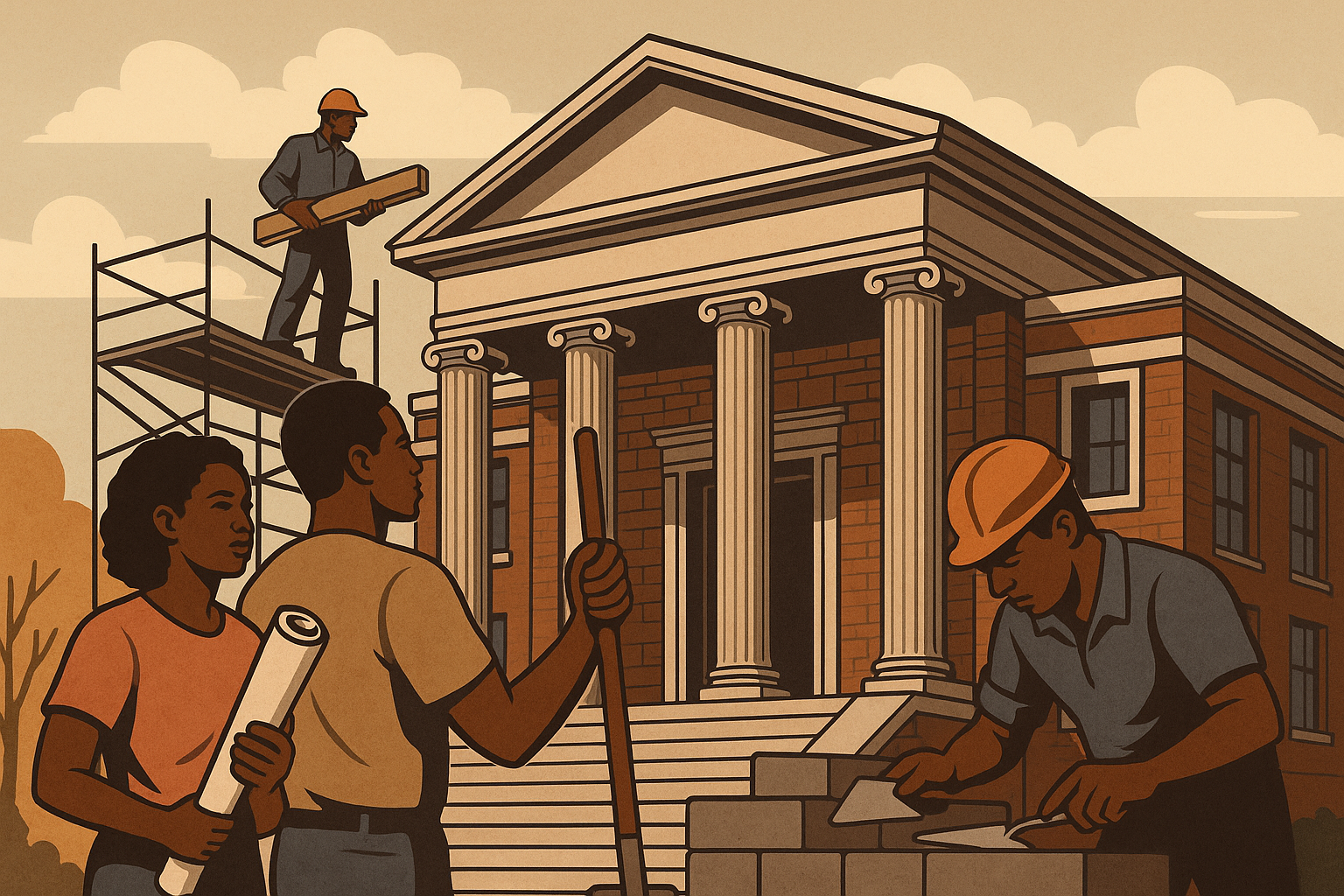
In a pivotal scene from the film Moneyball, Billy Beane stares across the table at a room of seasoned scouts and executives, asking again and again, “What’s the problem?” The men fumble for surface-level answers—lost players, declining performance, tight budgets—but Beane cuts through the noise with surgical precision: “You’re not even looking at the problem.” His frustration isn’t simply about baseball; it’s about the failure to reframe strategy in the face of structural disadvantages. It’s about institutions mistaking symptoms for causes.

That same failure of vision and the urgent need for a paradigm shift applies not just to baseball, but to African America’s quest for economic power, institutional wealth, and self-determined sovereignty.

African America’s greatest minds, labor, and capital are often deployed outside of African American institutions. In essence, the community is fielding players, but not for its own teams. Valedictorians enroll at predominantly white institutions. Brilliant entrepreneurs pitch to Silicon Valley venture capitalists. Top athletes build billion-dollar empires for Nike, not Actively Black. The irony is that African America is not talent-poor. It is institution-poor. And that distinction is everything.

The most misunderstood problem in African American wealth-building discourse is not the racial wealth gap, it is the institutional wealth gap. African America commands over $1.6 trillion in consumer spending power annually, yet circulates less than 2% of that inside its own institutions before it exits the community entirely. Compare this to Jewish Americans, who circulate an estimated 8 to 12 times within their institutional networks, or East Asian Americans at 6 to 12 times, or even Latino Americans at 4 to 6. The velocity of African American economic energy leaves almost immediately. Another financial literacy seminar cannot fix this. What is required are financial institutions that keep wealth anchored in the community and institution-to-institution cooperation that builds collective power rather than isolated individual net worth.

Much like Billy Beane confronting baseball’s scouting orthodoxy, African America must confront its deep obsession with prestige, particularly the pursuit of inclusion in institutions that were never designed for its empowerment. The community still celebrates when African Americans “break barriers” into historically exclusive spaces: the first Black partner at a global law firm, the first Black president of an Ivy League university, the first Black billionaire appointed to a PWI board. These are symbolic gestures, not systemic gains. They are the equivalent of drafting a slugger with a high batting average while ignoring his low on-base percentage. It may photograph well, but it does not win championships.

Meanwhile, African American institutions like HBCUs, Black-owned banks, credit unions, media companies, foundations remain undercapitalized and under-circulated. According to FDIC data, African American banks account for less than 0.03% of the U.S. banking system’s total assets, despite serving millions of customers. Most carry assets under $500 million, while PNC, JPMorgan Chase, and Bank of America each hold hundreds of billions in Black consumer deposits alone. The community is putting elite players on the field just not on its own team.

One of the most damaging consequences of the post-civil rights integration era has been the illusion of proximity to power. Inclusion into dominant systems has led many African Americans to feel they are participating in the architecture of power, when in reality they are consumers of it, not owners. The institutions that determine economic direction in this country like investment firms, insurance conglomerates, think tanks, and lobbying organizations remain largely absent African American leadership at the structural level. While the public fixates on celebrity billionaires, it rarely accounts for institutional billionaires: universities with $40 billion endowments, banks with $3 trillion balance sheets, pension funds managing hundreds of billions in assets. Harvard University’s endowment, at roughly $50 billion, generates more annual passive income than the top 20 HBCUs combined in operating budgets. The Ivy League is not competing with African America. It operates on an entirely different playing field.

The data makes the scale of the gap unmistakable. As of 2022, the median net worth of a white household exceeded $188,000. For African American households, the figure was $24,100. But the institutional gap is even more stark. The top 10 predominantly white universities hold over $200 billion in combined endowments. The top 10 HBCUs hold less than $3 billion combined. In the philanthropic sector, the contrast is equally severe: the Gates Foundation manages nearly $8 billion in annual revenue and over $80 billion in assets. Meanwhile, even foundations attached to African American billionaires often operate at a fraction of that capacity. When African Americans are high earners individually, they frequently exist within ecosystems of institutional fragility—fragile schools, fragile banks, fragile civic organizations. This fragility makes individual wealth vulnerable, disperses influence, and mutes policy impact. The community continues to negotiate from positions of dependence.

The strongest ethnic and national economies do not simply focus on internal wealth generation, they construct infrastructure for internal circulation and cooperation. That means Black-owned banks financing Black developers. HBCUs recruiting faculty trained at other HBCUs rather than defaulting to PWI pipelines. Black foundations endowing Black hospitals, think tanks, and research centers. Black technology firms building hiring relationships with HBCU STEM programs. Black media outlets directing advertising budgets toward Black-owned businesses rather than relying on revenue from Google and Pepsi. Currently, this kind of circulation is sporadic and disorganized. Too often, African American institutions function as isolated islands, each struggling independently in a competitive environment that rewards scale and coordination. What is needed is a federation mindset of institutions operating in genuine symbiosis, where growth is strategic rather than accidental. Consider the compounding effect if every HBCU committed 20% of its endowment to Black-owned financial institutions, or if every African American megachurch directed 10% of its annual budget toward a Black-owned insurance provider. These institution-to-institution agreements would create forms of institutional wealth that accumulate quietly but with enormous strategic consequence.

Billy Beane’s genius in Moneyball was not merely contrarianism. It was data literacy. He saw what others refused to acknowledge: that reaching base was more valuable than batting average, and that the traditional metrics of scouting obscured the actual drivers of winning. African America must apply the same discipline to its institutional life. That requires building institutional balance sheets that honestly account for asset and liability structures; capital flow maps that trace where African American money goes after it is earned; circulation velocity metrics that measure how many times a dollar moves among Black institutions before exiting; and influence indexes that evaluate which African American institutions actually shape policy, capital markets, and media narratives. Without that data infrastructure, the community will continue to feel prosperous in moments while remaining fragile in structure and celebrating the anecdote while missing the trend.

Talent allocation is the other dimension of the problem that demands a strategic reframe. Just as the scouts in Moneyball chased big names and home run statistics, African American institutions often pursue talent without connecting it to long-term institutional strategy. Celebrity partnerships, honorary degrees, and gala appearances generate visibility but rarely feed institutional growth. A Tuskegee graduate built the foundations of American agricultural science. But talent, without institutions to give it depth, direction, and deployment, is ultimately portable. It gets recruited away, diluted, or co-opted. The community does not simply need more talented individuals. It needs to scout differently, train differently, and deploy those individuals in ways that compound institutional strength rather than individual achievement.

The question of narrative control is inseparable from the question of institutional power. Of the top twenty media companies in the United States, none are Black-owned. Most African American narratives in news, entertainment, and advertising are filtered through non-Black ownership and editorial priorities. This means political discourse is easily hijacked, cultural capital is regularly commodified without equity stakes, and social movements are routinely defanged by outside interests with different agendas. Reclaiming narrative sovereignty requires sustained investment in Black-owned media, particularly digital platforms and local investigative journalism. More critically, it requires routing advertising dollars toward Black media institutions rather than treating them as secondary channels. Even the most incisive voices will remain echoes if they are amplified through someone else’s infrastructure.

The genius of Billy Beane was not discovering undervalued players, it was reframing the entire game. African America has been operating under a set of assumptions that no longer serve its institutional interests, if they ever did. It has been trying to win with outdated tactics, sentimental strategies, and a persistent belief that the core problem is individual rather than structural. Fighting racism is necessary but insufficient. Engineering sovereignty is the work. That begins with an honest diagnosis: African America is building talent for other people’s institutions. It is celebrating inclusion while surrendering control. It is mistaking prestige for ownership. And it continues to treat the gap as primarily personal when the evidence points overwhelmingly to institutional causes.

“You’re not even looking at the problem,” Beane said.

It is past time to look.

Disclaimer: This article was assisted by ClaudeAI.
The Color Line Was Never Broken: MLB’s Jackie Robinson Day and the Permanent Absence of Black Ownership

Blacks are the only group of people in America who have been taught to invest their time, talents, and resources into other people’s businesses and institutions rather than their own.– Dr. Claude Anderson

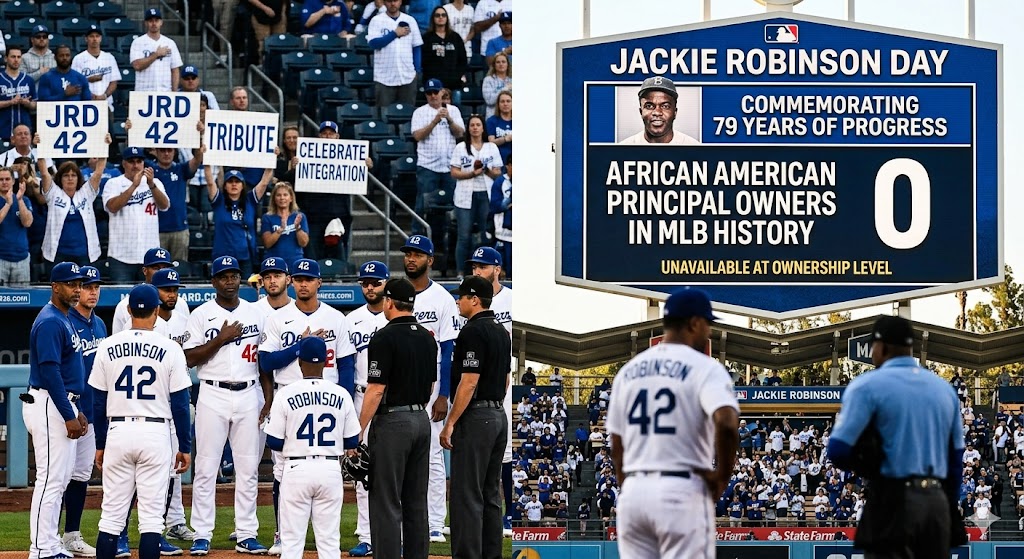
Every April 15th, Major League Baseball dresses itself in the iconography of racial progress. Every player, coach, manager, and umpire in the league wears number 42, the retired number of Jackie Robinson, in a league-wide act of commemorative solidarity. Stadiums host ceremonies. The commissioner issues statements. The Negro Leagues Baseball Museum is quoted in the wire copy. This year marked the 79th anniversary of Robinson’s debut with the Brooklyn Dodgers, and the ritual was performed with its usual solemnity and precision. Bob Kendrick, president of the Negro Leagues Baseball Museum, offered the occasion’s defining sentiment: every player of color who now enjoys the sport owes it to this man. It was the kind of statement that lands well precisely because it is true and precisely because it forecloses the question that actually matters: what do the owners of the sport owe?

The answer, measurable across 79 years, is nothing. Because in the entire recorded history of Major League Baseball, there has never been a single African American principal owner of a franchise. Not one. The league that wraps itself annually in the image of the man who broke its color barrier has never permitted Black Americans to sit at the table where the real decisions are made and the real wealth is accumulated. Jackie Robinson Day, in this light, is not a celebration. It is a ritual performance of symbolism in the absence of substance, a ceremony that honors a labor breakthrough while quietly burying the ownership catastrophe that labor breakthrough produced.

Dr. Claude Anderson diagnosed this dynamic with clinical precision in Black Labor, White Wealth: The Search for Power and Economic Justice. Anderson’s central thesis is that African Americans have historically been incorporated into American economic structures as labor inputs essential to the production of wealth but systematically excluded from its ownership and accumulation. The pattern Anderson traces across centuries of American economic life finds one of its most vivid contemporary illustrations in professional baseball. In 1947, there were zero African American owners in Major League Baseball. In 2026, there are zero African American owners in Major League Baseball. The number has not moved in nearly eight decades of ceremonies, commemorations, and retired jerseys. Whatever integration accomplished for those who could play, it accomplished nothing for those who might own.

The financial stakes of that absence are not abstract. The average MLB franchise value entering the 2026 season is $3.17 billion, a 12 percent increase from the prior year. The New York Yankees are valued at $9 billion; the Los Angeles Dodgers at $8 billion. Thirty franchises, each a multigenerational wealth vehicle, each appreciating at rates that make even the highest player salaries look modest by comparison. The mathematics of ownership versus labor in professional sports is not complicated: franchises compound wealth over generations, while athletic careers end, often before age 35, and rarely produce the kind of capital base required to enter the ownership market. George Steinbrenner paid $10 million for the New York Yankees in 1973; the team is now valued at nearly $9 billion — a 900-fold increase. No player’s salary trajectory has ever approximated that kind of return. The wealth gap between Black athletes and the owners who profit from their labor is not a gap it is a chasm, and it has been widening for eight decades while baseball holds its annual ceremony.

What made this chasm possible was the structural transformation that Robinson’s entry into MLB initiated. Rube Foster, considered the father of Negro League Baseball, was insistent as early as 1910 that Black teams should be owned by Black men. The Negro Leagues were not merely a segregated alternative to the major leagues they were an ownership infrastructure, an economic ecosystem, a complex of jobs, investment, and community capital that functioned precisely because it was self-contained. Virtually all of the initial Negro League ownership was Black, according to Garrick Kebede, a Houston-based financial adviser and Negro League Baseball historian. When Robinson crossed the color line under Branch Rickey’s terms, he did not negotiate a merger. He negotiated a labor transfer. African American talent, the asset that had built and sustained the Negro Leagues, departed for a structure in which African Americans held no ownership stake, no board seats, no equity, and no decision-making authority. The Negro Leagues, stripped of their best labor, collapsed. The ownership infrastructure they represented was dismantled. What remained was the arrangement that has persisted ever since: Black labor generating wealth for white ownership, with the annual ceremony serving as the cultural lubricant that makes the arrangement palatable.

This publication has argued before that what African Americans celebrate when they celebrate Robinson’s debut is better understood as a miscelebration, an uncritical embrace of a “first” that, examined structurally, represented institutional dispossession rather than institutional advancement. The framework is not complicated. A community’s economic power derives not from its ability to supply labor to others’ institutions, but from its capacity to build, own, and control institutions of its own. The Negro Leagues were such an institution. Their destruction produced precisely the outcome that Dr. Anderson’s framework would predict: a permanently subordinate position within an economic structure controlled by others, with symbolic inclusion substituting for actual power.

The percentage of Black players on Opening Day rosters increased from 6.0 percent in 2024 to 6.2 percent in 2025 to 6.8 percent in 2026 — the first back-to-back annual increases in at least two decades. MLB has invested in developmental programs aimed at reversing the long decline of Black players in the sport, and the league has used this uptick as evidence of progress on Jackie Robinson Day. The framing is instructive in its evasions. At the apex of Black participation in MLB, the figure reached 18.7 percent in 1981. Today’s 6.8 percent, celebrated as a milestone, remains less than half that peak and remains, critically, a measure only of labor participation. The ownership figure has not changed. It is zero. It has always been zero. The developmental programs that produce more Black players produce more labor for an ownership class that has never included a single African American. Whatever the developmental intention, the structural outcome is the same as it has always been: more Black men supplying the asset that generates wealth for others.

This is not, it must be stressed, an argument against Black Americans playing baseball. It is an argument about what the celebration of their playing, in the absence of ownership, actually signifies. It signifies that the arrangement Branch Rickey designed in 1947 one in which Black labor would integrate the league while Black ownership was never contemplated has proven durable across nearly eight decades and shows no sign of structural challenge. The 30 franchise owners whose combined wealth now runs into the hundreds of billions of dollars conduct their business in owners’ meetings that have never included an African American voice with the authority that ownership confers. The decisions made in those meetings about labor rules, revenue sharing, market expansion, franchise relocation, broadcast deals are made entirely without African American ownership participation. This is not an oversight. It is the design of the arrangement that Robinson’s entry formalized.

The institutional lessons of this history extend well beyond baseball. The Negro Leagues offer a template not for nostalgia but for analysis: what does it take to build an economic ecosystem that retains capital within a community rather than exporting it to others? The answer, in the Negro Leagues as in other domains, was ownership. When the Kansas City Monarchs played, the revenue stayed within a structure where Black owners, Black managers, Black vendors, and Black communities captured the economic return on Black athletic talent. That structure was dismantled not by force, but by the gravitational pull of integration on terms that never included ownership as a condition.

The HBCU athletic ecosystem faces an analogous set of choices in the present. The temptation to pursue visibility and validation within structures owned and controlled by others (the Power Five conferences, the NCAA tournament apparatus) reproduces the 1947 logic at the college level. As this publication has examined in detail, the HBCU Power Five has a combined all-time record of 4-55 in the NCAA tournament, and the SWAC and MEAC combined typically earn no more than approximately $680,000 in tournament payouts, roughly $34,000 per school when distributed across conference members. The alternative: owning the tournament, controlling the broadcast rights, building an HBCU Athletic Association would produce less spectacle and more capital. It would reproduce, in athletic governance, the logic that Rube Foster understood a century ago: the economic return on Black talent should accrue to Black institutions.

The broader African American institutional ecosystem — Black owned public and private companies, Black financial institutions, professional associations, fraternal organizations, and HBCUs themselves — contains the capacity for the kind of coordinated ownership strategy that MLB has never permitted and that the Negro League era briefly demonstrated was possible. The question is not whether that capacity exists. It is whether the community’s leadership is willing to pursue ownership as a strategic objective rather than labor participation as a cultural achievement. Dr. Anderson’s framework demands that distinction. So does the arithmetic of 30 MLB franchises averaging $3.17 billion in value, every one of them owned by someone who is not African American, generating their returns on a sport whose very mythology of racial progress was built on the back of a Black man who received no ownership stake in exchange for making the mythology possible.

Every April 15th, the number 42 appears on every jersey in Major League Baseball. It is, in its way, an honest accounting. Forty-two is the number of a man whose labor the league appropriated, whose institutional infrastructure it dismantled, and whose memory it now rents annually for its own legitimacy. What would constitute actual progress is the number of African American principal owners in MLB. That number is zero. It has always been zero. Until it changes, Jackie Robinson Day is not a celebration. It is an invoice of unpaid, and accumulating interest.

Disclaimer: This article was assisted by ClaudeAI.