
Blacks are the only group of people in America who have been taught to invest their time, talents, and resources into other people’s businesses and institutions rather than their own.– Dr. Claude Anderson
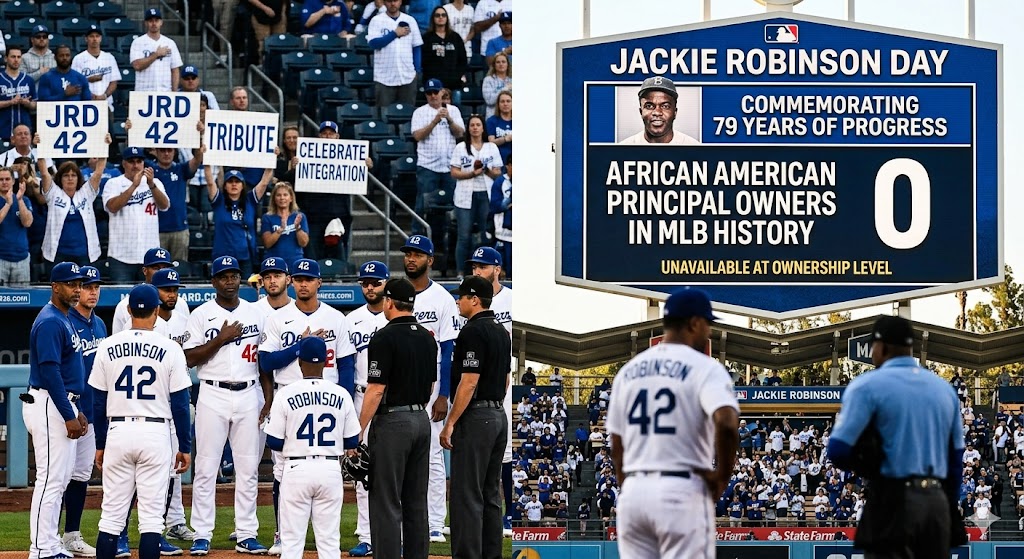
Every April 15th, Major League Baseball dresses itself in the iconography of racial progress. Every player, coach, manager, and umpire in the league wears number 42, the retired number of Jackie Robinson, in a league-wide act of commemorative solidarity. Stadiums host ceremonies. The commissioner issues statements. The Negro Leagues Baseball Museum is quoted in the wire copy. This year marked the 79th anniversary of Robinson’s debut with the Brooklyn Dodgers, and the ritual was performed with its usual solemnity and precision. Bob Kendrick, president of the Negro Leagues Baseball Museum, offered the occasion’s defining sentiment: every player of color who now enjoys the sport owes it to this man. It was the kind of statement that lands well precisely because it is true and precisely because it forecloses the question that actually matters: what do the owners of the sport owe?
The answer, measurable across 79 years, is nothing. Because in the entire recorded history of Major League Baseball, there has never been a single African American principal owner of a franchise. Not one. The league that wraps itself annually in the image of the man who broke its color barrier has never permitted Black Americans to sit at the table where the real decisions are made and the real wealth is accumulated. Jackie Robinson Day, in this light, is not a celebration. It is a ritual performance of symbolism in the absence of substance, a ceremony that honors a labor breakthrough while quietly burying the ownership catastrophe that labor breakthrough produced.
Dr. Claude Anderson diagnosed this dynamic with clinical precision in Black Labor, White Wealth: The Search for Power and Economic Justice. Anderson’s central thesis is that African Americans have historically been incorporated into American economic structures as labor inputs essential to the production of wealth but systematically excluded from its ownership and accumulation. The pattern Anderson traces across centuries of American economic life finds one of its most vivid contemporary illustrations in professional baseball. In 1947, there were zero African American owners in Major League Baseball. In 2026, there are zero African American owners in Major League Baseball. The number has not moved in nearly eight decades of ceremonies, commemorations, and retired jerseys. Whatever integration accomplished for those who could play, it accomplished nothing for those who might own.
The financial stakes of that absence are not abstract. The average MLB franchise value entering the 2026 season is $3.17 billion, a 12 percent increase from the prior year. The New York Yankees are valued at $9 billion; the Los Angeles Dodgers at $8 billion. Thirty franchises, each a multigenerational wealth vehicle, each appreciating at rates that make even the highest player salaries look modest by comparison. The mathematics of ownership versus labor in professional sports is not complicated: franchises compound wealth over generations, while athletic careers end, often before age 35, and rarely produce the kind of capital base required to enter the ownership market. George Steinbrenner paid $10 million for the New York Yankees in 1973; the team is now valued at nearly $9 billion — a 900-fold increase. No player’s salary trajectory has ever approximated that kind of return. The wealth gap between Black athletes and the owners who profit from their labor is not a gap it is a chasm, and it has been widening for eight decades while baseball holds its annual ceremony.
What made this chasm possible was the structural transformation that Robinson’s entry into MLB initiated. Rube Foster, considered the father of Negro League Baseball, was insistent as early as 1910 that Black teams should be owned by Black men. The Negro Leagues were not merely a segregated alternative to the major leagues they were an ownership infrastructure, an economic ecosystem, a complex of jobs, investment, and community capital that functioned precisely because it was self-contained. Virtually all of the initial Negro League ownership was Black, according to Garrick Kebede, a Houston-based financial adviser and Negro League Baseball historian. When Robinson crossed the color line under Branch Rickey’s terms, he did not negotiate a merger. He negotiated a labor transfer. African American talent, the asset that had built and sustained the Negro Leagues, departed for a structure in which African Americans held no ownership stake, no board seats, no equity, and no decision-making authority. The Negro Leagues, stripped of their best labor, collapsed. The ownership infrastructure they represented was dismantled. What remained was the arrangement that has persisted ever since: Black labor generating wealth for white ownership, with the annual ceremony serving as the cultural lubricant that makes the arrangement palatable.
This publication has argued before that what African Americans celebrate when they celebrate Robinson’s debut is better understood as a miscelebration, an uncritical embrace of a “first” that, examined structurally, represented institutional dispossession rather than institutional advancement. The framework is not complicated. A community’s economic power derives not from its ability to supply labor to others’ institutions, but from its capacity to build, own, and control institutions of its own. The Negro Leagues were such an institution. Their destruction produced precisely the outcome that Dr. Anderson’s framework would predict: a permanently subordinate position within an economic structure controlled by others, with symbolic inclusion substituting for actual power.
The percentage of Black players on Opening Day rosters increased from 6.0 percent in 2024 to 6.2 percent in 2025 to 6.8 percent in 2026 — the first back-to-back annual increases in at least two decades. MLB has invested in developmental programs aimed at reversing the long decline of Black players in the sport, and the league has used this uptick as evidence of progress on Jackie Robinson Day. The framing is instructive in its evasions. At the apex of Black participation in MLB, the figure reached 18.7 percent in 1981. Today’s 6.8 percent, celebrated as a milestone, remains less than half that peak and remains, critically, a measure only of labor participation. The ownership figure has not changed. It is zero. It has always been zero. The developmental programs that produce more Black players produce more labor for an ownership class that has never included a single African American. Whatever the developmental intention, the structural outcome is the same as it has always been: more Black men supplying the asset that generates wealth for others.
This is not, it must be stressed, an argument against Black Americans playing baseball. It is an argument about what the celebration of their playing, in the absence of ownership, actually signifies. It signifies that the arrangement Branch Rickey designed in 1947 one in which Black labor would integrate the league while Black ownership was never contemplated has proven durable across nearly eight decades and shows no sign of structural challenge. The 30 franchise owners whose combined wealth now runs into the hundreds of billions of dollars conduct their business in owners’ meetings that have never included an African American voice with the authority that ownership confers. The decisions made in those meetings about labor rules, revenue sharing, market expansion, franchise relocation, broadcast deals are made entirely without African American ownership participation. This is not an oversight. It is the design of the arrangement that Robinson’s entry formalized.
The institutional lessons of this history extend well beyond baseball. The Negro Leagues offer a template not for nostalgia but for analysis: what does it take to build an economic ecosystem that retains capital within a community rather than exporting it to others? The answer, in the Negro Leagues as in other domains, was ownership. When the Kansas City Monarchs played, the revenue stayed within a structure where Black owners, Black managers, Black vendors, and Black communities captured the economic return on Black athletic talent. That structure was dismantled not by force, but by the gravitational pull of integration on terms that never included ownership as a condition.
The HBCU athletic ecosystem faces an analogous set of choices in the present. The temptation to pursue visibility and validation within structures owned and controlled by others (the Power Five conferences, the NCAA tournament apparatus) reproduces the 1947 logic at the college level. As this publication has examined in detail, the HBCU Power Five has a combined all-time record of 4-55 in the NCAA tournament, and the SWAC and MEAC combined typically earn no more than approximately $680,000 in tournament payouts, roughly $34,000 per school when distributed across conference members. The alternative: owning the tournament, controlling the broadcast rights, building an HBCU Athletic Association would produce less spectacle and more capital. It would reproduce, in athletic governance, the logic that Rube Foster understood a century ago: the economic return on Black talent should accrue to Black institutions.
The broader African American institutional ecosystem — Black owned public and private companies, Black financial institutions, professional associations, fraternal organizations, and HBCUs themselves — contains the capacity for the kind of coordinated ownership strategy that MLB has never permitted and that the Negro League era briefly demonstrated was possible. The question is not whether that capacity exists. It is whether the community’s leadership is willing to pursue ownership as a strategic objective rather than labor participation as a cultural achievement. Dr. Anderson’s framework demands that distinction. So does the arithmetic of 30 MLB franchises averaging $3.17 billion in value, every one of them owned by someone who is not African American, generating their returns on a sport whose very mythology of racial progress was built on the back of a Black man who received no ownership stake in exchange for making the mythology possible.
Every April 15th, the number 42 appears on every jersey in Major League Baseball. It is, in its way, an honest accounting. Forty-two is the number of a man whose labor the league appropriated, whose institutional infrastructure it dismantled, and whose memory it now rents annually for its own legitimacy. What would constitute actual progress is the number of African American principal owners in MLB. That number is zero. It has always been zero. Until it changes, Jackie Robinson Day is not a celebration. It is an invoice of unpaid, and accumulating interest.
Disclaimer: This article was assisted by ClaudeAI.


