
It is our duty to fight for our freedom. It is our duty to win. We must love each other and support each other. We have nothing to lose but our chains. – Assata Shakur
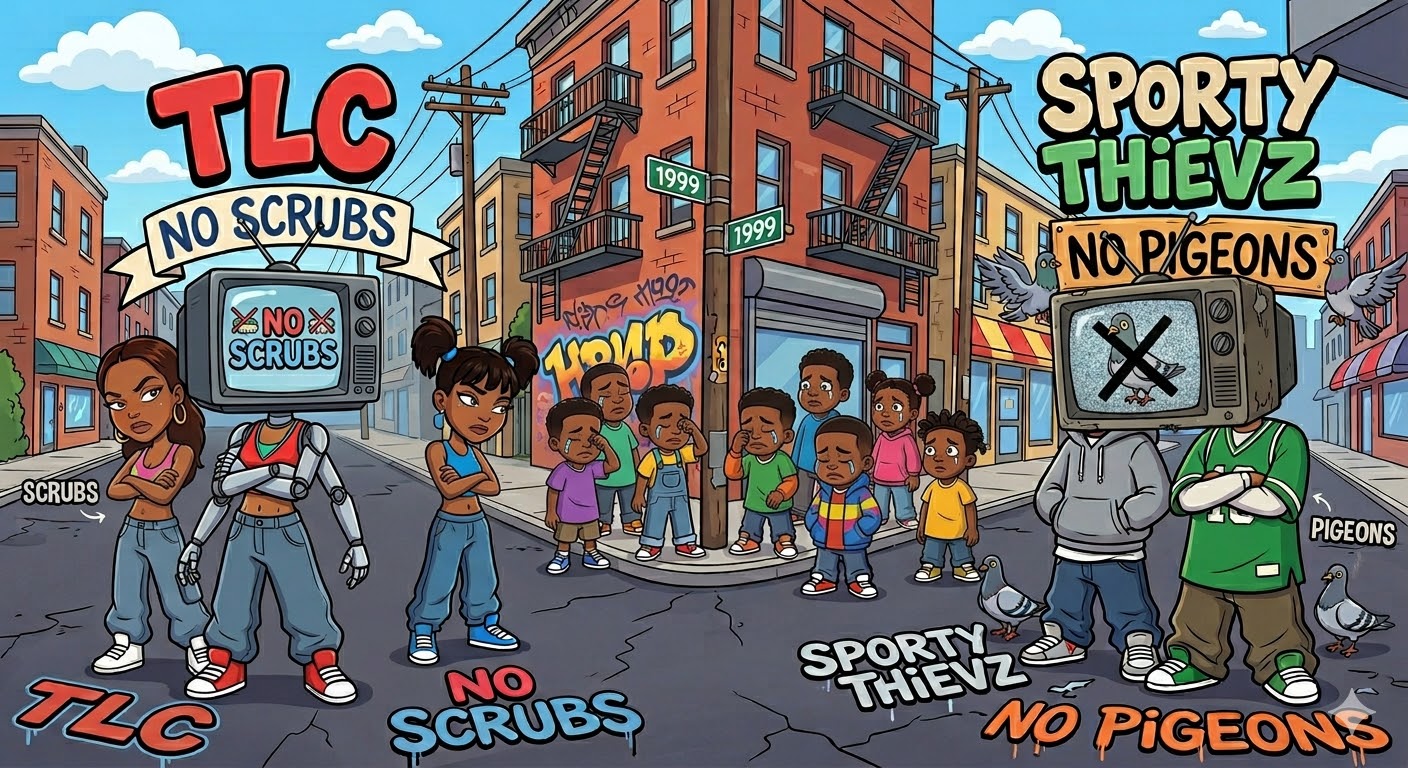
In February 1999, TLC released what would become one of the defining singles of their career. “No Scrubs” shot to number one on the Billboard Hot 100, where it remained for four consecutive weeks. The song’s message was clear and unapologetic: women were setting standards, and men who could not meet them need not apply. Within weeks, a relatively unknown rap group from Yonkers called Sporty Thievz fired back with “No Pigeons,” an answer record that used the same beat to deliver an equally scathing critique of women they deemed unworthy.
This exchange sparked what became known as a gender war on and off the airwaves, with radio stations playing both songs back-to-back and nightclubs dividing along battle lines — women shrieking in solidarity with TLC while men whooped for Sporty Thievz. Was this the inflection point where romantic and communal relationships between Black men and women began to fracture? Probably not. The roots run far deeper. But these songs crystallized something that had been building for years, a shift from celebration to criticism, from love songs to diss tracks, from the assumption of solidarity to the performance of mutual contempt.
Rewind a decade, and Black music told a fundamentally different story. The late 1980s and early 1990s gave us ballads that treated Black love not as a battlefield but as a sanctuary. Luther Vandross, Anita Baker, and Whitney Houston soundtracked weddings and anniversaries with a tenderness that affirmed the depth and dignity of Black romantic life. Mary J. Blige’s “Real Love” carried the longing of a generation. K-Ci & JoJo’s “All My Life” became a generational confession. Even within hip-hop, before the genre’s full commercial industrialization, there were moments of striking vulnerability. LL Cool J’s “I Need Love” in 1987 — a soft, earnest admission of emotional need — stood in productive tension with the bravado that would later become the genre’s commercial signature. These were not merely popular songs. They were cultural touchstones that told young Black people what love could look like, should look like. They were aspirational documents for a community’s interior life. And critically, the women in those songs, in those videos, on those album covers, looked like the community. They were Black women, centered and celebrated.
Something changed in the 1990s, and the change was not accidental. Dr. Dre and Snoop Dogg’s early albums codified a posture of romantic detachment, the deliberate rejection of love and respect for women, into hip-hop’s dominant vocabulary. This was compelling music that sold in enormous quantities, and in selling, it set a template. What had been one strand within a diverse genre became its commercial center of gravity. But the ideological shift ran deeper than misogyny alone. As hip-hop’s commercial footprint expanded through the mid-to-late 1990s and into the 2000s, something subtler and in some ways more psychologically damaging began appearing in the culture’s most visible spaces: the music video. The women cast as aspirational, as desirable, as worth pursuing began, with increasing frequency, to not be Black.
This was not happenstance. It was a pattern deliberate enough to be legible. As rap artists accumulated wealth and crossover appeal, the women featured alongside them in videos on yachts, in mansions, in the visual grammar of success skewed lighter, then non-Black altogether. The message embedded in those images was not subtle to anyone paying attention: arrival meant distance from Blackness. The highest expression of a Black man’s success, as the visual culture of the era constructed it, was access to women who were not Black. Video vixens of lighter complexions were elevated as the standard while dark-skinned Black women were marginalized or absent entirely. The beauty hierarchy being constructed in plain sight on BET and MTV was one in which Black women occupied an increasingly precarious position in the desirability calculus of their own community’s most prominent cultural exports.
By the time “No Scrubs” arrived in 1999, it landed in a culture already primed for conflict. Co-written by Kandi Burruss and Tameka “Tiny” Cottle during their downtime from Xscape, the song was a declaration of standards — women demanding ambition, respect, and genuine partnership rather than the attention of men riding in the passenger seat of someone else’s car. The demands were not unreasonable. Demands that ironically, many Black men would declare normal and reasonable from non-Black women. And within a media landscape designed to amplify division, what began as standard-setting quickly escalated into something more corrosive.
The response was immediate and polarizing. Radio stations hosted debates. BET reportedly edited both videos into a single seven-minute clip of gender war theater. MTV put both in heavy rotation. The media did not merely cover the conflict, it manufactured it into a cultural event, validating in the process the notion that Black men and women were not simply in disagreement but were fundamentally adversarial. Sporty Thievz’s rebuttal climbed to number 12 on the Billboard Hot 100, confirming that the antagonism resonated on both sides of the divide.
What made this moment significant was not the back-and-forth between two songs. It was what that back-and-forth revealed about the direction popular culture was pulling Black romantic life. These songs did not create the tensions between Black men and women. Economic dislocation, the carnage of the War on Drugs, and the structural dismantling of urban manufacturing bases had already placed enormous strain on Black households and Black partnership. Sociologist Elijah Anderson observed that young men in economically marginalized Black communities often pursued social status through the exploitation and diminishment of women, a pattern that commercial hip-hop both reflected and, once amplified at industrial scale, reinforced. The music industry, predominantly white-owned and indifferent to the social consequences of what it distributed, found conflict profitable and invested accordingly. What the community was living, the industry packaged and sold back to it as entertainment.
The visual erasure of Black women from the aspirational imagination of hip-hop did not stay confined to the screen. It seeped into everyday life with a thoroughness that was difficult to track precisely because it moved through private conversation, social expectation, and the slow accumulation of cultural messaging rather than through any single declarable event. By the early 2000s, a certain strain of public Black male discourse had begun treating dating or marrying non-Black women not merely as a personal preference but as a marker of status, sophistication, or liberation — a signal that one had transcended the presumed limitations of the community one came from. The logic was sometimes stated explicitly, more often implied: that Black women were too difficult, too loud, too independent, too damaged by their own circumstances to be worthy partners for men who had achieved something. The very qualities that had allowed Black women to survive conditions designed to break them were reframed as character defects.
This was not a fringe conversation. It became, with the amplification of the internet and eventually social media, a mainstream one relitigated endlessly in think pieces, radio debates, YouTube channels, and the comment sections of platforms that rewarded provocation over nuance. Black women responded with a mixture of hurt, anger, and their own declarations of independence from a community they felt had devalued them. Some began openly discussing dating outside their race with the same performative energy that had been directed at them. What had begun as a visual preference embedded in music videos had, over the course of a decade and a half, become a full-scale public negotiation over the terms of Black romantic belonging conducted almost entirely in the register of grievance.
The accumulated effect on a generation was not trivial. The words used to describe each other shape how people see each other, expect from each other, and ultimately what they believe is possible between each other. When the dominant narrative in the music young people consumed shifted from devotion to suspicion, from partnership to transaction, from vulnerability to armor, those shifts did not stay contained within the space of entertainment. They became internalized frameworks for courtship, for conflict, for what intimacy was permitted to look like. Young Black women who grew up hearing themselves described as pigeons, hoes, or gold diggers, and who watched the women in their favorite artists’ videos grow progressively less likely to resemble them, absorbed messages about their worth that the external world was already working hard to diminish. Young Black men who absorbed the message that emotional openness was weakness, that Black women were adversaries to be outmaneuvered or obstacles to be bypassed on the road to something better, were being trained away from the very capacities that stable, sustaining relationships require.
Flash forward to 2026, and the cultural inheritance of that era is visible everywhere. Online spaces where Black men and women engage have become, in many corners, theaters of mutual grievance and elaborate performances of self-protective independence that leave little room for the kind of trust that partnership demands. Love songs have become harder to find in mainstream Black pop, as though tenderness has been deemed commercially unviable. Artists like PJ Morton, who make soulful music about Black love in its full complexity, play smaller rooms while music that treats romantic relationships as contests dominates the charts. This is not to suggest that beautiful expressions of Black love have disappeared. They have not. But they have been pushed to the margins of a culture that once placed them at its center.
The stakes of this cultural displacement extend well beyond the personal. As HBCU Money has documented, the marriage rate among African Americans has dropped precipitously over the past several decades, from roughly 60 percent in the 1960s to just 29 percent in 2021 and that decline carries direct economic consequences for the community’s long-term wealth position. Black married couples held a median net worth of $131,000 in 2019, compared to only $29,000 for Black single individuals — a fourfold gap that represents not merely a lifestyle difference but a structural disadvantage in capital accumulation, homeownership, and the ability to transfer wealth across generations. A culture that spent two decades using its most powerful media to communicate that Black women were not the preferred partners of successful Black men, and that Black men were not worthy of Black women’s investment, did not simply produce unhappy relationships. It produced an economic headwind that compounds over time and registers now in the net worth data of an entire community.
None of this means that “No Scrubs” and “No Pigeons” caused the decline of Black marriage or the erosion of Black wealth. They did not. But they were early, loud signals of a cultural drift that institutions like HBCUs, Black media, Black churches, Black family networks were too slow to name and too under-resourced to counter. The music reflected life. But music also shapes life, and the failure to contest the direction that shaping was taking was itself a strategic failure.
The question now is not how to assign blame for the past quarter century. It is whether the community has the institutional will to consciously reconstruct the cultural narrative that was lost. That means creating material and institutional conditions in which stable Black partnership can flourish such as relationship education, financial literacy, community infrastructure that treats Black family formation as a strategic priority rather than a private matter. It means supporting artists who treat Black love as a subject worthy of complexity and craft rather than caricature. It means being deliberate, in public spaces, about the language used to describe one another and understanding that those descriptions accumulate into the expectations young people carry into their most formative relationships.
Before the gender wars, before the videos, before mutual contempt became entertainment and the erasure of Black women from Black men’s aspirational imagination became a cultural norm, Black music told a different story, one in which men and women were engaged in a common project, in which love was not weakness but the foundation of collective strength, and in which the most natural expression of a Black man’s success was a Black woman beside him. That story was not naïve. It was aspirational in the deepest sense: it named what the community was capable of and invited people to live up to it.
That story is still available to be told. The beat can carry a different message. Whether it does depends on what the community decides to demand, to create, and to believe is still possible.
Disclaimer: This article was assisted by ClaudeAI.

