My stake in Roc Nation should go to you. Leave a piece for your siblings too. — JAY-Z
Hip-hop created one of the largest and most influential waves of cultural production in modern history, a global ecosystem now valued in the tens of billions of dollars, rooted entirely in African American creativity. Yet as this asset class matured into one of the more reliable yield-generating instruments in entertainment finance, African America missed the allocator’s window. Rather than building an institutional buyer capable of acquiring, warehousing, and compounding the value of these catalogs at scale, the assets were sold piecemeal into a marketplace of external capital, and the long-duration cash flows that should have anchored African American balance sheets now sit instead on the books of firms with no obligation to the community that produced them.
This is not a critique of individual artists. Each seller acted rationally given the liquidity available, the risk they were carrying, and the absence of any institutional counterparty built for them. The failure sits one level up, at the level of capital formation. Over the past decade, catalog transactions involving Future, Lil Wayne, Nelly, Metro Boomin, Dr. Dre, and the estates of The Notorious B.I.G. and Juice WRLD confirmed what allocators across the industry already suspected: music IP behaves like an uncorrelated, inflation-resistant annuity, and hip-hop catalogs in particular carry decades of runway as the genre’s first generation of superstars ages into legacy status. Wall Street underwrote that thesis aggressively, and it did so through familiar channels; publishing majors, sovereign wealth-backed royalty funds, and private equity vehicles purpose-built to acquire exactly this kind of asset. African American institutional capital was not at the table to underwrite it at all, not because the thesis was unclear, but because no vehicle existed on our side capable of acting on it.
What was missing was not talent, timing, or demand. It was a dedicated acquisition vehicle, an African American-controlled counterpart to the publishing majors and the private-equity-backed royalty funds that have spent the last five years bidding up catalog multiples. Had that vehicle existed, artists negotiating an exit would have had a buyer that kept the rights, the governance, and the recurring royalty stream inside the community’s own institutional perimeter, rather than a forced choice between liquidity and control. The absence of that buyer meant the negotiation itself was structurally lopsided: artists sold to counterparties who understood the asset’s long-term value precisely because they had modeled it for years, while the community whose creative output generated the value had no equivalent underwriting capacity of its own.
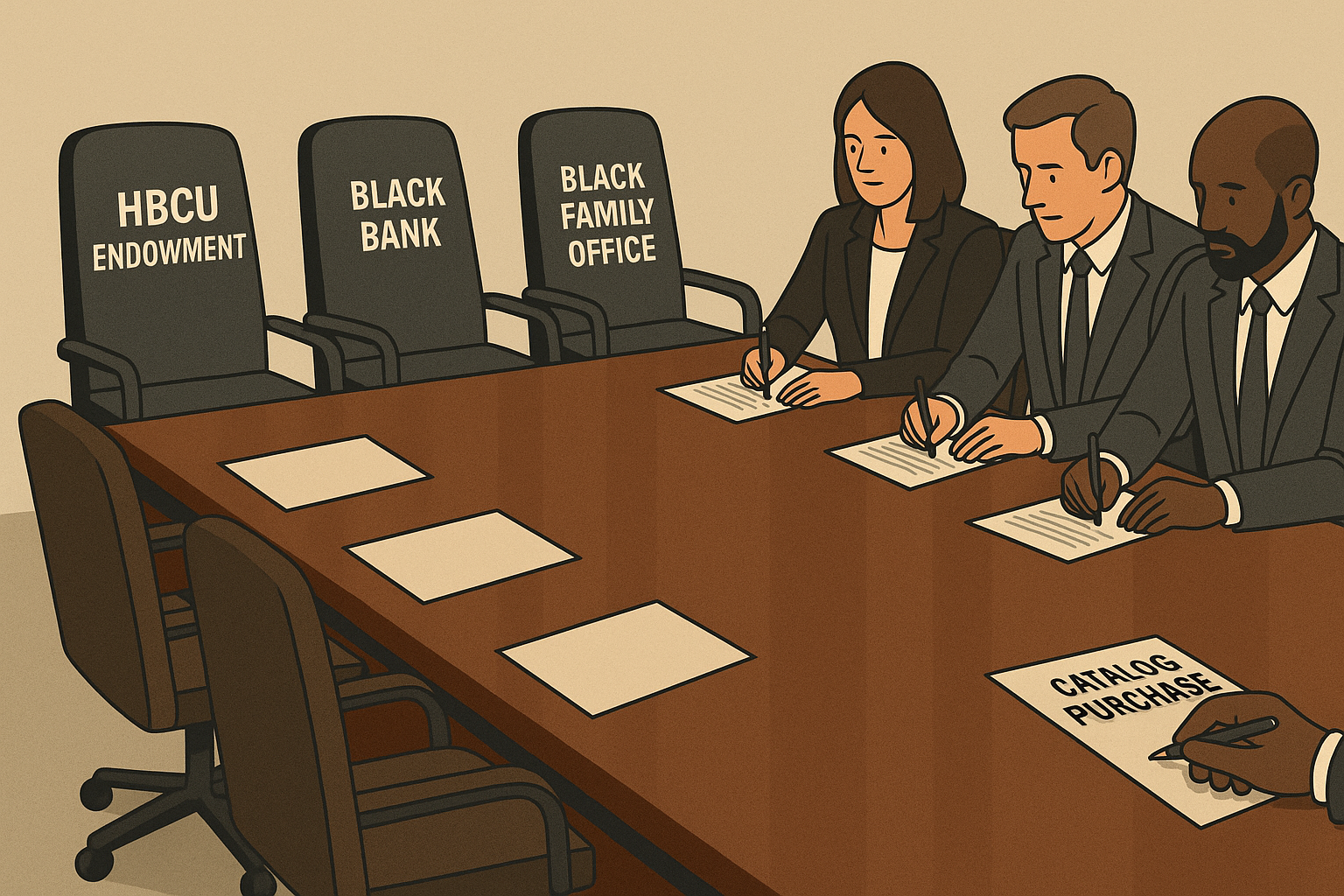
Modeled correctly, the vehicle looks less like a philanthropic gesture and more like a standard alternative-asset fund structure: a seeded acquisition platform, anchored by a small number of large limited partners — HBCU endowments, African American-owned banks and credit unions, pension allocators, and family offices — committing capital in the $150–200 million range at formation, with a mandate to acquire catalogs directly and co-invest alongside artists willing to trade full monetization for partial equity and long-term governance rights. Structured as a permanent-capital vehicle rather than a closed-end fund with a forced exit, it could compound royalty income across cycles the way infrastructure and timberland funds do, instead of racing toward a liquidity event. Every acquisition would function less like a purchase and more like a reinvestment: royalties recycled into scholarships, research fellowships, and follow-on acquisitions, building an internal rate of return measured not only in dollars but in institutional density. A second-tier warehouse facility, syndicated among African American banks and credit unions, could have financed acquisitions between capital calls, the same short-duration lending structure regional banks routinely provide to specialty finance funds elsewhere, just never extended to a Black-owned entity in this asset class.
Had this vehicle been seeded fifteen or twenty years ago, HBCU endowments that anchored the fund would today be collecting recurring royalty income and equity appreciation tied to some of the most consumed music on Earth — music their own institutions helped make possible by training generations of the artists, producers, engineers, and executives who built the genre. That is precisely the kind of long-duration, intergenerational asset endowments are built to hold, and it is exactly the kind of asset African American endowments still do not. It would also have solved a problem HBCU endowment officers raise consistently in private: a shortage of proprietary deal flow uncorrelated to the equities and fixed income already crowding most endowment portfolios.
The math on deployment is not speculative. Catalog multiples across the sector have traded in a range that makes even modest-scale entry accretive within a few years of steady licensing and streaming revenue, before accounting for the additional upside AI-driven licensing markets are expected to unlock. A firm seeded a decade or two ago, compounding acquisitions and reinvested royalties at that pace, would plausibly be a multi-billion-dollar institution today — very likely the largest African American-owned investment company in the country — and one whose asset base would not be office towers or equities correlated with the broader market, but irreplaceable, decades-durable intellectual property. Even a partial version of this thesis, consolidating a fraction of the past decade’s catalog sales under one African American-controlled holding structure, would today represent a multi-billion-dollar balance sheet generating tens of millions in annual cash flow — capital that could seed STEM endowments, venture funds, homeownership programs, land trusts, and fellowship pipelines rather than flow to shareholders with no stake in African America’s socioeconomic future. That is a materially different institutional posture than the one African America occupies today, where capital campaigns are run reactively, dollar by dollar, rather than compounding passively off an owned asset base.
That asset-class discipline matters on its own terms. Music IP is one of the few alternative categories where cash flows are largely insulated from the business cycle — people keep streaming during recessions — while also carrying genuine appreciation potential as catalogs age into classic status and licensing surface area expands across film, television, advertising, gaming, and international streaming markets. For allocators used to real estate cycles and public equity volatility, a hip-hop catalog fund would have offered something rare: uncorrelated, long-duration, culturally proprietary yield. And unlike most alternative asset classes African American institutions are chasing as new entrants — private equity, venture, and commercial real estate, where the community is competing on someone else’s terms and someone else’s decades of accumulated deal experience — this is one where the community is not catching up to someone else’s supply chain. It is the supply chain, and the only asset class where African America’s comparative advantage is not aspirational but already realized in the underlying creative output itself.
The opportunity cost compounds beyond the balance sheet. A consolidated catalog platform would have anchored career pipelines HBCU graduates are largely locked out of today — catalog valuation, music-rights law, licensing and sync placement, royalty accounting, AI-audio and data engineering, and global rights management. Those are high-margin, high-skill roles that now exist almost entirely inside firms African America does not own. Hundreds of positions that could have been anchored within a Black-controlled firm instead sit inside companies with no connection to the community whose creative output built the underlying asset. Ownership, not employment, is the relevant comparison here. A generation of African American executives has been well compensated running divisions of catalogs they hold no equity in; the transformative wealth event was always upstream, in the ownership stake, not the salary. The distinction matters because well-paid labor, however senior the title, does not compound the way ownership does — a lesson the ownership class has always understood and the professional class is still catching up to.
Governance follows capital, and that is where the deeper cost sits. Whoever holds the catalog decides which brand campaigns get licensed, which political messaging gets amplified or denied, and how an artist’s estate is administered after death. A board seated with artists, HBCU representatives, and African American family offices would not need to romanticize the music to protect it; it would simply have the standing to make licensing and estate decisions in the community’s interest, the same way any controlling shareholder does elsewhere. When ownership sits outside the community, that discretion sits outside it too — and African America’s most consumed cultural export continues generating returns for balance sheets with no stake in the institutions that produced it, no obligation to reinvest in the schools that trained its creators, and no reason to weigh cultural stewardship against quarterly licensing revenue.
The central lesson is structural, not moral. Artists cannot build institutions alone, and institutions have to exist before artists need them, not after. Without a buyer built for this purpose, artists sold into the only marketplace available — and did so rationally. The absence of an African American-controlled acquisition vehicle is an institutional-capital failure, not an individual one, and it is the same failure pattern that shows up whenever African America produces enormous cultural or economic value without first building the entity designed to capture and compound it. Other communities have not been shy about doing exactly this in adjacent industries — building dedicated acquisition vehicles ahead of a wave rather than reacting to it after the fact. The absence of a comparable African American vehicle in music is not for lack of a workable template; the template already exists elsewhere.
The window has not fully closed. A second wave of catalog monetization is forming as AI licensing markets mature and as hip-hop’s global consumer base expands across Africa, South Asia, and Latin America. A vehicle built now — structured with a multi-class equity model that lets artists contribute catalog for ownership shares, anchored by HBCU endowments and African American financial institutions, governed by a board that includes artists and HBCU leadership, and staffed with dedicated valuation, estate-protection, and licensing divisions — would not be building something unprecedented. The publishing majors and royalty-focused funds now competing for this paper have already proven the model works. The only open question is whether African American institutional capital enters this cycle as a buyer, or watches a second generation of catalogs leave the community the way the first one did.
Disclaimer: This article was assisted by ClaudeAI.
Black men like all men need to recognize that their worth in a relationship is and should be more than financial. That being said, for African America who has never reached 50% homeownership rate, to have men upset is on a level of a Eddie Murphy comedy – or Shakespeare tragegy. Take your pick. — William A. Foster, IV
In 1903, Maggie Lena Walker chartered the St. Luke Penny Savings Bank in Richmond, Virginia, becoming the first woman of any race in the United States to found and preside over a bank. She did not build it as a monument to her own ambition. She built it as infrastructure, a vessel through which the pennies of domestic workers and laundresses could become mortgages, storefronts, and a department store on Broad Street. Walker understood a principle African America has had to relearn in every generation since: an asset only compounds if there is an institution designed to hold it. A single woman’s initiative was never the story. The structure she built around it was.
That principle — asset first, institution second — is the correct lens for a trend now reshaping African American household formation, and it is being widely misread as a referendum on Black manhood rather than what it actually is. According to the National Association of Realtors’ 2025 Profile of Home Buyers and Sellers, single women account for 39 percent of all Black home purchases, nearly matching the 42 percent share held by married couples and far exceeding the single-women share among White (20 percent), Asian American/Pacific Islander (19 percent), or Hispanic (18 percent) buyers. NAR’s deputy chief economist Jessica Lautz notes that Black women have consistently outpaced women of every other racial and ethnic group as homebuyers — a pattern she attributes to a demographic “leaning especially hard on property as a tool for long-term wealth and stability.”
That explanation is accurate as far as it goes, but a rigorous accounting of the data requires a second layer Lautz’s framing does not reach: is this trend driven primarily by preference, or is it also driven by a contracting marriage market that leaves a growing share of Black women building wealth alone by structural necessity rather than by choice? Both can be true simultaneously, and treating them as mutually exclusive is the same interpretive error HBCU Money has flagged before when Black men cite the 75 percent figure, the share of married Black men wed to Black women, as proof that no structural shift is underway in Black partnership formation. That figure is real. So is the fact that Black men have posted the fastest-growing intermarriage rate of any male demographic group in the country, tripling from 8 percent of newly married Black men in 1980 to 24 percent by 2015, concentrated heavily among the most educated and highest-earning men. Among newly married Black adults overall, the gender gap in intermarriage runs 12 points in men’s favor — 24 percent of men to 12 percent of women. Among college graduates specifically, that gap widens to 17 points: 30 percent of Black male college graduates intermarry, against 13 percent of Black female college graduates.
Read against the NAR data, this is not a coincidence sitting beside another coincidence. It is one mechanism producing two visible outcomes. A marriage market in which credentialed Black women face a same-race partner pool contracting faster than any other group’s, compounded by incarceration’s well-documented effect on the available Black male population and a decades-long educational attainment gap that has moved decisively in women’s favor, is a marriage market with a measurable supply-demand imbalance on the women’s side of the ledger. Homeownership is one of the few asset classes a person can acquire entirely alone, without waiting on a partner who may not arrive on the expected timeline or at all. Framed this way, the surge in single Black women’s home purchases looks less like elective wealth-building and more like an institutionally rational hedge against a partnership market that is not behaving the way it does for other groups of women.
This is an accounting, not an accusation, and the distinction matters for how the community responds to it. It is not a claim that any individual man has abandoned anyone, and it is not a claim that any individual woman is buying a home out of desperation rather than ambition — both things NAR’s own qualitative data contradict, since single women report treating homeownership as a deliberate, prioritized financial goal, not a fallback. It is a claim that the aggregate pattern has a structural driver worth naming honestly, because institutions built to respond to “women choosing wealth-building” and institutions built to respond to “a rising share of women building wealth alone because the partnership market has structurally narrowed for them” are not the same institutions, and African America needs the second kind at least as much as the first.
Every functioning institution has a balance sheet, a division of roles based on comparative advantage, and a mechanism for retaining and compounding the capital that enters it. HBCU Money applies this logic routinely to banks, universities, and credit unions. It applies with equal force to the family and it requires the family, as an institution, to be designed for two distinct entry conditions rather than one: capital entering through a partnership, and capital entering through a woman building alone who may or may not partner later. A family-governance framework that only knows how to receive equity once a marriage has already formed is a framework that fails a growing share of the very women generating the equity it is supposed to hold.
Where partnership does form, the economics remain exactly as favorable as they were before this data was added to the picture. A household in which one partner already holds home equity is not a household where one officer outranks another; it is a balance sheet that begins with collateral instead of without it, refinanceable into business capital, deployable as a down payment on a second unit, combinable with a partner’s income to acquire block-level property neither could reach alone. None of that requires the man’s asset to arrive first or match hers in size; it requires a governance norm that allocates roles by comparative advantage rather than gender-coded ego, the same norm any competently run institution already applies to its officers. The men who read a partner’s equity as a threat rather than as capital entering the household are the ones least equipped to benefit from precisely this kind of coordination.
But the institutional response cannot stop at “coordinate better once partnered,” because the data says a meaningful and growing share of the ecosystem’s most credentialed women will be building wealth solo, for a period that may not be temporary. That is where African America’s institutional thinness compounds the problem. A Black-owned bank or credit union — a Citizens Trust, a OneUnited, a Hope Credit Union — is well positioned to build savings and refinance products for solo women building equity as a first-class household unit, not merely as a pre-partnership placeholder waiting to merge into someone else’s balance sheet. Family governance infrastructure; trusts, estate documentation, succession planning for how a solo-acquired home transfers to children, siblings, or reinvests into a next acquisition has to be built around the reality that a growing number of these estates will not have a second adult name on the deed, ever. HBCU business and law programs at Tougaloo, at Fort Valley State, at Coppin State, at Savannah State are positioned to teach family financial governance as a competency that includes solo wealth-holding as a designed-for outcome, not an edge case.
None of this changes the invitation at the center of this piece. A man who understands the full accounting, that Black women are buying homes at a record pace both because they are choosing to and because a structurally contracting partner pool makes solo acquisition a rational institutional hedge has more reason to be inspired, not less. Her closing is not a verdict on him individually; in aggregate, it is a population-level response to conditions that include, among other things, the very intermarriage pattern concentrated among men with his own credentials. That 12-point gap among the overall population widens to 17 points among the college-educated, unmatched by any other racial group in the country, and grows precisely with the credentials, a bachelor’s degree, a stable income, that also predict homeownership readiness. The honest response to that accounting is not resentment and it is not denial. It is building the coordination where partnership exists and building the infrastructure to support solo wealth-holding where it does not because both are now permanent features of the same institutional landscape, and the family, understood as an institution, has to be designed for both.
Maggie Lena Walker did not build her bank for women who were waiting on a partner to arrive before their savings counted. She built it to hold the capital of women who were already building, on whatever timeline their circumstances gave them. The single Black woman closing on a home in 2026 has done her part twice over; she has cleared discriminatory underwriting alone, and she has done it inside a marriage market that data shows is measurably tighter for her than for women of any other group. Whether that asset becomes the founding capital of a functioning family institution, or simply one more well-earned equity position with no institutional structure built to receive it, depends on whether the ecosystem is honest enough to build for the conditions that actually produced it.
Disclaimer: This article was assisted by ClaudeAI.
“Marriage is not just about two people. It is about generations. It is about legacy. It is about survival.” – Dr. Claudine Gay, former Harvard President
In a village that depended on a single hearth for warmth, the keeping of the fire was once a taught craft passed from elder to apprentice, tended with discipline, understood as the difference between a community that endured winter and one that scattered. Over generations, the village built schools for hunting, schools for building, schools for trade. But no one built a school for the fire. Slowly, fewer hands knew how to keep it lit. Neighbors blamed the wind, the wet wood, the weather. Few asked why the village had stopped teaching the one skill that kept every other institution warm enough to function. The fire did not go out because the people stopped valuing it. It went out because no institution took responsibility for keeping the knowledge alive.
African American marriage is that fire, and the data on its decline describes an institutional failure rather than a cultural one. According to Census Bureau figures, roughly 30 percent of African American adults were married as of the most recent American Community Survey data, compared with 48 percent of the general population, a gap that has widened steadily since the 1960s, when Black marriage rates were comparable to or higher than the national average. This is not a story about African Americans falling out of love with the institution of marriage. It is a story about an institution — Black marriage — losing the infrastructure that once supported it, without any comparable institution stepping in to replace that support.
The consequences extend well beyond the household. Marriage has historically functioned as one of the more reliable engines of capital retention available to any community: pooled income, shared debt reduction, dual-earner asset accumulation, and consolidated intergenerational transfer. Brookings Institution research has repeatedly found that married-couple households experience substantially lower poverty rates than single-parent households, and that children raised in stable two-parent homes show measurably better outcomes in educational attainment and economic mobility. For a community already contending with a fractional share of national wealth relative to population, the erosion of marriage as a mainstream institution is not incidental to the wealth gap — it is one of its active mechanisms. Every dissolved partnership typically means divided assets, duplicated housing costs, and a disrupted trajectory toward the kind of multigenerational capital formation that built family land holdings, small businesses, and college funds in prior generations.
The historical record makes clear that this was not always the pattern. W.E.B. Du Bois, in his early sociological studies of Black family life, documented how enslavement had deliberately disrupted African American marriage and kinship structures, and how formerly enslaved people responded to emancipation in part by rushing to formalize marriages that slavery had denied them any legal standing to protect. The Reconstruction-era freedpeople who built schools, mutual aid societies, and land cooperatives were frequently organized around married households functioning as economic units; the marital pair was, in a very literal sense, load-bearing infrastructure for Black institution-building in that era. What has since eroded is not the aspiration toward that model but the institutional scaffolding that made it achievable: stable employment, intact communities, and critically any structured space where the skills of sustaining a marriage were taught with the same seriousness as a trade.
This is precisely the vacuum HBCUs are positioned to fill, and the case for doing so does not require sentimental appeals to romance or nostalgia. It requires only that HBCUs apply the same institutional logic to family formation that they already apply to workforce development. An HBCU curriculum trains accountants, engineers, and physicians because the community needs functioning professionals; the same community needs functioning households, and no other institution in the African American ecosystem (not churches, not employers, not government agencies) is as well positioned to deliver rigorous, scaled, cross-disciplinary instruction on the mechanics of sustaining a marriage. Fisk University’s long tradition in sociology, Tougaloo College’s history of community-facing scholarship, and Grambling State’s applied family and consumer sciences programs all suggest existing academic infrastructure that could be redirected toward this purpose without requiring new departments built from scratch.
A serious marriage curriculum at an HBCU would resemble a professional program more than a personal-development seminar. It would draw faculty from economics departments to teach household financial planning and joint asset management; from psychology and counseling programs to address conflict resolution and intergenerational trauma; from history departments to contextualize how slavery, segregation, and mass incarceration shaped contemporary Black relationship patterns; and from business schools to examine how marital partnership functions as a structural input into family enterprise, drawing on the same case-study method used to teach corporate strategy. Institutions like Delaware State University and Norfolk State University, both of which maintain applied social science and business programs, could pilot such coursework without significant new capital investment. Coppin State and Savannah State, serving urban populations directly affected by the economic pressures driving marriage decline, would be logical sites for community-facing certificate offerings rather than undergraduate electives alone.
That continuing-education dimension matters as much as the classroom version. HBCUs already operate certificate programs in fields like nonprofit management and workforce development; a Certificate in Household Formation and Family Economics, offered through evening or weekend cohorts, could extend access to alumni, local community members, and couples well past traditional college age. Institutions such as Alcorn State and Fort Valley State, both deeply embedded in the agricultural economies of their regions, could frame this instruction around the long Black Southern tradition of the marital household as an economic production unit — a farm run by a married couple, a family business built jointly — rather than importing a therapeutic model disconnected from economic reality. Xavier University of Louisiana and Dillard University, both with strong pre-professional pipelines, could position the coursework alongside career preparation, treating relationship stability as a professional competency rather than a private matter.
None of this should be mistaken for a claim that curriculum alone resolves a decline rooted in economic insecurity, mass incarceration, and structural exclusion from stable employment. Those forces are real, and no fifteen-week course reverses them. But HBCUs have never waited for surrounding conditions to be favorable before building institutions; the founding of Black colleges in the aftermath of emancipation happened precisely because no one else was going to build the educational infrastructure African Americans needed, regardless of how hostile the broader environment was. Treating marriage education as a fringe offering, best left to churches or private counseling, concedes an institutional responsibility that HBCUs are better resourced to carry at scale. Cheyney University and Lincoln University, as the nation’s oldest HBCUs, carry a particular symbolic weight in reclaiming this ground, institutions whose founding generation understood family stability as inseparable from the broader project of Black institutional survival.
The strategic case is ultimately about capital retention and institutional density, the same throughlines that govern every other domain of HBCU strategy. A stable married household retains capital inside the family rather than losing it to divided assets and duplicated costs. It concentrates two incomes, two networks, and two sets of institutional relationships rather than diffusing them. And it strengthens the density of Black institutional life by producing the next generation of donors, alumni, and community stakeholders from intact family units with the resources to sustain that engagement. HBCUs already understand that they are training more than individual professionals, they are building the institutional backbone of a community. Treating marriage as infrastructure worth teaching, rather than a private matter outside the university’s mandate, is a natural extension of that mission, not a departure from it.
Disclaimer: This article was assisted by ClaudeAI.
“We have given you everything that you need to be successful. So don’t come back here talking about how the world is unfair when you haven’t done your part.” – Clair Huxtable (Paraphrased from Season 3)
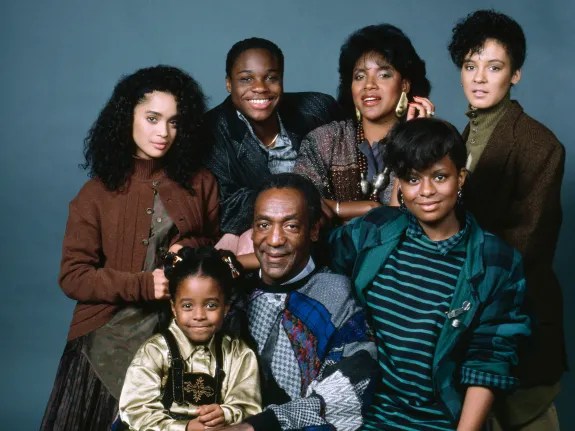
When Cliff and Clair built something extraordinary, their children inherited it but did any of them carry it forward? In American television history, few fictional families have made a more indelible mark than the Huxtables of The Cosby Show. Airing from 1984 to 1992, the series offered America and particularly Black America an aspirational portrait: Cliff Huxtable, a beloved OB/GYN, and Clair Huxtable, a formidable attorney, raising five children in a Brooklyn Heights brownstone steeped in jazz, fine art, intellectual ambition, and cultural pride. The Huxtables were not just upper-middle class. They were gateway members of the Black elite, the kind of family that might be found at National Association of Guardsmen dinners or invited into the ranks of the Boulé. Their home was a living museum of African American excellence.
And yet. As we trace the trajectories of Sandra, Denise, Theo, Vanessa, and Rudy into adulthood, something quietly disappointing emerges. A family that had every institutional advantage, strong support for education, professional networks, cultural capital, and financial stability underwritten across three generations produced children who largely did not carry the baton. They did not extend the Huxtable legacy into institutions. They did not invest in African American infrastructure. They did not, with few exceptions, even marry in ways that amplified the family’s reach and potential. This is not an indictment of fictional characters for its own sake. It is an examination through the lens of HBCU Money’s ongoing conversation about intergenerational Black wealth and institutional stewardship of what the Huxtable children represent as cultural symbols. And what they represent, ultimately, is a cautionary tale.
Before assessing the children, it is worth honoring the foundation. Cliff and Clair Huxtable are the product of struggle that extends behind them. Cliff’s father, Russell Huxtable, served in the 761st Tank Battalion in World War II, the celebrated Black Panther division, and in all likelihood was denied the full benefits of the G.I. Bill that built the postwar White middle class. As HBCU Money has previously detailed, the denial of those benefits to over 1.5 million Black veterans created a wealth gap whose effects ripple forward to this day, touching the institutional depletion of Black-owned banks, hospitals, and schools that once numbered in the hundreds and now count in the dozens. Cliff and Clair, then, are not simply successful professionals. They are the realized fruits of generations of sacrifice. Their Brooklyn brownstone, their art collection, their dinner-table debates about Howard and Hillman — all of it is downstream of ancestors who fought, were denied, and fought again. To understand the children’s failures as legacy-bearers, we must first appreciate the extraordinary engine their parents and grandparents built for them.
What makes the children’s failure so stark is precisely the scale of that engine. In 2012, Columbia Journalism Review examined the Forbes claim that 70 percent of its 400 wealthiest Americans had made their fortunes “entirely from scratch.” The analysis, drawing on research from United for a Fair Economy’s “Born on Third Base” report, found the opposite was true: at least 62 percent of those billionaires had inherited significant wealth, received substantial family startup capital, or were raised in upper-class households. Only 35 percent were raised poor or middle class, compared to 95 percent of the broader American public. The report’s conclusion cuts to the bone of any generational wealth conversation: even $50,000 in startup capital or inheritance is a decisive advantage over someone with identical capability but no money. The Huxtable children were not born on third base, but unlike most African Americans they were at least on first base while many of their “teammates” have not even entered the stadium. Cliff and Clair did not merely survive the structural violence that denied their parents and grandparents a fair start; they converted that survival into professional excellence, cultural capital, financial stability, and a home that stood as a monument to Black achievement. The question the CJR data forces is unambiguous: if the wealthiest Americans built their fortunes not from scratch but from the compounding advantage of family resources, why did the Huxtable children who had more familial advantage than most of those 400 build so little of institutional consequence?
The eldest child, Sandra, is where the inheritance miscalculations begin and they begin before she makes a single adult choice. Before a word is written about what Sandra did with her education, there is a prior question that deserves to sit at the center of this analysis: why did two devoted Hillman alumni send their most academically gifted child to Princeton? Cliff and Clair Huxtable are Hillman College. Hillman is not incidental to who they are it is the institution that formed them, connected them, and gave their family its cultural identity across generations. And yet, when their most academically promising child stood at the crossroads that the show literally framed as one of her defining early choices — follow the family to Hillman, or strike out for the Ivy League — the Huxtables pointed her toward Princeton. The show treated this as a triumph. From an HBCU Money perspective, it is the first inheritance miscalculation of the Huxtable legacy.
This is not an argument against academic excellence or elite institutions. It is an argument about what Black families, particularly those with deep roots in HBCU culture, signal to their children when they direct their best and brightest away from Black institutions and toward predominantly white ones as the pinnacle of achievement. The implicit message is corrosive: Hillman is good enough for us, but Princeton is better for you. That message does not build HBCU endowments. It does not recruit future alumni donors. It does not produce the generation of Black professionals who return to HBCU campuses as board members, major gift donors, and named building benefactors. It produces graduates who feel their greatest obligation is to their PWI alma mater and historically, that’s exactly where the money has gone. As HBCU Money has noted, there are today more PWI endowments worth over $1 billion than there are HBCUs and a meaningful portion of that endowment wealth was built from the donations of Black professionals who were guided, as children of achievement, toward white institutions.
Sandra arrives on screen already wearing the credential: a Princeton graduate studying pre-law, the embodiment of Black Ivy achievement. Clair calls her daughter “potentially the greatest legal mind of this century.” That praise is not parental hyperbole, it is the reasonable projection of a Princeton education, two elite professionals as parents, and a home saturated with cultural ambition. What Sandra does instead is marry Elvin Thibodeaux and open The Thibodeaux Wilderness Store. As HBCU Money explored in its January 2024 piece, the wilderness store was not inherently indefensible; the U.S. sporting goods industry grew from $15.6 billion in 1992 to $64.5 billion by 2021, and Dick’s Sporting Goods, built from a $300 grandmother’s loan, made its founder’s son a billionaire. The mathematical possibility was never the problem. The failure was one of vision, capital deployment, and institutional backing; the family’s reluctance to invest, and Sandra and Elvin’s matching refusal to accept help. Two wrongs, as that earlier article argued, do not make a generational wealth. But the deeper critique is this: Sandra never came back to Hillman in any institutional sense. She never endowed a chair. Never established a scholarship. Never directed her family’s wealth or her professional energy back toward the institution her parents loved. The Princeton credential, which should have been a bridge between Black elite achievement and Black institutional investment, became an endpoint. The store failed. The tragedy of Sandra is not just what she did after Princeton. It begins with the choice her parents made before she ever stepped foot on that campus.
Denise Huxtable is the most magnetic of the five children and, arguably, the most symbolically significant failure. She is the Huxtable who attends Hillman College; the same HBCU that both her parents and her grandparents attended, the institution that forms the emotional and cultural spine of the Huxtable family’s identity. Her enrollment at Hillman in the spin-off A Different World produced one of the most notable real-world cultural effects of the entire Cosby Show franchise: applications to HBCUs increased by 14 percent the year after Denise began her Hillman storyline, while predominantly white institutions saw their first measurable decline in Black enrollment since the civil rights era. And then she drops out. Denise receives five D grades, one C, and seven incompletes before leaving Hillman, becoming the first member of the Huxtable family to fail to complete a college education. She drifts to Africa, works briefly as a wildlife photographer’s assistant, and returns to the family home having eloped with Lt. Martin Kendall, a naval officer she met abroad, and having become stepmother to his young daughter Olivia. The man she marries is not aspiring toward general’s stars. He is a mid-career naval lieutenant, relocated from posting to posting, eventually landing in Singapore.
There is dignity in what Denise eventually does. She develops an interest in teaching children with learning disabilities and enrolls at Medgar Evers College, an HBCU in Brooklyn by every measure that matters: its founding mission, its community, its culture, and its commitment. She finds her way toward something purposeful. But the distance between what Denise represented; a Huxtable at Hillman, the embodiment of Black institutional continuity and what she became is a distance measured in dropped batons. She never builds a school. She never founds a program. She never directs her considerable aesthetic intelligence toward any African American institutional project. She is the Huxtable who had the clearest path to deepening the family’s connection to HBCU culture and instead left it behind.
Theo Huxtable’s arc is the most honorable of the five children and deserves genuine credit. He overcomes an undiagnosed dyslexia, matures into a young man of real purpose, turns down a job in San Francisco to remain with a community that needs him, and enters graduate school. There is something meaningful in a child of Huxtable privilege choosing to direct his life toward the margins of society rather than its apex. That is not nothing. That is, in fact, the beginning of the right instinct. But before we arrive at where Theo ended up, we need to ask the same question we asked about Sandra: where did he go to school, and was that the right choice? Theo attends New York University; a large, expensive, predominantly white research university in Greenwich Village. The show treats this as the natural college choice for a Brooklyn kid who struggled academically, a place that would give him a second chance in a familiar city. And perhaps, from a purely logistical standpoint, it made sense to keep him close to home while he found his footing after being diagnosed with dyslexia.
But the answer was not NYU. The answer was Medgar Evers College. Medgar Evers sits in central Brooklyn — Crown Heights, a subway ride from the Huxtable brownstone in Brooklyn Heights. The federal government classifies it as a Predominantly Black Institution rather than an HBCU — a bureaucratic distinction that, in the HBCU Money universe, carries the weight of a technicality, not a truth. Medgar Evers is an HBCU by every measure that actually matters. It is a UNCF partner institution. It is a member of the Thurgood Marshall College Fund. It was born in 1970 out of direct community activism by the people of central Brooklyn; the NAACP, the Bedford-Stuyvesant Restoration Corporation, local elected officials who understood that their neighborhood needed its own institution of higher learning. It is named for a civil rights martyr. Betty Shabazz, the widow of Malcolm X, taught there for more than twenty years. The Center for Black Literature lives there. The DuBois Bunche Center for Public Policy is there. Medgar Evers College is HBCU in soul, in mission, and in community and it is in Brooklyn. The Huxtables’ Brooklyn.
And here is where the Huxtable failure compounds itself. Families like Cliff and Clair; professionally connected, financially capable, civically respected are precisely the people who could have fought to close the gap between what Medgar Evers is and what Washington formally acknowledges it to be. Chicago State University, with a student body that is overwhelmingly Black and low-income, carries the same PBI designation rather than HBCU status. Dozens of institutions across the country serve Black communities with HBCU-level commitment but without HBCU-level federal funding. The designation gap costs these schools millions in Title III funding, research grants, and federal endowment challenge grants that accredited HBCUs can access. A Clair Huxtable — attorney, community leader, pillar of Black Brooklyn — lobbying Congress, organizing alumni coalitions, and using her professional platform to press for Medgar Evers’ reclassification is not a fantasy. It is the exact kind of institutional advocacy her career and her community position made possible. Instead, the show gives us a Clair who wins arguments at the dinner table and leaves Medgar Evers to fight Washington alone.
The Huxtables are the most prominent Black professional family in all of Brooklyn Heights, and in their borough minutes from their front door there is a college built for and by the Black community of Brooklyn, struggling for resources, struggling for endowment, struggling for the kind of civic engagement and professional support that families exactly like the Huxtables are positioned to provide. There is no record of either Cliff or Clair sitting on the Medgar Evers advisory board. No named program. No scholarship in the grandparents’ honor. No visiting lecture series. No mention whatsoever of the institution that their very own neighborhood built and that needed them. Theo at Medgar Evers, supported by two professional parents who lived in the same borough, engaged with the institution as board members, donors, and mentors, is not just a plausible scenario. It is the scenario that the Huxtable family’s proximity and resources all but demanded. A family of Cliff and Clair’s stature investing in Medgar Evers could have changed what that institution became: better-resourced, better-endowed, better-connected to the professional class of Black Brooklyn. Instead, the Huxtables sent Theo to Greenwich Village and left Medgar Evers to fend for itself with a four-year graduation rate that, at certain points in its history, hovered in the single digits not because the students were incapable, but because the resources were not there.
If proximity truly was not the binding constraint or if Cliff and Clair were willing to send Theo somewhere that required real travel, then the conversation expands further. There are no federally designated HBCUs in New York State, but the two closest to Brooklyn are both in Pennsylvania and neither is out of reach. Cheyney University, the oldest HBCU in the United States, founded in 1837, sits just 118 miles from Manhattan: approximately two and a half hours by car or just over two hours by Amtrak. Lincoln University, the first degree-granting HBCU in the country, is 45 miles southwest of Philadelphia, a direct trip down the Northeast corridor that any Huxtable parent could have made on a weekend. If the argument for NYU was proximity and family support, Medgar Evers ends that argument at the subway. Cheyney and Lincoln end it at the Turnpike.
Beyond geography lies a deeper case. Theo Huxtable is a student with dyslexia who struggled in large, anonymous academic environments and nearly failed out before receiving his diagnosis. What he needed was not the stimulation of a 50,000-student research university where introductory classes are held in lecture halls of hundreds. What he needed was the pedagogical intimacy of a small, nurturing HBCU — and the HBCU world has precisely those schools. Consider Wiley University in Marshall, Texas, founded in 1873, whose entire academic model is built around small class sizes, one-on-one faculty interaction, and the kind of professor-student relationship that does not allow a struggling learner to fall through the cracks. Consider Texas College, a small community-based institution with a tight-knit, family-oriented culture explicitly designed to support students who need to be held, not processed. Consider Tougaloo College in Mississippi, with an enrollment of fewer than 700 students, consistently ranked among the top performers in social mobility among all American colleges. Consider Morris College in Sumter, South Carolina, or Talladega College in Alabama; institutions whose small scale is their greatest asset, whose promise is that no promising young Black man will disappear.
Cliff and Clair had the resources to visit. They had the networks to surround Theo with mentors wherever he landed. They had the institutional imagination or should have had it to understand that sometimes a student with Theo’s profile does not need the energy of a world city. He needs a campus where the dean knows his name. He needs a professor who calls him at night when he misses class. The Huxtable name on a Cheyney building, a Huxtable-funded center for dyslexia research at Lincoln, a Theo Huxtable endowed scholarship at Medgar Evers, these are not fantasies. These are the logical outcomes of a family with Cliff and Clair’s resources making the intentional decision to invest their son’s educational journey in HBCU soil. Instead, Theo goes to NYU, another PWI enriched by a Huxtable child, and Medgar Evers College, Brooklyn’s own institution, built by the community the Huxtables called home, goes without the endowment gift, the advisory board seat, the named scholarship, the professional mentorship network that a family of their standing could have provided. His graduate school path is honorable. His commitment to his community is real. But a student with dyslexia, from one of the most celebrated HBCU families in fictional Black America, bypassed the institution at his own doorstep and the show never even noticed the loss.
Vanessa Huxtable does something her sister Denise notably failed to do: she actually attends and, as far as the show establishes, remains enrolled at an HBCU, Lincoln University in Pennsylvania, one of the oldest HBCUs in the country, whose alumni include Langston Hughes, Thurgood Marshall, and Kwame Nkrumah. It is not a consolation prize. It is a seat at a table with one of the most storied histories in African American higher education. But to what end? The show’s most memorable storyline for adult Vanessa is her relationship with Dabnis Brickey, a man in his late twenties whom she meets in college and who works as a head of maintenance. The two become engaged — but never marry. The relationship fizzles. While no person should be defined by their partner’s profession, the pairing raises, in the HBCU Money context, a meaningful question about partnership, institutional alignment, and the direction of shared ambition. The Huxtable-Brickey engagement was not a story about two people building something together. It was a storyline about immaturity and mismatch that dissolved before it could become anything more. The sharper critique is not about who Vanessa dated. It is about what she did with a Lincoln University education. Did she engage with Lincoln’s extraordinary alumni network? Did she pursue work connected to the Huxtable family’s values — legal advocacy, cultural preservation, community economics? The show leaves almost all of this unanswered. The seat at Lincoln mattered. What she built from it is the open question the show never bothered to answer.
Rudy Huxtable is still a child when The Cosby Show ends, and intellectual honesty demands we extend her a grace the other children do not require. What is observable is that she grows up in perhaps the most insulated version of the Huxtable home ; deeply loved, deeply protected, and surrounded by the consequences, both positive and cautionary, of her older siblings’ choices. The show offers very little to suggest she was being actively groomed for social leadership or institutional legacy-building. Her path might have been the most consciously shaped of any of the five had Cliff and Clair chosen to channel all of the lessons learned from Sandra, Denise, Theo, and Vanessa into an intentional curriculum of institutional stewardship for their youngest child. We do not know that they did. What we do know is that the pattern, up to the point the show ends, offers little reason for optimism.
The deepest critique of the Huxtable children is not about their individual career choices, their romantic partners, or even their ambition — or lack of it. It is about the complete absence of any institutional engagement with the structures that made the Huxtable family possible. Not one of the five children joins a historically Black fraternity or sorority. Not one enters politics or public service. Not one runs for a seat on the board of the Urban League, launches a scholarship at Hillman, funds an endowed chair at Lincoln, or establishes any program in their grandparents’ names. The Huxtable home is filled with African American art — jazz records, paintings, sculptures — but there is no evidence the children are being raised as collectors, as donors to HBCU museums, or as future trustees of Black cultural institutions. They were surrounded by the symbols of Black institutional life, but they were not explicitly taught to steward those institutions. They were given the language of cultural sophistication without being assigned the responsibility of its perpetuation. The Huxtable home was a museum. But museums require curators. And no Huxtable child ever seemed to take on that role.
What makes this absence so significant in the HBCU Money context is the backdrop against which it plays out. The number of African American-owned banks has fallen from 134 to just 16. Black-owned hospitals have dwindled from 500 to one. African American boarding schools, once numbering 100, now count four. The institutional infrastructure of Black America is in retreat, not because there is no talent or wealth in the community, but because too few people with the access and resources of the Huxtable children are directing those resources back into institutions. The fictional Huxtables had what the real community desperately needs: capital, networks, education, and cultural cachet. The tragedy is that none of it flowed back.
What if Sandra had taken her Princeton education and gone to an HBCU law school, then proceeded to build an energy law firm serving African Diaspora entrepreneurs from solar startups in Ghana to infrastructure companies across the Caribbean? What if she and Elvin had built the Thibodeaux Wilderness Store into a publicly traded conglomerate backed by HBCU endowment investments, making it the most valuable Black-owned company in America with Hillman’s medical school bearing the Huxtable name and its law school bearing Clair’s maiden name, Hanks? What if Denise had channeled her Afrocentric aesthetic into a global fashion brand headquartered in Accra, something that built African American designers into an international pipeline? What if Theo had used his personal experience with dyslexia and his graduate education to found a school for neurodiverse learners at Medgar Evers, an institution that bore his grandparents’ names and outlasted him? What if Vanessa had leveraged her Lincoln education and her sharp analytical mind into running for City Council, or building a media company dedicated to the stories of young Black women? What if all five siblings had pooled a fraction of their family’s resources to purchase and preserve Black historic sites in New York, to endow scholarships at Hillman and Lincoln, to donate pieces of the Huxtable art collection to HBCU museums, ensuring that the cultural wealth of their home did not simply disappear when the brownstone changed hands? These are not fantasy scenarios. They are the logical extension of what the Huxtable family had. They are the stories the show could have told — and didn’t.
The Huxtable children are not villains. They are, in most cases, decent people doing reasonable things. Theo’s commitment to his community center is admirable. Vanessa’s presence at Lincoln University is more than Denise managed. Even Sandra’s wilderness store venture, however mismanaged, represented an entrepreneurial impulse that properly capitalized and institutionally supported could have been something transformative. The failure is not in their character. The failure is in the absence of an explicit, intentional framework for what it means to be a Huxtable to inherit something extraordinary and be responsible for making it more extraordinary still. Cliff and Clair gave their children love, education, culture, and financial security. What they appear not to have transmitted with equal force is the obligation that comes with all of that: the obligation to perpetuate and expand the institutions that made the family possible.
The lesson for African American professional and elite families reading this is not to judge the Huxtable children. It is to look at your own household and ask: are we transmitting not just opportunity, but obligation? Are we teaching our children that the family’s resources are not just a safety net for their individual lives, but a seed investment in the African American institutions that need them? Are we grooming them for stewardship, or only for comfort? Intergenerational wealth transfer must come with intergenerational expectations not just for financial preservation, but for institutional expansion. Marriage, career, civic engagement, and cultural investment are not separate categories. They are interconnected levers of legacy. The Huxtables had their hands on every one of those levers. The tragedy is that their children let most of them go.
The Cosby Show gave us something rare and precious: a vision of African American prosperity that was tender, intellectually rigorous, and unashamedly aspirational. Cliff and Clair Huxtable remain among the most powerful positive representations of Black professional excellence in the history of American television. Their home, their values, their love for each other and their community, all of it remains instructive and affirming. But the show also, perhaps inadvertently, offered a sobering glimpse into what happens when the relay baton is passed without sufficient preparation of the runner. Sandra, Denise, Theo, Vanessa, and Rudy were given everything their grandparents were denied and their parents fought to build. With the notable exception of Theo’s honorable commitment to education and community, and the partial credit of Vanessa’s HBCU enrollment, the children did not translate that extraordinary inheritance into institutional advancement for Black America. Cliff and Clair built an account of extraordinary depth; financial, cultural, social, and institutional. Their children drew from it without meaningfully replenishing it. They provided their own children and extended families a remarkable safety net. But the account, measured against the potential of the lineage and the need of African American institutions, was left dangerously overdrawn.
Legacy is not a finish line. It is a relay race. The Huxtables ran a magnificent first two legs. The question their children’s stories pose to every Black professional family watching from the stands is simply this: when the baton reaches you, how far will you carry it?
Disclaimer: This article was assisted by ClaudeAI.
“Talent without institutions is a pipeline to someone else’s profit.” – William A. Foster, IV
In a pivotal scene from the film Moneyball, Billy Beane stares across the table at a room of seasoned scouts and executives, asking again and again, “What’s the problem?” The men fumble for surface-level answers—lost players, declining performance, tight budgets—but Beane cuts through the noise with surgical precision: “You’re not even looking at the problem.” His frustration isn’t simply about baseball; it’s about the failure to reframe strategy in the face of structural disadvantages. It’s about institutions mistaking symptoms for causes.
That same failure of vision and the urgent need for a paradigm shift applies not just to baseball, but to African America’s quest for economic power, institutional wealth, and self-determined sovereignty.
African America’s greatest minds, labor, and capital are often deployed outside of African American institutions. In essence, the community is fielding players, but not for its own teams. Valedictorians enroll at predominantly white institutions. Brilliant entrepreneurs pitch to Silicon Valley venture capitalists. Top athletes build billion-dollar empires for Nike, not Actively Black. The irony is that African America is not talent-poor. It is institution-poor. And that distinction is everything.
The most misunderstood problem in African American wealth-building discourse is not the racial wealth gap, it is the institutional wealth gap. African America commands over $1.6 trillion in consumer spending power annually, yet circulates less than 2% of that inside its own institutions before it exits the community entirely. Compare this to Jewish Americans, who circulate an estimated 8 to 12 times within their institutional networks, or East Asian Americans at 6 to 12 times, or even Latino Americans at 4 to 6. The velocity of African American economic energy leaves almost immediately. Another financial literacy seminar cannot fix this. What is required are financial institutions that keep wealth anchored in the community and institution-to-institution cooperation that builds collective power rather than isolated individual net worth.
Much like Billy Beane confronting baseball’s scouting orthodoxy, African America must confront its deep obsession with prestige, particularly the pursuit of inclusion in institutions that were never designed for its empowerment. The community still celebrates when African Americans “break barriers” into historically exclusive spaces: the first Black partner at a global law firm, the first Black president of an Ivy League university, the first Black billionaire appointed to a PWI board. These are symbolic gestures, not systemic gains. They are the equivalent of drafting a slugger with a high batting average while ignoring his low on-base percentage. It may photograph well, but it does not win championships.
Meanwhile, African American institutions like HBCUs, Black-owned banks, credit unions, media companies, foundations remain undercapitalized and under-circulated. According to FDIC data, African American banks account for less than 0.03% of the U.S. banking system’s total assets, despite serving millions of customers. Most carry assets under $500 million, while PNC, JPMorgan Chase, and Bank of America each hold hundreds of billions in Black consumer deposits alone. The community is putting elite players on the field just not on its own team.
One of the most damaging consequences of the post-civil rights integration era has been the illusion of proximity to power. Inclusion into dominant systems has led many African Americans to feel they are participating in the architecture of power, when in reality they are consumers of it, not owners. The institutions that determine economic direction in this country like investment firms, insurance conglomerates, think tanks, and lobbying organizations remain largely absent African American leadership at the structural level. While the public fixates on celebrity billionaires, it rarely accounts for institutional billionaires: universities with $40 billion endowments, banks with $3 trillion balance sheets, pension funds managing hundreds of billions in assets. Harvard University’s endowment, at roughly $50 billion, generates more annual passive income than the top 20 HBCUs combined in operating budgets. The Ivy League is not competing with African America. It operates on an entirely different playing field.
The data makes the scale of the gap unmistakable. As of 2022, the median net worth of a white household exceeded $188,000. For African American households, the figure was $24,100. But the institutional gap is even more stark. The top 10 predominantly white universities hold over $200 billion in combined endowments. The top 10 HBCUs hold less than $3 billion combined. In the philanthropic sector, the contrast is equally severe: the Gates Foundation manages nearly $8 billion in annual revenue and over $80 billion in assets. Meanwhile, even foundations attached to African American billionaires often operate at a fraction of that capacity. When African Americans are high earners individually, they frequently exist within ecosystems of institutional fragility—fragile schools, fragile banks, fragile civic organizations. This fragility makes individual wealth vulnerable, disperses influence, and mutes policy impact. The community continues to negotiate from positions of dependence.
The strongest ethnic and national economies do not simply focus on internal wealth generation, they construct infrastructure for internal circulation and cooperation. That means Black-owned banks financing Black developers. HBCUs recruiting faculty trained at other HBCUs rather than defaulting to PWI pipelines. Black foundations endowing Black hospitals, think tanks, and research centers. Black technology firms building hiring relationships with HBCU STEM programs. Black media outlets directing advertising budgets toward Black-owned businesses rather than relying on revenue from Google and Pepsi. Currently, this kind of circulation is sporadic and disorganized. Too often, African American institutions function as isolated islands, each struggling independently in a competitive environment that rewards scale and coordination. What is needed is a federation mindset of institutions operating in genuine symbiosis, where growth is strategic rather than accidental. Consider the compounding effect if every HBCU committed 20% of its endowment to Black-owned financial institutions, or if every African American megachurch directed 10% of its annual budget toward a Black-owned insurance provider. These institution-to-institution agreements would create forms of institutional wealth that accumulate quietly but with enormous strategic consequence.
Billy Beane’s genius in Moneyball was not merely contrarianism. It was data literacy. He saw what others refused to acknowledge: that reaching base was more valuable than batting average, and that the traditional metrics of scouting obscured the actual drivers of winning. African America must apply the same discipline to its institutional life. That requires building institutional balance sheets that honestly account for asset and liability structures; capital flow maps that trace where African American money goes after it is earned; circulation velocity metrics that measure how many times a dollar moves among Black institutions before exiting; and influence indexes that evaluate which African American institutions actually shape policy, capital markets, and media narratives. Without that data infrastructure, the community will continue to feel prosperous in moments while remaining fragile in structure and celebrating the anecdote while missing the trend.
Talent allocation is the other dimension of the problem that demands a strategic reframe. Just as the scouts in Moneyball chased big names and home run statistics, African American institutions often pursue talent without connecting it to long-term institutional strategy. Celebrity partnerships, honorary degrees, and gala appearances generate visibility but rarely feed institutional growth. A Tuskegee graduate built the foundations of American agricultural science. But talent, without institutions to give it depth, direction, and deployment, is ultimately portable. It gets recruited away, diluted, or co-opted. The community does not simply need more talented individuals. It needs to scout differently, train differently, and deploy those individuals in ways that compound institutional strength rather than individual achievement.
The question of narrative control is inseparable from the question of institutional power. Of the top twenty media companies in the United States, none are Black-owned. Most African American narratives in news, entertainment, and advertising are filtered through non-Black ownership and editorial priorities. This means political discourse is easily hijacked, cultural capital is regularly commodified without equity stakes, and social movements are routinely defanged by outside interests with different agendas. Reclaiming narrative sovereignty requires sustained investment in Black-owned media, particularly digital platforms and local investigative journalism. More critically, it requires routing advertising dollars toward Black media institutions rather than treating them as secondary channels. Even the most incisive voices will remain echoes if they are amplified through someone else’s infrastructure.
The genius of Billy Beane was not discovering undervalued players, it was reframing the entire game. African America has been operating under a set of assumptions that no longer serve its institutional interests, if they ever did. It has been trying to win with outdated tactics, sentimental strategies, and a persistent belief that the core problem is individual rather than structural. Fighting racism is necessary but insufficient. Engineering sovereignty is the work. That begins with an honest diagnosis: African America is building talent for other people’s institutions. It is celebrating inclusion while surrendering control. It is mistaking prestige for ownership. And it continues to treat the gap as primarily personal when the evidence points overwhelmingly to institutional causes.
“You’re not even looking at the problem,” Beane said.
It is past time to look.
Disclaimer: This article was assisted by ClaudeAI.