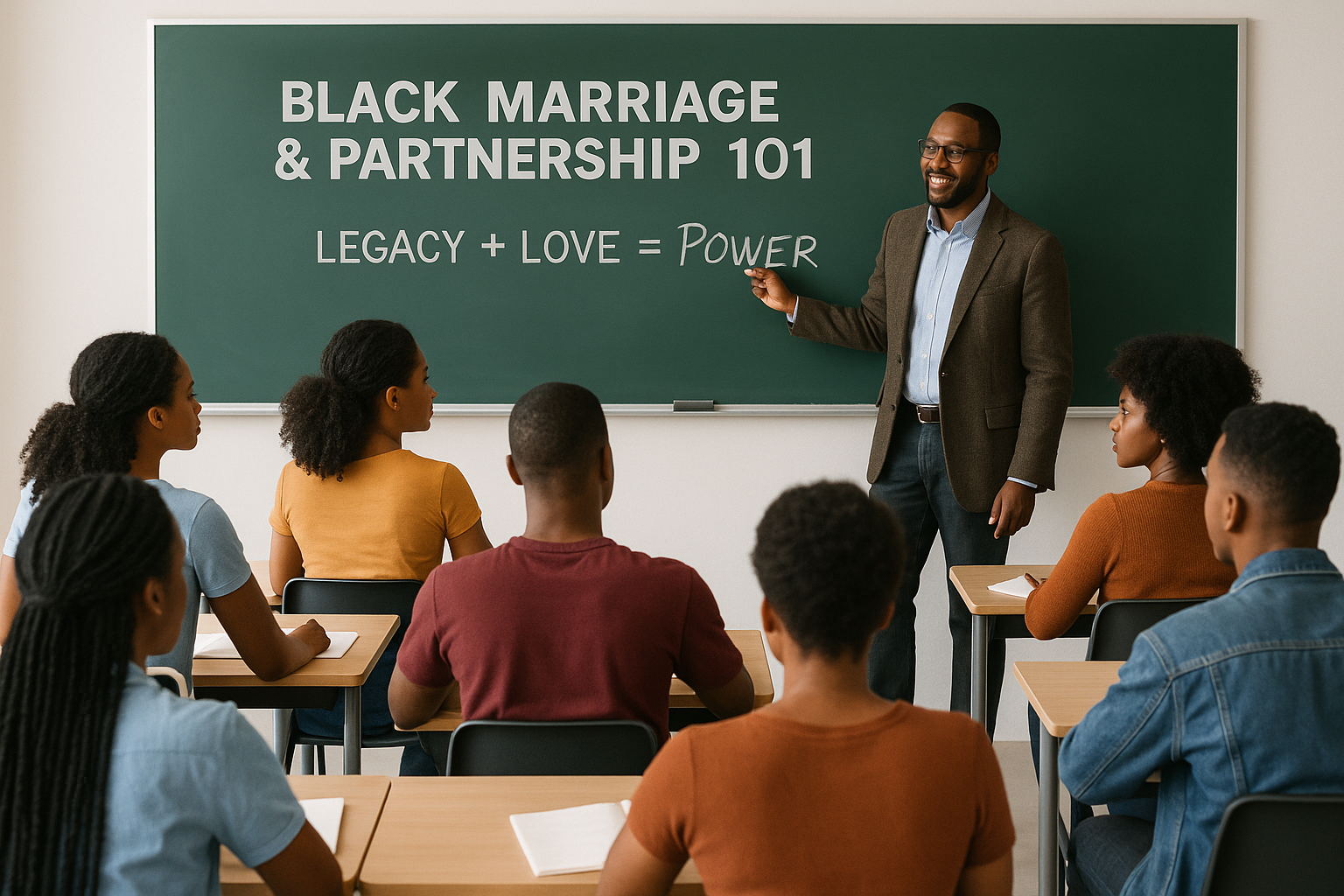
“Marriage is not just about two people. It is about generations. It is about legacy. It is about survival.” – Dr. Claudine Gay, former Harvard President
In a village that depended on a single hearth for warmth, the keeping of the fire was once a taught craft passed from elder to apprentice, tended with discipline, understood as the difference between a community that endured winter and one that scattered. Over generations, the village built schools for hunting, schools for building, schools for trade. But no one built a school for the fire. Slowly, fewer hands knew how to keep it lit. Neighbors blamed the wind, the wet wood, the weather. Few asked why the village had stopped teaching the one skill that kept every other institution warm enough to function. The fire did not go out because the people stopped valuing it. It went out because no institution took responsibility for keeping the knowledge alive.
African American marriage is that fire, and the data on its decline describes an institutional failure rather than a cultural one. According to Census Bureau figures, roughly 30 percent of African American adults were married as of the most recent American Community Survey data, compared with 48 percent of the general population, a gap that has widened steadily since the 1960s, when Black marriage rates were comparable to or higher than the national average. This is not a story about African Americans falling out of love with the institution of marriage. It is a story about an institution — Black marriage — losing the infrastructure that once supported it, without any comparable institution stepping in to replace that support.
The consequences extend well beyond the household. Marriage has historically functioned as one of the more reliable engines of capital retention available to any community: pooled income, shared debt reduction, dual-earner asset accumulation, and consolidated intergenerational transfer. Brookings Institution research has repeatedly found that married-couple households experience substantially lower poverty rates than single-parent households, and that children raised in stable two-parent homes show measurably better outcomes in educational attainment and economic mobility. For a community already contending with a fractional share of national wealth relative to population, the erosion of marriage as a mainstream institution is not incidental to the wealth gap — it is one of its active mechanisms. Every dissolved partnership typically means divided assets, duplicated housing costs, and a disrupted trajectory toward the kind of multigenerational capital formation that built family land holdings, small businesses, and college funds in prior generations.
The historical record makes clear that this was not always the pattern. W.E.B. Du Bois, in his early sociological studies of Black family life, documented how enslavement had deliberately disrupted African American marriage and kinship structures, and how formerly enslaved people responded to emancipation in part by rushing to formalize marriages that slavery had denied them any legal standing to protect. The Reconstruction-era freedpeople who built schools, mutual aid societies, and land cooperatives were frequently organized around married households functioning as economic units; the marital pair was, in a very literal sense, load-bearing infrastructure for Black institution-building in that era. What has since eroded is not the aspiration toward that model but the institutional scaffolding that made it achievable: stable employment, intact communities, and critically any structured space where the skills of sustaining a marriage were taught with the same seriousness as a trade.
This is precisely the vacuum HBCUs are positioned to fill, and the case for doing so does not require sentimental appeals to romance or nostalgia. It requires only that HBCUs apply the same institutional logic to family formation that they already apply to workforce development. An HBCU curriculum trains accountants, engineers, and physicians because the community needs functioning professionals; the same community needs functioning households, and no other institution in the African American ecosystem (not churches, not employers, not government agencies) is as well positioned to deliver rigorous, scaled, cross-disciplinary instruction on the mechanics of sustaining a marriage. Fisk University’s long tradition in sociology, Tougaloo College’s history of community-facing scholarship, and Grambling State’s applied family and consumer sciences programs all suggest existing academic infrastructure that could be redirected toward this purpose without requiring new departments built from scratch.
A serious marriage curriculum at an HBCU would resemble a professional program more than a personal-development seminar. It would draw faculty from economics departments to teach household financial planning and joint asset management; from psychology and counseling programs to address conflict resolution and intergenerational trauma; from history departments to contextualize how slavery, segregation, and mass incarceration shaped contemporary Black relationship patterns; and from business schools to examine how marital partnership functions as a structural input into family enterprise, drawing on the same case-study method used to teach corporate strategy. Institutions like Delaware State University and Norfolk State University, both of which maintain applied social science and business programs, could pilot such coursework without significant new capital investment. Coppin State and Savannah State, serving urban populations directly affected by the economic pressures driving marriage decline, would be logical sites for community-facing certificate offerings rather than undergraduate electives alone.
That continuing-education dimension matters as much as the classroom version. HBCUs already operate certificate programs in fields like nonprofit management and workforce development; a Certificate in Household Formation and Family Economics, offered through evening or weekend cohorts, could extend access to alumni, local community members, and couples well past traditional college age. Institutions such as Alcorn State and Fort Valley State, both deeply embedded in the agricultural economies of their regions, could frame this instruction around the long Black Southern tradition of the marital household as an economic production unit — a farm run by a married couple, a family business built jointly — rather than importing a therapeutic model disconnected from economic reality. Xavier University of Louisiana and Dillard University, both with strong pre-professional pipelines, could position the coursework alongside career preparation, treating relationship stability as a professional competency rather than a private matter.
None of this should be mistaken for a claim that curriculum alone resolves a decline rooted in economic insecurity, mass incarceration, and structural exclusion from stable employment. Those forces are real, and no fifteen-week course reverses them. But HBCUs have never waited for surrounding conditions to be favorable before building institutions; the founding of Black colleges in the aftermath of emancipation happened precisely because no one else was going to build the educational infrastructure African Americans needed, regardless of how hostile the broader environment was. Treating marriage education as a fringe offering, best left to churches or private counseling, concedes an institutional responsibility that HBCUs are better resourced to carry at scale. Cheyney University and Lincoln University, as the nation’s oldest HBCUs, carry a particular symbolic weight in reclaiming this ground, institutions whose founding generation understood family stability as inseparable from the broader project of Black institutional survival.
The strategic case is ultimately about capital retention and institutional density, the same throughlines that govern every other domain of HBCU strategy. A stable married household retains capital inside the family rather than losing it to divided assets and duplicated costs. It concentrates two incomes, two networks, and two sets of institutional relationships rather than diffusing them. And it strengthens the density of Black institutional life by producing the next generation of donors, alumni, and community stakeholders from intact family units with the resources to sustain that engagement. HBCUs already understand that they are training more than individual professionals, they are building the institutional backbone of a community. Treating marriage as infrastructure worth teaching, rather than a private matter outside the university’s mandate, is a natural extension of that mission, not a departure from it.
Disclaimer: This article was assisted by ClaudeAI.
“Nobody ever helps me into carriages, or over mud-puddles, or gives me any best place! And ain’t I a woman?” – Sojourner Truth
An Analysis of How White Womanhood Receives Redemption While Black Women Face Permanent Condemnation
When Julia Roberts climbed into Richard Gere’s Lotus Esprit on Hollywood Boulevard in 1990’s Pretty Woman, she embarked on a journey that would transform her from streetwalker to America’s sweetheart. The film grossed $463 million worldwide, launched Roberts into superstardom, and cemented itself as one of the most beloved romantic comedies in cinematic history. But beneath its glossy veneer of designer shopping bags and opera dates lies a troubling reality: this fairy tale was only ever written for white women.
The premise is deceptively simple. Vivian Ward, a Hollywood prostitute, is hired by wealthy businessman Edward Lewis for a week of companionship. What begins as a transactional arrangement blossoms into love, culminating in Edward rescuing Vivian from her fire escape—the knight in shining armor arriving in a white limousine. The audience cheers. America swoons. And a sex worker becomes a princess.
Now, imagine if Vivian Ward had been Black.
Pretty Woman operates on a fundamental assumption: that its protagonist deserves redemption, transformation, and ultimately, love. Vivian is presented as a victim of circumstance, a woman who “ended up” in sex work, whose intelligence and charm were simply waiting to be discovered by the right man. The film invites us to see past her profession, to recognize her inherent worth, and to celebrate her elevation into respectability. This grace, the permission to be flawed, to make mistakes, to be seen as complex and worthy despite one’s past is a privilege historically reserved for white women in American culture. It is the same grace that allows a reality television star to build a billion-dollar empire after a sex tape, while a Black woman who tells her own story about the entertainment industry becomes permanently marked.
The comparison between Kim Kardashian and Karrine Steffans (also known as Elisabeth Ovesen) illuminates this disparity with devastating clarity. Both women became famous through their connections to the entertainment industry and their sexuality. Yet their trajectories could not be more different. In 2007, a sex tape featuring Kim Kardashian and singer Ray J was leaked to the public. Rather than becoming a scarlet letter, this moment became the launchpad for one of the most successful media empires in modern history. Kardashian settled her lawsuit against the distributor for a reported $5 million, and months later, Keeping Up with the Kardashians premiered on E!.
Today, Kardashian is a billionaire businesswoman worth an estimated $1.7 billion. She has founded multiple successful companies including Skims, valued at over $4 billion. She has graced the covers of Vogue, been named to Time’s 100 Most Influential People, and received the Innovation Award at the prestigious CFDA Awards. She is pursuing a law degree and advocates for criminal justice reform, meeting with presidents and earning praise for her activism. The media narrative around Kardashian has evolved from scandal to legitimacy, from reality star to mogul. While critics occasionally invoke her sex tape, it exists largely as historical context rather than permanent condemnation. She has been granted the space to grow, to rebrand, to become something more than her past. Like Vivian Ward, Kim Kardashian has been rescued not by a wealthy man, but by a culture willing to let her write her own redemption arc.
In 2005, Karrine Steffans published Confessions of a Video Vixen, a memoir detailing her experiences in the hip-hop industry, including her work as a video vixen and her relationships with various entertainers. The book became a New York Times bestseller and sparked important conversations about the exploitation of women in the music industry, power dynamics, and female agency. But unlike Kardashian’s ascent, Steffans faced immediate and sustained backlash. She was vilified, ostracized, and permanently labeled. In a recent interview with Essence magazine commemorating the 20th anniversary edition of her book, Steffans who now using her birth name, Elisabeth Ovesen—reflected on the devastating impact: “Make no mistake about it, the way the public has treated me, the way the press has treated me, and the way that everyone has talked about me, made up lies about me, vicious lies that are still circulating in the press today, have ruined a lot of my relationships.”
Ovesen describes two decades of being “physically and emotionally beaten by the people in my life” and fighting “to stay alive.” She notes that “there’s been this cloud over me for 20 years,” affecting her ability to work, to form relationships, to simply exist without the weight of public condemnation. The contrast is stark. Kardashian parlayed a sex tape into a multi-billion dollar empire. Steffans wrote about her own experiences and became a pariah. One woman was granted grace and opportunity; the other faced professional exile and personal destruction. The difference in their treatment cannot be separated from race. American culture has long operated on a racialized system of respectability politics in which white womanhood is protected, salvageable, and worthy of redemption, while Black womanhood is disposable, permanently marked, and beyond repair.
This dynamic is rooted in historical systems of oppression. During slavery, white women were placed on pedestals as symbols of purity that needed protection, while Black women were systematically raped and denied any claim to virtue or protection. These ideologies didn’t disappear with emancipation they evolved, shaping everything from Jim Crow laws to contemporary media representations. Pretty Woman is a cinematic embodiment of these racial hierarchies. The film’s entire premise depends on the audience believing that Vivian deserves to be saved, that her circumstances don’t define her worth, that she is capable of transformation. This narrative of redemption is inherently tied to her whiteness.
A Black Vivian Ward would never have made it past the hotel lobby. The same Rodeo Drive saleswomen who snubbed Vivian for her appearance would have called security. The opera patrons who glanced at her with mild curiosity would have stared with open hostility. And Edward Lewis—wealthy, powerful, white—would never have seen her as a potential partner worthy of rescue. More likely, she would have remained a transaction, an object, a stereotype. But here’s the deeper, more painful truth: even if Edward Lewis had been Black, the fairy tale likely still wouldn’t have worked. A wealthy Black businessman might have hired a Black Vivian for the week, might have enjoyed her company, might have been attracted to her but the progression from transaction to transformation, from escort to equal partner, from sex worker to wife would have been profoundly unlikely.
This isn’t speculation it’s a pattern borne out in real-world dynamics. Successful Black men, particularly those who have achieved wealth and status in predominantly white spaces, often internalize the same white supremacist beauty standards and respectability politics that devalue Black women. They pursue white partners as status symbols, as evidence of their arrival, as markers of their distance from the “ghetto” or the “struggle.” A Black woman with a complicated past, with a history of survival sex work, with anything less than a perfect respectability résumé, is often deemed unworthy of the ring even, and sometimes especially, by Black men.
The real-life example of Kim Kardashian demonstrates this dynamic perfectly. Kanye West, a Black man from Chicago’s South Side who achieved massive success in music and fashion, married a white woman with a publicly distributed sex tape, elevated her, celebrated her, called her his muse, and gave her his children and his name. He saw past her history to her potential as a partner. Meanwhile, Karrine Steffans, a Black woman who survived childhood rape, domestic violence, and exploitation in the same entertainment industry, has been systematically rejected, abused, and deemed unworthy of commitment by the Black men in her life.
This reveals something devastating about internalized racism and misogynoir (the specific hatred of Black women). Black men who would marry white women “despite” their pasts often cannot extend that same grace to Black women. The white woman’s transgressions are forgivable, even invisible as evidence of her complexity, her journey, her humanity. The Black woman’s identical or lesser transgressions are permanent stains as evidence of her unworthiness, her damage, her fundamental unfitness for respectability.
So even in an imagined version of Pretty Woman with a Black Edward Lewis, the barriers facing a Black Vivian would remain nearly insurmountable. He might desire her, might enjoy the fantasy, might even genuinely care for her but marry her? Introduce her to his business associates? Make her the mother of his children? The social, psychological, and cultural obstacles would be formidable. She would still be fighting against centuries of messaging that Black women are sexually available but emotionally disposable, useful for pleasure but unworthy of partnership, good enough for right now but never for forever.
Perhaps nowhere is this racialized double standard more painful than in the realm of romantic relationships with Black men. Kim Kardashian has been married to and in long-term relationships with multiple Black men, most notably music producer Damon Thomas (her first husband), NFL player Reggie Bush, and the aforementioned rapper Kanye West (with whom she had four children) and none of whom held her past against her. Her sex tape, her reality television persona, her public relationships none of these factors prevented her from being pursued, married, and elevated by Black men in the entertainment industry. Kanye West collaborated with her professionally, and defended her publicly. Their 2014 wedding in Florence was described by The New York Times as “a historic blizzard of celebrity.” Despite their eventual divorce, West treated Kardashian as worthy of commitment, partnership, and the prestige of his name. Her past was irrelevant to her worthiness as a wife and mother in his eyes.
In stark contrast, Karrine Steffans has faced systematic rejection and abuse from Black men, both publicly and privately. Ovesen describes in the Essence interview spending “a lot of the last 20 years being physically and emotionally beaten by the people in my life; by the men in my life, by my former husbands, by my fiancés, by people just really treating me like garbage everywhere I go.” The message is clear: a white woman with a publicly documented sexual past can marry multiple Black men and be treated as a prize. A Black woman who speaks honestly about her experiences in the same entertainment industry becomes unmarriageable, unworthy of basic respect, deserving of violence and abandonment.
This dynamic reveals a disturbing truth about how Black men despite their own experiences with racism often participate in the devaluation of Black women while extending grace to white women that they deny their own. The same men who might celebrate Kardashian’s beauty, entrepreneurship, and motherhood have labeled Steffans as damaged goods, a cautionary tale, someone who violated the code by speaking truth to power. This individual disparity reflects broader statistical realities about marriage and relationship opportunities for white versus Black women. According to sociological research, white women are significantly more likely to be married than Black women across all education and income levels. In fact, white women who enter into relationships with Black men have higher marriage rates than Black women generally, a devastating indicator of how racial hierarchies shape intimate partnerships.
Even when controlling for comparable backgrounds and circumstances, a white woman is more likely to secure marriage and long-term commitment than a Black woman. This reality holds true whether that white woman is partnering with a white man or a Black man. The common denominator is not the race of the male partner, but the racial privilege of white womanhood itself. Kardashian’s romantic history exemplifies this phenomenon. Despite a sex tape, despite a 72-day marriage that many suspected was a publicity stunt, despite the constant media scrutiny of her relationships and body, she has never struggled to find partners willing to commit to her. She has been engaged multiple times, married three times, and has consistently attracted high-profile men who treat her past as irrelevant to her present worthiness. Meanwhile, Ovesen notes that the cloud over her reputation “has stopped me from doing certain things and caused certain people to not want to work with me, be around me, or get to know me.” The permanent scarlet letter she carries has affected every aspect of her life, including her ability to form healthy romantic relationships.
This disparity speaks to how Black women are uniquely devalued in American society. They face discrimination from white men who may fetishize them but rarely see them as worthy of commitment. They face rejection from Black men who have internalized white supremacist standards of beauty and respectability. And they face judgment from society at large that denies them the grace, forgiveness, and second chances routinely extended to white women. The differential treatment of Kardashian and Steffans reveals the impossible bind facing Black women. When Kardashian capitalized on her sexuality and media attention, she was entrepreneurial, savvy, taking control of her narrative. When Steffans wrote honestly about her experiences in an industry that commodified her body, she was a “tell-all” author, a betrayer, someone who violated unspoken codes by speaking her truth.
This reflects a broader pattern in which Black women are held to standards that are simultaneously more rigid and more dismissive than those applied to white women. Black women must be twice as good to get half as far, yet even perfection offers no protection from racism and misogyny. And when women transgress respectability politics as both Steffans and Kardashian did, albeit in different ways only one is granted the opportunity for redemption. The Eurocentric beauty standards that pervade American culture compound this injustice. Pretty Woman‘s transformation scenes emphasize Vivian’s adherence to conventional (read: white) standards of beauty—her hair, her clothes, her manner of speaking. These scenes suggest that respectability and worthiness are achieved through proximity to whiteness. Black women navigating these same spaces face additional barriers. Natural Black hair is deemed “unprofessional.” Black bodies are simultaneously hypersexualized and demonized. Black women’s anger is characterized as threatening rather than justified. The path to respectability that Vivian walks is not available to women who cannot or will not conform to white cultural norms.
Pretty Woman ultimately sells a meritocratic fantasy: that Vivian’s intelligence, charm, and inherent goodness allow her to transcend her circumstances. It suggests that worth is innate and will be recognized by those with the power to elevate it. This is the American Dream in romantic comedy form. But this dream is not equally accessible. Ovesen’s experience demonstrates that Black women can possess all the talent, intelligence, and determination in the world and still face insurmountable obstacles not because they lack merit, but because the system is designed to exclude them.
Ovesen is a bestselling author who has written multiple books, including The Vixen Manual and The Vixen Diaries. She is a literary coach helping other writers. She has been in therapy since 2006, working on her healing and growth. Yet she remains defined by decisions made decades ago, unable to escape the narrative that was written about her rather than by her. Meanwhile, Kardashian who has faced her share of criticism has been allowed to evolve. She is a businesswoman, a mother, an advocate, a law student. Her past is acknowledged but doesn’t define her present. She embodies the Pretty Woman promise: that transformation is possible, that redemption is available, that one’s history doesn’t have to determine one’s future.
The 20th anniversary edition of Confessions of a Video Vixen arrives at a moment when conversations about women’s autonomy, exploitation in entertainment, and the power of storytelling are more urgent than ever. Ovesen’s reflections on her journey offer profound insights into the costs of truth-telling for Black women. “I believe in speaking up loudly and often, I believe in saying what’s true and what is right, no matter what the consequences are,” Ovesen told Essence. This courage to speak despite knowing the price, to refuse silence even when silence might have been safer deserves recognition and respect. Ovesen’s story also challenges us to reconsider whose narratives we celebrate and whose we condemn. Pretty Woman asks us to sympathize with a white sex worker, to root for her happy ending, to believe in her worthiness of love and transformation. Yet when a Black woman shares her own experiences navigating exploitation and commodification, she faces derision rather than empathy.
This double standard extends beyond individual women to shape cultural narratives about who deserves grace, who can be redeemed, and whose humanity is recognized. It reflects deeper structural inequalities in which Blackness and particularly Black womanhood is constructed as incompatible with innocence, worthiness, or complexity. Pretty Woman ends with Edward climbing Vivian’s fire escape, conquering his fear of heights to rescue the woman he loves. “She rescues him right back,” Vivian tells him, suggesting a partnership of equals. It’s a romantic conclusion that has captivated audiences for more than three decades. But this ending was never written for Black women. There is no knight coming to rescue Black women from systemic oppression, from racialized misogyny, from the impossible standards that demand perfection while denying opportunity. There is no fairy godmother to transform them, no shopping montage to signal their worthiness, no opera scene to demonstrate their hidden sophistication.
Instead, Black women like Ovesen must rescue themselves. They must heal in a world that continues to wound them. They must build lives and careers despite clouds that follow them for decades. They must center themselves, as Ovesen describes doing during the pandemic, because no one else will. “I spent a lot of the last 20 years being physically and emotionally beaten by the people in my life,” Ovesen shared. “I’ve just been fighting to stay alive, and it wasn’t until the pandemic that I was able to hyperfocus on my healing.” Her survival is its own form of triumph, even if it looks nothing like Hollywood’s version.
Thirty-five years after Pretty Woman premiered, we must reckon with the stories we tell and whose experiences they center. We must examine the grace we extend to some women while withholding it from others. We must acknowledge that race fundamentally shapes whose humanity is recognized, whose past can be overcome, and whose future holds possibility. Kim Kardashian’s success is not illegitimate (but even that is worthy of discussion) she has demonstrated business acumen, resilience, and strategic thinking. But her trajectory has been facilitated by structural advantages unavailable to Black women in similar circumstances. Her story is a Pretty Woman narrative because she had access to the grace economy, the benefit of the doubt, the cultural permission to evolve beyond her past.
Karrine Steffans deserves that same grace. So do countless other Black women who have been denied the opportunity to grow, to change, to be seen as more than their worst moments or their most difficult circumstances. Their stories matter. Their humanity matters. And the systems that determine whose redemption is possible and whose is permanently out of reach must be challenged and dismantled. The fairy tale ending of Pretty Woman was never meant for everyone. But perhaps it’s time to stop accepting that inequality as inevitable and start demanding that grace, opportunity, and redemption become truly universal. Because every woman regardless of race deserves the chance to rescue herself and be rescued in return.
Disclaimer: This article was assisted by ClaudeAI.
Analysis: European Americans’ unemployment rate was unchanged from July. Asian Americans decreased 30 basis points and Latino Americans increased 30 basis points from July, respectively. African America’s unemployment rate increased by 30 basis points from July.
AFRICAN AMERICAN EMPLOYMENT REVIEW
AFRICAN AMERICAN MEN:
Unemployment Rate – 7.1%
Participation Rate – 69.8%
Employed – 9,893,000
Unemployed – 753,000
African American Men (AAM) saw a increase in their unemployment rate by 10 basis points in August. The group had an increase in their participation rate in August by 190 basis points, there highest participation rate in the past five months. African American Men gained 270,000 jobs in August and saw their number of unemployed increase by 30,000.
AFRICAN AMERICAN WOMEN:
Unemployment Rate – 6.7%
Participation Rate – 61.4%
Employed – 10,260,000
Unemployed – 739,000
African American Women saw a increase in their unemployment rate by 40 basis points in August. The group increased their participation rate in August by 30 basis points. African American Women gained 13,000 jobs in August and saw their number of unemployed increase by 45,000.
AFRICAN AMERICAN TEENAGERS:
Unemployment Rate – 24.8%
Participation Rate – 29.3%
Employed – 590,000
Unemployed – 195,000
African American Teenagers unemployment rate increased by 310 basis points. The group saw their participation rate increased by 10 basis points in August. African American Teenagers lost 24,000 jobs in August and saw their number of unemployed also increase 25,000.
African American Men-Women Job Gap: African American Women currently have 367,000 more jobs than African American Men in August. This is an decrease from 624,000 in July.
CONCLUSION: The overall economy added 22,000 jobs in August while African America added 260,000 jobs. From Reuters,”The warning bell that rang in the labor market a month ago just got louder,” Olu Sonola, head of U.S. economic research at Fitch Ratings in New York, said in reference to the U.S. labor market. “A weaker-than-expected jobs report all but seals a 25-basis-point rate cut later this month.” Fed Chair Jerome Powell had already reinforced rate cut speculation with an unexpectedly dovish speech at last month’s Fed symposium in Jackson Hole.”
Analysis: European Americans’ unemployment rate increased 10 basis points. Asian Americans increased 40 basis points and Latino Americans increased 20 basis points from June, respectively. African America’s unemployment rate increased by 40 basis points from June.
AFRICAN AMERICAN EMPLOYMENT REVIEW
AFRICAN AMERICAN MEN:
Unemployment Rate – 7.0%
Participation Rate – 67.9%
Employed – 9,623,000
Unemployed – 723,000
African American Men (AAM) saw a increase in their unemployment rate by 10 basis points in July. The group had a precipitous drop in their participation rate in July by 90 basis points. African American Men lost 129,000 jobs in July and saw their number of unemployed increase by 2,000.
AFRICAN AMERICAN WOMEN:
Unemployment Rate – 6.3%
Participation Rate – 61.1%
Employed – 10,247,000
Unemployed – 694,000
African American Women saw a increase in their unemployment rate by 50 basis points in July. The group increased their participation rate in July by 20 basis points. African American Women lost 1,000 jobs in July and saw their number of unemployed increase by 60,000.
AFRICAN AMERICAN TEENAGERS:
Unemployment Rate – 21.7%
Participation Rate – 29.2%
Employed – 614,000
Unemployed – 170,000
African American Teenagers unemployment rate increased by 250 basis points. The group saw their participation rate decreased by 80 basis points in July. African American Teenagers added 37,000 jobs in July and saw their number of unemployed also increase 15,000.
African American Men-Women Job Gap: African American Women currently have 624,000 more jobs than African American Men in July. This is an increase from 496,000 in June.
CONCLUSION: The overall economy added 73,000 jobs in July while African America lost 166,000 jobs. From CNBC, “This is a gamechanger jobs report,” said Heather Long, chief economist at Navy Federal Credit Union. “The labor market is deteriorating quickly.” The weak report, including the dramatic revisions, could provide incentive for the Federal Reserve to lower interest rates when it next meets in September. Following the report, futures traders raised the odds of a cut at the meeting to 75.5%, up from 40% on Thursday, according to CME Group data.”
Analysis: European Americans’ unemployment rate has remained steady for four straight months with virtually no change in unemployment rate. Asian Americans decreased 10 basis points and Latino Americans decreased 30 basis points from May, respectively. African America’s unemployment rate increased by 80 basis points from May.
AFRICAN AMERICAN EMPLOYMENT REVIEW
AFRICAN AMERICAN MEN:
Unemployment Rate – 6.9%
Participation Rate – 68.8%
Employed – 9,752,000
Unemployed – 721,000
African American Men (AAM) saw a increase in their unemployment rate by 170 basis points in June. The group had a mild rebound in their participation rate in June by 30 basis points. African American Men lost 117,000 jobs in June and saw their number of unemployed increase by 181,000.
AFRICAN AMERICAN WOMEN:
Unemployment Rate – 5.8%
Participation Rate – 60.9%
Employed – 10,248,000
Unemployed – 634,000
African American Women saw a decrease in their unemployment rate by 40 basis points in June. The group decreased their participation rate in June by 80 basis points. African American Women lost 84,000 jobs in June and saw their number of unemployed decrease by 50,000.
AFRICAN AMERICAN TEENAGERS:
Unemployment Rate – 19.2%
Participation Rate – 30.0%
Employed – 651,000
Unemployed – 155,000
African American Teenagers unemployment rate increased by 480 basis points. The group saw their participation rate increased by 210 basis points in June. African American Teenagers added 10,000 jobs in May and saw their number of unemployed also decrease 41,000.
African American Men-Women Job Gap: African American Women currently have 496,000 more jobs than African American Men in June. This is an increase from 463,000 in May.
CONCLUSION: The overall economy added 147,000 jobs in June while African America lost 193,000 jobs. From CNN, “It is becoming harder for Americans to find work: The average duration of unemployment rose from 21.8 weeks to 23 weeks, and the share of unemployed workers who have been out of a job for 27 weeks or longer rose to 23.3%, edging closer to a three-year high. Trump’s tariffs — and the dizzying back and forth on implementing them and pausing them — has caused many businesses to stall major decision-making or spending, including hiring.”