Tag Archives: black marriage

When the Music Changed: How “No Scrubs” and “No Pigeons” Reflected a Shift in Black Love

It is our duty to fight for our freedom. It is our duty to win. We must love each other and support each other. We have nothing to lose but our chains. – Assata Shakur
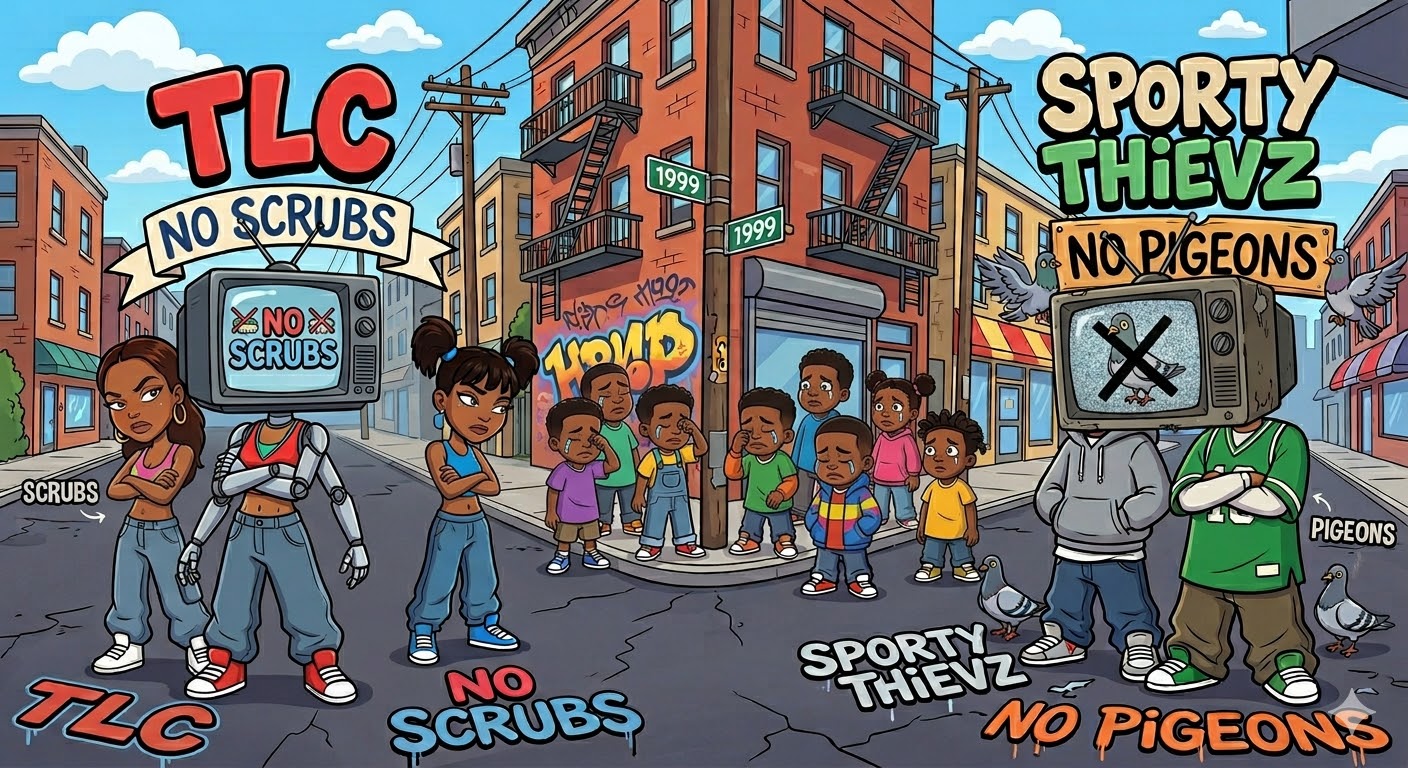
In February 1999, TLC released what would become one of the defining singles of their career. “No Scrubs” shot to number one on the Billboard Hot 100, where it remained for four consecutive weeks. The song’s message was clear and unapologetic: women were setting standards, and men who could not meet them need not apply. Within weeks, a relatively unknown rap group from Yonkers called Sporty Thievz fired back with “No Pigeons,” an answer record that used the same beat to deliver an equally scathing critique of women they deemed unworthy.

This exchange sparked what became known as a gender war on and off the airwaves, with radio stations playing both songs back-to-back and nightclubs dividing along battle lines — women shrieking in solidarity with TLC while men whooped for Sporty Thievz. Was this the inflection point where romantic and communal relationships between Black men and women began to fracture? Probably not. The roots run far deeper. But these songs crystallized something that had been building for years, a shift from celebration to criticism, from love songs to diss tracks, from the assumption of solidarity to the performance of mutual contempt.

Rewind a decade, and Black music told a fundamentally different story. The late 1980s and early 1990s gave us ballads that treated Black love not as a battlefield but as a sanctuary. Luther Vandross, Anita Baker, and Whitney Houston soundtracked weddings and anniversaries with a tenderness that affirmed the depth and dignity of Black romantic life. Mary J. Blige’s “Real Love” carried the longing of a generation. K-Ci & JoJo’s “All My Life” became a generational confession. Even within hip-hop, before the genre’s full commercial industrialization, there were moments of striking vulnerability. LL Cool J’s “I Need Love” in 1987 — a soft, earnest admission of emotional need — stood in productive tension with the bravado that would later become the genre’s commercial signature. These were not merely popular songs. They were cultural touchstones that told young Black people what love could look like, should look like. They were aspirational documents for a community’s interior life. And critically, the women in those songs, in those videos, on those album covers, looked like the community. They were Black women, centered and celebrated.

Something changed in the 1990s, and the change was not accidental. Dr. Dre and Snoop Dogg’s early albums codified a posture of romantic detachment, the deliberate rejection of love and respect for women, into hip-hop’s dominant vocabulary. This was compelling music that sold in enormous quantities, and in selling, it set a template. What had been one strand within a diverse genre became its commercial center of gravity. But the ideological shift ran deeper than misogyny alone. As hip-hop’s commercial footprint expanded through the mid-to-late 1990s and into the 2000s, something subtler and in some ways more psychologically damaging began appearing in the culture’s most visible spaces: the music video. The women cast as aspirational, as desirable, as worth pursuing began, with increasing frequency, to not be Black.

This was not happenstance. It was a pattern deliberate enough to be legible. As rap artists accumulated wealth and crossover appeal, the women featured alongside them in videos on yachts, in mansions, in the visual grammar of success skewed lighter, then non-Black altogether. The message embedded in those images was not subtle to anyone paying attention: arrival meant distance from Blackness. The highest expression of a Black man’s success, as the visual culture of the era constructed it, was access to women who were not Black. Video vixens of lighter complexions were elevated as the standard while dark-skinned Black women were marginalized or absent entirely. The beauty hierarchy being constructed in plain sight on BET and MTV was one in which Black women occupied an increasingly precarious position in the desirability calculus of their own community’s most prominent cultural exports.

By the time “No Scrubs” arrived in 1999, it landed in a culture already primed for conflict. Co-written by Kandi Burruss and Tameka “Tiny” Cottle during their downtime from Xscape, the song was a declaration of standards — women demanding ambition, respect, and genuine partnership rather than the attention of men riding in the passenger seat of someone else’s car. The demands were not unreasonable. Demands that ironically, many Black men would declare normal and reasonable from non-Black women. And within a media landscape designed to amplify division, what began as standard-setting quickly escalated into something more corrosive.

The response was immediate and polarizing. Radio stations hosted debates. BET reportedly edited both videos into a single seven-minute clip of gender war theater. MTV put both in heavy rotation. The media did not merely cover the conflict, it manufactured it into a cultural event, validating in the process the notion that Black men and women were not simply in disagreement but were fundamentally adversarial. Sporty Thievz’s rebuttal climbed to number 12 on the Billboard Hot 100, confirming that the antagonism resonated on both sides of the divide.

What made this moment significant was not the back-and-forth between two songs. It was what that back-and-forth revealed about the direction popular culture was pulling Black romantic life. These songs did not create the tensions between Black men and women. Economic dislocation, the carnage of the War on Drugs, and the structural dismantling of urban manufacturing bases had already placed enormous strain on Black households and Black partnership. Sociologist Elijah Anderson observed that young men in economically marginalized Black communities often pursued social status through the exploitation and diminishment of women, a pattern that commercial hip-hop both reflected and, once amplified at industrial scale, reinforced. The music industry, predominantly white-owned and indifferent to the social consequences of what it distributed, found conflict profitable and invested accordingly. What the community was living, the industry packaged and sold back to it as entertainment.

But HBCU Money still believes in love so enjoy….

The visual erasure of Black women from the aspirational imagination of hip-hop did not stay confined to the screen. It seeped into everyday life with a thoroughness that was difficult to track precisely because it moved through private conversation, social expectation, and the slow accumulation of cultural messaging rather than through any single declarable event. By the early 2000s, a certain strain of public Black male discourse had begun treating dating or marrying non-Black women not merely as a personal preference but as a marker of status, sophistication, or liberation — a signal that one had transcended the presumed limitations of the community one came from. The logic was sometimes stated explicitly, more often implied: that Black women were too difficult, too loud, too independent, too damaged by their own circumstances to be worthy partners for men who had achieved something. The very qualities that had allowed Black women to survive conditions designed to break them were reframed as character defects.

This was not a fringe conversation. It became, with the amplification of the internet and eventually social media, a mainstream one relitigated endlessly in think pieces, radio debates, YouTube channels, and the comment sections of platforms that rewarded provocation over nuance. Black women responded with a mixture of hurt, anger, and their own declarations of independence from a community they felt had devalued them. Some began openly discussing dating outside their race with the same performative energy that had been directed at them. What had begun as a visual preference embedded in music videos had, over the course of a decade and a half, become a full-scale public negotiation over the terms of Black romantic belonging conducted almost entirely in the register of grievance.

The accumulated effect on a generation was not trivial. The words used to describe each other shape how people see each other, expect from each other, and ultimately what they believe is possible between each other. When the dominant narrative in the music young people consumed shifted from devotion to suspicion, from partnership to transaction, from vulnerability to armor, those shifts did not stay contained within the space of entertainment. They became internalized frameworks for courtship, for conflict, for what intimacy was permitted to look like. Young Black women who grew up hearing themselves described as pigeons, hoes, or gold diggers, and who watched the women in their favorite artists’ videos grow progressively less likely to resemble them, absorbed messages about their worth that the external world was already working hard to diminish. Young Black men who absorbed the message that emotional openness was weakness, that Black women were adversaries to be outmaneuvered or obstacles to be bypassed on the road to something better, were being trained away from the very capacities that stable, sustaining relationships require.

Flash forward to 2026, and the cultural inheritance of that era is visible everywhere. Online spaces where Black men and women engage have become, in many corners, theaters of mutual grievance and elaborate performances of self-protective independence that leave little room for the kind of trust that partnership demands. Love songs have become harder to find in mainstream Black pop, as though tenderness has been deemed commercially unviable. Artists like PJ Morton, who make soulful music about Black love in its full complexity, play smaller rooms while music that treats romantic relationships as contests dominates the charts. This is not to suggest that beautiful expressions of Black love have disappeared. They have not. But they have been pushed to the margins of a culture that once placed them at its center.

The stakes of this cultural displacement extend well beyond the personal. As HBCU Money has documented, the marriage rate among African Americans has dropped precipitously over the past several decades, from roughly 60 percent in the 1960s to just 29 percent in 2021 and that decline carries direct economic consequences for the community’s long-term wealth position. Black married couples held a median net worth of $131,000 in 2019, compared to only $29,000 for Black single individuals — a fourfold gap that represents not merely a lifestyle difference but a structural disadvantage in capital accumulation, homeownership, and the ability to transfer wealth across generations. A culture that spent two decades using its most powerful media to communicate that Black women were not the preferred partners of successful Black men, and that Black men were not worthy of Black women’s investment, did not simply produce unhappy relationships. It produced an economic headwind that compounds over time and registers now in the net worth data of an entire community.

None of this means that “No Scrubs” and “No Pigeons” caused the decline of Black marriage or the erosion of Black wealth. They did not. But they were early, loud signals of a cultural drift that institutions like HBCUs, Black media, Black churches, Black family networks were too slow to name and too under-resourced to counter. The music reflected life. But music also shapes life, and the failure to contest the direction that shaping was taking was itself a strategic failure.

The question now is not how to assign blame for the past quarter century. It is whether the community has the institutional will to consciously reconstruct the cultural narrative that was lost. That means creating material and institutional conditions in which stable Black partnership can flourish such as relationship education, financial literacy, community infrastructure that treats Black family formation as a strategic priority rather than a private matter. It means supporting artists who treat Black love as a subject worthy of complexity and craft rather than caricature. It means being deliberate, in public spaces, about the language used to describe one another and understanding that those descriptions accumulate into the expectations young people carry into their most formative relationships.

Before the gender wars, before the videos, before mutual contempt became entertainment and the erasure of Black women from Black men’s aspirational imagination became a cultural norm, Black music told a different story, one in which men and women were engaged in a common project, in which love was not weakness but the foundation of collective strength, and in which the most natural expression of a Black man’s success was a Black woman beside him. That story was not naïve. It was aspirational in the deepest sense: it named what the community was capable of and invited people to live up to it.

That story is still available to be told. The beat can carry a different message. Whether it does depends on what the community decides to demand, to create, and to believe is still possible.

Disclaimer: This article was assisted by ClaudeAI.
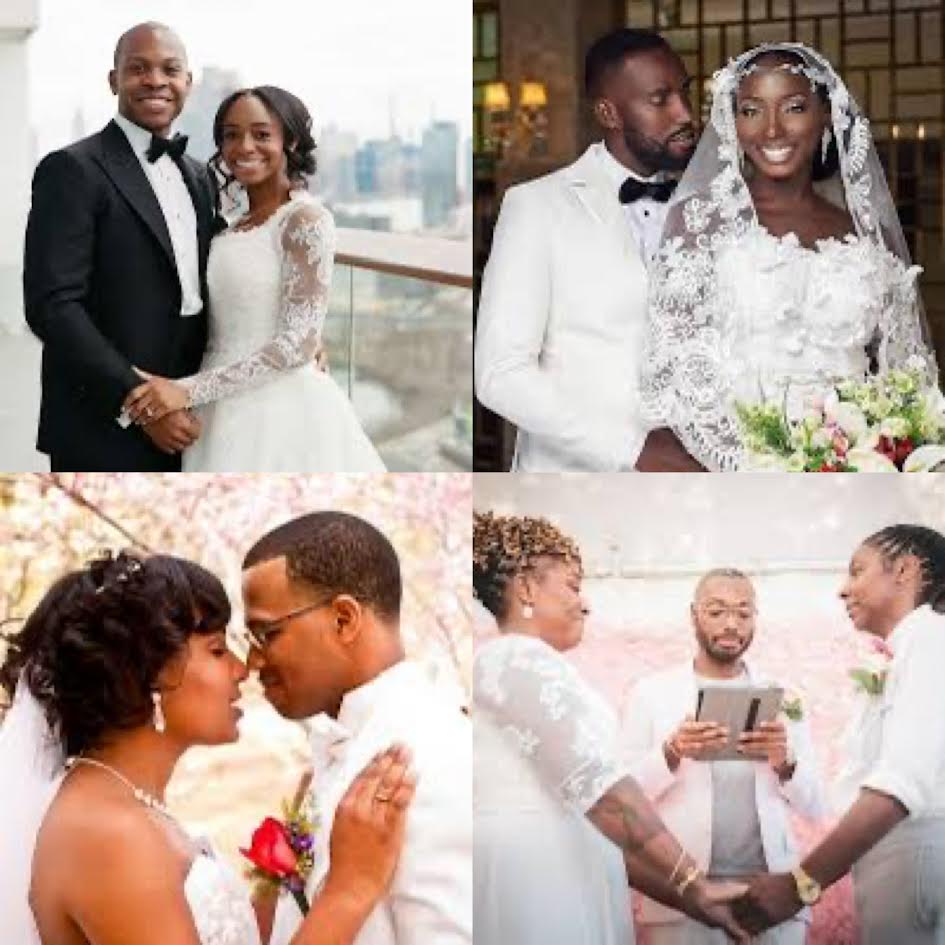
The Lack Of Marriage Is Holding Back African American Wealth – And How HBCUs Can Help

“Paradise is one’s own place, One’s own people, One’s own world, Knowing and known. Perhaps even Loving and loved.” – Octavia Butler

The declining marriage rates among African Americans are increasingly recognized as a significant factor holding back wealth accumulation within the community. This trend has profound implications for economic stability and intergenerational wealth transfer. Understanding the connection between marriage and wealth, along with relevant statistics, sheds light on this critical issue.

Married couples generally experience greater financial stability than single individuals. According to the U.S. Census Bureau, married couples tend to have higher median household incomes. In 2021, the median household income for married couples was approximately $100,000, compared to about $60,000 for single-parent households, which disproportionately include African American families.

Research has shown that marriage contributes significantly to wealth accumulation. A study by the Institute for Family Studies found that households headed by married couples have about three to four times the wealth of those headed by single individuals. Specifically, Black married couples had a median net worth of $131,000 in 2019, compared to only $29,000 for Black single individuals. This disparity highlights the financial advantages of marriage in building wealth.

From an economic development perspective, marriage plays a crucial role in the transfer of wealth between generations. Households with married parents are better positioned to pass down assets. A report from the Federal Reserve in 2019 indicated that only 45% of Black households had any wealth to pass on, compared to 70% of white households. The lack of marriage in the African American community limits opportunities for families to create and sustain intergenerational wealth.

It also has acute impact on social development within the African American community. Marriage can provide emotional and social stability, which is vital for sound financial decision-making. Couples often collaborate on budgeting, saving, and investing, leading to better financial outcomes. According to a Pew Research Center study, married couples are more likely to engage in long-term financial planning, further enhancing their wealth-building capacity.

The decline in marriage rates among African Americans is linked to systemic issues, including economic inequality, high incarceration rates, and historical trauma. The National Center for Family & Marriage Research reports that the marriage rate for African Americans has dropped significantly over the past few decades, from 60% in the 1960s to just 29% in 2021. Addressing these systemic barriers is essential for promoting stable relationships and supporting marriage as a pathway to wealth.

Cultural perceptions around marriage also play a role. While many African Americans value family and community, there may be less emphasis on traditional marriage structures. However, promoting awareness of the economic benefits of marriage within the community could encourage individuals to consider its advantages for wealth accumulation and stability.

Ways HBCUs Can Help Promote Black Marriage

HBCUs can play a pivotal role in promoting marriage within the African American community by implementing several strategies:

  • Educational Programs: HBCUs can offer workshops and seminars focused on relationship skills, financial literacy, and the benefits of marriage. By educating students on effective communication, conflict resolution, and financial planning, these programs can foster healthier relationships.
  • Mentorship and Counseling: Establishing mentorship programs that connect students with African American married couples can provide positive role models. Counseling services that focus on relationship dynamics and conflict resolution can also support students in building strong partnerships.
  • Community Engagement: HBCUs can organize community events that celebrate marriage and family life, encouraging students to engage with positive narratives around marriage. These events can include discussions, panels, and social activities that promote the value of committed relationships.
  • Collaborative Research: HBCUs can engage in research initiatives that explore the factors influencing marriage rates in the African American community. Understanding these dynamics can inform policies and programs aimed at supporting healthy relationships.
  • Scholarships and Incentives: Creating scholarship programs for students who participate in marriage enrichment programs can incentivize students to invest in their relationships while also promoting the value of African American marriage within the community.
  • Marriage Endowments: HBCU alumni can partner with the UNCF and Thurgood Marshall Fund to create an endowment that provides head start capital for African American marriages among their alumni. This head start capital can be disbursed at once or over a set number of years ensuring that couples get off to a financially stable start.

The decline in marriage rates among African Americans poses significant challenges to wealth accumulation and economic stability. By addressing the underlying issues and promoting the benefits of marriage, HBCUs can play a crucial role in fostering healthy relationships within the community. Implementing educational programs, mentorship opportunities, and community engagement initiatives can help strengthen marriage as a pathway to wealth and empower future generations to build a more financially secure future.

There is no African American community without the African American family and there is no African American family without African American marriage. At the very center of anything we discuss must be the institutional stabilization of the African American family and therefore African American marriages and partnerships. Right now the foundation of community and institution building is in crisis with no real way to stem the tide of the crisis. Building in more institutional support services for mental, physical, and nutritional health are just a few of the things needed along with financial stability programs would go a long way to the stability of African American marriage and partnerships. Generational wealth or generational poverty is on the line and great sacrifice must be made if we want the former and not more of the latter.

Would Huey & Riley Freeman Attend An HBCU?

“There is a place in God’s sun for the youth “farthest down” who has the vision, the determination, and the courage to reach it.” – Mary McLeod Bethune

It is no secret that desegregation crippled just about every African American owned institution from neighborhoods to businesses to HBCUs – and many would argue the foundational institutions of Black marriage and African American families themselves. African American institutional ownership was faced with having to compete for human capital of the very people whose interest they were built to serve and the institutional ownership that all other non-European American groups envy. In turn, our institutions experienced a mass exodus as African Americans believed that the grass was truly greener and ice colder on the Eurocentric side. Fast forward to today, many African Americans believe they live in a pseudo-meritocracy, a dystopian like post-racial world where even having African American institutions of our own is somehow un-American and participating in our own institutional spaces is a sign of being the “not quite good enough negro” as many of us attempt to impress the European American gaze. This despite other demographics firmly having their own such as Notre Dame for the European Catholics, Brandeis being a secular European Jewish institution, and of course Harvard the flagship WASP institution, so on and so on. Never mind that the majority of the HWCU/PWIs that tout “diversity” often have less than 5 percent African Americans on their campus – and the majority are often there only to play sports.

Case in point, the University of Texas who is one of the most profitable athletic program in the country has a less than 5 percent African American population on its campus. The numbers are even starker when it comes to African American males who make up less than 2 percent of overall campus population, but comprise around 70 percent of the football and basketball teams. HWCU/PWIs have shown one thing to be true, and that is they want the best and brightest of our young women and the fastest and strongest of our young men. HBCUs have been unable to compete due to misperception of inclusion and the reality of the resource/wealth gap between our communities that desegregation and the GI Bill largely caused. Many HBCUs go decades before they can raise enough funding for new facilities or scholarships. Harvard’s endowment in one year can lose more money than the amount all 100 plus HBCUs have combined and still be one of the largest higher education endowments in the world.

In an environment where higher education is getting more and more expensive, African American students who come from the group with the lowest median net worth and income in the country often make college choices based on financial needs more than most. The result, continued exodus and plummeting of African Americans choosing HBCUs due to the lack of scholarship and aid available and the ever present belief that white is right and better.. Currently, less than 10 percent of African American going to college are choosing HBCUs over HWCU/PWIs. A detriment to alumni sizes, social networks, donations, and most dire – HBCU endowments. Just increasing the 10 percent to 25 percent could stave off many of the financial woes facing HBCUs and start to bring circulation of intellectual and financial capital into African American institutions. So how can HBCUs recruit in “Woodcrest”? How do you recruit African Americans who have become immersed in non-Black communities to HBCUs? How do you recruit African Americans who are in African American communities that are impoverished and are only looking to get out? How do you recruit middle class and affluent African American families who have the financial resources African American institutions so desperately need? How do you get African Americans to care more about African American institutionalism than we do African American individualism?

Two of America’s most beloved animated characters of the past 20 years are Huey and Riley Freeman voiced by the regal and benevolent Regina King. The Boondocks first premiered in comic form in 1997 and by 2005 would find their way to television and into our hearts. Huey, the tormented revolutionary and his younger brother Riley, the wanna be thug/hustler and athlete who shows glimpses of artistic genius. Their grandfather, voiced by the late great John Witherspoon, has moved them to a predominantly European American suburb away from the Southside of Chicago’s predominantly African American community at the most formative time in their life. Grandpa Freeman is also part of the Civil Rights generation and is a friend of Dr. Martin Luther King, Jr.’s as it turned out in an episode called ‘The Return of the King’. A controversial episode, but poignant of what happens when children, in this case Riley, are removed from cultural immersion of our own community. Riley has no idea who Dr. Martin Luther King Jr. is and often refers to him as “Morgan Freeman King” in the episode. The irony should not be lost on the Morgan Freeman dig who himself believes Black History Month and being identified as African American is an insult. In another episode, this one more focused on Huey, entitled A Huey Freeman Christmas, Huey convinced his European American teacher to let him write and direct the Christmas play. Naturally, Huey being who he is makes Jesus Black and makes a very Afrocentric production that was ultimately seen by no one as parents of Huey’s European American classmates boycotted the play since their kids were not in it, appalled by its Afrocentricity, and ultimately had the teacher fired for being “irresponsible” highlighting how European Americans will put down one of their own to maintain institutional power. The school was named the J. Edgar Hoover Elementary after all, named for the notorious FBI who infiltrated, spied upon, and sought the destruction of everyone from Dr. Martin Luther King, Jr., Malcolm X, Black Panthers, and every other African American individual and institution he even remotely viewed as a threat to the European American institutional power structure.

Riley ignorant of his cultural identity, Huey militantly attempting to push his Afrocentricity into an Eurocentric institutional space, and Grandad feeling as if he has “made it” because he is able to eat cheese with The Man. This is the family you have to convince that an African American institution and space is the best place to be. There also is the influence of the community on Huey and Riley. Tom DuBois who is married to a European American woman, Uncle Ruckus who rails against all things Black – while being the darkest character on the show, Tom’s daughter Jazmine whom you are never quite sure how she identifies and that probably is the point, and countless others who throughout the show push against anything and everything that would empower African American institutionalism at all turns. In fact, there is no exposure or presence of any Black institutions on the show. The Boondocks one could argue was actually the forerunner to Blackish, but that is another article for another time. With so much pushing against Huey or Riley choosing an HBCU and their grandfather allowing them to attend an HBCU, how do we overcome such an obstacle? Is it possible? Is it even worth the energy?

The answer of course is – it is complicated. How do you win a war most of your population does not know it is in? Another part is turning every other cheek to be included and a proverbial peace that means its erasure? Those that do know they are in a war are fighting with antiquated strategies, equipment, and/or resources? HBCUs have limited resources and manpower to dedicate to recruiting. HBCUs one advantage is being an African American space, an African American institution dedicated to African American empowerment, or at least they were. Many HBCUs see making recruitment of African Americans a secondary objective in favor of more ethnic diversity – ignoring African American and Diaspora diversity as they attempt to parrot their PWI counterparts, declines in African American faculty and research geared towards African American interests becoming ever more pervasive – institutional gentrification by our own hands. In other words, many HBCUs are trying to become a watered down version of a PWI. This makes their case for recruiting even harder because of the aforementioned issues of limited resources and manpower. If a college student is going to choose a PWI versus an HBCU posing as a PWI knockoff, then usually they will go with the one who is the real thing so to speak. For those HBCUs trying to hold the line it is rough. They have to convince an African American population that does not want to live in or build African American communities, bank with African American banks, and see their ancestry as starting at slavery more than they see it internationalized with the Diaspora as Malcolm X and so many other Pan-Africanist have desperately tried to connect to little avail. That being educated by African Americans in an African American space as something valuable, worthwhile, and imperative to the African American community’s empowerment. A small task it is not.

How do we even get to students like Huey and Riley? Their geography is world’s away from any African American institution, their socialization will largely save for trips back to Chicago sparingly be within the confines of European American institutions and spaces, education will be firmly European American with a likelihood of an European American perspective on diversity being from European American majority ideology, and certainly it would be remiss to say that neither of their possible love interest are African American girls. Jazmine, the daughter of Tom and Sara DuBois, who is biracial and fits the cultural aptitude that often comes with those who have African American fathers and European American mothers where the mother drives the cultural nourishment and almost certainly are reared with an anti-Afrocentric value system. Riley’s probable love interest that is Cindy McPhearson, an European American girl, who shares a lot of the same interest and often similar toxic behaviors as Riley. One could argue they make even more sense should it play out than Huey and Jazmine from a qualitative level. All which was described, virtually none of it sits within an African American space or possibility. Yet, these are exactly the African American students you could argue we are in large part trying to recruit to HBCUs. This is the group that you need more than any other if you want to increase the African American rate choosing HBCUs to increase from 10 percent to 25 percent.

If African Americans are going to continue to not be proactive in the development of African American communities and empowerment of African American marriage and families then this entire conversation maybe for naught within a few generations as we will have self-gentrified ourselves out of existence. The question of how we get our talents and resources to prioritize the building of new African American institutions, supporting of existing African American institutions, and the empowering of all of our African American institutions is the central question for our survivability and furthermore our success as a people.

HBCU LOVE: Top Ten HBCU States With Highest African American Marriage Rate

Why is HBCU Money talking about marriage? We thought this was a site about money. Well, there are many economists and community developers that agree that one of the most fundamental ingredients to wealth building is marriage. It allows for scaling of capital towards savings and investment, reduction of expenses, and an ability to provide familial stability. Unfortunately, like our median income and wealth, there is no group less likely to actually get married than African Americans. The hurdles to African American marriage are deep and complicated and the solutions to them potentially even more deep and complicated. All that said, anything that leads to higher marriage rates between African Americans can only add to the community’s ability to actually stabilize and empower itself socially, economically, and politically. We of course acknowledge that marriages come in all forms, but the most important form is a healthy, happy, and loving marriage.

National African American Marriage Rate – 29.7%

  1. Virginia – 34.0%
  2. Maryland – 33.2%
  3. Delaware & Texas – 32.8%
  4. Florida & North Carolina – 31.3%
  5. Georgia – 30.9%
  6. Oklahoma – 30.0%
  7. Arkansas – 29.8%
  8. California – 29.7%
  9. Alabama & South Carolina – 29.4%
  10. Mississippi – 28.9%

The question then becomes how can HBCUs, their alumni, and other support organizations encourage more marriage among African Americans at HBCUs? This becomes vital for HBCU’s future because it could be suggested that a couple who both went to HBCUs would be more likely to send their child to an HBCU. Whereas a couple with only one HBCU parent present or no HBCU parents present is far less likely. To encourage coupling as part of an HBCU’s development strategy would by no means be simple given the ratio of women to men on HBCU campuses these days. Simply put, there are not enough men for women to choose from in the heterosexual relationships. And unless more data is collected on LGBTQ HBCU students, there may not be a viable quantity there for them either. This is why it would be important if this was to be considered that a network of HBCU development offices strategize together and increase the probability of matchmaking.

Tracking the statistics on HBCU marriage and family would also be immensely valuable information. An opportunity that certainly presents itself for further research by Hampton University’s National Center on African American Marriage and Parenting. Very little data is actually known on HBCU marriages and families.

Ultimately, HBCUs and their alumni though who can encourage more marriage among HBCU students/graduates must do so through ensuring those relationships are healthy. This means that there must be more mental and physical health development, financial literacy, and relationship etiquette taught. With seven of the ten HBCU states exceeding the national average for African American marriage the ingredients are certainly there for this seed to grow, but it indeed must be watered if we truly plan to see more marriage and healthier marriage which we know can also be one of the key tenets to community formation and building.

Source: U.S. Census