Tag Archives: economy

The Half of One Percent Problem: What Population Parity Would Actually Look Like for Black Banking

“African Americans love to quote that the dollar does not stay in our community but a few hours, which is true, but it is the belief that if they just buckle down and patronize more Black businesses. Unfortunately, until we understand institution to institution circulation and retention of capital, patronizing is just a redundant talking point. The same as trying to move oil – with no pipelines.” – William A. Foster, IV

A city plans for a population of five hundred thousand. It builds roads sized for five hundred thousand, schools sized for five hundred thousand, a water system sized for five hundred thousand. Then, by policy rather than accident, it allows only thirty thousand of those residents to ever draw water from the municipal system. The other four hundred seventy thousand are permitted to live in the city, work in the city, pay taxes to the city but they must find their water elsewhere, in smaller private wells scattered across town, each one a fraction of the capacity the city itself was built to provide. No one calls this a water crisis. They call it culture, or preference, or the free market sorting itself out. The wells keep drying up. The city keeps growing. Nobody asks why the math never closes.

That is, in miniature, the condition of African American banking in the United States in 2025. It is not a story about seventeen small institutions doing their best against long odds, though that story is true and worth telling. It is a story about scale; about what full institutional participation in the American banking system would actually require, measured in dollars, and about how far short of that requirement the current system sits. The gap is not rhetorical. It is arithmetic, and once it is laid out in full, it becomes difficult to discuss African American banking capacity using the language of individual bank performance at all. The conversation has to move to population, to proportion, and to the institutional habits that keep the proportion from closing.

Start with the top of the American banking system. As of March 31, 2026, the seventeen largest U.S. domestically chartered commercial banks by consolidated assets led by JPMorgan Chase at just over $4.0 trillion, followed by Bank of America, Citibank, Wells Fargo, and thirteen others hold a combined $16.36 trillion in assets. Now set beside that figure the complete universe of African American-owned banks in the country: seventeen institutions, spanning fifteen states and territories, holding a combined $6.72 billion. The ratio between the two groups is roughly 2,432 to 1. JPMorgan Chase alone holds approximately 597 times the combined assets of every African American-owned bank in the country put together. Liberty Bank & Trust of New Orleans, the single largest African American-owned bank in America at $1.1 billion, is outweighed by JPMorgan Chase alone at a ratio of roughly 3,634 to 1.

The scale of that gap becomes easier to hold in mind with a single object. In October 2025, JPMorgan Chase opened its new global headquarters at 270 Park Avenue in Manhattan; a 1,388-foot tower designed by architect Norman Foster, built at a reported cost of approximately $4 billion. The building alone cost nearly 60 percent of the combined total assets of every African American-owned bank in the United States. JPMorgan Chase did not draw down its balance sheet to build it, did not strain its capital position, and continued operating as the largest bank in the world throughout construction. The tower is, in other words, a rounding error for JPMorgan Chase and very nearly the entire African American banking sector’s balance sheet at the same time, the same dollar figure describing two entirely different orders of magnitude, depending on which side of the ledger it sits.

These comparisons are dramatic, but they are also, in a sense, unfair not to African American banks, but to the argument. Comparing seventeen community and regional institutions to the seventeen largest banks in the wealthiest economy in human history will always produce a lopsided ratio; the same exercise run against Sweden’s entire banking sector would look similarly stark. The more useful question, and the one that actually measures institutional health, is proportional. What share of America’s banking assets would African American-owned banks hold if African America held banking assets in proportion to its share of the American population — no more, no less, simply parity?

The U.S. Census Bureau’s 2025 population estimates place the Black-alone population of the United States at approximately 46.2 million people, or roughly 13.5 percent of the national population. HBCU Money’s own 2025 African American Owned Bank Directory places total FDIC-tracked domestic bank assets at approximately $24.9 trillion. If African America held banking assets proportional to its population share of the country, African American-owned banks would need to control approximately $3.36 trillion in assets or 13.5 percent of $24.9 trillion. The actual figure, again, is $6.72 billion. The gap between where population parity would place African American banking capacity and where it actually sits is approximately $3.355 trillion. To close that gap through organic growth at current rates where the sector’s total assets grew from $6.4 billion in 2024 to $6.7 billion in 2025, a $326 million increase would take not years or decades but centuries. Put differently: African American-owned banks would need to be roughly 500 times larger, in aggregate, than they are today simply to reach proportional representation. Not to dominate the banking sector. Not to overtake it. To match it.

It is worth sitting with what $3.36 trillion actually represents, because the number is large enough to lose its meaning through repetition. It is larger than the GDP of every country on earth except roughly the top eight. It is more than five hundred times the combined assets of every African American-owned bank that currently exists. It is, notably, not money that needs to be created from nothing it already exists, circulating through the American banking system, much of it deposited by African American individuals, businesses, churches, fraternities and sororities, professional associations, and institutions, simply routed through banks that are not African American-owned. The gap is not primarily a wealth-creation problem, though wealth creation matters. It is a capital-retention and capital-routing problem. The money exists. It is banking somewhere else.

This is where the conversation has to move from macroeconomics to institutional behavior, because the population-parity gap cannot be explained by African American banks lacking capable leadership, sound underwriting, or FDIC compliance. It has to be explained by where African American capital — individual, corporate, and institutional — chooses to be deposited, and the data on that question is uncomfortable. HBCU Money’s 2023 analysis of HBCU banking relationships found that of the country’s 107 HBCUs (U.S. Department of Education designation) and roughly 68 to 104 Predominantly Black Institutions (a federally designated but demographically fluid category, per the Postsecondary National Policy Institute), together approximately 200 institutions, only two were believed to bank with an African American-owned institution: Florida Memorial University, an HBCU, and Roxbury Community College, a PBI, both of which bank with OneUnited Bank. That means the overwhelming majority of the flagship educational institutions of Black America, the same institutions publicly organized around the mission of Black advancement, do not patronize the Black banking sector at all. This is not a scattered oversight. It is a structural pattern, and it repeats across nearly every category of African American institution: businesses, chambers of commerce, professional associations, churches, fraternal organizations, and nonprofits overwhelmingly bank with mainstream white-owned lenders, not because those lenders are barred by any law from serving them, but because institutional inertia, existing banking relationships, perceived convenience, and — bluntly — habit route the capital elsewhere by default.

Consider the case that HBCU Money’s 2023 piece surfaced: Howard University, the most prominent HBCU in the country, entered a five-year, $3.4 million-per-year partnership with PNC Bank to fund an entrepreneurship center on its own campus. PNC is a fine institution and the grant funded real programming. But PNC’s consolidated assets stand at roughly $568 billion as of early 2026, an amount that dwarfs the combined assets of every remaining African American-owned bank many times over, while Industrial Bank, an African American-owned institution with over $770 million in assets, sits a few miles away in the same city Howard calls home, unbanked by the university it neighbors. This is not a story about villainy. PNC did not do anything wrong by funding a center at Howard. It is a story about institutional default: when the moment came to choose a banking partner, the largest, most convenient, most established option was chosen, and the community institution built to receive exactly this kind of patronage was not seriously considered as an alternative. Multiply that single decision by every HBCU, every Black professional association, every African American-owned business banking outside the sector, every fraternity and sorority housing its national treasury with a conventional lender, and the population-parity gap stops looking mysterious. It looks like the predictable output of thousands of individually reasonable decisions that, in aggregate, produce collective institutional abandonment.

The deeper issue is what might be called the B2B lapse in African America’s institutional framework, the absence of a functioning business-to-business and institution-to-institution circulation system comparable to what other ethnic economic communities maintain as a matter of course. Economic development research has long noted that a dollar circulating within a tightly networked community; Asian immigrant enclaves, Jewish community networks, historically insular white ethnic communities tends to pass through many hands and institutions before leaving that community’s economic orbit, sometimes for weeks. The African American dollar, by contrast, is frequently cited as leaving the community’s economic orbit within hours, not because African American consumers spend irresponsibly, but because the institutional infrastructure that would capture and recirculate that dollar: Black-owned suppliers banking with Black-owned banks, insured by Black-owned insurers, audited by Black-owned accounting firms, financed by Black-owned lenders was never built to the density that other communities achieved, and where pieces of it do exist, they are not systematically used by the institutions closest to them. This is Institutional Density and Capital Retention, HBCU Money’s foundational concepts, expressed as a single measurable failure: African American institutions do not bank African American, insure African American, or contract African American at anywhere near the rate that would let the ecosystem compound on itself.

The consequence of that lapse is not merely symbolic. Capital retention compounds. A dollar deposited in an African American-owned bank does not simply sit there; under fractional reserve banking, it becomes the basis for loans to African American-owned businesses, African American homebuyers, and African American institutions that a mainstream lender evaluating the same borrowers through unfamiliar underwriting assumptions, without community-specific knowledge, and often with documented disparities in approval rates is statistically less likely to extend. Every HBCU endowment, every Black professional association’s operating account, every Black-owned business’s payroll account that banks outside the African American-owned system is not merely a missed opportunity for solidarity. It is a forgone multiplier on the community’s own capital, and it is the single most tractable lever available for narrowing the $3.36 trillion gap, because it does not require new wealth creation, it requires redirection of wealth that already exists.

“Do we want power? Or do we want the illusion of inclusion and equality? Because they are not the same.”

An institutional ecosystem that controls 0.027 percent of its own country’s banking assets does not set terms — it accepts them, from lenders who evaluate its businesses, its homebuyers, and its institutions on assumptions built for someone else’s community. Every dollar redirected into an African American-owned bank is a dollar that compounds inside the ecosystem instead of outside it becoming loan capital for the next Black-owned business, the next Black homebuyer, the next Black institution, and every dollar that stays outside it is a dollar the ecosystem permanently forfeits control over. Closing the population-parity gap is not a matter of asking African American institutions to sacrifice convenience for symbolism. It is a matter of an ecosystem deciding whether it intends to hold power over its own capital or continue lending that power to institutions that already hold $16 trillion of it.

The apex of African American banking’s share of national assets was 1926, when the sector held roughly 0.2 percent of America’s banking assets; ten times its current 0.027 percent share, achieved with a fraction of today’s Black professional class, Black business revenue, and Black institutional wealth. The population-parity gap is not a ceiling African America has never approached. It is a floor the community once stood far closer to, and has since drifted away from not through catastrophe, but through a hundred years of unexamined institutional habit. Closing even a fraction of that distance would not require African America to build something unprecedented. It would require African America’s own institutions to stop routing their capital away from the very system built to hold it.

Disclaimer: This article was assisted by ClaudeAI.
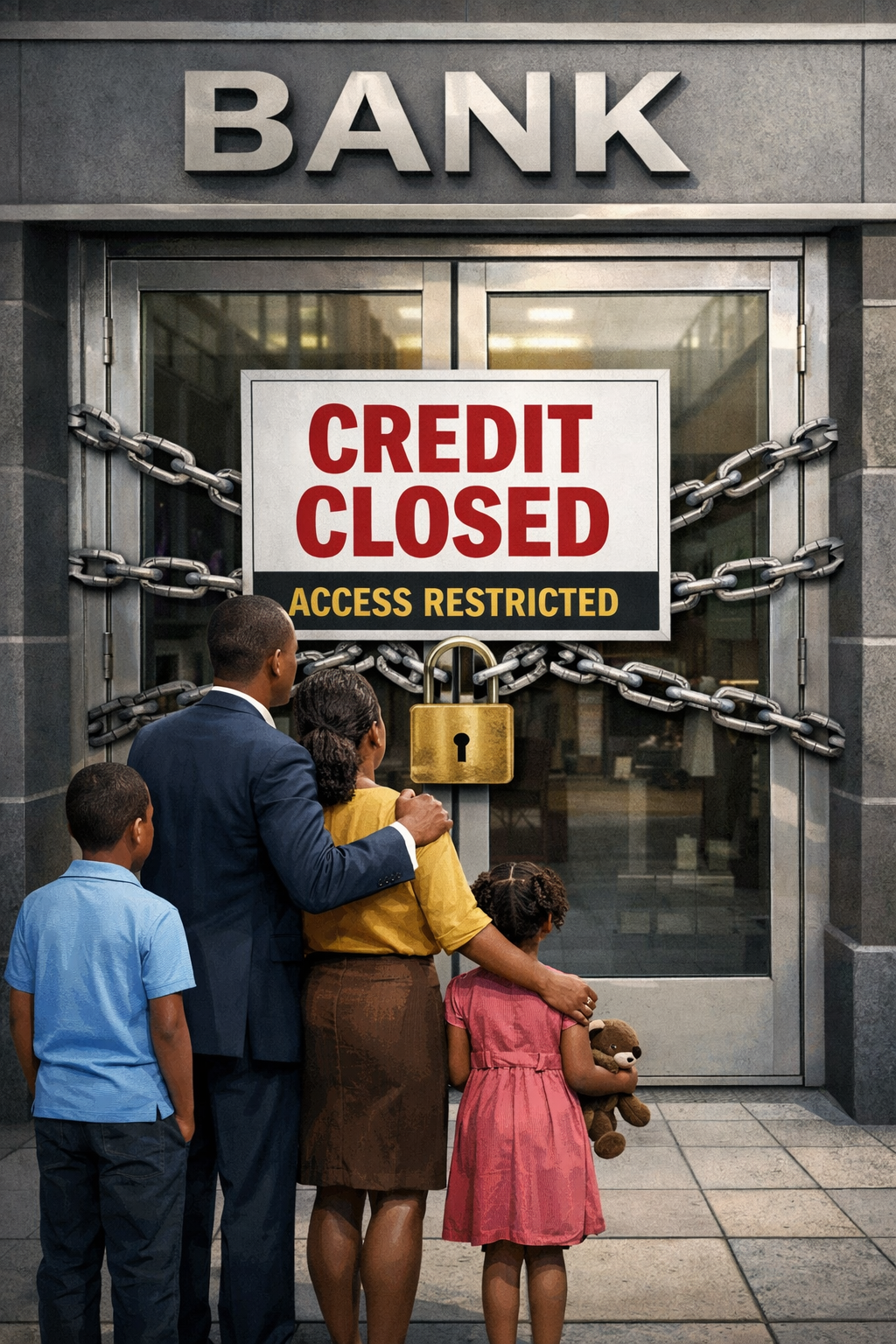
Credit Card Rate Caps Could Deepen Financial Inequality for African American Households

Our credit system, like almost institutional reality we have is very much dependent on Others. Until we realize and work towards infrastructure of our own institutional ownership within the credit landscape, then we will continue to be prey for predators and subsidizers that enriches others and their institutions. – William A. Foster, IV

When President Donald Trump announced a proposed 10% cap on credit card interest rates in January 2026, most Americans greeted the news with skeptical hope. The move seemed like a potential lifeline for families struggling with debt burdens and interest rates that often exceed 20%, even as many questioned whether it could actually happen. But for African American households, this well-intentioned policy could become another barrier in a financial system that has historically excluded and disadvantaged them.

The challenge lies not in the intention behind rate caps, but in their likely consequences. While lower interest rates sound beneficial on the surface, the economic reality of credit markets means that banks facing reduced profitability will respond by restricting who can access credit in the first place. For African American families already fighting against systemic barriers to financial services, this could close doors that were only partially open to begin with.

African American households face dramatically different credit market realities than their white counterparts. According to the FDIC’s 2023 survey, more than 10% of Black Americans lack access to basic checking or savings accounts, compared to just 2% of white Americans. This banking gap represents more than inconvenience it fundamentally limits the ability to build the credit history that determines access to affordable loans, mortgages, and yes, credit cards.

The wealth disparity tells an even starker story. The median net worth of white households stands at approximately $188,200, nearly eight times the $24,100 median for Black households. This gap isn’t accidental it’s the product of generations of discriminatory policies from redlining to predatory lending, compounded by the deterioration of African American-owned banks and credit unions. As Black ownership of financial institutions has declined, the community has become more reliant on external institutions for credit, creating conditions that invited more predatory lending into African American neighborhoods. When African Americans do access credit, they consistently face higher interest rates than white borrowers with similar incomes. High-income Black homeowners, for instance, receive mortgage rates comparable to low-income white homeowners.

The dependence on consumer credit has reached critical levels in African American households. Recent analysis from HBCU Money’s 2024 African America Annual Wealth Report reveals that consumer credit has surged to $740 billion, now representing nearly half of all African American household debt and approaching parity with home mortgage obligations of $780 billion. This near 1:1 ratio between consumer credit and mortgage debt represents a fundamental inversion of healthy household finance. For white households, the ratio stands at approximately 3:1 in favor of mortgage debt over consumer credit. The African American community stands alone in this precarious position, where high-interest, unsecured borrowing rivals the debt secured by appreciating assets.

These disparities matter enormously when considering how banks will respond to rate caps. Credit card companies operate on risk-based pricing models, charging higher rates to borrowers they perceive as riskier based on credit scores, income stability, and banking relationships. African American borrowers, because of structural disadvantages in each of these areas, already cluster in categories that receive higher interest rates. When banks can no longer charge those rates, they will simply stop offering credit to these borrowers entirely.

The banking industry’s response to Trump’s proposal has been swift and unequivocal: a 10% interest rate cap would force them to dramatically restrict credit availability. Analysis from the American Bankers Association suggests that nearly 95% of subprime borrowers, those with credit scores below 680 would lose access to credit cards under even a 15% cap. With rates currently averaging around 20%, a 10% ceiling would affect even more borrowers. Industry analysts estimate that between 82% and 88% of credit cardholders could see their cards eliminated or their credit limits drastically reduced. The Electronic Payments Coalition warns that low to moderate income consumers would be hit hardest, precisely the demographic where African American households are disproportionately represented.

This isn’t just industry fearmongering. Historical evidence supports these concerns. When Illinois implemented a 36% APR cap on all borrowing, lending to subprime borrowers plummeted. Similar patterns emerged from 19th-century usury laws and research on payday loan restrictions. The consistent pattern is clear: when rate caps make lending unprofitable, lenders exit the market or tighten requirements. For African American households, this creates a devastating catch-22. They’re more likely to need credit due to lower wealth levels and less access to family financial support. Yet they’re also more likely to be denied that credit or pushed into predatory alternatives when traditional sources dry up.

The credit card industry categorizes borrowers by risk, with subprime borrowers facing the highest rates but also the greatest need for access to credit. African American consumers are overrepresented in subprime categories, not because of personal failing but because of systemic factors that suppress credit scores. Historical discrimination in housing, employment, and lending created wealth gaps that persist through generations. Lower wealth means less ability to weather financial shocks, leading to missed payments that damage credit scores.

When major banks stop serving subprime borrowers, those families don’t suddenly stop needing credit. They turn to alternative sources and here’s where the rate cap could cause real harm. Payday lenders, pawn shops, auto title loans, and other fringe financial services often charge effective annual percentage rates far exceeding credit card rates, sometimes reaching 300% to 400% or higher. These services operate in a less regulated space where consumer protections are weaker and predatory practices more common.

African American neighborhoods already contain disproportionately high concentrations of these alternative lenders, a modern echo of historical redlining patterns. Bank branches are scarce in many predominantly Black communities, while check-cashing outlets and payday loan storefronts proliferate. A rate cap that drives more families into this unregulated market would exacerbate existing inequities. The irony is profound. A policy designed to protect consumers from high interest rates could push vulnerable families toward even higher costs and fewer protections. JPMorgan analysts warned that the rate cap could redirect borrowing away from regulated banks toward pawn shops and non-bank consumer lenders, increasing risks for consumers already under financial strain.

The consequences of restricted credit access extend far beyond the immediate inability to make purchases. Credit cards serve as emergency funds for families without substantial savings, a category that includes a disproportionate number of African American households. For many Black families facing persistent income gaps, credit cards function not just as a convenience but as an income supplemental tool, helping to bridge the gap between earnings and the actual cost of living. When a car breaks down, a medical bill arrives, or a job loss creates temporary income disruption, credit cards can mean the difference between weathering the storm and falling into a debt spiral that damages credit for years.

The reality is that consumer credit has become essential infrastructure for African American household finance. With consumer credit growing by 10.4% in 2024, more than double the 4.0% growth in mortgage debt, Black families are increasingly dependent on expensive borrowing to maintain living standards. This isn’t a choice so much as a structural reality of trying to survive on incomes that remain roughly 60% of median white household income while facing higher costs for everything from insurance to groceries in predominantly Black neighborhoods.

Small business ownership represents another critical pathway to wealth building where African Americans face systemic barriers. Black entrepreneurs already struggle to access business loans, with approval rates significantly lower than for white business owners with similar qualifications, another systemic issue from African American banks and credit unions having limited deposits and being unable to extend loans and credit. Many small business owners use personal credit cards to fund startup costs, inventory purchases, and cash flow gaps. Restricting credit card access would eliminate this crucial financing option for aspiring Black entrepreneurs.

The rewards and benefits ecosystem could also shift dramatically. Banks have indicated they would likely reduce or eliminate rewards programs to offset lost interest income from rate caps. While this might seem minor compared to interest savings, rewards programs have become an important tool for building value, particularly for higher-credit consumers who pay balances in full monthly. The Vanderbilt Policy Accelerator research found that borrowers with credit scores of 760 or lower would see reductions in credit card rewards under a rate cap. Perhaps most concerning is the potential for credit scoring and financial history deterioration. When credit lines are closed or limits reduced, credit utilization ratios increase, which damages credit scores. This creates a downward spiral where reduced access leads to worse credit, which leads to further reduced access. For African American families working to build credit and financial stability, this could set progress back by years.

The genuine problem of high credit card interest rates and mounting consumer debt deserves serious policy attention. But effective solutions must account for how credit markets actually function and who would be most affected by reduced access. Rather than interest rate caps, policymakers should consider approaches that expand access while addressing affordability. Strengthening African American-owned banks, credit unions, and community development financial institutions would restore economic self-determination to communities that once had thriving financial ecosystems. These institutions don’t just serve African American communities they’re owned by them, led by them, and invested in their long-term prosperity. Historically, Black-owned banks have proven they can maintain sound lending practices while understanding the full context of their customers’ financial lives in ways that large, distant institutions simply cannot.

Currently, there are only 18 Black or African American owned banks with combined assets of just $6.4 billion, a tiny fraction of the industry. The absence of robust Black-owned financial institutions means that virtually all of the $740 billion in consumer credit carried by African American households flows to institutions outside the community. With African American-owned banks holding assets equivalent to less than 1% of Black household debt, the overwhelming majority of interest payments—potentially $120 billion annually—enriches predominantly white-owned institutions with no vested interest in Black wealth creation or community reinvestment. This extraction mechanism operates continuously, draining capital that could otherwise be intermediated through Black-owned institutions to support local lending and community development.

Strengthening requirements for transparent pricing, fee limitations, and responsible lending standards could protect consumers without eliminating credit availability. Regulators could mandate clearer disclosure of total costs, limit penalty fees that disproportionately burden those already struggling, and establish guardrails against predatory terms while preserving access to credit itself. Yet even these modest reforms face an uphill battle in the current political climate. The reality is that meaningful policy solutions require political will that simply doesn’t exist right now for addressing racial economic disparities directly. This makes the unintended consequences of blunt instruments like interest rate caps even more dangerous—they can restrict credit access under the banner of consumer protection while offering no viable alternatives.

The fundamental reality is clear: waiting for federal policy to solve credit access problems is a losing strategy. African American households face a specific set of economic challenges rooted in a specific history, and the solutions must be equally specific not generic approaches that treat all groups the same. The path forward requires African American communities to build their own financial infrastructure. This means capitalizing and expanding Black-owned banks and credit unions that can offer credit products designed for the actual economic realities of their customers, not risk models built on white wealth patterns. It means creating community-based lending circles and cooperative credit arrangements that leverage collective resources. It means developing alternative credit scoring systems that account for rent payments, utility bills, and other financial behaviors that traditional models ignore.

Rebuilding this sector isn’t about charity or inclusion; it’s about economic self-determination. Black-owned financial institutions have historically understood that a credit score doesn’t tell the whole story of a person’s creditworthiness, and they’ve made sound lending decisions based on relationship banking and community knowledge that large institutions can’t replicate. The challenge isn’t convincing European American owned banks to be fairer, it’s building the capacity to not need them as much. When African American communities had stronger networks of Black-owned banks, insurance companies, and credit unions, they had more options and more power. Rebuilding that infrastructure, combined with individual financial strategies that emphasize building assets and reducing dependence on consumer credit, offers a more sustainable path than hoping for beneficial federal intervention.

A 10% interest rate cap might sound appealing in the abstract, but for African American households, it likely means one thing: less access to the credit system entirely. The question then becomes not whether mainstream banks will treat Black borrowers fairly, but how communities can create their own credit access systems that serve their actual needs. That’s not a policy problem it’s a community capacity problem, and it requires community-driven solutions.

Disclaimer: This article was assisted by ClaudeAI.

African America’s August 2025 Jobs Report – 7.5%

Overall Unemployment: 4.1%

African America: 7.2%

Latino America: 5.3%

European America: 3.7%

Asian America: 3.6%

Analysis: European Americans’ unemployment rate was unchanged from July. Asian Americans decreased 30 basis points and Latino Americans increased 30 basis points from July, respectively. African America’s unemployment rate increased by 30 basis points from July.

AFRICAN AMERICAN EMPLOYMENT REVIEW

AFRICAN AMERICAN MEN: 

Unemployment Rate – 7.1%

Participation Rate – 69.8%

Employed – 9,893,000

Unemployed – 753,000

African American Men (AAM) saw a increase in their unemployment rate by 10 basis points in August. The group had an increase in their participation rate in August by 190 basis points, there highest participation rate in the past five months. African American Men gained 270,000 jobs in August and saw their number of unemployed increase by 30,000.

AFRICAN AMERICAN WOMEN: 

Unemployment Rate – 6.7%

Participation Rate – 61.4%

Employed – 10,260,000

Unemployed – 739,000

African American Women saw a increase in their unemployment rate by 40 basis points in August. The group increased their participation rate in August by 30 basis points. African American Women gained 13,000 jobs in August and saw their number of unemployed increase by 45,000.

AFRICAN AMERICAN TEENAGERS:

Unemployment Rate – 24.8%

Participation Rate – 29.3%

Employed – 590,000

Unemployed – 195,000

African American Teenagers unemployment rate increased by 310 basis points. The group saw their participation rate increased by 10 basis points in August. African American Teenagers lost 24,000 jobs in August and saw their number of unemployed also increase 25,000.

African American Men-Women Job Gap: African American Women currently have 367,000 more jobs than African American Men in August. This is an decrease from 624,000 in July.

CONCLUSION: The overall economy added 22,000 jobs in August while African America added 260,000 jobs. From Reuters,”The warning bell that rang in the labor market a month ago just got louder,” Olu Sonola, head of U.S. economic research at Fitch Ratings in New York, said in reference to the U.S. labor market. “A weaker-than-expected jobs report all but seals a 25-basis-point rate cut later this month.” Fed Chair Jerome Powell had already reinforced rate cut speculation with an unexpectedly dovish speech at last month’s Fed symposium in Jackson Hole.”

Source: Bureau of Labor Statistics

African America’s July 2025 Jobs Report – 7.2%

Overall Unemployment: 4.1%

African America: 7.2%

Latino America: 4.8%

European America: 3.7%

Asian America: 3.5%

Analysis: European Americans’ unemployment rate increased 10 basis points. Asian Americans increased 40 basis points and Latino Americans increased 20 basis points from June, respectively. African America’s unemployment rate increased by 40 basis points from June.

AFRICAN AMERICAN EMPLOYMENT REVIEW

AFRICAN AMERICAN MEN: 

Unemployment Rate – 7.0%

Participation Rate – 67.9%

Employed – 9,623,000

Unemployed – 723,000

African American Men (AAM) saw a increase in their unemployment rate by 10 basis points in July. The group had a precipitous drop in their participation rate in July by 90 basis points. African American Men lost 129,000 jobs in July and saw their number of unemployed increase by 2,000.

AFRICAN AMERICAN WOMEN: 

Unemployment Rate – 6.3%

Participation Rate – 61.1%

Employed – 10,247,000

Unemployed – 694,000

African American Women saw a increase in their unemployment rate by 50 basis points in July. The group increased their participation rate in July by 20 basis points. African American Women lost 1,000 jobs in July and saw their number of unemployed increase by 60,000.

AFRICAN AMERICAN TEENAGERS:

Unemployment Rate – 21.7%

Participation Rate – 29.2%

Employed – 614,000

Unemployed – 170,000

African American Teenagers unemployment rate increased by 250 basis points. The group saw their participation rate decreased by 80 basis points in July. African American Teenagers added 37,000 jobs in July and saw their number of unemployed also increase 15,000.

African American Men-Women Job Gap: African American Women currently have 624,000 more jobs than African American Men in July. This is an increase from 496,000 in June.

CONCLUSION: The overall economy added 73,000 jobs in July while African America lost 166,000 jobs. From CNBC, “This is a gamechanger jobs report,” said Heather Long, chief economist at Navy Federal Credit Union. “The labor market is deteriorating quickly.” The weak report, including the dramatic revisions, could provide incentive for the Federal Reserve to lower interest rates when it next meets in September. Following the report, futures traders raised the odds of a cut at the meeting to 75.5%, up from 40% on Thursday, according to CME Group data.”

Source: Bureau of Labor Statistics

The Firing of The BLS Commissioner Reaffirms: President Trump Only Believes In Fake Facts

“When power makes truth expendable, only the brave will keep records.” — HBCU Money Editorial Board

On August 1, 2025, the United States crossed a threshold most democracies fear but few anticipate with precision the moment a nation’s statistical agency becomes a political target not for corruption, but for accuracy.

Following a weaker-than-expected jobs report with just 73,000 jobs added in July and significant downward revisions to prior months, President Donald Trump abruptly ordered the firing of Dr. Erika McEntarfer, Commissioner of the Bureau of Labor Statistics (BLS). The justification? The data embarrassed him. The evidence? None. The implications? Profound.

For over a century, the BLS has served as the impartial scorekeeper of the American labor market. Its reports help inform everything from Federal Reserve monetary policy to wage negotiations, business expansion decisions, and university research. Most critically, the BLS is the foundation for public trust in employment data, a cornerstone of economic legitimacy.

Trump’s dismissal of Dr. McEntarfer, who was confirmed with bipartisan support and is regarded as a rigorous labor economist, did not challenge methodology, nor did it cite misconduct. Instead, it was an overt signal: when facts contradict the leader’s narrative, the facts must go.

This act is not merely executive overreach. It is an institutional decapitation. And it represents the clearest break yet from the post-WWII consensus that government data should be nonpartisan, methodologically sound, and politically untouchable. In a global economy, this is the equivalent of a currency devaluation not of the dollar, but of America’s data credibility.

When leadership no longer trusts or permits accurate data, policy becomes reactive, erratic, and performative. Investors, entrepreneurs, and institutions rely on the BLS to signal economic direction. Without it, credit markets misfire, fiscal policy lacks direction, and monetary policy becomes unmoored. For African American-owned banks, real estate firms, and HBCU endowment managers, this degrades their ability to assess employment trends in Black communities, apply for federal workforce grants, or time bond offerings based on unemployment benchmarks. Even philanthropic giving strategies may suffer if the poverty, wage, and employment data they are based on becomes manipulated or suppressed.

America’s strength lies in its institutions, not its individuals. By removing the head of a critical statistical agency on political grounds, the White House has signaled that no institution is beyond coercion. This undermines the rule of law and places civil servants especially those in technocratic roles on notice: loyalty matters more than evidence. African American civil servants, many of whom have worked tirelessly to diversify and reform these institutions from within, may see decades of credibility erased. It’s a chilling reminder that representation within agencies means little if those agencies are subject to autocratic whim.

International investors, trade partners, and credit agencies track U.S. labor data as a proxy for global economic health. If they begin to suspect that U.S. statistics are manipulated, they may hedge their investments, slow trade, or reevaluate the reliability of U.S. fiscal metrics. In the long-term, this can impact foreign direct investment in African American economic zones, HBCU research partnerships with global firms, and even diaspora remittance flows, if currency stability is affected by market anxiety.

Perhaps most dangerously, Trump’s decision follows a long trajectory of undermining truth-based systems elections, public health, the judiciary, and now economic data. This creates a vacuum in which conspiracy becomes conventional wisdom. In such an environment, fake facts become state currency. This has severe implications for African American institutions. Much of African American advocacy whether for reparations, investment, or educational equity rests on data. If national data sources are neutered or politicized, then the burden of proof shifts unfairly onto communities already under-resourced in research infrastructure.

HBCUs, Black think tanks, and African American foundations must view this firing not as a political blip, but a doctrine in action. When truth becomes negotiable, institutions that depend on it must move from passive reliance to active defense. HBCUs with strong economics, political science, or data science departments such as Howard, Spelman, and FAMU should develop Black-centered labor and socioeconomic data initiatives. These should complement, verify, or challenge federal data when necessary.

Institutions should also create safeguards digital, legal, and procedural to document how and when data manipulation may be occurring. This includes archiving historic BLS data, creating public dashboards, and writing explanatory briefs for the community. In addition, the next generation of data scientists, economists, and statisticians trained at HBCUs must be equipped not only with technical skill but a political consciousness of how truth is weaponized. Their work should be rooted not just in method, but in mission.

There is also an urgent need for civic engagement. African American policy organizations must pressure Congress to enact legal protections that insulate agencies like BLS, Census, and the Congressional Budget Office from political interference. Civil society must create watchdog coalitions that expose attempts to politicize data or intimidate public servants. Parallel to this, an emergency data defense fund backed by foundations and Black philanthropic leaders could help institutions respond rapidly to threats against data integrity.

Dr. McEntarfer’s firing is not merely about jobs data. It is about whether America will continue to govern itself by fact or by fiat. For African Americans, who have fought centuries of data invisibility, distortion, and misuse from redlining to police profiling the stakes are especially high.

The Bureau of Labor Statistics was once seen as above politics. That era is over.

African American institutions must now assume a new role not just consumers of data, but defenders of its integrity. If truth is to survive, it will not be because it was protected by tradition, but because it was guarded by those with the most to lose from its disappearance.

Disclaimer: This article was assisted by ChatGPT.