
“How do we think about buying the home, but not who is supplying the mortgage? The capital, the very thing we constantly say needs to circulate more we give no thought too. We give no thought to who owns the mortgage company, title company, the real estate brokerage company our agent works for. All we know is – we are buying a house and unfortunately we think that is enough and we could not be more wrong.” – William A. Foster, IV
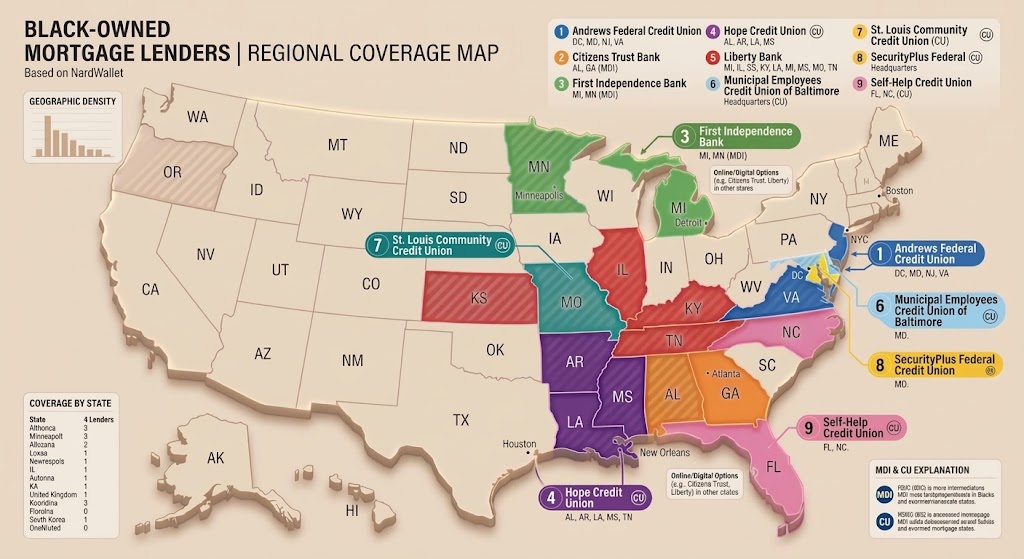
Draw a map of the United States and mark every county with a Black population share above fifteen percent. The shading will run thick down the Mississippi Delta, wrap around the Chesapeake, spill across the Piedmont Carolinas, thicken again in Houston and Dallas, and pool densely in New York, Philadelphia, and the Bay Area. Now draw a second map, this one marking every mortgage lender in America that is actually owned — not merely led, not merely branded, not merely marketed — by African Americans, and actively originating home loans for the house a borrower actually lives in. The second map is nearly blank. Nine dots, clustered in a dozen states, mostly small cities, mostly credit unions. Overlay the two maps and the mismatch becomes the argument: the geography of Black homeownership demand and the geography of Black-owned mortgage capital do not correspond. For most African American home buyers in the country’s largest Black population centers, the choice to bank Black on the single largest financial transaction of their lives does not exist. It was never offered.
This is not a complaint about willingness. It is a diagnosis of capacity. HBCU Money has argued consistently that Black wealth-building runs through institutions, not sentiment, and nowhere is that clearer than in the mortgage market, where the difference between origination by a Black-owned lender and origination by a mainstream white-owned lender is not cosmetic. It is the difference between interest payments compounding inside the African American institutional ecosystem; funding future loans, future branches, future capital reserves and interest payments leaving it permanently, financing balance sheets with no obligation to reinvest. A mortgage is a thirty-year capital-retention decision disguised as a housing decision, and right now the overwhelming majority of that decision is being made by institutions with no stake in Black community reinvestment.
Start with what actually exists. According to NerdWallet’s most recent accounting of lenders serving Black communities, published in January 2026, ten institutions make the list. One of them, Legacy Home Loans, is Black-led and does meaningful volume and it is licensed to operate in twenty-nine states plus Washington, D.C. but it is not Black-owned; it is a nonbank mortgage company, not a depository institution held by African American shareholders or member-owners. It belongs in a different conversation, one about Black executive leadership inside a financial system still substantially owned by others. It should not be counted alongside the nine that are actually owned by African Americans, because ownership, not leadership, is what determines whether profit and reinvestment obligations stay inside the ecosystem or exit it. And even Legacy’s twenty-nine-state reach should be read against the actual scale of the mortgage industry it operates inside: Rocket Mortgage alone originated roughly 429,000 loans worth $116.2 billion in 2025, and the ten largest lenders in the country together accounted for more than a quarter of all mortgage dollar volume originated nationally that year. A single top lender’s annual dollar volume dwarfs the combined asset base of every African American-owned bank and credit union in the country several times over.
The nine that are actually Black-owned are, without exception, small and regional. Andrews Federal Credit Union serves Maryland, New Jersey, Virginia, and Washington, D.C., with a natural base among military members and veterans. Citizens Trust Bank operates out of Atlanta, serving Alabama and Georgia, with a first-time buyer program built on partnership with the Federal Home Loan Bank of Atlanta. First Independence Bank serves Detroit and Minneapolis. Hope Credit Union covers a five-state footprint across the Deep South (Alabama, Arkansas, Louisiana, Mississippi, and Tennessee) with underwriting flexibility built for lower-income borrowers, including ITIN loans for those without Social Security numbers. Liberty Bank has the widest reach of the nine, touching Alabama, Illinois, Kansas, Kentucky, Louisiana, Michigan, Mississippi, Missouri, and Tennessee, and runs a Detroit-specific restoration and acquisition program. Municipal Employees Credit Union of Baltimore and SecurityPlus Federal Credit Union both concentrate on Baltimore. St. Louis Community Credit Union concentrates on St. Louis. Self-Help Credit Union serves Florida and North Carolina, with no-down-payment products designed for borrowers with thin or alternative credit files. What unites all nine, and distinguishes them from the banks discussed below, is that a borrower can walk in the door and finance the home they intend to live in directly with the institution; not a commercial building, not a rental property, not a construction loan against a development, but the primary residence itself.
Compress that list into a set of states and the coverage runs to roughly seventeen states plus the District of Columbia: Alabama, Arkansas, Florida, Georgia, Illinois, Kansas, Kentucky, Louisiana, Maryland, Michigan, Minnesota, Mississippi, Missouri, North Carolina, New Jersey, Tennessee, and Virginia. That is the entire national footprint of Black-owned primary-residence mortgage lending capacity in America.
Now compare it against where African Americans actually live in the largest numbers, and against the fuller picture of where Black-owned banks and credit unions operate at all, primary mortgages or not. Texas holds the largest Black population of any state in the country, concentrated in Houston, Dallas-Fort Worth, and San Antonio. Houston is home to Unity National Bank, and the state carries fourteen active Black-owned credit unions, the fourth-highest count nationally, yet the distinction here has to be precise. Unity does lend against real estate, and lends actively: by its own account, its loan portfolio runs heaviest in commercial and industrial lending, commercial real estate, and small business loans, and it offers financing for owner-occupied and investor commercial buildings, housing development and construction, and SBA-backed acquisitions. What it does not do is originate primary-residence home mortgages directly. Unity’s own materials describe that product as handled “through a trusted third-party partnership” rather than underwritten and held by the bank itself which means a Black family in Houston can finance a commercial building or a construction project through a Black-owned bank, but not, in any direct sense, the house they intend to live in. That is a meaningfully different thing from Citizens Trust, Hope Credit Union, or Liberty Bank actually closing a primary-residence loan in their own name, and it is the precise reason Unity does not appear among the nine even though it is a real, active, community-rooted Black-owned bank. New York tells a related story: no Black-owned bank operates in the state at all, but fifteen active Black-owned credit unions do, the third-highest concentration in the country, serving a Black population that ranks fourth largest nationally and carries the historic institutional density of Harlem, Brooklyn, Buffalo, and Rochester and still, none of those fifteen institutions reach the national primary-mortgage-lender list. Pennsylvania is home to United Bank of Philadelphia, one of the country’s African American-owned banks, and to two of the HBCUs this publication takes care to highlight rather than ignore in Cheyney University, the nation’s first degree-granting HBCU, and Lincoln University, the first degree-granting HBCU for men, yet whatever its lending mix, it does not appear on the active primary-mortgage list either. South Carolina follows a similar pattern: Optus Bank operates out of Columbia, in a state where African Americans make up one of the highest population shares in the country and where Claflin, Voorhees, Allen, Benedict, Morris College, and South Carolina State together form one of the densest HBCU clusters anywhere, but Optus does not appear on that list. California is the thinnest case in this group by far. OneUnited Bank, headquartered in Boston, operates branches and does considerable business in the state, serving a Black population of well over two million people concentrated in Los Angeles, Oakland, and the Bay Area but OneUnited does not offer mortgages anywhere, and California’s own credit union sector amounts to a single active institution holding $318,105 in assets and 262 members, a presence that has contracted since 2016 rather than grown. In each of these five states, the absence is not institutional absence; it is a narrower and in some ways more troubling gap between capital existing, and in some cases lending actively, and that capital being deployed specifically into the primary-residence mortgage product that would make it meaningful to a home buyer rather than a developer or a business owner.
Delaware, Ohio, and Wisconsin sit in a starker category, and two of the three arrived there only this year. Delaware, which by population share ranks among the most heavily African American states in the union and is home to Delaware State University, has no Black-owned bank on record. Ohio, home to Central State University and Wilberforce University, lost its last African American-owned bank, Adelphi Bank, when the institution’s ownership diluted below majority African American control in 2025; a particularly bitter loss because Adelphi had been the first new African American-owned bank chartered anywhere in the country in twenty-three years, and its growing asset base made the loss of ownership control, rather than a closure, the actual wound. Wisconsin’s loss came from the opposite direction: Columbia Savings and Loan Association of Milwaukee, chartered in 1924 and one of the oldest African American-owned financial institutions in the country, survived the Depression, the savings-and-loan crisis, and the 2008 collapse, only to close in 2025 after its capital base finally gave out. Milwaukee’s Black population runs to roughly thirty-nine percent of the city, and it now has no African American-owned bank of any kind, a fact HBCU Money’s own reporting names directly. Together, Ohio and Wisconsin’s losses erased nearly $130 million in Black-owned banking assets in a single year, offset only partly by the addition of Redemption Bank in Salt Lake City, Utah; a welcome new entrant, but one whose presence in a state with a comparatively small Black population does nothing for the students at Central State and Wilberforce or the residents of Milwaukee’s north side. Missouri, notably, does not belong in this category at all while it has no Black-owned bank, but it is one of only four states, alongside Maryland, Mississippi, and Virginia, that together hold roughly eighty percent of all African American-owned credit union assets nationally, with St. Louis Community Credit Union anchoring real capacity in the state even without a bank of its own.
This is the pattern the institutional lens is built to catch and the individual-success lens is built to miss. It is not that Black home buyers in Houston, Harlem, Philadelphia, Columbia, or Los Angeles lack the income, the credit profiles, or the desire to build wealth through homeownership. It is that the institutional infrastructure to let them do it through an ownership structure aligned with their own community’s capital retention simply does not exist where they live, or exists and does real business there, sometimes real estate business, without that business ever reaching the specific product that would make the ownership meaningful to a family buying a home to live in, or existed until this year and has now been lost outright. The absence is structural, and structural absences do not close through individual effort; they close through institutional construction, merger, and expansion or they do not close at all.
The scale problem compounds the geography problem. HBCU Money’s own 2025 directories count African American-owned banks holding $6.7 billion in assets, and 205 active African American-owned credit unions holding $8.15 billion in assets and serving 726,929 members, a combined $14.85 billion in Black-owned depository capital against nearly $25 trillion in total American bank assets alone. The credit union count has fallen from 318 institutions in 2016 to 205 today, a 35 percent decline in the number of institutions even as combined assets more than doubled over the same period, a sector consolidating around its strongest players while losing breadth, not one expanding into new geography. The bank sector tells the same story in sharper relief: two of its oldest and newest institutions, a century-old Milwaukee thrift and a two-year-old Columbus startup, both vanished from the ranks in the same year. Of this already-thin universe, only a handful of institutions actively originate primary-residence consumer mortgages at any real volume; many of the rest, like Unity National, are real and active lenders in commercial and investment real estate without extending that activity into owner-occupied home loans, while others are simply not underwriting real estate credit as a core product line at all, whether from capital constraints, risk appetite, or the absence of the correspondent relationships and secondary-market infrastructure that make mortgage lending viable at scale for a small institution. HBCU Money’s own Annual Wealth Report puts African American household net worth at roughly $5.6 trillion, a figure that makes plain how thin the institutional base is relative to the capital it would need to absorb if African American mortgage demand were redirected toward it in any serious volume. Nine primary-mortgage lenders drawing on $14.85 billion in combined sector assets cannot underwrite home purchases for a population of over forty million people concentrated in dozens of metropolitan areas outside their combined footprint, particularly against an industry where a single national lender moves more than $100 billion in loans in one year. The mismatch is not a marketing problem to be solved with a “bank Black” campaign. It is a balance-sheet, charter, product-line, and geographic-coverage problem that campaigns cannot fix.
What follows from this is not resignation but a specific set of institutional priorities. First, expansion of primary-mortgage capacity into states where Black-owned depository institutions already operate including in adjacent real estate lending, as Unity National does in Texas but do not lend on owner-occupied homes, should be treated as a nearer-term strategic objective than chartering new institutions from scratch, since the regulatory relationship, the deposit base, the real estate underwriting expertise, and in New York’s and Texas’s cases a double-digit count of existing credit unions already exist; what is missing is a specific product line, which is a narrower and more solvable gap than institutional absence. Second, the roughly two hundred active Black-owned credit unions nationally represent underused latent capacity concentrated too heavily in four states; a coordinated push through NCUA guidance, CDFI Fund support, or philanthropic capital specifically earmarked for mortgage-program buildout to bring a meaningful share of the New York and Texas credit union bases into primary-mortgage origination would multiply national coverage without requiring a single new charter. Third, secondary-market aggregation matters more for this sector than for almost any other segment of American banking: a consortium structure that allows small Black-owned institutions to originate loans locally while pooling them for sale or securitization through a shared, mission-aligned intermediary would let a nine-lender map become a fifty-state map without requiring each institution to carry mortgage risk alone on an undersized balance sheet. Fourth, HBCUs themselves properly understood as one node in the broader African American institutional ecosystem rather than its center sit inside several of the exact metropolitan areas where lending capacity is absent, dormant, commercial-only, or newly lost, and alumni associations, endowment offices, and institutional banking relationships at schools in Texas, South Carolina, Pennsylvania, California, and Ohio could function as anchor depositors and referral partners, giving a Unity National, an Optus Bank, or a New York credit union the local relationship base and deposit volume needed to justify building out a primary-mortgage division that does not currently exist.
Fifth, and perhaps most directly actionable, the sector needs its own version of what Legacy Home Loans already proves is possible: a dedicated, Black-owned nonbank mortgage company, built by an entrepreneur with outside investment capital, licensed to originate across multiple states, and structured from the outset to correspond with rather than compete against the depository institutions already discussed. Legacy demonstrates the model works at scale: twenty-nine states plus Washington, D.C., built without ever taking a deposit or carrying a bank charter. What Legacy does not solve is ownership; profit and control sit with a Black-led company, not a Black-owned one, and the model’s success has not yet been replicated in Black-owned form. A founder pursuing this path would not need to invent underwriting or licensing from scratch — nonbank mortgage companies operate on well-established regulatory rails — but would need enough capital to meet state net-worth and bonding requirements across a meaningful footprint, and enough underwriting and secondary-market discipline to sell originated loans forward rather than hold them on a balance sheet the company does not have. The natural distribution partners for such a company are exactly the institutions already identified in this piece as active in real estate or deposits but not in primary mortgages: Unity National Bank in Houston, whose existing commercial real estate lending relationships and third-party mortgage referral arrangement could be absorbed directly into a Black-owned originator rather than an outside partner; United Bank of Philadelphia; Optus Bank in Columbia; OneUnited’s branch network in California; and the credit union bases in New York and Texas. None of them would need to build a primary-mortgage division of their own if a Black-owned originator existed to take the referral, close the loan under a shared or co-branded relationship, and let the deposit-taking institution keep the account and the trust while the mortgage company carries the origination expertise and risk. That structure — bank or credit union as the front door, a dedicated Black-owned originator as the engine behind it — would close more of the map faster than waiting for seventeen banks and two hundred credit unions to each build mortgage capacity independently, and it is the one recommendation on this list that does not depend on an existing institution changing its strategy first; it only requires someone to build it.
None of this requires new instruments that do not yet exist. It requires existing Black-owned banks and credit unions to treat mortgage buildout and geographic expansion as core strategy rather than incidental growth, it requires an entrepreneur and investment capital willing to build the origination company that connects them, and it requires the broader institutional ecosystem such as HBCUs, Black chambers of commerce, Black professional networks to function as coordinated infrastructure for that expansion rather than as separate, isolated actors each solving a piece of the same problem independently. The map of nine dots is not a permanent feature of the landscape. It is the current state of an institutional sector that lost two of its members in a single year, has not gained a stable new charter in over two decades, has shed a third of its credit unions since 2016, and has not yet been asked, systematically, to turn the capital and the real estate expertise it already has into mortgages for the families it was built to serve. Reversing it is a matter of capital, coordination, and institutional will not of finding more good customers, who have never been the scarce resource in this equation.
Disclaimer: This article was assisted by ClaudeAI.

