
“We are not thinking deep enough to have economic impact. We think about the restaurant, we do not think about the farm, the bank that finances the supplies, delivery trucks, the silverware and the mine. All of these things have owneship to them and all we hope to own is the restaurant. Our economic thoughts are a shallow puddle in the economic ocean.” – William A. Foster, IV
A blacksmith in a river town made the finest tools in the region. His mark was stamped on every plow blade and door hinge that left his forge, and buyers traveled for days to reach him. But he bought his iron from a merchant downriver. The merchant set the price, set the terms, and decided in lean years which smiths got supplied first. One winter the merchant raised his price by half and sent the best ore to a rival. The blacksmith’s mark was still on every blade. That winter the town learned that a mark on the blade is not a claim on the iron.
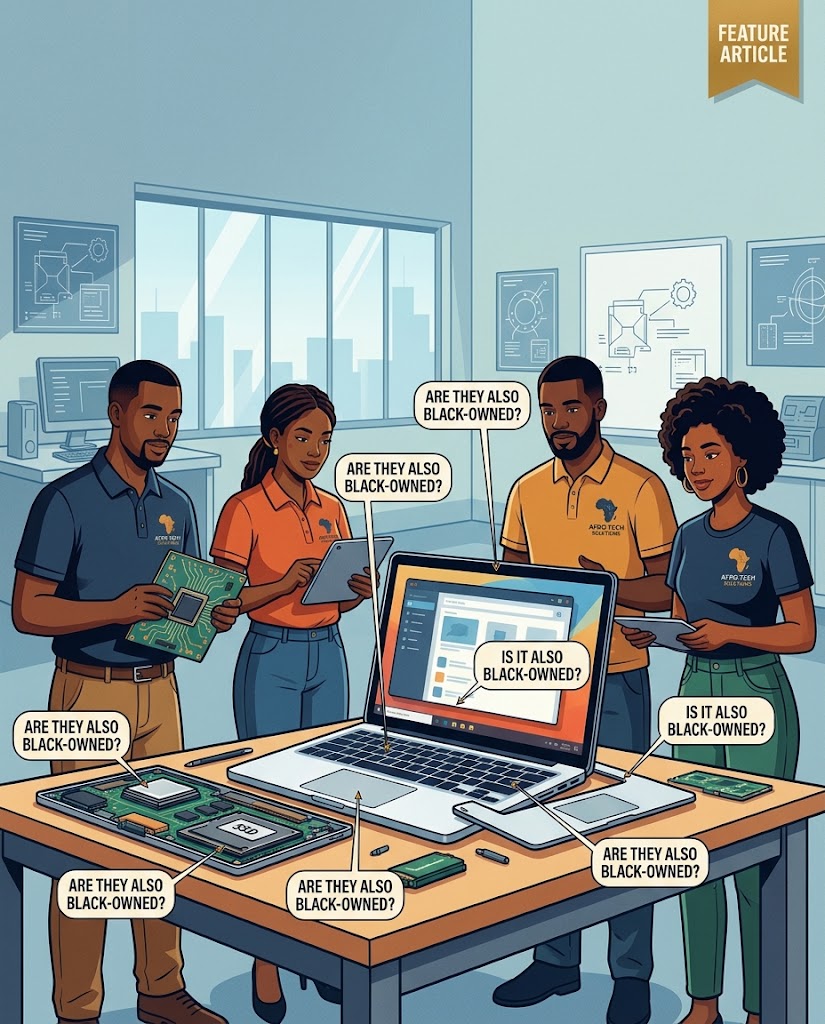
Can African America build a Black-owned laptop? Yes, and it could do so within a year. Contract manufacturers in Shenzhen, Taipei, and Suzhou will put any well-capitalized firm’s logo on a finished notebook, with the specifications, casing, and packaging chosen from a catalog. That is exactly why the question is too easy. The better question is whether African America could build a laptop whose supply chain is at least 51 percent African American owned. That question does not test whether the community can own a product. It tests whether the community can own the value that moves between the mine and the consumer. The answer separates a brand from an industry, and a community that consumes technology from one that retains the capital its consumption creates.
The laptop is a useful test case because it is one of the most routine capital leaks in African American economic life. Every HBCU student who arrives on campus buys one. So do faculty members, administrative offices, Black-owned small businesses, church administrators, and the public school systems of predominantly Black cities. Replacement cycles keep that spending recurring. Nearly every dollar leaves the ecosystem on the day of purchase. It goes to chip designers in California, memory producers in South Korea, assemblers in Taiwan and mainland China, national retail chains, and the mainstream white-owned lenders and card issuers that finance the purchase. The community pays for the whole value chain and owns none of it.
A laptop’s economics are dominated by a small number of components whose production is concentrated in a few firms and a few countries. The market research firm TrendForce benchmarks a mainstream notebook that retailed for $900 in early 2025. In that benchmark, the CPU, DRAM, and SSD made up roughly 45 percent of the system’s total bill of materials cost. After more than a year of memory price escalation driven by artificial intelligence data center demand, those three components accounted for 68 percent of the benchmark notebook’s bill of materials by the third quarter of 2026. Before the price spike, TrendForce’s broader breakdown put the battery at 5 to 10 percent of the bill of materials and the printed circuit board at 3 to 5 percent. The display, chassis, keyboard, and thermal systems account for most of the remainder.
If “supply chain ownership” means ownership of components by cost, then a 51 percent African American-owned laptop is impossible today. The same standard, however, would disqualify America’s most famous computer companies. Dell and HP do not fabricate their own processors or memory. Apple designs its own chips but contracts out their fabrication. No one describes those firms as lacking an industry. They own the layers of the value chain where design, distribution, customer relationships, and margin sit, and they buy commodity silicon from a small club of fabricators that almost no nation can join. A standard that only a handful of countries could meet is not a useful standard for institutional strategy.
HBCU Money proposes a more rigorous and more honest measure: the share of the consumer’s dollar captured by owned institutions across the device’s full life. That runs from raw mineral through processing, components, design, firmware, final assembly, logistics, distribution, retail, financing, warranty service, refurbishment, and end-of-life recovery. Under that measure, the question becomes answerable, and the answer depends on how far African America is willing to extend its ownership up and down the chain.
The mineral layer is where the historical pattern is most visible. About three quarters of the world’s 2025 cobalt mine supply came from one country, the Democratic Republic of the Congo. Cobalt is a core input for the lithium-ion batteries in every laptop. Yet as recently as late 2025, the DRC did not possess any active cobalt refining capacity. Its mineral wealth leaves the country in raw or semi-processed form, and the value is added elsewhere. Dr. John Henrik Clarke described this condition in a 1986 lecture to the Greater London Council, “The African in the New World: Their Contribution to Science, Invention and Technology.” He wrote that “Africa is the world’s richest continent, full of poor people, people who are poor because someone else is managing their resources.” Clarke was not describing a shortage of resources. He was describing a shortage of institutions positioned between the resource and the finished product. The laptop in an HBCU freshman’s backpack is a direct descendant of that arrangement. The cobalt in its battery may have come from Katanga, but every dollar of value added after the mine gate went to someone else.
Consider the first scenario, in which only African American-owned entities count toward the 51 percent. Silicon, memory, and storage are out of reach and will remain so. What can be owned today is the industrial design and engineering of the device, the firmware and software image, board-level design, final assembly and testing, procurement and logistics, direct-to-institution distribution, retail, consumer and institutional financing, warranty and repair service, and refurbishment and resale. None of those layers requires a semiconductor fab. All of them carry margin. Several of them, particularly financing, service, and refurbishment, keep producing revenue for years after the initial sale. Under a value-added standard, a firm that owns the brand but outsources everything else might capture 5 to 10 percent of the consumer dollar. A firm that owns every layer from design to the customer’s monthly payment can plausibly capture a majority of the dollar over the device’s working life.
The 2026 memory shock carries a strategic lesson here. Every percentage point that silicon gains in the bill of materials is a point that must be won back downstream. When component prices rise, the non-silicon layers of the chain get squeezed first. An African American laptop venture built as a brand alone would be structurally fragile, exposed to price decisions made in Seoul and Hsinchu. A venture that owns distribution, financing, and service would be structurally durable, because those layers are where the consumer relationship lives and where margin can be defended. The first scenario is achievable under a full-stack ownership model and precarious under a brand-only model. The difference between the two is institutional, not technical.
The second scenario counts Africa Core and diaspora-owned entities toward the 51 percent. The arithmetic changes materially because the upstream layers come into play. Afreximbank has signaled a deliberate shift in its capital allocation. Its president, George Elombi, said the bank is no longer interested in investors who mine and export raw material, and wants partners who mine and process at home. In Central Africa, Zambia and the DRC are jointly developing a $2.7 billion battery special economic zone designed to manufacture battery precursor materials rather than export lithium, cobalt and copper in raw form. The underlying 2023 framework agreement has Afreximbank and the UN Economic Commission for Africa leading the establishment of an operating company in consortium with public and private investors from the DRC and Zambia. If precursor processing, cell production, and battery pack assembly move into African-owned institutions, the battery layer of the laptop becomes ownable.
The assembly layer already has an African precedent that deserves more attention from the HBCU community. Jomo Kenyatta University of Agriculture and Technology in Kenya produces the Taifa laptop through the Nairobi Industrial and Technology Park, an industrial park that is 100 percent owned by the university. The model is candid about its limits. It imports custom-design and general-design parts and locally assembles them into finished units. What matters is the ownership structure: a university created a subsidiary, captured the assembly and brand layers, and pursued the tax treatment that made local assembly viable. That is a template an HBCU consortium can study directly.
Rwanda offers the necessary counterexample. Kigali has produced laptops marketed as “Made in Rwanda” since 2015, but the business behind the project is Positivo BGH, a South American technology company, a joint venture of Brazilian and Argentine firms. Location is not ownership. A factory on African soil owned by foreign capital sends its profits abroad just as reliably as a factory in Shenzhen. Rwanda nonetheless shows the mechanism that makes production possible: the company entered on the basis of an agreement to sell the government 150,000 devices each year. Guaranteed procurement built the factory. Whoever controls anchor demand controls the terms of industrial entry.
In the second scenario, then, African American-owned design, distribution, financing, and service can combine with Africa Core-owned battery processing, pack production, chassis work, and assembly to clear 51 percent of the value-added dollar with room to spare. Silicon remains external, as it does for nearly every nation on earth. The laptop would be majority-owned by the African world from the mineral to the monthly payment, a configuration no individual African nation or diaspora community could achieve alone.
What stands between the scenarios and execution is talent, and here Clarke’s lecture offers a second lesson. He describes how English mechanics brought to the Caribbean died or went home, and African craftsmen replaced them in maintaining the plantations. The craftsmen became indispensable, and once indispensable, they began making demands. In New England, enslaved Africans put to work as ship caulkers acquired basic industrial skills that became the foundation of a free artisan class. Leverage followed skill that could not be replaced. The same dynamic governs the battery and electronics value chain today. Elombi told TechCabal that Africa has the resources and the money, but, in his words, “What we don’t have is the expertise.”
HBCUs are positioned to supply that expertise, and the institutional scaffolding already exists. The HBCU CHIPS Network, launched with federal support, includes Alabama A&M, Bowie State, Central State, Delaware State, Dillard, Florida A&M, Fort Valley State, Jackson State, Morgan State, Norfolk State, North Carolina A&T, Prairie View A&M, Savannah State, Southern University, Tennessee State, Texas Southern, Tuskegee, Wilberforce, and Winston-Salem State, among others. Central State’s semiconductor internship program, backed by Intel and the National Science Foundation, grew from 20 interns in 2023 to 46 in 2025, selected from 309 applicants, with host sites that include Prairie View A&M. These programs currently train talent for firms the community does not own. Concentrating that talent inside a community-owned hardware enterprise, and exporting it as technical partnership to Africa Core processing zones, would turn a workforce pipeline into institutional leverage.
The strategic path follows directly. The first requirement is a standard. HBCU Money’s value-added ownership measure should be formalized and independently audited, so that “Black-owned” in hardware describes capital retention rather than a logo. Without a standard, the market will reward brand-only ventures that keep 5 percent of the dollar and advertise themselves as ownership.
The second requirement is anchor demand, which HBCUs already control. HBCU enrollment stood at 292,524 in 2023. If each of those students bought one device every four years, the resulting demand would be roughly 73,000 units annually. That is about half the scale of the Rwandan government contract that brought a laptop factory to Kigali, before counting faculty, staff, administrative offices, and school districts in predominantly Black cities. A consortium procurement agreement among HBCUs, even for a fraction of that volume, is the single most powerful lever available, because it converts dispersed consumer spending into bankable offtake.
The third requirement is an ownership vehicle. The model should be a consortium-owned operating company that draws on both the JKUAT subsidiary structure and the Afreximbank and ECA operating company structure. Public HBCUs in hostile state environments have limited freedom to take equity positions directly. Their foundations and alumni associations, however, are legally independent actors and can hold that equity. Private institutions such as Dillard, Tougaloo, Wilberforce, and Fisk can participate more directly.
The fourth requirement is financing that stays inside the ecosystem. HBCU Money’s directories count 17 African American-owned banks holding roughly $6.72 billion in combined assets and 205 African American-owned credit unions holding roughly $8.15 billion. That base is sufficient to finance inventory, receivables, and student device loans at the scale of an initial production run. Every interest payment on a student laptop loan that currently flows to a mainstream white-owned lender is capital the ecosystem could retain.
The fifth requirement is sequencing. The venture should begin with the layers that need the least capital and create the most local employment: final assembly and testing, repair, and refurbishment. These operations belong in HBCU communities such as Greensboro, Baltimore, Norfolk, Prairie View, and Wilberforce, where they create technician employment and a service network that outlasts any single product generation. Refurbishment in particular turns each device into multiple sales and creates a return stream of used batteries that can eventually connect to Africa Core processing.
The sixth requirement is formal Africa Core partnership. It should include technical exchange with JKUAT’s industrial park, engineering partnerships with the DRC-Zambia precursor initiative, and a procurement commitment to African-assembled battery packs and components as they reach specification. The diaspora’s leverage in these relationships is exactly the expertise that African development finance says it lacks, paired with a consumer market that African producers need.
The blacksmith’s mistake was never his craftsmanship. It was believing that the mark on the blade was the same as a claim on the iron. A laptop with a Black-owned logo and a 5 percent Black-owned supply chain is a marketing achievement. A laptop whose value chain is majority-owned by African American and Africa Core institutions, from refined cobalt to the credit union loan that pays for it, is an industry. African America can build the first tomorrow. Whether it builds the second depends on whether its universities, banks, credit unions, and African partners decide to act as a single ecosystem rather than as separate customers of someone else’s supply chain.
Disclaimer: This article was assisted by ClaudeAI.

