
“We keep showing up to the battlefield with a basket of flowers.” — William A. Foster, IV
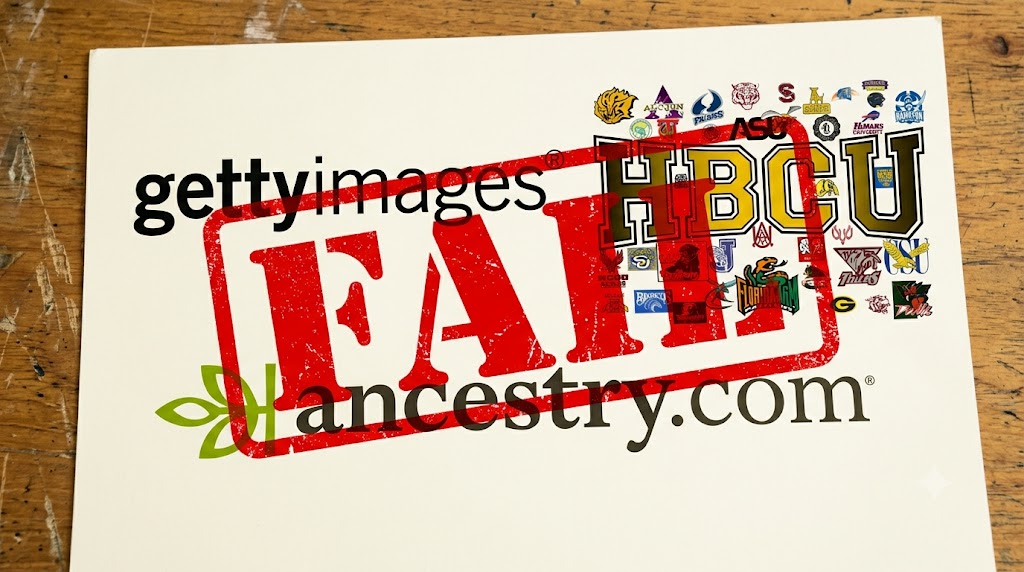
HBCUs handed their irreplaceable institutional memory to outside companies for safekeeping. One of those companies just used that same catalog to rebuild itself inside ChatGPT while independent research shows the AI systems now being enriched by Black archives are covertly programmed to penalize Black people.
There is an old story about a village whose elders grew afraid that flood and fire would one day erase the ledger of who belonged to whom — the births, the marriages, the boundary lines drawn generations back by people long dead. A traveling scribe arrived offering to copy every page into his own great book, free of charge, so the village would never lose its memory again. The elders kept the original ledger. They were told they would always own it. What no one thought to ask was what the scribe’s book would become once it left the village gate. Years later, a tax collector arrived in a province three days’ ride away, carrying not muskets but the scribe’s ledger, now bound into a registry used to determine who owed what, who could travel where, and who did not count. The village’s own lineage, copied in good faith for safekeeping, had become the very instrument used to sort and diminish its descendants. The ledger had not simply failed to enrich the village. It had been turned against it.
This is the bind a number of HBCUs may be walking into, mostly by continued naivety, through the digitization of their archives.
In 2025, Getty Images, through its HBCU Grants Program, announced a partnership with the genealogy company Ancestry to digitize historical records from historically Black colleges and universities of yearbooks, newsletters, student records, newspaper archives beyond the more than 10,000 photographs already collected in Getty’s HBCU Collection. Lincoln University was the first to join. The terms, as reported, were generous on their face: participating schools retain copyright to their print and digitized materials, earn revenue from licensing fees, and gain campuswide access to Ancestry’s genealogical platform. Framed this way, it reads as a preservation story, a corporate partner using its infrastructure to protect what fire, time, and underfunded archives could not.
But preservation was never the only thing being built. Getty Images is not a nonprofit archive. It is a publicly traded visual content marketplace that has spent the better part of three years suing AI companies over unlicensed use of its catalog, watching its core stock-photo business get hollowed out by generative tools that let anyone create a usable image on demand rather than license one. Getty’s first-quarter 2026 revenue came in below analyst estimates, and its creative-licensing revenue was falling year over year. The company needed a new identity. On June 21, 2026, it found one: a multi-year display partnership with OpenAI that puts Getty’s licensed content libraries; the same libraries that now include digitized HBCU yearbooks, student records, and institutional photography into the search and discovery experiences inside ChatGPT. Getty’s stock price roughly tripled within a day of the announcement.
That reinvention is happening because the alternative may be liquidation. Getty carries roughly $1.3 billion in debt against an image library whose value analysts describe as melting in the face of AI-generated competition. Its equity is valued at a fraction of its enterprise value, its profits have declined for five consecutive years, and in March 2026 the company received a formal noncompliance notice from the New York Stock Exchange. It has already tried an NFT pivot that collapsed and is now weighing a contested merger with Shutterstock, still under review by UK regulators. Coverage describing the company as on the brink of bankruptcy predates the OpenAI deal by three months. That context matters for HBCUs specifically: the digitized yearbooks, student records, and institutional photography now sit inside the licensed-content library of a financially distressed public company. Retaining copyright to the underlying documents does not give HBCUs any say over what happens to the surrounding infrastructure — the platform, the licensing relationships, the curated “HBCU Collection” itself — if Getty enters bankruptcy proceedings or completes a merger. That infrastructure is a balance-sheet asset, and balance-sheet assets get sold to creditors, folded into acquiring companies, or restructured on terms set by people who have never been in a room with an HBCU archivist. An institution that signs a preservation agreement with a company this fragile is not just dependent on that company’s strategic choices. It is dependent on that company’s solvency.
The companies have been careful to describe this as a display and discovery deal, not a training deal; Getty’s images, the reporting insists, will not be folded into OpenAI’s model weights, only surfaced with attribution when ChatGPT users search for visuals. That distinction matters to lawyers. It should matter much less to HBCU trustees, foundations, and general counsels, because the relevant question was never whether Getty’s catalog would train a model somewhere down the line. The relevant question is who decided that the digitized memory of Black institutions would become inventory in Getty’s strategic reinvention as, in its own framing, “a licensed content layer AI companies need” and what HBCUs received, structurally, for being part of that reinvention. The answer, as far as the public record shows, is a flat licensing fee and a consumer genealogy subscription. No equity in Getty’s repositioning. No board seat. No audit rights over how, where, or alongside what the material now appears. The asset HBCUs were told they would always own quietly became someone else’s turnaround story, and the schools found out the way everyone else did from a press release.
What makes this more than a licensing-terms dispute is what independent researchers have already documented about the systems now being enriched by this material. A 2024 Nature study out of Stanford and the University of Chicago led by Valentin Hofmann, Pratyusha Ria Kalluri, Dan Jurafsky, and Sharese King found that major large language models, including multiple generations of OpenAI’s GPT family, exhibit what the researchers call covert racism against speakers of African American English. Using a matched-guise method, the team found these models were significantly more likely to associate text written in African American English with archaic, pre–Civil Rights-era stereotypes calling the speaker lazy, stupid, ignorant, or dirty even while the same models gave warm, positive answers when asked directly about Black people. The covert bias did not shrink as the models got bigger or newer; in the researchers’ findings, it grew. And the harms were not abstract: in their experiments, models assigned speakers of African American English to lower-prestige jobs, convicted them of crimes more often, and recommended the death penalty over a life sentence more often than for speakers of Standard American English describing the identical act.
A separate technical review published in MIT’s Data Intelligence journal catalogs the broader structural problems with ChatGPT-class systems: a documented tendency to hallucinate confident, fabricated text; an originality problem serious enough that plagiarism-detection studies have found unacceptable similarity rates in a meaningful share of AI-generated academic work; unresolved copyright questions stemming from training data whose provenance OpenAI has never fully disclosed; and privacy risks tied to large-scale, loosely governed data ingestion. None of this is fringe criticism. It is the peer-reviewed and institutionally published baseline understanding of the technology now being handed a new discovery surface built, in part, from Black institutional archives.
Put plainly: HBCUs digitized their history to protect it from being lost, and a meaningful slice of that history is now circulating through the search layer of a system independently shown to encode the exact stereotypes (laziness, criminality, low worth) that HBCUs were founded to refute. The ledger did not just fail to enrich the village. It is sitting inside the registry now used against it.
This was avoidable, and the proof is that a Black-owned alternative already exists in the exact lane Ancestry occupies. African Ancestry has spent more than two decades helping people of African descent trace their lineage to a specific present-day African country and ethnic group through DNA testing; the precise genealogical mission Ancestry was brought in to serve, built and owned by people with every incentive to govern HBCU lineage data the way HBCUs would govern it themselves. No HBCU digitization announcement to date has named African Ancestry as a structural partner, a data steward, or an equity participant in a Black-owned genealogical and archival infrastructure built to HBCU specifications. The capacity was never the obstacle. The question, as with every partnership in this recurring pattern, is whether HBCU leadership thought to ask why the steward of last resort had to be someone else’s company.
This is also not a new pattern dressed up in new technology. HBCUs have shown a consistent institutional habit of treating partnerships with well-resourced outside companies as wins in themselves, without pricing in what happens to the asset — money, talent, or in this case memory — once it leaves campus. The same logic that sends institutional banking relationships, construction contracts, and real estate partnerships to non-Black firms with larger marketing budgets sent HBCU archives to the largest visual-content company in the world rather than to a coalition of Black-owned archival, genealogical, and data-infrastructure firms capitalized for exactly that purpose. The difference with data is that the leak compounds. A dollar spent with a non-Black vendor leaves the ecosystem once. A digitized archive licensed into someone else’s AI strategy can be relicensed, redisplayed, and repackaged indefinitely, generating value on every future turn that the originating institution has no claim to and, increasingly, no visibility into.
None of this is an argument for refusing digitization, or for sentimental attachment to physical archives that fire and flood will eventually win against. It is an argument for treating institutional data exactly like institutional capital, because that is what it now is. HBCUs that have already signed digitization agreements should have counsel audit every one of them for downstream-licensing clauses; the fine print that allows a partner to relicense, redisplay, or repurpose institutional material in deals the school never approved and was never asked about. Future agreements should require consent and compensation for any second-order use, equity or revenue-share participation rather than flat fees, and standing audit rights over how AI systems trained on or surfacing institutional content treat Black subjects, Black history, and Black language. And HBCUs sitting on irreplaceable archives should be capitalizing Black-owned digital infrastructure, African Ancestry among the obvious candidates, to build the stewardship capacity that makes a Getty Images necessary in the first place, rather than discovering, after the fact, what their memory was worth to someone else.
The scribe’s ledger is already out of the village. The only remaining question is who governs what it becomes next.
Disclaimer: This article was assisted by ClaudeAI.

