Tag Archives: HBCU research infrastructure

Can We Talk About More Than Sports? The Disappearance of the African American Male Intellectual

If I want intellectual rigor, I have to go into spaces with people who do not look like me. The spaces where we talk objectively about military strategy, economics, technology, space, institutional development, endowments, and the systems that build power. When I need institutional work done, I look to African American women because they show up. For reasons that are numerous, most Black men are on the sidelines or consumed by individualism. Our Diaspora awaits the next generation of Dr. John Henrik Clarke, Kwame Nkrumah, Steve Biko, DuBois, Garvey, Washington, and countless men who were thinkers, fighters, builders, and doers. But I am no longer sure they are coming. – William A. Foster, IV
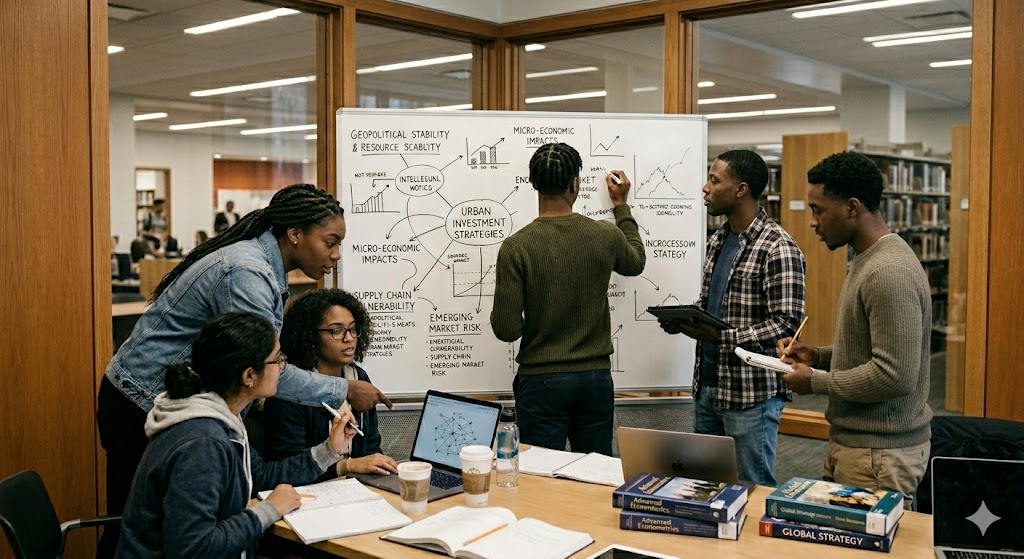
When a community’s most visible men are athletes, entertainers, and algorithm-driven provocateurs, the institutions that could translate attention into power are left to build themselves. There is a particular kind of institutional poverty that does not show up in endowment reports or balance sheets. It is subtler and, in the long run, more corrosive than the capital deficits that HBCU Money typically examines. It is the poverty of visible intellectual leadership specifically, the near-total absence of African American men from the serious public discourse of economics, geopolitics, institutional strategy, and capital formation. What fills the vacuum is well documented by anyone who has spent time on YouTube, on cable television, or in a social gathering of professional Black men: sports commentary, entertainment industry gossip, and a growing genre of conspiratorial self-help that markets itself as political awakening but delivers little more than grievance with a production budget. The consequences of this vacancy are institutional, not merely cultural, and any honest account of why African American community-building institutions remain fragile must reckon with it.

Romaine Bostick, the Bloomberg Television anchor, is frequently cited and for good reason as something close to an anomaly. He is an African American man with a prominent platform inside a credentialed financial media institution, covering markets, macroeconomics, and capital with the rigor the subject demands. That his name is cited as singular rather than representative is not a reflection on him; it is an indictment of the structural conditions that produced only one of him at that level of visibility. The financial influencer class that has proliferated across social media in the last decade is a poor substitute. These platforms trade in individual wealth accumulation tips like portfolio aesthetics, real estate flipping, credit score optimization framed in aspirational language that carefully avoids any structural critique or institutional prescription. They are, in the language of the economist, private goods masquerading as public ones: they may benefit the individual subscriber but they produce nothing resembling the collective institutional infrastructure that a community’s long-term capital position actually requires.

The geopolitical vacancy is if anything more severe. The Jewish American community, the Indian American community, the Irish American political diaspora each has produced, over generations, a class of intellectuals, strategists, and institutional builders who translate geopolitical analysis into concrete lobbying architecture, foreign policy positioning, and diaspora coordination frameworks. The American Israel Public Affairs Committee did not emerge from a vacuum; it emerged from decades of serious people doing serious analytical work and then building the organizational scaffolding to convert that work into leverage. The African American community, with a diaspora that spans the Atlantic world and a set of geopolitical interests that touch on the entire African continent, U.S. foreign policy in the Caribbean, trade frameworks, and international development finance, has produced no comparable institution anchored in credentialed, rigorous, non-partisan strategic analysis. What exists instead is a loosely connected series of advocacy organizations whose analytical capacity is episodic at best and whose institutional memory rarely survives leadership transitions.

This is not an argument about individual men failing to apply themselves. It is an argument about the structural incentive architecture that shapes which kinds of African American male expression receive platforms, capital, and cultural reinforcement. Sports and entertainment are not accidents; they are the products of a media and investment ecosystem that has found it profitable to channel Black male talent into spectacle and to treat Black male intellectual output as a niche product with limited commercial upside. The algorithm that governs YouTube’s recommendation engine is not neutral; it reflects and amplifies the market logic that has always been more comfortable monetizing Black performance than Black analysis. The red pill content ecosystem which deserves to be understood as an ideological product, not an organic community is filling a genuine vacuum in the discourse by offering what appears to be structural critique while systematically redirecting legitimate grievance away from institutional analysis and toward interpersonal conflict. It is, in this sense, a distraction infrastructure with considerable commercial and political utility to those who benefit from African American institutional disorganization.

What makes this dynamic particularly difficult to dislodge is that it has produced a convincing counterfeit of intellectual engagement. A podcast downloaded by a hundred thousand people, a YouTube channel with three-hour deep dives assembled from Google searches, a social media account that circulates economic statistics stripped of their methodological context none of these is institutional development, and none constitutes rigorous research or analysis. The distinction matters enormously. Genuine analytical infrastructure requires peer accountability, primary source methodology, longitudinal data collection, and the kind of institutional memory that persists beyond any individual’s attention span or content calendar. A think tank analyst who has spent five years building a quantitative model of African American capital flows in the Gulf South is doing categorically different work than a podcaster who has spent five years doing the same Google searches on a better microphone. Conflating the two does not merely flatter the latter; it degrades the standard against which the former is measured and obscures the actual vacancy the community needs to address. Fluency in the language of analysis is not the same as the capacity to produce it, and a community that cannot distinguish between the two will continue to mistake audience size for institutional weight.

African American male YouTuber whose room is filled with sports and rap on the walls and TV while he discusses sports commentary.

The pattern repeats at every level of Black public life. When prominent African American athletes and entertainers, men with platforms reaching millions and net worths that rival the asset bases of the largest Black-owned banks in America, comment on the condition of majority-Black cities, the frame is almost invariably that of the consumer: the amenities, the hotel, the general atmosphere of a road trip. The institutional landscape like the HBCU that has anchored the city’s intellectual life for over a century, the Black-owned bank that King named from the pulpit, the planned African American neighborhood that once constituted an entire economic ecosystem is simply not visible from that vantage point. That invisibility is not a personal failing. It is the predictable output of a system, diagnosed with precision by William C. Rhoden in Forty Million Dollar Slaves, in which Black wealth is generated within structures designed to route it outward from communities rather than back through the institutions those communities need to build durable power. Individual civic commitment, however genuine, does not substitute for the analytical infrastructure that would make institutional orientation the default rather than the exception.

The think tank gap is perhaps the most concrete expression of this structural absence. The Brookings Institution, the Council on Foreign Relations, the Center for Strategic and International Studies are not merely academic repositories; they are influence infrastructure. They produce the analysis that shapes congressional testimony, executive branch policy, corporate strategy, and media framing. The African American intellectual presence within these institutions is real but peripheral; what does not yet exist is a Black-led, HBCU-anchored, intellectually credentialed think tank with the resources and gravitas to place African American institutional interests at the center of national economic and foreign policy debate. This is not a complaint; it is a specification. The W.E.B. Du Bois tradition, rigorous, data-grounded, institutionally minded provides the intellectual lineage. The question is whether the generation of African American men currently consuming sports highlight reels and financial influencer content will produce the institutional builders who can turn that lineage into operating infrastructure.

The HBCU system is the most logical anchor for that infrastructure, and the institutions best positioned to build it are not necessarily the ones that already carry the heaviest brand weight. Morgan State University in Baltimore, with its pathway to R1 research designation and deep roots in urban economic analysis, is positioned to anchor a serious institute for African American urban policy, one that could feed analysis directly into the D.C. policy corridor less than an hour away. Fisk University in Nashville carries the intellectual lineage of W.E.B. Du Bois’s Atlanta Studies and the American Missionary Association’s most rigorous scholarly tradition; it has no dominant professional program crowding out an identity, which means a well-capitalized center for African American diaspora economics and geopolitical strategy could become the institution’s defining contribution to the next generation of scholarship. Delaware State University, with its proximity to the financial and legal infrastructure of Wilmington and the policy apparatus of Washington, has the geographic position to build an international trade and diaspora investment research program that no other HBCU is currently occupying. And Tougaloo College in Mississippi — small, historically central to the civil rights intellectual tradition, located in the heart of the Black Belt — represents exactly the kind of institution where an endowed center for African American political economy could become a flagship program rather than an appendage. The argument for these institutions over the obvious names is not that the obvious names lack talent. It is that talent concentrated in already-crowded institutional identities produces marginal gains; talent concentrated in institutions with open institutional real estate produces defining ones.

None of this infrastructure can be built without reckoning honestly with what the pipeline into it looks like. The analytical deficit does not begin in adulthood; it begins well before any young man ever encounters a university campus. According to DC Action’s analysis of District assessment data, only 23 percent of Black students demonstrate reading proficiency and a mere 11 percent demonstrate math proficiency — compared to 82 and 75 percent respectively for their white peers. These are not Washington anomalies; they are a concentrated reflection of a national pattern. Compounding the academic deficit is the enrichment deficit: a Wallace Foundation study found that while nearly 1.9 million Black children participated in structured summer learning programs in 2019, an additional 2.3 million would have enrolled if programs had been available, with cost cited as the primary barrier. Debate leagues, Model UN chapters, economics competitions, civic enrichment programs develop the extracurricular architecture that socializes young people into rigorous analytical discourse before they arrive at college are precisely the programs that disappear first in underfunded majority-Black school systems. An HBCU cannot build a think tank culture if the students arriving have spent twelve years in environments that did not reward that kind of engagement and had no institutional infrastructure to cultivate it.

But the educational deprivation is only one layer of the pipeline problem. Boys and in particular Black boys are not exempt from this, arguably face an intensified version of it are socialized from an early age into codes of masculinity that position intellectual seriousness as a threat to social belonging. Yanis Varoufakis, an economist and former Finance Minister of Greece, reflecting on his own formation, observed that even in the most progressive environments, boys construct their identity through hierarchies among themselves and in relation to girls, a dialectic of recognition that has little room for the boy who reads political economy or debates monetary policy at the lunch table. For Black boys in particular, this universal male socialization pressure is compounded by the specific cultural script that the media ecosystem has assigned to Black masculinity: athletic dominance, entertainment charisma, and street credibility. Anti-intellectualism is not merely tolerated within that script it is frequently enforced, with academic seriousness coded as a form of social betrayal. The community pays for that enforcement every generation, in the form of men who arrive at adulthood with the raw intelligence for serious analytical work and none of the institutional orientation or scholarly habits that would convert that intelligence into research, analysis, and institutional leadership. The misogyny that runs alongside the anti-intellectualism is not incidental to it; both are features of a masculinity script that defines strength as dominance rather than as the capacity to build something that outlasts you.

There is also an honest conversation to be had about the social environments in which African American professional men operate and the norms those environments reinforce. A friend group that discusses travel plans and makes no space for discussions of institutional investment, community capital formation, or coordinated political strategy is not merely a social observation; it is a microcosm of a broader norm enforcement mechanism. Social belonging within many African American professional male networks has been decoupled from the kind of civic and institutional seriousness that characterized the generation of men who built the original HBCU infrastructure, the African American financial institution network, and the civil rights legal architecture. That decoupling is not random; it is the downstream consequence of decades of systematic underinvestment in the institutions like the historically Black newspapers, the civic fraternal organizations with genuine programmatic ambitions, the professional associations with real research and advocacy functions that once transmitted serious institutional norms across generations of Black men.

The isolation felt by those who maintain a serious institutional orientation in this environment is real and should be named plainly. It is the isolation of working against the grain of both a mainstream media architecture that has no structural interest in platforming Black male institutional seriousness and a community social architecture that has internalized the substitution of individual aspiration for collective institutional ambition. It is exhausting in the way that all labor against structural inertia is exhausting. But exhaustion is a data point, not a reason for retreat. The work of rebuilding the intellectual infrastructure of African American institutional life — the think tanks, the policy journals, the credentialed analytical voices, the geopolitical strategy apparatus — is among the highest-leverage investments available to the HBCU ecosystem and its allies. The vacancy at the table is not permanent. It is a structural problem, which means it has structural solutions. The task is to build them with the same seriousness that previous generations built everything from Tuskegee to the Thurgood Marshall College Fund, one institution at a time, on a foundation of rigor rather than spectacle.

EDITOR’S NOTE

The argument in this article is not that African American men lack the intellectual capacity for institutional seriousness. It is that the infrastructure which would reward and amplify that seriousness has not been built and that building it is a higher-order priority than any individual wealth-building strategy this publication will ever publish. A community with no analytical architecture is a community that will always be responding to other people’s institutional decisions rather than shaping its own. The athletes will keep playing. The entertainers will keep performing. The influencers will keep posting. The question is whether, alongside all of that, the institutions get built. That is the only question that matters at scale.

Disclaimer: This article was assisted by Claude AI.
The Ecosystem We Have Not Built: What the HERD Survey Tells Us About HBCU Research Infrastructure

When you can do the common things of life in an uncommon way, you will command the attention of the world. – George Washington Carver

In Washington, the phrase “support for HBCUs” has become one of the most reliable applause lines in American political life. Presidents invoke it. Appropriations committees cite it. Press releases are issued, summits are convened, and photographs are taken with smiling institutional presidents. And then, year after year, the National Center for Science and Engineering Statistics releases the Higher Education Research and Development (HERD) Survey, the most comprehensive longitudinal dataset tracking university research investment in the United States, and the applause gives way to the same uncomfortable arithmetic.

In FY 2024, 59 HBCUs and affiliated institutions spent a combined $929.2 million on research and development. That is a large number in isolation. It is a devastating number in context. The total national higher education R&D enterprise that same year amounted to $117.7 billion. HBCUs accounted for 0.79% of it which is less than eight-tenths of one percent of the nation’s research investment, for institutions that produce a disproportionate share of Black STEM graduates, pre-medical students, and humanities scholars. The gap between what this figure is and what it should be is not a rounding error. It is a policy failure of the first order. But before laying the entirety of that failure at Washington’s feet, it is worth asking a harder question: how much of it is also self-inflicted?

What is worse than the current number is the trajectory. In 2015, the HBCU share of national R&D stood at 0.82%. In 2024, it stands at 0.79%. Ten years, three presidencies, dozens of executive orders, and multiple congressional funding packages later, the needle has moved — backward. The absolute dollar figures have grown, from $565.8 million in 2015 to $929.2 million in 2024, an increase of roughly 64% over the decade. But that growth is illusory when measured against the expansion of the national enterprise itself. The entire higher education R&D sector grew from $68.7 billion to $117.7 billion over the same period, an increase of 71%. HBCUs did not keep pace. They ran, and the field ran faster.

This is not a partisan observation. The data is indifferent to party affiliation. Under the Obama administration in FY 2015, HBCUs held a 0.82% share. By FY 2016, Obama’s final full year, it had slipped to 0.80%. Under the first Trump administration, the share fell steadily from 0.75% in 2017 to a decade-low of 0.63% in 2020. The Biden era produced the strongest absolute growth — $929 million in 2024 against $542 million in 2020 — but even at its peak, the Biden era only recovered the share to 0.79%, still below the Obama-era baseline. No administration has treated parity as a governing imperative. No Congress has appropriated at the scale the problem requires.

The HERD data makes the scale of the problem legible in a way that press releases cannot obscure. To reach just 1% of national R&D investment, a number that is not ambitious but merely honest, given that HBCUs serve a population roughly 15% of the total undergraduate student body, annual HBCU research expenditures would need to reach $1.18 billion, a gap of $248 million from current levels. To reach 2%, still proportionally below HBCU enrollment weight, the number is $2.35 billion, a gap of more than $1.4 billion annually. At 5%, which is arguably the minimum threshold for serious institutional research competitiveness, the annual requirement rises to $5.89 billion. These are not fantastical projections. They are the arithmetic of what it costs to matter in the modern knowledge economy.

There is one additional data point that every HBCU president, board member, alumni association chair, and development officer should be required to sit with before any other conversation about strategy begins. In FY 2024, 39 individual PWIs each spent more on research and development than all 59 HBCUs combined. Not more per institution. More in total more than $929 million apiece, individually, at 39 separate universities, while the entire organized HBCU sector could not collectively match what any one of them spent alone. Johns Hopkins, the perennial top-ranked research university, spent $4.1 billion on R&D in FY 2024, an amount more than four times the combined output of every HBCU in the country. But Johns Hopkins is not the only comparison that should give pause. The University of Pennsylvania spent $2.2 billion, an amount more than twice the entire HBCU sector. The University of California San Francisco spent $2.1 billion. The University of Michigan spent $2.1 billion. The University of Wisconsin-Madison spent $1.9 billion. These are not the top five institutions in the country by research output simply because they are wealthier or more selective than HBCUs in some abstract sense. They are the top five because they decided, at an institutional level, that research was the primary mechanism through which a university generates long-term power — economic, political, and reputational — and they built accordingly. Each of those five institutions, on its own, individually outspends every HBCU in America combined by a factor of two or more. Ohio State. Texas A&M. These are not exotic outliers. Several of them are state universities with public missions not fundamentally dissimilar from many HBCUs. The difference is not that their researchers are more talented or their communities more deserving. The difference is that somewhere in their institutional histories, research became the mission not a supplement to it. That reorientation produced decades of compounding returns. HBCUs are still debating whether to begin.

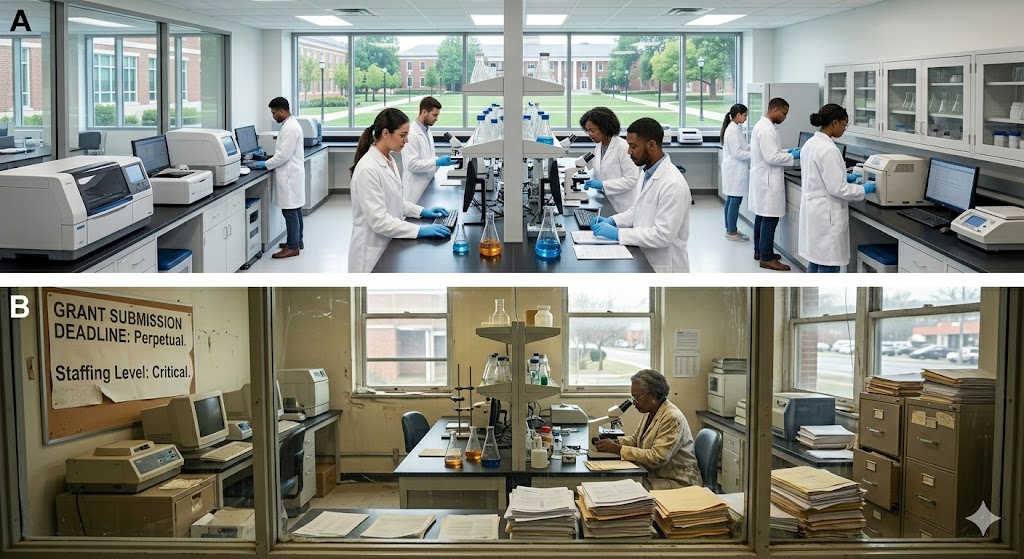
The external funding gap is real. But it exists alongside and is partly enabled by a pattern of institutional self-neglect that the HBCU sector has been reluctant to examine with full candor. Too many HBCU administrations, particularly those overseeing graduate programs, have treated research not as a strategic priority but as a grant-chasing appendage: a necessary line item for federal reporting, a credential for accreditation purposes, something the provost manages while the president attends to enrollment and donor relations. The result is an institutional culture in which research infrastructure is perpetually undercapitalized, grant offices are understaffed, and the graduate school — the engine of every serious research university — is treated as a placeholder for undergraduates (the bulk of most HBCU graduate schools are their own undergraduates) rather than the economic generator it is designed to be. This is not an abstraction. It shows up directly in the HERD rankings.

Howard University, the flagship of HBCU research activity, spent $101.8 million in FY 2024, ranking 178th nationally. North Carolina A&T, which has made the most deliberate institutional bet on STEM research, spent $81.8 million and ranked 192nd. Morehouse School of Medicine spent $68.7 million and ranked 212th. Florida A&M spent $68.7 million and ranked 213th. These are the top tier four institutions spending a combined $321 million out of the sector’s $929 million total. The other 55 institutions divided the remaining $608 million, an average of just $11 million each. And that average flatters the distribution considerably. Grambling State University, one of the most storied names in HBCU history, spent $486,000 in FY 2024, ranked 811th nationally, in the 13th percentile. Shaw University spent $452,000. Coppin State spent $304,000. Mississippi Valley State spent $161,000. Jarvis Christian College spent $150,000. These are institutions with graduate programs, loyal alumni networks, and deep community roots. The research numbers they are producing are not the result of limited potential. They are the result of limited prioritization. There is a meaningful distinction between the two, and the sector has been too comfortable blurring it.

The comparison with peer land-grant and regional public universities is instructive and uncomfortable. A regional public university with comparable enrollment to Morgan State or Tennessee State will typically have a dedicated technology transfer office, a research commercialization incubator, multiple endowed research chairs, and a graduate school that is explicitly linked to the institution’s strategic revenue plan. These are not luxuries at those institutions. They are understood as core infrastructure. At too many HBCUs, they remain aspirational bullet points in strategic plans that are never fully funded.

The institutional neglect of research infrastructure does not exist in a vacuum. It is reinforced and in many ways perpetuated by a philanthropic culture among HBCU alumni that directs dollars toward the visible and the sentimental rather than the strategic. Ask an HBCU alumni association what its fundraising priorities are, and the answers are predictable: scholarships, athletics, the marching band, campus beautification, the homecoming experience. These are not illegitimate priorities. Scholarships keep students enrolled. A great homecoming is an institutional identity statement. But they are not the investments that build research universities, and the gap between where HBCU alumni philanthropy flows and where HBCU research infrastructure requires investment is one of the most consequential misalignments in Black institutional life.

The problem is structural and informational. HBCU alumni, by and large, do not know what their institutions’ research portfolios look like. They do not know that their alma mater ranks in the 13th percentile of national research expenditures. They do not know that the graduate school is operating without a dedicated technology licensing office. They have never been presented with a case for why endowing a research chair in computational biology or environmental science would generate more long-term institutional value than another scholarship fund. No one has made that case to them, because the institutions themselves have not fully internalized it. PWI alumni are regularly presented with precisely this framing. Major research universities run sophisticated campaigns explaining to their donor bases that an endowed professorship creates a permanent research income stream, that a gift to a technology commercialization fund can generate licensing revenue that multiplies the original gift, that an investment in graduate fellowships attracts research talent that then generates grant overhead that funds the next generation of infrastructure. The cause-and-effect chain from donation to institutional research capacity to economic output is laid out explicitly. HBCU development offices have, with notable exceptions, not made this case. The result is that HBCU alumni who are themselves scientists, engineers, physicians, and entrepreneurs give generously to scholarships while their institutions’ research infrastructure atrophies. They are loyal donors funding an incomplete vision of what their institutions could be.

The competitive gap is widening not only in research expenditure but in the commercialization infrastructure that converts research into institutional wealth and nowhere is that gap more nakedly visible than in patent production. The National Academy of Inventors publishes an annual ranking of U.S. universities by utility patents granted. In 2024, the University of California system led the country with 540 patents. MIT produced 295. The University of Texas system produced 234. Purdue produced 213. Stanford produced 199. Not one HBCU appears anywhere in the top 100. Not Howard. Not NC A&T. Not Florida A&M. The list runs to 100 institutions and ends with universities holding 14 patents each. HBCUs could not place a single institution on it. This is not incidental. It is the downstream consequence of four and a half decades of abdication from the commercialization economy that the Bayh-Dole Act of 1980 made available to every research university in America. That legislation gave universities ownership of discoveries made with federal research funding — a structural gift that created the legal architecture for technology licensing offices, spinoff companies, and the university-based venture ecosystem that now anchors the innovation economies of entire regions. MIT’s technology licensing office has generated billions in cumulative revenue and been instrumental in creating hundreds of companies. Stanford’s equivalent has returned substantial royalty income to its operating budget and endowment for decades. The institutions that built aggressive commercialization infrastructure around Bayh-Dole are now compounding institutional wealth at a rate that has nothing to do with tuition receipts or annual federal appropriations. HBCUs have largely been bystanders to this transformation for forty-five years. Every year that an HBCU produces federally funded research without a pipeline for commercializing it is a year in which intellectual property that legally belongs to the institution is effectively abandoned. The patents are not filed. The licensing agreements are not negotiated. The spinoff companies are not formed. The wealth that research can generate, wealth that is independent of enrollment cycles, tuition sensitivity, and federal political winds is left on the table. When a major technology company funds a research center at MIT or Carnegie Mellon, it is making an investment in an ecosystem that has already demonstrated the capacity to convert that investment into commercially viable output. That ecosystem produced Google. It produced Genentech. It produced the foundational patents behind industries that did not exist a generation ago. The question for HBCUs is not how to be invited into that ecosystem. Invitation is not the goal, and dependence on the goodwill of institutions that have never prioritized Black wealth creation is not a strategy. The goal is to build a parallel ecosystem; one anchored in HBCU research infrastructure, capitalized through the African diaspora, and oriented toward producing the companies, the patents, and the intellectual property that generate Black institutional wealth on a generational time horizon. The African American community has spending power measured in the trillions. The African continent represents one of the fastest-growing concentrations of capital and technological ambition in the world. The Caribbean and broader diaspora hold resources, networks, and markets that no MIT spinoff has been designed to serve. An HBCU-anchored research commercialization ecosystem, built in genuine partnership with diaspora capital rather than in perpetual petition to federal appropriators, is the architecture through which an African American-owned Google becomes imaginable not as aspiration, but as institutional output. Stanford did not produce Google because it got lucky. It produced Google because it had spent decades building the research infrastructure, the technology transfer capacity, the graduate talent pipelines, and the investor relationships that made commercializable discovery an institutional inevitability rather than an accident. HBCUs have the community. They have the talent. They have, in the diaspora, a potential capital base that dwarfs what most research universities could claim at the moment they began building. What they have not yet built is the infrastructure that converts all of that latent capacity into compounding institutional power. That is the work. And it cannot begin until the sector decides that research is not an afterthought it is the foundation.

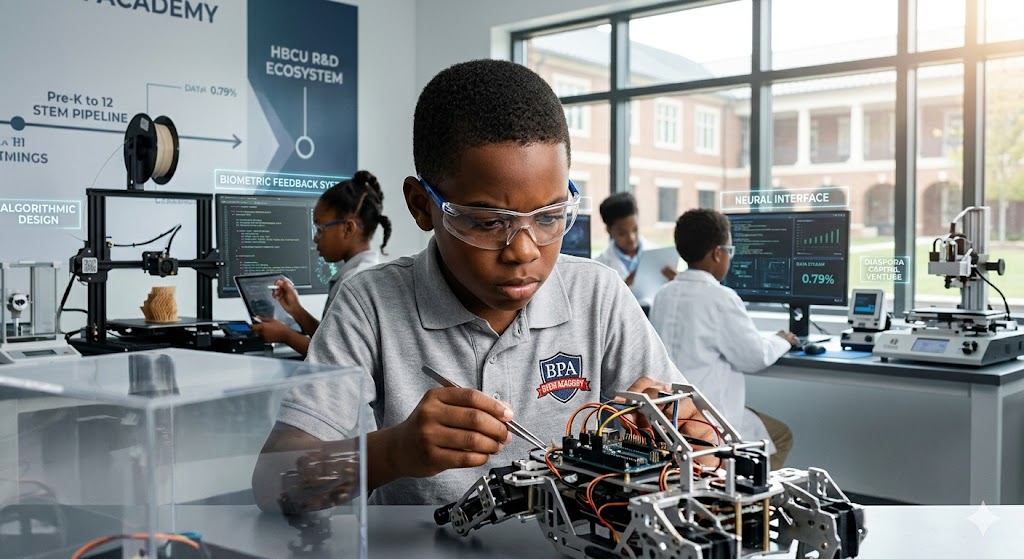
None of that ecosystem can be built, however, if the students arriving at HBCU research programs have spent their entire academic formation inside institutions that treated STEM as an afterthought. The research university does not begin at the graduate school. It begins at the pipeline that feeds it. The elite PWI research institutions that dominate the HERD rankings and the NAI patent list are not drawing their graduate talent from underfunded schools with overextended teachers and no competition culture. They are drawing from Phillips Exeter, Phillips Andover, and the constellation of elite preparatory institutions that have spent generations building exactly the kind of STEM competition infrastructure (doctoral-level coaches, state-of-the-art laboratories, national Olympiad pipelines) that produces the researchers who then generate the patents and the companies. The African American community once had more than 100 Black boarding schools. Four remain. The collapse of that infrastructure is not unrelated to the HERD data. It is part of the same story. Rebuilding a network of elite Black private day schools and boarding schools institutions explicitly designed as STEM pipelines into HBCUs and from HBCUs into the research economy is not a separate conversation from the one this article is having. It is the upstream chapter of it. An HBCU research ecosystem capable of producing commercially viable intellectual property requires a feeder system that has been preparing Black students for that level of scientific culture since before they arrive on campus. The Eight Schools Association does not produce Intel Science Fair winners by accident. Neither will HBCUs produce the next generation of research scientists, patent-holders, and technology entrepreneurs without building the institutional infrastructure that makes that outcome systematic rather than exceptional.

The deepest problem, however, is one that no federal grant program and no alumni campaign can solve on its own. It is a problem of institutional identity. Research at most HBCUs is understood as the work of a specific class of people: faculty with PhDs, graduate students, grant administrators. It is not understood as the work of the institution. This is a fundamentally impoverished conception of what a research university is, and it has real consequences for both the quantity and the quality of what gets produced. The most research-intensive universities in the world do not operate this way. At institutions where research is genuinely central to the mission, the orientation pervades the entire organization. The facilities management team understands that their work maintains the physical infrastructure on which research depends. Procurement staff understand that how they manage equipment acquisition and vendor relationships affects the cost-efficiency of the research enterprise. The administrative staff in grant offices understand themselves as investigators’ partners, not their compliance monitors. The groundskeepers and custodial staff who maintain the physical environment of laboratories and research spaces are part of an institution that takes seriously what happens inside those spaces. This is not sentimentality. It is operational culture. And it is the difference between institutions that treat research as a revenue center and those that treat it as a credential.

For HBCUs, the argument for this kind of whole-institution research identity is not merely operational. It is strategic and historical. The communities that HBCUs were built to serve have profound, unmet research needs: in environmental health, in medical outcomes, in economic development, in urban infrastructure, in food systems, in financial services. The proximity of HBCUs to those communities — geographic, cultural, institutional — is itself a competitive research advantage that no PWI can fully replicate. Community-engaged research, participatory research models, place-based longitudinal studies of Black American communities — these are areas in which HBCUs have natural authority. But capitalizing on that authority requires treating research as a whole-institution commitment, not a departmental function. It means building research literacy across every level of the institution. It means having honest conversations, from the boardroom to the grounds crew, about what research is, why it matters, and what the institution loses every year it is treated as secondary. Not because every employee will write a journal article, but because institutional culture is built through shared understanding of institutional purpose. When everyone connected to a campus understands that its long-term capacity to serve its community is tied to its research productivity, the institution begins to function differently. Budget priorities shift. Hiring decisions reflect research capacity. Alumni giving conversations expand beyond the sentimental to the strategic.

The institutions already gaining ground demonstrate the model. Morgan State’s growth from $13.6 million in 2015 to $55.5 million in 2024 — a 309% increase — did not come from waiting on Washington. It came from deciding that research was a strategic priority and building the administrative infrastructure to compete for it. Winston-Salem State’s 840% growth over the same period came from targeting federal health research dollars with institutional precision. Delaware State nearly tripled its portfolio. These trajectories prove the capacity exists.

There are also signs that the sector is beginning to grasp the coordination imperative. On April 29, 2026, fifteen HBCUs announced the formation of the Association of HBCU Research Institutions (AHRI), a national coalition explicitly designed to accelerate research capacity, increase the number of HBCUs achieving R1 Carnegie Classification, and expand collective policy influence. The founding membership includes Howard, the sector’s only R1 institution, alongside thirteen R2 institutions: Clark Atlanta, Delaware State, Florida A&M, Hampton, Jackson State, Morgan State, NC A&T, Prairie View A&M, South Carolina State, Southern University, Tennessee State, Texas Southern, and Virginia State. Collectively, AHRI’s members account for roughly half of all competitively awarded federal research funding among HBCUs. The coalition is co-located with the Association of American Universities and has secured a three-year, $1 million grant from Harvard’s Legacy of Slavery initiative, with Harvard’s Office of the Vice Provost for Research providing technical assistance. The formation of AHRI is the most substantive structural move the HBCU research sector has made in a generation, and it deserves to be recognized as such. But one million dollars over three years, measured against a sector-wide research gap of hundreds of millions annually and a patent economy in which HBCUs hold zero of the top 100 positions, is a foundation, not a solution. The significance of AHRI is not the capital it has raised. It is the architecture it represents — fifteen institutions deciding that isolation is no longer a viable strategy. If that architecture is built upon seriously, capitalized at the scale the HERD data demands, and extended to the 44 HBCU/PBI institutions not yet in the coalition, it becomes the organizational infrastructure through which the ecosystem this article has described can actually be constructed. If it becomes another announcement without a follow-through funding strategy, the HERD Survey will record the same story in 2034 that it has recorded every year since 2015.

But the formation of AHRI also demands a harder question that the coalition’s announcement did not address: how much genuine institutional autonomy do its member institutions actually have? Research strategy is a function of institutional governance. An institution that cannot independently set its research agenda, control its own board appointments, or protect its leadership from politically motivated interference cannot build the kind of sustained, multi-year research infrastructure the HERD data demands regardless of what coalition it joins. This is not a hypothetical concern. Prairie View A&M, one of AHRI’s founding members, operates within the Texas A&M University System, a governance structure in which the flagship institution’s interests, priorities, and resource allocation decisions do not always align with those of a historically Black land-grant whose research mission serves a fundamentally different community. The degree to which Prairie View can pursue an independent research commercialization strategy, build its own technology transfer infrastructure, or make unilateral decisions about patent filing and licensing within that system is a question the coalition’s formation does not resolve. Texas Southern, another AHRI founding member, has experienced more direct interference: its board has been subject to hostile gubernatorial appointments that resulted in the termination of institutional leadership in ways that the broader HBCU community recognized as reflecting political interests rather than institutional ones. Tennessee State has faced comparable dynamics, with the state’s Republican-controlled legislature effectively vacating its board and replacing it with gubernatorial appointees, a maneuver that places the strategic direction of a public HBCU in the hands of an administration with no particular stake in HBCU research excellence. An HBCU that cannot protect its own president, control its own board, or govern its own research agenda is not positioned to build a serious research enterprise regardless of its AHRI membership. The coalition is only as strategically coherent as the institutional autonomy of its members. That autonomy, for several of its founding institutions, is not guaranteed. It is contested.

The structural argument that the data ultimately forces is this: no external actor — no administration, no Congress, no philanthropic initiative operating at current scales — has demonstrated the will to close a gap this large. Replicating and scaling what the sector’s fastest-growing research institutions have done requires HBCU administrations to stop treating their research enterprises as afterthoughts, HBCU alumni to stop treating their philanthropy as sentiment, and HBCU communities to start treating institutional research capacity as what it actually is — a long-term economic and political asset that compounds in value every year it is invested in, and deteriorates every year it is not.

The HERD Survey is updated annually. And annually, the same story is told. The question is whether the institutions that story concerns have finally decided to write a different one.


Data sourced from the National Center for Science and Engineering Statistics, Higher Education R&D Survey (HERD), FY 2015–2024; and the National Academy of Inventors, 2024 Top 100 U.S. Universities Granted U.S. Utility Patents. All HERD expenditure figures are in thousands of current dollars.

Disclaimer: This article was assisted by ClaudeAI.