
Tag Archives: HBCU research funding

The Ecosystem We Have Not Built: What the HERD Survey Tells Us About HBCU Research Infrastructure

When you can do the common things of life in an uncommon way, you will command the attention of the world. – George Washington Carver
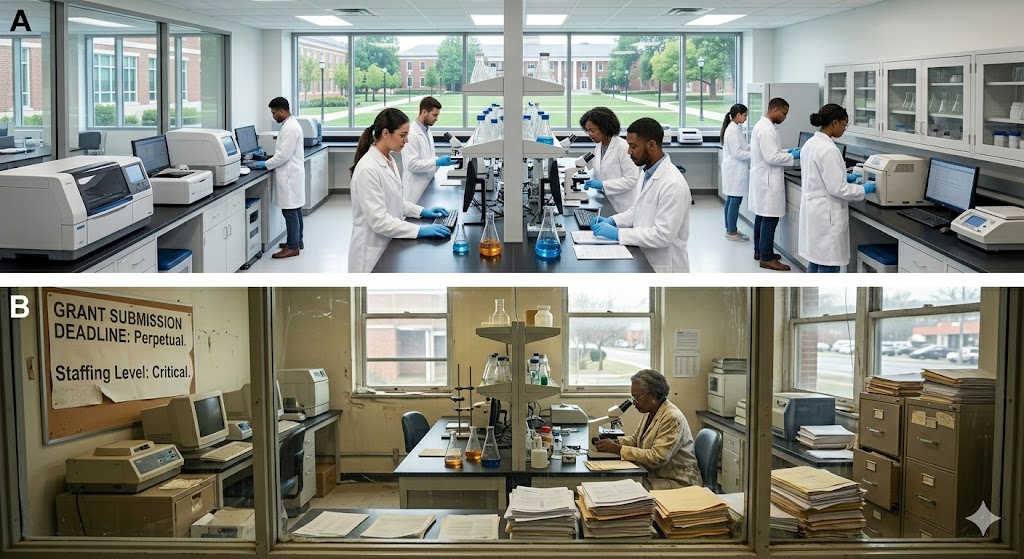
In Washington, the phrase “support for HBCUs” has become one of the most reliable applause lines in American political life. Presidents invoke it. Appropriations committees cite it. Press releases are issued, summits are convened, and photographs are taken with smiling institutional presidents. And then, year after year, the National Center for Science and Engineering Statistics releases the Higher Education Research and Development (HERD) Survey, the most comprehensive longitudinal dataset tracking university research investment in the United States, and the applause gives way to the same uncomfortable arithmetic.

In FY 2024, 59 HBCUs and affiliated institutions spent a combined $929.2 million on research and development. That is a large number in isolation. It is a devastating number in context. The total national higher education R&D enterprise that same year amounted to $117.7 billion. HBCUs accounted for 0.79% of it which is less than eight-tenths of one percent of the nation’s research investment, for institutions that produce a disproportionate share of Black STEM graduates, pre-medical students, and humanities scholars. The gap between what this figure is and what it should be is not a rounding error. It is a policy failure of the first order. But before laying the entirety of that failure at Washington’s feet, it is worth asking a harder question: how much of it is also self-inflicted?

What is worse than the current number is the trajectory. In 2015, the HBCU share of national R&D stood at 0.82%. In 2024, it stands at 0.79%. Ten years, three presidencies, dozens of executive orders, and multiple congressional funding packages later, the needle has moved — backward. The absolute dollar figures have grown, from $565.8 million in 2015 to $929.2 million in 2024, an increase of roughly 64% over the decade. But that growth is illusory when measured against the expansion of the national enterprise itself. The entire higher education R&D sector grew from $68.7 billion to $117.7 billion over the same period, an increase of 71%. HBCUs did not keep pace. They ran, and the field ran faster.

This is not a partisan observation. The data is indifferent to party affiliation. Under the Obama administration in FY 2015, HBCUs held a 0.82% share. By FY 2016, Obama’s final full year, it had slipped to 0.80%. Under the first Trump administration, the share fell steadily from 0.75% in 2017 to a decade-low of 0.63% in 2020. The Biden era produced the strongest absolute growth — $929 million in 2024 against $542 million in 2020 — but even at its peak, the Biden era only recovered the share to 0.79%, still below the Obama-era baseline. No administration has treated parity as a governing imperative. No Congress has appropriated at the scale the problem requires.

The HERD data makes the scale of the problem legible in a way that press releases cannot obscure. To reach just 1% of national R&D investment, a number that is not ambitious but merely honest, given that HBCUs serve a population roughly 15% of the total undergraduate student body, annual HBCU research expenditures would need to reach $1.18 billion, a gap of $248 million from current levels. To reach 2%, still proportionally below HBCU enrollment weight, the number is $2.35 billion, a gap of more than $1.4 billion annually. At 5%, which is arguably the minimum threshold for serious institutional research competitiveness, the annual requirement rises to $5.89 billion. These are not fantastical projections. They are the arithmetic of what it costs to matter in the modern knowledge economy.

There is one additional data point that every HBCU president, board member, alumni association chair, and development officer should be required to sit with before any other conversation about strategy begins. In FY 2024, 39 individual PWIs each spent more on research and development than all 59 HBCUs combined. Not more per institution. More in total more than $929 million apiece, individually, at 39 separate universities, while the entire organized HBCU sector could not collectively match what any one of them spent alone. Johns Hopkins, the perennial top-ranked research university, spent $4.1 billion on R&D in FY 2024, an amount more than four times the combined output of every HBCU in the country. But Johns Hopkins is not the only comparison that should give pause. The University of Pennsylvania spent $2.2 billion, an amount more than twice the entire HBCU sector. The University of California San Francisco spent $2.1 billion. The University of Michigan spent $2.1 billion. The University of Wisconsin-Madison spent $1.9 billion. These are not the top five institutions in the country by research output simply because they are wealthier or more selective than HBCUs in some abstract sense. They are the top five because they decided, at an institutional level, that research was the primary mechanism through which a university generates long-term power — economic, political, and reputational — and they built accordingly. Each of those five institutions, on its own, individually outspends every HBCU in America combined by a factor of two or more. Ohio State. Texas A&M. These are not exotic outliers. Several of them are state universities with public missions not fundamentally dissimilar from many HBCUs. The difference is not that their researchers are more talented or their communities more deserving. The difference is that somewhere in their institutional histories, research became the mission not a supplement to it. That reorientation produced decades of compounding returns. HBCUs are still debating whether to begin.

The external funding gap is real. But it exists alongside and is partly enabled by a pattern of institutional self-neglect that the HBCU sector has been reluctant to examine with full candor. Too many HBCU administrations, particularly those overseeing graduate programs, have treated research not as a strategic priority but as a grant-chasing appendage: a necessary line item for federal reporting, a credential for accreditation purposes, something the provost manages while the president attends to enrollment and donor relations. The result is an institutional culture in which research infrastructure is perpetually undercapitalized, grant offices are understaffed, and the graduate school — the engine of every serious research university — is treated as a placeholder for undergraduates (the bulk of most HBCU graduate schools are their own undergraduates) rather than the economic generator it is designed to be. This is not an abstraction. It shows up directly in the HERD rankings.

Howard University, the flagship of HBCU research activity, spent $101.8 million in FY 2024, ranking 178th nationally. North Carolina A&T, which has made the most deliberate institutional bet on STEM research, spent $81.8 million and ranked 192nd. Morehouse School of Medicine spent $68.7 million and ranked 212th. Florida A&M spent $68.7 million and ranked 213th. These are the top tier four institutions spending a combined $321 million out of the sector’s $929 million total. The other 55 institutions divided the remaining $608 million, an average of just $11 million each. And that average flatters the distribution considerably. Grambling State University, one of the most storied names in HBCU history, spent $486,000 in FY 2024, ranked 811th nationally, in the 13th percentile. Shaw University spent $452,000. Coppin State spent $304,000. Mississippi Valley State spent $161,000. Jarvis Christian College spent $150,000. These are institutions with graduate programs, loyal alumni networks, and deep community roots. The research numbers they are producing are not the result of limited potential. They are the result of limited prioritization. There is a meaningful distinction between the two, and the sector has been too comfortable blurring it.

The comparison with peer land-grant and regional public universities is instructive and uncomfortable. A regional public university with comparable enrollment to Morgan State or Tennessee State will typically have a dedicated technology transfer office, a research commercialization incubator, multiple endowed research chairs, and a graduate school that is explicitly linked to the institution’s strategic revenue plan. These are not luxuries at those institutions. They are understood as core infrastructure. At too many HBCUs, they remain aspirational bullet points in strategic plans that are never fully funded.

The institutional neglect of research infrastructure does not exist in a vacuum. It is reinforced and in many ways perpetuated by a philanthropic culture among HBCU alumni that directs dollars toward the visible and the sentimental rather than the strategic. Ask an HBCU alumni association what its fundraising priorities are, and the answers are predictable: scholarships, athletics, the marching band, campus beautification, the homecoming experience. These are not illegitimate priorities. Scholarships keep students enrolled. A great homecoming is an institutional identity statement. But they are not the investments that build research universities, and the gap between where HBCU alumni philanthropy flows and where HBCU research infrastructure requires investment is one of the most consequential misalignments in Black institutional life.

The problem is structural and informational. HBCU alumni, by and large, do not know what their institutions’ research portfolios look like. They do not know that their alma mater ranks in the 13th percentile of national research expenditures. They do not know that the graduate school is operating without a dedicated technology licensing office. They have never been presented with a case for why endowing a research chair in computational biology or environmental science would generate more long-term institutional value than another scholarship fund. No one has made that case to them, because the institutions themselves have not fully internalized it. PWI alumni are regularly presented with precisely this framing. Major research universities run sophisticated campaigns explaining to their donor bases that an endowed professorship creates a permanent research income stream, that a gift to a technology commercialization fund can generate licensing revenue that multiplies the original gift, that an investment in graduate fellowships attracts research talent that then generates grant overhead that funds the next generation of infrastructure. The cause-and-effect chain from donation to institutional research capacity to economic output is laid out explicitly. HBCU development offices have, with notable exceptions, not made this case. The result is that HBCU alumni who are themselves scientists, engineers, physicians, and entrepreneurs give generously to scholarships while their institutions’ research infrastructure atrophies. They are loyal donors funding an incomplete vision of what their institutions could be.

The competitive gap is widening not only in research expenditure but in the commercialization infrastructure that converts research into institutional wealth and nowhere is that gap more nakedly visible than in patent production. The National Academy of Inventors publishes an annual ranking of U.S. universities by utility patents granted. In 2024, the University of California system led the country with 540 patents. MIT produced 295. The University of Texas system produced 234. Purdue produced 213. Stanford produced 199. Not one HBCU appears anywhere in the top 100. Not Howard. Not NC A&T. Not Florida A&M. The list runs to 100 institutions and ends with universities holding 14 patents each. HBCUs could not place a single institution on it. This is not incidental. It is the downstream consequence of four and a half decades of abdication from the commercialization economy that the Bayh-Dole Act of 1980 made available to every research university in America. That legislation gave universities ownership of discoveries made with federal research funding — a structural gift that created the legal architecture for technology licensing offices, spinoff companies, and the university-based venture ecosystem that now anchors the innovation economies of entire regions. MIT’s technology licensing office has generated billions in cumulative revenue and been instrumental in creating hundreds of companies. Stanford’s equivalent has returned substantial royalty income to its operating budget and endowment for decades. The institutions that built aggressive commercialization infrastructure around Bayh-Dole are now compounding institutional wealth at a rate that has nothing to do with tuition receipts or annual federal appropriations. HBCUs have largely been bystanders to this transformation for forty-five years. Every year that an HBCU produces federally funded research without a pipeline for commercializing it is a year in which intellectual property that legally belongs to the institution is effectively abandoned. The patents are not filed. The licensing agreements are not negotiated. The spinoff companies are not formed. The wealth that research can generate, wealth that is independent of enrollment cycles, tuition sensitivity, and federal political winds is left on the table. When a major technology company funds a research center at MIT or Carnegie Mellon, it is making an investment in an ecosystem that has already demonstrated the capacity to convert that investment into commercially viable output. That ecosystem produced Google. It produced Genentech. It produced the foundational patents behind industries that did not exist a generation ago. The question for HBCUs is not how to be invited into that ecosystem. Invitation is not the goal, and dependence on the goodwill of institutions that have never prioritized Black wealth creation is not a strategy. The goal is to build a parallel ecosystem; one anchored in HBCU research infrastructure, capitalized through the African diaspora, and oriented toward producing the companies, the patents, and the intellectual property that generate Black institutional wealth on a generational time horizon. The African American community has spending power measured in the trillions. The African continent represents one of the fastest-growing concentrations of capital and technological ambition in the world. The Caribbean and broader diaspora hold resources, networks, and markets that no MIT spinoff has been designed to serve. An HBCU-anchored research commercialization ecosystem, built in genuine partnership with diaspora capital rather than in perpetual petition to federal appropriators, is the architecture through which an African American-owned Google becomes imaginable not as aspiration, but as institutional output. Stanford did not produce Google because it got lucky. It produced Google because it had spent decades building the research infrastructure, the technology transfer capacity, the graduate talent pipelines, and the investor relationships that made commercializable discovery an institutional inevitability rather than an accident. HBCUs have the community. They have the talent. They have, in the diaspora, a potential capital base that dwarfs what most research universities could claim at the moment they began building. What they have not yet built is the infrastructure that converts all of that latent capacity into compounding institutional power. That is the work. And it cannot begin until the sector decides that research is not an afterthought it is the foundation.

None of that ecosystem can be built, however, if the students arriving at HBCU research programs have spent their entire academic formation inside institutions that treated STEM as an afterthought. The research university does not begin at the graduate school. It begins at the pipeline that feeds it. The elite PWI research institutions that dominate the HERD rankings and the NAI patent list are not drawing their graduate talent from underfunded schools with overextended teachers and no competition culture. They are drawing from Phillips Exeter, Phillips Andover, and the constellation of elite preparatory institutions that have spent generations building exactly the kind of STEM competition infrastructure (doctoral-level coaches, state-of-the-art laboratories, national Olympiad pipelines) that produces the researchers who then generate the patents and the companies. The African American community once had more than 100 Black boarding schools. Four remain. The collapse of that infrastructure is not unrelated to the HERD data. It is part of the same story. Rebuilding a network of elite Black private day schools and boarding schools institutions explicitly designed as STEM pipelines into HBCUs and from HBCUs into the research economy is not a separate conversation from the one this article is having. It is the upstream chapter of it. An HBCU research ecosystem capable of producing commercially viable intellectual property requires a feeder system that has been preparing Black students for that level of scientific culture since before they arrive on campus. The Eight Schools Association does not produce Intel Science Fair winners by accident. Neither will HBCUs produce the next generation of research scientists, patent-holders, and technology entrepreneurs without building the institutional infrastructure that makes that outcome systematic rather than exceptional.

The deepest problem, however, is one that no federal grant program and no alumni campaign can solve on its own. It is a problem of institutional identity. Research at most HBCUs is understood as the work of a specific class of people: faculty with PhDs, graduate students, grant administrators. It is not understood as the work of the institution. This is a fundamentally impoverished conception of what a research university is, and it has real consequences for both the quantity and the quality of what gets produced. The most research-intensive universities in the world do not operate this way. At institutions where research is genuinely central to the mission, the orientation pervades the entire organization. The facilities management team understands that their work maintains the physical infrastructure on which research depends. Procurement staff understand that how they manage equipment acquisition and vendor relationships affects the cost-efficiency of the research enterprise. The administrative staff in grant offices understand themselves as investigators’ partners, not their compliance monitors. The groundskeepers and custodial staff who maintain the physical environment of laboratories and research spaces are part of an institution that takes seriously what happens inside those spaces. This is not sentimentality. It is operational culture. And it is the difference between institutions that treat research as a revenue center and those that treat it as a credential.

For HBCUs, the argument for this kind of whole-institution research identity is not merely operational. It is strategic and historical. The communities that HBCUs were built to serve have profound, unmet research needs: in environmental health, in medical outcomes, in economic development, in urban infrastructure, in food systems, in financial services. The proximity of HBCUs to those communities — geographic, cultural, institutional — is itself a competitive research advantage that no PWI can fully replicate. Community-engaged research, participatory research models, place-based longitudinal studies of Black American communities — these are areas in which HBCUs have natural authority. But capitalizing on that authority requires treating research as a whole-institution commitment, not a departmental function. It means building research literacy across every level of the institution. It means having honest conversations, from the boardroom to the grounds crew, about what research is, why it matters, and what the institution loses every year it is treated as secondary. Not because every employee will write a journal article, but because institutional culture is built through shared understanding of institutional purpose. When everyone connected to a campus understands that its long-term capacity to serve its community is tied to its research productivity, the institution begins to function differently. Budget priorities shift. Hiring decisions reflect research capacity. Alumni giving conversations expand beyond the sentimental to the strategic.

The institutions already gaining ground demonstrate the model. Morgan State’s growth from $13.6 million in 2015 to $55.5 million in 2024 — a 309% increase — did not come from waiting on Washington. It came from deciding that research was a strategic priority and building the administrative infrastructure to compete for it. Winston-Salem State’s 840% growth over the same period came from targeting federal health research dollars with institutional precision. Delaware State nearly tripled its portfolio. These trajectories prove the capacity exists.

There are also signs that the sector is beginning to grasp the coordination imperative. On April 29, 2026, fifteen HBCUs announced the formation of the Association of HBCU Research Institutions (AHRI), a national coalition explicitly designed to accelerate research capacity, increase the number of HBCUs achieving R1 Carnegie Classification, and expand collective policy influence. The founding membership includes Howard, the sector’s only R1 institution, alongside thirteen R2 institutions: Clark Atlanta, Delaware State, Florida A&M, Hampton, Jackson State, Morgan State, NC A&T, Prairie View A&M, South Carolina State, Southern University, Tennessee State, Texas Southern, and Virginia State. Collectively, AHRI’s members account for roughly half of all competitively awarded federal research funding among HBCUs. The coalition is co-located with the Association of American Universities and has secured a three-year, $1 million grant from Harvard’s Legacy of Slavery initiative, with Harvard’s Office of the Vice Provost for Research providing technical assistance. The formation of AHRI is the most substantive structural move the HBCU research sector has made in a generation, and it deserves to be recognized as such. But one million dollars over three years, measured against a sector-wide research gap of hundreds of millions annually and a patent economy in which HBCUs hold zero of the top 100 positions, is a foundation, not a solution. The significance of AHRI is not the capital it has raised. It is the architecture it represents — fifteen institutions deciding that isolation is no longer a viable strategy. If that architecture is built upon seriously, capitalized at the scale the HERD data demands, and extended to the 44 HBCU/PBI institutions not yet in the coalition, it becomes the organizational infrastructure through which the ecosystem this article has described can actually be constructed. If it becomes another announcement without a follow-through funding strategy, the HERD Survey will record the same story in 2034 that it has recorded every year since 2015.

But the formation of AHRI also demands a harder question that the coalition’s announcement did not address: how much genuine institutional autonomy do its member institutions actually have? Research strategy is a function of institutional governance. An institution that cannot independently set its research agenda, control its own board appointments, or protect its leadership from politically motivated interference cannot build the kind of sustained, multi-year research infrastructure the HERD data demands regardless of what coalition it joins. This is not a hypothetical concern. Prairie View A&M, one of AHRI’s founding members, operates within the Texas A&M University System, a governance structure in which the flagship institution’s interests, priorities, and resource allocation decisions do not always align with those of a historically Black land-grant whose research mission serves a fundamentally different community. The degree to which Prairie View can pursue an independent research commercialization strategy, build its own technology transfer infrastructure, or make unilateral decisions about patent filing and licensing within that system is a question the coalition’s formation does not resolve. Texas Southern, another AHRI founding member, has experienced more direct interference: its board has been subject to hostile gubernatorial appointments that resulted in the termination of institutional leadership in ways that the broader HBCU community recognized as reflecting political interests rather than institutional ones. Tennessee State has faced comparable dynamics, with the state’s Republican-controlled legislature effectively vacating its board and replacing it with gubernatorial appointees, a maneuver that places the strategic direction of a public HBCU in the hands of an administration with no particular stake in HBCU research excellence. An HBCU that cannot protect its own president, control its own board, or govern its own research agenda is not positioned to build a serious research enterprise regardless of its AHRI membership. The coalition is only as strategically coherent as the institutional autonomy of its members. That autonomy, for several of its founding institutions, is not guaranteed. It is contested.

The structural argument that the data ultimately forces is this: no external actor — no administration, no Congress, no philanthropic initiative operating at current scales — has demonstrated the will to close a gap this large. Replicating and scaling what the sector’s fastest-growing research institutions have done requires HBCU administrations to stop treating their research enterprises as afterthoughts, HBCU alumni to stop treating their philanthropy as sentiment, and HBCU communities to start treating institutional research capacity as what it actually is — a long-term economic and political asset that compounds in value every year it is invested in, and deteriorates every year it is not.

The HERD Survey is updated annually. And annually, the same story is told. The question is whether the institutions that story concerns have finally decided to write a different one.


Data sourced from the National Center for Science and Engineering Statistics, Higher Education R&D Survey (HERD), FY 2015–2024; and the National Academy of Inventors, 2024 Top 100 U.S. Universities Granted U.S. Utility Patents. All HERD expenditure figures are in thousands of current dollars.

Disclaimer: This article was assisted by ClaudeAI.

When Rivalries Do Nothing: What 50 Cent and T.I. Could Learn from Rockefeller and Carnegie

As I grow older, I pay less attention to what men say. I just watch what they do. – Andrew Carnegie

In the late 19th century, two men stood at the pinnacle of American industry and despised each other. John D. Rockefeller, the oil baron who had quietly and methodically assembled Standard Oil into a monopoly, and Andrew Carnegie, the steel magnate who built his empire on the sweat and ingenuity of immigrant labor, were the defining rivals of the Gilded Age. They competed for wealth, for prestige, for the title of richest man in America — and then, crucially, they competed for something else entirely: legacy.

What that competition produced is almost too vast to comprehend.

Andrew Carnegie funded 2,509 libraries between 1883 and 1929, with 1,681 built in the United States alone. Over 26 primary organizations — including Carnegie Mellon University, Carnegie Hall, the Carnegie Institution for Science, and the Carnegie Endowment for International Peace — were established directly by him. Over 2,500 institutions and buildings worldwide bear his name. Pittsburgh, where his steel empire was born, holds the highest concentration, but the Carnegie name stretches across every state and dozens of countries. The Carnegie Corporation of New York, still active today, continues to fund education and democracy initiatives well into the 21st century.

The Rockefeller legacy is no less staggering. Dozens of major institutions bear his family’s name: Rockefeller University, The Rockefeller Foundation, the Rockefeller Brothers Fund, Rockefeller Center in the heart of Manhattan. His name is on halls at Cornell and Vassar, on a chapel at the University of Chicago, on an archive center that preserves the history of American philanthropy itself. And then there is the commercial legacy — when the Supreme Court broke up Standard Oil in 1911 into 34 companies, those companies eventually consolidated into what we now call ExxonMobil, Chevron, BP, Marathon Petroleum, and ConocoPhillips. That group of Standard Oil descendants today carries a combined market capitalization of approximately $1.3 trillion. The wealth Rockefeller created never stopped compounding. It simply changed form.

But here is what makes the Rockefeller legacy particularly resonant for this publication and this community: Morehouse College bears the name of Rockefeller’s former pastor, John Morehouse. Spelman College — the oldest historically Black college for women in the United States — bears the maiden name of Rockefeller’s wife, Laura Spelman. John D. Rockefeller was among Spelman’s earliest and most significant funders, contributing to the institution that would go on to educate generations of Black women who shaped American life. The man whose name is synonymous with monopoly capitalism was also, in a meaningful way, a patron of Black higher education at a moment when almost no one else was willing to be.

And the Rockefeller Foundation’s Form 990, publicly available through ProPublica’s Nonprofit Explorer, tells the ongoing story in hard numbers: total assets of $6.23 billion, net assets of $5.39 billion, and $440 million in charitable disbursements in 2023 alone — while the endowment principal remained largely intact. The Carnegie Endowment for International Peace, similarly available for public examination, reports total assets of $602 million and net assets of $559 million as of its most recent filing, up from $238 million in net assets just a decade ago. These institutions are still growing. They are still filing 990s. They are still deploying capital into the world more than a century after the men who created them drew their last breath.

A prior HBCU Money analysis of African American philanthropic institutions laid bare exactly why this distinction between revenue and investment income is the difference between activity and power. The King Center in Atlanta — one of the strongest African American legacy nonprofits in the country — earned $788,000 in investment income in 2022. The Ford Foundation generated $1.2 billion in investment income that same year. The Rockefeller Foundation generated $120 million. The Ford Foundation ran a $520 million deficit that year while the King Center ran a $1.28 million surplus — and Ford is the stronger institution by an almost incomprehensible margin. Ford can choose to run half a billion dollars in the red because its endowment is so vast that the deficit barely registers against the principal. The King Center’s surplus is a sign of precarity, not strength: it means the institution spent the year clinging to solvency rather than deploying capital into the world.

And then there is the Steward Family Foundation, anchored by David Steward — the wealthiest African American man in the country. In 2023 it reported $12.5 million in revenue. It held $22,000 in assets. It generated $29,000 in investment income. The wealthiest Black man in America has structured his primary philanthropic vehicle to distribute money annually and accumulate nothing — a pass-through, not a perpetual institution. His foundation will not be filing a 990 in a hundred years. It is not designed to. That is not a critique of David Steward’s generosity. It is a description of the architecture of Black philanthropy at its current upper limit: generous in the moment, invisible across generations.

That is what it looks like when a rivalry is pointed at something beyond ego.

Now enter Clifford Joseph Harris Jr. and Curtis James Jackson III, better known to the world as T.I. and 50 Cent.

The beef between these two hip-hop heavyweights has been simmering for years, recently reignited and escalating into a public spectacle that has captured the attention of the culture. T.I.’s son, King Harris, has leaped into the fray on his father’s behalf. Social media has lit up. Shots have been fired — verbal ones, though given the histories of both men, the word carries particular weight. The culture watches, chooses sides, and amplifies the conflict.

And what does it produce? Absolutely nothing of value to the African American community.

That is not an overstatement. It is the most precise accounting available.

This beef will not lead to a competition over who can build the largest endowment at an HBCU. It will not culminate in 50 Cent funding a new research center at Howard University while T.I. answers by endowing a chair at Morehouse — the school that, let us not forget, already carries the indirect legacy of a man who built an oil monopoly. It will not inspire either man to deposit millions into African American-owned banks, institutions that are chronically undercapitalized and desperately in need of the kind of support that Black wealth could provide if it were directed with intention. It will not produce a dollar for African American early childhood education programs. It will not fund K-12 institutions in the underserved communities both men came from. It will not build a single research facility dedicated to attacking the health disparities — hypertension, diabetes, maternal mortality, cancer survival rates — that continue to devastate Black America at disproportionate rates.

It will do nothing. It will generate content. It will generate clout. It will generate revenue for platforms that profit from conflict. It will generate nothing else.

The Medgar and Myrlie Evers Institute — honoring the NAACP field secretary who was assassinated in his own driveway in 1963 and the woman who spent thirty years pursuing his killer to justice — reported just $107,000 in total revenue in 2023 and earned nothing in investment income. Nothing. The institution charged with preserving the legacy of one of the most consequential civil rights martyrs in American history is running on the institutional equivalent of fumes. The Martin and Coretta King Center in Atlanta, the steward of Dr. King’s legacy and one of the most visited civil rights landmarks in the country, earned $788,000 in investment income in 2022 against an endowment that remains a fraction of what the institution’s mission demands. The Malcolm X and Dr. Betty Shabazz Memorial and Educational Center in New York — preserving the legacy of a man who came from the same streets, the same circumstances, the same defiance of a system designed to destroy him that both T.I. and 50 Cent have built careers channeling — generated $1,500 in investment income on $1.4 million in total revenue. Fifteen hundred dollars. Two men who have each earned more than that in the time it takes to read this sentence have not made these institutions whole.

This is the specific, named, documented cost of Black celebrity beef. Not an abstraction. Not a metaphor. Three institutions. Three legacies. Three sets of numbers that should make every wealthy Black American in this country uncomfortable.

This is not an indictment of either man as human beings. Both T.I. and 50 Cent have done genuine good in their communities at various points in their careers. Both are extraordinarily successful businessmen who built empires from circumstances that did not favor them. The fact that they arrived at wealth and influence from the bottom of American society makes their success stories genuinely remarkable. That is precisely why the waste of it is so tragic.

Consider the arithmetic of Carnegie’s library program alone. Two thousand five hundred libraries. Built over 46 years. In communities across the United States, the United Kingdom, Canada, Australia, South Africa, and beyond. Free public libraries, at a time when access to books was a privilege of the wealthy. Carnegie gave away approximately $350 million during his lifetime — roughly $6 billion in today’s dollars — and the institutions he funded are still operating, still serving the public, still bearing his name. The competition between Carnegie and Rockefeller over who could give more, who could build more, who could leave the more lasting mark did not diminish either man’s wealth in any meaningful sense. It simply ensured that their names — and more importantly, the institutions those names represent — would outlast them by centuries.

There is a version of the T.I. and 50 Cent rivalry that could be genuinely historic. Imagine if these two men, instead of trading barbs online, announced a ten-year competition — tracked publicly, adjudicated by the community — over who could deploy their wealth most effectively for Black institutional development. Imagine 50 Cent challenging T.I. to match him dollar for dollar in deposits to Black-owned banks. Imagine T.I. responding by pledging to fund early childhood education centers in Atlanta and daring 50 to do the same in New York. Imagine the cultural energy that currently flows into this beef redirected into a genuine rivalry over who could build more, endow more, fund more, create more for a community that gave both of them everything they needed to become who they are.

The HBCU endowment gap is the starkest measure of the opportunity being squandered — and the universities that Rockefeller and Carnegie personally founded make the disparity almost impossible to look at directly.

Rockefeller founded the University of Chicago. As of June 30, 2025, its endowment stood at $10.9 billion, having returned 10.2% on investments in a single fiscal year. Carnegie founded Carnegie Mellon University. Its endowment reached $3.48 billion as of that same date, with a 10.9% net investment return for the year. Together, those two universities — founded by two men who were rivals — hold endowments exceeding $14 billion.

The combined endowments of all 100 HBCUs do not reach $6 billion. Two universities, founded by two rivals more than a century ago, hold nearly three times the endowment wealth of every HBCU in America combined.

Read that again. Two schools. Three times the endowment of one hundred.

That is not a funding gap. That is a structural chasm, built over generations, that determines whose scholars get paid, whose research gets funded, whose students graduate without debt, and whose institutions survive economic downturns without crisis. The University of Chicago and Carnegie Mellon will never face an existential budget crisis. They will never have to choose between keeping the lights on and retaining faculty. Their endowments generate enough annual return to fund operations, scholarships, and research without ever touching the principal. Meanwhile, HBCUs operate on margins that would make most community colleges uncomfortable, sustained by the dedication of their communities and the faith that the work matters — because the money has never matched the mission.

That is not a condemnation of HBCUs. It is a condemnation of the conditions under which they have been forced to operate, and an indictment of the Black wealth that has not yet organized itself to close that gap. The model for what organized private wealth can do exists and is documented in publicly filed 990s and university endowment reports. The only missing ingredient is the will to compete for something that matters.

The research funding gap is, if anything, even more consequential than the endowment gap — because research is where the future is written.

According to the National Science Foundation’s Higher Education Research and Development survey, the top 20 predominantly white institutions combined spend $36.5 billion annually on research and development. The top 20 HBCUs combined spend $712 million. That is not a gap. That is a ratio of more than 51 to 1. And to make the disparity even more concrete: 52 individual PWIs each spend more on R&D by themselves than all 20 of the top HBCU research institutions combined. Fifty-two schools. Each one, alone, outspending the entire upper tier of Black higher education research.

This is where the consequences of underfunding stop being abstract. Research funding determines who gets to ask the questions that shape medicine, technology, public policy, and economic development. It determines whose communities get studied, whose health outcomes get investigated, whose diseases get treated, whose neighborhoods get the infrastructure investments that flow from university-anchored economic development. When HBCUs are systematically excluded from this resource base, the African American community is not simply being denied prestige. It is being denied the scientific and institutional capacity to solve its own problems on its own terms.

The $35.8 billion annual research gap between the top 20 PWIs and the top 20 HBCUs is the price the African American community pays, every single year, for the failure to build research endowments at Black institutions. It is a recurring tax on Black intellectual capacity, levied not by law but by the absence of the kind of sustained private philanthropic investment that Rockefeller directed toward the University of Chicago and Carnegie directed toward Carnegie Mellon. Those institutions now have the endowments to fund research independence for generations. HBCUs are still waiting for someone to care enough to start.

The health dimension of this research gap is where the stakes become most personal. Black Americans die younger, suffer more chronically, and receive worse care at nearly every point of contact with the American medical system. Maternal mortality, hypertension, diabetes, cancer survival rates — the disparities are not mysteries. They are the predictable output of a research infrastructure that has never been adequately funded to study, understand, and treat Black patients on their own terms, in their own communities, with their own trust. The research capacity to change that exists at HBCUs and affiliated medical schools — institutions with the community relationships and patient access that predominantly white research universities have spent decades failing to build. But research capacity without research funding is just potential. Private endowments directed at HBCU medical research would save lives in ways that are measurable, documentable, and permanent. That is not a metaphor. It is a clinical fact.

African American-owned banks need the same intentional capital. Black-owned financial institutions are among the most important and most neglected infrastructure in the African American community. They survive on thin margins in the communities that need them most, while billions of dollars of Black wealth sit in institutions that have never demonstrated meaningful commitment to Black economic development. A public competition between two of the most influential men in Black popular culture over who could move more capital into Black banks would do more for Black economic infrastructure than a decade of policy advocacy.

None of this will happen because of the current beef between T.I. and 50 Cent. The cultural energy, the attention, the platform — all of it is being spent on a conflict that produces nothing, files no 990, builds no endowment, funds no scholar, saves no life.

Carnegie built 2,509 libraries. Rockefeller’s philanthropic descendants are still disbursing hundreds of millions of dollars annually, more than a century after his death, at institutions that carry his family’s name — including two HBCUs that bear the names of his pastor and his wife. The companies that descended from his oil trust are worth $1.3 trillion today. The two universities those rivals founded — the University of Chicago and Carnegie Mellon — together hold $14 billion in endowments and anchor research enterprises that collectively dwarf the entire HBCU research sector. Fifty-two individual predominantly white institutions each spend more on research annually than every top HBCU combined. The legacy of that Gilded Age rivalry is written in stone and endowment and laboratory and policy across the American landscape, in ways that will persist for another century at minimum.

What will the legacy of this beef be? Nothing. A few viral moments. A news cycle. A cultural footnote.

The competition that actually matters — the one that could put Black institutions on financial footing that no future political administration could threaten, that could fund the scholars and researchers and early childhood programs and community banks that the African American community has been building toward for generations — that competition has not yet begun.

It could begin tomorrow. The Medgar and Myrlie Evers Institute needs an endowment. The Martin and Coretta King Center needs an endowment. The Malcolm X and Dr. Betty Shabazz Memorial and Educational Center needs an endowment. Dozens of HBCUs need endowments. Scores of African American nonprofits are running on annual donations and faith while the institutions that honor the people who bled and died for the freedom that made Black celebrity possible in the first place operate on budgets that would embarrass a mid-size law firm. A rivalry over who could change that — who could move first, who could give more, who could build something that files a 990 a hundred years from now — would be worth watching. It would be worth celebrating. It would be worth the cultural energy that is currently being fed into nothing.

It is waiting for two men, or any two men, to decide that legacy is more interesting than drama.

The 990 filings are ready to be written. The institutions are ready to be named. Morehouse and Spelman proved more than a century ago that an industrialist’s rivalry could, when channeled correctly, leave Black institutions standing long after the industrialist was gone.

The only question now is who in this generation is willing to compete for something that will still matter when they are gone.

Disclaimer: This article was assisted by ClaudeAI.

From Classrooms to Cleanrooms: What HBCUs Must Do to Compete with PWIs in Deep Tech and Semiconductor Innovation

“A lot of kids growing up today aren’t told that you can be whatever you want to be. I am living proof you can do that. If you have the talent and the passion, you can build the future.” – Mark Dean, Black IBM engineer and inventor who co-created the personal computer and holds three of IBM’s original nine PC patents

In late June 2025, HEXAspec—a Rice University spinout—captured a $500,000 National Science Foundation (NSF) Partnership for Innovation grant for its breakthrough work in thermal management for GPUs. In a tech world grappling with the environmental and efficiency challenges of artificial intelligence (AI) and high-performance computing, the achievement turned heads across academic, investment, and scientific communities alike. Yet amid the applause lies a hard truth: not one HBCU was remotely close to competing for that same prize. Not because HBCUs lack talent, but because they lack the systemic infrastructure to harvest, incubate, and capitalize on that talent.

The chasm between HBCUs and predominantly white institutions (PWIs) in deep tech commercialization is as wide as it is worrisome. Deep tech—defined by transformative innovation in areas like semiconductors, quantum computing, and climate technology—requires long-term capital, robust research infrastructure, and high-trust, high-dollar partnerships with government and industry. These are precisely the things HBCUs have historically been denied or underinvested in. The question now is not whether HBCUs can catch up—but whether they will prioritize institutional shifts necessary to stop losing by default.

The Innovation Economy: The New Gateway to Power

Today’s innovation economy is no longer driven by consumer startups hawking mobile apps. Instead, it is being shaped by semiconductors, AI infrastructure, clean energy technologies, and advanced materials. These domains form the core of what the Department of Commerce calls “national critical capabilities”—a short list of sectors that will dictate U.S. competitiveness in the coming century.

The federal government, through the CHIPS and Science Act, the Inflation Reduction Act, and NSF initiatives like the Engines program, has made clear where it will direct its attention—and money. However, most of that funding has flowed to elite PWIs like MIT, Stanford, and Rice. Why? Because those institutions have built systems that convert faculty research into startups, license technologies to Fortune 500 companies, and aggressively pursue government grants through dedicated offices with seasoned staff and alumni connections.

HBCUs, by contrast, often find themselves trapped in subsistence mode—juggling shrinking state funding, donor droughts, and outdated infrastructure. Even when they do produce brilliant scientists and engineers, they are often siphoned off by PWIs, venture capital firms, or federal labs where their IP contributions enrich other institutions.

The goal for HBCUs is not just to get a slice of the pie—it is to own the bakery.

Why HBCUs Are Losing in Deep Tech (And How To Fix It)

1. No Institutionalized Commercialization Pathways

Rice University’s HEXAspec didn’t win a grant because of luck. It emerged from the university’s Liu Idea Lab for Innovation and Entrepreneurship (Lilie), which exists solely to help faculty and students translate research into viable companies. Most HBCUs do not have such a lab—or even a dedicated Office of Technology Transfer.

To compete, HBCUs must institutionalize commercialization in their mission. This means establishing:

  • Internal seed funding mechanisms for promising research
  • Technology transfer offices with experienced patent lawyers and startup advisors
  • Accelerator programs targeting deep tech verticals
  • Alumni angel networks to fund spinouts

Without these, ideas will remain trapped in the lab—and the economic fruits will go elsewhere.

2. Lack of Research Infrastructure in Key Industries

Semiconductors, materials science, and energy storage require state-of-the-art labs, cleanrooms, and expensive machinery. These are multi-million-dollar commitments most HBCUs currently lack. But waiting for philanthropy or state generosity to fund them is a losing strategy.

Instead, HBCUs should pursue regional consortia to co-own such infrastructure. For example, a Deep South Semiconductor Consortium could bring together Jackson State, Tuskegee, Southern University, and Prairie View A&M to jointly invest in fabrication labs, wafer testing facilities, and AI research clusters. Land-grant HBCUs have both the land and the federal designation to attract such funding—if they are organized and bold.

3. Underleveraged Alumni Networks

MIT alumni fund startups before most even have a name. At HBCUs, alumni often wait for a call to contribute to scholarships or athletic departments. There is little systemic cultivation of alumni as early-stage investors, strategic partners, or board members in research spinouts.

This must change. Institutions like Howard, Morehouse, and NC A&T should be grooming alumni with industry experience to invest in campus spinouts. HBCU endowments should allocate a small percentage to internal venture capital—seeding their own companies instead of investing in white-led VC funds that ignore Black founders.

4. Faculty Incentives and Sabbaticals

Many HBCU faculty juggle overwhelming teaching loads, with little time or incentive for research commercialization. Unlike PWIs, where professors routinely take sabbaticals to commercialize research or sit on startup boards, HBCUs rarely support such flexibility.

Presidents and provosts must restructure faculty contracts to reward commercialization, encourage patent filings, and support teaching reductions for faculty leading deep tech ventures. Faculty must become institutional entrepreneurs, not just employees.

Federal Funding Alone Won’t Save Us

Yes, HBCUs have been historically underfunded. Yes, they face structural racism. But federal funding, when it comes, should meet us halfway—not pull us from the basement. Competing for NSF grants requires grant writers, internal review committees, and aggressive outreach. When Rice University wins NSF money, it’s because the institution has a playbook.

HBCUs need a playbook. The White House’s Initiative on HBCUs can fund technical assistance centers focused on grant acquisition, proposal design, and intellectual property strategy. These centers should live at HBCUs, not just be managed by consulting firms and retired PWI administrators with no stake in HBCU sovereignty.

Deep Tech is a Strategic Asset. HBCUs Must Treat it as Such.

In 2025, global supply chains are being rewritten. Semiconductor control is no longer just an industry issue—it is national security. Nations are forming tech alliances. Cities are building innovation districts. And investors are backing companies with decade-long R&D timelines because the rewards are generational.

HBCUs must enter this arena with the same clarity and urgency as any geopolitical actor. The institutions that helped engineer Black America’s ascent during segregation must now help engineer Black America’s role in the Fourth Industrial Revolution. That means going far beyond DEI rhetoric and focusing on institutional capital, not just human capital.

What a Competitive HBCU Ecosystem Could Look Like

Imagine this:

  • Howard University launches a Deep Tech Lab with funding from Black-led venture capital firms.
  • NC A&T, already a top producer of Black engineers, builds a quantum computing facility co-owned with MIT Lincoln Lab, with graduates flowing into DARPA-backed projects.
  • Fisk University, with its elite physics tradition, leads a semiconductor materials initiative funded through an HBCU Engines grant from NSF.
  • HBCU United, a new consortium of 30 HBCUs, pools $100M in alumni capital to invest in research commercialization, faculty sabbaticals, and patent acquisition.

This is not fantasy. It is simply the result of what happens when HBCUs start behaving like institutions of power—not institutions asking for inclusion.

Compete or Be Colonized (Again)

The innovation economy is not just about startups and science. It is about who will own the 21st century. If HBCUs do not build internal capacity to compete in the deep tech space, they will become labor farms—training brilliant Black minds who will go on to build white wealth.

Rice University’s HEXAspec is a signal — and a threat. It tells us what’s possible. The question is whether HBCUs will treat it as a wake-up call or another missed opportunity.

In the words of Frederick Douglass, “Power concedes nothing without a demand.” It’s time HBCUs demand more—of themselves and of the systems they are meant to challenge. The lab coats may be new, but the game remains the same: compete, or be colonized.

Disclaimer: This article was assisted by ChatGPT.