
— Paul Robeson, quoted in John Henrik Clarke’s collected writings
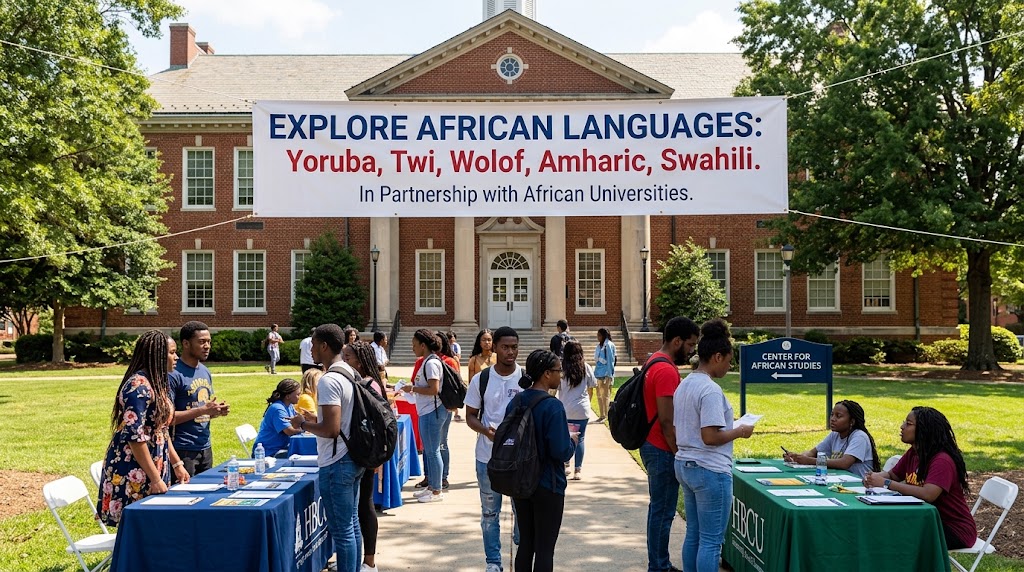
Young Africans relearning their grandparents’ languages is the visible half of a much larger story. The invisible half is that African American institutions have spent sixty years absent from the infrastructure that produces language fluency, and that absence has a price tag.
In 1939, a young man from the Gold Coast arrived at a small Black college in rural Pennsylvania to study economics and sociology. He would return home fifteen years later not merely educated but fluent in the vocabulary of institutions — economics, law, organizing, statecraft — and he would use it to lead his country to independence. A few years behind him, a young man from eastern Nigeria walked the same campus, and he too would go home to become a founding president. Lincoln University did not teach Kwame Nkrumah or Nnamdi Azikiwe Twi or Igbo. It gave them something else: the conviction that a Black institution could be the staging ground for African sovereignty. What Lincoln never built afterward was the other half of that exchange; a standing pipeline through which African language, and the economic access that comes with it, flowed back into the African American institutional ecosystem. That gap, nearly a century old, is still open.
HBCUs should be offering credit-bearing instruction in African languages — Yoruba, Twi, Wolof, Amharic, Swahili — built through direct partnership with African universities, not as a cultural enrichment elective but as core workforce and trade infrastructure. The case for this is economic and institutional, not sentimental.
Language instruction is not a neutral academic offering. It is credentialing infrastructure, and credentialing infrastructure determines who gets hired into the jobs that sit between two economies. Every multinational corporation, trade mission, diplomatic post, and NGO office that needs someone who can move between English and an African language recruits from wherever that language is taught at scale. For the last half-century, that has meant federally funded area studies centers at a small number of predominantly white research universities. Title VI of the Higher Education Act has funneled National Resource Center funding into African Studies programs concentrated in a handful of institutions for decades, building durable pipelines between those campuses and the State Department, USAID, the World Bank, and multinational firms doing business across the continent. HBCUs, with rare exception, were never inside that funding architecture. The result is a predictable one: the African American professional class that works in Africa-facing trade, diplomacy, and business overwhelmingly credentialed somewhere other than a Black institution. The institutional capital generated by that career pipeline; the alumni networks, the corporate relationships, the government contracts, the endowment gifts that follow professional success accrued elsewhere.
This is a capital retention problem before it is a curriculum problem. African economies are not a charity case for the diaspora to sentimentally reconnect with; several are among the fastest-growing consumer and resource markets in the world, and the firms, universities, and governments of Ghana, Nigeria, Kenya, and Senegal are actively building the commercial and diplomatic infrastructure to engage global partners on their own terms. The African American institutional ecosystem currently has almost no standing mechanism to plug into that growth as an equal counterparty rather than as an occasional cultural visitor. A study-abroad semester is not that mechanism. A three-week heritage trip is not that mechanism. What is required is the unglamorous, compounding infrastructure of formal academic partnership: articulated language sequences, dual-enrollment agreements, joint faculty appointments, and degree pathways that produce graduates fluent enough to staff a trade desk, negotiate a supply contract, or serve as the ninth employee at a firm doing business in Accra rather than the twenty-fifth interpreter hired by someone else’s firm.
The historical precedent for this kind of institutional coordination already exists inside the African American tradition, even if it was never built out permanently. The 1955 Bandung Conference gave the Black American political and intellectual class its first serious modern vocabulary for treating African and Asian nations as strategic partners rather than subjects of missionary concern. The American Negro Leadership Conference on Africa, convened in 1962 under A. Philip Randolph, briefly organized Black civil rights leadership around explicit support for African independence movements, treating the fates of the two struggles as structurally linked. Both moments produced statements, delegations, and solidarity. Neither produced a permanent academic infrastructure. The language centers, the joint degree programs, the standing faculty exchanges — the parts that would have made the relationship self-sustaining rather than dependent on a given generation’s political enthusiasm — were never built. HBCUs are positioned to finish that unfinished work, but only if the relationship is structured as reciprocal institutional infrastructure rather than one more symbolic exchange.
What this looks like in practice is specific and buildable. A regional HBCU such as Delaware State, Fort Valley State, Norfolk State, Coppin State can enter a formal instructional partnership with a University of Ghana or University of Cape Coast for Twi and Akan instruction, delivered through hybrid faculty exchange: a visiting Ghanaian instructor teaching on the HBCU campus for a term, HBCU students completing an immersion sequence in Accra the following year, with credits and cost structured through the partnership rather than left to an expensive third-party study-abroad vendor. A Gulf Coast institution like Dillard, Xavier of Louisiana, or Tougaloo, with existing Francophone ties through Louisiana’s own linguistic history, is a natural partner for Wolof instruction anchored through Cheikh Anta Diop University in Dakar. Fisk, Alcorn State, or Bethune-Cookman could anchor Yoruba instruction through the University of Ibadan, building directly on the existing scholarly infrastructure around Yoruba studies that already exists in American academia but rarely touches a Black campus. Morgan State or Savannah State, given their urban commercial catchment areas, are positioned for Swahili and Amharic instruction tied to University of Nairobi partnerships, aimed explicitly at trade, logistics, and international business students rather than only humanities majors. None of this requires inventing new institutional categories. It requires HBCU administrations and boards to treat language partnership agreements with the same seriousness as athletic conference realignment or bond issuance, as long-term structural commitments with a defined return, not as a one-time grant-funded pilot program that disappears when the grant ends.
The financial case follows directly from the strategic one. Endowed language chairs, funded through targeted alumni or corporate giving rather than general operating budgets, insulate these programs from the boom-bust cycle that has killed most previous African language initiatives at American universities once federal or foundation funding lapsed. A joint appointment structure, where the partner African university co-funds a faculty line, reduces the standalone cost burden on an HBCU operating budget that is already stretched thin relative to peer PWIs. And the graduates of these programs are not a cost center to be justified on cultural grounds alone — they are the raw talent pool for an intermediary economic role that is currently uncontested territory for Black institutions: trade representatives, import-export entrepreneurs, diplomatic staff, and corporate Africa-desk officers who studied the language and the business context at the same institution, rather than picking up conversational fluency as an afterthought to a degree earned somewhere else entirely.
Institutional density is built one deliberate infrastructure decision at a time, and African language instruction, delivered through direct university-to-university partnership rather than through federally funded programs at institutions with no historical stake in the outcome, is one of the more obtainable pieces of that infrastructure available to HBCUs today. The relationship Lincoln University started with Nkrumah and Azikiwe in the 1930s was never completed on the language side of the ledger. Completing it now is not a nostalgic gesture toward Pan-Africanism. It is a decision about which institutions get to sit at the table as Africa’s economies continue to grow, and which ones remain permanently one credentialing cycle behind.
Disclaimer: This article was assisted by ClaudeAI.

