Tag Archives: African American institutional power

The $10 Solution: Why Small, Recurring Gifts Are the Missing Pillar of Black Institutional Finance

The African American institutional ecosystem—comprising HBCUs, Black-led nonprofits, community health organizations, and civic associations—faces a structural financing problem that no single grant cycle, federal appropriation, or celebrity donation can solve on its own. The challenge is not a shortage of Black generosity. It is a shortage of organized, recurring, and institutionally directed Black generosity. The $10 monthly donation—modest by any individual measure—represents, in aggregate, one of the most underutilized instruments of capital formation available to African American institutions today.

This is not an argument for charity. It is an argument for institutional finance through democratized recurring revenue.

Before prescribing solutions, the data demands a reckoning with the scale of the funding disparity confronting African American-led institutions. According to research compiled by the Bridgespan Group and Echoing Green, the revenues of Black-led organizations are 24 percent smaller than the revenues of their white-led counterparts. When it comes to unrestricted funding—the holy grail of financial support—the picture is even bleaker: the unrestricted net assets of Black-led organizations are 76 percent smaller than their white-led counterparts. That disparity in unrestricted assets is not a footnote. It is the operating condition under which virtually every Black-led institution functions daily.

The revenue figures are equally sobering in aggregate. In terms of total sector-wide revenue, majority Black-led organizations receive less than $3 billion, compared with majority white-led organizations that receive about $85 billion. The ratio of roughly 28 to 1 reflects decades of what practitioners in the sector have termed “philanthropic redlining,” a structural pattern in which institutional funders extend trust, operating support, and scale capital disproportionately to white-led organizations. The organizational profile of the sector makes this crisis especially acute. Majority Black-led nonprofits tend to be smaller, with 61 percent operating with budgets under $100,000 and only 2 percent with budgets over $10 million. The median annual revenue of majority Black-led nonprofits is $302,000, compared with $908,000 for majority white-led nonprofits. An organization operating at $302,000 in annual revenue has little margin for program investment, staff development, or reserve accumulation. It is, by any financial standard, an institution surviving rather than building.

The Association of Black Foundation Executives found that 60 percent of Black-led organizations surveyed had budgets of $500,000 or less, and just 23 percent had reserves of three months or more. A three-month operating reserve is considered the absolute minimum threshold for organizational resilience. The fact that more than three-quarters of Black-led nonprofits fall below that floor means that any disruption to funding—a grant not renewed, a donor who lapses, a federal program curtailed—can be existential. HBCUs face a structurally analogous problem in higher education finance. The PWI-HBCU NACUBO Top 10 Endowment Gap for 2024 stands at $129.2 to $1. HBCUs comprised 1.5 percent of NACUBO’s reporting institutions and 0.3 percent of the reporting endowment assets, while PWI endowments with assets over $5 billion hold 58.5 percent of the $884.3 billion in total reporting endowment assets. Even Howard University, which became the first HBCU to cross the $1 billion endowment threshold, a genuine milestone, remains an order of magnitude behind flagship PWIs whose endowments measure in the tens of billions.

These figures, taken together, describe an ecosystem that is generationally undercapitalized. The structural solution requires multiple interventions: federal policy reform, corporate accountability, philanthropic sector reorientation, and enhanced major gift cultivation. But each of those levers operates on a long timeline and with significant uncertainty. What African American households, alumni chapters, and giving groups can control today is the flow of their own recurring dollars into the institutions that serve them.

African Americans are among the most generous donors in the United States, a fact that is consistently underappreciated in both mainstream philanthropic discourse and internal community conversations. Nearly two-thirds of Black households donate to community-based organizations and causes, totaling $11 billion each year. Black households on average give away 25 percent more of their income per year than white households, and of all racial or ethnic groups, Black families have contributed the largest proportion of their wealth to charity since 2010. High-net-worth Black families are reportedly more likely to have family traditions around giving than their white counterparts and report more fulfillment from their charitable giving. Research by the Indiana University Lilly Family School of Philanthropy documents that Black Americans donated 3 to 4 percent of their income to charity on average across the years studied, a rate that outpaces other demographic groups relative to income.

The generosity is not in question. What is in question is the institutional destination of that generosity and the form it takes. A community that donates $11 billion annually but whose primary institutional ecosystem of HBCUs, Black-led nonprofits, Black hospitals, Black media operates on poverty-level budgets has a capital distribution problem, not a giving problem. The money is there. The institutional routing is not. A significant portion of that giving flows to religious congregations, mutual aid to extended family networks, and causes with no institutional anchor in the African American ecosystem. None of those giving patterns are illegitimate. But they do not build endowments. They do not fund operating reserves. They do not provide the recurring, unrestricted revenue that allows a Black-led nonprofit to hire a development officer, invest in data infrastructure, or weather a single major donor’s departure.

The $10 monthly donation ($120 annually) is not a symbolic gesture. At scale, it is a recapitalization strategy. There are approximately 47 million African Americans in the United States. If only 5 percent of Black households which is roughly 2.5 million households out of an estimated 17 million committed $10 per month to a Black-led institution, the aggregate annual flow would reach $300 million. Directed strategically across HBCUs, Black-led nonprofits, and community health institutions, that represents more than 10 percent of the current total revenue flowing to the majority Black-led nonprofit sector.

The power of recurring giving extends beyond the dollar amount. Industry data confirms that monthly donors give 42 percent more than one-time givers on an annualized basis, driven by the cumulative effect of consistent contributions and the reduced likelihood of lapsing. For nonprofits, recurring revenue is categorically different from episodic revenue: it is predictable, plannable, and bankable in ways that grant income and campaign proceeds are not. An organization with 500 monthly donors at $10 each has a guaranteed $60,000 annual baseline; modest but stable enough to justify hiring, to secure a line of credit, or to launch a matching gift campaign. Unrestricted monthly giving is also the form of philanthropy most urgently needed by Black-led institutions. The systemic deficiency in unrestricted funding, that 76 percent gap compared to white-led peers, reflects a structural pattern in which Black organizations receive grants with narrow programmatic restrictions that prevent investment in the internal capacity required for organizational growth. A $10 monthly donation from an HBCU alumnus to their alma mater’s annual fund, or from a community member to a local Black-led nonprofit, is by definition unrestricted. The institution decides how to deploy it: toward a staff position, a technology upgrade, an emergency reserve, or a matching gift that unlocks foundation dollars.

The most efficient mechanism for scaling these commitments into institutional capital is not individual action—it is collective action through organizational infrastructure. HBCU alumni chapters and African American giving groups represent an underutilized distribution network for democratized recurring philanthropy. An alumni chapter with 200 active members in which 60 percent commit to $10 monthly generates $14,400 annually—directed, unrestricted, recurring. A national HBCU alumni association with 50 chapters operating at that participation rate generates $720,000 annually for institutional endowment or operating support. Multiply that across the more than 100 HBCUs, many of which have alumni association networks across dozens of cities, and the aggregate potential is measured in the tens of millions of dollars per year, capital that currently does not exist on HBCU balance sheets.

Giving groups offer a parallel vehicle. Giving circles like the New Generation of African American Philanthropists, which began as a 15-person circle in Charlotte, have grown into significant collective giving entities committed to disrupting conventional philanthropy. These structures are particularly well-suited to the $10 monthly model because they combine the social accountability of a group commitment with the financial efficiency of pooled, recurring capital. A giving group that aggregates 100 members at $10 monthly generates $12,000 annually in deployable grants, small enough to be accessible to any working professional, large enough to meaningfully support a Black-led organization’s operating budget. The alumni chapter as a philanthropic vehicle is also strategically superior to individual giving in one critical respect: it creates an institutional relationship between the donor and the institution that survives any individual’s personal financial fluctuation. When the chapter commits, the institution can plan around that commitment. When an individual donor commits in isolation, attrition erodes the revenue base unpredictably.

The compounding returns of this approach are significant. An HBCU with 10,000 alumni in which 15 percent participate at $10 monthly generates $1.8 million annually. Invested at a conservative 5 percent return, sustained over ten years with reinvestment, that giving program alone produces an endowment contribution of more than $22 million, enough to fund two endowed faculty chairs or establish a meaningful scholarship fund. The compounding logic of recurring philanthropy, applied to institutional endowment-building, is the same logic that has built the multibillion-dollar endowments of elite PWIs over generations: not a handful of transformative gifts alone, but a consistent culture of giving across a broad alumni base, sustained over decades. For Black-led nonprofits, the calculus is more immediate. More than half of Black-led nonprofit leaders report that their organization would shut down if they lost one or two key funders. An organization that replaces that concentration risk with 300 monthly donors at $10 each has effectively immunized itself against the collapse of any single funding relationship. Donor diversification, the standard recommendation of every organizational capacity consultant in the sector, is operationally achieved through the accumulation of recurring small donors, not through the pursuit of larger restricted grants. According to the National Committee for Responsive Philanthropy, funding to Black communities accounts for only 1 percent of all community foundation funding, resulting in an underfunding of Black communities of $2 billion. Community philanthropy from within the ecosystem is not a substitute for external institutional accountability but it is the only source of capital over which African American institutions have direct and immediate control.


Recommendations for Institutional Action
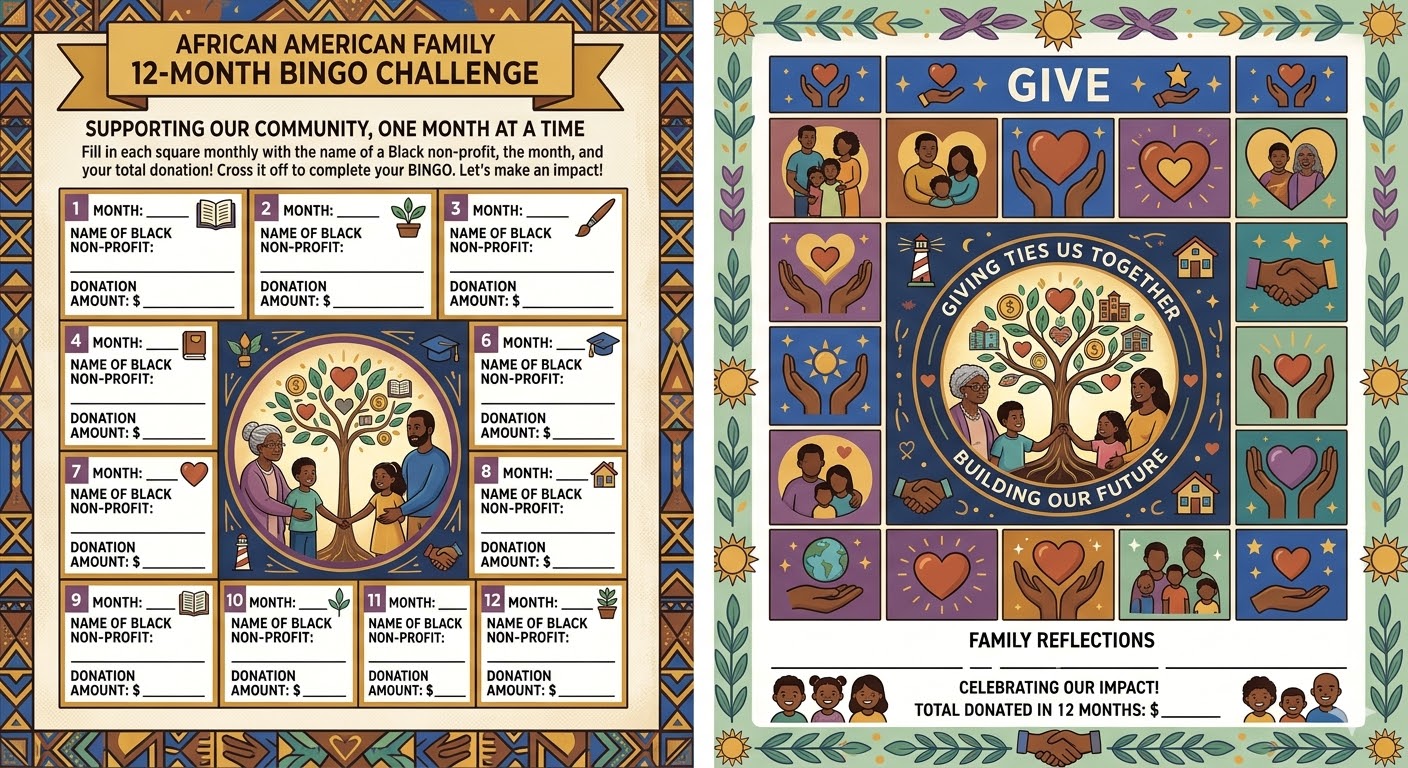
For HBCU Development Offices: The immediate priority is building and marketing a monthly giving program with a specific $10 entry point. The language should be explicit: this is not charity; it is institutional investment. Alumni who would not write a $120 check will often commit to $10 monthly if the onboarding is frictionless and the institutional communication is consistent and strategic. Technology infrastructure for recurring giving is low-cost and widely available. The barrier is not technical it is a development culture that has historically prioritized major gift cultivation at the expense of broad-base annual fund growth.

For Alumni Chapters: Chapters should establish a formal monthly giving commitment as a condition of active chapter membership or officer eligibility not as a financial barrier, but as a cultural signal that institutional support is a baseline expectation of HBCU alumni engagement, not an exceptional act. Chapters with robust monthly giving programs should publicize their aggregate contribution totals, creating competitive social proof across the alumni network.

For African American Giving Groups: Existing giving circles and collective philanthropy organizations should formally adopt Black-led nonprofits and HBCU foundations as priority beneficiaries and structure their pooled contributions as recurring monthly flows rather than single annual grants. The stability value of a twelve-month recurring commitment to a recipient organization exceeds the programmatic value of a larger, one-time check.

For Individual Households: The allocation question is straightforward. African American households already give. The strategic question is whether a portion of that existing generosity is directed toward institutions with the capacity to aggregate capital, build reserves, and generate long-term community returns. Setting up one $10 monthly recurring gift to an HBCU foundation or Black-led nonprofit requires less than ten minutes and commits less than the cost of two streaming subscriptions per month.


The structural underfunding of African American institutions is not primarily a story of insufficient generosity—it is a story of insufficient institutional routing. Black households give $11 billion annually. Black-led institutions capture a fraction of that flow. The gap between those two figures is the organizing challenge of African American institutional philanthropy.

The $10 monthly commitment is not the complete answer. It does not replace federal investment, it does not substitute for corporate accountability in philanthropic grantmaking, and it does not eliminate the need for transformative major gifts to HBCU endowments. But it is the instrument most immediately available, most broadly accessible, and most structurally valuable to the organizations that need stable, unrestricted, recurring revenue to survive and eventually to scale.

Communities are built by institutions. Institutions are built by capital. Capital, in the absence of inherited wealth and equitable access to external philanthropy, must be built from within—one recurring commitment at a time.

Disclaimer: This article was assisted by ClaudeAI.

The Largest IPO in African History Is Happening. Where Are African America’s Institutions?

Our work is the presentatoin of our capabilities. – Edward Gibbon

There is an old story about a village that lived along a great river. Every season, merchants from distant lands traveled that river, loading their boats with timber, ore, and grain pulled from the very land the villagers had worked for generations. Those merchants sailed downstream to markets where fortunes were made and power was consolidated, and season by season, neighboring tribes who had learned to build boats and send their own goods to market grew stronger their granaries fuller, their children better protected, their voices louder in the councils where decisions were made about who owned what and who owed whom. The village elders watched all of this from the bank. They were not ignorant men and women. They knew the river better than any merchant who passed through. They understood its currents, its seasons, its dangers. But they had never built boats. The lumber was expensive. The tools were hard to come by. The timing was never quite right. And so the resources of their land flowed downstream in other people’s vessels, enriching other people’s villages, while their own families and sibling villages just around the bend, bound to them by blood and history grew more exposed with each passing year. Then one season, a young man and a young woman stood before the elders and said: we know how to build the boats. We know where the timber is. We know the market downstream. The only question is whether this village will finally decide that the river belongs to us too.

The most consequential capital markets event in African history is unfolding in real time, and there is no reason for HBCU endowments and alumni associations to be spectators.

Aliko Dangote, the Nigerian industrialist whose Dangote Petroleum Refinery and Petrochemicals FZE has already reshaped the energy economics of West Africa, is preparing to take the refinery public. The offering structured as a coordinated multi-exchange IPO spanning the Nigerian Exchange, the Johannesburg Stock Exchange, the Nairobi Securities Exchange, the Ghana Stock Exchange, and several additional African bourses carries a valuation range of $40 billion to $50 billion. At a 10% stake offering, the actual transaction size approaches $5 billion, making it by a wide margin the largest equity offering ever conducted on an African stock exchange. The IPO subscription window is expected to open later in 2026.

For HBCU endowment officers, foundation boards, and alumni association investment committees who have spent the last decade searching for alternative assets that offer both competitive returns and meaningful institutional alignment, this transaction deserves serious analysis. It is not a charity play or a symbolic gesture toward Pan-African solidarity. It is a hard industrial asset, generating real revenue in hard currency, operating at the center of a continental energy transformation that will define the next quarter century of African economic development.

The strategic case begins with the asset itself.

The Dangote Refinery, located in the Ibeju-Lekki Free Trade Zone on the outskirts of Lagos, is the world’s largest single-train crude oil processing facility, with a current capacity of 650,000 barrels per day. It reached full operational capacity in early 2024, has already turned Nigeria into a net fuel exporter, and has disrupted global trade routes that previously ran refined petroleum products from European refineries back into the African market. The refinery currently supplies over 90% of Nigeria’s domestic petrol demand and has exported refined fuel to five African countries. The Dangote Group’s revenues have grown from $3.3 billion to $18 billion over the past five years, and the refinery’s expansion roadmap which envisions more than doubling capacity to 1.4 million barrels per day is the central purpose of the IPO capital raise.

One structural feature of the transaction is particularly noteworthy for institutional investors operating in the United States: dividends will be paid in US dollars, even though shares are purchased in naira. This is not a minor administrative detail. It addresses the core foreign-exchange risk concern that typically limits American institutional appetite for African equity markets. Dollar-denominated dividends from an asset generating dollar-denominated revenues — the refinery sells its output at global commodity prices — transforms the currency risk profile of the investment from speculative to manageable. For HBCU endowments that are overwhelmingly concentrated in US equities and fixed income, this creates a genuine entry point into the African investment universe without the full currency risk exposure that has historically made direct African market participation unattractive.

Now consider where HBCU endowments currently stand in the landscape of American higher education finance.

According to the most recent NACUBO-Commonfund Study of Endowments, HBCU institutions accounted for approximately $2.4 billion of the $944 billion in total endowment assets reported by participating institutions. The average HBCU endowment was $236.7 million, compared to $1.4 billion for all NCSE respondents. Only two HBCUs — Howard University, which crossed the $1 billion threshold, and Spelman College hold endowments above $500 million. The PWI-to-HBCU endowment gap among the top 10 institutions in each category stands at roughly 129 to 1. HBCU endowment gift flows fell to $67.7 million in FY25 from $91.9 million in FY24. On nearly every metric, the structural undercapitalization of HBCU institutional wealth is not merely significant; it is a threat to the long-term viability of institutions that serve as the backbone of African American professional formation.

The investment allocation patterns compounding this problem are equally stark. HBCU endowments allocate just 14% of their portfolios to alternative asset classes, compared to 41% for their non-HBCU peers — a 27-percentage-point gap that systematically excludes them from the asset classes driving the highest long-term returns. The reasons are structural and understandable: smaller endowments have fewer investment staff, face higher minimum investment thresholds at most alternative asset managers, and operate with more conservative board mandates. But the consequence is that HBCU endowments are systematically excluded from the alternative and international asset classes that generate the outsized returns sustaining the endowments of Harvard, Yale, and the University of Texas system. The compounding effect of this exclusion over decades is not a gap — it is a chasm.

The Dangote IPO, precisely because of its scale, its multi-exchange structure, and its dollar dividend commitment, represents an unusual opportunity to begin addressing one dimension of this allocation problem.

For institutions with sufficient endowment size to participate as institutional investors in the international tranche of the offering — Howard, Spelman, Hampton, and a small handful of others — the case for direct participation is straightforward. A position in the world’s largest single-train refinery, at an entry valuation of $40 to $50 billion, in an asset whose expansion is already funded and whose revenues are denominated in the currency in which your dividends will be paid, provides genuine portfolio diversification, inflation protection through commodity-linked revenues, and exposure to the fastest-urbanizing, fastest-growing consumer energy market on earth. Africa’s urban population is projected to double by 2050. Every major city added to the African urban grid requires energy infrastructure. The Dangote Refinery is positioned at the center of that demand trajectory.

For institutions whose endowment size makes direct participation in the IPO difficult which is the reality for most of the HBCU sector the answer is not to sit out. It is to aggregate. The 1890 Foundation, which serves as the coordinating hub for the nation’s 19 historically Black land-grant universities and has already demonstrated its capacity to administer large-scale federal partnerships, is the most credible existing infrastructure for a consortium investment vehicle among its member institutions. A formally structured investment fund operating through the 1890 network governed by participating endowment officers, managed by professional advisers with international markets experience, and capitalized through pooled contributions from member institutions would provide access to investment minimums and due diligence resources that no individual 1890 institution could assemble independently. The SWAC, MEAC, SIAC, CIAA, and HBCU Athletic Conference represent analogous organizing structures across the sector where the same consortium investment logic applies where each already functions as a governance body with member institutions, shared administrative infrastructure, and collective standing that could anchor a pooled investment vehicle.

HBCU alumni associations belong in this conversation, but not as secondary vehicles for the institution’s benefit. They belong as independent institutional investors making strategic decisions on their own financial merits. An alumni association that builds an investment fund with its own governance, its own professional management, and its own return targets is building institutional wealth for its membership, not running a philanthropic pipeline to its parent institution. The distinction matters. An alumni association investment fund capitalized by members seeking competitive financial returns will attract a different level of participation, a different quality of governance, and ultimately a different scale of capital than one framed as an alumni giving mechanism wearing investment clothes. Where coordination between a university endowment and its alumni association investment fund makes strategic sense such as co-investment in a shared opportunity, shared due diligence costs, complementary positions in the same offering that coordination should happen by design, not by default. But each institution must be making an independent decision of financial merit.

The argument for this model is not merely aspirational. It has historical precedent in other diaspora investment networks. The Indian American diaspora has consistently channeled capital into Indian infrastructure and technology sectors through organized networks of high-net-worth investors coordinated through professional associations and regional affinity groups. Cuban American capital networks have played a documented role in channeling investment back into businesses serving the diaspora in South Florida. Jewish American institutional networks have sustained diaspora bond programs through organized professional and philanthropic structures for decades. The mechanisms are known. The question is whether African American institutional leadership will build the organizational infrastructure to replicate them.

But the case for HBCU institutional participation in the Dangote IPO extends beyond portfolio diversification or even diaspora solidarity. It is about the connective tissue between two halves of the same people that has never been fully built. African American institutions sit on intellectual capital in agriculture, medicine, engineering, law, public policy, and the sciences that is directly relevant to the development challenges facing African Core nations. African institutions sit on natural capital, emerging market infrastructure, and a demographic growth trajectory that represents the most significant economic expansion of the twenty-first century. The relationship between the two has been episodic and philanthropic where it should be structural and transactional. An HBCU endowment that holds equity in the Dangote Refinery is not making a charitable gesture toward the continent — it is establishing a financial relationship that creates the institutional logic for research partnerships, faculty exchanges, student pipelines, and joint ventures that philanthropy alone never compels. Capital is the language institutions speak to each other when they intend to be taken seriously. Beyond the bilateral opportunity, there is a harder truth: Africa’s resources have been extracted, its assets undervalued, and its markets structured to serve outside interests since the colonial era. That dynamic does not end on its own. It ends when African institutions and their diaspora counterparts accumulate enough ownership stake in African Core assets that the continent’s wealth begins compounding inward rather than flowing out. Every dollar of HBCU and African American institutional capital deployed into African equity markets is a dollar that does not go to the outside investors who have historically treated the African Core as a source of raw return without reciprocal obligation. Ownership is the only permanent answer to extraction.

The Dangote IPO is not only an investment proposition. It is a test of whether Black institutional America can organize itself to participate in the capital formation of the African Core, the region whose industrialization will define the global economy’s next chapter or whether, once again, the value created in this geography will accrue primarily to investors who had the institutional organization to show up.

Nigeria’s regulatory environment carries the political and macroeconomic variance typical of any large, resource-rich emerging economy no more inherently unstable than the frontier and emerging markets of Eastern Europe, Southeast Asia, or Latin America that well-capitalized endowments have allocated to for decades without treating the risk as exceptional. That Nigerian markets have historically been characterized as uniquely risky reflects less about Nigeria’s actual risk profile than about the systematic undervaluation of African Core economies by external rating frameworks designed to serve the capital interests of institutions that benefit from keeping African assets mispriced. The multi-exchange listing structure presents a genuine operational challenge: coordinating clearing, settlement, and trading standards across multiple African exchanges simultaneously has no established precedent at this scale, and execution risk is real. Currency risk, while substantially mitigated by the dollar dividend structure, is not eliminated. And the refinery carries $3.65 billion in outstanding debt, with plans to repay through operations and asset sales — a material factor in any serious valuation analysis.

These risks are real. They do not, however, distinguish this offering from the risk profile of the emerging market private equity and infrastructure funds that well-capitalized non-HBCU endowments have been allocating to for the past two decades. The difference is not that those endowments found risk-free investments in emerging markets. The difference is that they built the institutional capacity to analyze and manage those risks, and they positioned themselves to capture the returns that came with accepting them.

HBCU endowments that remain concentrated in domestic equities and fixed income because they lack the investment staff to evaluate an African infrastructure IPO are not being prudent. They are being institutionally underpowered in a way that will compound against their beneficiaries for generations.

The path forward requires several concrete steps. First, HBCU endowment boards and foundation leadership should commission formal analysis of the Dangote prospectus as it becomes available and engage the offering’s appointed advisers — Stanbic IBTC Capital, Vetiva Advisory Services, and FirstCap — to understand the terms available to international institutional participants. Second, the 1890 Foundation, UNCF, the Thurgood Marshall College Fund, the HBCU Faculty Development Network, and the leadership of the SWAC, MEAC, SIAC, CIAA, and HBCU Athletic Conference should open formal conversations now about the governance structure of consortium investment vehicles within their respective networks, before this offering closes and before the next one arrives. Each of these organizations already operates across multiple institutions with shared administrative infrastructure; the investment coordination function is an extension of capacity they already possess, not a capability they would need to build from scratch. Third, HBCU alumni association leadership (national organizations, alumni chapters, and the professional networks that shadow every major HBCU) should be building investment fund infrastructure as a parallel track, governed independently and capitalized on financial merit, with coordination with institutional endowments happening where it creates genuine value for both parties.

The architecture of African wealth is being redrawn. The Dangote IPO is not a metaphor for that process. It is the process, in concrete form, open for institutional participation by any investor with the organizational capacity to engage it.

The young man and the young woman are standing before the elders. The boats can be built. The only question is whether this village will finally decide that the river belongs to them too.


This article is for informational and analytical purposes only and does not constitute investment advice. Prospective investors should conduct independent due diligence and consult qualified financial advisers before making investment decisions.

Disclaimer: This article was assisted by ClaudeAI.
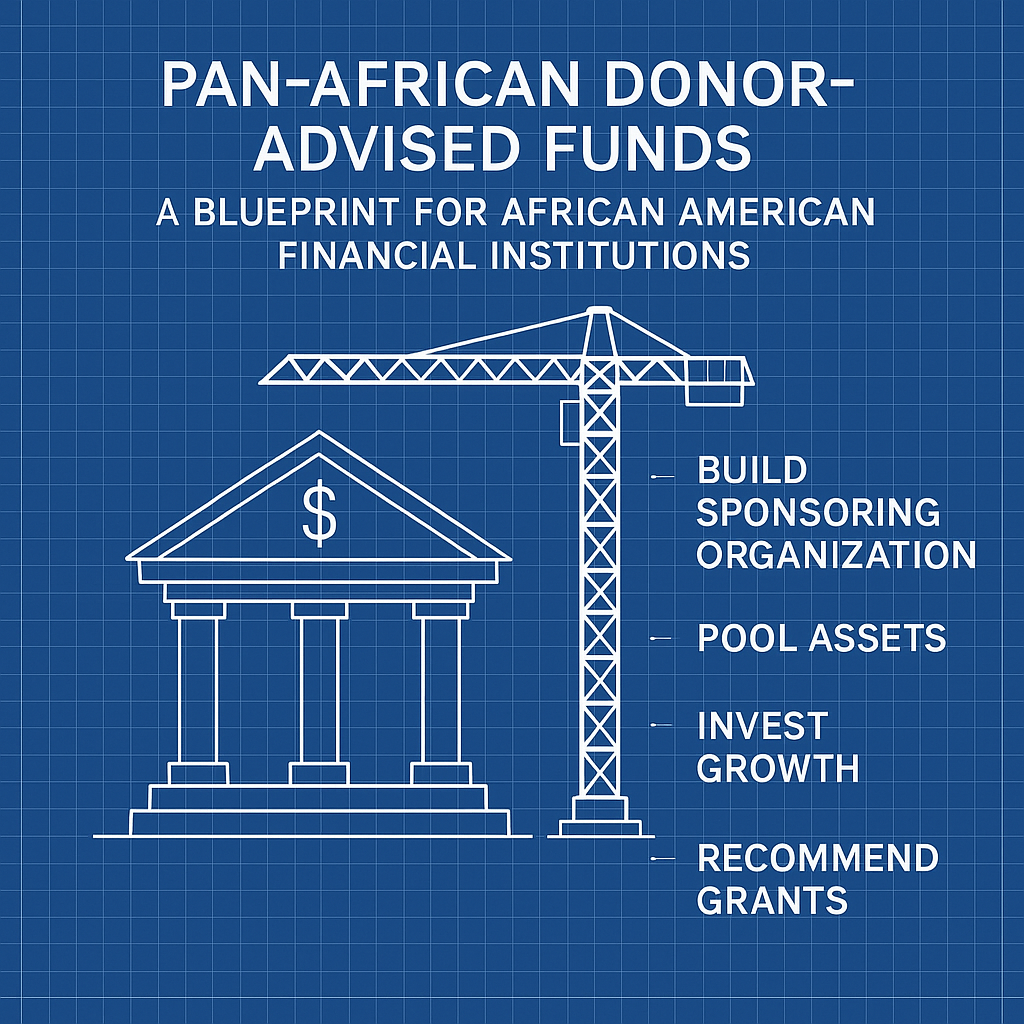
Pan-African Donor-Advised Funds: A Blueprint For African American Financial Institutions

“To be a poor man is hard, but to be a poor race in a land of dollars is the very bottom of hardships.” — W.E.B. Du Bois

Philanthropy, at its best, is not only about generosity but also about power. For African America and the broader African Diaspora, philanthropy has too often been reduced to the goodwill of outsider corporations, foundations, and billionaires whose dollars arrive with priorities and strings attached. If African American financial institutions are to play a central role in reshaping the destiny of our people, they must learn to wield the tools of modern philanthropy at scale. Chief among these tools is the donor-advised fund.

A donor-advised fund, or DAF, is a charitable giving vehicle hosted by a sponsoring public charity. Donors contribute assets such as cash, securities, or real estate, receive an immediate tax deduction, and then recommend grants to nonprofit organizations over time. These funds are often described as “charitable investment accounts,” because once assets are placed inside them they can be invested for tax-free growth, providing donors the flexibility to make grants years or even decades later. Unlike private foundations, DAFs do not carry heavy administrative costs, reporting requirements, or annual payout mandates. That combination of flexibility, efficiency, and tax benefit has made them the fastest-growing vehicle in philanthropy, with more than $229 billion in assets managed in the United States by 2022.

The technical mechanics are straightforward, but the implications for African American institutional power are profound. When majority institutions host DAFs, they not only manage the assets and collect the fees but also strengthen their institutional position in the broader philanthropic ecosystem. If African American banks, credit unions, and HBCUs were to host their own DAF platforms, they would retain both the capital and the influence. They would also ensure that those assets circulate internally, building the capacity of Black institutions rather than reinforcing external ones.

The Pan-African case for donor-advised funds grows out of both history and strategy. The African Diaspora is scattered across North America, the Caribbean, South America, Europe, and Africa. Despite cultural variations, there is a shared experience of enslavement, colonization, and systemic exclusion that has left us fragmented and underdeveloped institutionally. A Pan-African DAF would allow African America’s wealth to pool with Diasporic wealth, creating a philanthropic capital base that could fund initiatives from Harlem to Havana, from Lagos to London. Imagine a Spelman alumna in Atlanta, a banker in Kingston, and a tech entrepreneur in Nairobi all contributing to the same Pan-African DAF. The fund’s assets grow through coordinated investment, and the grants sustain HBCUs, African universities, Diaspora think tanks, hospitals, and cooperative businesses. Philanthropy would move beyond sporadic generosity into a coordinated, long-term Diasporic strategy.

African American financial institutions are uniquely positioned to lead in building these vehicles. Black-owned banks could create DAF platforms, allowing depositors and wealthier clients to establish accounts, with the bank managing the assets and directing grants into curated pools of African American and Diaspora institutions. HBCUs could build DAFs under their endowment arms, offering alumni the chance to contribute not just to individual schools but to collective vehicles that support Black higher education broadly. Credit unions, already rooted in cooperative traditions, could create member-based DAFs that channel contributions into scholarships, healthcare clinics, or Diaspora research projects. A Pan-African exchange could even emerge, allowing African American donors to support African institutions and African donors to support African American initiatives, breaking down silos and creating reciprocity.

The impact on philanthropy would be transformative. Pooling resources through Pan-African DAFs would reduce fragmentation and administrative waste. A single DAF with $1 billion in assets could deploy $50 million in annual grants while continuing to grow its capital base. Instead of thousands of scattered donations, these funds would strategically target long-term capacity-building institutions like universities, hospitals, and think tanks. They would also allow families to pass advisory privileges to children and grandchildren, embedding intergenerational philanthropy into family legacies. By linking U.S. tax benefits with Diaspora impact, Pan-African DAFs would connect global Black institutions across borders in ways never before achieved.

More than philanthropy, DAFs are about institutional power. Hosting our own funds would allow African America to retain capital that otherwise circulates through majority institutions. The act of managing billions in philanthropic assets would increase the legitimacy, visibility, and bargaining power of African American banks and credit unions in the national financial system. Control over DAFs also allows agenda-setting: funding HBCU graduate schools, African healthcare systems, Diaspora media, or land ownership initiatives. With sufficient scale, Pan-African DAFs would fund the think tanks, advocacy networks, and policy shops that shape legislation and strategy across the Diaspora. They would also strengthen interdependence between Black banks, universities, and cooperatives, weaving a tighter institutional ecosystem. And globally, they would reframe African American philanthropy as not merely domestic but as a force shaping development across Africa, the Caribbean, and beyond.

Mainstream philanthropic firms offer lessons. Fidelity Charitable, Schwab Charitable, and Vanguard Charitable collectively manage tens of billions in DAF assets, attracting donors with ease of use, professional management, and trusted brands. But they also embody the critique that DAFs can warehouse wealth indefinitely, giving donors immediate tax deductions without ensuring timely disbursement to communities. A Pan-African DAF must avoid this trap by committing to clear disbursement expectations, perhaps requiring annual grantmaking of 7 to 10 percent of assets. It must also invest in building trust and branding. Fidelity and Schwab are household names; African American financial institutions must cultivate similar reputations for professionalism, security, and vision if they are to attract donors at scale.

The roadmap to implementation is straightforward. Institutions must establish DAFs under existing nonprofit or financial arms with full compliance to IRS rules. They must develop Pan-African investment strategies that allocate assets into African American-owned funds, African sovereign bonds, and Diasporic infrastructure projects. They need technology platforms that allow donors to open accounts, contribute assets, recommend grants, and track impact with ease. Partnerships with vetted institutions across the Diaspora are essential, ensuring that grants reach trusted universities, hospitals, and cooperatives. Above all, a compelling public narrative must frame participation in Pan-African DAFs as not just philanthropy but as an act of liberation and institution building. Families should be encouraged to use DAFs to teach the next generation about philanthropy and responsibility, embedding giving as a permanent part of Diasporic culture.

The vision for the future is clear. By 2045, African American banks could be managing $100 billion in Pan-African DAFs, with $7–10 billion flowing annually into HBCUs, African universities, hospitals, and think tanks. Fee revenues from managing these assets would sustain our financial institutions, while the grants would expand the capacity of Diasporic institutions. The Pan-African DAF could become one of the most powerful philanthropic vehicles in the world, rivaling Gates, Ford, and Rockefeller. But unlike those entities, it would not be rooted in charity; it would be rooted in sovereignty. It would represent a Diaspora using philanthropy to build freedom, not dependency.

Donor-advised funds are not new, but their potential for African American and Pan-African institutions has yet to be realized. For too long, our wealth has flowed outward, strengthening others’ institutions while leaving ours fragile. By developing Pan-African DAFs, African American banks, credit unions, and HBCUs can capture that wealth, grow it, and deploy it across the Diaspora to increase our power. This is not simply about philanthropy; it is about sovereignty, agenda-setting, and survival. The next century will not be decided by who receives charity but by who controls the institutions that give it.

Disclaimer: This article was assisted by ChatGPT

When the Gift Isn’t the Power: Prairie View’s Historic Donations and the Quiet Reality of UTIMCO Control

“A gift can open a door, but only ownership lets you walk through it on your own terms.”

When Prairie View A&M University announced that it had received a historic $63 million unrestricted gift from philanthropist MacKenzie Scott, headlines celebrated the moment as a watershed for the institution, the Texas A&M University System, and the broader HBCU sector. It was framed as both a moral recognition of PVAMU’s legacy and a financial turning point that would catalyze new academic, cultural, and research frontiers.

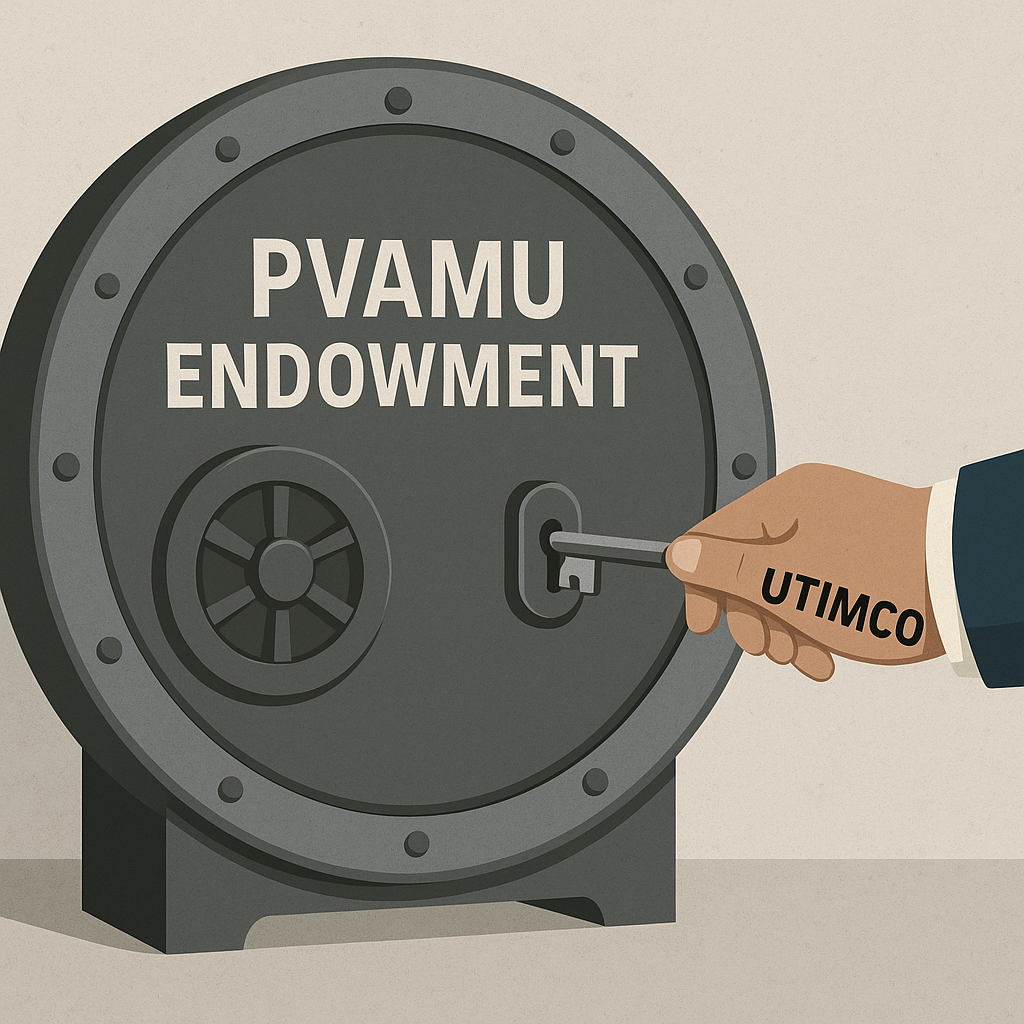
And yet, behind the applause and the very real gratitude there remains a more sobering, structural reality: Prairie View does not actually control its capital. The university’s endowment, like that of all Texas A&M System schools, is controlled and managed by UTIMCO, the University of Texas/Texas A&M Investment Management Company. UTIMCO is one of the largest public endowment management entities in the United States, overseeing well over $70 billion in assets. It is powerful, sophisticated, and critically not directly accountable to Prairie View’s leadership or the African American community whose future PVAMU represents.

This is the overlooked truth in the philanthropic triumph narrative: historic gifts do not necessarily translate into historic power. And power, not simply capital, is the currency African American institutions have always lacked most in the American economic order. Prairie View A&M University’s situation is a case study in the difference.

This article explores:

  • Why Prairie View’s record-setting gift still leaves it structurally dependent
  • How UTIMCO’s control restricts the institution’s long-term sovereignty
  • What this tells us about HBCU philanthropy and institutional design
  • Why African American institutional power requires ownership, not just funding
  • What steps Prairie View, other public HBCUs, and African American philanthropists can take to change the paradigm

This is not about questioning the value or impact of MacKenzie Scott’s generosity. It is about ensuring that gifts to African American institutions actually translate into durable, compounding power not momentary uplift that still sits under someone else’s governance.

The Gift Was Unprecedented—But the Structure Wasn’t

MacKenzie Scott’s philanthropic investments in Prairie View were transformational by any measure. Unrestricted capital is rare. Unrestricted capital at that scale is almost unheard of for HBCUs. Prairie View announced bold plans: initiatives in student success, research expansion, recruitment of top scholars, and community-facing programs that would have immediate impact.

However, beneath these aspirational goals lies a structural constraint. As a member of the Texas A&M University System, Prairie View’s endowment assets are not independently managed. Instead, they are placed under UTIMCO stewardship.

This means:

  • Prairie View cannot choose its own investment strategy
  • Prairie View cannot decide its own risk profile
  • Prairie View cannot determine long-term reinvestment philosophies
  • Prairie View cannot directly leverage its endowment as collateral or strategic capital
  • Prairie View has limited input into how its own financial future is shaped

Prairie View is wealthy in name, but not in governance. This is the difference between having money and having power.

Why UTIMCO Control Matters

UTIMCO is a financial powerhouse. It runs an endowment strategy modeled on the “Yale model” of diversified, high-yield, alternative-asset heavy investing. Its size gives it access to premier private equity, hedge funds, venture capital, and global asset vehicles that smaller endowments could never reach. But Prairie View is not UTIMCO’s strategic priority. And Prairie View does not have representation proportionate to its needs, mission, or history on the governance side of the investment enterprise.

The problems with this arrangement are structural, not personal:

1. Prairie View’s capital becomes part of a system that does not share its cultural mission.

UTIMCO’s fiduciary responsibility is to the entire system—primarily UT Austin and Texas A&M University, the two flagship institutions with the largest political influence and endowment weight.

2. Prairie View does not benefit proportionately from its own growth.

When UTIMCO’s investments outperform, the rising tide lifts the entire system but Prairie View’s small allocation does not allow it to meaningfully influence direction or capture outsized opportunity.

3. Prairie View is locked out of using its endowment to build independent institutional leverage.

For example:

  • Launching Prairie View–controlled venture funds
  • Building independent real-estate portfolios
  • Creating sovereign partnerships with African universities
  • Developing major research parks or revenue-producing assets
  • Issuing bonds based on endowment performance
  • Using the endowment to create a Prairie View Development Corporation
  • Deposit into African American Owned Banks

These are the exact strategies that allow elite institutions to become global players. Without endowment control, Prairie View cannot follow the same playbook.

4. African American institutional power remains externally governed.

Even when philanthropy flows to us, governance does not.
This is the core dilemma.

The Limits of Public-Sector HBCU Philanthropy

Public HBCUs occupy an uncomfortable position in American philanthropy. They exist inside systems created by and for institutions that do not share their origin story, demographic composition, or cultural mission. As a result, public HBCUs rarely benefit from the full compounding power that large donations should create. A $63 million donation to a private HBCU with full endowment control is a generational shift. A $63 million donation to a public HBCU inside a state-controlled investment empire is uplift but not sovereignty. The structure, not the gift itself, limits the long-term multiplier effect.

The True Power of an Endowment Is Governance, Not Size

The most elite universities such as Harvard, Yale, Stanford understand that the endowment is not merely a pot of money. It is the engine of independence, the foundation of strategic risk-taking, and the vault that allows them to pursue multi-century planning horizons. Prairie View’s endowment, while larger than before, becomes one more line item inside a massive investment entity whose priorities were never designed around the empowerment of African American institutions.

This raises fundamental questions:

  • If Prairie View doubled or tripled its endowment, would it gain any more control?
  • If Prairie View received a $500 million gift tomorrow, would it govern that capital?
  • What does “wealth” mean if the institution cannot direct it?

These questions get at the heart of African American philanthropic strategy:
Power is not the receipt of capital it is the control of capital.

Why This Matters for African American Philanthropy

The African American community is entering a new era of giving. Donors both internal and external to the community are showing increased willingness to fund African American institutions, particularly HBCUs. But if those donations sit inside structures that we do not control, then the long-term compounding advantage is lost. Philanthropy that uplifts without empowering is charity. Philanthropy that transfers capital and governance is institution-building. Prairie View deserves the latter. All HBCUs deserve the latter. African America deserves the latter.

What Would It Look Like for Prairie View to Have Full Capital Control?

If Prairie View controlled its own endowment strategy, several catalytic changes could occur:

1. PVAMU could launch its own independent investment office.

This would allow:

  • Hiring Black fund managers
  • Building partnerships with African investment firms
  • Investing directly in Prairie View–based startups
  • Growing an internal investment culture among alumni and students

2. PVAMU could build a multibillion-dollar research and development ecosystem.

The endowment could seed:

  • A Prairie View Innovation Corridor
  • A Black-owned semiconductor research consortium
  • Autonomous vehicle labs
  • Agricultural technology incubators
  • An African Diaspora science and engineering exchange
  • A rural Texas innovation hub exporting expertise globally

3. PVAMU could pursue independent financial engineering strategies.

Including:

  • Issuing bonds based on endowment earnings
  • Creating a real estate trust
  • Launching a PVAMU-controlled venture fund
  • Building a revenue-producing hospital network
  • Constructing Prairie View–owned student housing developments

4. PVAMU could fundamentally reshape African American institutional futures.

With full investment autonomy, Prairie View could become:

  • A national model for Black endowment governance
  • A financial anchor for African American rural communities
  • A bridge between Texas and the global African Diaspora
  • A site of intergenerational wealth-creation for African American students
  • An institution that attracts not only students but developers, scientists, and investors

This is the scale of possibility currently constrained by UTIMCO governance.

What Needs to Change—A Philanthropic and Policy Framework

To transition from uplift to sovereignty, African American leaders, donors, and policymakers must pursue concrete reforms:

1. Public HBCUs must secure special provisions for independent endowment management.

This could include:

  • Carve-outs from state systems
  • Special legislative exemptions
  • Hybrid governance models where system oversight continues but investment control shifts with the ultimate goal of full sovereignty

2. Large donors should explicitly require endowment autonomy as part of major gifts.

Imagine if MacKenzie Scott had stipulated:

“This gift must be placed in a separately managed fund controlled solely by Prairie View A&M University and its own designated board of trustees.”

That single sentence would have changed the institution’s next 100 years.

3. Prairie View alumni must build parallel philanthropic capital pools.

This includes:

  • Alumni-controlled investment funds
  • Prairie View-specific donor-advised funds
  • Community investment vehicles
  • A Prairie View Cooperative Endowment Fund

These independent vehicles can partner with but not be controlled by state systems.

4. National African American institutions must lobby for HBCU endowment independence.

A single policy shift could alter the landscape for every public HBCU:

Public HBCUs must have governance authority over capital donated specifically to them.

A Moment of Truth for HBCU Philanthropy

Prairie View’s historic gift was a moment of celebration—but also a moment of clarity. If African American institutions cannot control the endowments gifted to them, then the path to sovereignty remains blocked.

The philanthropic sector must confront this truth:

We cannot build African American power without African American control of African American capital.

Prairie View A&M University has always carried a dual identity, an HBCU of national importance inside a system not built for it. The generosity of donors like MacKenzie Scott can change the scale of Prairie View’s work, but only structural reform can change the nature of Prairie View’s power. The next era of HBCU philanthropy cannot simply be about larger gifts. It must be about gifts that come with governance, strategy, and autonomy.

Because endowments don’t build institutions.
Endowment sovereignty does.

Disclaimer: This article was assisted by ChatGPT.

Why African American Institutions Must Stop Chasing Donations and Start Building Endowments: The Investment Income Crisis in Black Philanthropy

“Philanthropy reflects not just generosity, but power. When African American foundations hold millions while their counterparts hold billions, the capacity to shape society is written in the balance sheets.” – HBCU Money Editorial Board

In the nonprofit and philanthropic world, financial statements tell a story much deeper than annual fundraising drives or program headlines. For African American institutions in particular, the real question of institutional power is not how much money comes in each year, but how much money is working on their behalf every day through investment income. The gap between African American legacy institutions and the nation’s major philanthropic foundations makes this truth impossible to ignore.

When most people evaluate nonprofits, they look at annual revenue: how much an institution raised in donations, how much it earned from programs, how much it reported on the IRS Form 990. By this metric, many organizations appear healthy. The King Center in Atlanta, for instance, reported $9.1 million in revenue in 2022, and the Malcolm X & Dr. Betty Shabazz Center reported $1.4 million in the same year. Even the Medgar & Myrlie Evers Institute, operating at a much smaller scale, posted $107,000 in revenue in 2023. Yet revenue alone is a deceptive indicator. It measures activity, not stability. Donations can be fickle. Program revenue can evaporate in downturns. Grants can dry up with shifts in political winds. A true measure of institutional health is whether an organization can generate its own independent cash flow — investment income.

The numbers reveal just how stark the divide is. The King Center, the strongest among African American legacy nonprofits, earned $788,000 in investment income in 2022. That represented nearly 9 percent of its total revenue, cushioning its operations with reliable, asset-driven support. By contrast, the Shabazz Center earned just $1,500 in investment income, and the Evers Institute earned nothing at all. Both remain almost entirely dependent on yearly contributions and program dollars. When compared to America’s powerhouse philanthropic institutions, the difference borders on staggering. The Ford Foundation generated $1.2 billion in investment income in 2022 — over 1,500 times what the King Center earned. The Rockefeller Foundation earned $120 million. The Walton Family Foundation, tied to the heirs of Walmart, brought in $240 million. The Bloomberg Family Foundation, anchored by the billionaire media mogul, generated $344 million. In this world, investment income is not supplemental; it is the engine. It underwrites operations, absorbs shocks, and ensures that missions continue even in the absence of donor enthusiasm. Investment portfolios are endowments of power, spinning off influence year after year.

This also clarifies why net income, the difference between revenue and expenses, is often misunderstood as a sign of strength. The King Center ran a $1.28 million surplus in 2022, while the Ford Foundation ran a $520 million deficit. Which institution is stronger? The answer is obvious: Ford. It can afford to run half a billion dollars in the red precisely because it has tens of billions in assets generating massive returns. Its deficit is a choice, not a crisis. By contrast, the Medgar Evers Institute’s deficit of just $25,000 in 2023 threatens its very survival because it has no investment base to fall back on. Net income measures short-term breathing room; investment income measures long-term power.

The contrast becomes sharper when examining the Steward Family Foundation, tied to David Steward, the wealthiest African American man. In 2023, the foundation reported $12.5 million in revenue and $857,000 in surplus, but just $29,000 in investment income. It holds only $22,000 in assets. Despite extraordinary personal wealth, the foundation is structured as a pass-through, distributing annual gifts rather than building a permanent, income-generating endowment. The Steward paradox highlights a broader challenge: African American wealth, even when achieved at extraordinary levels, has not consistently been institutionalized into enduring investment vehicles capable of generating influence across generations.

The implications of this reality are profound. Institutions without investment income are vulnerable to political tides, donor fatigue, and economic downturns. Their missions — whether preserving the legacy of Martin Luther King Jr., Malcolm X, or Medgar Evers — rest precariously on year-to-year survival. By contrast, the Ford or Rockefeller foundations can guarantee their voices in the public square for centuries. This imbalance in institutional financing means African American causes remain at the mercy of others’ benevolence while rival institutions are powered by their own wealth.

If investment income is the true measure of power, then African American institutions must pursue one clear priority: endowments. Not just annual fundraising, not just program grants, but the deliberate accumulation of assets whose returns will underwrite their missions indefinitely. Imagine if the King Center’s $788,000 in annual investment income could be multiplied tenfold or a hundredfold. Imagine if the Shabazz Center or the Medgar Evers Institute could fund their programming entirely from endowment returns. Imagine if the Steward Family Foundation transformed from a pass-through into a billion-dollar perpetual institution. This is the difference between surviving and shaping the future.

Investment income is the institutional equivalent of compound interest in personal finance. It rewards patience, discipline, and foresight. It separates organizations that merely exist from those that endure. For African American institutions, the lesson is clear: to secure legacies, to project influence, and to build power, they must shift their focus from short-term fundraising to long-term asset building. Only then can African American institutions stand as peers to Ford, Rockefeller, Walton, and Bloomberg — not just in name, but in financial reality.

Disclaimer: This article was assisted by ChatGPT.