“We are not in a position to only accept temporary funding to do permanent work. Structural change requires structural investment.” – William A. Foster, IV
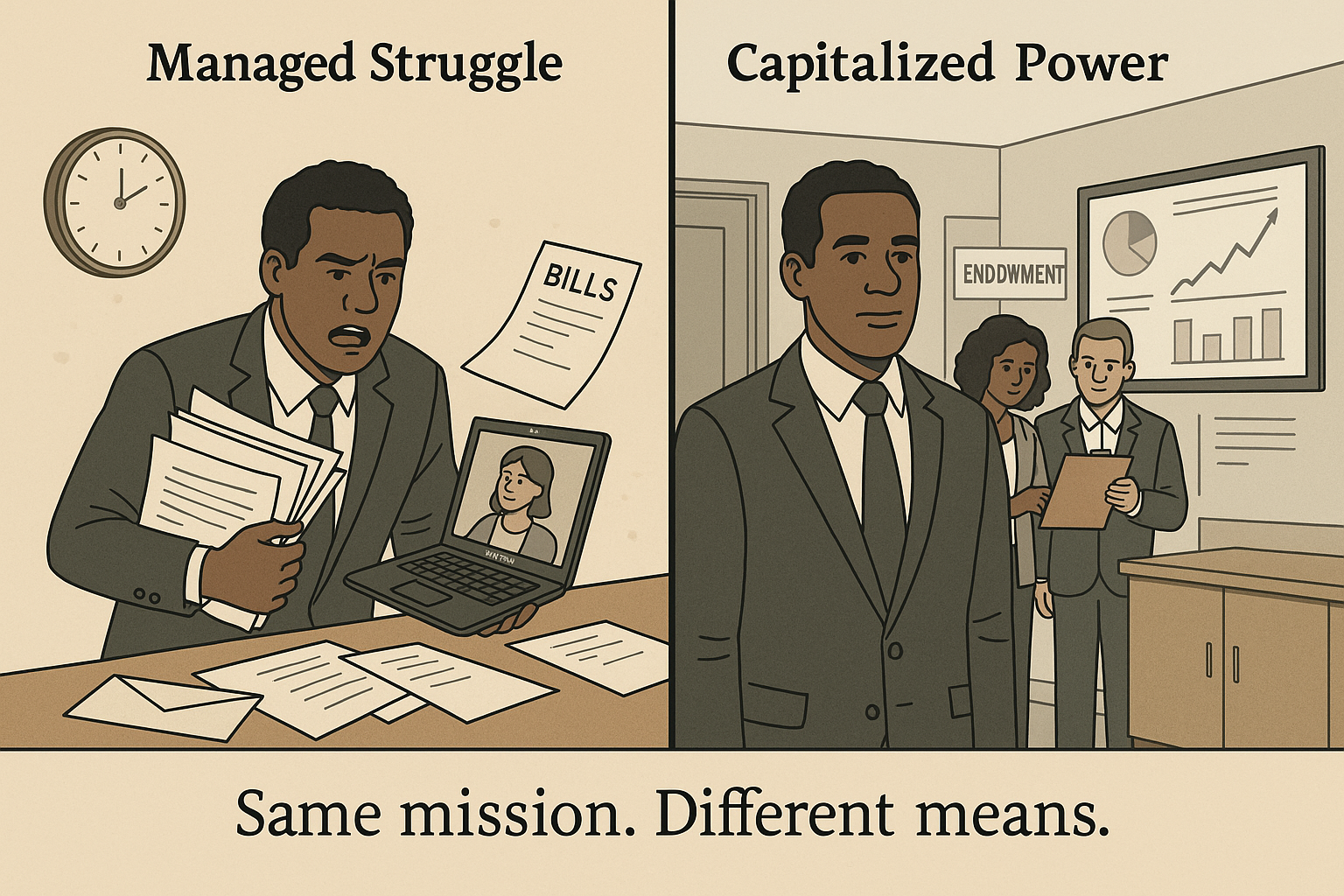
Two orchards stood on opposite sides of the same valley. The first was planted by a family that bought its land outright, secured its water rights, and set aside part of every harvest to buy new seedlings. The second was tended by a family that owned nothing but its skill. Each season a wealthy neighbor delivered a basket of fruit, and the family was celebrated across the valley for how carefully and fairly it shared that fruit with the hungry. Fifty years later the first orchard had tripled in size and fed three villages. The second family was still waiting at the road for the basket, and still praised for its generosity. No one in the valley thought to ask why the most admired family in it owned no trees.
The African American nonprofit sector does not suffer from a shortage of mission, talent, or impact. It suffers from a shortage of balance sheet. Black-led organizations run schools, clinics, museums, legal defense funds, and community development corporations with remarkable effectiveness. Yet most of them do so without the one asset that turns an organization into an institution: capital it controls, invests, and compounds on its own terms. An organization that cannot hold capital cannot hold power. It can only borrow power, one grant cycle at a time, from whoever holds the capital instead.
The scale of the gap is well documented. Research by Echoing Green and the Bridgespan Group looked only at the strongest applicants to Echoing Green’s fellowship. Among those applicants, Black-led organizations had revenues 24 percent smaller than their white-led counterparts and unrestricted net assets 76 percent smaller, and the disparities held even among organizations doing the same work. The gap widened further in organizations focused on Black men and boys. There, Black-led organizations had revenues 45 percent smaller and unrestricted net assets 91 percent smaller than white-led organizations. The researchers were blunt about what unrestricted money signals, noting that such funding often functions as a proxy for trust, and the disparities persisted even after accounting for issue area and education levels.
Unrestricted net assets are the nonprofit equivalent of working capital and retained earnings combined. They decide whether an organization can survive a late reimbursement, hire ahead of growth, buy its building, or say no to a funder whose priorities have drifted from its own. An organization with a 76 percent deficit in this category is not just smaller. It is structurally dependent. Every strategic decision passes through the filter of the next check.
For HBCU readers, this is not someone else’s problem. Every HBCU is a nonprofit, and in many African American communities it is the largest nonprofit by a wide margin. The capital logic that constrains a youth program in Baltimore also constrains an HBCU in Holly Springs or Orangeburg, only at a larger scale. The institutional wealth gap is a single problem running through the entire African American nonprofit ecosystem, and HBCUs sit at its center rather than above it.
The gap has a history, and that history is the history of compounding. America’s great philanthropic foundations were capitalized during a period when African Americans were legally segregated and systematically excluded from wealth formation. The Rockefeller Foundation was founded in 1913, the W.K. Kellogg Foundation in 1930, and the Ford Foundation in 1936. Their endowments came from Gilded Age and industrial fortunes, and they have compounded ever since. Consider a dollar placed in an endowment in 1936 that earned a 5 percent real annual return. By 2026 it would be worth roughly eighty dollars in today’s purchasing power. White-led institutions have had ninety years of that arithmetic working for them. African American organizations spent the same decades building on membership dues, church collections, and one-time grants. The Universal Negro Improvement Association, the National Urban League, and generations of local mutual aid societies were born of necessity, not surplus. They were built to meet immediate needs, and immediate needs consume capital rather than accumulate it.
HBCU endowments show the result most clearly. HBCU Money’s analysis of the latest NACUBO data found that four additional HBCUs crossed the $100 million mark a year after Howard became the first HBCU to pass $1 billion. Over the same period, 89 predominantly white institutions held at least $2 billion. Only Howard and Spelman sit above the $500 million level that increasingly functions as the floor for institutional stability. Across all of American higher education, the median endowment among the 657 institutions in the FY25 NACUBO-Commonfund study was $253.6 million. Nearly the entire HBCU sector therefore operates below the midpoint of American higher education’s capital distribution.
The consequences are not abstract. Morris Brown College lost its accreditation in 2002 largely over financial management and spent two decades rebuilding before regaining accreditation in 2022. Fisk University, holding one of the most important art collections of any HBCU, spent years in court before it could sell a half-interest in its Alfred Stieglitz Collection to Crystal Bridges Museum of American Art for $30 million to stabilize its finances. In the Fisk case, an undercapitalized Black institution converted a cultural asset into operating liquidity by transferring partial ownership to a heavily capitalized white-founded institution. That is the institutional wealth gap operating in its purest form. The asset did not disappear. It moved to the balance sheet that could afford to hold it.
Philanthropic flows reinforce rather than correct the imbalance. The Philanthropic Initiative for Racial Equity’s analysis found that in 2018, the most recent year with complete grants data, only 6 percent of philanthropic dollars supported racial equity work and just 1 percent supported racial justice work. The dollars that do flow toward Black communities frequently bypass Black-led institutions. The same analysis found that more than a third of the top 20 racial equity grant recipients from 2015 through 2018 were organizations launched and driven by white business leaders pursuing their own theories of change for Black and Brown communities. Funding is also concentrated in a few hands. The ten largest racial justice funders accounted for 60 percent of all racial justice funding over that period, which leaves grantees exposed when foundation interests shift.
The mechanism behind this pattern mirrors the credit-scoring logic that disadvantages first-time Black homebuyers. Funders cite “capacity” and “scalability” when allocating large grants. Capacity, in practice, means an existing balance sheet, an established development staff, and a history of prior large grants. Past access to capital becomes the justification for future access to capital. A Black-led organization with a strong track record but a thin balance sheet is classified as risky. A white-led organization with a thick balance sheet and a newer track record in the same field is classified as ready to scale. The outcome follows directly. Both organizations do the work, but only one accumulates the assets.
Arts and culture show the pattern in hard numbers. The Whitney Museum of American Art reported total assets of $1.02 billion in 2024. The Studio Museum in Harlem, among the best-capitalized Black cultural institutions in the country, reported total assets of $301 million that same year. The composition of its revenue matters as much as the size. Contributions made up 88.6 percent of the Studio Museum’s revenue, while investment income made up just 5.2 percent. An institution whose revenue comes mostly from contributions must go back to donors every year. An institution whose revenue comes substantially from investment income answers mainly to its own investment committee. The Studio Museum is also the exception, not the rule. Below it sit hundreds of local Black museums, theaters, and historical societies that operate on seasonal fundraising with no investment income at all.
Undercapitalization also produces a quieter problem: capital displacement. When racial reckonings or historical anniversaries draw public attention, well-capitalized predominantly white institutions launch centers, initiatives, and exhibitions on Black life, often funded by eight-figure gifts. A Black-led policy institute with two decades of work in the same field may struggle to raise a fraction of that for general operations. The research, the data, the donor relationships, and the reputational return accumulate on the balance sheet of the institution that already had one. Black-led organizations are then invited in as community partners or implementation subcontractors. They deliver programs designed and owned elsewhere, and they carry the operational risk without holding the intellectual property.
External forces do not account for the entire gap, and an analysis that stopped there would be incomplete. Many African American nonprofits have operating cultures that deepen their undercapitalization. The dominant institutional habit is to make do: stretch every restricted dollar across program delivery and treat surplus, when it appears, as money to spend on unmet need rather than capital to retain. Few Black-led nonprofits maintain a board-approved investment policy statement. Fewer still run formal planned giving programs that ask donors to name the organization in their wills. Boards are often recruited for their program credibility or community standing rather than their access to capital or their fiduciary expertise. Many organizations also rely on a single charismatic founder whose personal relationships are the institution’s real fundraising engine, and those relationships leave with the founder.
There is also a capital retention failure hiding in plain sight. When African American nonprofits and HBCUs do hold reserves, those reserves usually sit in mainstream white-owned banks. HBCU Money’s 2025 directories count 17 African American-owned banks holding roughly $6.72 billion in combined assets and 205 African American-owned credit unions holding roughly $8.15 billion. Yet only about two HBCUs bank with African American-owned institutions, with Florida Memorial University’s relationship with OneUnited Bank among the few examples. Nonprofit operating accounts, endowment cash, and payroll deposits follow the same pattern. The sector’s own liquidity leaves the ecosystem and funds lending decisions made elsewhere.
The strategic stakes are rising. Race-explicit philanthropy now faces direct legal and political challenge. ABFE has built a dedicated defense initiative because, as it describes the landscape, escalating political and legal attacks threaten to roll back racial equity efforts across the philanthropic sector. This is the self-interest case in its simplest form. An institution that depends on external discretion inherits every risk that discretion carries. When a foundation’s legal counsel grows cautious, when a corporate giving program is quietly wound down, or when a donor’s priorities shift with the news cycle, the dependent organization absorbs the shock. The endowed organization does not. Institutional capital is not a luxury for stable times. It is insurance against unstable ones.
What follows is a set of concrete actions that African American nonprofits, HBCUs, and their affiliated foundations can take now.
The first is to treat endowment building as an operating discipline rather than a someday aspiration. Any Black-led nonprofit with a stable budget can adopt a board-approved policy that sends a fixed share of every unrestricted surplus into a quasi-endowment, meaning a reserve the board designates as permanent even though no donor has restricted it. It can also launch a bequest program immediately. That requires little more than standard will language on its website, a short list of donors over fifty, and board members trained to have the conversation. Endowments of $5 million to $10 million are within reach for many mid-sized organizations over a decade. At a 4 to 5 percent spending rate, they produce durable general operating support that no funder can withdraw.
The second is pooled investment. Small endowments face a scale problem, because top-tier asset managers set minimums that a $3 million fund cannot meet, and fees consume a larger share of small portfolios. American higher education solved this problem once before. Commonfund was created in 1971 with Ford Foundation support so that colleges could pool assets and gain access to institutional-quality management. African American nonprofits and smaller HBCU foundations can apply the same model today. A pooled vehicle serving organizations of similar size, including foundations at institutions like Tougaloo, Edward Waters, Coppin State, and Fort Valley State alongside independent Black-led nonprofits, would lower costs, improve access, and create a single investment committee with the expertise individual boards often lack. Placing the vehicle’s management with African American-owned asset managers would also retain the fee income inside the ecosystem.
The third is deposit discipline. Every African American nonprofit and HBCU foundation can move at least its operating accounts, and ideally its endowment cash allocation, into the 17 African American-owned banks and 205 African American-owned credit unions. This requires no new institution and no new legislation. It requires a board resolution and a treasurer willing to change banks. Deposits are the raw material of lending. A nonprofit’s payroll account held at a Black-owned bank in Durham, Atlanta, or Houston becomes a small business loan or mortgage in that same community.
The fourth is real estate. Many Black-led organizations rent their space, which turns years of occupancy into someone else’s equity. The Black church understood long ago that owning property turns occupancy into an appreciating asset and, often, into rental income. Nonprofits should adopt the same approach with equal rigor, prioritizing acquisition of mixed-use or commercial property that can house their operations and generate income. HBCU-adjacent corridors, from the neighborhoods around Dillard and Xavier of Louisiana to the blocks surrounding Savannah State and Norfolk State, are natural sites where nonprofit ownership reinforces institutional density around the campus.
The fifth is to build and use Black-led philanthropic intermediaries. Mainstream community foundations hold most of the country’s donor-advised funds and legacy gifts, which means African American donors who use them are placing their charitable capital under someone else’s stewardship. Black-led community foundations, such as the Black Belt Community Foundation in Alabama, provide an alternative that keeps stewardship, investment decisions, and grant priorities inside the ecosystem. HBCU foundations, including those at public institutions like Alcorn State and Delaware State that are legally independent of their state governments, can extend this role by offering alumni a place to house donor-advised funds. That would keep alumni charitable capital circulating through the institutions that produced the wealth in the first place.
The sixth is to redirect how emerging African American wealth gives. High-net-worth African American donors frequently give to alma maters, churches, and national causes, but they often give to programs rather than to permanent capital. A gift to an endowment compounds indefinitely, while a gift to a program is spent once. Donors who want lasting institutions should ask for endowment designation by default. As HBCU Money has argued in its analysis of small recurring gifts, the broad base of modest donors matters as much as the major gift, and recurring contributions directed to permanent funds build capital that no single donor could build alone.
The seventh is to professionalize development and concentrate the talent to do it. Fundraising cannot remain a side task for an overextended executive director. A full-time development officer responsible for donor cultivation, planned giving, and institutional funders is a capital investment with measurable returns, not an overhead cost. HBCUs are positioned to supply this talent. Their business schools, accounting programs, and alumni networks can build a deliberate pipeline of advancement officers, investment professionals, and nonprofit chief financial officers who stay inside the African American institutional ecosystem. Concentrating that expertise is how the sector stops renting financial competence from outside consultants.
None of these measures works as well in isolation as it does in combination. A nonprofit that builds a quasi-endowment, invests it through a pooled vehicle managed by a Black-owned firm, holds its cash at a Black-owned bank, owns its building near an HBCU, receives donor-advised grants from a Black-led community foundation, and employs a development director trained at an HBCU business school is not an isolated organization. It is a node in a network of reinforcing institutions. Each connection keeps capital, fees, deposits, and talent circulating inside the ecosystem instead of leaking out of it. That is what institutional density means in practice, and it is the difference between a community that hosts nonprofits and a community that owns institutions.
Power is expensive. It requires patience, planning, and above all capital that answers to the people who hold it. For generations, African American nonprofits and HBCUs have been admired for what they accomplish with so little. That admiration has too often substituted for the capital that would have let them accomplish far more. The valley praised the second family for its generosity for fifty years. It would have served the family better, and the valley too, to help it buy land.
Disclaimer: This article was assisted by ClaudeAI.