Tag Archives: African American philanthropy

The $10 Solution: Why Small, Recurring Gifts Are the Missing Pillar of Black Institutional Finance

The African American institutional ecosystem—comprising HBCUs, Black-led nonprofits, community health organizations, and civic associations—faces a structural financing problem that no single grant cycle, federal appropriation, or celebrity donation can solve on its own. The challenge is not a shortage of Black generosity. It is a shortage of organized, recurring, and institutionally directed Black generosity. The $10 monthly donation—modest by any individual measure—represents, in aggregate, one of the most underutilized instruments of capital formation available to African American institutions today.

This is not an argument for charity. It is an argument for institutional finance through democratized recurring revenue.

Before prescribing solutions, the data demands a reckoning with the scale of the funding disparity confronting African American-led institutions. According to research compiled by the Bridgespan Group and Echoing Green, the revenues of Black-led organizations are 24 percent smaller than the revenues of their white-led counterparts. When it comes to unrestricted funding—the holy grail of financial support—the picture is even bleaker: the unrestricted net assets of Black-led organizations are 76 percent smaller than their white-led counterparts. That disparity in unrestricted assets is not a footnote. It is the operating condition under which virtually every Black-led institution functions daily.

The revenue figures are equally sobering in aggregate. In terms of total sector-wide revenue, majority Black-led organizations receive less than $3 billion, compared with majority white-led organizations that receive about $85 billion. The ratio of roughly 28 to 1 reflects decades of what practitioners in the sector have termed “philanthropic redlining,” a structural pattern in which institutional funders extend trust, operating support, and scale capital disproportionately to white-led organizations. The organizational profile of the sector makes this crisis especially acute. Majority Black-led nonprofits tend to be smaller, with 61 percent operating with budgets under $100,000 and only 2 percent with budgets over $10 million. The median annual revenue of majority Black-led nonprofits is $302,000, compared with $908,000 for majority white-led nonprofits. An organization operating at $302,000 in annual revenue has little margin for program investment, staff development, or reserve accumulation. It is, by any financial standard, an institution surviving rather than building.

The Association of Black Foundation Executives found that 60 percent of Black-led organizations surveyed had budgets of $500,000 or less, and just 23 percent had reserves of three months or more. A three-month operating reserve is considered the absolute minimum threshold for organizational resilience. The fact that more than three-quarters of Black-led nonprofits fall below that floor means that any disruption to funding—a grant not renewed, a donor who lapses, a federal program curtailed—can be existential. HBCUs face a structurally analogous problem in higher education finance. The PWI-HBCU NACUBO Top 10 Endowment Gap for 2024 stands at $129.2 to $1. HBCUs comprised 1.5 percent of NACUBO’s reporting institutions and 0.3 percent of the reporting endowment assets, while PWI endowments with assets over $5 billion hold 58.5 percent of the $884.3 billion in total reporting endowment assets. Even Howard University, which became the first HBCU to cross the $1 billion endowment threshold, a genuine milestone, remains an order of magnitude behind flagship PWIs whose endowments measure in the tens of billions.

These figures, taken together, describe an ecosystem that is generationally undercapitalized. The structural solution requires multiple interventions: federal policy reform, corporate accountability, philanthropic sector reorientation, and enhanced major gift cultivation. But each of those levers operates on a long timeline and with significant uncertainty. What African American households, alumni chapters, and giving groups can control today is the flow of their own recurring dollars into the institutions that serve them.

African Americans are among the most generous donors in the United States, a fact that is consistently underappreciated in both mainstream philanthropic discourse and internal community conversations. Nearly two-thirds of Black households donate to community-based organizations and causes, totaling $11 billion each year. Black households on average give away 25 percent more of their income per year than white households, and of all racial or ethnic groups, Black families have contributed the largest proportion of their wealth to charity since 2010. High-net-worth Black families are reportedly more likely to have family traditions around giving than their white counterparts and report more fulfillment from their charitable giving. Research by the Indiana University Lilly Family School of Philanthropy documents that Black Americans donated 3 to 4 percent of their income to charity on average across the years studied, a rate that outpaces other demographic groups relative to income.

The generosity is not in question. What is in question is the institutional destination of that generosity and the form it takes. A community that donates $11 billion annually but whose primary institutional ecosystem of HBCUs, Black-led nonprofits, Black hospitals, Black media operates on poverty-level budgets has a capital distribution problem, not a giving problem. The money is there. The institutional routing is not. A significant portion of that giving flows to religious congregations, mutual aid to extended family networks, and causes with no institutional anchor in the African American ecosystem. None of those giving patterns are illegitimate. But they do not build endowments. They do not fund operating reserves. They do not provide the recurring, unrestricted revenue that allows a Black-led nonprofit to hire a development officer, invest in data infrastructure, or weather a single major donor’s departure.

The $10 monthly donation ($120 annually) is not a symbolic gesture. At scale, it is a recapitalization strategy. There are approximately 47 million African Americans in the United States. If only 5 percent of Black households which is roughly 2.5 million households out of an estimated 17 million committed $10 per month to a Black-led institution, the aggregate annual flow would reach $300 million. Directed strategically across HBCUs, Black-led nonprofits, and community health institutions, that represents more than 10 percent of the current total revenue flowing to the majority Black-led nonprofit sector.

The power of recurring giving extends beyond the dollar amount. Industry data confirms that monthly donors give 42 percent more than one-time givers on an annualized basis, driven by the cumulative effect of consistent contributions and the reduced likelihood of lapsing. For nonprofits, recurring revenue is categorically different from episodic revenue: it is predictable, plannable, and bankable in ways that grant income and campaign proceeds are not. An organization with 500 monthly donors at $10 each has a guaranteed $60,000 annual baseline; modest but stable enough to justify hiring, to secure a line of credit, or to launch a matching gift campaign. Unrestricted monthly giving is also the form of philanthropy most urgently needed by Black-led institutions. The systemic deficiency in unrestricted funding, that 76 percent gap compared to white-led peers, reflects a structural pattern in which Black organizations receive grants with narrow programmatic restrictions that prevent investment in the internal capacity required for organizational growth. A $10 monthly donation from an HBCU alumnus to their alma mater’s annual fund, or from a community member to a local Black-led nonprofit, is by definition unrestricted. The institution decides how to deploy it: toward a staff position, a technology upgrade, an emergency reserve, or a matching gift that unlocks foundation dollars.

The most efficient mechanism for scaling these commitments into institutional capital is not individual action—it is collective action through organizational infrastructure. HBCU alumni chapters and African American giving groups represent an underutilized distribution network for democratized recurring philanthropy. An alumni chapter with 200 active members in which 60 percent commit to $10 monthly generates $14,400 annually—directed, unrestricted, recurring. A national HBCU alumni association with 50 chapters operating at that participation rate generates $720,000 annually for institutional endowment or operating support. Multiply that across the more than 100 HBCUs, many of which have alumni association networks across dozens of cities, and the aggregate potential is measured in the tens of millions of dollars per year, capital that currently does not exist on HBCU balance sheets.

Giving groups offer a parallel vehicle. Giving circles like the New Generation of African American Philanthropists, which began as a 15-person circle in Charlotte, have grown into significant collective giving entities committed to disrupting conventional philanthropy. These structures are particularly well-suited to the $10 monthly model because they combine the social accountability of a group commitment with the financial efficiency of pooled, recurring capital. A giving group that aggregates 100 members at $10 monthly generates $12,000 annually in deployable grants, small enough to be accessible to any working professional, large enough to meaningfully support a Black-led organization’s operating budget. The alumni chapter as a philanthropic vehicle is also strategically superior to individual giving in one critical respect: it creates an institutional relationship between the donor and the institution that survives any individual’s personal financial fluctuation. When the chapter commits, the institution can plan around that commitment. When an individual donor commits in isolation, attrition erodes the revenue base unpredictably.

The compounding returns of this approach are significant. An HBCU with 10,000 alumni in which 15 percent participate at $10 monthly generates $1.8 million annually. Invested at a conservative 5 percent return, sustained over ten years with reinvestment, that giving program alone produces an endowment contribution of more than $22 million, enough to fund two endowed faculty chairs or establish a meaningful scholarship fund. The compounding logic of recurring philanthropy, applied to institutional endowment-building, is the same logic that has built the multibillion-dollar endowments of elite PWIs over generations: not a handful of transformative gifts alone, but a consistent culture of giving across a broad alumni base, sustained over decades. For Black-led nonprofits, the calculus is more immediate. More than half of Black-led nonprofit leaders report that their organization would shut down if they lost one or two key funders. An organization that replaces that concentration risk with 300 monthly donors at $10 each has effectively immunized itself against the collapse of any single funding relationship. Donor diversification, the standard recommendation of every organizational capacity consultant in the sector, is operationally achieved through the accumulation of recurring small donors, not through the pursuit of larger restricted grants. According to the National Committee for Responsive Philanthropy, funding to Black communities accounts for only 1 percent of all community foundation funding, resulting in an underfunding of Black communities of $2 billion. Community philanthropy from within the ecosystem is not a substitute for external institutional accountability but it is the only source of capital over which African American institutions have direct and immediate control.


Recommendations for Institutional Action

For HBCU Development Offices: The immediate priority is building and marketing a monthly giving program with a specific $10 entry point. The language should be explicit: this is not charity; it is institutional investment. Alumni who would not write a $120 check will often commit to $10 monthly if the onboarding is frictionless and the institutional communication is consistent and strategic. Technology infrastructure for recurring giving is low-cost and widely available. The barrier is not technical it is a development culture that has historically prioritized major gift cultivation at the expense of broad-base annual fund growth.

For Alumni Chapters: Chapters should establish a formal monthly giving commitment as a condition of active chapter membership or officer eligibility not as a financial barrier, but as a cultural signal that institutional support is a baseline expectation of HBCU alumni engagement, not an exceptional act. Chapters with robust monthly giving programs should publicize their aggregate contribution totals, creating competitive social proof across the alumni network.

For African American Giving Groups: Existing giving circles and collective philanthropy organizations should formally adopt Black-led nonprofits and HBCU foundations as priority beneficiaries and structure their pooled contributions as recurring monthly flows rather than single annual grants. The stability value of a twelve-month recurring commitment to a recipient organization exceeds the programmatic value of a larger, one-time check.

For Individual Households: The allocation question is straightforward. African American households already give. The strategic question is whether a portion of that existing generosity is directed toward institutions with the capacity to aggregate capital, build reserves, and generate long-term community returns. Setting up one $10 monthly recurring gift to an HBCU foundation or Black-led nonprofit requires less than ten minutes and commits less than the cost of two streaming subscriptions per month.


The structural underfunding of African American institutions is not primarily a story of insufficient generosity—it is a story of insufficient institutional routing. Black households give $11 billion annually. Black-led institutions capture a fraction of that flow. The gap between those two figures is the organizing challenge of African American institutional philanthropy.

The $10 monthly commitment is not the complete answer. It does not replace federal investment, it does not substitute for corporate accountability in philanthropic grantmaking, and it does not eliminate the need for transformative major gifts to HBCU endowments. But it is the instrument most immediately available, most broadly accessible, and most structurally valuable to the organizations that need stable, unrestricted, recurring revenue to survive and eventually to scale.

Communities are built by institutions. Institutions are built by capital. Capital, in the absence of inherited wealth and equitable access to external philanthropy, must be built from within—one recurring commitment at a time.

Disclaimer: This article was assisted by ClaudeAI.

“You’re Not Even Looking at the Problem”: Why African America Is Losing the Game of Wealth & Power

“Talent without institutions is a pipeline to someone else’s profit.” – William A. Foster, IV

In a pivotal scene from the film Moneyball, Billy Beane stares across the table at a room of seasoned scouts and executives, asking again and again, “What’s the problem?” The men fumble for surface-level answers—lost players, declining performance, tight budgets—but Beane cuts through the noise with surgical precision: “You’re not even looking at the problem.” His frustration isn’t simply about baseball; it’s about the failure to reframe strategy in the face of structural disadvantages. It’s about institutions mistaking symptoms for causes.

That same failure of vision and the urgent need for a paradigm shift applies not just to baseball, but to African America’s quest for economic power, institutional wealth, and self-determined sovereignty.

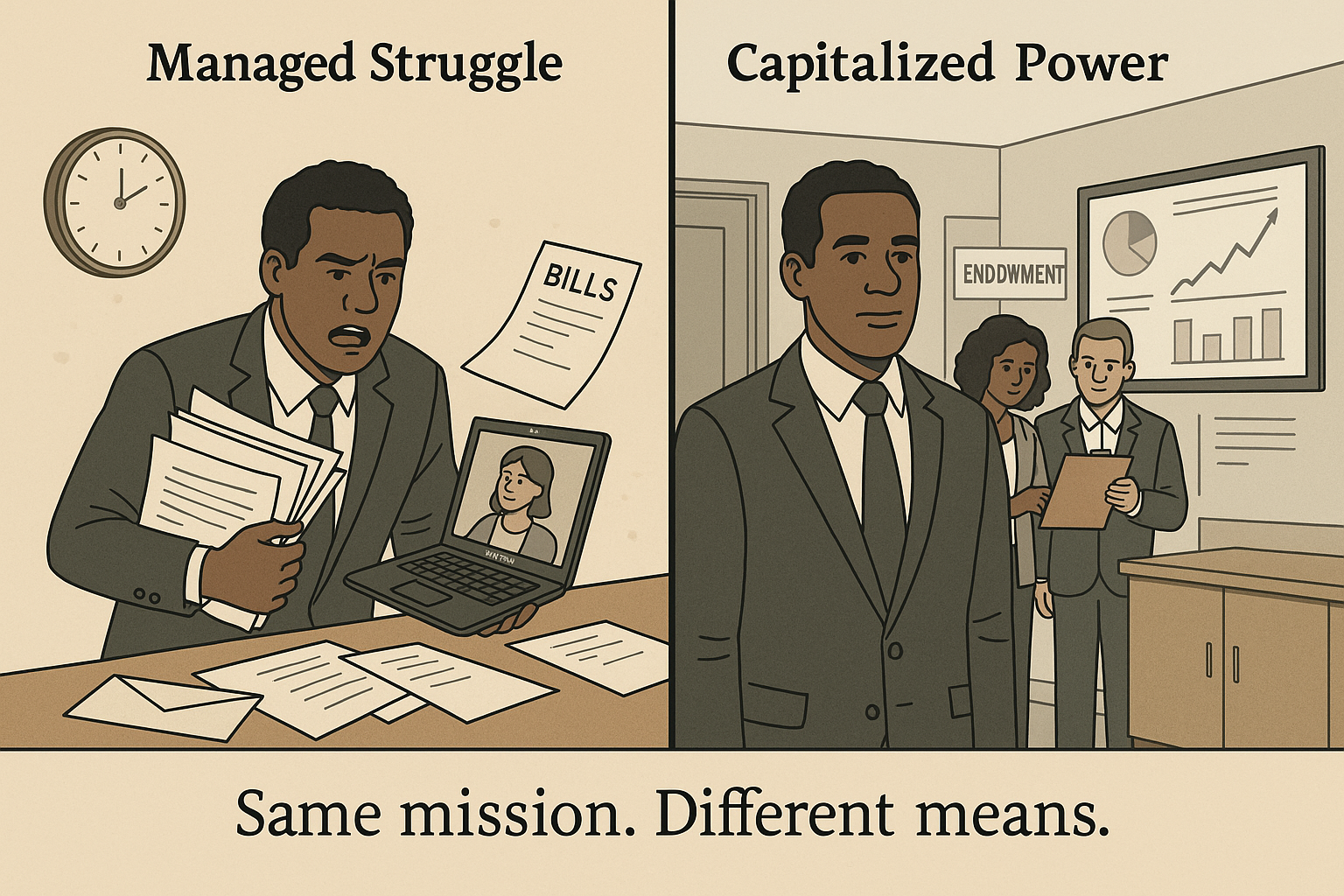
African America’s greatest minds, labor, and capital are often deployed outside of African American institutions. In essence, the community is fielding players, but not for its own teams. Valedictorians enroll at predominantly white institutions. Brilliant entrepreneurs pitch to Silicon Valley venture capitalists. Top athletes build billion-dollar empires for Nike, not Actively Black. The irony is that African America is not talent-poor. It is institution-poor. And that distinction is everything.

The most misunderstood problem in African American wealth-building discourse is not the racial wealth gap, it is the institutional wealth gap. African America commands over $1.6 trillion in consumer spending power annually, yet circulates less than 2% of that inside its own institutions before it exits the community entirely. Compare this to Jewish Americans, who circulate an estimated 8 to 12 times within their institutional networks, or East Asian Americans at 6 to 12 times, or even Latino Americans at 4 to 6. The velocity of African American economic energy leaves almost immediately. Another financial literacy seminar cannot fix this. What is required are financial institutions that keep wealth anchored in the community and institution-to-institution cooperation that builds collective power rather than isolated individual net worth.

Much like Billy Beane confronting baseball’s scouting orthodoxy, African America must confront its deep obsession with prestige, particularly the pursuit of inclusion in institutions that were never designed for its empowerment. The community still celebrates when African Americans “break barriers” into historically exclusive spaces: the first Black partner at a global law firm, the first Black president of an Ivy League university, the first Black billionaire appointed to a PWI board. These are symbolic gestures, not systemic gains. They are the equivalent of drafting a slugger with a high batting average while ignoring his low on-base percentage. It may photograph well, but it does not win championships.

Meanwhile, African American institutions like HBCUs, Black-owned banks, credit unions, media companies, foundations remain undercapitalized and under-circulated. According to FDIC data, African American banks account for less than 0.03% of the U.S. banking system’s total assets, despite serving millions of customers. Most carry assets under $500 million, while PNC, JPMorgan Chase, and Bank of America each hold hundreds of billions in Black consumer deposits alone. The community is putting elite players on the field just not on its own team.

One of the most damaging consequences of the post-civil rights integration era has been the illusion of proximity to power. Inclusion into dominant systems has led many African Americans to feel they are participating in the architecture of power, when in reality they are consumers of it, not owners. The institutions that determine economic direction in this country like investment firms, insurance conglomerates, think tanks, and lobbying organizations remain largely absent African American leadership at the structural level. While the public fixates on celebrity billionaires, it rarely accounts for institutional billionaires: universities with $40 billion endowments, banks with $3 trillion balance sheets, pension funds managing hundreds of billions in assets. Harvard University’s endowment, at roughly $50 billion, generates more annual passive income than the top 20 HBCUs combined in operating budgets. The Ivy League is not competing with African America. It operates on an entirely different playing field.

The data makes the scale of the gap unmistakable. As of 2022, the median net worth of a white household exceeded $188,000. For African American households, the figure was $24,100. But the institutional gap is even more stark. The top 10 predominantly white universities hold over $200 billion in combined endowments. The top 10 HBCUs hold less than $3 billion combined. In the philanthropic sector, the contrast is equally severe: the Gates Foundation manages nearly $8 billion in annual revenue and over $80 billion in assets. Meanwhile, even foundations attached to African American billionaires often operate at a fraction of that capacity. When African Americans are high earners individually, they frequently exist within ecosystems of institutional fragility—fragile schools, fragile banks, fragile civic organizations. This fragility makes individual wealth vulnerable, disperses influence, and mutes policy impact. The community continues to negotiate from positions of dependence.

The strongest ethnic and national economies do not simply focus on internal wealth generation, they construct infrastructure for internal circulation and cooperation. That means Black-owned banks financing Black developers. HBCUs recruiting faculty trained at other HBCUs rather than defaulting to PWI pipelines. Black foundations endowing Black hospitals, think tanks, and research centers. Black technology firms building hiring relationships with HBCU STEM programs. Black media outlets directing advertising budgets toward Black-owned businesses rather than relying on revenue from Google and Pepsi. Currently, this kind of circulation is sporadic and disorganized. Too often, African American institutions function as isolated islands, each struggling independently in a competitive environment that rewards scale and coordination. What is needed is a federation mindset of institutions operating in genuine symbiosis, where growth is strategic rather than accidental. Consider the compounding effect if every HBCU committed 20% of its endowment to Black-owned financial institutions, or if every African American megachurch directed 10% of its annual budget toward a Black-owned insurance provider. These institution-to-institution agreements would create forms of institutional wealth that accumulate quietly but with enormous strategic consequence.

Billy Beane’s genius in Moneyball was not merely contrarianism. It was data literacy. He saw what others refused to acknowledge: that reaching base was more valuable than batting average, and that the traditional metrics of scouting obscured the actual drivers of winning. African America must apply the same discipline to its institutional life. That requires building institutional balance sheets that honestly account for asset and liability structures; capital flow maps that trace where African American money goes after it is earned; circulation velocity metrics that measure how many times a dollar moves among Black institutions before exiting; and influence indexes that evaluate which African American institutions actually shape policy, capital markets, and media narratives. Without that data infrastructure, the community will continue to feel prosperous in moments while remaining fragile in structure and celebrating the anecdote while missing the trend.

Talent allocation is the other dimension of the problem that demands a strategic reframe. Just as the scouts in Moneyball chased big names and home run statistics, African American institutions often pursue talent without connecting it to long-term institutional strategy. Celebrity partnerships, honorary degrees, and gala appearances generate visibility but rarely feed institutional growth. A Tuskegee graduate built the foundations of American agricultural science. But talent, without institutions to give it depth, direction, and deployment, is ultimately portable. It gets recruited away, diluted, or co-opted. The community does not simply need more talented individuals. It needs to scout differently, train differently, and deploy those individuals in ways that compound institutional strength rather than individual achievement.

The question of narrative control is inseparable from the question of institutional power. Of the top twenty media companies in the United States, none are Black-owned. Most African American narratives in news, entertainment, and advertising are filtered through non-Black ownership and editorial priorities. This means political discourse is easily hijacked, cultural capital is regularly commodified without equity stakes, and social movements are routinely defanged by outside interests with different agendas. Reclaiming narrative sovereignty requires sustained investment in Black-owned media, particularly digital platforms and local investigative journalism. More critically, it requires routing advertising dollars toward Black media institutions rather than treating them as secondary channels. Even the most incisive voices will remain echoes if they are amplified through someone else’s infrastructure.

The genius of Billy Beane was not discovering undervalued players, it was reframing the entire game. African America has been operating under a set of assumptions that no longer serve its institutional interests, if they ever did. It has been trying to win with outdated tactics, sentimental strategies, and a persistent belief that the core problem is individual rather than structural. Fighting racism is necessary but insufficient. Engineering sovereignty is the work. That begins with an honest diagnosis: African America is building talent for other people’s institutions. It is celebrating inclusion while surrendering control. It is mistaking prestige for ownership. And it continues to treat the gap as primarily personal when the evidence points overwhelmingly to institutional causes.

“You’re not even looking at the problem,” Beane said.

It is past time to look.

Disclaimer: This article was assisted by ClaudeAI.
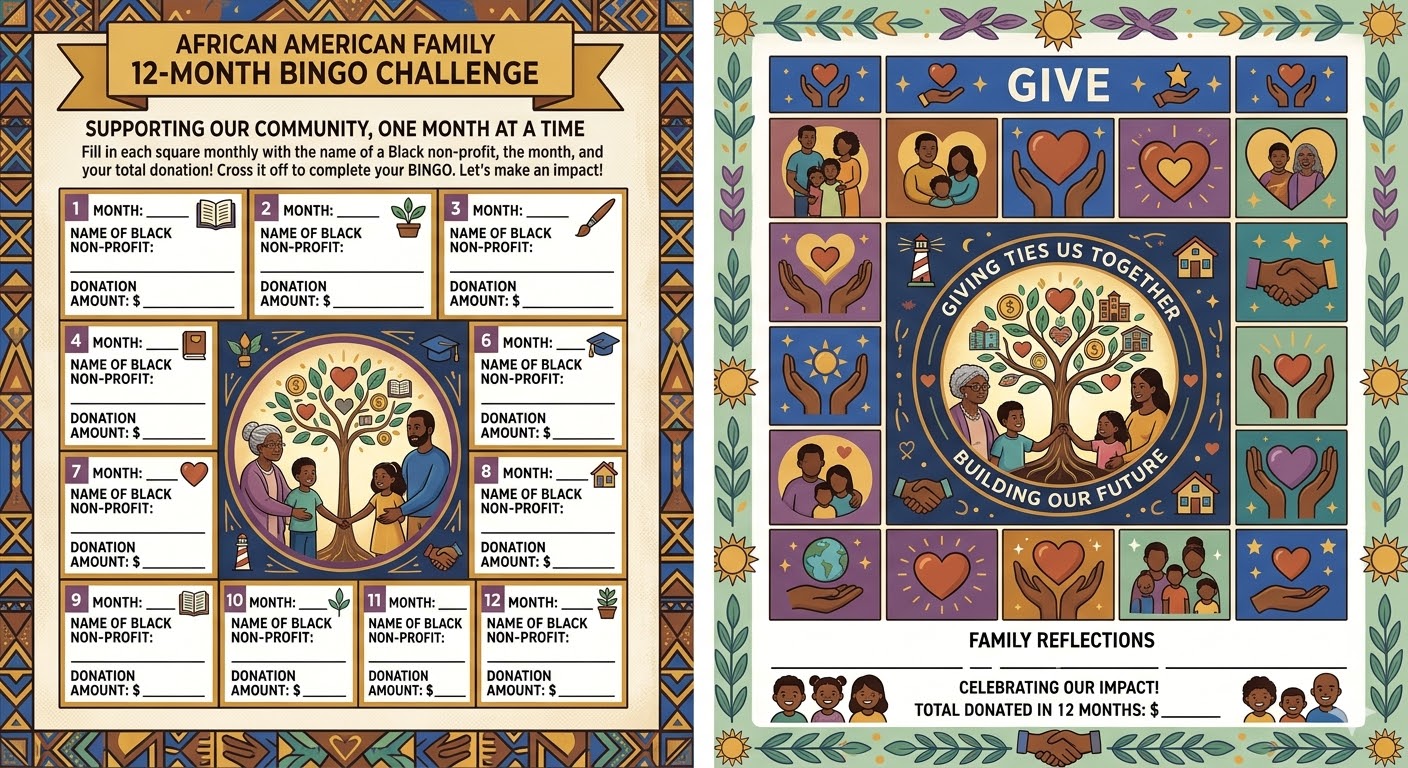
Teaching the Next Generation: A Guide to Empowering African American Youth Through Strategic Philanthropy

A single twig breaks, but the bundle of twigs is strong. – Tecumseh

The tradition of giving runs deep in African American communities. From the mutual aid societies formed during enslavement to the church collections that funded the Civil Rights Movement, Black Americans have always understood that our collective survival depends on our willingness to invest in one another. Yet somewhere between necessity and aspiration, we’ve lost the language to teach our children that philanthropy isn’t charity—it’s power.

Teaching African American children ages 5-18 about philanthropy means doing more than dropping coins in a collection plate. It means helping them understand that strategic giving builds the institutions that will protect, educate, and employ them throughout their lives. It means showing them that every dollar they contribute to Black-led organizations is a vote for their own future.

Starting Early: Philanthropy for Elementary Ages (5-10)

Young children understand fairness instinctively. They know when something isn’t right, and they want to help fix it. This natural empathy creates the perfect foundation for introducing philanthropic concepts.

Begin with concrete examples from African American history. Tell them about the Free African Society, founded in 1787 by Richard Allen and Absalom Jones, which provided mutual aid to Black Philadelphians. Explain how enslaved people pooled resources to purchase freedom for family members. These aren’t abstract concepts they’re survival strategies that became institutional frameworks.

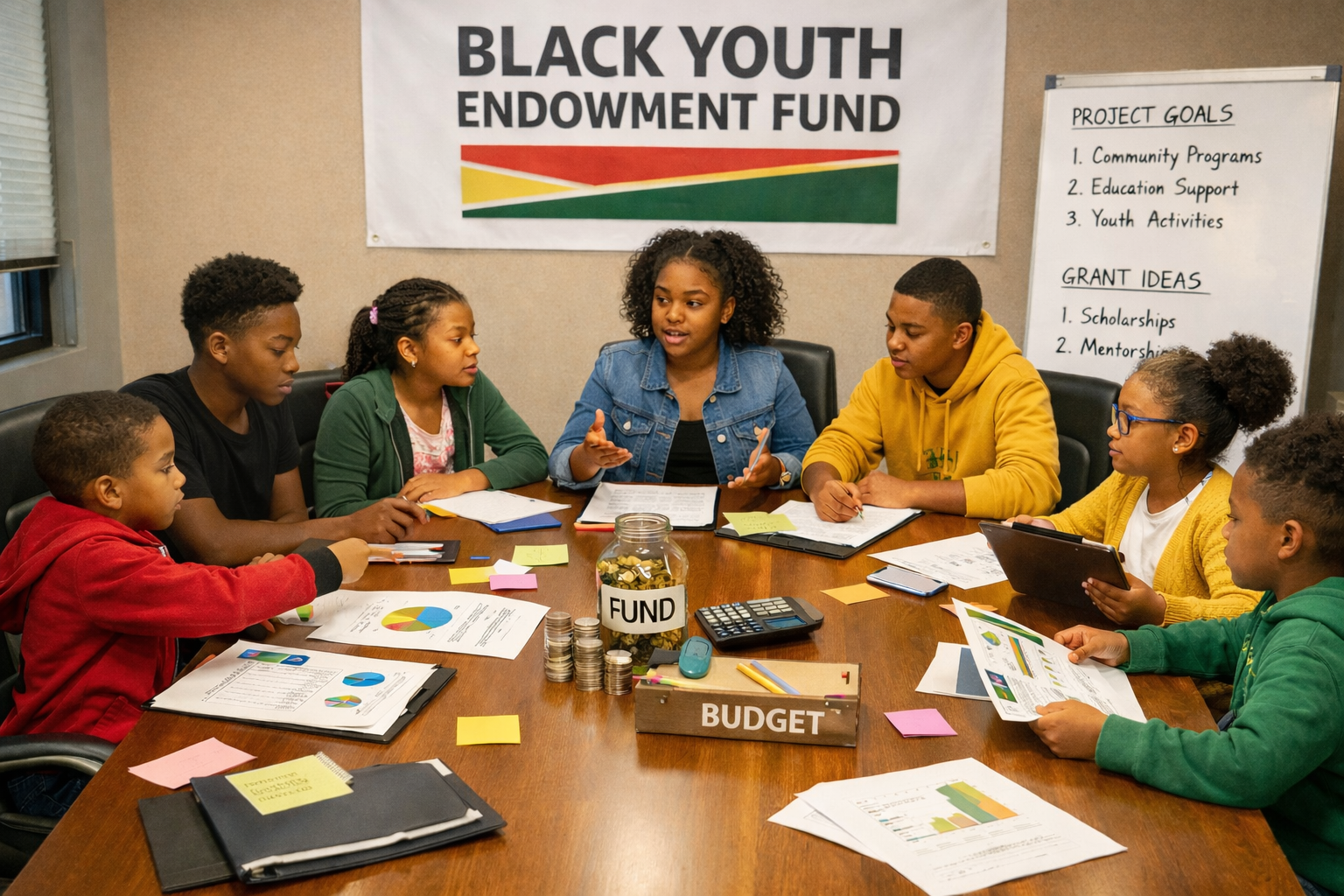
Create a family giving jar where children can contribute a portion of their allowance or gift money. Let them research and choose a Black-led organization to support quarterly. This could be a local youth program, a historical preservation society, or an HBCU scholarship fund. The key is giving them agency in the decision-making process. When children see their small contributions combine with others to create meaningful impact, they begin to understand collective power.

Use storytelling to illustrate how institutions are built. Talk about how HBCUs were created because white institutions excluded Black students. Explain how Mary McLeod Bethune started a school with $1.50 and turned it into Bethune-Cookman University. Show them that great institutions often begin with small, consistent contributions from people who understood the long game.

Middle School: Understanding Institutional Building (11-13)

By middle school, children can grasp more sophisticated concepts about how money moves and how power is built. This is when we introduce them to the difference between charity and institutional philanthropy.

Charity addresses immediate needs—feeding the hungry, clothing the poor. Institutional philanthropy builds the structures that create long-term change: schools, hospitals, community development corporations, legal defense funds, policy organizations. Both matter, but only institutional philanthropy shifts power dynamics.

Teach them about the NAACP Legal Defense Fund, established in 1940. Explain how sustained philanthropic support allowed lawyers like Thurgood Marshall to develop the legal strategy that led to Brown v. Board of Education. This wasn’t a one-time donation it was years of investment that transformed American society.

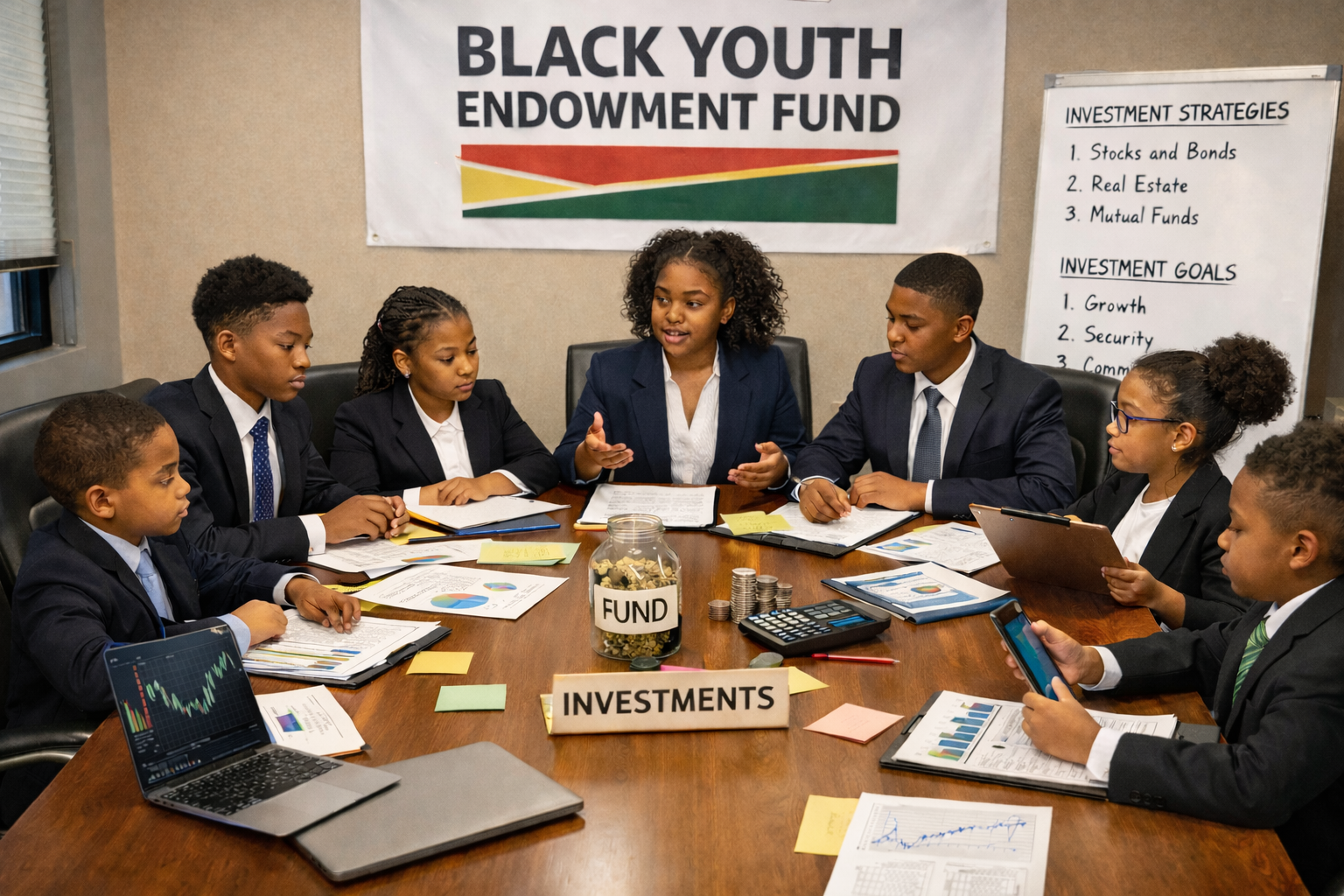
Introduce the concept of endowments and investment income. Too many African American organizations operate in perpetual crisis mode, chasing donations year after year. Show students the difference between an organization with a $100,000 annual budget that must be fundraised every twelve months and an organization with a $2 million endowment generating $80,000 annually in investment income. The second organization can focus on mission instead of survival.

Start a philanthropy club at school or in your community. Let students identify a need in their community and develop a giving circle to address it. They should practice everything: setting fundraising goals, researching organizations, making collective decisions, tracking impact, and understanding how their contributions grow through consistent giving. This hands-on experience transforms abstract concepts into practical skills.

High School: Strategic Power Building (14-18)

High school students are ready to understand philanthropy as a tool for social, economic, and political empowerment. They can analyze power structures and recognize how institutional support or the lack thereof shapes outcomes in Black communities.

Teach them to read institutional budgets and annual reports. Show them how to evaluate whether an organization has sufficient reserves, how much goes to programs versus overhead, and whether they’re building long-term sustainability. This financial literacy is essential for effective philanthropy.

Explore the concept of investment income in depth. Many students don’t realize that major institutions—universities, museums, hospitals—operate primarily on endowment income, not annual fundraising. Harvard’s endowment generated approximately $2.3 billion in investment income in recent years. Imagine if HBCUs collectively had similar resources. Explain that building Black institutional power requires moving beyond the donation mentality to an investment mindset.

Discuss how philanthropy intersects with political power. Show them how think tanks, policy organizations, and advocacy groups are funded. Explain that when Black communities don’t adequately fund our own policy organizations, others define the agenda affecting our lives. The Tea Party movement and its affiliated organizations received hundreds of millions in philanthropic support that reshaped American politics. What might be possible if African American communities invested similarly in organizations advancing our interests?

Examine collective philanthropy models. Traditional philanthropy often centers wealthy donors making large gifts. But collective giving where many people contribute smaller amounts has always been the African American philanthropic model. From church building funds to contemporary giving circles, we’ve understood that our strength lies in numbers. Today’s technology makes collective philanthropy more powerful than ever. A thousand people giving $100 monthly creates $1.2 million annually enough to endow a scholarship, support a community organization, or launch a new initiative.

Encourage students to start giving now, even if it’s $5 monthly to an organization they believe in. The habit matters more than the amount. A teenager who gives $10 monthly from age 16 to 66 contributes $6,000 in direct donations, but if that money is invested and earns average returns, it represents tens of thousands in institutional support.

Teaching African American youth about philanthropy means helping them understand its components and how they work together to build institutional power.

Educational Institutions: HBCUs, independent schools, scholarship funds, and educational support organizations create pathways to opportunity and preserve cultural knowledge. Sustained philanthropic support allows these institutions to build endowments, improve facilities, and attract top faculty and students.

Economic Development: Community development corporations, Black-owned business incubators, affordable housing organizations, and loan funds build wealth and economic stability. These institutions require patient capital and sustained support to create generational impact.

Legal and Policy Organizations: Civil rights organizations, legal defense funds, policy think tanks, and advocacy groups shape the rules that govern society. Inadequate funding in this sector means Black interests remain underrepresented in policy formation.

Cultural Institutions: Museums, historical societies, arts organizations, and media companies preserve our stories and shape narratives. Control over our cultural narrative requires institutional infrastructure that only sustained philanthropy can build.

Health and Social Services: Community health centers, mental health organizations, and social service providers address immediate needs while building the institutional capacity to serve Black communities long-term.

Each component requires different funding strategies. Some need operating support, others need capital for buildings or technology, many need endowment building. Teaching youth to think strategically about where and how they give helps them maximize impact.

The most important lesson we can teach African American children about philanthropy is that it’s not optional it’s essential. Every community that has built institutional power has done so through sustained, strategic philanthropy. Jewish communities support Jewish institutions. Asian American communities support Asian American institutions. African American communities must do the same.

Start conversations early. Make giving a family practice. Teach children to evaluate organizations critically. Help them understand that building Black institutional power is a marathon, not a sprint. Show them that their contributions, combined with others, create the schools, organizations, and institutions that will serve generations to come.

This isn’t about guilt or obligation. It’s about power, self-determination, and legacy. When we teach our children that philanthropy is institution-building, we give them tools to shape their own future rather than waiting for others to determine it for them.

The question isn’t whether African American communities can afford to invest in our institutions. The question is whether we can afford not to.

Why African American Institutions Must Stop Chasing Donations and Start Building Endowments: The Investment Income Crisis in Black Philanthropy

“Philanthropy reflects not just generosity, but power. When African American foundations hold millions while their counterparts hold billions, the capacity to shape society is written in the balance sheets.” – HBCU Money Editorial Board

In the nonprofit and philanthropic world, financial statements tell a story much deeper than annual fundraising drives or program headlines. For African American institutions in particular, the real question of institutional power is not how much money comes in each year, but how much money is working on their behalf every day through investment income. The gap between African American legacy institutions and the nation’s major philanthropic foundations makes this truth impossible to ignore.

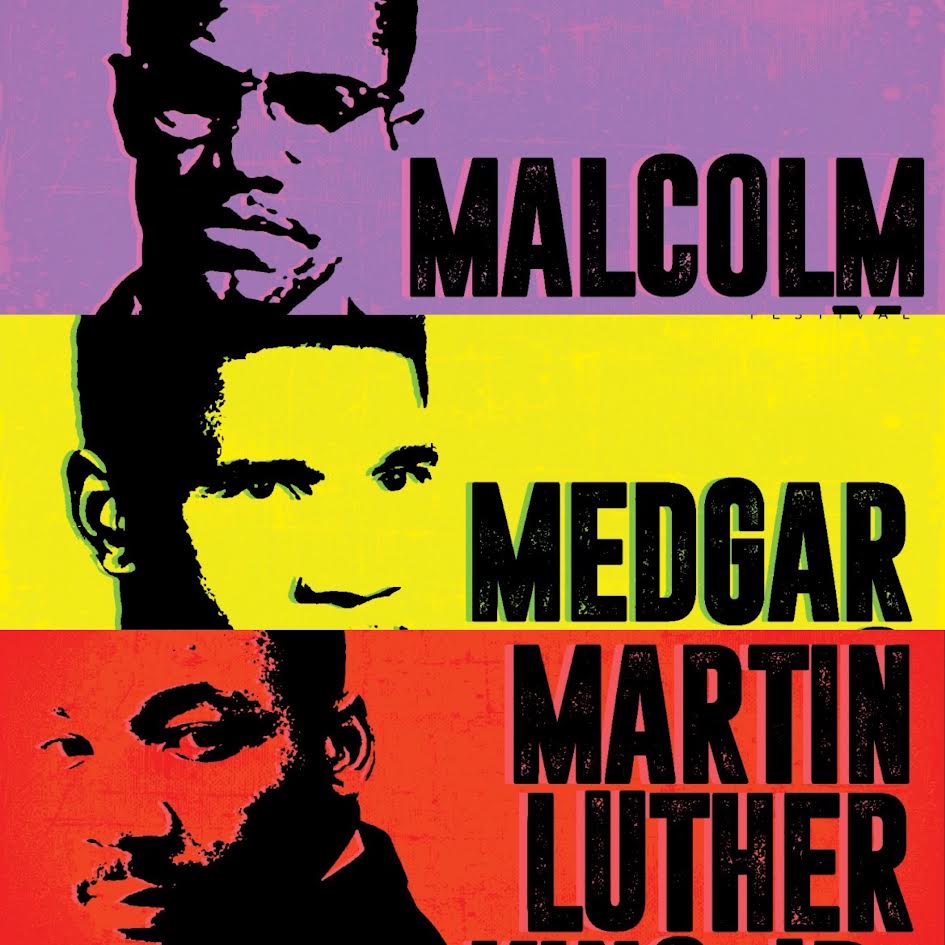
When most people evaluate nonprofits, they look at annual revenue: how much an institution raised in donations, how much it earned from programs, how much it reported on the IRS Form 990. By this metric, many organizations appear healthy. The King Center in Atlanta, for instance, reported $9.1 million in revenue in 2022, and the Malcolm X & Dr. Betty Shabazz Center reported $1.4 million in the same year. Even the Medgar & Myrlie Evers Institute, operating at a much smaller scale, posted $107,000 in revenue in 2023. Yet revenue alone is a deceptive indicator. It measures activity, not stability. Donations can be fickle. Program revenue can evaporate in downturns. Grants can dry up with shifts in political winds. A true measure of institutional health is whether an organization can generate its own independent cash flow — investment income.

The numbers reveal just how stark the divide is. The King Center, the strongest among African American legacy nonprofits, earned $788,000 in investment income in 2022. That represented nearly 9 percent of its total revenue, cushioning its operations with reliable, asset-driven support. By contrast, the Shabazz Center earned just $1,500 in investment income, and the Evers Institute earned nothing at all. Both remain almost entirely dependent on yearly contributions and program dollars. When compared to America’s powerhouse philanthropic institutions, the difference borders on staggering. The Ford Foundation generated $1.2 billion in investment income in 2022 — over 1,500 times what the King Center earned. The Rockefeller Foundation earned $120 million. The Walton Family Foundation, tied to the heirs of Walmart, brought in $240 million. The Bloomberg Family Foundation, anchored by the billionaire media mogul, generated $344 million. In this world, investment income is not supplemental; it is the engine. It underwrites operations, absorbs shocks, and ensures that missions continue even in the absence of donor enthusiasm. Investment portfolios are endowments of power, spinning off influence year after year.

This also clarifies why net income, the difference between revenue and expenses, is often misunderstood as a sign of strength. The King Center ran a $1.28 million surplus in 2022, while the Ford Foundation ran a $520 million deficit. Which institution is stronger? The answer is obvious: Ford. It can afford to run half a billion dollars in the red precisely because it has tens of billions in assets generating massive returns. Its deficit is a choice, not a crisis. By contrast, the Medgar Evers Institute’s deficit of just $25,000 in 2023 threatens its very survival because it has no investment base to fall back on. Net income measures short-term breathing room; investment income measures long-term power.

The contrast becomes sharper when examining the Steward Family Foundation, tied to David Steward, the wealthiest African American man. In 2023, the foundation reported $12.5 million in revenue and $857,000 in surplus, but just $29,000 in investment income. It holds only $22,000 in assets. Despite extraordinary personal wealth, the foundation is structured as a pass-through, distributing annual gifts rather than building a permanent, income-generating endowment. The Steward paradox highlights a broader challenge: African American wealth, even when achieved at extraordinary levels, has not consistently been institutionalized into enduring investment vehicles capable of generating influence across generations.

The implications of this reality are profound. Institutions without investment income are vulnerable to political tides, donor fatigue, and economic downturns. Their missions — whether preserving the legacy of Martin Luther King Jr., Malcolm X, or Medgar Evers — rest precariously on year-to-year survival. By contrast, the Ford or Rockefeller foundations can guarantee their voices in the public square for centuries. This imbalance in institutional financing means African American causes remain at the mercy of others’ benevolence while rival institutions are powered by their own wealth.

If investment income is the true measure of power, then African American institutions must pursue one clear priority: endowments. Not just annual fundraising, not just program grants, but the deliberate accumulation of assets whose returns will underwrite their missions indefinitely. Imagine if the King Center’s $788,000 in annual investment income could be multiplied tenfold or a hundredfold. Imagine if the Shabazz Center or the Medgar Evers Institute could fund their programming entirely from endowment returns. Imagine if the Steward Family Foundation transformed from a pass-through into a billion-dollar perpetual institution. This is the difference between surviving and shaping the future.

Investment income is the institutional equivalent of compound interest in personal finance. It rewards patience, discipline, and foresight. It separates organizations that merely exist from those that endure. For African American institutions, the lesson is clear: to secure legacies, to project influence, and to build power, they must shift their focus from short-term fundraising to long-term asset building. Only then can African American institutions stand as peers to Ford, Rockefeller, Walton, and Bloomberg — not just in name, but in financial reality.

Disclaimer: This article was assisted by ChatGPT.

When Intel Leaves: Endowments, NCCU, and the $2.5 Billion NBA Paradox

“I know I got it made while the masses of black people are catchin’ hell, but as long as they ain’t free, I ain’t free.” – Muhammad Ali

The recent news that Intel will discontinue its $1 million annual funding of North Carolina Central University’s (NCCU) Technology Law and Policy Center is more than just a line item in the university’s budget. It is a sharp reminder of how precarious institutional development becomes when African American colleges and universities rely on the European American corporate cycle of generosity and withdrawal. Where is African American corporate philanthropy is a pertinent question, but an article for another day.

Intel’s departure leaves a gap that must now be filled through other means. But the mathematics of filling it points to a broader truth: without substantial, permanent endowments, HBCUs will remain vulnerable to the political and financial whims of European American corporations. To replace $1 million in annual program funding, NCCU would need to raise between $20 million and $25 million in endowment principal assuming a 4–5% annual spending rate, the standard in higher education finance.

The fact that an entire academic pipeline, designed to produce future African American lawyers and policymakers, can be destabilized by a single corporate decision underscores the fragility of HBCU institutional power. And it raises a haunting contrast: while 66 African American NBA players will together earn $2.5 billion in salaries this upcoming season, not a single African American university controls an endowment robust enough to insulate it from the kind of disruption Intel’s withdrawal has now caused.

The mechanics are straightforward. Endowments work by pooling donated capital, investing it, and spending a sustainable portion of annual returns—usually 4–5%. To replace Intel’s $1 million annual gift, NCCU must therefore build an endowment of $20–25 million. This is not extraordinary by university standards. At most predominantly white institutions (PWIs), a $25 million endowment is considered modest. At Harvard, Yale, or Stanford, it would not even make the footnotes. Yet for NCCU, an institution with an endowment of $89 million as of December 2024, the sudden need for another $20–25 million underscores the gap between HBCUs and their white peers.

The underlying truth is that corporate funding is inherently unstable. It ebbs and flows with market cycles, political administrations, and corporate priorities. Endowments, however, endure across generations. The very act of raising such capital is itself an exercise in institutional power: it demonstrates to the world that the university and its community can stand on their own financial feet.

Intel did not single out NCCU maliciously. The company is undergoing a profound transformation, not least because the U.S. government has become its largest shareholder after a multi-billion-dollar deal with the Trump administration. Like other firms facing political scrutiny, Intel is quietly shedding high-profile DEI commitments. For NCCU, however, the effect is real. The Technology Law and Policy Center was designed to provide African American law students with training in emerging technology and policy—a space historically closed to Black lawyers. It also featured internships at Intel, summer placements, and the now-defunct “Intel Rule,” which required outside law firms to staff diverse teams if they wanted Intel’s business. Now, without a replacement funding mechanism, the Center risks contraction. Students will still enroll. Faculty will still teach. But the acceleration that Intel’s money provided—the ability to recruit nationally, to build cutting-edge programming, to give students exposure to high-tech legal practice—will slow.

Enter the paradox of the NBA’s 66 Black players earning $25 million or more in the upcoming season. Collectively, those 66 players will earn $2.5 billion in salary during the 2025–2026 season. Each of these players individually makes at least what NCCU would need to permanently replace Intel’s $1 million annual commitment through endowment. The collective sum is staggering: $2.5 billion in one season—enough to seed $25 million endowments at 100 HBCUs.

It is not about individual responsibility. No one player can be expected to save an institution. But collectively, the paradox points to the imbalance between African American individual wealth and African American institutional poverty. Even if just 10% of that wealth—$250 million—were organized and directed into HBCU endowments, the result could replace Intel’s contribution not only at NCCU but across multiple campuses. Yet there is no mechanism, no institutional strategy, no coordinated pipeline that directs such flows into African American universities. This is not new. For decades, African American excellence has been harvested at the level of the individual, while African American institutions have remained underfunded. The NBA is simply the latest, most visible example.

The Intel withdrawal reminds us of a hard truth: reliance on outside benevolence is not a strategy for power. It is, at best, a strategy for survival. Corporate giving is always the first budget item to shrink when recession looms or political winds shift. For HBCUs, this means programs rise and fall on decisions made in Silicon Valley or Wall Street boardrooms—far removed from Durham, Tallahassee, Baton Rouge, or Montgomery. The vulnerability is compounded when African American communities assume that the generosity of corporations will substitute for building our own endowments. The danger is not simply financial but cultural: it conditions us to believe that power comes from outside, not from within.

Intel’s $1 million a year was not charity—it was investment. It bought Intel goodwill, a trained pipeline of diverse lawyers, and reputational capital in the DEI era. Now that DEI is politically unpopular, the investment is deemed expendable. This is why endowments matter. They are not subject to the quarterly report or the election cycle. They anchor institutions in the long term.

Let’s be clear about the scale of the challenge. The combined endowments of all HBCUs hover around $4 billion, compared to more than $800 billion at PWIs. Harvard alone has an endowment of nearly $52 billion. NCCU’s endowment stands at $89 million. To raise an additional $20–25 million to replace Intel’s support would represent a 22–28% increase in its current endowment base. Such a leap is achievable—but it requires strategy. It means cultivating alumni giving systematically. It means leveraging African American wealth beyond alumni, drawing in professional athletes, entertainers, and entrepreneurs. It means creating vehicles—donor-advised funds, pooled endowments, institutional investment cooperatives—that make giving both efficient and impactful. Most of all, it means shifting mindset. We must stop thinking of endowments as luxuries reserved for Ivy League institutions. They are necessities. They are the only way to secure institutional independence.

The Intel decision can serve as a turning point, if we are willing to see it clearly. Corporations are not institutional guardians. They may play a role, but they will not underwrite our survival. Their goals are their own. When interests diverge, as they now have, funding vanishes. Individual wealth must be institutionalized. The contrast between NBA salaries and HBCU endowment poverty is not about shaming athletes. It is about building structures that make institutional giving the default, not the exception. Endowments are the only safety net. No government program, no corporate sponsorship, no philanthropic fad can substitute. Only endowments give institutions perpetual capacity to fund themselves.

What would it take, concretely, for NCCU to raise the $25 million needed? A handful of major gifts in the $2–5 million range from alumni, athletes, or African American business leaders could jump-start the campaign. NBA, NFL, and WNBA players could be recruited to create a pooled fund. Instead of individual gifts, imagine a collective “Athletes for HBCU Endowments” initiative. African American foundations and community funds could direct grants toward seed capital, matched by alumni. If every NCCU law graduate gave $1,000 a year for ten years, the cumulative effect would approach the tens of millions. NCCU could also partner with African American-owned banks and investment firms to maximize returns and circulate dollars within the community. The strategy would not only replace Intel but set a precedent: when outside money leaves, we do not shrink. We build.

The broader question is not whether NCCU will survive the loss of Intel’s support. It will. The real question is whether African American institutions will continue to live in the shadow of dependency—or whether we will use moments like this to chart a new course. The paradox of $2.5 billion in NBA salaries versus the need for a $25 million endowment is not just a rhetorical flourish. It is a mirror held up to African America. It asks whether we will continue to celebrate individual wealth while neglecting collective survival.

Every dollar of Intel’s withdrawal can be replaced. But only if African American wealth is organized. Only if alumni, athletes, and entrepreneurs see endowments not as gifts but as obligations. Only if we remember that the true measure of power is not what any one of us earns, but what we can build together.

Intel has reminded us of an uncomfortable truth: corporate giving is temporary. Endowments are permanent. To replace $1 million a year, NCCU needs $25 million in endowment. That number is not insurmountable. It is the equivalent of one NBA salary in a single season. There are 66 African American players earning at least that much this year alone, with combined salaries of $2.5 billion. The juxtaposition is stark: individuals flourish while institutions starve. The future of HBCUs—and the broader African American ecosystem—depends on closing that gap. Until African America learns to institutionalize its wealth, every Intel withdrawal will feel like a crisis. But the day we build our endowments, such exits will be footnotes. And our institutions will finally stand on the firm ground they have always deserved.

Disclaimer: This article was assisted by ChatGPT.