The African American institutional ecosystem—comprising HBCUs, Black-led nonprofits, community health organizations, and civic associations—faces a structural financing problem that no single grant cycle, federal appropriation, or celebrity donation can solve on its own. The challenge is not a shortage of Black generosity. It is a shortage of organized, recurring, and institutionally directed Black generosity. The $10 monthly donation—modest by any individual measure—represents, in aggregate, one of the most underutilized instruments of capital formation available to African American institutions today.
This is not an argument for charity. It is an argument for institutional finance through democratized recurring revenue.
Before prescribing solutions, the data demands a reckoning with the scale of the funding disparity confronting African American-led institutions. According to research compiled by the Bridgespan Group and Echoing Green, the revenues of Black-led organizations are 24 percent smaller than the revenues of their white-led counterparts. When it comes to unrestricted funding—the holy grail of financial support—the picture is even bleaker: the unrestricted net assets of Black-led organizations are 76 percent smaller than their white-led counterparts. That disparity in unrestricted assets is not a footnote. It is the operating condition under which virtually every Black-led institution functions daily.
The revenue figures are equally sobering in aggregate. In terms of total sector-wide revenue, majority Black-led organizations receive less than $3 billion, compared with majority white-led organizations that receive about $85 billion. The ratio of roughly 28 to 1 reflects decades of what practitioners in the sector have termed “philanthropic redlining,” a structural pattern in which institutional funders extend trust, operating support, and scale capital disproportionately to white-led organizations. The organizational profile of the sector makes this crisis especially acute. Majority Black-led nonprofits tend to be smaller, with 61 percent operating with budgets under $100,000 and only 2 percent with budgets over $10 million. The median annual revenue of majority Black-led nonprofits is $302,000, compared with $908,000 for majority white-led nonprofits. An organization operating at $302,000 in annual revenue has little margin for program investment, staff development, or reserve accumulation. It is, by any financial standard, an institution surviving rather than building.
The Association of Black Foundation Executives found that 60 percent of Black-led organizations surveyed had budgets of $500,000 or less, and just 23 percent had reserves of three months or more. A three-month operating reserve is considered the absolute minimum threshold for organizational resilience. The fact that more than three-quarters of Black-led nonprofits fall below that floor means that any disruption to funding—a grant not renewed, a donor who lapses, a federal program curtailed—can be existential. HBCUs face a structurally analogous problem in higher education finance. The PWI-HBCU NACUBO Top 10 Endowment Gap for 2024 stands at $129.2 to $1. HBCUs comprised 1.5 percent of NACUBO’s reporting institutions and 0.3 percent of the reporting endowment assets, while PWI endowments with assets over $5 billion hold 58.5 percent of the $884.3 billion in total reporting endowment assets. Even Howard University, which became the first HBCU to cross the $1 billion endowment threshold, a genuine milestone, remains an order of magnitude behind flagship PWIs whose endowments measure in the tens of billions.
These figures, taken together, describe an ecosystem that is generationally undercapitalized. The structural solution requires multiple interventions: federal policy reform, corporate accountability, philanthropic sector reorientation, and enhanced major gift cultivation. But each of those levers operates on a long timeline and with significant uncertainty. What African American households, alumni chapters, and giving groups can control today is the flow of their own recurring dollars into the institutions that serve them.
African Americans are among the most generous donors in the United States, a fact that is consistently underappreciated in both mainstream philanthropic discourse and internal community conversations. Nearly two-thirds of Black households donate to community-based organizations and causes, totaling $11 billion each year. Black households on average give away 25 percent more of their income per year than white households, and of all racial or ethnic groups, Black families have contributed the largest proportion of their wealth to charity since 2010. High-net-worth Black families are reportedly more likely to have family traditions around giving than their white counterparts and report more fulfillment from their charitable giving. Research by the Indiana University Lilly Family School of Philanthropy documents that Black Americans donated 3 to 4 percent of their income to charity on average across the years studied, a rate that outpaces other demographic groups relative to income.
The generosity is not in question. What is in question is the institutional destination of that generosity and the form it takes. A community that donates $11 billion annually but whose primary institutional ecosystem of HBCUs, Black-led nonprofits, Black hospitals, Black media operates on poverty-level budgets has a capital distribution problem, not a giving problem. The money is there. The institutional routing is not. A significant portion of that giving flows to religious congregations, mutual aid to extended family networks, and causes with no institutional anchor in the African American ecosystem. None of those giving patterns are illegitimate. But they do not build endowments. They do not fund operating reserves. They do not provide the recurring, unrestricted revenue that allows a Black-led nonprofit to hire a development officer, invest in data infrastructure, or weather a single major donor’s departure.
The $10 monthly donation ($120 annually) is not a symbolic gesture. At scale, it is a recapitalization strategy. There are approximately 47 million African Americans in the United States. If only 5 percent of Black households which is roughly 2.5 million households out of an estimated 17 million committed $10 per month to a Black-led institution, the aggregate annual flow would reach $300 million. Directed strategically across HBCUs, Black-led nonprofits, and community health institutions, that represents more than 10 percent of the current total revenue flowing to the majority Black-led nonprofit sector.
The power of recurring giving extends beyond the dollar amount. Industry data confirms that monthly donors give 42 percent more than one-time givers on an annualized basis, driven by the cumulative effect of consistent contributions and the reduced likelihood of lapsing. For nonprofits, recurring revenue is categorically different from episodic revenue: it is predictable, plannable, and bankable in ways that grant income and campaign proceeds are not. An organization with 500 monthly donors at $10 each has a guaranteed $60,000 annual baseline; modest but stable enough to justify hiring, to secure a line of credit, or to launch a matching gift campaign. Unrestricted monthly giving is also the form of philanthropy most urgently needed by Black-led institutions. The systemic deficiency in unrestricted funding, that 76 percent gap compared to white-led peers, reflects a structural pattern in which Black organizations receive grants with narrow programmatic restrictions that prevent investment in the internal capacity required for organizational growth. A $10 monthly donation from an HBCU alumnus to their alma mater’s annual fund, or from a community member to a local Black-led nonprofit, is by definition unrestricted. The institution decides how to deploy it: toward a staff position, a technology upgrade, an emergency reserve, or a matching gift that unlocks foundation dollars.
The most efficient mechanism for scaling these commitments into institutional capital is not individual action—it is collective action through organizational infrastructure. HBCU alumni chapters and African American giving groups represent an underutilized distribution network for democratized recurring philanthropy. An alumni chapter with 200 active members in which 60 percent commit to $10 monthly generates $14,400 annually—directed, unrestricted, recurring. A national HBCU alumni association with 50 chapters operating at that participation rate generates $720,000 annually for institutional endowment or operating support. Multiply that across the more than 100 HBCUs, many of which have alumni association networks across dozens of cities, and the aggregate potential is measured in the tens of millions of dollars per year, capital that currently does not exist on HBCU balance sheets.
Giving groups offer a parallel vehicle. Giving circles like the New Generation of African American Philanthropists, which began as a 15-person circle in Charlotte, have grown into significant collective giving entities committed to disrupting conventional philanthropy. These structures are particularly well-suited to the $10 monthly model because they combine the social accountability of a group commitment with the financial efficiency of pooled, recurring capital. A giving group that aggregates 100 members at $10 monthly generates $12,000 annually in deployable grants, small enough to be accessible to any working professional, large enough to meaningfully support a Black-led organization’s operating budget. The alumni chapter as a philanthropic vehicle is also strategically superior to individual giving in one critical respect: it creates an institutional relationship between the donor and the institution that survives any individual’s personal financial fluctuation. When the chapter commits, the institution can plan around that commitment. When an individual donor commits in isolation, attrition erodes the revenue base unpredictably.
The compounding returns of this approach are significant. An HBCU with 10,000 alumni in which 15 percent participate at $10 monthly generates $1.8 million annually. Invested at a conservative 5 percent return, sustained over ten years with reinvestment, that giving program alone produces an endowment contribution of more than $22 million, enough to fund two endowed faculty chairs or establish a meaningful scholarship fund. The compounding logic of recurring philanthropy, applied to institutional endowment-building, is the same logic that has built the multibillion-dollar endowments of elite PWIs over generations: not a handful of transformative gifts alone, but a consistent culture of giving across a broad alumni base, sustained over decades. For Black-led nonprofits, the calculus is more immediate. More than half of Black-led nonprofit leaders report that their organization would shut down if they lost one or two key funders. An organization that replaces that concentration risk with 300 monthly donors at $10 each has effectively immunized itself against the collapse of any single funding relationship. Donor diversification, the standard recommendation of every organizational capacity consultant in the sector, is operationally achieved through the accumulation of recurring small donors, not through the pursuit of larger restricted grants. According to the National Committee for Responsive Philanthropy, funding to Black communities accounts for only 1 percent of all community foundation funding, resulting in an underfunding of Black communities of $2 billion. Community philanthropy from within the ecosystem is not a substitute for external institutional accountability but it is the only source of capital over which African American institutions have direct and immediate control.
Recommendations for Institutional Action
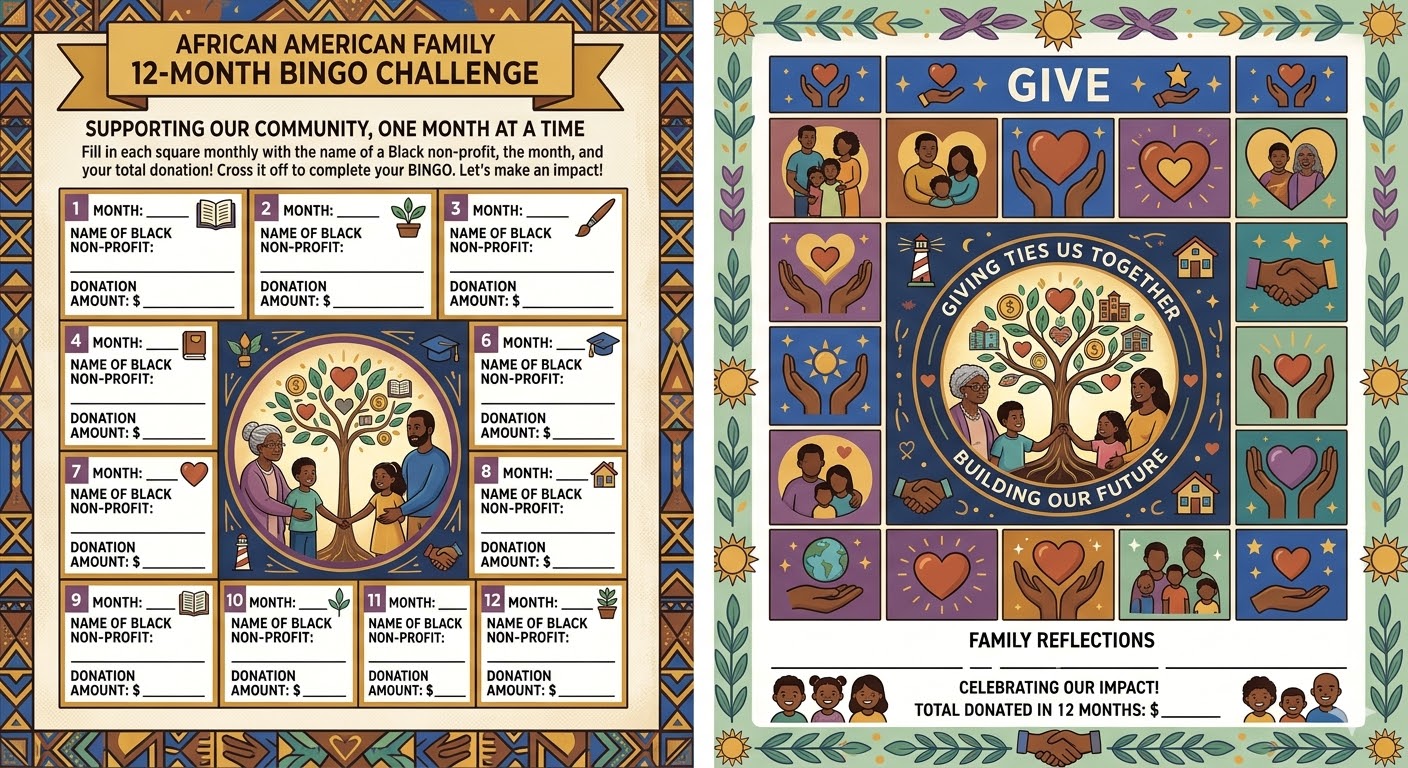
For HBCU Development Offices: The immediate priority is building and marketing a monthly giving program with a specific $10 entry point. The language should be explicit: this is not charity; it is institutional investment. Alumni who would not write a $120 check will often commit to $10 monthly if the onboarding is frictionless and the institutional communication is consistent and strategic. Technology infrastructure for recurring giving is low-cost and widely available. The barrier is not technical it is a development culture that has historically prioritized major gift cultivation at the expense of broad-base annual fund growth.
For Alumni Chapters: Chapters should establish a formal monthly giving commitment as a condition of active chapter membership or officer eligibility not as a financial barrier, but as a cultural signal that institutional support is a baseline expectation of HBCU alumni engagement, not an exceptional act. Chapters with robust monthly giving programs should publicize their aggregate contribution totals, creating competitive social proof across the alumni network.
For African American Giving Groups: Existing giving circles and collective philanthropy organizations should formally adopt Black-led nonprofits and HBCU foundations as priority beneficiaries and structure their pooled contributions as recurring monthly flows rather than single annual grants. The stability value of a twelve-month recurring commitment to a recipient organization exceeds the programmatic value of a larger, one-time check.
For Individual Households: The allocation question is straightforward. African American households already give. The strategic question is whether a portion of that existing generosity is directed toward institutions with the capacity to aggregate capital, build reserves, and generate long-term community returns. Setting up one $10 monthly recurring gift to an HBCU foundation or Black-led nonprofit requires less than ten minutes and commits less than the cost of two streaming subscriptions per month.
The structural underfunding of African American institutions is not primarily a story of insufficient generosity—it is a story of insufficient institutional routing. Black households give $11 billion annually. Black-led institutions capture a fraction of that flow. The gap between those two figures is the organizing challenge of African American institutional philanthropy.
The $10 monthly commitment is not the complete answer. It does not replace federal investment, it does not substitute for corporate accountability in philanthropic grantmaking, and it does not eliminate the need for transformative major gifts to HBCU endowments. But it is the instrument most immediately available, most broadly accessible, and most structurally valuable to the organizations that need stable, unrestricted, recurring revenue to survive and eventually to scale.
Communities are built by institutions. Institutions are built by capital. Capital, in the absence of inherited wealth and equitable access to external philanthropy, must be built from within—one recurring commitment at a time.
Disclaimer: This article was assisted by ClaudeAI.