
Tag Archives: Black nonprofit funding gap

The $10 Solution: Why Small, Recurring Gifts Are the Missing Pillar of Black Institutional Finance

The African American institutional ecosystem—comprising HBCUs, Black-led nonprofits, community health organizations, and civic associations—faces a structural financing problem that no single grant cycle, federal appropriation, or celebrity donation can solve on its own. The challenge is not a shortage of Black generosity. It is a shortage of organized, recurring, and institutionally directed Black generosity. The $10 monthly donation—modest by any individual measure—represents, in aggregate, one of the most underutilized instruments of capital formation available to African American institutions today.

This is not an argument for charity. It is an argument for institutional finance through democratized recurring revenue.

Before prescribing solutions, the data demands a reckoning with the scale of the funding disparity confronting African American-led institutions. According to research compiled by the Bridgespan Group and Echoing Green, the revenues of Black-led organizations are 24 percent smaller than the revenues of their white-led counterparts. When it comes to unrestricted funding—the holy grail of financial support—the picture is even bleaker: the unrestricted net assets of Black-led organizations are 76 percent smaller than their white-led counterparts. That disparity in unrestricted assets is not a footnote. It is the operating condition under which virtually every Black-led institution functions daily.

The revenue figures are equally sobering in aggregate. In terms of total sector-wide revenue, majority Black-led organizations receive less than $3 billion, compared with majority white-led organizations that receive about $85 billion. The ratio of roughly 28 to 1 reflects decades of what practitioners in the sector have termed “philanthropic redlining,” a structural pattern in which institutional funders extend trust, operating support, and scale capital disproportionately to white-led organizations. The organizational profile of the sector makes this crisis especially acute. Majority Black-led nonprofits tend to be smaller, with 61 percent operating with budgets under $100,000 and only 2 percent with budgets over $10 million. The median annual revenue of majority Black-led nonprofits is $302,000, compared with $908,000 for majority white-led nonprofits. An organization operating at $302,000 in annual revenue has little margin for program investment, staff development, or reserve accumulation. It is, by any financial standard, an institution surviving rather than building.

The Association of Black Foundation Executives found that 60 percent of Black-led organizations surveyed had budgets of $500,000 or less, and just 23 percent had reserves of three months or more. A three-month operating reserve is considered the absolute minimum threshold for organizational resilience. The fact that more than three-quarters of Black-led nonprofits fall below that floor means that any disruption to funding—a grant not renewed, a donor who lapses, a federal program curtailed—can be existential. HBCUs face a structurally analogous problem in higher education finance. The PWI-HBCU NACUBO Top 10 Endowment Gap for 2024 stands at $129.2 to $1. HBCUs comprised 1.5 percent of NACUBO’s reporting institutions and 0.3 percent of the reporting endowment assets, while PWI endowments with assets over $5 billion hold 58.5 percent of the $884.3 billion in total reporting endowment assets. Even Howard University, which became the first HBCU to cross the $1 billion endowment threshold, a genuine milestone, remains an order of magnitude behind flagship PWIs whose endowments measure in the tens of billions.

These figures, taken together, describe an ecosystem that is generationally undercapitalized. The structural solution requires multiple interventions: federal policy reform, corporate accountability, philanthropic sector reorientation, and enhanced major gift cultivation. But each of those levers operates on a long timeline and with significant uncertainty. What African American households, alumni chapters, and giving groups can control today is the flow of their own recurring dollars into the institutions that serve them.

African Americans are among the most generous donors in the United States, a fact that is consistently underappreciated in both mainstream philanthropic discourse and internal community conversations. Nearly two-thirds of Black households donate to community-based organizations and causes, totaling $11 billion each year. Black households on average give away 25 percent more of their income per year than white households, and of all racial or ethnic groups, Black families have contributed the largest proportion of their wealth to charity since 2010. High-net-worth Black families are reportedly more likely to have family traditions around giving than their white counterparts and report more fulfillment from their charitable giving. Research by the Indiana University Lilly Family School of Philanthropy documents that Black Americans donated 3 to 4 percent of their income to charity on average across the years studied, a rate that outpaces other demographic groups relative to income.

The generosity is not in question. What is in question is the institutional destination of that generosity and the form it takes. A community that donates $11 billion annually but whose primary institutional ecosystem of HBCUs, Black-led nonprofits, Black hospitals, Black media operates on poverty-level budgets has a capital distribution problem, not a giving problem. The money is there. The institutional routing is not. A significant portion of that giving flows to religious congregations, mutual aid to extended family networks, and causes with no institutional anchor in the African American ecosystem. None of those giving patterns are illegitimate. But they do not build endowments. They do not fund operating reserves. They do not provide the recurring, unrestricted revenue that allows a Black-led nonprofit to hire a development officer, invest in data infrastructure, or weather a single major donor’s departure.

The $10 monthly donation ($120 annually) is not a symbolic gesture. At scale, it is a recapitalization strategy. There are approximately 47 million African Americans in the United States. If only 5 percent of Black households which is roughly 2.5 million households out of an estimated 17 million committed $10 per month to a Black-led institution, the aggregate annual flow would reach $300 million. Directed strategically across HBCUs, Black-led nonprofits, and community health institutions, that represents more than 10 percent of the current total revenue flowing to the majority Black-led nonprofit sector.

The power of recurring giving extends beyond the dollar amount. Industry data confirms that monthly donors give 42 percent more than one-time givers on an annualized basis, driven by the cumulative effect of consistent contributions and the reduced likelihood of lapsing. For nonprofits, recurring revenue is categorically different from episodic revenue: it is predictable, plannable, and bankable in ways that grant income and campaign proceeds are not. An organization with 500 monthly donors at $10 each has a guaranteed $60,000 annual baseline; modest but stable enough to justify hiring, to secure a line of credit, or to launch a matching gift campaign. Unrestricted monthly giving is also the form of philanthropy most urgently needed by Black-led institutions. The systemic deficiency in unrestricted funding, that 76 percent gap compared to white-led peers, reflects a structural pattern in which Black organizations receive grants with narrow programmatic restrictions that prevent investment in the internal capacity required for organizational growth. A $10 monthly donation from an HBCU alumnus to their alma mater’s annual fund, or from a community member to a local Black-led nonprofit, is by definition unrestricted. The institution decides how to deploy it: toward a staff position, a technology upgrade, an emergency reserve, or a matching gift that unlocks foundation dollars.

The most efficient mechanism for scaling these commitments into institutional capital is not individual action—it is collective action through organizational infrastructure. HBCU alumni chapters and African American giving groups represent an underutilized distribution network for democratized recurring philanthropy. An alumni chapter with 200 active members in which 60 percent commit to $10 monthly generates $14,400 annually—directed, unrestricted, recurring. A national HBCU alumni association with 50 chapters operating at that participation rate generates $720,000 annually for institutional endowment or operating support. Multiply that across the more than 100 HBCUs, many of which have alumni association networks across dozens of cities, and the aggregate potential is measured in the tens of millions of dollars per year, capital that currently does not exist on HBCU balance sheets.

Giving groups offer a parallel vehicle. Giving circles like the New Generation of African American Philanthropists, which began as a 15-person circle in Charlotte, have grown into significant collective giving entities committed to disrupting conventional philanthropy. These structures are particularly well-suited to the $10 monthly model because they combine the social accountability of a group commitment with the financial efficiency of pooled, recurring capital. A giving group that aggregates 100 members at $10 monthly generates $12,000 annually in deployable grants, small enough to be accessible to any working professional, large enough to meaningfully support a Black-led organization’s operating budget. The alumni chapter as a philanthropic vehicle is also strategically superior to individual giving in one critical respect: it creates an institutional relationship between the donor and the institution that survives any individual’s personal financial fluctuation. When the chapter commits, the institution can plan around that commitment. When an individual donor commits in isolation, attrition erodes the revenue base unpredictably.

The compounding returns of this approach are significant. An HBCU with 10,000 alumni in which 15 percent participate at $10 monthly generates $1.8 million annually. Invested at a conservative 5 percent return, sustained over ten years with reinvestment, that giving program alone produces an endowment contribution of more than $22 million, enough to fund two endowed faculty chairs or establish a meaningful scholarship fund. The compounding logic of recurring philanthropy, applied to institutional endowment-building, is the same logic that has built the multibillion-dollar endowments of elite PWIs over generations: not a handful of transformative gifts alone, but a consistent culture of giving across a broad alumni base, sustained over decades. For Black-led nonprofits, the calculus is more immediate. More than half of Black-led nonprofit leaders report that their organization would shut down if they lost one or two key funders. An organization that replaces that concentration risk with 300 monthly donors at $10 each has effectively immunized itself against the collapse of any single funding relationship. Donor diversification, the standard recommendation of every organizational capacity consultant in the sector, is operationally achieved through the accumulation of recurring small donors, not through the pursuit of larger restricted grants. According to the National Committee for Responsive Philanthropy, funding to Black communities accounts for only 1 percent of all community foundation funding, resulting in an underfunding of Black communities of $2 billion. Community philanthropy from within the ecosystem is not a substitute for external institutional accountability but it is the only source of capital over which African American institutions have direct and immediate control.


Recommendations for Institutional Action
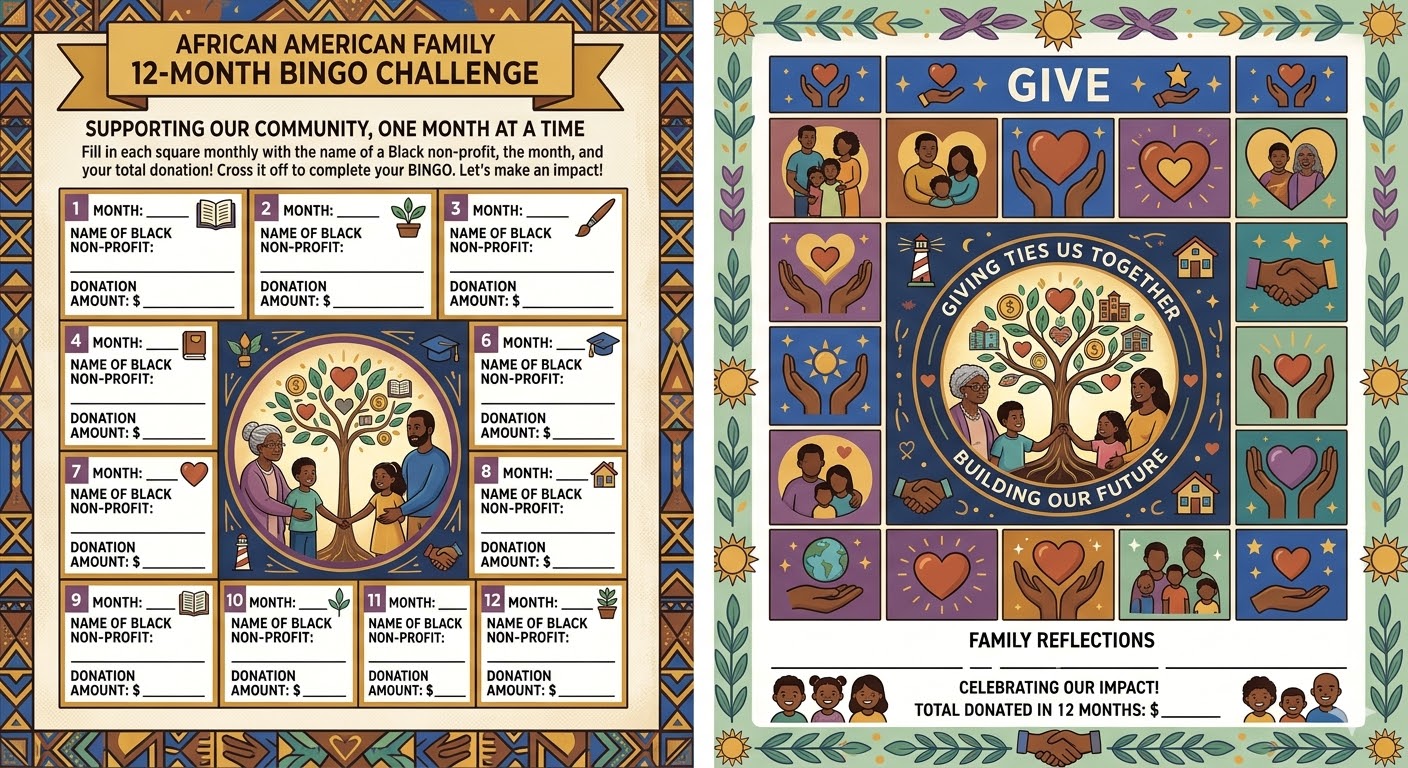
For HBCU Development Offices: The immediate priority is building and marketing a monthly giving program with a specific $10 entry point. The language should be explicit: this is not charity; it is institutional investment. Alumni who would not write a $120 check will often commit to $10 monthly if the onboarding is frictionless and the institutional communication is consistent and strategic. Technology infrastructure for recurring giving is low-cost and widely available. The barrier is not technical it is a development culture that has historically prioritized major gift cultivation at the expense of broad-base annual fund growth.

For Alumni Chapters: Chapters should establish a formal monthly giving commitment as a condition of active chapter membership or officer eligibility not as a financial barrier, but as a cultural signal that institutional support is a baseline expectation of HBCU alumni engagement, not an exceptional act. Chapters with robust monthly giving programs should publicize their aggregate contribution totals, creating competitive social proof across the alumni network.

For African American Giving Groups: Existing giving circles and collective philanthropy organizations should formally adopt Black-led nonprofits and HBCU foundations as priority beneficiaries and structure their pooled contributions as recurring monthly flows rather than single annual grants. The stability value of a twelve-month recurring commitment to a recipient organization exceeds the programmatic value of a larger, one-time check.

For Individual Households: The allocation question is straightforward. African American households already give. The strategic question is whether a portion of that existing generosity is directed toward institutions with the capacity to aggregate capital, build reserves, and generate long-term community returns. Setting up one $10 monthly recurring gift to an HBCU foundation or Black-led nonprofit requires less than ten minutes and commits less than the cost of two streaming subscriptions per month.


The structural underfunding of African American institutions is not primarily a story of insufficient generosity—it is a story of insufficient institutional routing. Black households give $11 billion annually. Black-led institutions capture a fraction of that flow. The gap between those two figures is the organizing challenge of African American institutional philanthropy.

The $10 monthly commitment is not the complete answer. It does not replace federal investment, it does not substitute for corporate accountability in philanthropic grantmaking, and it does not eliminate the need for transformative major gifts to HBCU endowments. But it is the instrument most immediately available, most broadly accessible, and most structurally valuable to the organizations that need stable, unrestricted, recurring revenue to survive and eventually to scale.

Communities are built by institutions. Institutions are built by capital. Capital, in the absence of inherited wealth and equitable access to external philanthropy, must be built from within—one recurring commitment at a time.

Disclaimer: This article was assisted by ClaudeAI.
One Year, $241 Million: What Three African American Athlete Families Could Do for Black Nonprofit Infrastructure

We put too much burden on a few to carry the many, but it does not remove the responsibility of the few to provide the accelerant that the many often cannot. – William A. Foster, IV

There is an old story, told in many forms across many communities, about a village built beside a river. The river flooded every generation, and every generation the village rebuilt — hauling timber, patching roofs, burying the dead, and beginning again. The village produced, across its history, a number of its sons and daughters who left, distinguished themselves in distant cities, and returned at flood time with wagons of supplies and tears in their eyes. The village received them gratefully. It rebuilt again. What the village never did and what no returning son or daughter, however generous, ever proposed was to move the village to higher ground, dig the drainage channels, or build the levee that would make the next flood a manageable inconvenience rather than a recurring devastation. The supplies were real. The grief was genuine. But the wagon that arrives after the flood is not the same thing as the engineering that prevents it. One is charity. The other is infrastructure. African American institutional life has lived, for too long, beside the river.

The question is not hypothetical in the way that thought experiments usually are. The money exists. The institutions that need it exist. The gap between them is not a mystery it is documented in publicly filed IRS Form 990s, in university endowment reports, in the annual financial statements of African American nonprofits that are, in many cases, running on budgets that would embarrass a mid-sized dental practice. What has not existed, at least not yet, is the architecture of intention that would connect the two. It is worth stating plainly that this architecture is not novel, not radical, and not exclusionary, it is what every other community with durable institutional power has built and continues to build without apology, and it is built most reliably through the household. When a Jewish couple endows a chair at Brandeis, establishes a donor-advised fund through the Jewish Communal Fund, or makes a lead gift to their local Jewish federation, no one questions the cultural logic of the decision. It is understood as the natural expression of a family whose identity, community, and institutional loyalty are aligned. When an Indian American couple directs philanthropic capital toward an IIT alumni endowment, an Indian American arts institution, or a diaspora investment vehicle, it is celebrated as community cohesion in action. When an Irish American family in Boston gives generously to Boston College or the local Catholic Charities chapter, the giving is read as heritage and pride. These couples and families are not accused of exclusion. They are not asked to justify why their philanthropy reflects their identity. They are not told that their giving should serve a broader, more universal constituency before it serves their own. The African American community is held to a different standard, one that is not articulated as a standard so much as assumed as a condition.

African Americans are expected to fight for the big tent, to frame every institutional investment in the language of universal benefit, to justify community-directed giving in terms that no other community is required to provide. Jewish families give to Jewish institutions. Indian couples give to Indian institutions. Cuban American networks build Cuban American power. And the African American family that proposes to do the same is asked, implicitly or explicitly, to explain itself. That asymmetry does not originate in principled universalism. It originates in a philanthropic power structure in which African American institutions have historically depended on external goodwill for their survival, and in which the communities whose goodwill has been most consequential (typically well-meaning white liberals) have developed, consciously or not, a proprietary relationship to the terms on which Black institutional investment is deemed acceptable. Communities that hold the center of gravity in their own institutional infrastructure do not need outside permission to give to themselves. They simply give. The African American community has not yet fully reclaimed that center of gravity and it is precisely that gap, between institutional need and internally generated capital, that creates the opening for a different standard to be applied, and accepted. The question being asked here about African American athlete families and the African American nonprofit ecosystem is not a different kind of question. It is the same question every community of consequence has already answered for itself, on its own terms, without waiting for permission. This analysis proceeds from that premise, asking a precise and answerable question: if the highest-paid African American athlete families those with African American partners or spouses, reflecting a household whose cultural loyalty and community identity are aligned in the way that Jewish couples, Indian American couples, and Irish American families align theirs without apology dedicated one year of their combined earnings to establishing endowments for African American nonprofits, what would that look like? What would change? And what would it mean for the institutions that have been waiting, in some cases for generations, for that question to be asked seriously?

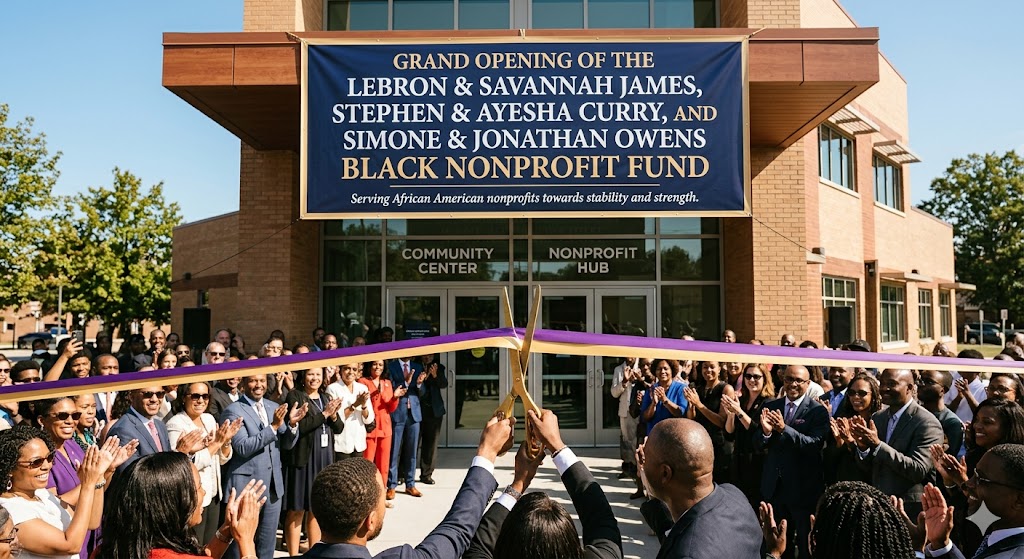
The three families at the center of this analysis were identified based on the 2024 earnings data compiled for the highest-paid African American athletes and the requirement that their household include an African American partner or spouse — a condition that matters because endowment-building at this scale is, or should be, a household decision, not a unilateral one, and because the framework here is explicitly about families whose full economic identity is embedded in the African American community. LeBron and Savannah James reported combined household earnings anchored by LeBron’s $128.2 million in 2024, which includes his NBA salary, his Nike lifetime deal, and the returns from business ventures including SpringHill Co. and his stake in Fenway Sports Group. Stephen and Ayesha Curry contributed $102 million, with Stephen’s Curry Brand partnership with Under Armour structured, as his peers at Under Armour have noted publicly, analogously to Michael Jordan’s Nike arrangement, including equity participation. Simone and Jonathan Owens, with Simone’s $11.2 million derived almost entirely from sponsorships with Athleta, Visa, Core Power, and Uber Eats following her historic Paris Games performance and Jonathan’s NFL career with the Chicago Bears, round out the group. Three families. Combined annual earnings of approximately $241.4 million.

To understand what $241.4 million could accomplish for African American nonprofit infrastructure, it is necessary to first understand what that infrastructure currently looks like and how comprehensively undercapitalized it is across nearly every domain of African American civic life. The problem is not concentrated in a handful of high-profile institutions. It is structural and pervasive. A prior analysis in this publication documented the investment income crisis at the core of Black philanthropy with precision: the gap between annual contributions-dependent revenue and the asset-generated investment income that allows institutions to operate with independence and permanence is, for the vast majority of African American nonprofits, not a gap at all. It is an absence. Institutions that have received contributions for decades that have built recognizable names and genuine community trust often hold investment income figures of zero or near-zero. That means every year of operation restarts from scratch. Every program depends on the next grant cycle. Every staffing decision is made against the backdrop of funding that may or may not be renewed. This is not a description of institutional weakness. It is a description of what happens when an entire sector is financed as though permanence were a luxury rather than a prerequisite for effectiveness.

Consider the Black and Missing Foundation, founded in 2008 and dedicated to raising awareness about missing African Americans, a population that receives demonstrably less media coverage, law enforcement attention, and public concern than missing white individuals. The Foundation has built genuine public visibility, including a documentary series that brought its work to a national audience. Its two co-founders, Derrica and Natalie Wilson, have spent years making the case that the crisis of missing Black Americans is not only a law enforcement failure but a media failure, a resource failure, and an institutional failure. According to its publicly filed Form 990, the Foundation reported $602,887 in total revenue in its fiscal year ending December 2024 with 100 percent of that revenue derived from contributions, zero investment income, and a net deficit of $87,568 on the year. Its total net assets stood at $852,506. This is the complete financial picture of an organization that addresses one of the most acute and chronically underreported crises in African American life. When a Black child goes missing and the Foundation cannot respond with the speed and resources the situation demands when staff capacity is constrained, when outreach budgets are thin, when the organization cannot sustain the surge capacity that a crisis by definition requires the cost is not measured in program metrics. It is measured in outcomes. Time lost in the first hours of a missing person’s case is not recovered. An institution too financially fragile to deploy resources at the moment of maximum urgency is, in the most direct sense, an institution that cannot fully do its job. The Black and Missing Foundation is not exceptional in its financial precarity. It is representative of it.

The data that contextualizes this precarity at scale comes from a joint April 2026 research publication by Candid and ABFE (Association of Black Foundation Executives) titled From Transaction to Transformation: Three Ways Foundations Can Invest in Black-Led Nonprofits for Lasting Change. The findings are worth sitting with. Between 2016 and 2023, only 50 percent of Black-led nonprofits received foundation funding in a given year, compared with 70 percent of other nonprofits. For small Black-led nonprofits, those operating below the threshold of visibility that attracts institutional grantmakers, the figure fell to 30 percent. These organizations were not absent from the funding marketplace by choice: the research found they had the lowest grant success rates of any category studied, meaning they were applying and being rejected at rates their counterparts did not face. The racial justice uprisings of 2020 produced what many organizations hoped was a structural shift; foundation giving to Black-led nonprofits increased, and for a brief window it appeared that the sector’s chronic underfunding was finally being addressed. The data tells a different story. Small Black-led nonprofits saw no significant change in the amount of funding they received during the 2020 surge, the increased dollars flowed predominantly to large organizations already established in foundation portfolios. And by 2023, even those larger organizations were seeing funding retreat, with one nonprofit leader describing the reversal plainly: that window closed in 2023, and resources were already drying up. The funding that arrived as a moral response to a moment of crisis did not become structural. It came and went. The organizations that most needed it barely felt it. And the organizations now relying on new funders — 64 percent of small Black nonprofits’ total grant funding comes from first-time funders rather than sustained relationships — face the perpetual overhead of cultivating those relationships from scratch, year after year, at the cost of the mission time and organizational capacity they cannot afford to spend.

This is the terrain into which $241.4 million, strategically deployed, could introduce genuine structural change not by replicating what major foundations already do, but by doing what major foundations have demonstrably failed to do. The first and most immediately actionable use of athlete family capital at this scale would be the establishment of matching endowment programs targeted specifically at small and mid-sized Black-led nonprofits. A $50 million matching fund seeded by these families and structured to match community donations to qualifying organizations dollar for dollar up to a defined threshold would accomplish two things simultaneously: it would inject direct capital into organizations that the existing grant marketplace consistently bypasses, and it would create a mechanism for broader community participation in institutional capitalization that does not currently exist at scale. The matching structure matters because it changes the dynamic of community giving from charity to investment: when a donor knows that their contribution will be doubled before it reaches the institution, the incentive calculus shifts. Matching programs have been used for decades in university fundraising precisely because they work. There is no structural reason they cannot be deployed for African American nonprofit infrastructure, and there is no reason that athlete family capital cannot be the seed that makes them possible. A second use of this capital would be the creation of multi-year, unrestricted operating grants for African American nonprofits that meet basic governance and transparency thresholds — grants that do not require program-specific reporting, that do not expire at the end of a fiscal year, and that allow organizations to build the staffing, reserve funds, and institutional capacity that project grants never cover. The Candid/ABFE research is explicit on this point: grant dollars alone are insufficient for transformative change, and the organizations that need sustained support the most are the ones least likely to receive it from existing funders. Unrestricted, multi-year capital is what converts an organization that restarts every year into one that accumulates. A third function of this capital would be institutional stability grants, one-time capitalization awards to organizations like the Black and Missing Foundation, which have demonstrated mission effectiveness and community trust but carry balance sheets too thin to absorb any operational disruption. A stability grant of $2 to $5 million to an organization with under $1 million in net assets does not make that organization wealthy. It gives it a runway. It buys the time and the breathing room that allow leadership to focus on mission rather than survival. And at a 4.5 percent annual return on even a $2 million endowment base, it generates $90,000 per year in perpetual investment income which is not a transformative sum, but the difference between zero and something, between an organization that exists year to year and one that has a permanent financial floor.

There is a dimension of this argument that goes beyond the mechanics of endowment returns, and it requires a frank accounting of where African American nonprofits currently find themselves in the philanthropic ecosystem. A prior HBCU Money analysis documented what that publication called the double-edged sword of external philanthropy: the reality that large gifts from non-African American donors, however genuinely valuable in addressing immediate capital needs, carry structural leverage that internally generated endowments do not. Over 95 percent of HBCUs have endowments below $100 million. The pattern holds across the nonprofit sector more broadly. MacKenzie Scott, the ex-wife of Amazon founder Jeff Bezos, with a net worth estimated at $38.3 billion has now directed more than $1 billion to HBCUs since 2020, part of a $26 billion philanthropic commitment that spans thousands of organizations. Her 2025 gifts alone included $80 million to Howard University, $63 million each to Morgan State and Prairie View A&M, $50 million each to Bowie State, Norfolk State, Virginia State, and Winston-Salem State, and $70 million each to the Thurgood Marshall College Fund and the United Negro College Fund. Michael Bloomberg separately directed $100 million to the nation’s four HBCU medical schools. The scale is staggering and the structural question it raises is equally so. A single donor’s philanthropic decisions now shape the financial trajectory of dozens of African American institutions simultaneously, representing a concentration of external philanthropic influence over what is supposed to be the independent infrastructure of African American intellectual and civic life. The harder question the one that institution after institution has been reluctant to ask publicly is what recognition of that kind costs in terms of institutional autonomy. The institution that cannot survive without the gift is not in a position to refuse the influence that follows it. Money that keeps the doors open commands a different kind of deference than money that provides additional capacity. The capital that athlete families could direct toward Black nonprofit infrastructure would not carry that cost. It would be capitalized by people who came from the communities the institutions serve, whose identities are inseparable from the African American community. That is a different kind of money. It is money that strengthens the institution’s voice rather than qualifying it.

The household dimension of this framework is not incidental. It is, in fact, the mechanism through which this kind of capital commitment becomes plausible. LeBron James’s individual philanthropy is well-documented; his I PROMISE School has become a national model for community-anchored public education. But the I PROMISE School is a program investment, not an endowment. It is an annual commitment that requires continued capital to sustain. The distinction matters because a program can be discontinued when priorities shift or resources contract. An endowment cannot be discontinued, its principal persists and generates income regardless of whether the founding family remains engaged. Savannah James has become a sophisticated philanthropic voice on questions of Black women’s health and family economic stability. A household endowment initiative would represent the institutionalization of both of those philanthropic identities into something permanent. The same logic applies to Ayesha Curry, whose Eat. Learn. Play. Foundation has deployed significant resources in Oakland and beyond but operates as a program-driven organization requiring annual capital commitments rather than as a perpetual institution with asset-driven income. And it applies to Simone Biles’s philanthropic work on behalf of abuse survivors and mental health infrastructure, causes that require the kind of sustained, multi-year institutional commitment that annual giving cannot reliably provide.

This analysis acknowledges the objection that will immediately arise: $241.4 million is the combined annual earnings of three families, and asking families to commit one year of income to endowment capitalization is not a trivial request. It is, however, not an unprecedented one. John D. Rockefeller gave away approximately $350 million during his lifetime, roughly $6 billion in today’s dollars, and the institutions that received those gifts are still operating, still growing, still deploying capital into the world, more than a century after he died. Andrew Carnegie gave away approximately the same amount. Both men demonstrated that the conversion of personal wealth into institutional endowments produces returns measured not in investment income but in institutional permanence and civilizational influence that no other deployment of capital can match. The Rockefeller Foundation today holds $6.23 billion in total assets and disbursed $440 million in charitable grants in 2023 while leaving the principal largely intact. These are the compounding returns on gifts made by men who died in the early 20th century. The three families in this analysis have the opportunity to create the same kind of compounding institutional legacy and unlike Rockefeller and Carnegie, they would be directing that capital toward institutions that serve the communities from which they came.

The structural argument for endowment over annual giving is ultimately an argument about time horizons. Annual giving asks: what is the most effective thing I can do with this capital right now? Endowment building asks: what is the most effective thing I can do with this capital across the next hundred years? The two questions produce different answers. Annual giving at scale sustains real programming and real operations. But it does not accumulate. It does not compound. It does not transform an institution’s relationship to financial risk. An endowment does all three. It changes the Black and Missing Foundation or any of the hundreds of small African American nonprofits running below the foundation funding threshold from an organization that must survive year to year into one that has a permanent financial floor from which it can actually build.

Before concluding, it is necessary to name plainly what this analysis does not argue, because the misreading would be consequential. It is not the job of three African American athlete families to underwrite the entire architecture of Black nonprofit infrastructure. The impulse to look at high-earning African American athletes and assign them collective responsibility for community institutional development is a reflex that deserves scrutiny rather than endorsement. It conflates income with wealth, celebrity with capital, and individual obligation with structural solution. The problems facing African American nonprofits are measured not in hundreds of millions but in the tens and potentially hundreds of billions, a gap that no collection of athlete earnings was ever going to close. The thought experiment offered here is illustrative, not prescriptive. The further assumption that even the highest-paid African American athletes represent a deep and stable philanthropic reservoir collapses under basic scrutiny. Athletic careers are short. The median NFL career lasts approximately three years. The wealth that survives even significant earnings depends entirely on financial decisions made during a compressed window of peak income, and a substantial number of professional athletes face serious financial stress within years of retirement. LeBron James and Stephen Curry are extraordinary outliers, not a generalizable class. It is also worth noting that professional athletes despite their prominence in popular culture and their genuine compensation occupy a position at the bottom of the organizational chart of the industries that employ them. They are well-paid labor. The team owner, the league investor, the media conglomerate executive who controls broadcast rights: those are the economic principals. A 23-year-old making seven figures is still, in the structural sense, the cashier. Understanding the economics of the institution you work for is not a skill that compensation alone confers. The deeper structural point is this: the class that actually generates transformative philanthropic capacity is not the labor class at any pay grade it is the ownership class. The Rockefeller and Carnegie legacies that shadow this entire analysis were not built on salaries. They were built on equity stakes in oil and steel on the compounding returns of assets that appreciated and generated income regardless of whether their owners continued working. The families whose philanthropy has reshaped American institutional life across generations — the Waltons, the Johnsons, the Pritzkers — built their capacity through business ownership, real estate, investment portfolios, and family asset structures that accumulate across decades and pass wealth forward rather than dissipating it at career’s end. That is the class whose analog is largely missing from African American institutional life. It is not missing because African Americans cannot build businesses or accumulate assets. It is missing because systematic exclusion from capital markets, property ownership, business credit, and institutional investment has compressed the timeline and scale at which African American family wealth has been permitted to compound. The consequence for Black nonprofits and HBCUs is direct: the families who write the transformative endowment checks at Harvard and Yale and the University of Chicago are families whose wealth has been compounding, in many cases, since the industrial era. African American families have been building from a much more recent and more disrupted starting point. Athletes earn. Owners accumulate. Until the African American community develops the ownership infrastructure — the family-held businesses, the real estate portfolios, the investment compounders across generations — that generates the asset-based wealth on which transformative institutional philanthropy depends, the question of who funds Black nonprofit endowments will continue to be answered, as it has been answered historically, by people outside the community whose generosity arrives with strings attached. The thought experiment posed here is worth conducting. But the honest conclusion of this analysis is not that three athlete families should give more. It is that the community needs to build the ownership infrastructure that makes the question of athlete philanthropy feel like what it should always have been: a supplement to community wealth, not a substitute for it.

None of this, however, exempts the broader community from its own share of the responsibility. The argument that athlete families cannot and should not bear the full weight of Black nonprofit capitalization is correct. The argument that the ownership class whose asset-based wealth could transform these institutions is largely absent from African American life is also correct. But neither observation releases the 40 million members of the African American community from what they can do right now, at whatever income level they occupy. The data from prior HBCU Money analysis is instructive: nearly a third of Black-led nonprofits operate on annual budgets of just $30,000. Forty-three and a half percent have no full-time paid employees. These are not institutions that require a philanthropist or an endowment to become functional they require the community whose interests they serve to treat consistent, recurring giving as a non-negotiable line item rather than an occasional gesture. Ten dollars per paycheck. Twenty dollars per paycheck. Directed not as a one-time response to a crisis or a viral campaign but as a standing commitment to an organization the giver has vetted and chosen to sustain. Across a community of 40 million people, the aggregate of those modest recurring commitments is not modest at all. The philanthropy club model where small groups of family members, friends, or HBCU alumni pooling monthly contributions, rotating responsibility for identifying and presenting organizations, building institutional knowledge alongside financial commitment is precisely the infrastructure through which that aggregate gets organized. It converts individual giving from an isolated act into a collective practice, and it creates the kind of sustained, recurring revenue that the Candid and ABFE research identifies as the resource most critically absent from small Black nonprofits: not grant windfalls, but continuing funder relationships. An organization that knows it will receive $500 per month from a philanthropy club of fifteen members for the next three years can plan around that. It can hire. It can retain staff. It can make the multi-year programmatic commitments that one-time donations cannot support. The athlete family endowment and the $20 paycheck deduction are not competing strategies. They are the same strategy operating at different scales, and the community needs both.

The $241.4 million scenario described here is a thought experiment. No announcement has been made, no commitment recorded. But the arithmetic is real and the institutional need is real; documented not in the finances of a handful of celebrated civil rights organizations but in the 990s of hundreds of African American nonprofits that address genuine crises with revenues measured in the hundreds of thousands, investment income of zero, and staffing levels that cannot absorb a bad quarter let alone a structural funding retreat. The capital to begin closing that gap exists. What has not yet materialized is the architecture of intention that would direct it. The institutions that three athlete families could help build through matching programs, stability grants, and unrestricted multi-year capital would still be filing 990s long after all of us have gone. But the full distance will only be closed when the African American community stops looking to its athletes to do what only owners can do and what the community as a whole must become responsible in building.

Disclaimer: This article was assisted by ClaudeAI.