Tag Archives: meac

The Largest IPO in African History Is Happening. Where Are African America’s Institutions?

Our work is the presentatoin of our capabilities. – Edward Gibbon

There is an old story about a village that lived along a great river. Every season, merchants from distant lands traveled that river, loading their boats with timber, ore, and grain pulled from the very land the villagers had worked for generations. Those merchants sailed downstream to markets where fortunes were made and power was consolidated, and season by season, neighboring tribes who had learned to build boats and send their own goods to market grew stronger their granaries fuller, their children better protected, their voices louder in the councils where decisions were made about who owned what and who owed whom. The village elders watched all of this from the bank. They were not ignorant men and women. They knew the river better than any merchant who passed through. They understood its currents, its seasons, its dangers. But they had never built boats. The lumber was expensive. The tools were hard to come by. The timing was never quite right. And so the resources of their land flowed downstream in other people’s vessels, enriching other people’s villages, while their own families and sibling villages just around the bend, bound to them by blood and history grew more exposed with each passing year. Then one season, a young man and a young woman stood before the elders and said: we know how to build the boats. We know where the timber is. We know the market downstream. The only question is whether this village will finally decide that the river belongs to us too.

The most consequential capital markets event in African history is unfolding in real time, and there is no reason for HBCU endowments and alumni associations to be spectators.

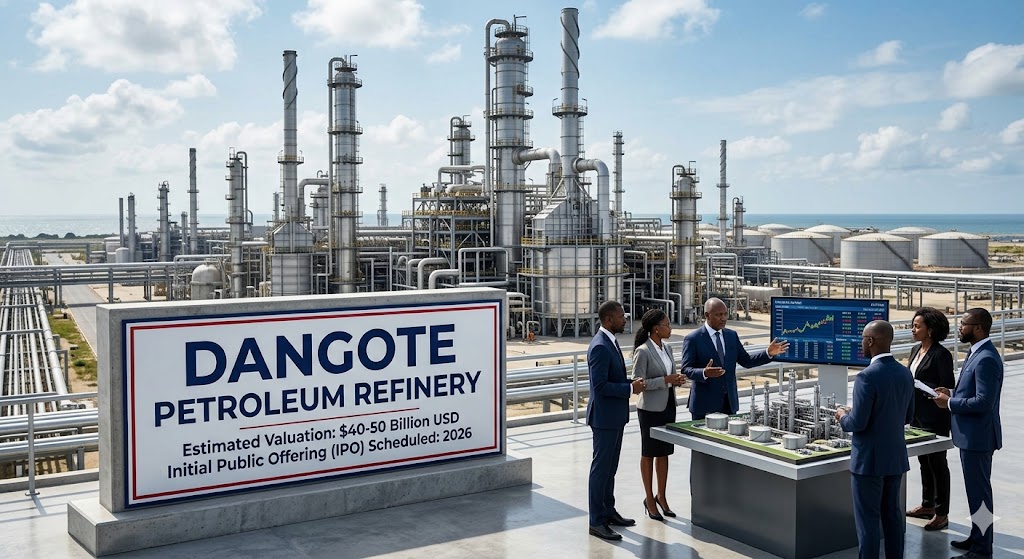
Aliko Dangote, the Nigerian industrialist whose Dangote Petroleum Refinery and Petrochemicals FZE has already reshaped the energy economics of West Africa, is preparing to take the refinery public. The offering structured as a coordinated multi-exchange IPO spanning the Nigerian Exchange, the Johannesburg Stock Exchange, the Nairobi Securities Exchange, the Ghana Stock Exchange, and several additional African bourses carries a valuation range of $40 billion to $50 billion. At a 10% stake offering, the actual transaction size approaches $5 billion, making it by a wide margin the largest equity offering ever conducted on an African stock exchange. The IPO subscription window is expected to open later in 2026.

For HBCU endowment officers, foundation boards, and alumni association investment committees who have spent the last decade searching for alternative assets that offer both competitive returns and meaningful institutional alignment, this transaction deserves serious analysis. It is not a charity play or a symbolic gesture toward Pan-African solidarity. It is a hard industrial asset, generating real revenue in hard currency, operating at the center of a continental energy transformation that will define the next quarter century of African economic development.

The strategic case begins with the asset itself.

The Dangote Refinery, located in the Ibeju-Lekki Free Trade Zone on the outskirts of Lagos, is the world’s largest single-train crude oil processing facility, with a current capacity of 650,000 barrels per day. It reached full operational capacity in early 2024, has already turned Nigeria into a net fuel exporter, and has disrupted global trade routes that previously ran refined petroleum products from European refineries back into the African market. The refinery currently supplies over 90% of Nigeria’s domestic petrol demand and has exported refined fuel to five African countries. The Dangote Group’s revenues have grown from $3.3 billion to $18 billion over the past five years, and the refinery’s expansion roadmap which envisions more than doubling capacity to 1.4 million barrels per day is the central purpose of the IPO capital raise.

One structural feature of the transaction is particularly noteworthy for institutional investors operating in the United States: dividends will be paid in US dollars, even though shares are purchased in naira. This is not a minor administrative detail. It addresses the core foreign-exchange risk concern that typically limits American institutional appetite for African equity markets. Dollar-denominated dividends from an asset generating dollar-denominated revenues — the refinery sells its output at global commodity prices — transforms the currency risk profile of the investment from speculative to manageable. For HBCU endowments that are overwhelmingly concentrated in US equities and fixed income, this creates a genuine entry point into the African investment universe without the full currency risk exposure that has historically made direct African market participation unattractive.

Now consider where HBCU endowments currently stand in the landscape of American higher education finance.

According to the most recent NACUBO-Commonfund Study of Endowments, HBCU institutions accounted for approximately $2.4 billion of the $944 billion in total endowment assets reported by participating institutions. The average HBCU endowment was $236.7 million, compared to $1.4 billion for all NCSE respondents. Only two HBCUs — Howard University, which crossed the $1 billion threshold, and Spelman College hold endowments above $500 million. The PWI-to-HBCU endowment gap among the top 10 institutions in each category stands at roughly 129 to 1. HBCU endowment gift flows fell to $67.7 million in FY25 from $91.9 million in FY24. On nearly every metric, the structural undercapitalization of HBCU institutional wealth is not merely significant; it is a threat to the long-term viability of institutions that serve as the backbone of African American professional formation.

The investment allocation patterns compounding this problem are equally stark. HBCU endowments allocate just 14% of their portfolios to alternative asset classes, compared to 41% for their non-HBCU peers — a 27-percentage-point gap that systematically excludes them from the asset classes driving the highest long-term returns. The reasons are structural and understandable: smaller endowments have fewer investment staff, face higher minimum investment thresholds at most alternative asset managers, and operate with more conservative board mandates. But the consequence is that HBCU endowments are systematically excluded from the alternative and international asset classes that generate the outsized returns sustaining the endowments of Harvard, Yale, and the University of Texas system. The compounding effect of this exclusion over decades is not a gap — it is a chasm.

The Dangote IPO, precisely because of its scale, its multi-exchange structure, and its dollar dividend commitment, represents an unusual opportunity to begin addressing one dimension of this allocation problem.

For institutions with sufficient endowment size to participate as institutional investors in the international tranche of the offering — Howard, Spelman, Hampton, and a small handful of others — the case for direct participation is straightforward. A position in the world’s largest single-train refinery, at an entry valuation of $40 to $50 billion, in an asset whose expansion is already funded and whose revenues are denominated in the currency in which your dividends will be paid, provides genuine portfolio diversification, inflation protection through commodity-linked revenues, and exposure to the fastest-urbanizing, fastest-growing consumer energy market on earth. Africa’s urban population is projected to double by 2050. Every major city added to the African urban grid requires energy infrastructure. The Dangote Refinery is positioned at the center of that demand trajectory.

For institutions whose endowment size makes direct participation in the IPO difficult which is the reality for most of the HBCU sector the answer is not to sit out. It is to aggregate. The 1890 Foundation, which serves as the coordinating hub for the nation’s 19 historically Black land-grant universities and has already demonstrated its capacity to administer large-scale federal partnerships, is the most credible existing infrastructure for a consortium investment vehicle among its member institutions. A formally structured investment fund operating through the 1890 network governed by participating endowment officers, managed by professional advisers with international markets experience, and capitalized through pooled contributions from member institutions would provide access to investment minimums and due diligence resources that no individual 1890 institution could assemble independently. The SWAC, MEAC, SIAC, CIAA, and HBCU Athletic Conference represent analogous organizing structures across the sector where the same consortium investment logic applies where each already functions as a governance body with member institutions, shared administrative infrastructure, and collective standing that could anchor a pooled investment vehicle.

HBCU alumni associations belong in this conversation, but not as secondary vehicles for the institution’s benefit. They belong as independent institutional investors making strategic decisions on their own financial merits. An alumni association that builds an investment fund with its own governance, its own professional management, and its own return targets is building institutional wealth for its membership, not running a philanthropic pipeline to its parent institution. The distinction matters. An alumni association investment fund capitalized by members seeking competitive financial returns will attract a different level of participation, a different quality of governance, and ultimately a different scale of capital than one framed as an alumni giving mechanism wearing investment clothes. Where coordination between a university endowment and its alumni association investment fund makes strategic sense such as co-investment in a shared opportunity, shared due diligence costs, complementary positions in the same offering that coordination should happen by design, not by default. But each institution must be making an independent decision of financial merit.

The argument for this model is not merely aspirational. It has historical precedent in other diaspora investment networks. The Indian American diaspora has consistently channeled capital into Indian infrastructure and technology sectors through organized networks of high-net-worth investors coordinated through professional associations and regional affinity groups. Cuban American capital networks have played a documented role in channeling investment back into businesses serving the diaspora in South Florida. Jewish American institutional networks have sustained diaspora bond programs through organized professional and philanthropic structures for decades. The mechanisms are known. The question is whether African American institutional leadership will build the organizational infrastructure to replicate them.

But the case for HBCU institutional participation in the Dangote IPO extends beyond portfolio diversification or even diaspora solidarity. It is about the connective tissue between two halves of the same people that has never been fully built. African American institutions sit on intellectual capital in agriculture, medicine, engineering, law, public policy, and the sciences that is directly relevant to the development challenges facing African Core nations. African institutions sit on natural capital, emerging market infrastructure, and a demographic growth trajectory that represents the most significant economic expansion of the twenty-first century. The relationship between the two has been episodic and philanthropic where it should be structural and transactional. An HBCU endowment that holds equity in the Dangote Refinery is not making a charitable gesture toward the continent — it is establishing a financial relationship that creates the institutional logic for research partnerships, faculty exchanges, student pipelines, and joint ventures that philanthropy alone never compels. Capital is the language institutions speak to each other when they intend to be taken seriously. Beyond the bilateral opportunity, there is a harder truth: Africa’s resources have been extracted, its assets undervalued, and its markets structured to serve outside interests since the colonial era. That dynamic does not end on its own. It ends when African institutions and their diaspora counterparts accumulate enough ownership stake in African Core assets that the continent’s wealth begins compounding inward rather than flowing out. Every dollar of HBCU and African American institutional capital deployed into African equity markets is a dollar that does not go to the outside investors who have historically treated the African Core as a source of raw return without reciprocal obligation. Ownership is the only permanent answer to extraction.

The Dangote IPO is not only an investment proposition. It is a test of whether Black institutional America can organize itself to participate in the capital formation of the African Core, the region whose industrialization will define the global economy’s next chapter or whether, once again, the value created in this geography will accrue primarily to investors who had the institutional organization to show up.

Nigeria’s regulatory environment carries the political and macroeconomic variance typical of any large, resource-rich emerging economy no more inherently unstable than the frontier and emerging markets of Eastern Europe, Southeast Asia, or Latin America that well-capitalized endowments have allocated to for decades without treating the risk as exceptional. That Nigerian markets have historically been characterized as uniquely risky reflects less about Nigeria’s actual risk profile than about the systematic undervaluation of African Core economies by external rating frameworks designed to serve the capital interests of institutions that benefit from keeping African assets mispriced. The multi-exchange listing structure presents a genuine operational challenge: coordinating clearing, settlement, and trading standards across multiple African exchanges simultaneously has no established precedent at this scale, and execution risk is real. Currency risk, while substantially mitigated by the dollar dividend structure, is not eliminated. And the refinery carries $3.65 billion in outstanding debt, with plans to repay through operations and asset sales — a material factor in any serious valuation analysis.

These risks are real. They do not, however, distinguish this offering from the risk profile of the emerging market private equity and infrastructure funds that well-capitalized non-HBCU endowments have been allocating to for the past two decades. The difference is not that those endowments found risk-free investments in emerging markets. The difference is that they built the institutional capacity to analyze and manage those risks, and they positioned themselves to capture the returns that came with accepting them.

HBCU endowments that remain concentrated in domestic equities and fixed income because they lack the investment staff to evaluate an African infrastructure IPO are not being prudent. They are being institutionally underpowered in a way that will compound against their beneficiaries for generations.

The path forward requires several concrete steps. First, HBCU endowment boards and foundation leadership should commission formal analysis of the Dangote prospectus as it becomes available and engage the offering’s appointed advisers — Stanbic IBTC Capital, Vetiva Advisory Services, and FirstCap — to understand the terms available to international institutional participants. Second, the 1890 Foundation, UNCF, the Thurgood Marshall College Fund, the HBCU Faculty Development Network, and the leadership of the SWAC, MEAC, SIAC, CIAA, and HBCU Athletic Conference should open formal conversations now about the governance structure of consortium investment vehicles within their respective networks, before this offering closes and before the next one arrives. Each of these organizations already operates across multiple institutions with shared administrative infrastructure; the investment coordination function is an extension of capacity they already possess, not a capability they would need to build from scratch. Third, HBCU alumni association leadership (national organizations, alumni chapters, and the professional networks that shadow every major HBCU) should be building investment fund infrastructure as a parallel track, governed independently and capitalized on financial merit, with coordination with institutional endowments happening where it creates genuine value for both parties.

The architecture of African wealth is being redrawn. The Dangote IPO is not a metaphor for that process. It is the process, in concrete form, open for institutional participation by any investor with the organizational capacity to engage it.

The young man and the young woman are standing before the elders. The boats can be built. The only question is whether this village will finally decide that the river belongs to them too.


This article is for informational and analytical purposes only and does not constitute investment advice. Prospective investors should conduct independent due diligence and consult qualified financial advisers before making investment decisions.

Disclaimer: This article was assisted by ClaudeAI.
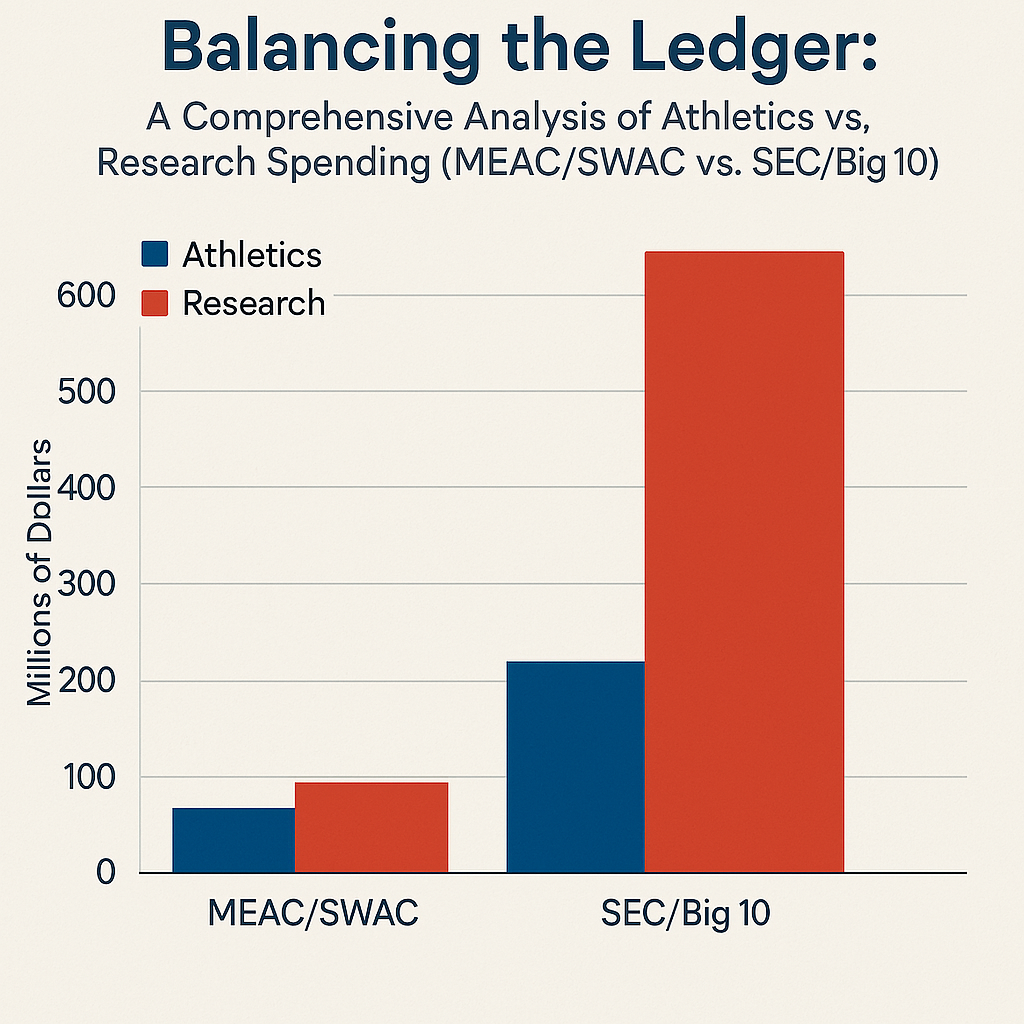
Balancing the Ledger: A Comprehensive Analysis of Athletics vs. Research Spending (MEAC/SWAC vs. SEC/Big 10)

“Since new developments are the products of a creative mind, we must therefore stimulate and encourage that type of mind in every way possible.” – George Washington Carver

In the financially stratified ecosystem of American higher education, institutions are increasingly confronted with a binary tension: to invest in athletic visibility or academic viability. For universities across the NCAA spectrum, especially those in the MEAC and SWAC conferences compared to their counterparts in the SEC and Big Ten, this decision is less about preference and more about resource constraints and strategic direction. Yet, data reveals a persistent imbalance in how these priorities manifest, and more critically, the long-term costs of these choices.

Conference Dynamics: Institutional Identity and Capital Exposure

The MEAC and SWAC are defined by institutions that are predominantly Historically Black Colleges and Universities (HBCUs). These universities have traditionally operated under capital scarcity, navigating chronic underfunding while serving as incubators of social mobility for African American communities. Their mission, often grounded in equity and community uplift, limits their ability to generate large commercial revenues through athletics. This is not due to a lack of talent or audience, but because media deals, booster contributions, and government funding disproportionately favor PWI institutions.

By contrast, the SEC and Big Ten represent the economic elite of collegiate athletics and academia. With flagship state universities at their helm, these conferences are buttressed by multi-billion-dollar endowments, large donor bases, and lucrative broadcast contracts. Their budgets allow for investments in both athletics and research without having to cannibalize one to fund the other. In essence, they play the game with more capital and fewer trade-offs.

Athletics Budgets: Symbolism vs. Strategy

MEAC and SWAC institutions report average athletics expenditures between $11 million and $12 million annually. Notable programs like North Carolina A&T and Prairie View A&M may hover slightly higher, but Mississippi Valley State and others operate on budgets as low as $3.9 million. These figures pale in comparison to SEC schools like Alabama or Texas A&M, where athletic spending exceeds $150 million. The Big Ten’s Ohio State leads all with $215 million dedicated to athletics alone.

While athletic programs at HBCUs serve as cultural centers and enrollment drivers, their limited revenue-generating capacity renders them economically unsustainable without substantial subsidization. Many are forced to divert institutional funds, raise student fees, or solicit local donations just to keep programs afloat. In contrast, SEC and Big Ten programs function as media properties, brand engines, and financial assets, often contributing revenue back to their academic institutions.

Athletics at HBCUs carry significant intangible value, cultural pride, alumni engagement, community identity, but these cannot substitute for financial sustainability. The opportunity cost of maintaining expensive athletic programs without equivalent return on investment demands strategic scrutiny.

Research Spending: The Forgotten Core

Where the real divergence occurs is in research investment. MEAC and SWAC research expenditures are overwhelmingly modest. With the exceptions of Howard University ($122 million) and Florida A&M ($41 million), most institutions sit between $2 million and $25 million in annual research activity. These figures reflect decades of underinvestment and insufficient infrastructure, not a lack of capacity or talent.

Meanwhile, SEC and Big Ten institutions routinely surpass $500 million in annual research outlays. Schools like Michigan ($1.67 billion), Wisconsin ($1.36 billion), and Penn State ($996 million) operate on a scale comparable to government agencies and national labs. They attract large NIH, NSF, and Department of Defense grants. They lead clinical trials, generate patents, and build interdisciplinary research parks.

This disparity is not simply numerical; it is strategic. Research drives federal grants, patents, corporate partnerships, and endowment growth. It also attracts high-performing faculty and students, serving as the foundation of institutional longevity and economic influence.

The Ratio That Tells the Future

The athletics-to-research spending ratio offers a lens into institutional philosophy:

  • Norfolk State: 2:1 athletics to research
  • Jackson State: 0.7:1
  • Mississippi Valley State: 6:1
  • Alabama: 0.15:1
  • Michigan: 0.11:1
  • Wisconsin: 0.11:1

While SEC and Big Ten schools spend more on athletics than HBCUs, they also spend exponentially more on research. The imbalance within HBCUs is a reflection not of poor prioritization, but of systemic capital deprivation. These ratios also underscore how HBCUs are often forced to choose between visibility and viability, between entertainment and innovation, because they lack the financial bandwidth to pursue both.

Research as Revenue: Commercialization and the Innovation Economy

University research is not merely an academic endeavor it is a gateway to commercialization. Inventions born in labs often become patents. Patents become licensing agreements. Licensing revenue, in turn, flows back into the institution. The University of Florida’s development and commercialization of Gatorade yielded more than $280 million over time. Stanford’s involvement in launching Google and Hewlett-Packard has helped fuel its $36 billion endowment. Wisconsin’s WARF fund manages $4 billion in research-derived assets.

This model is not just aspirational; it is replicable. But replication requires infrastructure, policy, and intention.

Building the Infrastructure: A Two-Track Strategy for HBCUs

Campus Infrastructure

  1. Strengthen Technology Transfer Offices (TTOs): These serve as the conversion points from research to revenue. TTOs are responsible for managing patents, evaluating commercial potential, and negotiating licensing agreements.
  2. Invest in Innovation Facilities: Makerspaces, incubators, wet labs, and data science centers can all be built in underused buildings or retrofitted spaces.
  3. Embed Commercialization in Curriculum: Courses in IP law, venture creation, product development, and ethics should be available to both undergraduates and graduate students.
  4. Create Campus Accelerators: Provide seed funding, pitch competitions, and alumni mentorship. These accelerators can be industry-specific (e.g., AgTech at Tuskegee, FinTech at Howard).
  5. Celebrate Wins: Every patent, startup, or licensing deal should be internally recognized and externally marketed. Visibility breeds validation and investment.

Capital Infrastructure

  1. Black-Owned Banks: Offer startup lines of credit and financial education embedded in innovation ecosystems. These institutions can also hold endowment funds or manage cash flow from royalty revenues.
  2. Diaspora Sovereign Wealth Funds: Channel African and Caribbean capital into HBCU startups and joint ventures. Funds like Nigeria’s NSIA or Pan-African VC firms could provide growth capital.
  3. HBCU Venture & Endowment Funds: Seeded by Black VC firms, family offices, and institutional investors. These funds can create co-investment syndicates for promising faculty or student ventures.
  4. Donor-Advised Funds (DAFs): Enable alumni to contribute to IP pipelines through tax-efficient giving. DAFs could also be matched by corporate sponsors or philanthropic partners.

Building Strategic Partnerships for Scale

HBCUs need not operate in silos. Strategic collaboration can accelerate commercialization and R&D outcomes:

  • Inter-HBCU R&D Collaboratives: Morgan State and FAMU could co-sponsor patent consortiums.
  • Cross-registration commercialization programs with PWIs like Johns Hopkins or Emory.
  • Statewide HBCU innovation districts tied to workforce pipelines and rural development.

From the Lab to the Ledger: Case Studies in ROI

  1. University of Florida – Gatorade: In the 1960s, UF researchers developed a hydration drink to help football players endure Florida’s brutal heat. The result, Gatorade, has yielded over $280 million in licensing revenue. These funds helped UF build research infrastructure, attract top scientists, and grow its endowment.
  2. Stanford University – Silicon Valley: Stanford was not always wealthy. Its proximity to innovation and its open policies toward student and faculty entrepreneurship led to the creation of Google, Cisco, and more. Today, Stanford’s alumni-founded companies generate trillions in global market value.
  3. University of Wisconsin – WARF: Established in 1925, the Wisconsin Alumni Research Foundation has monetized research in Vitamin D, stem cells, and imaging. With over $4 billion in assets, WARF reinvests in faculty, students, and commercialization pipelines.
  4. MIT – Ecosystem Builders: MIT’s Deshpande Center and The Engine Fund act as innovation pipelines that commercialize tough tech. MIT startups have created over 4.6 million jobs globally.

What HBCUs Must Avoid: Dependency Without Ownership

Too often, HBCUs have served as intellectual suppliers while other institutions and corporations reap the financial rewards. Faculty develop ideas, only for those patents to be captured by universities with larger TTOs. Students build prototypes, only to license them under incubators unaffiliated with their home campus.

To shift this paradigm, ownership must be embedded from the start. That means building institutional IP portfolios and teaching students the economics of invention.

A Circular Ecosystem Rooted in Culture and Capital

StakeholderRole in the Pipeline
Black-Owned BanksStartup capital, credit access, and embedded finance literacy
Diaspora Wealth FundsStrategic investment, global partnerships, and joint IP deals
African American NPOsStakeholder investors, endowment builders, and R&D supporters
Black Media & AlumniNarrative shaping, promotional power, and advocacy
HBCU TTOs & LeadershipPatent management, research development, and startup formation

Final Calculations: Wealth Is Institutional, Not Individual

The data from MEAC, SWAC, SEC, and Big Ten schools paints a vivid picture of the financial landscape of higher education. While SEC and Big Ten schools show that it is possible to be excellent in both athletics and academics, MEAC and SWAC institutions face tougher choices due to structural inequalities and historical underfunding.

As conversations around equity, student success, and public accountability continue, this kind of comparative data is essential. Whether aiming for a championship or a Nobel Prize, universities must remember that their ultimate mission is to educate, innovate, and uplift communities.

University research isn’t just about publications and academic prestige it’s a launchpad for innovation, economic growth, and financial sustainability. When strategically supported, it becomes a core driver of commercialization, entrepreneurship, and long-term prosperity through patents and endowment growth.

Many HBCUs and smaller institutions already are incubators of brilliance but they’ve been left out of the research-to-wealth pipeline due to underfunding and limited infrastructure. With targeted investments and smart policy, they can flip the script and become not just engines of education, but engines of innovation and wealth creation.

Disclaimer: This article was assisted by ChatGPT.

Do The Math: HBCUs Owning Their Own Tournaments Can Pay Better Than Hoping To Be Cinderellas Against PWIs In Theirs

“Take the fast road and get robbed then. Do you want to be famous or do you want to be rich? Because there is a likeliness that you might not be able to be both in this game. At a certain point you have to decide, do you want to be seen and known and look like you got bread and have everybody assume you got bread? Or do you really want to have bread and have people just assume you broke and not really getting it?” – Bun B

Jackie Robinson’s foray into Major League Baseball. Sam “Bam” Cunningham’s foray into PWI football. Texas Western’s championship in 1966 in PWI basketball. These are pivotal moments when an individual’s action would start the demolition of the institutions of African American institutional athletic power along with collapse of the infrastructure and ecosystems that made them such valuable assets to the African American community. In both instances, it would precipitate a talent and economic drain of African American institutions. 

The Negro Leagues would ultimately fold, ownership, executives, managers, hundreds if not thousands of jobs that were the byproduct of the Negro League wiped away to the sands of time. In 1947, there were zero African American owners in Major League Baseball. In 2023, there are zero African American owners in Major League Baseball. “Virtually all of the initial (Negro League) ownership was Black”, says Garrick Kebede, a Houston-based financial adviser and Negro League Baseball historian. In fact, across all major professional sports leagues (121 teams), there is only one African American principal owner – Michael Jordan, owner of the Charlotte Hornets and rumors are he is on the verge of selling the team almost eight decades after Branch Rickey poached Jackie Robinson. On the labor side, Major League Baseball reached its African American apex of players in 1981 with 18.7 percent of the players being African American. In 2023, that number has seen a precipitous decline down to 6.7 percent – a number not seen since 1957, a decade after Jackie Robinson entered the majors. Jackie Robinson’s move to the MLB did not just set the stage for the demise of the Negro Leagues, it would set the seed for HBCUs athletic demise just a few decades later.

A little over two decades later in 1966, Texas Western University (now, University of Texas El-Paso) would win the NCAA basketball championship with the first all-black starting lineup at a PWI and a few years later in 1970, Sam “Bam” Cunningham would take USC’s offense and run all over the all-white University of Alabama. Jerry Claiborne, an assistant to Head Coach Bear Bryant at the University of Alabama, famously said, “Sam Cunningham did more to integrate Alabama in 60 minutes than Martin Luther King Jr. did in 20 years.” But he did not integrate anything. Both instances simply convinced PWIs that Black athletes were the future of their programs and taking that talent from HBCUs could financially benefit them immensely among their STILL predominantly white fan bases and boosters. The fans and boosters just want to win. And while a decrease in European American players happened, the coaches, boosters, trustees, school bodies, and ownership in all the places that matter would still be what it has always been. Before enslaved Africans were brought to America, indentured servants who were the poor of Europe would be the labor pool of early America. This was to be no different of a transition. And ownership is ultimately the rub of where all of this lies for African America and HBCUs. 

The money behind the playoffs for football, the NCAA and NIT tournament for basketball, and the World Series for baseball and softball is dare we say – complicated. This in part is due to the way payouts are structured for each playoff/tournament and how schools and conferences choose to deal with the funds they receive for participating. For instance, in the NCAA tournament, “The NCAA urges the conference to distribute the earnings equally to the schools, but it is not a requirement. Typically, the bigger conferences will divide the money and send it to its member schools. The smaller ones, however, need the money to cover their own expenses, and then will send what’s left to its member schools.”, according to AS’s Jennifer Bubel. On the other hand, the NCAA’s ownership of the NIT operates a bit differently. “The NCAA has a complex way of rewarding teams for participating in March Madness. For the NIT, it’s much simpler. In addition to having travel, hotel and other expenses comped, each school in the NIT is given $4,000 for every game it plays. It’s a total payout pool of $128,000 this year.” says Sportico’s Eben Nvoy-Williams. Yet, Nvoy-Williams also points out that the NIT’s profitability to the NCAA while being lesser known is extremely profitable, “Though it’s nowhere near the commercial entity of March Madness, the National Invitation Tournament, or NIT, is a very profitable business for the NCAA. In 2019, the last year the event was held, it turned a $2.1 million profit on $3.3 million in expenses, according to financial documents. In 2018, the numbers were similar.” For football, “Each conference receives $6 million from the College Football Playoff for each team selected for a semifinal game and $4 million for each team that plays in a non-playoff bowl under the College Football Playoff.” reports Business of College Sports. Last but not least there is baseball, “In 2011, the NCAA included the College World Series as part of a $500 million television deal with ESPN for 24 sports championships through 2023-2024.” according to Huddle Up’s Joe Pompliano. Have we lost everyone yet? To sum it up, the finances of college athletics are extremely complicated. Adding to that complication is the fact that these playoffs and tournaments are all owned by the NCAA. But that ownership is now under threat as the Power 5 members realizing their own outsized power within the NCAA are vying to form their own entity. CBS Sports reports, “Majority of Power Five schools favor breaking away” and they primarily are looking to do so because they recognize they are a disproportionate contributor to NCAA events and more ownership would allow to share less and keep more within their conferences. Whether or not they determine that ownership is within the NCAA or a separate athletic association of their own is to be determined. Given their outsize influence in the NCAA though it may end up being a debate over how you pronounce tomato or potato. 

Many HBCU athletic supporters believe it is better that HBCUs fight for the respect and equality of their PWI counterparts in the NCAA as opposed to taking ownership of the HBCU Power Five (SWAC, MEAC, SIAC, CIAA, and GCAC) and forming the HBCU Athletic Association. This despite not having the alumni bases, boosters, or economic weight to be anything more than what we are in the NCAA’s ecosystem. In some respects, it harkens to the playing field of hip-hop where many artists finally started realizing that it was far better financially to be an independent artist than sign to a major label where an advance (also known as a loan) would keep the artist indebted to the label forever. A continued belief is that all we need to do is get the best athletes to come back to HBCUs and that resolves everything. Something no one seems to actually have an answer on how to accomplish or recognition in just how much that would cost – again, while not having the financial resources to accomplish it. Many think abandoning HBCU conferences and moving into PWI conferences is the answer despite multiple schools having tried and failing. HBCUs weakening HBCU conferences for PWI conferences is no different than African American athletes abandoning HBCUs for PWIs. It does not help us scale institutional power or circulate institutional capital. 

As it stands right now, the NCAA tournament is worth approximately $340,000 per win and with only the SWAC and MEAC participating (FBS schools only), even with a miraculous run it would workout to only $220,250 per school between the two conferences should they BOTH make it all the way to the Final Four. The secret to a conference actually making a lot of money in the NCAA tournament is having multiple teams from the conference get into the tournament. The SWAC/MEAC always only get one each and that is the automatic bid from winning their conference tournament. Money that a team earns in the tournament is usually (not required) split evenly among all of the members of the conference. Not always the case with smaller schools like HBCUs whose individual programs usually need every single penny. Given that every SWAC/MEAC athletic programs runs in the red and their 2019-2020 combined losses were to the tune of $161M it is hard to say whether the basketball programs that make it will share or can even afford to share.

The harsh reality of the probability for a deep run for HBCU men’s basketball is reflected in the SWAC/MEAC’s win-loss record in the tournament. Without comment, it is 4-55 all-time and we think that speaks for itself. It means that the SWAC/MEAC earned usually earn no more than the one unit times two teams for making it and this year that works out to a total of approximately $680,000 combined and $34,000 per school in the conferences if it is evenly divided. Can HBCUs create their own HBCU basketball tournament that would earn each school more than $34,000 per year? That is essentially the question that must be answered in considering creating our own tournament versus continuing to play in the NCAA tournament. If you included all 57 members of the HBCU Five, then that would need to be a tournament that produced a profit of $1.94M. Based on the NIT’s numbers, that would mean expenses of $3.1M or $55,000 per school approximately and revenues of approximately $5M or $87,700 per school. Again, this is a profit of almost $2M for the HBCU Five. The difference in this case is that of course the conferences would have an asset they could actually put on their financial statements that would be held in trust among their member institutions. Quite an enticing carrot in trying to recruit independent HBCUs to join the conference like Tennessee State University or PBIs like Chicago State University. The HBCU Five should be able to leverage a television contract for at least the cost of the tournament with everything else being profit thereafter. This could be repeated with football, baseball, and other sports.

Continued delusion around HBCU athletics competing with PWI athletic programs that have budgets ten times their size, a roster of boosters who write million dollar checks annually, corporate relationships with executives who also are PWI alumni and owned by PWI shareholders is a one-way train ticket to Diasasterville with the brake lines cut. You can not do what your competitor is doing when your resources socially, economically, and politically are as obtuse as HBCU reality. There are no HBCU boosters writing million dollar checks annually, there are no companies with HBCU executives and owned by HBCU shareholders who can provide multimillion corporate sponsorships, and there are reasons we all know and only say in private about why many African American high school athletes and their families overwhelmingly choose PWIs. We have to do different, think different, be creative, and solve the Rubik’s Cube that is not only the athletic conundrum we are facing but the lack of ownership crisis that continues to have a chokehold on African American institutionalism since 1947.

How Much Would The SWAC/MEAC Earn If Texas Southern University & Howard University Made The Final Four?

How Much is 1 Unit Worth?

“The value of one unit changes each year, and in 2022, it is estimated to be $338,887. That’s up a little bit from 2021, when a unit was worth $337,141.” according to Boardroom.

Here’s how it all plays out:

  • The SWAC/MEAC sent two teams to the NCAA Tournament: Texas Southern University and Howard University.
  • The two teams have earned one ECF unit for the SWAC/MEAC by making it to the tournament ($338,887 x 2 = $677,774).
  • Let’s say Texas Southern University wins the 16/16 play in game in the First Four. By then playing the traditional 16/1 (the First Round), Texas Southern gets another unit for the SWAC and gives it the possibility of earning seven units versus Howard University being able to earn a maximum of six units due to not having to play in a play-in game.*
  • Let’s say Texas Southern and Howard both lose their 16/1 games. Texas Southern University would have earned two units and Howard University would have earned one unit.*
  • Should both win and then have a Second Round loss. That’s one more unit for both and nothing more.
  • Now, let’s say both go on a miracle run to the national championship game. They would earn an additional unit for playing in the Second Round, Sweet 16, Elite Eight, and National Semifinal, for a total of thirteen units.
  • In total, this gives the SWAC/MEAC 13 units from this tournament, to be paid each year for the next six years, resulting in a total of $4.41M annually given to the SWAC/MEAC. That’s $26.43M total, which the conference will pay out to each of its 20 teams. If distributed equally, that’s $220,250 per school, per year, for a total of $1.32M.**

*HBCU Money was not able to confirm that the play-in game is worth an additional unit but serves as one in our example.

**Wins in the semifinals or final don’t count for units.

The 2019-2020 SWAC/MEAC Athletic Financial Review

In the fourth HBCU Money report on the SWAC/MEAC’s athletic finances, there has been one trend that is consistent – an acute amount of red on the balance sheet of each respective HBCU as it pertains to their athletic departments and it continues to grow redder and redder. Since HBCU Money first began reporting the SWAC/MEAC Athletic Financial Review, there have been losses of $128.6 million (2014-2015), $147.1 million (2016-2017), $150.7 million (2017-2018), and this year they continue their trend of the athletic black hole with losses over $161 million through athletics with no correction in sight. Not exactly the cash generating juggernauts that HBCU alumni have in mind when it comes to how deeply many believe that athletics can be the financial savior to HBCU financial prosperity. Instead, athletics seems to be potentially at the crux of many HBCU financial woes. Almost unfathomable is that many in the SWAC/MEAC have athletic budgets higher than their research budgets.

The harsh reality is that even with all the popularity buzz generated by Jackson State University’s head football coach, Deion Sanders, the factors working against HBCU athletics ever achieving real profitability remains a pipe dream at best. To land a major television contract, which is the only reason on mass that the SEC and Big 10 are the profitable athletic programs they are requires something that HBCU alumni bases severely lack. Large fan bases that have high incomes and an affluence. The harsh reality that HBCUs have small alumni bases, a reality that has been exacerbated post-desegregation where now HBCUs only get 9 percent of African Americans in college, combined with African America having both the lowest median income and wealth do not make for a recipe for advertisers to pay top dollar to television stations who would then healthily compensate HBCU institutions. HBCU athletics can be profitable, but it requires a completely different business model than our PWI counterparts. See, “The 5 Steps To HBCU Athletic Profitability”.

HBCU athletic revenues went down while expenses and subsidies went up in 2019-2020. That is usually a trend all would prefer be flipped. Students continue to bear the brunt of generating HBCU athletic revenues. This year’s review shows that approximately 73 percent of HBCU athletic revenues are generated through subsidies, up from 70 percent the year prior. Something to consider when 90 percent of HBCU students graduate with student loan debt.

REVENUES (in millions)

Total: $200.4 (down 1.2% from 2017-2018)

Median: $10.3 (down 4.6% from 2017-2018)

Average: $10.6  (up 5.0% from 2017-2018)

Highest revenue: Prairie View A&M University  $18.7 million

Lowest revenue: Coppin State University  $2.8 million

EXPENSES (in millions)

Total: $213.0 (up 0.5% from 2017-2018)

Median: $12.5 (up 15.7% from 2017-2018)

Average: $11.2 (up 5.7% from 2017-2018)

Highest expenses: Prairie View A&M University  $18.7 million

Lowest expenses: Mississippi Valley State University  $3.9 million

SUBSIDY

Total: $148.4 (up 4.9% from 2017-2018)

Median: $6.4 (down 18.4% from 2017-2018)

Average: $7.1 (unchanged from 2017-2018)

Highest subsidy: Prairie View A&M University $15.5 million

Lowest subsidy: Coppin State University $1.7 million

Highest % of revenues: Delaware State University: 92.0%

Lowest % of revenues: Florida A&M University: 37.0%

PROFIT/LOSS (W/ SUBSIDY)

Total: $-12.7 million (down 40.0% from 2017-2018)

Median: $0 (up 100.0% from 2017-2018)

Average: $-666,295 (down 46.3% from 2017-2018)

Highest profit/loss: North Carolina A&T State University  $615,094

Lowest profit/loss: North Carolina Central University  $-6,264,082

PROFIT/LOSS (W/O SUBSIDY)

Total: $-161.0 million (down 6.8% from 2017-2018)

Median: $-9.8 million (down 40.0% from 2017-2018)

Average: $-8.5 million (down 13.3% from 2017-2018)

Highest profit/loss: Mississippi Valley State University  $-2,177,123

Lowest profit/loss: Prairie View A&M University  $-15,417,471

CONCLUSION: At current, it would take an approximately $4.3 billion endowment dedicated to athletics to ween the SWAC/MEAC off of these subsidies onto a sustainable path. A sum greater than all HBCU endowments combined. Perhaps through merchandise sales, Jackson State could see its way to profitability without subsidies. Perhaps, but as former HBCU alumnus and NFL Hall of Famer Shannon Sharpe recently said, “There is only one Deion Sanders”. One thing is for certain, HBCUs have not done a proper cost-benefit analysis for the money they spend and subsidize to their athletic departments nor have they explored potential alternative models.

Editor’s Note: Howard and Bethune-Cookman are excluded in this report because they are private institutions and their athletic finances were not included in this report.

Source: USA Today