Tag Archives: politics

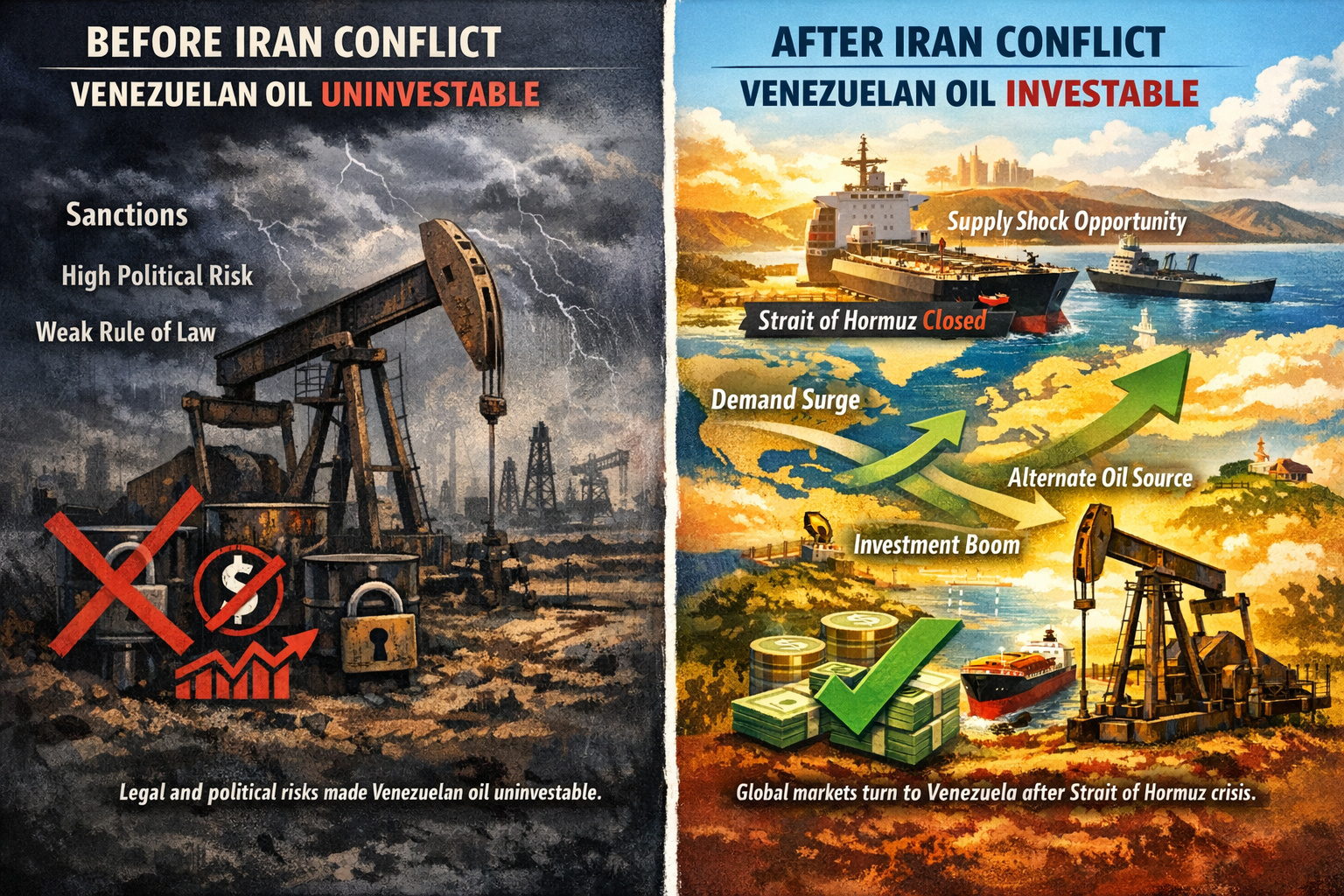
The Hormuz Gambit: Is the Iran Conflict a Backdoor to make Venezuelan Oil Investable? Is Nigeria Next?

The one thing that many of my fellow economists forget sometimes and my fellow financiers always consider is that supply and demand can absolutely be manipulated. – William A. Foster, IV

Venezuela sits atop the world’s largest proven oil reserves, but there is a reason the world’s largest oil companies have spent decades looking the other way. Venezuelan crude is among the heaviest, most expensive oil to extract and refine on the planet and at prevailing global prices, the economics have never justified the risk. To make Venezuelan oil investable, you would need to do one thing above all else: constrain enough of the world’s more accessible supply to drive prices high enough that the Orinoco Belt finally pencils out. What follows in this article is a hypothesis but it is one grounded in data, in sequence, and in the financial interests of an administration that has already invited 20 oil executives to the White House to discuss $100 billion in Venezuelan investment. When you map the Trump administration’s simultaneous pressure on Iran, the Strait of Hormuz, and Canada — nations and chokepoints representing an extraordinary share of global oil supply — against the economic preconditions required to make Venezuelan oil viable, what emerges may not be a series of unrelated geopolitical events. It may be the roadmap.

When the United States and Israel launched coordinated strikes on Iran on February 28, 2026, the world’s attention rightly fixed on the geopolitical shockwave radiating outward from the Persian Gulf. Oil markets braced. Analysts warned of prices surging past $100 a barrel. Iran’s Revolutionary Guard announced it was restricting navigation through the Strait of Hormuz and suddenly the global economy was staring at the edge of a cliff.

But here is the question that deserves more scrutiny, particularly from an economics perspective: Who benefits when Hormuz closes?

The easy answer is that no one does and that may be correct in the short term. According to the U.S. Energy Information Administration, oil flow through the Strait averaged 20 million barrels per day in 2024, roughly 20% of global petroleum liquids consumption and more than one-quarter of all seaborne oil traded worldwide. The EIA is unambiguous on a point that makes the stakes even higher: very few alternative options exist to move oil out of the region if the Strait is closed. Unlike other maritime chokepoints that can be circumvented by longer routes, most volumes transiting Hormuz have no practical alternative means of exiting the Persian Gulf. Beyond oil, approximately one-fifth of all global liquefied natural gas trade also moves through the Strait — primarily from Qatar — meaning a closure would simultaneously shock both oil and gas markets worldwide. China, which receives a substantial share of its crude imports through the Strait, would be hit hard. Asia broadly would scramble. Global recession becomes a credible scenario.

But in the medium to long term, there is another answer and it points south, toward South America, toward a country sitting atop the single largest proven oil reserve on the planet: Venezuela.

Venezuela holds 303.2 billion barrels of proven reserves. Iran, the nation now at war with the United States and Israel, holds 208.6 billion — the world’s third largest. Together, countries one and three on that global leaderboard account for more than a third of all documented reserves on Earth. When Iran’s oil already sanctioned and constrained for years becomes even more inaccessible due to active military conflict and Strait disruption, the scramble for alternative supply sources intensifies immediately. And Venezuela, which the Trump administration directly intervened in militarily in January 2026, resulting in the removal of President Nicolás Maduro, suddenly becomes the most geopolitically convenient alternative on the map.

Coincidence? Perhaps. But as an economics exercise, the question is worth pressing — because the financial architecture around Venezuela was already being assembled before the first bomb fell on Iran.

Before that architecture can be understood, a fundamental point about Venezuelan oil must be established, because all oil is not equal and that inequality is the key to understanding everything that follows. The global crude market distinguishes sharply between light and heavy crude based on API gravity, a scale developed by the American Petroleum Institute that measures how dense crude oil is relative to water. As Mansfield Energy explains, light crude, with its lower density and lower sulfur content, breaks down easily through relatively simple distillation into high-value products like gasoline, jet fuel, and diesel. It commands a market premium precisely because refiners can process it cheaply and quickly with standard equipment, generating fewer byproducts and higher profit margins. Heavy crude is a fundamentally different proposition. It is denser, thicker, and higher in sulfur, requiring advanced and expensive processing methods — upgrading, de-asphalting, hydrotreating, and coking — that demand major capital investment in specialized equipment, generate more residual byproducts, and carry greater environmental costs. Critically, refineries are designed around specific crude grades; a refinery built for light crude cannot simply switch to processing heavy oil. Venezuela’s reserves sit overwhelmingly in the Orinoco Belt, where the crude is not merely heavy but extra-heavy coming out of the ground, as UC Berkeley economist David Levine described it in January 2026, with the consistency of cold peanut butter. Before it can even move through a pipeline, it must be mixed with costly imported diluents such as naphtha, adding roughly $15 per barrel to costs before it reaches a port. Once it arrives at the rare refinery equipped to handle it, Venezuelan crude still trades at a $12 to $20 discount compared to Brent, the global benchmark. At $60 a barrel, Levine concluded, it simply is not economical to ramp up Venezuelan production quickly, despite the staggering reserve figures on paper.

To understand why that price environment matters so much, consider the global cost of production context. According to Hagen Energy Consulting, Saudi Arabia with its vast, easily accessible conventional reserves and established infrastructure produces a barrel of oil for as little as $10 to $15. North American producers, relying on more technically demanding methods like fracking and oil sands extraction, spend $30 to $70 per barrel depending on the operation. These are the benchmarks against which Venezuela must compete for capital. Venezuela cannot. Before a single barrel of Orinoco extra-heavy crude reaches a tanker, the operator has already spent roughly $15 per barrel on diluents just to make it flow through a pipe. Add to that the operational costs of extracting oil from a deteriorated production infrastructure that has not seen serious investment in decades, the cost of the specialized coker refinery processing required at the other end, and the $12 to $20 per barrel discount applied at market because of the crude’s inferior quality — and a conservative estimate of the all-in cost to produce and deliver a marketable barrel of Venezuelan oil runs well above $50, and by many industry assessments significantly higher once capital recovery on new infrastructure is factored in. For comparison, at $60 per barrel global crude pricing, Saudi Arabia earns $45 to $50 of profit per barrel. Venezuela may be breaking even — or losing money — on the same barrel. This is not a marginal disadvantage. It is a structural one, and it explains why the reserves number that appears so staggering on paper has translated into so little investment in practice.

This is the economic trap — and it reveals the hidden logic of the Hormuz crisis. The only variable that changes the investment calculus is the global price of crude, and the only thing that moves that price high enough, fast enough, is removing a significant portion of the world’s most accessible supply from the market. At $100 a barrel — the price level analysts warned a Hormuz closure could trigger — the Venezuelan math begins to shift. And the Strait, as the EIA makes clear, is not a disruption that can be routed around. Iran, which was producing over three million barrels per day before the escalation, is now effectively removed from accessible global markets. The Strait disruption threatens to pull millions more barrels per day offline across the entire Gulf. Canada, subjected to tariff warfare and annexation pressure, faces economic distress that clouds its own production investment climate. Each of these actions, viewed separately, looks like geopolitics. Viewed together through an economics lens, they look like a price floor being constructed — one that would make the Orinoco Belt profitable for the first time in a generation. Trump himself, in an earlier iteration of his public comments, called Venezuelan oil “garbage oil” and “the worst oil probably anywhere in the world.” That the same administration would then order a military intervention and immediately convene 20 oil executives to discuss $100 billion in Venezuelan investment is not a contradiction if the plan all along was to engineer the price environment in which garbage oil becomes gold.

On January 9, 2026 — just days after U.S. military intervention effectively ended the Maduro government — a group of executives from approximately 20 oil companies met at the White House at President Trump’s invitation. Trump urged them to commit at least $100 billion of their own capital to rebuild Venezuela’s aging infrastructure and restore production. ExxonMobil CEO Darren Woods offered a blunt assessment: Venezuela’s current frameworks make it “uninvestable,” requiring “durable investment protections” and wholesale changes to the country’s hydrocarbon laws. This was not a discouragement. It was a to-do list. For decades, Venezuela’s oil sector had been precisely what a February 2026 GIS Reports analysis called it — uninvestable — due to erratic nationalist policy, the nationalization of the industry under PDVSA in 1976, repeated asset seizures, and deep institutional erosion. The country that was uninvestable last year was suddenly, in the span of a military operation, being re-imagined as indispensable. But indispensable only works as an investment thesis if the price is right. And the price only gets right if the supply everywhere else gets tight.

The arc of the strategy becomes clearer when you add the third data point: Canada. Canada holds the world’s fourth-largest proven oil reserves at approximately 163 billion barrels — the single largest reserve holder in the Western Hemisphere outside of Venezuela. Since the earliest days of his second term, Trump has relentlessly pushed the idea of making Canada the 51st state of the United States. What many initially dismissed as rhetorical provocation has proven to be a sustained, multi-front campaign. Trump told the World Economic Forum that Canada could avoid his sweeping 25 percent tariffs simply by becoming a U.S. state. Canadian Foreign Minister Mélanie Joly stated plainly that Trump’s goal was to weaken Canada economically “in order eventually to annex us.” Former Prime Minister Justin Trudeau warned that the administration sought a total collapse of the Canadian economy to make annexation easier. The Chicago Council on Global Affairs connected this directly to Trump’s 19th-century view of American power — a period when the nation’s wealth was built on high tariffs and territorial acquisition, when “growing” literally meant expanding the map.

Now hold all three data points at once: Venezuela, the world’s largest reserve nation, subjected to military intervention. Iran, the world’s third-largest, subjected to military strikes and Strait disruption. Canada, the world’s fourth-largest, subjected to economic warfare and annexation pressure. Three of the top four reserve nations on Earth, targeted through three different methods of coercion, all trending toward the same directional outcome: greater American control over, or direct access to, the world’s most valuable underground assets.

This analysis cannot be separated from the broader financial context of this administration, and to ignore that context would be an economics failure. A landmark investigation published in The New Yorker documented that by early 2026, Trump and his family had made nearly $4 billion off the presidency through crypto ventures, Gulf real estate and licensing deals, private clubs, and lucrative transactions with foreign governments. As government ethics reform advocate Fred Wertheimer of the Campaign Legal Center observed, the sheer volume of financial arrangements flowing to the Trump family creates a clear mechanism for purchasing presidential favor. The family’s major financial dealings in the Persian Gulf region — the same region now destabilized by U.S.-backed military action — raise questions that economics-minded observers are obligated to ask openly.

The map that emerges from all of this is not random. Look at the full top ten proven reserve rankings. Saudi Arabia holds 267.2 billion barrels at number two. Canada is fourth at 163 billion. Iraq holds 145 billion at fifth. The UAE holds 113 billion at sixth. Kuwait 101.5 billion at seventh. Russia 80 billion at eighth. Libya 48 billion at ninth. And at number ten sits Nigeria, with 37.3 billion barrels. With the exception of Venezuela, Iran, and Canada — all currently under forms of American pressure — the remaining nations on that list are aligned with or accommodating of American strategic interests to varying degrees. Saudi Arabia is a decades-long security partner. Iraq is a country whose government was reconstructed under U.S. military occupation. The UAE and Kuwait host American military installations. Libya, despite its chronic instability, has been a site of Western-backed political intervention since 2011.

The pattern is this: nations outside the architecture of American strategic alignment get targeted. Nations inside it get protected, or at minimum, left alone to convert their reserves into durable sovereign wealth.

Nigeria sits at number ten, the only majority-Black nation in the top ten, and it is conspicuously absent from the strategic conversation happening in Washington boardrooms and war rooms. For now. Nigeria is the most populous Black nation on Earth and the economic anchor of sub-Saharan Africa. Despite holding 37.3 billion barrels of proven oil reserves and 210 trillion cubic feet of natural gas — the largest gas reserves on the African continent — Nigeria’s production share remains far below what its reserve ranking would suggest, hampered by underinvestment and infrastructure deficits. Its oil wealth has historically flowed outward toward Western and Asian energy majors, with relatively little strategic agency exercised by African institutions over the terms, the pricing, or the downstream development. That profile of vast reserves, underperforming production, weak institutional leverage, and no formal alignment with American strategic infrastructure is not a description of a nation safely outside this administration’s field of vision. It is a description of a nation that fits the pattern precisely. Venezuela was uninvestable until Washington decided it wasn’t. Iran was sanctioned until sanctions gave way to strikes. Canada was a trusted ally until its oil reserves made it a target for annexation rhetoric. The question is not whether Nigeria is on anyone’s chessboard. The question is whether Nigeria and the institutions that speak for the African world will have any hand in determining what move comes next.

And here is where the analysis must be unflinching about a structural gap: there is no established framework, no durable institutional channel, through which African American institutions in particular but not limited to African American policy organizations exercise real influence over Nigerian energy strategy, African Union economic policy, or the terms under which African reserves get developed and monetized. The intellectual talent exists. The cultural and ancestral connection exists. What does not exist at least not in any operationally significant form is the institutional architecture to translate that into geostrategic relevance. Jewish American institutions spent a century building the financial, political, and diplomatic infrastructure to influence U.S. foreign policy toward Israel. Indian American networks developed sophisticated pathways into technology policy and trade diplomacy. Arab American organizations have grown their Washington footprint substantially. African American institutions, by contrast, have historically been oriented inward toward civil rights, domestic policy, and economic inclusion within the United States for reasons that are entirely understandable given the weight of that struggle. But the world being drawn in front of us now is one in which the reserves map is being rewritten by force and economic coercion, and the strategic conversation about what Nigeria’s number ten ranking means is happening almost entirely without Black American institutional input, and arguably without sufficient African institutional agency either.

The scenario this article poses is, to be clear, a hypothesis — a geopolitical and economic reading of events that fit a pattern but have not been confirmed as deliberate strategy. The chaos of military conflict has its own logic, and actors in Washington, Tel Aviv, and Tehran are all operating with competing interests. But the circumstantial case is compelling: an administration with documented financial entanglements across the Gulf region solicited $100 billion in Venezuelan investment from oil executives — weeks before strikes that made alternative oil supply a global emergency. Whether this is coordinated design or opportunistic exploitation of circumstances, the pattern points toward the same beneficiaries.

The question it forces upon Black institutions on both sides of the Atlantic is whether the moment will finally compel the building of what has never been built: a serious, long-range framework for Diaspora engagement with African resource sovereignty before Washington, Beijing, or Riyadh decides what that sovereignty is worth.

In economics, we follow the money. Right now, the money trail leads from the Strait of Hormuz to the Orinoco Belt, through the Oval Office, and toward a continent whose largest reserve nation has no seat at the table where its future is being decided.


HBCU Money covers economics, finance, and wealth-building from a perspective that centers Black communities and institutions. The views expressed in Economics section analysis pieces represent the author’s independent economic assessment.

Disclaimer: This article was assisted by ClaudeAI.

Dr. King’s Dream is Dead: African America Must Focus On Its Own Institutional Sovereignty and Survival

“I fear I may have integrated my people into a burning house.” – Dr. Martin Luther King, Jr.

By William A. Foster, IV

For my parents and grandparents not many years ago, it was the White Citizens Council, Ku Klux Klan, Bull Connor, George Wallace, and more. Today, it is MAGA, ICE, Donald Trump, Charlie Kirk, and more. African America long held out hope that we would be in someway accepted into America’s fabric. We contributed centries of free labor capital, centuries of cultural capital, and did it all under an umbrella of racial terrorism. This hope was held without so much as an apology or reparation. The Civil Rights Movement of which much of my family was a part of from my mother’s letter to Dr. King himself that now sits in the archives of Boston College to part of our family that was forced to relocate to Jamaica by the US government, likely Hoover’s FBI. They fought for equal protections and equal opportunities, but it was and has always been a fool’s errand. A group in power will never voluntarily relinquish that power and European Americans are no exception to that rule. The problem is and has always been that only African America was fighting for reconciliation. It has been a dance between two dance partners where one is constantly stomping on the feet of the other, stealing money out of our pockets as they swirl us around, and smiling at us while putting a knife nine inches in our back and pulling it out six inches while calling it progress.

As a child, my sister and I had the privilege of attending Wee Care, an African American primary school in Prairie View, Texas in the town where our family’s illustrious HBCU, Prairie View A&M University is located and where my mother has taught students, developed faculty, and served in leadership for almost five decades. Unfortunately for us, the school only went up to the first grade at which time my mother was forced to choose her “best” option. My mother’s best option was an overwhelmingly European American Catholic school in the heart of Tomball, Texas, at the time a fairly known small Texas town – with all of the small town Texas dynamics when it came to race. Only my second and fifth grade teachers were nice to me. One was really young and the other a hippy. In sixth and seventh grade at another predominantly European American Catholic school I would experience the first time being called the N word by a fellow classmate. Even in the resulting aftermath of the fight I was blamed by the principal for being violent. Imagine that. The African American private schools were limited and given the distance from where we lived almost impossible for my mother to change us to an African American school where we would be culturally safe. That though was not the whole story. You see my classmates through elementary in particular were thought to be lifetime friends, but in my later years I would learn a valuable lesson from a graduate program I would attend in Boston at a Jewish institution. Do not confuse friendship and loyalty. I am thankful to this day for the lessons from that institution because it opened my eyes to so much in the world of navigating power dynamics. It was in those lessons that I realized that many of my so called friends from elementary were also loyal to causes that would see me and my family back on a plantation if the winds blew in the right direction and they saw no moral or ideological conflict.

From that point on, I realized that what I must lean into is the institutional development of my own people. From African America to the African Diaspora and that the connectivity of our institutions would be our strength and saving grace. But alas, many of us still yearned for acceptance into PWIs, European American corporations even though we do not think of them as such that is exactly who they are owned by when you examine their ownership, and predominantly European American neighborhoods. To access whiteness is seen as progress and success. In every place we lived, I largely remember us always being the only African American family in the neighborhood. Something I know that none of my childhood “friends” ever thought about or crossed their mind. Their families would never move into an African American community and be the only one. They saw our spaces as hostile even though we have always been overly welcoming even to our detriment, but as I said being the only African American family in a predominantly European American community was often seen as “progress” for many in our community. It was a mistake, a violent psychological mistake that still harms many of us to this day. The same way Ruby Bridges, a six-year old child, had to be escorted by Federal agents into a school because we assumed the fight for desegregation was making America true to its values. We were wrong then and we have been wrong about what Ameria’s values actually are.

Dr. King said in his famous speech, “I have a dream that one day this nation will rise up and live out the true meaning of its creed. We hold these truths to be self-evident that all men are created equal. I have a dream that one day out in the red hills of Georgia the sons of former slaves and the sons of former slaveowners will be able to sit down together at the table of brotherhood. I have a dream that one day even the state of Mississippi, a state sweltering with the heat of oppression, will be transformed into an oasis of freedom and justice. I have a dream that my four little children will one day live in a nation where they will not be judged by the color of their skin but by their character. I have a dream today. I have a dream that one day down in Alabama, with its vicious racists, with its governor having his lips dripping with the words of interposition and nullification; that one day right down in Alabama little black boys and black girls will be able to join hands with little white boys and white girls as sisters and brothers. I have a dream today.”

The dream is dead. It was a dream that required two parties to reconcile their past with only one willing to do so while suffering the brutality that has persisted since 1619. Dr. King’s speech was given on August 28, 1963 and two weeks later on September 15, 1963, the KKK bombed 16th Street Baptist Church and killed four African American girls: Addie Mae Collins (age 14, born April 18, 1949), Carol Denise McNair (age 11, born November 17, 1951), Carole Rosamond Robertson (age 14, born April 24, 1949), and Cynthia Dionne Wesley (age 14, born April 30, 1949). My mother was born in 1949. It could have easily been her. There are countless African American deaths at the hands of racial terrorism that we will never know about. The Red Summer of 1919 when the most African Americans (on record) were lynched. An entire Civil War just decades prior was waged over whether or not the United States should or should continue to be a country rooted in the slave economy. The complexity by which the North and South were guilty of profiting from – looking at you Harvard and others and have never rectified. The bloodshed, terror, and violence has been endless and it has not receded.

“I wouldn’t give it no more thought than wringing a cat’s neck! And there ain’t a court in Mississippi that’d convict me for it.” Frank Bailey’s, a character in Mississippi Burning, quote in regards to killing African Americans. This is and has been America’s attitude towards African America in its entirety. Not just individuals, but our institutions and communities as well. The underfunding of HBCUs or the burning of countless towns from Rosewood to Tulsa, our death and demise is sport and entertainment. African America has constantly believed that we could appeal to the morality of fellow Americans and “Christians”. We could work hard enough and show them our humanity. Imagine us thinking we need to prove to them we were hard working, civil, or human. It is both comical and insulting. But like many centuries ago, we have since the end of the Civil Rights Movement returns to working hard for everyone but ourselves and our institutions. That time needs to be over and we need to return to the principles and efforts that built towns like Rosewood, Greenwood, 100 HBCUs, 100 African American boarding schools, and over 500 African American owned hospitals. It is time to abandon any hope that peace can be achieved. Our sovereignty and survival is all that matters going forward. There are no more olive branches to be had. Not even from those that call themselves moderates or liberals because far too often we have seen them fall silent or pushed us to assimilate into spaces that did not empower us, did not provide institutional ownership to us, and often were spaces that were paternalistic and just as hostile to us as their conservative cousins. No, there are no more olive branches to be had because our survival depends on it.

Dr. John Henrik Clarke, a noted Pan-African historian, and someone who I consider an unofficial mentor said that any African American who is looking to devise a plan must look at our communities as nation-states and therefore must consider these fundamental pillars:

How will my people be housed?

How will my people be educated?

How will my people be fed?

How will my people be defended?

The answers to these questions can no longer be grassroots, they have to be institutional and they have to be thought about in a way that recognizes that our sovereign nation-state is adjacent to an adversary who has and will invade us. It is not a question of if they will, but when will they because they have so many times before. Unfortuantely, we cannot ask Dr. King what his thoughts about his “Dream” for America would be today because at the age of 39 he was assassinated. He was assassinated three years after his contemporary Malcolm X was assasinated and five years after Medgar Evers was assassinated in his driveway. Medgar Evers just two months before the “I Have A Dream” speech would take place. He was not blind to what America was for African America and he was certainly not blind to how our adversaries saw us or the lengths they were willing to go to in order to silence us. For the last 50 plus years since Dr. King’s passing African America has tried to make a peace that we should now see is not possible. It is time for the Dream Redefined and that dream should start and stop with actions that provide for the institutional sovereignty and survial of African America period.

The Firing of The BLS Commissioner Reaffirms: President Trump Only Believes In Fake Facts

“When power makes truth expendable, only the brave will keep records.” — HBCU Money Editorial Board

On August 1, 2025, the United States crossed a threshold most democracies fear but few anticipate with precision the moment a nation’s statistical agency becomes a political target not for corruption, but for accuracy.

Following a weaker-than-expected jobs report with just 73,000 jobs added in July and significant downward revisions to prior months, President Donald Trump abruptly ordered the firing of Dr. Erika McEntarfer, Commissioner of the Bureau of Labor Statistics (BLS). The justification? The data embarrassed him. The evidence? None. The implications? Profound.

For over a century, the BLS has served as the impartial scorekeeper of the American labor market. Its reports help inform everything from Federal Reserve monetary policy to wage negotiations, business expansion decisions, and university research. Most critically, the BLS is the foundation for public trust in employment data, a cornerstone of economic legitimacy.

Trump’s dismissal of Dr. McEntarfer, who was confirmed with bipartisan support and is regarded as a rigorous labor economist, did not challenge methodology, nor did it cite misconduct. Instead, it was an overt signal: when facts contradict the leader’s narrative, the facts must go.

This act is not merely executive overreach. It is an institutional decapitation. And it represents the clearest break yet from the post-WWII consensus that government data should be nonpartisan, methodologically sound, and politically untouchable. In a global economy, this is the equivalent of a currency devaluation not of the dollar, but of America’s data credibility.

When leadership no longer trusts or permits accurate data, policy becomes reactive, erratic, and performative. Investors, entrepreneurs, and institutions rely on the BLS to signal economic direction. Without it, credit markets misfire, fiscal policy lacks direction, and monetary policy becomes unmoored. For African American-owned banks, real estate firms, and HBCU endowment managers, this degrades their ability to assess employment trends in Black communities, apply for federal workforce grants, or time bond offerings based on unemployment benchmarks. Even philanthropic giving strategies may suffer if the poverty, wage, and employment data they are based on becomes manipulated or suppressed.

America’s strength lies in its institutions, not its individuals. By removing the head of a critical statistical agency on political grounds, the White House has signaled that no institution is beyond coercion. This undermines the rule of law and places civil servants especially those in technocratic roles on notice: loyalty matters more than evidence. African American civil servants, many of whom have worked tirelessly to diversify and reform these institutions from within, may see decades of credibility erased. It’s a chilling reminder that representation within agencies means little if those agencies are subject to autocratic whim.

International investors, trade partners, and credit agencies track U.S. labor data as a proxy for global economic health. If they begin to suspect that U.S. statistics are manipulated, they may hedge their investments, slow trade, or reevaluate the reliability of U.S. fiscal metrics. In the long-term, this can impact foreign direct investment in African American economic zones, HBCU research partnerships with global firms, and even diaspora remittance flows, if currency stability is affected by market anxiety.

Perhaps most dangerously, Trump’s decision follows a long trajectory of undermining truth-based systems elections, public health, the judiciary, and now economic data. This creates a vacuum in which conspiracy becomes conventional wisdom. In such an environment, fake facts become state currency. This has severe implications for African American institutions. Much of African American advocacy whether for reparations, investment, or educational equity rests on data. If national data sources are neutered or politicized, then the burden of proof shifts unfairly onto communities already under-resourced in research infrastructure.

HBCUs, Black think tanks, and African American foundations must view this firing not as a political blip, but a doctrine in action. When truth becomes negotiable, institutions that depend on it must move from passive reliance to active defense. HBCUs with strong economics, political science, or data science departments such as Howard, Spelman, and FAMU should develop Black-centered labor and socioeconomic data initiatives. These should complement, verify, or challenge federal data when necessary.

Institutions should also create safeguards digital, legal, and procedural to document how and when data manipulation may be occurring. This includes archiving historic BLS data, creating public dashboards, and writing explanatory briefs for the community. In addition, the next generation of data scientists, economists, and statisticians trained at HBCUs must be equipped not only with technical skill but a political consciousness of how truth is weaponized. Their work should be rooted not just in method, but in mission.

There is also an urgent need for civic engagement. African American policy organizations must pressure Congress to enact legal protections that insulate agencies like BLS, Census, and the Congressional Budget Office from political interference. Civil society must create watchdog coalitions that expose attempts to politicize data or intimidate public servants. Parallel to this, an emergency data defense fund backed by foundations and Black philanthropic leaders could help institutions respond rapidly to threats against data integrity.

Dr. McEntarfer’s firing is not merely about jobs data. It is about whether America will continue to govern itself by fact or by fiat. For African Americans, who have fought centuries of data invisibility, distortion, and misuse from redlining to police profiling the stakes are especially high.

The Bureau of Labor Statistics was once seen as above politics. That era is over.

African American institutions must now assume a new role not just consumers of data, but defenders of its integrity. If truth is to survive, it will not be because it was protected by tradition, but because it was guarded by those with the most to lose from its disappearance.

Disclaimer: This article was assisted by ChatGPT.

If the State Won’t Pay, the Rich Must: The $27.5 Billion Endowment Public Broadcasting Now Requires

“In the absence of state support, those with capital must decide: will they merely enjoy the benefits of a stable society—or invest in the institutions that make it possible?”
Arielle Morgan, Senior Fellow, Institute for Civic Infrastructure

The withdrawal of $1.1 billion in federal funding from the Corporation for Public Broadcasting is not merely a fiscal adjustment—it is a structural dislocation. It marks the effective end of a decades-long social contract in which the U.S. government ensured the existence of a nationwide, non-commercial broadcasting ecosystem intended to serve the public interest. For PBS, NPR, and their hundreds of affiliate stations across the country, the clock is now ticking toward an uncertain future.

But if the U.S. government is no longer willing to fund public broadcasting, another powerful bloc may have to: the ultra-wealthy and the corporations that have long built brand equity on the back of public trust and public platforms. In other words, the very elite who most benefit from stability, reliable information, and a functioning democracy may now be expected to underwrite one of its most foundational institutions.

The price tag? $27.5 billion.

A Simple, Uncomfortable Equation

To replace $1.1 billion in federal funding with investment returns, the equation is straightforward. Using a conservative draw rate of 4%—commonly applied by universities and foundations to ensure long-term preservation of capital—an endowment of $27.5 billion would be required to generate that annual payout.

This is not a charity exercise. It is a capital strategy.

To reach this target, two basic donor models stand out:

  • 275 individuals contributing $100 million each
  • 2,750 individuals contributing $10 million each

These figures are within striking distance of the top echelon of American wealth. As of 2024, the United States had over 800 billionaires and more than 23,000 centi-millionaires (individuals with $100 million or more in net worth). Put bluntly, it would require only 1.2% of America’s centi-millionaires to secure the future of public broadcasting in perpetuity.

What’s at Stake for the Elite

There is a growing recognition—even among the ultra-wealthy—that civil society must be preserved, even if governments no longer have the capacity or political will to do so. The fragility of liberal democracy, demonstrated by political polarization, misinformation, and institutional distrust, poses long-term risks not only to the electorate but also to markets, capital flows, and reputational value.

Public broadcasting—independent, educational, and widely trusted—has long been a stabilizing force in this ecosystem. Its reach into rural towns, inner cities, and suburban households makes it a conduit for shared narratives and factual baselines. It is not exaggeration to say that NPR and PBS, through All Things Considered, NewsHour, Frontline, and Sesame Street, have helped preserve a measure of social cohesion in a deeply divided country.

For the ultra-wealthy, losing this infrastructure would not simply be a cultural loss. It would be a strategic risk.

Hence the question: if the state won’t fund it, why won’t they?

The Precedent Is There

Large-scale philanthropic endowments are nothing new. In the past two decades:

  • Michael Bloomberg has donated over $3.3 billion to his alma mater Johns Hopkins University.
  • MacKenzie Scott has given away over $16 billion since 2019.
  • The Gates Foundation operates with a $67 billion endowment and deploys billions annually to global health and education initiatives.
  • Ken Griffin recently contributed $300 million to Harvard University.

Yet public broadcasting—a sector with tangible civic impact—has rarely drawn the same scale of contribution. This may be due in part to its status as a federal recipient, which gave the impression of permanence and stability. That illusion has now evaporated.

What remains is the opportunity to build a truly private-public media model—one whose operating capital is drawn from private wealth but whose editorial independence is legally insulated from donor interference.

A Corporate Response to a Public Crisis

Philanthropists are not the only entities positioned to act. Corporations, particularly those with vested interests in news, content, or public trust, have a strategic imperative to help capitalise such an endowment. Among the most obvious candidates:

  • Technology firms such as Apple, Amazon, Google, and Meta, which dominate digital content distribution and advertising, but face persistent scrutiny over misinformation and platform responsibility.
  • Media conglomerates such as Comcast, Disney, and Paramount, whose own news divisions benefit from a well-informed public and a credible informational ecosystem.
  • Financial firms such as JPMorgan Chase, Goldman Sachs, and BlackRock, for whom geopolitical and social stability underpin long-term asset growth.

Indeed, a structured vehicle—such as a Public Broadcasting Endowment Corporation (PBEC)—could allow corporations to make long-term contributions that are tax-deductible, reputationally beneficial, and materially impactful. Their names need not appear on programming or editorial decisions; the return on investment would be brand credibility and a stronger civic framework.

Moreover, such a fund could become a flagship ESG initiative—aligning corporate interests with measurable civic outcomes.

Structuring the Capital Stack

A diversified funding approach would enhance resilience and buy-in. A potential framework:

Donor TypeTarget ContributionTotal
275 HNWIs @ $100M$27.5 billion100%
OR
1,000 HNWIs @ $10M$10 billion36%
100 Corporates @ $100M$10 billion36%
Broad-based campaign$7.5 billion28%
Total$27.5 billion100%

A broad-based campaign could also complement elite contributions. Imagine a national “Democracy Dividend” campaign: one million Americans pledging $1,000 annually for ten years. That alone would yield $10 billion—a testament to public commitment alongside private wealth.

From Pledge Drives to Private Equity

Public broadcasting has traditionally raised funds through grassroots donations and corporate underwriting. But this model is no longer viable on its own. What is required is a transition from pledge drives to portfolio management.

The envisioned endowment would be governed by a professional board and investment committee, structured similarly to major university endowments. Earnings would be deployed annually to:

  • Sustain local PBS and NPR affiliates, especially in underserved areas
  • Support original investigative journalism and children’s educational content
  • Fund innovation in digital and streaming public media
  • Preserve and digitize historic programming archives
  • Maintain emergency broadcast systems and rural information networks

Crucially, editorial integrity would be enshrined by legal charter—preventing donors or sponsors from influencing content.

Philanthropy as Infrastructure

Too often, philanthropy is reactive—applied to symptoms rather than systems. An endowment, by contrast, is structural. It is a recognition that certain institutions are too important to be left at the mercy of annual budgets, market swings, or election cycles.

The erosion of federal support for public broadcasting is a warning signal. The infrastructure of civic life—fact-based journalism, educational programming, and communal storytelling—requires capital insulation, not just ideological support.

This is not about saving Big Bird or Masterpiece Theatre. It is about fortifying one of the last remaining platforms where Americans—regardless of political identity or geography—encounter one another not as algorithms or enemies, but as citizens.

Will the Wealthy Step Up?

The government has walked away. The funding gap is real. But the wealth to close it is readily available.

If even a fraction of the world’s wealthiest individuals and corporations stepped forward with capital rather than condolences, the future of public broadcasting could shift from a question of survival to a model of strategic, sovereign independence.

In the end, it is not about whether we can raise $27.5 billion. It is whether the people most capable of doing so will finally recognise that their wealth is not a wall—but a bridge to a more stable, informed, and democratic society.

🎯 Key Facts

  • Total CPB federal subsidy rescinded: $1.1 billion
  • This funding supports both PBS and NPR, primarily by supporting local member stations.
  • Goal: Replace $1.1 billion per year in perpetuity through investment returns from an endowment.

📊 Endowment Calculation Assumptions

To generate $1.1 billion annually, the endowment must safely yield that amount without depleting principal.

ScenarioInvestment ReturnAnnual Draw RateRequired Endowment
Conservative5% return4% draw$27.5 billion
Moderate6% return4% draw$27.5 billion
Ambitious8% return5% draw$22 billion

Rule of Thumb:

  • Endowment needed = Annual Budget ÷ Draw Rate
  • So for $1.1 billion with a 4% draw:
    $1,100,000,000 ÷ 0.04 = $27.5 billion

🏛️ Comparisons to Similar Institutions

InstitutionEndowmentNotes
Harvard University$50.7B (2024)Largest university endowment
Bill & Melinda Gates Foundation$67B (2024)Largest U.S. philanthropic fund
NPRN/ADoes not have a large central endowment
Howard University$1B (2024)Largest HBCU endowment

🔄 Alternatives or Supplements

If not a full endowment, partial coverage models could include:

  • A $5B–$10B endowment paired with annual fundraising
  • Public-private consortiums involving universities, foundations, and philanthropists

💡 Final Recommendation

To fully replace the $1.1B annual CPB subsidy, a minimum $27.5 billion endowment would be needed under conservative investment assumptions.
This figure ensures long-term sustainability without needing annual appropriations or political reauthorization.

Disclaimer: This article was assisted by ChatGPT.

Building Bridges for the Future: How Claflin University and Africa University Are Reimagining HBCU-African Higher Education Partnerships

“The regeneration of Africa means that a new and unique civilization is soon to be added to the world.” — Dr. Edward Wilmot Blyden

In a world increasingly threatened by climate change, biodiversity loss, and global inequality, it is not only science that must rise to meet the moment—it is institutions. The historic collaboration between Claflin University, a leading Historically Black College and University (HBCU) in Orangeburg, South Carolina, and Africa University in Zimbabwe is a testament to what the future of Pan-African higher education cooperation can and must look like.

As seen in the powerful image of four smiling graduates—young scholars representing Africa University’s Class of 2025—this partnership is more than symbolic. These four AU alums were awarded Master of Science degrees in Biotechnology and Climate Change through an online program with Claflin University. It marks a significant step forward in bridging the gap between HBCUs and African universities, offering not just degrees, but transformation, elevation, and a realignment of institutional relationships across the African Diaspora.

Claflin University’s Dr. Gloria McCutcheon, a seasoned environmental scientist and scholar, alongside Africa University’s Dr. James Salley, deserves our deepest thanks and congratulations for stewarding this visionary effort. This is more than an academic exercise. It is an investment in Black global agency—an institutional architecture that boldly resists the neo-colonial fragmentation of Black intellect and instead forges knowledge capital across oceans.

The Institutional Revolution: Why It Matters

Historically, relationships between HBCUs and African universities have been underdeveloped. While shared historical and cultural lineages run deep, formal cooperation in research, degree programs, and faculty development has often been episodic and underfunded. This is due in part to a lack of intercontinental policy alignment, but also due to the structural underinvestment in both HBCUs and African institutions of higher learning.

Yet this partnership challenges that stagnation. By aligning their academic missions, Africa University and Claflin University are modeling a future where Black institutions on both sides of the Atlantic are no longer rivals for Western validation, but co-creators of global excellence.

Biotechnology and climate change are not only timely fields—they are strategic. These disciplines shape the future of agriculture, health, water, and energy. As climate change disproportionately affects the Global South, it is imperative that scientists and researchers from Africa and the African Diaspora lead in developing regionally grounded and globally relevant solutions. The MS program is designed with this in mind, empowering graduates with the tools to confront challenges that affect their communities directly.

This is the praxis of Black institutional sovereignty. It is not merely symbolic, it is materially transformational.

Online Education as Pan-African Infrastructure

One of the most remarkable elements of this partnership is its fully online format. In doing so, it sidesteps the exorbitant costs and restrictive visa policies that often inhibit African students from accessing U.S.-based graduate education. Rather than uprooting scholars from their communities and obligations, this model allows them to remain embedded in the ecosystems they intend to serve.

It is also a vital counterpoint to the often exploitative model of international student tuition dependency seen at many Predominantly White Institutions (PWIs). Instead of recruiting African students primarily as revenue sources, this partnership honors them as scholars and change-makers—collaborators in knowledge production, not customers.

This is especially crucial as online education technologies mature and expand access. The future of African Diaspora cooperation must be hybrid and tech-savvy, using every digital tool available to scale education, connect institutions, and reinforce the sovereignty of Black intellectual spaces.

Claflin’s leadership in this area signals what is possible for other HBCUs. Morehouse School of Medicine has already begun integrating global health partnerships, and Howard University has longstanding African studies initiatives. Yet this direct academic program collaboration between Claflin and Africa University sets a new precedent—one that should become a norm, not an exception.

The Bigger Picture: Climate, Biotechnology, and Black Sovereignty

The selection of Biotechnology and Climate Change as the focus of this master’s program is a strategic masterstroke. Climate adaptation, agricultural sustainability, and bio-innovation are the battlegrounds of the 21st century. From Nairobi to New Orleans, African-descended people are often the first to feel the tremors of ecological collapse. We are also, too often, the last to benefit from the technological revolutions responding to it.

By placing young African scholars at the cutting edge of these fields, Claflin and Africa University are not just preparing students for careers—they are preparing them to lead revolutions. Innovations in biotech can reshape everything from vaccine distribution to drought-resistant crops. Expertise in climate change can determine which communities survive sea-level rise, which economies can adapt to volatile weather, and which governments can formulate climate justice policies that center the most vulnerable.

This partnership builds knowledge that is simultaneously scientific and sovereign. It reflects a belief that Black students should not just study solutions crafted elsewhere, but invent their own. In a world that too often imposes external “development” frameworks on African nations and communities, this program declares: we are the architects of our own future.

A Framework for Expansion: What Comes Next?

One successful cohort is a seed. But the real question is how to scale this model.

Here are five recommendations:

  1. Joint Endowments – HBCUs and African universities should pursue shared endowment vehicles that fund joint programs, scholarships, and research. Such funds would represent a new kind of transatlantic educational capital—independent, mission-driven, and Pan-African in structure.
  2. Faculty Exchange Pipelines – Beyond student exchanges, institutions must prioritize reciprocal faculty exchange programs. African professors teaching at HBCUs (physically or virtually) and vice versa would broaden curricular offerings and deepen cultural fluency. HBCU Faculty Development Network is the perfect conduit to sponsor the programming infrastructure for such an exchange.
  3. Shared Research Institutes – HBCUs and African universities could establish co-branded research institutes focusing on themes like climate change, food security, public health, and digital governance—topics where the Global Black experience offers unique insights.
  4. Diasporic Accreditation Models – One major barrier is credential recognition. A Pan-African accreditation body could facilitate mutual recognition of degrees and allow smoother transitions for students moving between institutions in the Diaspora.
  5. Government & Philanthropy Engagement – African governments and HBCU-aligned philanthropies must see this kind of partnership as strategic infrastructure. They must fund it accordingly. Every dollar spent here is a dollar spent on self-determination.

The Role of Leadership

Credit must be given where it is due. Dr. Gloria McCutcheon’s work at Claflin demonstrates what it means for faculty to move beyond the classroom and into institution-building. Her leadership not only provided the academic structure for the MS program but built the trust and collaborative framework that such international partnerships demand.

Likewise, Dr. James Salley’s leadership at Africa University—an institution that has long carried the banner of Pan-African Christian higher education—has been instrumental. AU was founded on the principle of serving Africa through excellence, and this collaboration expands that mission into the Diaspora.

This is what visionary leadership looks like: daring to connect what colonialism sought to divide.

The Image as Testament

Courtesy of Claflin University

The image that inspired this article—four young scholars, standing confidently in front of a brick building, adorned in the sunlight of new opportunity—represents more than a graduation. It is a visual declaration of Pan-African potential. Their smiles, their presence, their achievement—each affirms the power of institutions that choose cooperation over competition, legacy over ego, and elevation over exploitation.

They are not just Claflin graduates or Africa University alumni. They are trailblazers of a new academic order—one that transcends borders and builds Black excellence into the very structure of education itself.

Final Thoughts: Pan-African Pedagogy Is The Future

In a century defined by ecological upheaval, technological disruption, and renewed global competition, the African Diaspora cannot afford fragmented institutions. HBCUs and African universities must see each other as natural allies—extensions of a common historical, intellectual, and cultural struggle.

This Claflin-AU partnership is not just a program. It is a model of what is possible when Pan-African Diaspora institutions collaborate with purpose. It is a rejection of dependency and a commitment to capacity-building. It is the beginning of an educational ecosystem rooted in mutual respect, sovereign vision, and Pan-African commitment.

Let it grow. Let others follow. Let this be the future of Pan-African education—intercontinental, interdisciplinary, empowering, and unapologetically transformative.

Congratulations again to the Class of 2025. Your success is our collective success.

#SCUMCConference #elevationandtransformation