Tag Archives: politics

If the State Won’t Pay, the Rich Must: The $27.5 Billion Endowment Public Broadcasting Now Requires

“In the absence of state support, those with capital must decide: will they merely enjoy the benefits of a stable society—or invest in the institutions that make it possible?”
Arielle Morgan, Senior Fellow, Institute for Civic Infrastructure

The withdrawal of $1.1 billion in federal funding from the Corporation for Public Broadcasting is not merely a fiscal adjustment—it is a structural dislocation. It marks the effective end of a decades-long social contract in which the U.S. government ensured the existence of a nationwide, non-commercial broadcasting ecosystem intended to serve the public interest. For PBS, NPR, and their hundreds of affiliate stations across the country, the clock is now ticking toward an uncertain future.

But if the U.S. government is no longer willing to fund public broadcasting, another powerful bloc may have to: the ultra-wealthy and the corporations that have long built brand equity on the back of public trust and public platforms. In other words, the very elite who most benefit from stability, reliable information, and a functioning democracy may now be expected to underwrite one of its most foundational institutions.

The price tag? $27.5 billion.

A Simple, Uncomfortable Equation

To replace $1.1 billion in federal funding with investment returns, the equation is straightforward. Using a conservative draw rate of 4%—commonly applied by universities and foundations to ensure long-term preservation of capital—an endowment of $27.5 billion would be required to generate that annual payout.

This is not a charity exercise. It is a capital strategy.

To reach this target, two basic donor models stand out:

  • 275 individuals contributing $100 million each
  • 2,750 individuals contributing $10 million each

These figures are within striking distance of the top echelon of American wealth. As of 2024, the United States had over 800 billionaires and more than 23,000 centi-millionaires (individuals with $100 million or more in net worth). Put bluntly, it would require only 1.2% of America’s centi-millionaires to secure the future of public broadcasting in perpetuity.

What’s at Stake for the Elite

There is a growing recognition—even among the ultra-wealthy—that civil society must be preserved, even if governments no longer have the capacity or political will to do so. The fragility of liberal democracy, demonstrated by political polarization, misinformation, and institutional distrust, poses long-term risks not only to the electorate but also to markets, capital flows, and reputational value.

Public broadcasting—independent, educational, and widely trusted—has long been a stabilizing force in this ecosystem. Its reach into rural towns, inner cities, and suburban households makes it a conduit for shared narratives and factual baselines. It is not exaggeration to say that NPR and PBS, through All Things Considered, NewsHour, Frontline, and Sesame Street, have helped preserve a measure of social cohesion in a deeply divided country.

For the ultra-wealthy, losing this infrastructure would not simply be a cultural loss. It would be a strategic risk.

Hence the question: if the state won’t fund it, why won’t they?

The Precedent Is There

Large-scale philanthropic endowments are nothing new. In the past two decades:

  • Michael Bloomberg has donated over $3.3 billion to his alma mater Johns Hopkins University.
  • MacKenzie Scott has given away over $16 billion since 2019.
  • The Gates Foundation operates with a $67 billion endowment and deploys billions annually to global health and education initiatives.
  • Ken Griffin recently contributed $300 million to Harvard University.

Yet public broadcasting—a sector with tangible civic impact—has rarely drawn the same scale of contribution. This may be due in part to its status as a federal recipient, which gave the impression of permanence and stability. That illusion has now evaporated.

What remains is the opportunity to build a truly private-public media model—one whose operating capital is drawn from private wealth but whose editorial independence is legally insulated from donor interference.

A Corporate Response to a Public Crisis

Philanthropists are not the only entities positioned to act. Corporations, particularly those with vested interests in news, content, or public trust, have a strategic imperative to help capitalise such an endowment. Among the most obvious candidates:

  • Technology firms such as Apple, Amazon, Google, and Meta, which dominate digital content distribution and advertising, but face persistent scrutiny over misinformation and platform responsibility.
  • Media conglomerates such as Comcast, Disney, and Paramount, whose own news divisions benefit from a well-informed public and a credible informational ecosystem.
  • Financial firms such as JPMorgan Chase, Goldman Sachs, and BlackRock, for whom geopolitical and social stability underpin long-term asset growth.

Indeed, a structured vehicle—such as a Public Broadcasting Endowment Corporation (PBEC)—could allow corporations to make long-term contributions that are tax-deductible, reputationally beneficial, and materially impactful. Their names need not appear on programming or editorial decisions; the return on investment would be brand credibility and a stronger civic framework.

Moreover, such a fund could become a flagship ESG initiative—aligning corporate interests with measurable civic outcomes.

Structuring the Capital Stack

A diversified funding approach would enhance resilience and buy-in. A potential framework:

Donor TypeTarget ContributionTotal
275 HNWIs @ $100M$27.5 billion100%
OR
1,000 HNWIs @ $10M$10 billion36%
100 Corporates @ $100M$10 billion36%
Broad-based campaign$7.5 billion28%
Total$27.5 billion100%

A broad-based campaign could also complement elite contributions. Imagine a national “Democracy Dividend” campaign: one million Americans pledging $1,000 annually for ten years. That alone would yield $10 billion—a testament to public commitment alongside private wealth.

From Pledge Drives to Private Equity

Public broadcasting has traditionally raised funds through grassroots donations and corporate underwriting. But this model is no longer viable on its own. What is required is a transition from pledge drives to portfolio management.

The envisioned endowment would be governed by a professional board and investment committee, structured similarly to major university endowments. Earnings would be deployed annually to:

  • Sustain local PBS and NPR affiliates, especially in underserved areas
  • Support original investigative journalism and children’s educational content
  • Fund innovation in digital and streaming public media
  • Preserve and digitize historic programming archives
  • Maintain emergency broadcast systems and rural information networks

Crucially, editorial integrity would be enshrined by legal charter—preventing donors or sponsors from influencing content.

Philanthropy as Infrastructure

Too often, philanthropy is reactive—applied to symptoms rather than systems. An endowment, by contrast, is structural. It is a recognition that certain institutions are too important to be left at the mercy of annual budgets, market swings, or election cycles.

The erosion of federal support for public broadcasting is a warning signal. The infrastructure of civic life—fact-based journalism, educational programming, and communal storytelling—requires capital insulation, not just ideological support.

This is not about saving Big Bird or Masterpiece Theatre. It is about fortifying one of the last remaining platforms where Americans—regardless of political identity or geography—encounter one another not as algorithms or enemies, but as citizens.

Will the Wealthy Step Up?

The government has walked away. The funding gap is real. But the wealth to close it is readily available.

If even a fraction of the world’s wealthiest individuals and corporations stepped forward with capital rather than condolences, the future of public broadcasting could shift from a question of survival to a model of strategic, sovereign independence.

In the end, it is not about whether we can raise $27.5 billion. It is whether the people most capable of doing so will finally recognise that their wealth is not a wall—but a bridge to a more stable, informed, and democratic society.

🎯 Key Facts

  • Total CPB federal subsidy rescinded: $1.1 billion
  • This funding supports both PBS and NPR, primarily by supporting local member stations.
  • Goal: Replace $1.1 billion per year in perpetuity through investment returns from an endowment.

📊 Endowment Calculation Assumptions

To generate $1.1 billion annually, the endowment must safely yield that amount without depleting principal.

ScenarioInvestment ReturnAnnual Draw RateRequired Endowment
Conservative5% return4% draw$27.5 billion
Moderate6% return4% draw$27.5 billion
Ambitious8% return5% draw$22 billion

Rule of Thumb:

  • Endowment needed = Annual Budget ÷ Draw Rate
  • So for $1.1 billion with a 4% draw:
    $1,100,000,000 ÷ 0.04 = $27.5 billion

🏛️ Comparisons to Similar Institutions

InstitutionEndowmentNotes
Harvard University$50.7B (2024)Largest university endowment
Bill & Melinda Gates Foundation$67B (2024)Largest U.S. philanthropic fund
NPRN/ADoes not have a large central endowment
Howard University$1B (2024)Largest HBCU endowment

🔄 Alternatives or Supplements

If not a full endowment, partial coverage models could include:

  • A $5B–$10B endowment paired with annual fundraising
  • Public-private consortiums involving universities, foundations, and philanthropists

💡 Final Recommendation

To fully replace the $1.1B annual CPB subsidy, a minimum $27.5 billion endowment would be needed under conservative investment assumptions.
This figure ensures long-term sustainability without needing annual appropriations or political reauthorization.

Disclaimer: This article was assisted by ChatGPT.

Building Bridges for the Future: How Claflin University and Africa University Are Reimagining HBCU-African Higher Education Partnerships

“The regeneration of Africa means that a new and unique civilization is soon to be added to the world.” — Dr. Edward Wilmot Blyden

In a world increasingly threatened by climate change, biodiversity loss, and global inequality, it is not only science that must rise to meet the moment—it is institutions. The historic collaboration between Claflin University, a leading Historically Black College and University (HBCU) in Orangeburg, South Carolina, and Africa University in Zimbabwe is a testament to what the future of Pan-African higher education cooperation can and must look like.

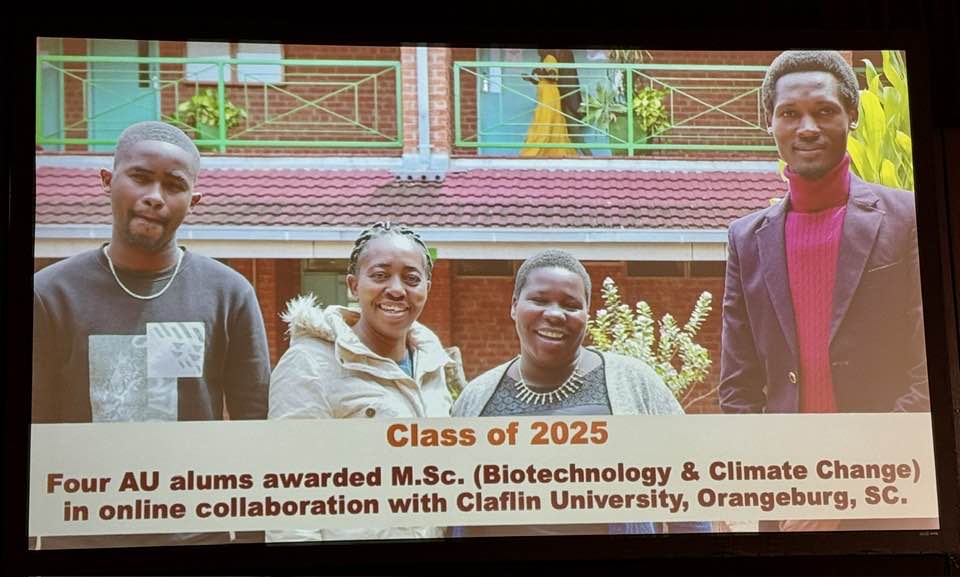
As seen in the powerful image of four smiling graduates—young scholars representing Africa University’s Class of 2025—this partnership is more than symbolic. These four AU alums were awarded Master of Science degrees in Biotechnology and Climate Change through an online program with Claflin University. It marks a significant step forward in bridging the gap between HBCUs and African universities, offering not just degrees, but transformation, elevation, and a realignment of institutional relationships across the African Diaspora.

Claflin University’s Dr. Gloria McCutcheon, a seasoned environmental scientist and scholar, alongside Africa University’s Dr. James Salley, deserves our deepest thanks and congratulations for stewarding this visionary effort. This is more than an academic exercise. It is an investment in Black global agency—an institutional architecture that boldly resists the neo-colonial fragmentation of Black intellect and instead forges knowledge capital across oceans.

The Institutional Revolution: Why It Matters

Historically, relationships between HBCUs and African universities have been underdeveloped. While shared historical and cultural lineages run deep, formal cooperation in research, degree programs, and faculty development has often been episodic and underfunded. This is due in part to a lack of intercontinental policy alignment, but also due to the structural underinvestment in both HBCUs and African institutions of higher learning.

Yet this partnership challenges that stagnation. By aligning their academic missions, Africa University and Claflin University are modeling a future where Black institutions on both sides of the Atlantic are no longer rivals for Western validation, but co-creators of global excellence.

Biotechnology and climate change are not only timely fields—they are strategic. These disciplines shape the future of agriculture, health, water, and energy. As climate change disproportionately affects the Global South, it is imperative that scientists and researchers from Africa and the African Diaspora lead in developing regionally grounded and globally relevant solutions. The MS program is designed with this in mind, empowering graduates with the tools to confront challenges that affect their communities directly.

This is the praxis of Black institutional sovereignty. It is not merely symbolic, it is materially transformational.

Online Education as Pan-African Infrastructure

One of the most remarkable elements of this partnership is its fully online format. In doing so, it sidesteps the exorbitant costs and restrictive visa policies that often inhibit African students from accessing U.S.-based graduate education. Rather than uprooting scholars from their communities and obligations, this model allows them to remain embedded in the ecosystems they intend to serve.

It is also a vital counterpoint to the often exploitative model of international student tuition dependency seen at many Predominantly White Institutions (PWIs). Instead of recruiting African students primarily as revenue sources, this partnership honors them as scholars and change-makers—collaborators in knowledge production, not customers.

This is especially crucial as online education technologies mature and expand access. The future of African Diaspora cooperation must be hybrid and tech-savvy, using every digital tool available to scale education, connect institutions, and reinforce the sovereignty of Black intellectual spaces.

Claflin’s leadership in this area signals what is possible for other HBCUs. Morehouse School of Medicine has already begun integrating global health partnerships, and Howard University has longstanding African studies initiatives. Yet this direct academic program collaboration between Claflin and Africa University sets a new precedent—one that should become a norm, not an exception.

The Bigger Picture: Climate, Biotechnology, and Black Sovereignty

The selection of Biotechnology and Climate Change as the focus of this master’s program is a strategic masterstroke. Climate adaptation, agricultural sustainability, and bio-innovation are the battlegrounds of the 21st century. From Nairobi to New Orleans, African-descended people are often the first to feel the tremors of ecological collapse. We are also, too often, the last to benefit from the technological revolutions responding to it.

By placing young African scholars at the cutting edge of these fields, Claflin and Africa University are not just preparing students for careers—they are preparing them to lead revolutions. Innovations in biotech can reshape everything from vaccine distribution to drought-resistant crops. Expertise in climate change can determine which communities survive sea-level rise, which economies can adapt to volatile weather, and which governments can formulate climate justice policies that center the most vulnerable.

This partnership builds knowledge that is simultaneously scientific and sovereign. It reflects a belief that Black students should not just study solutions crafted elsewhere, but invent their own. In a world that too often imposes external “development” frameworks on African nations and communities, this program declares: we are the architects of our own future.

A Framework for Expansion: What Comes Next?

One successful cohort is a seed. But the real question is how to scale this model.

Here are five recommendations:

  1. Joint Endowments – HBCUs and African universities should pursue shared endowment vehicles that fund joint programs, scholarships, and research. Such funds would represent a new kind of transatlantic educational capital—independent, mission-driven, and Pan-African in structure.
  2. Faculty Exchange Pipelines – Beyond student exchanges, institutions must prioritize reciprocal faculty exchange programs. African professors teaching at HBCUs (physically or virtually) and vice versa would broaden curricular offerings and deepen cultural fluency. HBCU Faculty Development Network is the perfect conduit to sponsor the programming infrastructure for such an exchange.
  3. Shared Research Institutes – HBCUs and African universities could establish co-branded research institutes focusing on themes like climate change, food security, public health, and digital governance—topics where the Global Black experience offers unique insights.
  4. Diasporic Accreditation Models – One major barrier is credential recognition. A Pan-African accreditation body could facilitate mutual recognition of degrees and allow smoother transitions for students moving between institutions in the Diaspora.
  5. Government & Philanthropy Engagement – African governments and HBCU-aligned philanthropies must see this kind of partnership as strategic infrastructure. They must fund it accordingly. Every dollar spent here is a dollar spent on self-determination.

The Role of Leadership

Credit must be given where it is due. Dr. Gloria McCutcheon’s work at Claflin demonstrates what it means for faculty to move beyond the classroom and into institution-building. Her leadership not only provided the academic structure for the MS program but built the trust and collaborative framework that such international partnerships demand.

Likewise, Dr. James Salley’s leadership at Africa University—an institution that has long carried the banner of Pan-African Christian higher education—has been instrumental. AU was founded on the principle of serving Africa through excellence, and this collaboration expands that mission into the Diaspora.

This is what visionary leadership looks like: daring to connect what colonialism sought to divide.

The Image as Testament

Courtesy of Claflin University

The image that inspired this article—four young scholars, standing confidently in front of a brick building, adorned in the sunlight of new opportunity—represents more than a graduation. It is a visual declaration of Pan-African potential. Their smiles, their presence, their achievement—each affirms the power of institutions that choose cooperation over competition, legacy over ego, and elevation over exploitation.

They are not just Claflin graduates or Africa University alumni. They are trailblazers of a new academic order—one that transcends borders and builds Black excellence into the very structure of education itself.

Final Thoughts: Pan-African Pedagogy Is The Future

In a century defined by ecological upheaval, technological disruption, and renewed global competition, the African Diaspora cannot afford fragmented institutions. HBCUs and African universities must see each other as natural allies—extensions of a common historical, intellectual, and cultural struggle.

This Claflin-AU partnership is not just a program. It is a model of what is possible when Pan-African Diaspora institutions collaborate with purpose. It is a rejection of dependency and a commitment to capacity-building. It is the beginning of an educational ecosystem rooted in mutual respect, sovereign vision, and Pan-African commitment.

Let it grow. Let others follow. Let this be the future of Pan-African education—intercontinental, interdisciplinary, empowering, and unapologetically transformative.

Congratulations again to the Class of 2025. Your success is our collective success.

#SCUMCConference #elevationandtransformation

HBCU Money™ Turns 13 Years Old

By William A. Foster, IV

Life is a hard battle anyway. If we laugh and sing a little as we fight the good fight of freedom, it makes it all go easier. I will not allow my life’s light to be determined by the darkness around me. – Sojourner Truth

HBCU Money is officially a teenager. Usually the teenage years are a rough and tumultuous time and it is hard to see that being any differently for us. The current social and political climates that we are about to experience over the next four years will test our patience and fortitude. It is vital that HBCU Money stays a voice of focus, strategy, and guidance in the African American institutional space as it relates to economics, finance, and investment.

It is inherent that we continue to strengthen and build our African American institutional ecosystem. It is also vital that that ecosystem build bridges of connection with the African Diaspora institutional ecosystem. We must throw off the shackles of isolationism and island mentality that plagues us so deeply. Before we make decisions we must ask ourselves is there an African American institution that exist that serves that need or want. If it is not there, then we must discuss building it. Where is the HBCU that has an African American MBA that teaches us how to build and run businesses from our interest? Where is the HBCU that has a law school focused on African American agriculture and real estate? Where is the African American bank focused on export-import for African American businesses? Are we using our talents to enhance ourselves individually or are we using our talents to enhance our institutions that enhance the collective? These are just a few of the vital things we are missing in our financial infrastructure.

There is not much that needs to be said, but plenty that needs to be done.

Without Hyperactive Alumni, HBCUs Will Bear The Brunt Of The Building Tsunami Of College Closures And The End Of Their Blackness

“95 percent of colleges are tuition driven.” – Robert Franek, The Princeton Review

HBCU alumni and their alumni associations need to demand immediately to see the financials of their HBCU – this is of course assuming their alumni associations house is in order but that is another article for another day. At public HBCUs this is bit easier because of them being a state institution, but private and especially religious-based private HBCUs that effort can prove to be a lot more complicated. However, you do not need to wait until you see fire to call the fire department if you already smell smoke. The fire is there you just cannot see it yet. This is the harsh reality for America’s college business model and this should be the terrifying reality for HBCUs. Far too many colleges in America have unsustainable businesses models and nothing highlights how glaringly broken the model is like their acute reliance on tuition revenue and paltry or nonexistent endowment revenue.

How did we get here? For HBCUs this issue started at desegregation when well over 90 percent of college bound African Americans would matriculate through HBCUs. The Civil Rights Movement fundamentally changed that and struck a death by a thousand cuts to not only HBCUs, but African American owned and operated institutions in general over the past 50 years. We all know the saying about “their ice is colder” so and so forth. African American neighborhoods slowly collapsed, African American owned and operated hospitals have gone from 500 to 1, African American owned banks were at over 50 just 25 years ago now are at 16 – and falling, African American boarding schools once a mighty 100 now only have 4 remaining. HBCUs have not been spared either with the closures of St. Paul’s College, Knoxville College, Bishop College, and Lewis College of Business being the most recent closures over the past thirty plus years.

The reality of what started then for HBCUs saw its fuse lit for PWIs in 2008 amidst the Great Recession when the world economy and capitalism as we know it almost collapsed. As most of African America/HBCUs know, when European America/PWIs catch cold, we catch pneumonia, COVID, Spanish Flu, all while having no insurance or African American doctors. The Great Recession’s effects were many, but perhaps its greatest impact is that many families moving forward simply have chosen to opt out of having children. In the years following, America’s peak high school graduation class is set to graduate in 2025 (see chart below) and forecast of graduating classes thereafter begins a precipitous decline. This poses an extremely bleak outlook for African America whose 2024-2025 and 2025-2026 classes are nominally equal to the African American graduating classes of 2009-2010 and 2010-2011 where in all four graduation years the number of graduates was north of 470,000. The stark difference is that it has taken 15 years to recover to that nominal number all while the percentage of African Americans graduating peaked in 2009-2010 and 2010-2011 when African American high school graduates accounted for 15 percent of American high school graduates. Since 2010-2011, percentages have been declining and will struggle to reach 14 percent of American high school graduates in 2024-2025 and 2025-2026.

In contrast, the two groups who are seeing the most precipitous increase are Hispanic America and Asian America, both who by 2025-2026 will have seen their percentages increase for 27 years without interruption. It poses the question and conversation of whether or not HBCUs can remain predominantly African American for another day, but that day is sooner than later especially given that HBCUs only get roughly 10-12 percent of the college bound African Americans that graduate from high school. USA Today reports, “Yet while 67% of white high school graduates went directly to college in 2020, the most recent year for which the figure is available, 54% of Black high school graduates did, the National Center for Education Statistics reports. That’s down from 66% in 2010.” Needless to say African American education from Early Childhood Education through Graduate School simply does not appear to be trending in any positive direction. Taking 54 percent of approximately 470,000 leaves us with around 254,000 college bound African Americans for HBCUs and based on the 10-12 percent we recruit it means that only 25,000 are likely to find their way to the 100 HBCUs or 2,500 per school. The math as they say is not going to math if this holds true, especially given the reliance on tuition revenue.

According to Appily, “In the United States alone, there are more than 6,500 postsecondary Title IV institutions. Of these institutions, 2,189 of them are Title IV non-degree-granting. The rest are degree-granting, with 1,485 being 2-year colleges and 2,828 being 4-year colleges.” Our number to focus on is the latter number of 2,828 4-year colleges. Of that 2,828 we know approximately 100 are HBCUs or 3 percent. Appily also states that there are approximately 1,626 public degree-granting universities and 1,202 private degree-granting colleges. That means that overall, almost 58 percent of American colleges are public and 42 percent are private. For HBCUs, it is essentially a 50/50 split down the line when it comes to public/private. From a geographic standpoint, 331 4-year colleges are located in the Mid-Atlantic, 495 4-year colleges in the Northeast, and 457 4-year colleges in the Midwest according to CollegeSimply. This accounts for 45 percent of the 4-year colleges in the entire country. On the contrary, HBCUs are highly concentrated in the Southeastern part of the United States which is something of a doubled edged sword. Birth rates in the aforementioned PWI geographic strongholds post-Great Recession are where the highest concentration of concern are so this is a plus, but HBCUs while not predominantly located in those areas are located in predominantly in the Southeast where high school gradation rates are the lowest among all regions in the country and where the states with the highest poverty rates are concentrated. So while the population demographics may not be an issue the ability to afford college most certainly will be and with HBCU endowments being what they are that will be even more magnified. The real question then becomes who is most at risk.

It would be far too elementary to say that simply having a large endowment is an indicator, but as a starting point let us see where that takes us. NACUBO’s 2022 Endowment Study reports 136 public/private colleges/universities in America with endowments over $1 billion – there are no HBCUs. We could even go a step further and look at endowment value per full-time student (see below) gives us a bit more insight. It shows that a university such as Princeton for instance that cost around $85,000 per year to attend that the university would need an endowment of $1.7 million per student to allow a student to attend for free. As we see, Princeton’s endowment value per full-time student is almost $4.1 million which far exceeds the coverage needed. Spelman College is the leading HBCU in endowment value per full-time student at $218,792 (see below) but based on their almost $50,000 per year cost of attendance it needs approximately $1 million per student to allow a student to attend for free. So we see the stark difference in endowment coverage for its full-time students between Princeton and Spelman, the leading PWI and HBCU, respectively.

It is also worth noting the drop between Princeton and Harvard is a 51 percent drop while Spelman to Howard is over 65 percent highlighting just how scarce the resources per student even within the top HBCUs versus their PWI counterparts. This is vital to note because endowments fund far more than student scholarships. They fund professor salaries, research, utilities, and so much more. Endowments returns are also rarely fully available to the operations side of the university to use. Most universities, especially the larger endowments, reinvest a significant amount of their endowment returns back into the endowment. A controversial practice for many who feel like multibillion dollar endowments should be used to battle the college inflation cost. That though requires an institution to have a multibillion endowment to argue about. Again, no HBCU has even $1 billion let alone multiple.

Like most African American individual and household statistics the outlook and trendlines look bleak, but most of us do not know or interested in what the data says. African American institutional outlooks and trendlines are not immune and given institutions weight on individual and household outcomes their trendlines tend to be the vanguard or foreshadow of the future. However, all hope is not lost. HBCU alumni and alumni associations must realize this is an emergency. It was an emergency yesterday, it was an emergency ten years ago, and it was an emergency fifty years ago the moment the seed of desegregation was planted. Waiting on the benevolence of ‘The Double-Edged Sword of White Philanthropy’ is not a sustainable answer or strategically sound. The question now is what is the strategy and possibility ahead.

HBCUs and their proxies lack targeted and developed pipelines that A) are improving the K-12 outcomes of African American students B) ensuring that those that do graduate are coming to HBCUs. For HBCUs that still care about being dominant African American institutions there is a roadmap they can follow. The directory from Black Minds Matter list 461 African American owned schools that span K-12 that provide at the very least a starting pool to develop. This means HBCU alumni must invest to ensure that these schools thrive and that students ultimately find their way in a pipeline that ends in both HBCU undergraduate and HBCU graduate schools. Donating to these K-12 African American schools has a myriad of echo effects: more HBCU teachers hired, develop the curriculums and institutional learning of tomorrow that prioritizes attending HBCUs, purchase supplemental equipment like new technology, ensuring our children are properly nourished, and more. All of this investment and engagement should ultimately lead to moving the African American selection of HBCUs above and beyond the paltry 10 percent we now have of African American bound college students and perhaps can reignite the high school graduation rates.

The other conversation we need to have, albeit a very uncomfortable one is HBCU mergers, creation of HBCU systems, and new institutional formations that may allow us to be more financially sustainable. For instance, Fisk and Meharry are quite literally across the street from each other. Public HBCUs in each state merging underneath a joint system while the campuses remain separate. Or at the very least creating shared foundations, i.e. The (insert state) HBCU Investment Foundation that would manage the endowments and institutional development of all the HBCUs in that state collectively. For once we have to be aggressively proactive and not wait until crisis is upon us and be our usual reactive. Far too many of our HBCUs simply will not survive and those that do will be left on islands and in a collectively weaker state to battle external forces that we know would prefer African American institutions go away all together.

In order for HBCUs to survive for another century enrollment has to start trending upward and hyperbolically. We must also make some hard choices about what we are choosing to spend our limited institutional money on. Should our athletics move down a division to save millions? Probably, especially if that money can be used to strengthen our endowments, reduce student loan debt so our graduates can build wealth faster, and invest in the K-12 pipeline. This and many more hard conversations need to be debated and discussed among HBCU alumni immediately. We are late, but we are not too late. Decisive actions need to be taken to put far more of our schools on sound financial footing and increase the pipeline of students coming in and the endowment value per full-time student. Otherwise, we maybe seeing a lot of HBCUs being read their last rites.

HBCU Money™ Business Book Feature – Emancipation Betrayed: The Hidden History of Black Organizing and White Violence in Florida from Reconstruction to the Bloody Election of 1920

emancipation-betrayed-hidden-history-black-organizing-white-violence-paul-ortiz-hardcover-cover-art

In this penetrating examination of African American politics and culture, Paul Ortiz throws a powerful light on the struggle of black Floridians to create the first statewide civil rights movement against Jim Crow. Concentrating on the period between the end of slavery and the election of 1920, Emancipation Betrayed vividly demonstrates that the decades leading up to the historic voter registration drive of 1919-20 were marked by intense battles during which African Americans struck for higher wages, took up arms to prevent lynching, forged independent political alliances, boycotted segregated streetcars, and created a democratic historical memory of the Civil War and Reconstruction. Contrary to previous claims that African Americans made few strides toward building an effective civil rights movement during this period, Ortiz documents how black Floridians formed mutual aid organizations–secret societies, women’s clubs, labor unions, and churches–to bolster dignity and survival in the harsh climate of Florida, which had the highest lynching rate of any state in the union. African Americans called on these institutions to build a statewide movement to regain the right to vote after World War I. African American women played a decisive role in the campaign as they mobilized in the months leading up to the passage of the Nineteenth Amendment. The 1920 contest culminated in the bloodiest Election Day in modern American history, when white supremacists and the Ku Klux Klan violently, and with state sanction, prevented African Americans from voting. Ortiz’s eloquent interpretation of the many ways that black Floridians fought to expand the meaning of freedom beyond formal equality and his broader consideration of how people resist oppression and create new social movements illuminate a strategic era of United States history and reveal how the legacy of legal segregation continues to play itself out to this day.