
“History is not everything, but it is a starting point. History is a clock that people use to tell their political and cultural time of day.” – Dr. John H. Clarke
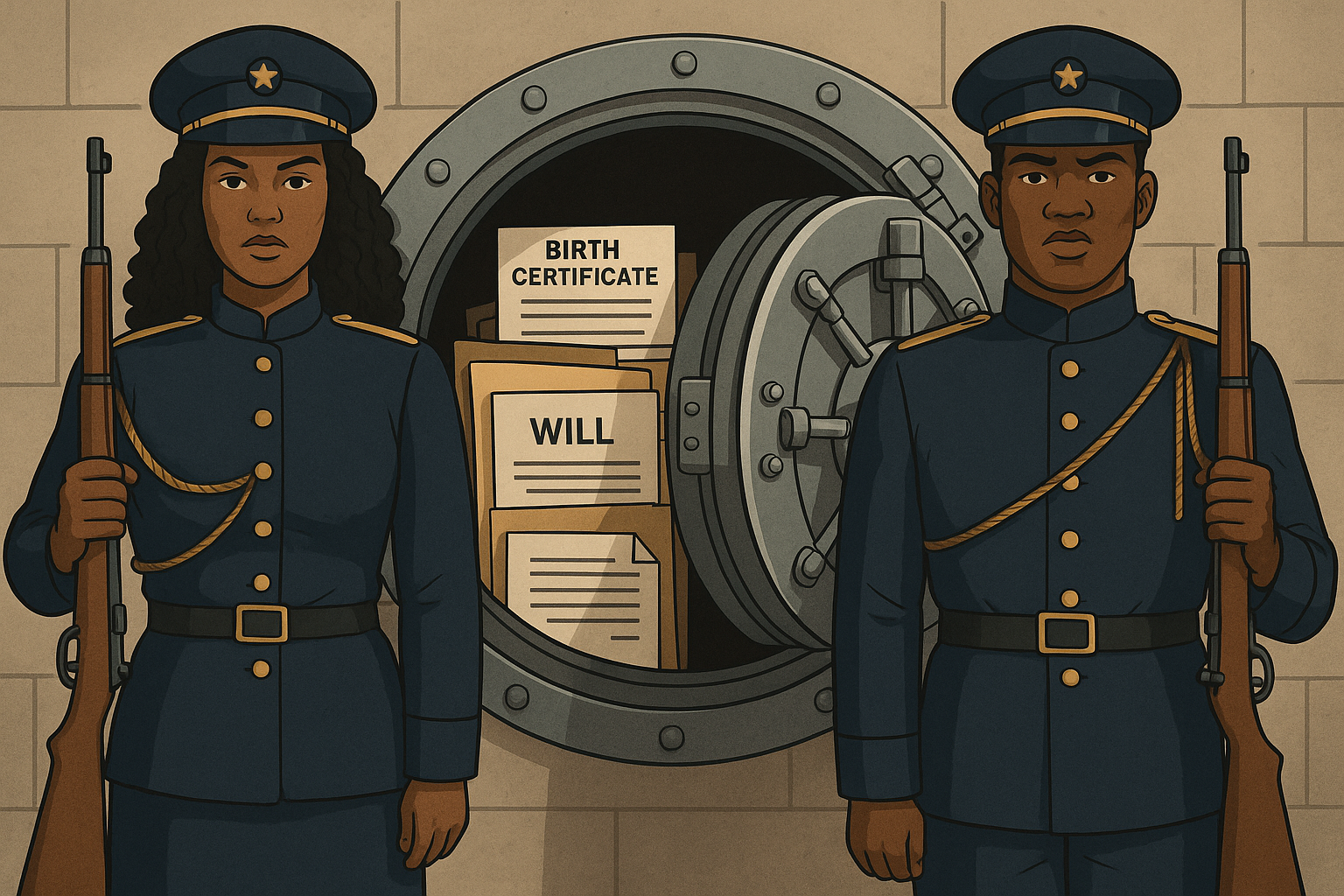
When J.J. McAvoy posted that she had called her parents for her birth certificate — she is 32 years old, married, and had just given birth — and received a photocopy in return, the laughter that swept across social media was immediate and recognizable. The joke landed because so many African Americans already lived it. But McAvoy herself was quick to reframe what she had set in motion. She noted that many of those taking the post with undue gravity were, in her observation, mostly white and that within Black communities, and among children of immigrants broadly, the hoarding of vital documents is less a dysfunction than a cultural inheritance, a running joke with serious roots.
She was right to make the distinction, and right not to dwell on it. The gap in comprehension she identified is real, but it is a symptom rather than a subject. The more substantive question is what that document like a birth certificate, a social security card, a passport held at the airport by a father who will not be reasoned with has historically meant to the people who guard it so fiercely.
The story of documentation and Black life in America is, at its core, a story about legal existence being contingent and contested. In the antebellum South, free Black Americans were required to carry freedom papers at all times, documents that proved they were not property. The absence of those papers whether lost, stolen, or destroyed by someone who stood to profit from the confusion could mean re-enslavement regardless of the truth. Men and women who had purchased their freedom, who had been manumitted by slaveholders, who had been born free, were reduced to the credibility of their paperwork in a system that had already decided their testimony was worth less than the word of any white stranger. That terror was not abstract. It had names and dates and courthouses attached to it.
After emancipation, the Freedmen’s Bureau attempted to register the formerly enslaved — births, marriages, labor contracts — in part because these populations had been deliberately excluded from the civic record-keeping that gave other Americans legal standing and recognizition as humans and not property. The effort was incomplete and short-lived, terminated by a federal government that lost its appetite for Reconstruction before the work was finished. For much of the late nineteenth and early twentieth centuries, Black births in the rural South were irregularly registered or not registered at all, and the consequences were not merely administrative. They affected access to public education, to Social Security benefits when the program launched in 1935, to military service documentation, and ultimately to the GI Bill, the single largest wealth-generating policy instrument of the twentieth century, from which Black veterans were largely excluded in practice even when nominally included in law. A generation of men who had served their country returned home and were told, in the language of paperwork and procedure, that the country did not fully recognize them in return.
To understand what that does to a family’s relationship with documents is to understand why a mother in 2025 hands her 32-year-old daughter a photocopy with the quiet conviction that she is doing the right thing. The original stays home. It always has. It always will.
The immigrant dimension that McAvoy raised adds a distinct but parallel layer. Across the African diaspora from the Caribbean to West Africa to East Africa bureaucratic records have historically been instruments of colonial administration, tools used to enumerate populations for taxation, labor extraction, and political control rather than for their benefit. The post-independence period did not always improve the relationship between these communities and their states’ record-keeping capacities. Families who migrated to the United Kingdom, Canada, or the United States brought with them a highly practical awareness that official documentation was difficult to obtain, slow to replace, and potentially decisive at border crossings, immigration hearings, and employment offices. The father who holds all the passports at the airport is not performing control for its own sake. He is managing risk in an environment where he has learned, from experience or inheritance, that the cost of a lost document may be measured in years, not inconvenience.
The white commenters who read McAvoy’s post and felt something like offense who interpreted the photocopy as a slight against her autonomy, a failure of parental trust, or evidence of some controlling dynamic in need of correction were responding from a place of privilege, one so ambient and unexamined that it had long since stopped announcing itself. The comfort of never having needed to fear a document, or its absence, had quietly become their baseline assumption about how the world works and baselines, by nature, are invisible to the people standing on them. This is not to say that white American parents never hold onto their children’s documents many do, and for reasons that are practical, sentimental, or simply habitual. But the framework underneath that habit is categorically different. When a Black mother keeps the original and hands her daughter a photocopy, she is participating in a tradition of protective custodianship that was forged under conditions of genuine institutional threat. When the behavior appears in other communities, it tends to reflect preference or personality rather than the accumulated memory of a legal system that spent generations using paperwork as an instrument of exclusion. The gesture may look the same from the outside. The history behind it is not.
But that experience has a shape, and its shape matters here. For many white Americans, particularly those whose families arrived in earlier waves of European immigration and were absorbed into the documented mainstream within a generation or two, vital records have long been administrative conveniences rather than instruments of survival. A birth certificate sits in a drawer until it is needed for a passport, then returns to the drawer. The state is presumed, on the whole, to be a reliable record-keeper and a reasonably neutral one. When something is lost, it can be replaced without particular consequence. What that experience does not contain and therefore cannot easily imagine the gravity of is the long American tradition of using documentation not to protect Black people but to control, exclude, and erase them.
This is not ancient history dressed up for rhetorical effect. It is a through line. In the postbellum South, the absence of a birth certificate was used to deny Black children access to public schools. Across the early twentieth century, irregular birth registration in Black communities, a product of deliberate neglect rather than accident, was later used to disqualify those same people from New Deal programs, Social Security, and veterans’ benefits. The administrative record was never neutral. It was a gate, and the gatekeepers were selective about who they waved through. In more recent decades, voter ID laws have disproportionately affected Black Americans in part because the chain of documentation required to obtain qualifying identification — a birth certificate to get a state ID, a state ID to get further documentation collapses for people whose births were never properly registered or whose records were lost, damaged, or bureaucratically stranded across county lines. The Kafkaesque quality of that loop is not incidental. It is the contemporary expression of a system that has historically found it useful to keep certain people difficult to verify. To be undocumented, in the eyes of the American state, has too often meant being unentitled to vote, to own, to claim what was owed.
The land tells the same story. Heirs property, land passed down across generations without a will or clear legal title is, at its root, a documentation failure that was never accidental. During the Jim Crow era, many Black families deliberately avoided formal documentation of their land holdings out of a well-founded distrust of white attorneys and a court system that had shown them repeatedly it was not a venue for justice but another instrument of exploitation. The bitter irony is that the very avoidance of a system designed to harm them created a vulnerability that system then moved to exploit. The U.S. Department of Agriculture has called heirs property the leading cause of Black involuntary land loss, estimating it contributed to a 90 percent decline in Black-owned farmland between 1910 and 1997. Today, heirs property is estimated to make up more than a third of Southern Black-owned land — some 3.5 million acres worth more than $28 billion — with owners left particularly vulnerable to speculators and developers who can exploit partition laws to acquire their property, in some cases by purchasing the interest of a single heir and then forcing a full sale as a fractional owner. In Brazos County, Texas, African American families lost long-held acreage to men who weaponized arcane documents to acquire plots potentially worth millions, land that in some cases had been held since before living memory, worked by hand across multiple generations. What was taken was not simply real estate. It was the accumulated wealth of people who had been denied nearly every other avenue for building it. The birth certificate in the fireproof box and the deed that was never drawn up are expressions of the same wound, the wound of a people who learned, at great cost, that the law’s paperwork could be turned against them, and who then had to decide, with imperfect information and scarce resources, whether engaging with it or avoiding it posed the greater danger. Both choices carried consequences. The system ensured that.
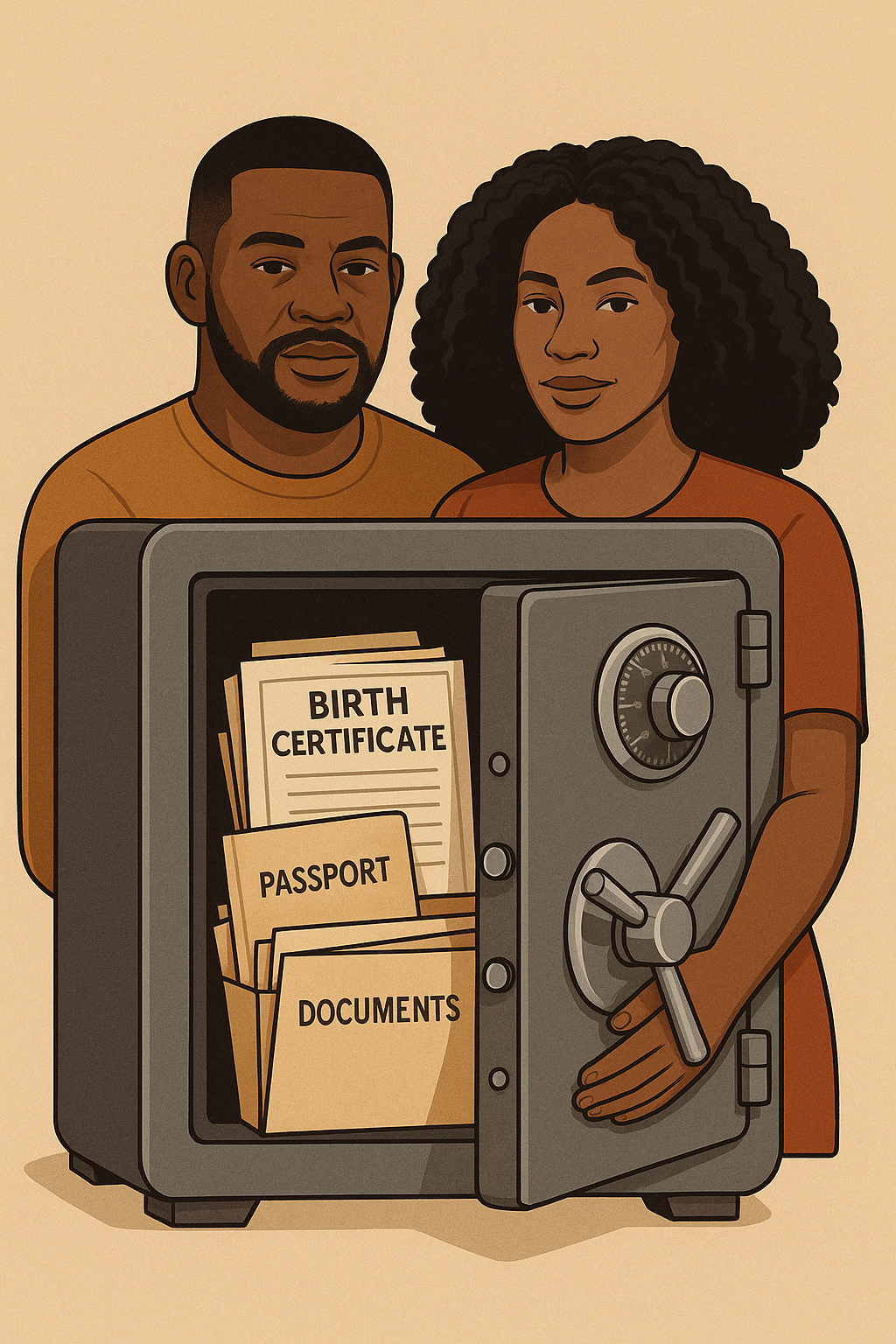
That presumption of institutional reliability, then, is itself a form of inherited privilege not dramatic or visible, but structural, and so deeply internalized that its absence in others can read as pathology rather than history. To look at a Black mother handing her adult daughter a photocopy and see dysfunction is to see only the surface of an arrangement whose foundations run several centuries deep. The offense taken in those comments was, in a sense, the product of a history too comfortable to have produced the habit being observed, a history in which the document was never a weapon aimed at you, and so you cannot quite believe it was ever aimed at anyone.
This dynamic plays out in notable ways within the culture of Historically Black Colleges and Universities. Move-in day at an HBCU is, among many things, a study in the document-as-heirloom. Parents arrive not just with linens and storage bins but with accordion folders thick with immunization records, financial aid correspondence, and original birth certificates that will not be staying in any dorm room drawer. Admissions counselors at HBCUs have long understood the architecture of this arrangement — when a student answers a records request with “my mom has that,” it is not treated as negligence but recognized as a family system functioning exactly as designed. Financial aid officers are accustomed to parents appearing at the table for signings long past the age of legal majority, not because the student is incapable but because the family has not yet completed its own internal transfer of authority. Registrars learn, over years of practice, that some students cannot recite their Social Security numbers from memory because those numbers live in a locked cabinet several states away. At HBCUs, these realities are met with institutional familiarity rather than bureaucratic impatience, a quiet advantage compared to the more rigid cultures of predominantly white institutions, where the assumption of individual administrative independence can feel, to students carrying this inheritance, like a form of alienation.
It is worth noting, as McAvoy did briefly, that this behavior can also carry a more complicated valence that can be control over adult children expressed through the withholding of legal personhood, a dynamic that is not unique to any community but takes on particular texture where independence has historically been constrained by external forces. The refusal of a parent to release a document can be love and caution in equal measure, but it can also be an assertion of ongoing authority that outlasts its original justification. Both things are true and coexist without contradiction.
What the joke obscures, and what the history illuminates, is the quiet administrative heroism that this behavior represents across generations. Grandmothers who maintained informal genealogies because census records were incomplete or falsified. Church ledgers that served as the only registration of births in communities where the county courthouse was not a safe place. Families who kept originals under mattresses and in kitchen cabinets because they had learned the hard way that institutions lose things, or make things disappear. The photocopy McAvoy received is not a failure of trust in her, it is an artifact of that long vigilance, passed down intact.
Eventually, there comes a time when the document must change hands. Whether it is applying for a passport, enrolling a child in school, or as in McAvoy’s case giving birth to the next generation, adulthood makes its administrative demands, and the family archive must begin its transfer. The transition is rarely smooth, because what is being transferred is not merely paper. The most effective approach is one that frames the conversation not as a retrieval but as a succession signaling to the parent that the custodial function they have performed for decades is not being dismissed but inherited. A request built around the language of responsibility, of building a family file and carrying the record forward, lands with considerably more weight than a casual ask between other errands. Offering to digitize the entire family archive to scan and organize every document the household holds reframes the transaction as continuation rather than extraction, and gives the parent something to receive rather than simply something to surrender. And beneath any practical negotiation, there is the recognition that their reluctance was never spite. It was stewardship, practiced under conditions that made stewardship necessary.
The gap this dynamic reveals also represents an opening. A culturally responsive document safekeeping and digital archiving service built specifically for African American families sitting somewhere between a secure cloud vault, a legacy planning firm, and a notarial service, and animated by the particular anxieties and histories this community carries does not yet exist at meaningful scale. Black-owned banks and credit unions are especially well-positioned to move into this space, bundling document protection and vital records vaulting with existing wealth-building and financial literacy programs. The vision is not complicated: a family opens a savings account and, alongside it, receives access to a secure repository for their vital records, estate documents, and generational paperwork all of it portable, encrypted, and governed by the family rather than an institution with a different set of interests. In a community where trust has been earned slowly and lost quickly, that kind of service is not merely a product. It is a cultural preservation mission with a business model attached.
What a viral moment like this one surfaces, beneath the laughter, is that communities navigate the world differently depending on what history has taught them the stakes of navigation are. For those who have never had reason to doubt that the state would honor their existence when called upon to do so, a birth certificate is a formality. For those whose families have lived through its denial, its destruction, or its instrumentalization against them, it is something considerably more serious and the person who holds it is performing a function that goes well beyond filing.
So yes, laugh at the photocopy. The humor is earned and it is real. But when the original finally passes into your hands embossed seal, official signature, the full weight of the state’s acknowledgment that you exist — take a moment to understand what your parents were holding all those years. They were not just keeping a document safe. They were keeping you legible in a world that has not always been eager to read you. That is not bureaucracy. That is love with a filing system.
Disclaimer: This article was assisted by ClaudeAI.

